The Washington Post reports: Retired Army Lt. Gen. Mark Hertling says he had “a visceral response” to some of the rhetoric Donald Trump unleashed during the most recent Republican debate.
But the statement that really concerned him, Hertling told CNN’s Chris Cuomo on Monday, came when Trump told debate moderator Bret Baier that there’s no way U.S. service members would refuse to follow his orders.
“They won’t refuse,” Trump said during Thursday’s debate on Fox News. “They’re not going to refuse me, believe me. If I say do it, they’re going to do it. That’s what leadership is all about.”
Hertling forcefully disagreed, calling the Republican front-runner’s management style “toxic leadership.” [Continue reading…]
Category Archives: Issues
Is Donald Trump a fascist?
Jeffrey Herf writes: Is Donald Trump, now with the results of Super Tuesday the Republican presidential nominee-apparent, a fascist? It is stunning even to pose the question in the context of a national-scale American election, but many people are posing it, and they are not entirely wrong to do so. The short answer to the question is “no, but.” But the “but” begs an historically tutored explanation, the conclusion to which should not make us feel too good about the “no” part of the answer.
When an historian asks a question like this, methodological fragilities rush to consciousness. Context is critical, so much so that in some ways it is impossible to state in any simple fashion what the similarities and differences are between Donald Trump and the fascist and Nazi dictators of Europe’s 20th century. But we can sketch out the domains in which a comparison might make sense. Those domains include, most prominently, attitudes toward democracy, political violence, press freedoms, and the role of the state within society and culture.
When Trump asserts that politicians are “all talk and no action” he casts doubt on a great virtue of elected legislatures in democracies—namely, the creation of a public sphere in which people with divergent views can talk with and to one another. Trump does not, as Hitler and Mussolini did, openly denounce the institutions of liberal democracy. Yet like them he accuses those institutions of failing to adequately address political and economic crises. The classic dictators denounced democracy itself, especially the peaceful democratic competition among political parties, as a formula for national weakness. Trump has not done so, but his dictatorial personality suggests that he can do singlehandedly what American political institutions have failed to do for many years running. [Continue reading…]
Limit the next president’s power to wage drone warfare
Jameel Jaffer and Brett Max Kaufman write: When Barack Obama took office as the reluctant heir to George W. Bush’s “war on terror,” he renounced some of his predecessor’s most extreme policies. There is one Bush-era policy, though, that President Obama made emphatically his own: the summary killing of suspected militants and terrorists, usually by drone.
In less than a year, the president will bequeath this policy, and the sweeping legal claims that underlie it, to someone who may see the world very differently from him. Before that happens, he should bring the drone campaign out of the shadows and do what he can to constrain the power he unleashed.
President Bush started the drone wars, but Mr. Obama vastly expanded them. Almost entirely on his watch, United States strikes have killed as many as 5,000 people, possibly 1,000 of them civilians. The president approved strikes in places far from combat zones. He authorized the C.I.A. to carry out “signature strikes” aimed at people whose identities the agency did not know but whose activities supposedly suggested militancy. He approved the deliberate killing of an American, Anwar al-Awlaki.
The president also oversaw an aggressive effort to control the public narrative about drone strikes. Even as senior officials selectively disclosed information to the news media, his administration resisted Freedom of Information Act lawsuits, arguing that national security would be harmed if the government confirmed drone strikes were taking place. [Continue reading…]
The soldier with PTSD who flew halfway around the world to die alone on the side of a mountain

Kathryn Joyce writes: On the second-to-last day of 2013, when the glow of Christmas had passed and there was nothing to do but settle in for months of unbroken winter, a stranger arrived in Saranac Lake, a 5,400-person mountain town 70 miles shy of the Canadian border. Set amid the patchwork of forest preserves and villages that make up the largest publicly protected area in the Lower 48, Saranac Lake is the self-appointed “Capital of the Adirondacks,” a onetime best small town of New York, and the place where I’m from.
The stranger was a 31-year-old infantry captain in the Royal Australian Regiment who’d been diagnosed with post-traumatic stress disorder after returning from Afghanistan two years before. He arrived at 6 p.m. on the one bus that comes through town each day: an Adirondack Trailways coach that chugs slowly uphill from Albany, stopping in what seems like every podunk town along the way.
To get to Albany, he’d taken a bus from New York City, and before that planes from San Francisco, Sydney, Canberra, and, ultimately, Adelaide, Australia, his own hometown, more than 10,500 miles away. He was male-model good-looking—wholesome and tidy, with intelligent eyes—though he’d recently grown shockingly thin and had cut his brown, widow’s-peaked hair so close it was nearly shaved.
He’d been a battle captain in Afghanistan’s Uruzgan province, just north of Kandahar, working as part of a North Atlantic Treaty Organization coalition force. But his PTSD diagnosis had placed him on restricted status, and he’d since been re-assigned to a desk job in Canberra, Australia’s sterile government seat. He had a medical review coming up in January and, his family would later tell the police, he feared he might be discharged. The Australian Defence Force was withdrawing from Afghanistan at the end of 2014, and the military was downsizing; everyone who remained had to be fit to deploy. [Continue reading…]
Takeover of opposition newspaper is a death warrant for free speech in Turkey
By Ahmet Erdi Öztürk, University of Ljubljana
On Friday March 4, a Turkish court ruled that the country’s biggest daily newspaper, Zaman, would be run by appointed trustees – ostensibly because of its so called “terrorist” activities, but more likely because the publication was linked to US-based Muslim preacher Fethullah Gülen, an opponent of the government.
Shortly after the court’s decision, police stormed the paper’s Istanbul headquarters in a dramatic midnight raid, firing tear gas and water cannon at the hundreds-strong crowd that formed outside.
The new administrative members dismissed the editor, executive editor and other senior staff, transforming the newspaper’s editorial line, in less than 48 hours, from a rigorous opposition voice into a propaganda mouthpiece for the president, Recep Tayyip Erdoğan.
Full disclosure: I have written oped pieces for Zaman for the past two years or so – at a rate of about two or three per month. Never at any time was there any attempt to dictate my angle or censor my work, even when – as I did several times – I wrote articles that were critical of Gulen or his movement. Now I feel that the doors of this newspaper are closed – not only for me but also for most of the other academic writers who had used the paper as a vehicle for their opinions.
This episode has not come as a huge surprise to anyone who has been following Turkey’s political scene. While Erdoğan and his AKP party enjoyed close relations with Gulen and his Hizmet educational and religious movement when the party first emerged – and observers believe that Hizmet used his enormous popularity to help Erdogan secure his first term as prime minister in 2002 – things have gone bad between them since 2013.
How AIPAC mainstreams anti-Muslim hate
Ali Gharib writes: ast year, Investigative Project on Terrorism head Steven Emerson quietly pulled out of the annual conference of Washington’s most influential pro-Israel lobby group, the American Israel Public Affairs Committee (AIPAC). He pinned the withdrawal on “an unexpected medical problem that required my immediate attention,” but it was impossible not to notice that it came amid reverberations of criticism for the latest of Emerson’s Islamophobic outbursts.
A couple months before the AIPAC summit, Emerson had taken to the airwaves of Fox News to expound on so-called no-go zones in Europe, purported Muslim enclaves where governments dared not go. But there was a problem: “They don’t exist,” David Graham wrote in The Atlantic. And yet Emerson took the myth even farther. In the United Kingdom, he reported on Fox, “There are actual cities like Birmingham that are totally Muslim, where non-Muslims simply don’t go in!”
The Birmingham comment elicited ridicule from across the spectrum — “This guy is clearly a complete idiot,” British Prime Minister David Cameron said in an interview — and eventually Emerson and, perhaps more improbably, Fox News itself apologized. A few weeks later, Emerson was out at AIPAC.
Now, Emerson is back. His name appears on a list of confirmed speakers published by AIPAC ahead of its Washington, DC, conference later this month. [Continue reading…]
Refugee crisis magnified by European divisions

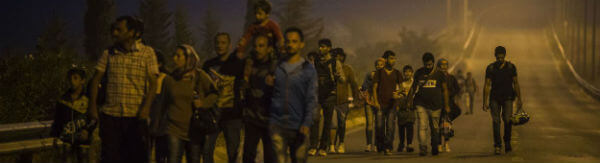
Der Spiegel reports: A rickety gate of galvanized wire is all that separates desperation from hope. The gate is part of the fence erected in the farming village of Idomeni on the border between Greece and Macedonia. At this moment, some 12,000 people are waiting for it to be opened.
It’s the gateway to Europe and the gateway to Germany.
A woman in boots and a blue uniform stands guard in front of the gate. Her name is Foteini Gagaridou and she is an official with the Greek border police — and she looks exhausted. All it would take for her to open the border would be to pull a thin metal pin out of the latch, but she’s not allowed to.
If it were up to her, she says, she would let every single one of these people pass through, just as they were able to do just a few weeks earlier — across the border to Macedonia and on through Serbia, Croatia and Slovenia to Austria, where they could continue their journey to Germany on what is known as the Balkan Route. It’s the same path chosen by hundreds of thousands of refugees last year, but the Balkan Route is now closed. It ends at Gagaridou’s wire gate.
This is where Fortress Europe begins, secured with razor wire and defended with tear gas. Desperate scenes played out here on Monday, reminiscent of those witnessed in Hungary back in September. A group of young men used a steel beam as a battering ram to break down the gate. Rocks flew through the air as the gate flew off its hinges, prompting the volleying of tear gas cartridges and stun grenades from the Macedonian side. Men could be seen running and children screaming. One woman lay on the ground with her daughter, crying.
This frontier has become Europe’s new southern border, with Greece serving as Europe’s waiting room — and the possible setting for a humanitarian disaster. Around 32,000 migrants are currently stranded in the country, a number that the Greek Interior Ministry says could quickly swell to 70,000. The aid organization Doctors Without Borders is even expecting 200,000 refugees. Greece’s reception camps are already full, and the highly indebted country is stretched well beyond its capacity.
The decision as to whether and how many refugees will be able to cross the border isn’t one for border guard Gagaridou to make. Rather, it will be taken by the Macedonian government. Macedonia, for its part, is pointing fingers at countries further to the north, noting it is they who have tightened their borders, especially Austria, which created a chain reaction of border closures last week. The countries apparently felt they could wait no longer for the broader European solution German Chancellor Angela Merkel has promised will result from a special EU summit scheduled for March 7.
Merkel wants to see Turkey stem the flow of refugees and put a stop to the exodus to Europe. European leaders agreed on Feb. 18 that this plan remains the “priority.” But Austria and the Balkan states nevertheless moved ahead and closed their borders.
Idomeni has become a symbol of the current political chaos in Europe and the crumbling of a joint European refugee policy. The town is emblematic of the new Europe of fences. It is here that German Chancellor Angela Merkel’s open border policies have met their end. Under Austria’s leadership, the Balkan Route has been closed in the precise move Berlin had hoped to avoid.
Merkel has begun warning of the EU’s disintegration “into small states” that will be unable to compete in a globalized world, as well as of the possibility that border controls might soon be reintroduced all across Europe.
Were Europe in agreement, it would be unproblematic to accommodate 2-3 million refugees, given the Continent’s population of a half billion people. From such a perspective, the current spat actually seems somewhat ridiculous. But in the run up to next week’s EU summit, Europe is gripped by strife. Europe’s greatest achievement, the opening of its borders through the Schengen agreement, is at stake, and the increasingly toxic atmosphere between countries has reached alarming dimensions. [Continue reading…]

Migration evidence shows how badly the EU needs to rethink its strategy
By Vicki Squire, University of Warwick and Nina Perkowski, University of Warwick
European leaders continue to be stumped by the so-called migration crisis. Fences are going up in the east and warnings are being issued that there is no more room. But people keep coming.
Europe’s agenda on migration is primarily focused on preventing people from reaching Europe. It seems to rest on the assumption that an unending number of people want to come to the EU, and that deterrent measures are therefore necessary.
But our new research shows that these are flawed assumptions. It suggests that people don’t always move with the aim of reaching Europe as an ideal end goal. Often they simply seek a place of safety.
The Arab revolutions have been misunderstood or even wilfully mischaracterised by Western leftists

In a review of Burning Country: Syrians in Revolution and War, by Robin Yassin-Kassab and Leila al-Shami, Joe Gill writes: As well as a non-orthodox telling of the conflict from the point of view of the activists and fighters who took part in the revolution, the book also speaks to the confusion and reluctance of western progressives to engage in the reality of Syria. “What’s happening is of immense human, cultural importance, not just for Syria and the Middle East but for the whole world. We do actually live in age of very messy revolutions,” says Yassin-Kassab.
Western suspicion of Islamists of whatever hue colours how the Syrian revolution is perceived, leading to potentially disastrous conclusions as to how the war might be ended. “There are a huge range of Islamists – we don’t at all agree with them, but nevertheless they are there. Some are foreigners and criminals, some of them are Syrians and represent a constituency,” said Yassin-Kassab.
By late 2013, and certainly by 2015, a consensus had emerged in the West, if not in the Gulf and Turkey, that there were no good opposition forces left on the ground who could take the reigns if and when Assad fell.
The Arab revolutions, because they do not conform to a traditional Marxist or anti-colonial narrative of liberation struggles, and in the case of Syria and Libya are ranged against nominally “anti-imperialist” regimes, have also been misunderstood or even wilfully mischaracterised by western leftists, according to al-Shami and Yassin-Kassab. “I actually fail to see the difference between the left and right as a result of all this. You don’t hear anything about [the Syrian revolutionary movement] in western leftist circles. You need to go to the grassroots to what people are really thinking and feeling.” Without this bottom up approach, the author says that outsiders are “open to the first propagandist narrative that comes along.” [Continue reading…]
Rivalries stall push to retake Mosul
The Wall Street Journal reports: Defense Secretary Ash Carter said last week that the Syrian town of Shaddadi had been cleared of militants, cutting off an important supply line between Mosul and Raqqa, Islamic State’s de facto capital in Syria. Mr. McGurk [President Obama’s envoy on the fight against ISIS] described Shaddadi’s liberation and a similar victory in the Iraqi city of Sinjar as the beginning of an effort to isolate Mosul.
Over the weekend, Iraq’s military airdropped leaflets over the occupied city addressed to “the patient sons of Mosul.” “Your security forces settled the fight in Ramadi in Iraq’s favor,” it read. “Now they are readying for the biggest battle…be ready.”
But Iran, through the Shiite militias it supports, is insisting on a role in Mosul after being sidelined in recently liberated Ramadi, according to Iraqi and U.S. officials. Iraq’s Sunni groups and the U.S. fear militia participation will fan sectarian tensions and expand Iran’s already sizable influence in Iraq.
Kurdish officials insist their forces should have a role in the fight to recapture Mosul, as well. But Baghdad worries the Kurds will use the fight to take territory that helps strengthen their case for an autonomous Kurdish homeland.
The jockeying among Iraq’s splintered groups, and the foreign powers that back them, have repeatedly pushed back the timetable to retake Mosul. As a result, some Iraqi and U.S. officials are now predicting the offensive won’t even begin this year. [Continue reading…]
Is nuclear power our energy future — or a dinosaur in a death spiral?
Dave Levitan writes: Nuclear power is dead. Long live nuclear power. Nuclear power is the only way forward. Nuclear power is a red herring. Nuclear power is too dangerous. Nuclear power is the safest power source around. Nuclear is nothing. Nuclear is everything.
It is now generally agreed that the world must rapidly reduce carbon emissions in order to fight off dangerous climate change, but the “how” of that process remains up for debate. And within that debate, nothing seems to produce such starkly opposing viewpoints as nuclear energy. Some experts and advocates argue that carbon-free nuclear power represents the only real hope of keeping the planet’s temperature in check. Others claim that nuclear is risky, unnecessary and far too expensive to make a dent.
The same basic data set — nuclear plants currently in existence, those under construction, the status of new technologies, the history of costs and delays, and a few striking accidents — produces those totally contradictory opinions and predictions. Nuclear power is a Rorschach test: You see what you want to see — a rosy nuclear future or an old-world dinosaur in a slow death spiral — reflecting your own views on the energy present and future. In all likelihood, no one will be proven right or wrong for decades. [Continue reading…]
Former Petraeus adviser, Lt Col David Kilcullen: ‘No ISIS if we didn’t invade Iraq’
In a review of Kilcullen’s new book, Blood Year: Islamic State and the Failures of the War on Terror, David Gardner writes: “The greatest strategic screw-up since Hitler’s invasion of Russia” is how David Kilcullen describes George W Bush’s invasion of Iraq in 2003. If anyone thinks that is a throwaway line they should read on. For it comes from one of the architects of the 2007-08 “surge” into Iraq that sought to restore security to a society the US-led occupation broke, and to create space to rebuild a state it destroyed.
Kilcullen was a young lieutenant colonel in the Australian army who had served in Iraq and Afghanistan, a scholar steeped in counter-insurgency theory, “watching closely and keeping notes as this enormous slow-motion train wreck took place”. In 2007 he was seconded to US forces as chief adviser to General David Petraeus, commander of the surge. This strategy combined a big influx of American troops with co-opted Sunni tribal fighters to defeat al-Qaeda. The jihadis, later to transmute into the far greater threat of Isis, had virtually no presence in Iraq prior to the invasion — but used it to turn the country into a charnel house and trigger the region-wide war between Sunni and Shia Islam that has now ripped Syria apart.
Put simply, Kilcullen argues we should never have gone into Iraq, with the job still unfinished in Afghanistan after 9/11. But the US and its allies were morally and legally obliged afterwards to try to “halt the carnage and restore some normality”. Like many soldiers, Kilcullen does not do gore. So when he mentions, in the sparest of prose given the depravity of the sectarian bloodletting, the “commercial kidnapping gangs auctioning off terrified children for slaughter, in a makeshift night market that operated under lights near the soccer stadium”, it is a kick in the stomach.
The surge sharply reduced the violence. But the US, now under President Barack Obama, had exhausted its attention span. Meanwhile, Iraqi leaders twisted by sectarianism would not use the space this success created for reconciliation.
Mr Obama, to be fair, was elected on a pledge to extract Americans from Middle East wars. Yet in Kilcullen’s judgment, he left Iraq irresponsibly early. He failed to register how Nouri al-Maliki, the Shia Islamist premier and joint protégé of the US and Iran, was stampeding Iraq’s Sunni minority into jihadi arms by his sectarian power grab. With al-Qaeda wounded by its “near death experience” with the surge, few noticed its rebirth in the ashes of Syria. Recklessness in Iraq was followed by fecklessness in Syria — “passivity in the face of catastrophe” that spells strategic disaster for the US and the west. [Continue reading…]
From Trump to Merkel: How the world is divided between fear and openness

Ulrich Speck writes: Two major concepts define the political struggle in the west today. One can be termed “globalism”, which is currently most prominently represented by the German chancellor, Angela Merkel. The other is “territorialism”, a view that the very likely Republican candidate for the US elections in November, Donald Trump, represents.
At the core of the debate is the meaning of borders: should they be porous or tightly controlled? Are they mainly an obstacle to the free and productive flow of ideas, people, goods and information and should therefore be largely dismantled? Or are massive borders welcome and indispensable as a protection against all kinds of real or perceived threats such as competition and terrorism?
For globalists such as Merkel, interconnectedness is a good thing because it is what drives progress towards more prosperity and freedom everywhere. For territorialists such as Trump, interconnectedness is mainly a threat. What is good and healthy is attributed to the natives and what is dangerous comes from outside: unfair Chinese competition, dangerous Mexican immigrants and Middle Eastern terrorists. [Continue reading…]
The violence Trump incites
Peter Beinart writes: Asked last August about a Bernie Sanders event in which Black Lives Matters protesters spoke at length from the stage, Trump called the senator from Vermont’s response “disgusting.” He added: “That will never happen with me! I don’t know if I’ll do the fighting myself or other people will, but that was a disgrace. I felt badly for him. But it showed that he was weak. Believe me, that’s not going to happen to Trump.”
It’s no coincidence that Trump raised the specter of violence. The Black Lives Matter disruptions had been peaceful. But as Trump’s campaign took off in the summer and fall of last year, he began depicting entire categories of overwhelmingly peaceful people as a physical threat. Undocumented Mexican immigrants were potential “rapists.” Syrian refugees were “strong, powerful men” who might be a “trojan horse” for ISIS.
Trump’s supporters exhibit high levels of what political scientists call “authoritarianism.” Authoritarians are unusually fearful of disorder and favor simple, brutal methods of quashing it. As Amanda Taub has noted, “When many Americans perceived imminent physical threats, the population of authoritarians could seem to swell rapidly.” So by fanning popular fears of chaos, especially violent chaos, Trump wins yet more votes.
He does this, in part, by turning his treatment of the activists who seek to disrupt his events into a parable for how he would restore order in society at large. [Continue reading…]
Trump on ISIS: ‘You have to play the game the way they’re playing the game’
When the Bush administration developed its torture program, it deployed legal arguments to obscure the fact that the techniques being used, such as waterboarding, were indeed forms of torture.
Where it appears to have been non-deceptive was in claiming that the purpose — ill-conceived as this might have been — was gathering intelligence. (Abu Graib, on the other hand, demonstrated the inevitable proliferation of abuse that followed from presidentially sanctioned torture.)
The use of extreme methods was justified, the proponents of what were euphemistically described as “harsh interrogation techniques” said, because of the magnitude of threat posed by terrorist plots.
In contrast, when Donald Trump talks about torture and about reducing the legal restrictions on what is currently permitted, he’s not talking about interrogation. He’s talking about the use of torture as a weapon of intimidation.
ISIS doesn’t decapitate its captives in order to extract information. It’s use of brutality is designed to intimidate its opponents and to force populations into submission.
Like ISIS, Trump sees all things in terms of the power dynamics of domination.
Since brutality has been one of the most effective weapons in ISIS’s arsenal, when Trump says, “You have to play the game the way they’re playing the game,” he is arguing that the United States needs to become as capable of provoking terror as are any of the terrorists it wants to combat.
The Donald Trump show
Germany’s refugee crisis
Israel employs legal principle of collective punishment used by Nazi Germany
In an editorial, Haaretz says: Over the past few months, Israel has adopted the principle known in German as sippenhaft – meaning a family’s shared responsibility for a crime committed by one of its members. Its origins lie in ancient times, when an offender’s entire tribe would be punished for his crimes. In the modern era, this principle was characteristic of totalitarian regimes, when the relatives of “enemies of the state” were punished by exile, imprisonment or execution. Today, this method is common in North Korea.
The Netanyahu government’s response to shooting, knifing and car-ramming attacks is based on the same principle: The family that “supports and assists” the terrorist, as Netanyahu put it, is as guilty of terror as the offender. That is why house demolitions have been renewed. According to figures by the nonprofit B’Tselem, 31 Palestinian homes have been demolished whose relatives were involved in attacks, with other demolitions planned. That is also why Israel is holding the bodies of attackers from East Jerusalem and punishing their families by delaying burials. Israeli advocates of sippenhaft argue that it’s the only way to deter the Palestinians, citing cases in which families gave up suspects as proof that the method works. To them, the deportation of families to Gaza seems the ultimate weapon against lone-wolf attacks.
But the Palestinians are not the only ones who’ll pay the price for punishing the families; Israel will, too. Because a state that adopts the legal methods and laws of totalitarian states begins to look like those countries, even if it calls itself “the only democracy in the Middle East.” [Continue reading…]