Category Archives: Issues

Reflections on the war on Gaza

Azzam Tamimi writes: First: For the people of Gaza, the recent ceasefire deal between the resistance and Israel did not accomplish all they were seeking. Yet, at the same time, it achieved none of what the Israelis were hoping for. Perhaps the reason the two sides managed to agree, finally, on a ceasefire, was their conviction that there was no way any of them could achieve more under the prevalent circumstances.

It is true that the Israelis have enjoyed unprecedented Arab support in their war against Gaza and continuous encouragement from certain Arab quarters to inflict as much damage as they could on Gaza to pressure Hamas into capitulation. Yet, they have not been able to cripple the resistance or force it to surrender. As for the resistance, it has indeed enjoyed the full and unconditional backing of the people of Gaza, despite the siege and the pain, in the hope that this latest round of conflict would led to lifting the siege that has been imposed on the Strip for nearly eight years. Yet, it has not been possible for the resistance to obtain guarantees that the siege would finally be ended.

Second: The artillery and the rockets have gone silent and the annoying buzzing and whizzing of Israeli warplanes in Gaza’s skies is no longer there, yet the propaganda warfare will continue for some time to come. Each side will seek to prove it came out victorious having achieved its objectives.

The Israelis consider the continuation of the siege a sign of their success whereas the resistance considers the failure of the Israelis to impose demilitarisation a sign of victory. However, one can see a marked difference between the two sides. As soon as the ceasefire deal went into effect, the masses in Gaza took to the streets to celebrate and express joy over what they truly believed was victory.

On the other side, the Israeli masses seemed confused and even distressed. Few Israelis believe that the war has accomplished much for them. Israeli Prime Minister Benjamin Netanyahu started the offensive against Gaza with high expectations. He promised his public that he would dismantle the military infrastructure of Hamas and the other resistance factions, that he would destroy the tunnels and that he would put an end to the firing of the rockets from Gaza. However, none of this was achieved. [Continue reading…]

Facebooktwittermail

With Gaza war, movement to boycott Israel gains momentum in Europe

The New York Times reports: A branch of Sainsbury’s grocery store removed kosher products from its shelves, it said, to prevent anti-Israel demonstrations. The Tricycle Theater in north London, after hosting a Jewish film festival for eight years, demanded to vet the content of any film made with arts funding from the Israeli government. George Galloway, a member of Parliament known for his vehement criticism of Israel, declared Bradford, England, an “Israel-free zone.”

Mr. Galloway, in comments being investigated by the police, said, “We don’t want any Israeli goods; we don’t want any Israeli services; we don’t want any Israeli academics coming to the university or college; we don’t even want any Israeli tourists to come to Bradford.”

The war in Gaza and its aftermath have inflamed opinion in Europe and, experts and analysts say, are likely to increase support for the movement to boycott, disinvest from and sanction Israel, known as BDS.

“We entered this war in Gaza with the perception that the Israeli government is not interested in reaching peace with the Palestinians,” said Meir Javedanfar, an Israeli analyst at the Interdisciplinary Center Herzliya, a private university. “Now, after the casualties and the destruction, I’m very worried about the impact this could have on Israel. It could make it very easy for the BDS campaign to isolate Israel and call for more boycotts.”

Gilead Sher and Einav Yogev, in a paper for the Institute for National Security Studies in Tel Aviv, warn that Gaza means Israel pays “a much heavier price in public opinion and in erosion of support for its positions in negotiations with the Palestinians.”

Along with reports of “familiar anti-Semitic attacks on Jews,” they said, “the movement to boycott Israel is expanding politically and among the public.”

Daniel Levy of the European Council on Foreign Relations points to the debate over halting arms exports to Israel, which has been given new momentum in Britain and Spain by the asymmetry of the Gaza war.

“You’re beginning to see the translation of public sympathy into something politically meaningful,” he said. He noted two tracks — the governmental one, which distinguishes between Israel and the occupied territories, and the social one of academic, commercial and artistic boycotts. [Continue reading…]

Facebooktwittermail

Military skill and terrorist technique fuel success of ISIS

The New York Times reports: As fighters for the Islamic State in Iraq and Syria continue to seize territory, the group has quietly built an effective management structure of mostly middle-aged Iraqis overseeing departments of finance, arms, local governance, military operations and recruitment.

At the top the organization is the self-declared leader of all Muslims, Abu Bakr al-Baghdadi, a radical chief executive officer of sorts, who handpicked many of his deputies from among the men he met while a prisoner in American custody at the Camp Bucca detention center a decade ago.

He had a preference for military men, and so his leadership team includes many officers from Saddam Hussein’s long-disbanded army.

They include former Iraqi officers like Fadel al-Hayali, the top deputy for Iraq, who once served Mr. Hussein as a lieutenant colonel, and Adnan al-Sweidawi, a former lieutenant colonel who now heads the group’s military council.

The pedigree of its leadership, outlined by an Iraqi who has seen documents seized by the Iraqi military, as well as by American intelligence officials, helps explain its battlefield successes: Its leaders augmented traditional military skill with terrorist techniques refined through years of fighting American troops, while also having deep local knowledge and contacts. ISIS is in effect a hybrid of terrorists and an army.

“These are the academies that these men graduated from to become what they are today,” said the Iraqi, a researcher named Hisham Alhashimi.

ISIS, which calls itself Islamic State, burst into global consciousness in June when its fighters seized Mosul, Iraq’s second-largest city, after moving into Iraq from their base in Syria.

The Iraqi Army melted away, and Mr. Baghdadi declared a caliphate, or Islamic state, that erased borders and imposed Taliban-like rule over a large territory. Not everyone was surprised by the group’s success. “These guys know the terrorism business inside and out, and they are the ones who survived aggressive counterterrorism campaigns during the surge,” said one American intelligence official, referring to the increase in American troops in Iraq in 2007. “They didn’t survive by being incompetent.” [Continue reading…]

Facebooktwittermail

It’s not just the South and Fox News: Liberals have a white privilege problem too

Joseph Heathcott writes: I spent 12 years of my life in St. Louis. I went to college there. Got married. Landed my first teaching job. Bought my first house. Between door-knocking for candidates and causes, driving around on ice cold nights in a homeless shelter van, and breaking bread in people’s homes and churches and synagogues, I came to know the metropolis well. I came to love and admire its many communities — including Ferguson: so tenacious, so full of hardworking families trying to stay afloat, trying to dismantle racial apartheid and make a better life for their children.

But each time I tried to write about Ferguson, I could only stare into the blank screen, dumbfounded. It wasn’t the killing of Michael Brown that left me speechless: tragically, the murder of black men by police is common. It wasn’t the riots that stumped me: Ferguson residents are rightfully fed up with being treated as second-class citizens. It wasn’t even the ludicrous spectacle of a hyper-militarized police response. I’ve been following that story for years.

No, what dumbfounded me was the outpouring of white anger and resentment. As police, pundits, politicians and their supporters sought control over the narrative of events in Ferguson, they drew from the deep well of moral panic and race hatred that in many ways define our contemporary political landscape. I am not talking about the moronic counter-protests by the Klan, or the impending race war hallucinated by capital-R Racists. I am talking about the insidious language of white privilege — the civil, polite, unconscious adoption by white people of racially normative viewpoints that give us comfort and help explain the world on our terms.

For those of us born with white skin, white privilege is the air we breathe; we don’t even have to think about it. It is like the fish that never notices the water in which it swims. It is a glorious gift we have given to ourselves through the social order we have constructed, from top to bottom and bottom to top. It is the pillage of continents, the enslavement of people, the hatred of dark-skinned “others,” all somehow magically laundered by our commitments to democracy, self-reliance, individualism and the “post-racial, color-blind society.” It is our abject unwillingness to confront our history, to correct the deficits of our memory, to lean against the amnesia of a white story told. [Continue reading…]

Facebooktwittermail

Which antidote to ISIS?

Rami G Khouri writes: I have no doubt that the single most important, widespread, continuous and still active reason for the birth and spread of the Islamic State mindset is the curse of modern Arab security states that since the 1970s have treated citizens like children that need to be taught obedience and passivity above all else. Other factors played a role in this modern tragedy of statehood across the Arab world, including the threat of Zionism and violent Israeli colonialism (see Gaza today for that continuing tale) and the continuous meddling and military attacks by foreign powers, including the U.S., some European states, Russia and Iran.

In my 45 years in the Arab world observing and writing about the conditions on the ground, the only thing that surprises me now is why such extremist phenomena that have caused the catastrophic collapse of existing states did not happen earlier. At least since around 1970, the average Arab citizen has lived in political, economic and social systems that have offered zero accountability, political rights and participation. States have been characterized by steadily expanding dysfunction and corruption, economic disparities that have driven majorities into chronic poverty, and humiliating inaction or failure in confronting the threats of Zionism and foreign hegemonic ambitions. They have also virtually banned developing one’s full potential in terms of intellect, creativity, public participation, culture and identity.

The Islamic State phenomenon is the latest and perhaps not the final stop on a journey of mass Arab humiliation and dehumanization that has been primarily managed by Arab autocratic regimes that revolve around single families or clans, with immense, continuing support from foreign patrons. Foreign military attacks in Arab countries (Iraq, Libya) have exacerbated this trend, as has Israeli aggression against Palestinians and other Arabs. But the single biggest driver of the kind of criminal Islamist extremism we see in this phenomenon is the predicament of several hundred million individual Arab men and women who find – generation after generation – that in their own societies they are unable to achieve their full humanity or potential, or exercise their full powers of thought and creativity; or, in many cases, obtain basic life needs for their families. [Continue reading…]

Facebooktwittermail

An open letter from Egyptian political activist Alaa Abd El Fattah

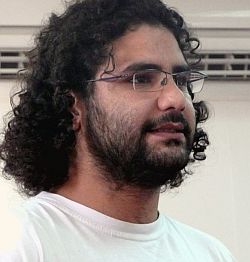
On August 18, Alaa Abd El Fattah wrote: At 4 pm today, I celebrated with my colleagues my last meal in prison.

I have decided — when I saw my father fighting against death locked in a body that was no longer subject to his will — I decided to start an open hunger strike until I achieve my freedom. The well-being of my body is of no value while it remains subject to an unjust power in an open-ended imprisonment not controlled by the law or any concept of justice.

Alaa-Abd-El-FattahI’ve had the thought before, but I put it aside. I did not want to place yet another burden on my family — we all know that the Ministry of the Interior does not make life easy for hunger strikers. But now I’ve realized that my family’s hardship increases with every day that I’m in jail. My youngest sister, Sanaa, and the protesters of Ettehadiya were arrested only because they demanded freedom for people already detained. They put my sister in prison because she demanded my freedom! And so our family’s efforts were fragmented between two prisoners, and my father’s heart worn out between two courts — my father, who had postponed a necessary surgery more than once because of this ill-fated Shura Council case.

They tore me from my son, Khaled, while he was still struggling to get over the trauma of my first imprisonment. Then there was the brute performance of the Ministry of the Interior as they carried out their “humane” gesture — my visit to my father in the ICU. The police tried to empty the hospital ward and corridor of patients and doctors and family and nurses before they would allow the visit. They set times and informed us, and then canceled. In the end they snatched me from my prison cell at dawn with the same tenderness shown when they arrested me.

The police general could not decide how to ensure I would not escape. He was completely convinced that this was all a ruse, that nobody was sick and we were conspiring to deprive him of his hours of rest. I arrived at the hospital chained to the iron frame of the police transport vehicle, and, finally, in the ward they snuck in a camera and filmed us against our will.

All this served to prove to me that my being patient would not help my mother, Laila, my sister, Mona, or my wife, Manal. That waiting does not relieve my family of hardship but actually makes them prisoners like me, subject to the dictates and the moods of an organization devoid of humanity and incapable of compassion. [Continue reading…]

Facebooktwittermail

How social media silences debate

Claire Cain Miller reports: The Internet might be a useful tool for activists and organizers, in episodes from the Arab Spring to the Ice Bucket Challenge. But over all, it has diminished rather than enhanced political participation, according to new data.

Social media, like Twitter and Facebook, has the effect of tamping down diversity of opinion and stifling debate about public affairs. It makes people less likely to voice opinions, particularly when they think their views differ from those of their friends, according to a report published Tuesday by researchers at Pew Research Center and Rutgers University.

The researchers also found that those who use social media regularly are more reluctant to express dissenting views in the offline world.

The Internet, it seems, is contributing to the polarization of America, as people surround themselves with people who think like them and hesitate to say anything different. Internet companies magnify the effect, by tweaking their algorithms to show us more content from people who are similar to us. [Continue reading…]

Facebooktwittermail

How Assad fostered the growth of ISIS

The Wall Street Journal reports: The Islamic State, which metastasized from a group of militants seeking to overthrow the Syrian government into a marauding army gobbling up chunks of the Middle East, gained momentum early on from a calculated decision by Syrian President Bashar al-Assad to go easy on it, according to people close to the regime.

Earlier in the three-year-old Syrian uprising, Mr. Assad decided to mostly avoid fighting the Islamic State to enable it to cannibalize the more secular rebel group supported by the West, the Free Syrian Army, said Izzat Shahbandar, an Assad ally and former Iraqi lawmaker who was Baghdad’s liaison to Damascus. The goal, he said, was to force the world to choose between the regime and extremists.

“When the Syrian army is not fighting the Islamic State, this makes the group stronger,” said Mr. Shahbandar, a close aide to former Iraqi Prime Minister Nouri al-Maliki, who said Mr. Assad described the strategy to him personally during a visit in May to Damascus. “And sometimes, the army gives them a safe path to allow the Islamic State to attack the FSA and seize their weapons.”

“It’s a strategy to eliminate the FSA and have the two main players face each other in Syria: Assad and the Islamic State,” said Mr. Shahbandar. “And now [Damascus] is asking the world to help, and the world can’t say no.”

The Islamic State, also known by the acronyms ISIS and ISIL, has emerged recently as a major threat to the entire region and beyond. Its seizure of territory in neighboring Iraq triggered American airstrikes, and its execution this week of kidnapped American journalist James Foley prompted President Barack Obama to vow to continue the U.S. air war against the group in Iraq and to relentlessly pursue the killers. General Martin Dempsey, the chairman of the Joint Chiefs of Staff, said the group can’t be defeated without choking off its operations in Syria.

This account of how the Islamic State benefited from the complex three-way civil war in Syria between the government, the largely secular, moderate rebels and the hard-core Islamist groups was pieced together from interviews with Syrian rebel commanders and opposition figures, Iraqi government officials and Western diplomats, as well as al Qaeda documents seized by the U.S. military in Iraq.

The Assad regime now appears to be shifting away from its early reluctance to engage the group.

In June, Syria launched airstrikes on the group’s headquarters in Raqqa in northern Syria, the first large-scale offensive against the militant group since it rose to power a year ago. This week, Syria flew more than three dozen sorties on Raqqa, its biggest assault on the group yet.

The Syrian ambassador to Lebanon, Ali Abdel-Karim Ali, denied that Damascus supported the Islamic State early on and praised his government’s battlefield response to the group, pointing to dozens of recent strikes on the group’s headquarters.

“Our priorities changed as these groups emerged,” Mr. Ali said in an interview at his office. “Last month it was protecting Damascus, for example. Today it is Raqqa.”

Speaking of the Islamic State aggression that has decimated the more secular FSA, he said: “When these groups clashed, the Syrian government benefited. When you have so many enemies and they clash with each other, you must take advantage of it. You step back, see who is left and finish them off.”

Mr. Shahbandar said the Islamic State’s recent success forced the Syrian government and its Iranian allies to ramp up their military assaults, hoping the West will throw its weight behind Damascus and Tehran to defeat the extremists. Such cooperation would put the U.S. and its regional allies such as Saudi Arabia in an uncomfortable position, after years of supporting the FSA and demanding that Mr. Assad step down.

There are some signs that the opposing sides might be willing to work together. In Iraq, the U.S. began arming Kurdish Peshmerga forces this month, while the Iranians sent advisers.

The Syrian government facilitated the predecessor to the Islamic State — al Qaeda in Iraq — when that group’s primary target was U.S. troops then in the country. [Continue reading…]

Facebooktwittermail

Anya Schiffrin: Who knew we were living in the golden age of investigative journalism?

Almost a decade ago, I spent more than a year freelancing for a major metropolitan newspaper — one of the biggest in the country. I would, on an intermittent basis, work out of a newsroom that appeared to be in a state of constant churn. Whoever wasn’t being downsized seemed to be jumping ship or madly searching for a life raft. It looked as if bean counters were beating reporters and editors into submission or sending them out of the business and into journalism schools where they would train a new generation of young reporters. For just what wasn’t clear. Jobs that would no longer exist? 

Before the special series I was working on was complete, my co-writer — the paper’s Washington investigative editor — had left for the friendlier confines of academia and the editor who greenlit the series had resigned in the face of management’s demands for steep cuts to newsroom staff. It seemed as if the only remaining person associated with the series was a gifted photographer (who left for greener pastures within a year).

I thought I was witnessing the end of an era, the death of an institution. 

At the same time, I was also working for a small but growing online publication that managed to produce three original articles each week — a mix of commentary, news analysis, and original investigative reporting.  More than a decade into that gig, the Nation Institute’s TomDispatch.com is still going strong, still publishing three original articles per week, and syndicating that content out to dozens and dozens of online publications, reaching hundreds of thousands of potential readers.

Over that time, online outlets have come and gone, venerable newspapers have closed up shop, predictions of doom — of the death of print publications, the demise of investigative reporting (maybe even of journalism itself) — have been aired repeatedly. And it’s true that in this new era it hasn’t been easy to make a living as a journalist or keep a media outlet afloat.  Yet, as a reader, I notice something else: I can’t even hope to read every eye-catching article that flashes by on my Twitter feed or piles up in my inbox from one listserve or another. I end up with 25 open windows in my taskbar — top-quality journalism from legacy media outlets and new digital magazines that I hope I might be able to skim later that day or the next or sometime before my laptop slows to a crawl under the weight of so much groundbreaking reporting.

It turned out that, 10 years ago, I actually was witnessing the end of an era while living through the formative stages of another.  It’s been a moment in which stories published on a relatively tiny website like TomDispatch circle the globe in a flash and a writer like me, who never went to journalism school, can see his articles almost instantly translated into Spanish, Japanese, Italian, and languages I don’t even recognize, and then reposted on websites from South America to Africa to Asia. In other words, they sometimes reach the sort of global audience that once might have been a stretch even for a reporter at a prestigious mainstream media outlet. 

Over these years, I’ve also watched others who have passed through the Nation Institute wade into a scary media market and find great success. TomDispatch’s own former intern Andy Kroll, for example, has gone on to break one important story after another at Mother Jones, a print publication that now thrives online, while former Nation Institute program associate Liliana Segura has taken a top post at First Look Media, one of the most dynamic and talked-about new media ventures in years. And they are hardly anomalies.

In her new book, Global Muckraking: 100 Years of Investigative Journalism from Around the World, Anya Schiffrin, the director of the media and communications program at Columbia University’s School of International and Public Affairs, chronicles the brave new world of global journalism in the age of the Internet (and how the stage was set for the new golden age of the reader we’re living in). In her inaugural article for TomDispatch, the longtime foreign correspondent reveals the investigative exposés by today’s top global muckrakers that you missed and explains why investigative journalism is on the rise, not the decline, worldwide. 

From Asia to Central America, a new generation of Nellie Blys and Ida Tarbells, Seymour Hershes and Rachel Carsons, is breaking one big story after another with equal parts old-fashioned shoe leather and twenty-first-century knowhow. “The fact that journalists have been calling attention to some of the same problems for more than a hundred years might make one despondent, but it shouldn’t…” Schiffrin writes in her book. “That the battles are still going on should remind us that new abuses, new forms of corruption, are always emerging, providing new opportunities and new responsibilities for the media.” Luckily, there is a new generation of reporters around the world, she points out, rising to the challenge. Nick Turse

The fall and rise of investigative journalism
From Asia to Africa to Latin America, muckrakers have corrupt officials and corporate cronies on the run
By Anya Schiffrin

In our world, the news about the news is often grim. Newspapers are shrinking, folding up, or being cut loose by their parent companies. Layoffs are up and staffs are down. That investigative reporter who covered the state capitol — she’s not there anymore. Newspapers like the Los Angeles Times, the Washington Post, and the Chicago Tribune have suffered from multiple rounds of layoffs over the years. You know the story and it would be easy enough to imagine that it was the world’s story as well. But despite a long run of journalistic tough times, the loss of advertising dollars, and the challenge of the Internet, there’s been a blossoming of investigative journalism across the globe from Honduras to Myanmar, New Zealand to Indonesia.

Woodward and Bernstein may be a fading memory in this country, but journalists with names largely unknown in the U.S. like Khadija Ismayilova, Rafael Marques, and Gianina Segnina are breaking one blockbuster story after another, exposing corrupt government officials and their crony corporate pals in Azerbaijan, Angola, and Costa Rica. As I travel the world, I’m energized by the journalists I meet who are taking great risks to shine much needed light on shadowy wrongdoing.

Continue reading

Facebooktwittermail

Teenager describes being used as a human shield by Israeli soldiers

The New York Times reports: A Palestinian teenager says that Israeli soldiers detained him for five days last month, forcing him to sleep blindfolded and handcuffed in his underwear and to search and dig for tunnels in Khuza’a, his village near Gaza’s eastern border, which was all but destroyed in the fighting.

The teenager, Ahmed Jamal Abu Raida, said the soldiers assumed he was connected to Hamas, the militant Islamist group that dominates Gaza, insulted him and Allah and threatened to sic a dog on him.

“My life was in danger,” Ahmed, 17, said in one of two lengthy interviews on Thursday and Friday. As soldiers made him walk in front of them through the neighborhood and check houses for tunnels, he added, “In every second, I was going to the unknown.”

His assertions, of actions that would violate both international law and a 2005 Israeli Supreme Court ruling, could not be independently corroborated; Ahmed’s father, Jamal Abu Raida, who held a senior position in Gaza’s Tourism Ministry under the Hamas-controlled government, said the family forgot to take photographs documenting any abuse in its happiness over the youth’s return, and disposed of the clothing he was given upon his release. The case was publicized Thursday by Defense for Children International-Palestine, an organization whose reports on abuses of Palestinian youths in West Bank military jails have been challenged by the Israeli authorities.

The Israeli military confirmed that troops had suspected Ahmed of being a militant and detained him during their ground operation in Gaza, noting his father’s affiliation with Hamas. A military spokesman promised several times to provide more details, but ultimately did not deal with the substance of the allegations, saying they had “been referred to the appropriate authorities for examination.”

A military statement also challenged the credibility of D.C.I.-Palestine, which accused the Israeli military of using Ahmed as a human shield by coercing him to engage in military actions. Throughout the current conflict, Israel has argued that Hamas uses Gaza residents as human shields by conducting militant activity in crowded public places.

“D.C.I.-Palestine’s report represents a perverse inversion of a truth in which Hamas persistently engages in the use of human shields, while the I.D.F.’s code of conduct rejects, in absolute terms, such behavior,” the military statement said, using the abbreviation for the Israel Defense Forces.

Israeli soldiers could not have used human shields because they are all good boys who follow the rules.

What kind of imbecile in the IDF sees fit to present this line of reasoning? Israeli arrogance, in its contempt for the intelligence of others, is itself a form of idiocy.

In 2010, Haaretz reported:

The southern command military court convicted two Israeli soldiers on Sunday of using human shields during Operation Cast Lead, Israel’s offensive in the Gaza Strip, in the winter of 2008-2009.

The soldiers were convicted of offenses including inappropriate behavior and overstepping authority for ordering an 11-year-old Palestinian to search bags suspected to have been booby trapped.

The conviction is the first such conviction for what is termed in the Israel Defense Forces “neighbor procedure” – the use of human shields during searches and pursuits, which has been outlawed.

Note: this was the first conviction — not the first occurrence.

Moreover, when the report notes that the use of human shields has been outlawed, this alludes to two facts:

1. That the use of human shields was standard practice in the IDF, and
2. that even after Israel’s high court ruled that the use of human shields was illegal, the IDF tried to get the ruling overturned.

The fact that the IDF failed in that effort, does not infer that individual soldiers stopped viewing the use of human shields as serving their interests — merely that those engaging in this practice would understand that they would need to take greater effort to avoid getting caught.

Facebooktwittermail

Aviva Chomsky: What’s at stake in the border debate

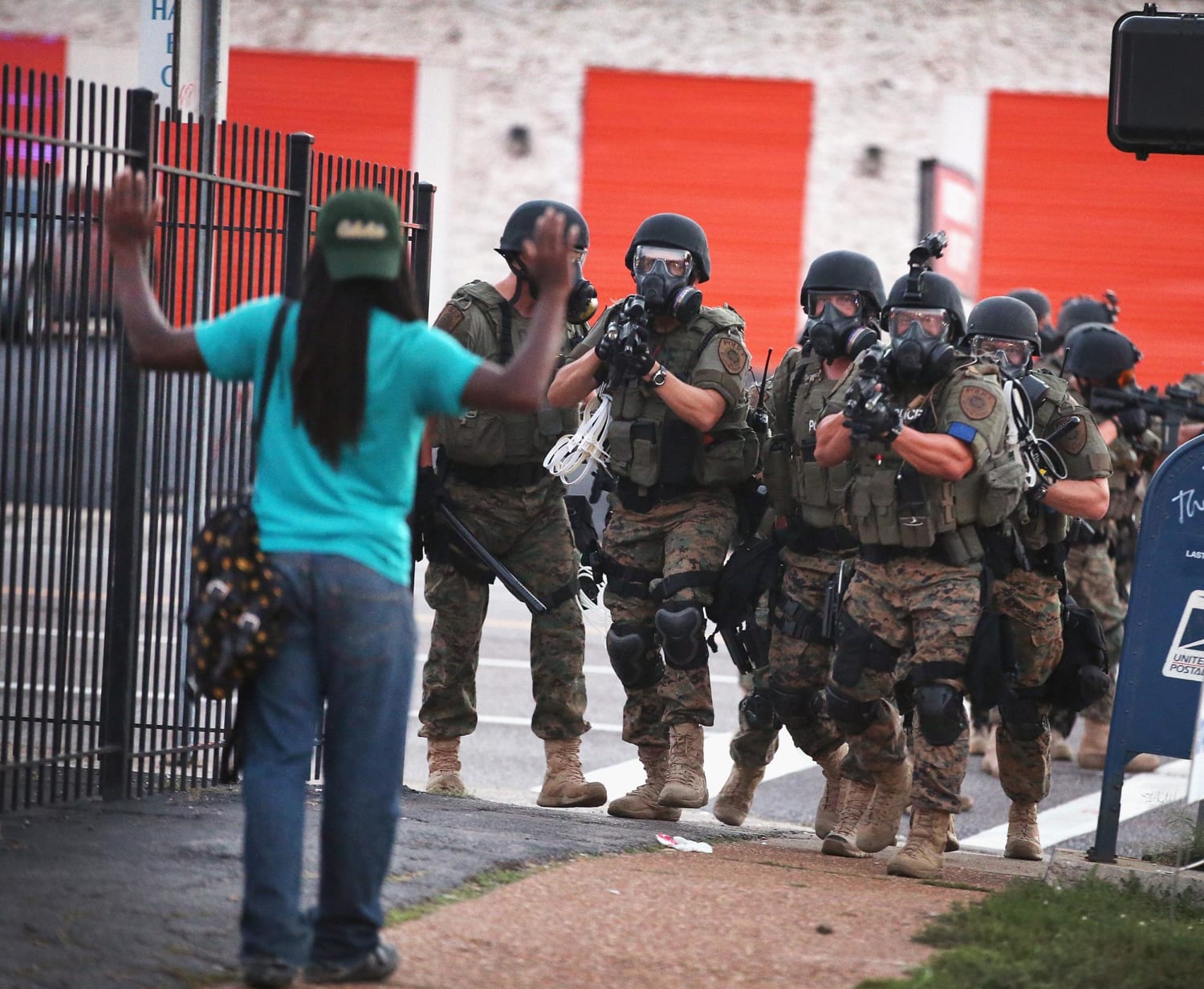
The militarization of the police has been underway since 9/11, but only in the aftermath of the six-shot killing of an unarmed teenager in Ferguson, Missouri, with photos of streets in a St. Louis suburb that looked like occupied Iraq or Afghanistan, has the fact of it, the shock of it, seemed to hit home widely.  Congressional representatives are now proposing bills to stop the Pentagon from giving the latest in war equipment to local police forces.  The president even interrupted his golfing vacation on Martha’s Vineyard to return to Washington, in part for “briefings” on the ongoing crisis in Ferguson.  So militarization is finally a major story.

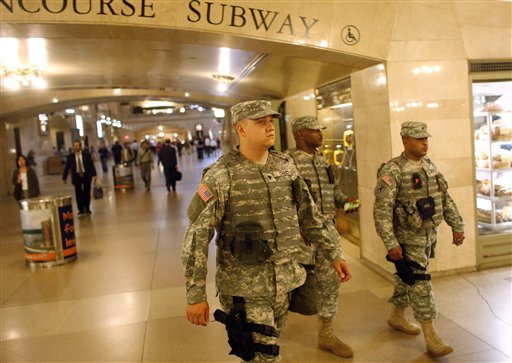
And that’s no small thing.  On the other hand, the news from Ferguson can’t begin to catch the full process of militarization this society has been undergoing or the way America’s distant wars are coming home. We have, at least, a fine book by Radley Balko on how the police have been militarized.  Unfortunately, on the subject of the militarization of the country, there is none.  And yet from armed soldiers in railway stations to the mass surveillance of Americans, from the endless celebration of our “warriors” to the domestic use of drones, this country has been undergoing a significant process of militarization (and, if there were such a word, national securitization).

Perhaps nowhere has this been truer than on America’s borders and on the subject of immigration.  It’s no longer “give me your tired, your poor, your huddled masses yearning to breathe free.”  The U.S. is in the process of becoming a citadel nation with up-armored, locked-down borders and a Border Patrol operating in a “Constitution-free zone” deep into the country.  The news is regularly filled with discussions of the need to “bolster border security” in ways that would have been unimaginable to previous generations.  In the meantime, the Border Patrol is producing its own set of Ferguson-style killings as, like SWAT teams around the U.S., it adopts an ever more militarized mindset and the weaponry to go with it.  As James Tomsheck, the former head of internal affairs for U.S. Customs and Border Protection, put it recently, “It has been suggested by Border Patrol leadership that they are the Marine Corps of the U.S. law enforcement community.  The Border Patrol has a self-identity of a paramilitary border security force and not that of a law enforcement organization.”

It’s in this context that the emotional flare-up over undocumented Central American children crossing the southern border by the thousands took place.  In fact, without the process of militarization, that “debate” — with its discussion of “invasions,” “surges,” “terrorists,” and “tip of the spear” solutions — makes no sense.  Its language was far more appropriate to the invasion and occupation of Iraq than the arrival in this country of desperate kids, fleeing hellish conditions, and often looking for their parents.

Aviva Chomsky is the author of a new history of just how the words “immigration” and “illegal” became wedded — it wasn’t talked about that way not so many decades ago — and how immigrants became demonized in ways that are familiar in American history.  The Los Angeles Times has hailed Undocumented: How Immigration Became Illegal for adding “smart, new, and provocative scholarship to the immigration debate.” As in her book, so today at TomDispatch, Chomsky puts the most recent version of the immigration “debate” into a larger context, revealing just what we prefer not to see in our increasingly up-armored nation. Tom Engelhardt

America’s continuing border crisis
The real story behind the “invasion” of the children
By Aviva Chomsky

Call it irony or call it a nightmare, but the “crisis” of Central American children crossing the U.S.-Mexican border, which lasted for months amid fervent and angry debate, is now fading from the news.  The media stories have been legion, the words expended many.  And yet, as the “crisis” leaves town, as the sound and fury die down and attention shifts elsewhere (even though the children continue to arrive), the real factors that would have made sense of what’s been happening remain essentially untouched and largely unmentioned.  It couldn’t be stranger — or sadder.

Since late June 2014, the “surge” of those thousands of desperate children entering this country has been in the news.  Sensational stories were followed by fervent demonstrations and counter-demonstrations with emotions running high.  And it’s not a debate that stayed near the southern border either.  In my home state, Massachusetts, Governor Deval Patrick tearfully offered to detain some of the children — and that was somehow turned into a humanitarian gesture that liberals applauded and anti-immigrant activists decried.  Meanwhile the mayor of Lynn, a city north of Boston, echoed nativists on the border, announcing that her town didn’t want any more immigrants.  The months of this sort of emotion, partisanship, and one-upmanship have, however, diverted attention from the real issues.  As so often is the case, there is so much more to the story than what we’ve been hearing in the news.

Continue reading

Facebooktwittermail

As part of its black economy, oil sales earn ISIS $2 million every day

Luay Al Khatteeb writes: The United Nation Security Council dramatically escalated the conflict with the Islamic State of Iraq and Levant (ISIL), Al Nusra Front (JNF) and other Al Qaeda splinter groups by passing UN Resolution 2170 in August 2014, thereby expanding the range of retaliatory measures (short of military action) against individuals associated with those groups. This UN Security Council is the latest in a series of draconian UN Resolutions against terror groups pursuant to its responsibility of Forgotten Obligations and affirming its primary role as peacekeepers enshrined in the UN Charter.

The cumulative effect of these resolutions recognizes the long term threat posed by ISIL which was addressed by President Obama in a White House briefing on the 18 August. What Obama did not address however was ISIL’s threat to global energy security, which forms (in part) the premise of this article.

The implications of these UN resolutions for ISIL are clear. The UN Security Council has effectively decided to cut off ISIL’s main lifeline, which is the illicit black economy derived mainly from the oil resources under its control. Consequently, ISIL’s ability to recruit and equip members, consolidate gains if not expand its theatre of operations will be affected. Furthermore, middle men including financiers, arms dealers, traders and Member States now face punitive action for failing to comply.

Whilst I have aired my thoughts on the main features of ISIL’s black market economy, I set out in this Article, my analysis of the background and significance of the UN’s latest bold move against ISIL, ANF and other Qaeda splinters.

Contrary to the media’s one dimensional portrayal of ISIL as a bunch of nihilist extremists, ISIL have moved relatively fast and in a relatively sophisticated manner to create an ‘ad-hoc’ black market economy over the territories it controls. ISIL is no longer desperate for donors’ funding to continue and expand their operations given they now possess a loosely integrated and thriving black economy consisting of approximately 60% of Syria’s oil assets and 7 oil producing assets in Iraq. It has successfully achieved a thriving black market economy by developing an extensive network of middlemen in neighboring territories and countries to trade crude oil for cash and in kind.

ISIL’s estimated total revenues from its oil production are around USD $2 million a day! Put simply, ISIL are in a position to smuggle over 30,000 barrels of crude oil a day to neighboring territories and countries at a price of between USD $25 to USD $60 per barrel depending on the number of middle men involved. [Continue reading…]

Facebooktwittermail

Most Gazans want long-term truce but oppose disarmament

Ynet: In a survey released Saturday by the Palestinian Center for Public Opinion (PCPO), the majority of Gaza’s residents said that they supported a long-term agreement for peace with Israel, but that disarmament of the Gaza Strip was an unacceptable demand from the Jewish State.

PCPO workers went door to door to ask their subjects some important questions and 87.6% of those asked said that they wanted a long-term agreement to be reached to stop the fighting, but even more, 93.2% said that disarmament of Hamas and the Gaza Strip was out of the question.

Facebooktwittermail

Ferguson and Gaza: The definitive study of how they are and are not similar

David Palumbo-Liu writes: As photographs and videoclips from Ferguson overwhelmed our mediascapes, they created a strange double-optic. They seemed overlaid upon representations of events that had previously dominated our public consciousness: Images of the massive and on-going destruction of Gaza by the Israeli military. This stereoscopic image immediately drew bloggers, pundits and op-ed writers to rush to draw parallels. Indeed, in graphic terms alone the image of tear gas canisters filling the air with toxic smoke and of protesters hurling them back defiantly seemed exactly the same. And when tweets offering advice to demonstrators in Ferguson emerged from Palestinians, and reports of Ferguson police having been trained by Israelis surfaced, all that only seemed to complete the equation: Ferguson is Gaza.

There are many parallels and resonances to be sure, and below I will get to some key ones. But I have delayed responding because, as a comparatist, and also as someone concerned about racism in the U.S. and the racist policies of Israel, it is important to weigh things in as dispassionate a way as possible, to do justice to both sides.

Many years ago, the eminent British Marxist historian Raymond Williams reflected on conversations he was having with Palestinian literary critic and activist Edward Said. Williams was particularly interested in seeing just how much of his work on British working class culture, history, and society could be understood as having to do in any way with Said’s concerns regarding Israel-Palestine, most especially with regard to what was going on then: the brutal Israeli bombing and invasion of Lebanon in 1982. Regarding that catastrophe, Hadas Thier writes, “During the course of Israel’s bombardment of the country, civilians and civilian infrastructure were systematically attacked, refugee camps and Lebanese towns were leveled, Beirut was battered for seventy-five days, and after all military objectives were met, the affair concluded with a grotesque massacre of women, children, and the elderly at the Sabra and Shatila refugee camps.” Williams’ conclusion is instructive:

The analysis of history is not a subject separate from history, but the representations are part of the history, contribute to the history, are active elements in the way that history continues; in the way forces are distributed; in the way people perceive situations, both from inside their own pressing realities and from outside them; if we are saying this is a real method, then the empirical test it’s being put to here is that comparable methods of analysis are being applied to situations which are very far apart in space, have many differences of texture, and have very different consequences in the contemporary world. There is an obvious distance from what is happening in the English countryside, or in the English inner cities, to the chaos in Lebanon. Yet nevertheless I think it is true that the method, the underlying method, found a congruity.

This discretion, this caution to pay attention to how history is represented and to get the historical record straight despite surface similarities, is found as well in the Nigerian novelist Chimamanda Ngozi Adichie’s novel on Biafra, “Half of a Yellow Sun.” At one point she tells of a journalist’s hesitation at making comparisons between Biafra and other historical events: “After he writes this, he mentions the German women who fled Hamburg with the charred bodies of their children stuffed in suitcases, the Rwandan women who pocketed tiny parts of their mauled babies. But he is careful not to draw parallels.”

How then can we strike a balance between on the one hand reacting viscerally to the images from Ferguson, which point to the long and constantly replenished history of police assaults on black bodies, and the images of Israel’s murderous rampage in Gaza, an assault continuous with Israel’s history of oppression and persecution of an entire people, while on the other hand resisting drawing too quickly an immediate, provocative, but inexact parallel?

It is in the median space between declaring an equivalence and withdrawing into discreet silence that we should concentrate our energies. Comparisons may be “odious,” to quote Shakespeare, but they can also be instructive. They help us tease out the specifics while coming to understand basic and important similarities. To do this one needs to employ a “congruent” method.

Here are five ways we can see congruence in what is happening in Ferguson and in Gaza. [Continue reading…]

Facebooktwittermail

How a fake ‘anti-semitic’ commenter smeared Common Dreams to support Israel

For Common Dreams, Lance Tapley reports: Like many other news websites, Common Dreams has been plagued by inflammatory anti-Semitic comments following its stories. But on Common Dreams these posts have been so frequent and intense they have driven away donors from a nonprofit dependent on reader generosity.

A Common Dreams investigation has discovered that more than a thousand of these damaging comments over the past two years were written with a deceptive purpose by a Jewish Harvard graduate in his thirties who was irritated by the website’s discussion of issues involving Israel.

His intricate campaign, which he has admitted to Common Dreams, included posting comments by a screen name, “JewishProgressive,” whose purpose was to draw attention to and denounce the anti-Semitic comments that he had written under many other screen names.

The deception was many-layered. At one point he had one of his characters charge that the anti-Semitic comments and the criticism of the anti-Semitic comments must be written by “internet trolls who have been known to impersonate anti-Semites in order to then double-back and accuse others of supporting anti-Semitism” — exactly what he was doing. (Trolls are posters who foment discord.)

The impersonation, this character wrote, must be part of an “elaborate Hasbara setup,” referring to an Israeli international public-relations campaign. When Common Dreams finally confronted the man behind the deceptive posting, he denied that he himself was involved with Hasbara.

His posting on Common Dreams illustrates the susceptibility of website comment threads to massive manipulation. [Continue reading…]

Facebooktwittermail

The end of liberal Zionism

Antony Lerman writes: Liberal Zionists are at a crossroads. The original tradition of combining Zionism and liberalism — which meant ending the occupation of the West Bank and Gaza, supporting a Palestinian state as well as a Jewish state with a permanent Jewish majority, and standing behind Israel when it was threatened — was well intentioned. But everything liberal Zionists stand for is now in doubt.

The decision of Israel’s prime minister, Benjamin Netanyahu, to launch a military campaign against Hamas in Gaza has cost the lives, to date, of 64 soldiers and three civilians on the Israeli side, and nearly 2,000 Palestinians, the majority of whom were civilians.

“Never do liberal Zionists feel more torn than when Israel is at war,” wrote Jonathan Freedland, The Guardian’s opinion editor and a leading British liberal Zionist, for The New York Review of Books last month. He’s not alone. Columnists like Jonathan Chait, Roger Cohen and Thomas L. Friedman have all riffed in recent weeks on the theme that what Israel is doing can’t be reconciled with their humanism.

But it’s not just Gaza, and the latest episode of “shock and awe” militarism. The romantic Zionist ideal, to which Jewish liberals — and I was one, once — subscribed for so many decades, has been tarnished by the reality of modern Israel. The attacks on freedom of speech and human rights organizations in Israel, the land-grabbing settler movement, a growing strain of anti-Arab and anti-immigrant racism, extremist politics, and a powerful, intolerant religious right — this mixture has pushed liberal Zionism to the brink. [Continue reading…]

Facebooktwittermail