Category Archives: Issues

Israel’s ability to kill Americans with impunity

Roger Cohen writes:

Here’s what the United Nations report on Israel’s raid last year on the Turkish-flagged Mavi Marmara had to say about the killing of a 19-year-old U.S. citizen on board:

“At least one of those killed, Furkan Dogan, was shot at extremely close range. Mr. Dogan sustained wounds to the face, back of the skull, back and left leg. That suggests he may already have been lying wounded when the fatal shot was delivered, as suggested by witness accounts to that effect.”

The four-member panel, led by Sir Geoffrey Palmer, a former prime minister of New Zealand, appears with these words to raise the possibility of an execution or something close.

Dogan, born in upstate New York, was an aspiring doctor. Little interested in politics, he’d won a lottery to travel on the Gaza-bound vessel. The report says of him and the other eight people killed that, “No evidence has been provided to establish that any of the deceased were armed with lethal weapons.”

I met Dogan’s father, Ahmet, a professor at Erciyes University in Kayseri, last year in Ankara: His grief was as deep as his dismay at U.S. evasiveness. It’s hard to imagine any other circumstances in which the slaying in international waters, at point-blank range, of a U.S. citizen by forces of a foreign power would prompt such a singular American silence.

Unless, that is, one considers the case of the USS Liberty, the American ship that was attacked by Israeli forces in international waters in 1967 during the Six-Day War, resulting in the deaths of 34 crew members and the injury of 170.

Two squadrons of US Navy fighter-bombers were sent to repel the unprovoked Israeli attack and could have reached the Liberty in time to prevent a torpedo attack that killed 26 Americans, but the operation was aborted. As far as the White House was concerned, it was more important to avoid embarrassing Israel than it was to protect American lives.

After newly declassified government documents were released in 2007, the Chicago Tribune reported:

J.Q. “Tony” Hart, then a chief petty officer assigned to a U.S. Navy relay station in Morocco that handled communications between Washington and the 6th Fleet, remembered listening as Defense Secretary Robert McNamara, in Washington, ordered Rear Adm. Lawrence Geis, commander of the America’s carrier battle group, to bring the jets home.

When Geis protested that the Liberty was under attack and needed help, Hart said, McNamara retorted that “President [Lyndon] Johnson is not going to go to war or embarrass an American ally over a few sailors.”

McNamara, who is now 91, told the Tribune he has “absolutely no recollection of what I did that day,” except that “I have a memory that I didn’t know at the time what was going on.”

The Johnson administration did not publicly dispute Israel’s claim that the attack had been nothing more than a disastrous mistake. But internal White House documents obtained from the Lyndon B. Johnson Presidential Library show that the Israelis’ explanation of how the mistake had occurred was not believed.

Except for McNamara, most senior administration officials from Secretary of State Dean Rusk on down privately agreed with Johnson’s intelligence adviser, Clark Clifford, who was quoted in minutes of a National Security Council staff meeting as saying it was “inconceivable” that the attack had been a case of mistaken identity.

The attack “couldn’t be anything else but deliberate,” the NSA’s director, Lt. Gen. Marshall Carter, later told Congress.
[…]
For all its apparent complexity, the attack on the Liberty can be reduced to a single question: Was the ship flying the American flag at the time of the attack, and was that flag visible from the air?

The survivors interviewed by the Tribune uniformly agree that the Liberty was flying the Stars and Stripes before, during and after the attack, except for a brief period in which one flag that had been shot down was replaced with another, larger flag — the ship’s “holiday colors” — that measured 13 feet long.

Concludes one of the declassified NSA documents: “Every official interview of numerous Liberty crewmen gave consistent evidence that indeed the Liberty was flying an American flag — and, further, the weather conditions were ideal to ensure its easy observance and identification.”


Facebooktwittermail

Israel’s idea of ‘tolerance’ when facing non-violent Palestinian protesters

Reuters reports:

Brigadier-General Michael Edelstein, the officer crafting Israel’s counter-demonstration doctrines, said troops were now better equipped and trained to police the occupied West Bank and the boundaries with Gaza, Lebanon and Syria.

“The balance has changed. We have more means that we can use, therefore the use of lethal weapons will decrease,” he told foreign reporters in a briefing.

He said there was no plan to reinforce military garrisons, which had been practicing non-lethal riot control techniques.

Israel has also invested heavily in riot-dispersal gear including accurate tear-gas launchers, high-powered loudspeakers that emit an intolerable buzzing noise, and cannons for dousing crowds with water or a foul-smelling liquid known as “skunk.”

The objective, Edelstein said, was “to be able to handle riots while diminishing casualties on both sides.”

Asked if this meant that Israeli forces, accused in the past of shoot-on-sight policies against Palestinians, would now show more tolerance, he said: “Much more tolerance.”

Facebooktwittermail

Libyan rebel leader says MI6 knew he was tortured

The Independent reports:

“They knew I was being tortured, I have no doubt of that,” Abdelhakim Belhaj, a former prisoner who is now the rebel security chief of the Libyan capital, said about the British intelligence agents who came to interrogate him while he was in the hands of Muammar Gaddafi’s secret police.

“I hoped they would do something about it. I was too terrified during the meeting to say out loud what was being done to me because I thought the Libyans [secret police] were taping what was going on. When the Libyan guards left I made sign movements with my hands.

“The British people nodded, showed they understood. They showed this understanding several times. But nothing changed, the torture continued for a long time afterwards.”

The appalling treatment inflicted on Mr Belhaj, a former head of the Libyan Islamist Fighting Group (LIFG), is now in the centre of an international diplomatic storm. The Independent revealed, after discovering secret files in Tripoli, how Britain played a key role in the rendition of Mr Belhaj, which delivered him into hands of the Gaddafi regime for seven years of incarceration, six of them in solitary confinement.

Mr Belhaj’s vehement claims that British officials were fully aware of the maltreatment he was undergoing and lays the UK intelligence services open to charges of direct complicity. There is nothing to suggest in a tranche of MI6 papers that the UK raised concerns about his ordeal with the regime.

Instead there are repeated requests to the Libyan secret police for information about Mr Belhaj, including one believed to be from Sir Mark Allen, who was then MI6’s head of counter-terrorism and now works for BP, when arranging Tony Blair’s visit to meet Colonel Gaddafi. “I was grateful to you for helping the officer we sent out last week. Abu Abd Allah’s [a nom-de-guerre for Mr Belhaj] information on the situation in this country is of urgent importance to us.”

Speaking to The Independent in a Tripoli hotel now being used by the Transitional National Council (TNC), Mr Belhaj described being interviewed by three British agents, one woman and two men, at the security headquarters of Moussa Koussa, who was then Libya’s spymaster. The two questioning sessions each lasted about two hours. The name of the female officer is known to The Independent but it is not being published for security reasons. Documents show that she was one of the most frequent visitors to Tripoli under the Gaddafi regime.

“The British people they sent were real experts, they knew the names of LIFG members in England, even their codenames. I have been told [by regime officials] that if I named them as being involved with al-Qa’ida they would be returned to Libya and my own conditions would improve. I was given names of other opposition people who were not even members of LIFG, who I did not even know,” Mr Belhaj, 45, said.

“I told the British, as I told everyone else, that LIFG had no link with al-Qa’ida. I knew making a link would stop what was happening to me, but I was not going to do it. I showed the British about what was happening to me.”

Mr Belhaj’s sense of being betrayed extends beyond the unheeded plea for help to the UK agents during his interrogation. After being arrested in Malaysia as a suspect during the US-led “war on terror”, he had applied for asylum to the UK, which was supposedly granted. Instead, British intelligence used the system to start a chain of events that led to his rendition to Libya. As Mr Belhaj and his wife, who was four months pregnant, travelled from Kuala Lumpur to the Thai capital, Bangkok, on the way to London in March 2004 they were arrested by CIA officers and the Thai police.

Mr Belhaj said he was subjected to physical abuse in Thailand before being moved to Abu Salim prison, a place of fear for Libyans where torture became a daily occurrence and often involved being suspended from the ceiling by his wrists.

Mr Belhaj, who was released from prison under an amnesty by the regime earlier this year, said yesterday: “My wife is still badly affected by what happened, even after all these years. It was very frightening for her. I am angry that the asylum application was used in this way. I thought Britain was a place where human rights were respected. I thought it was a place I could go to be safe. Instead, they used this to trap me.

Patrick Cockburn writes:

Here is an account by a Libyan, who did not want to disclose his name, of what it was like to be tortured by Libyan security. He says: “I was blindfolded and taken upstairs. I was shocked with electricity and made to sit on broken glass. They were kicking and punching me until I confessed. I said ‘No’.” This went on for over a week.

One day the interrogators tied his hands behind his back and took him upstairs. He continues: “They opened the door and I saw my son and wife. There were five or six members of security with masks. They tied me to a chair and one of them said: ‘Do you want to sign or should we torture them?'”

According to the prisoner one of the interrogators took his 10-month-old son and put a wire on his hand and “he screamed and his face turned red”. The little boy appeared to stop breathing. Soon afterwards the prisoner signed the confession demanded by Libyan security.

The testimony about the baby’s torture in front of his father was recorded by Human Rights Watch in Tripoli in 2005. The same year the UK signed a Memorandum of Understanding accepting Libyan diplomatic assurances that torture would not be used against Libyan exiles repatriated from the UK to Libya. Few documents agreed to by a British government exude so much hypocrisy and cynicism.

Facebooktwittermail

America’s inability to win wars, pay for them, or explain why it fights

Gary Younge writes:

In the immediate aftermath of the September 11 attacks the then national security adviser, Condoleezza Rice, called in her senior staff and asked them to think seriously about “how [to] capitalise on these opportunities”. The primary opportunity came from a public united in anger, grief and fear which the Bush administration sought to leverage to maximum political effect. “I think September 11 was one of those great earthquakes that clarify and sharpen,” Rice told the New Yorker six months afterwards. “Events are in much sharper relief.”

Ten years later the US response to the terror attacks have clarified three things: the limits to what its enormous military power can achieve, its relative geopolitical decline and the intensity of its polarised political culture. It proved itself incapable of winning the wars it chose to fight and incapable of paying for them and incapable of coming to any consensus as to why. The combination of domestic repression at home and military aggression abroad kept no one safe, and endangered the lives of many. The execution of Osama bin Laden provoked such joy in part because almost every other American response to 9/11 is regarded as a partial or total failure.

Inevitably, the unity brought about by the tragedy of 9/11 proved as intense as it was fleeting. The rally around the flag was a genuine, impulsive reaction to events in a nation where patriotism is not an optional addendum to the political culture but an essential, central component of it. Having been attacked as a nation, people logically felt the need to identify as a nation.

But beyond mourning of the immediate victims’ friends and families, there was an element of narcissism to this national grief that would play out in policy and remains evident in the tone of many of today’s retrospectives. The problem, for some, was not that such a tragedy had happened but that it could have happened in America and to Americans.

Facebooktwittermail

Can Israel adapt to democracy?

While Israel’s ability to develop internally as a democracy is shackled by the undemocratic nature of Zionism, it’s hardly surprising that the growth of democracy outside Israel — notably in Turkey and Egypt — presents a conundrum for the Jewish state: how can harmonious relations be maintained with historically friendly governments without also attempting to cultivate friendly relations with the people that those governments represent?

Democracy is a simple idea: people matter. And if Israel doesn’t get this, it doesn’t get democracy.

İhsan Dağı writes:

Public opinion has had an increasing impact on Turkey’s foreign policy-making in recent years. Democratization and a growing participation in civil society, due to economic development and the EU accession process, have empowered public opinion to assert itself on the matter of foreign affairs, which was not the case a decade ago. Thus Turkey’s relationship with Israel was questioned whenever Israel engaged in violent policies in the region, like the war in Lebanon and the attacks on Gaza. Public reaction to Israeli aggression in the region is bound to be taken into consideration by a government that is accountable to its people.

Especially after the killing of eight Turks and one Turkish-American aboard the Mavi Marmara by Israeli soldiers, public opinion is ever more important. It will be very difficult to win the people over to a rapprochement with Israel, without at least an official apology and compensation.

It is therefore a mistake to assume that the Erdoğan government is the source of the problem, and to claim that Turkish-Israeli relations would return to normal under a non-AK Party government. To refute this I will say two things: First, the AK Party government is only responding to the public mood and demands. Second, the AK Party is very unlikely to disappear from the political scene in Turkey. That is to say that both the current public mood and the AK Party’s rule appear as though they will be around for a while. So instead of sitting and waiting in vain for them to disappear, Israel and its friends should try to not lose Turkey’s support permanently.

My advice to the Israeli government is that it should get used to living and working with the AK Party government, and to try to understand the “new Turkey” because even in a future post-AK Party period things will never be the same as in days past.

Facebooktwittermail

Ankara and Tel Aviv, collision course or path to progress?

Haaretz reports:

Turkey on Monday informed Israel’s top diplomat in Ankara that nearly all senior Israeli embassy personnel must leave the country by Wednesday.

Ella Ofek, the deputy to the Israeli ambassador to Turkey and the person currently in charge of the Israeli embassy in Ankara, was summoned to the Turkish Foreign Ministry on Monday. Ofek was informed that all Israeli diplomats ranked above the level of second secretary, including the IDF military attaché, must depart Turkey by Wednesday.

The only Israeli diplomats permitted to remain include embassy spokesman Nizar Amir and personnel who provide consular services.

Facebooktwittermail

Turkish FM says flotilla issue not just between Israel and Turkey

Today’s Zaman reports:

Firmly opposing the portrayal of the recent escalation of the crisis between Turkey and Israel solely as a bilateral affair which must be resolved between the two countries, Turkey’s Foreign Minister Ahmet Davutoğlu has warned that when dealing with Israel’s lethal 2010 raid on a Gaza-bound aid flotilla, in which nine pro-Palestinian activists were killed, the international community should not ignore the fact that Israel’s repeated breaches of international law and ethics lie at the core of the issue.

Davutoğlu made these remarks when he was called upon to answer various questions concerning a new set of Turkish measures against Israel from his European counterparts at an informal meeting of the European Union. The meeting on Saturday gathered together 27 ministers from EU member countries, as well as their counterparts from Iceland, Turkey, Croatia, Montenegro and Macedonia, all nations aspiring to join the bloc, in the Baltic Sea resort of Sopot, Poland.Davutoğlu was the last minister to take the stage, where he answered questions apparently prompted by his announcement Friday in Ankara that Turkey has downgraded its diplomatic ties with Israel to the level of second secretary, and giving the Israeli ambassador and other high-level diplomats until Wednesday to leave the country.

In other measures against Israel, Turkey suspended military agreements, promised to back legal suits brought against Israel by the families of the raid victims, and vowed to take steps to ensure that freedom to navigate is maintained in the eastern Mediterranean.

Speaking with Today’s Zaman late on Saturday en route from Sopot to Turkey, Davutoğlu said he first explained to the assembled ministers how the situation in the eastern Mediterranean has been prone to escalating tensions due, to the unresolved Cyprus conflict and the ongoing crisis in Syria. “I brought up the issue of the overall dynamics in the eastern Mediterranean. I noted that everyone should be careful, and told them about the Israel issue. Everyone came up to me and asked if there is anything they can do about it. They agree that Turkey is right, and they advise us to ease up the tension. I told them that it is an issue in its own right for us, with or without the Arab Spring or the Middle East conflict. When the incident happened a year ago, there was no Arab Spring. It is about principles for us. Our people were murdered by an army outside of combat conditions,” Davutoğlu told Today’s Zaman.

“I told them that this is what upset us: Among those detained on that ship there were people from most of the countries sitting around this table. We brought them from Tel Aviv to İstanbul and sent them back to their countries. When our people returned, the issue was suddenly dubbed an Israeli conflict. If they had stayed there, it would have been your issue too. This is not a particular issue between us and Israel; it is an issue between Israel and international law and ethics and the international community. So if you want to help, go tell Israel to apologize and pay compensation. If you just do that, that would be best help,” the minister added. The foreign minister was referring to the fact that the Mavi Marmara, aboard which eight Turks and one Turkish-American were killed during the May 31, 2010 raid, was part of a flotilla which included about 600 activists from 32 different countries, including Australia, Belgium, Canada, Greece, France, Sweden and the US.

Facebooktwittermail

Wikileaks: Israeli army thinks violence is the best response to non-violence

Joseph Dana writes:

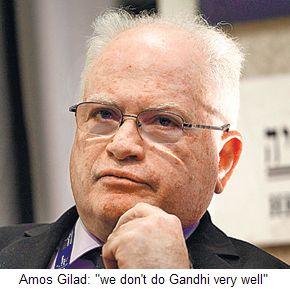
In a new wikileaks cable, Director of Policy and Political-Military Affairs at the Israel Ministry of Defense, Maj. General (reserves) Amos Gilad, told American government officials, ‘we don’t do Gandhi very well’ in reference to unarmed demonstrations taking place throughout the West Bank and specifically in Nabi Saleh. The cable confirms that the Israeli army has, in recent months, decided to increase violent pressure on the demonstrations ‘even [if the] demonstrations appear peaceful.’

In the cable, titled “IDF PLANS HARSHER METHODS WITH WEST BANK DEMONSTRATIONS” and labeled confidential, the Israeli army is portrayed as fed up with the demonstrations and likely to engage in harsh repression if the demonstrations continue or grow.

The cable sent February 12, 2010:

C O N F I D E N T I A L TEL AVIV 000344

SIPDIS

E.O. 12958: DECL: 02/12/2020
TAGS: PREL MOPS KWBG IS
SUBJECT: IDF PLANS HARSHER METHODS WITH WEST BANK
DEMONSTRATIONS

Classified By: Deputy Chief of Mission Luis G. Moreno for reasons 1.4 (
b) and (d).

¶1. (C) In meetings with U.S. officials on February 4, OC
Central Command MG Avi Mizrachi expressed frustration with
on-going demonstrations in the West Bank, which he believes
are being orchestrated to increase tensions. Mizrachi, whose
area of responsibility includes all of the West Bank and
Central Israel, warned that the IDF will start to be more
assertive in how it deals with these demonstrations, even
demonstrations that appear peaceful.

¶2. (C) After visiting two of these “so-called peaceful
demonstrations,” Mizrachi said he did not know what they were
about; the villages were not near the barrier and they had no
problems with movement or settlers. Mizrachi asserted that
the Palestinian villagers also do not know the reason for the
demonstrations and said that they were only demonstrating
because they were told to do so.

¶3. (C) Mizrachi warned that he will start sending his trucks
with “dirty water” to break up these protests, even if they
are not violent, because they serve no purpose other than
creating friction. (NOTE: dirty water is a reference to the
IDF’s chemically treated water that duplicates the effects of
skunk spray. End note.) Mizrachi said he heard rumors that
Palestinian PM Salam Fayyad was planning to attend one of
these protests, adding that if Fayyad gets sprayed with dirty
water, it will make everyone look bad.

¶4. (C) On orders from Mizrachi, West Bank commander BG
Nitzan Alon and West Bank civil administrator BG Poli
Mordechi reportedly met with the Palestinian security force
commanders recently to deliver a strong message that they
must stop these demonstrations or the IDF will. Mizrachi
asserted that he would prefer not to break up these
demonstrations, but will if he must. Many of the
demonstrations are organized by “suspicious people,” Mizrachi
said, and he plans on arresting organizers of demonstrations
that “serve no purpose” beyond exciting the population.

¶5. (C) COMMENT: Less violent demonstrations are likely to
stymie the IDF. As MOD Pol-Mil chief Amos Gilad told USG
interlocutors recently, “we don’t do Gandhi very well.” The
IDF impatience with these demonstrations may also be
connected to the recent arrests of foreign NGO workers with
expired or solely tourist visas who have been attending, and
often organizing, the protests. The GoI reportedly ceased
issuing B1 work visas to the foreign staff of NGOs working in
the occupied territories; for several months now it has
restricted them and their families to B2 visitor visas with
varying durations and sometmies limited to single-entry. On
February 10, officials from the MOI immigration enforcement
unit (the “Oz” unit) told PolOff that they made the arrests
of NGO workers in the West Bank at the request of the IDF.
However, the court ruled that the Oz unit cannot operate
beyond the Green Line, and subsequently released the
detainees, who were mostly European. The Oz unit officials
told PolOff that they will not challenge that ruling and have
no further operations planned in the West Bank. END COMMENT.
Cunningham

Facebooktwittermail

Google wants to own you

Mathew Ingram writes:

Ever since Google launched its new Google+ social network, we and others have pointed out that the search giant clearly has more in mind than just providing a nice place for people to share photos of their pets. For one thing, Google needs to tap into the “social signals” that people provide through networks such as Facebook so it can improve its search results. There’s a larger motive, too: As Chairman and former Chief Executive Officer Eric Schmidt admitted during an interview in Edinburgh over the weekend, Google is taking a hard line on the real-name issue because it sees Google+ as an “identity service” or platform on which it can build other products.

Schmidt’s comments came during an interview with Andy Carvin, the National Public Radio digital editor who has become a one-man newswire during the Arab Spring revolutions. Carvin asked the Google chairman about the company’s reasoning for pushing its real-name policies on Google+—a policy that many have criticized (including us) because it excludes potentially valuable viewpoints that might be expressed by political dissidents and others who prefer to remain anonymous. In effect, Schmidt said Google isn’t interested in changing its policies to accommodate those kinds of users: If people want to remain anonymous, he said, then they shouldn’t use Google+.

It was the former Google CEO’s remarks about the rationale for this policy that were most interesting: He didn’t just say—as Vic Gundotra, the Google executive in charge of the new social network has—that having real names maintains a certain tone of behavior that is preferable to anonymous forums (an argument that online-community pioneer Derek Powazek has also made). According to Carvin, Schmidt said the reason Google needs users with real names is that the company sees Google+ as the core of an identity platform it is building that can be used for other things:

He (Eric) replied by saying that G+ was built primarily as an identity service, so fundamentally it depends on people using their real names if they’re going to build future products that leverage that information.

As Union Square Ventures partner Fred Wilson noted in a blog post in response to Schmidt’s comments, this is an admission by the company that it wants to be an identity gatekeeper.

Facebooktwittermail

Plight of sub-Saharan Africans in Libya

The BBC reports:

“Justice” does not know where the young men came from nor whose side they were on.

All he knows is that they were aggressive and demanding money. When he tried to tell them he had nothing to give them, not a penny, they stabbed him in the stomach and then they sped away.

Justice, a Nigerian in his early 50s, is lucky to be alive. He was treated in a Tripoli clinic and now has a huge scar across his stomach.

Like thousands of sub-Saharan Africans, he found himself in the wrong place at the wrong time when Libya’s civil conflict erupted earlier this year.

Many Africans were accused by pro-Gaddafi loyalists and by the opposition rebels of being paid mercenaries, and were persecuted for that.

While, there is evidence that many so-called foreigners did take up arms in this conflict, the vast majority were unjustly accused and now find themselves trapped in a foreign land without money and with few friends.

The group of as many as 2,000 Africans I came across were living in a dilapidated fishing port on the outskirts of Tripoli.

Sleeping in disused warehouses or under the meagre shade given by abandoned fishing boats, Ghanaians, Malians, Nigerians and many others told of their desperation.

“We need help,” said a 24-year-old Ghanaian man.

He denied accusations that some people at the camp had been fighters but readily admitted that many were immigrants who had come to Libya in recent years looking for work.

“We are poor, with no food and it’s so dangerous that the men here don’t sleep at night,” said the man.

Facebooktwittermail

Crime and punishment in Libya: inside Gaddafi’s surveillance system

Abigail Hauslohner reports:

In the initial days after Libyan rebels overran Col. Muammar Gaddafi’s forces in eastern Libya last February, one of the most prevalent emotions on the street was shock. “We thought 90% of the people were with Gaddafi,” Camilla Esbak remarked in the rebel stronghold of the Green Mountains. “So we never expected this.” For years, most Libyans had been hesitant to voice opposition, they said, even to their children and close friends, fearing the pervasiveness and brutality of their dictator’s security network. And when the revolution finally came, they marveled that so many of their neighbors had shared their opinions all along.

And yet, as rebels have begun to sift through the buildings and archives of Gaddafi’s internal security apparatus over the past week, Libyans are also finding confirmation that they had every reason to be paranoid.

Based on TIME’s examination of documents, maps, computer files, and surveillance hardware found in a handful of security offices around Tripoli, Gaddafi’s internal security network appears to have permeated every neighborhood, town, and city of the vast North African country for decades. The regime monitored thousands of people; tapping phone calls and hacking e-mails, according to the Wall Street Journal. And in some cases, it appears that a single person of interest was matched by at least one security officer who was assigned to him specifically. In other cases, Abdel Karim Gadoora, a former interior ministry surveillance officer told TIME: “Whenever there was someone, they would just go and arrest them right away.”

In one unmarked security office in an apartment building off of Tripoli’s Green Square — now renamed Martyr’s Square — there are registration books full of the plainclothes men that internal security had staffed around the city. A chart in one binder details the “youth” that the government had given Kalashnikovs to. In Abu Slim, there were 9 gangs and 143 people with weapons, it says; there were 170 in the rebel stronghold of Souk al-Jumaa and 45 in the wealthy, diplomatic neighborhood of Hay al Andalus.

In a control room, Gadoora says that the seven TV screens are rigged to dozens of cameras around Green Square and downtown. The whole office, he says, was dedicated only to the surveillance of downtown Tripoli. But there are dozens like this, he adds, each dedicated to a different neighborhood. Detailed maps, including those produced by U.S. commercial satellite image providers, cover the walls. But Gaddafi’s vast Bab al-Aziziya compound is always just a blank shape, suggesting that the dictator feared even the men who he had assigned to keep watch on his citizens. And indeed, the archives of another internal security building corroborates rebel claims that government employees and army officers were frequently targeted by the very regime that employed them.

Facebooktwittermail

The war on terror — the first war in history paid for entirely on credit

The economist, Joseph E. Stiglitz, writes:

The Sept. 11, 2001, terror attacks by al-Qaida were meant to harm the United States, and they did, but in ways that Osama Bin Laden probably never imagined. President George W. Bush’s response to the attacks compromised America’s basic principles, undermined its economy, and weakened its security.

The attack on Afghanistan that followed the 9/11 attacks was understandable, but the subsequent invasion of Iraq was entirely unconnected to al-Qaida—as much as Bush tried to establish a link. That war of choice quickly became very expensive—orders of magnitude beyond the $60 billion claimed at the beginning—as colossal incompetence met dishonest misrepresentation.

Indeed, when Linda Bilmes and I calculated America’s war costs three years ago, the conservative tally was $3 trillion to $5 trillion. Since then, the costs have mounted further. With almost 50 percent of returning troops eligible to receive some level of disability payment, and more than 600,000 treated so far in veterans’ medical facilities, we now estimate that future disability payments and health care costs will total $600 billion to $900 billion. The social costs, reflected in veteran suicides (which have topped 18 per day in recent years) and family breakups, are incalculable.

Even if Bush could be forgiven for taking America, and much of the rest of the world, to war on false pretenses, and for misrepresenting the cost of the venture, there is no excuse for how he chose to finance it. His was the first war in history paid for entirely on credit. As America went into battle, with deficits already soaring from his 2001 tax cut, Bush decided to plunge ahead with yet another round of tax “relief” for the wealthy.

Today, America is focused on unemployment and the deficit. Both threats to America’s future can, in no small measure, be traced to the wars in Afghanistan and Iraq. Increased defense spending, together with the Bush tax cuts, is a key reason why America went from a fiscal surplus of 2 percent of GDP when Bush was elected to its parlous deficit and debt position today. Direct government spending on those wars so far amounts to roughly $2 trillion—$17,000 for every U.S. household—with bills yet to be received increasing this amount by more than 50 percent.

Facebooktwittermail

For Syria’s protesters there is no going back

Traveling from safe house to safe house, Anthony Shadid meets Syria’s young revolutionaries, one of whom declares: “We’ve already won. We’re victorious now. I lived a life of terror, fear and killing, and now I’m free.”

It was past 11 a.m., and Abdullah was finally waking up. The night before had gone late, he and his friends challenging and daring and fleeing from the feared mukhabarat, Syria’s secret police, who for the past five months have been bent on crushing dissent here in Homs. With a few hours of sleep behind him, Abdullah rolled off his mattress and began tapping out details of their exploits on his laptop. The clashes had been fierce and lasted hours, past the muezzin’s call to prayer at dawn. “We won’t bow to anyone but God,” the protesters declared. The mukhabarat replied with tear gas, buckshot and bullets. “Hot” was how Abdullah described it as he typed.

As safe houses go, the room he slept in was lavish. A wide-screen television shared space on the wall with framed Koranic verses, rendered in sloping gold script. The hot wind of the Syrian summer billowed the thick drapes like sails in a storm. There was a mattress for each of the four men, all in their 20s, who slept surrounded by their smartphones and laptops and satellite phones and speakers.

Abdullah, a 26-year-old computer engineer and pious Muslim, is a wanted man. He joined the first protest in Homs in March, and since then he has emerged as one of the dozen or so leaders of the youth resistance. His savvy with technology has made him a target for the police, and this was the fifth place he had slept in in less than a week. He hadn’t been to his family’s home in two months. Around his neck he wore a tiny toy penguin that was actually a thumb drive, which he treated like a talisman, occasionally squeezing it to make sure it was still there. I sat next to him on the mattress and watched as he traded messages with other activists on Skype, then updated a Facebook page that serves as an underground newspaper, then marked a Google Earth map of Homs with the spots of the latest unrest. “If there’s no Internet,” Abdullah said, “there’s no life.”

The other young men in the room began to stir. Abdullah’s friend Iyad (last names of the activists will not be used, in order to protect their identities), brought in tea and emptied ashtrays. They all soon started talking with an excitement that belied the danger to which they have grown accustomed. By day, a measure of normal life unfolds in Homs: stores and government offices are open, and people go about their business. Checkpoints have proliferated, though, and the most active youth try to stay off the streets, worrying that they are easier to identity in the daylight. By night, they gather in scores, sometimes in the hundreds, in open defiance of the regime. In Iyad’s living room, they bragged about spreading nails in the streets to flatten the tires of security-force vehicles and described to me how they load onions into plastic pipes and fire them by igniting hair spray. When security forces surged toward one of their comrades, they shouted to him: “You’ve got 20 guys around you! Blow yourself up!”

“They just fled,” Abdullah said, smiling as he recalled the security forces retreating in fear from the imaginary explosives.

Facebooktwittermail

The Tripoli uprising

Anand Gopal writes:

One night late last month, in a sweltering apartment deep in the heart of Tripoli, a group of men gathered around the television to watch the evening news. The program was carried on Libya al-Ahrar, a Doha-based news channel beaming into Libya in support of the revolution. At precisely 8:30 p.m., after the breaking of the Ramadan fast and as locals were streaming to the mosques, the message these men were waiting for came: “Truly, we have granted you a clear victory,” the newscaster said, before signing off for the night.

It was a verse from the Quran, but to the men in this room, in the tightly packed neighborhood of Souq al-Juma, it was so much more — a code that signaled that their uprising was to begin. Over the next 48 hours, the people of Tripoli pushed Libya’s six-month revolution to its staggering denouement, ensuring their country would never again be the same and reinvigorating the Arab awakening — and it all began in this neighborhood.

The men watching the television were part of a group of 62 underground revolutionaries who had been preparing for this day for weeks. Malik Jamal Abargo, a 20-something port worker, was one of them. He grabbed his Kalashnikov and rushed into the streets with his comrades. “My heart was pounding,” he says. “I thought that I might become a martyr.”

The sight of the small crowd chanting slogans against Muammar al-Qaddafi in the street prompted shouts from the mosque. Soon its speakers issued forth a thunderous chant: Allahu akbar! Out came Khalid Abu Humeida, a customs worker. “I was standing in line for vegetables when I heard it,” he says. “It had more force to me than any bomb or jet. I knew what to do.” He was joined by Salem El Burai, a restaurant owner who came rushing out with a bag of rocks. Abdul, who would not give his last name and has no job at all, emerged with a Molotov cocktail.

The crowd grew to hundreds — the first large open protests against the government in any part of Tripoli since February, when demonstrations were drowned in blood. Almost immediately, truckloads of state security forces began to arrive. They pointed their weapons at the demonstrators. “We inched forward, step by step, trying not to waver,” says Abdul.

Facebooktwittermail

Don’t fear Islamic law in America

Eliyahu Stern writes:

More than a dozen American states are considering outlawing aspects of Shariah law. Some of these efforts would curtail Muslims from settling disputes over dietary laws and marriage through religious arbitration, while others would go even further in stigmatizing Islamic life: a bill recently passed by the Tennessee General Assembly equates Shariah with a set of rules that promote “the destruction of the national existence of the United States.”

Supporters of these bills contend that such measures are needed to protect the country against homegrown terrorism and safeguard its Judeo-Christian values. The Republican presidential candidate Newt Gingrich has said that “Shariah is a mortal threat to the survival of freedom in the United States and in the world as we know it.”

This is exactly wrong. The crusade against Shariah undermines American democracy, ignores our country’s successful history of religious tolerance and assimilation, and creates a dangerous divide between America and its fastest-growing religious minority.

The suggestion that Shariah threatens American security is disturbingly reminiscent of the accusation, in 19th-century Europe, that Jewish religious law was seditious. In 1807, Napoleon convened an assembly of rabbinic authorities to address the question of whether Jewish law prevented Jews from being loyal citizens of the republic. (They said that it did not.)

Fear that Jewish law bred disloyalty was not limited to political elites; leading European philosophers also entertained the idea. Kant argued that the particularistic nature of “Jewish legislation” made Jews “hostile to all other peoples.” And Hegel contended that Jewish dietary rules and other Mosaic laws barred Jews from identifying with their fellow Prussians and called into question their ability to be civil servants.

The German philosopher Bruno Bauer offered Jews a bargain: renounce Jewish law and be granted full legal rights. He insisted that, otherwise, laws prohibiting work on the Sabbath made it impossible for Jews to be true citizens. (Bauer conveniently ignored the fact that many fully observant Jews violated the Sabbath to fight in the Prussian wars against Napoleon.)

During that era, Christianity was seen as either a universally valid basis of the state or a faith that harmoniously coexisted with the secular law of the land. Conversely, Judaism was seen as a competing legal system — making Jews at best an unassimilable minority, at worst a fifth column. It was not until the late 19th century that all Jews were granted full citizenship in Western Europe (and even then it was short lived).

Most Americans today would be appalled if Muslims suffered from legally sanctioned discrimination as Jews once did in Europe. Still, there are signs that many Americans view Muslims in this country as disloyal. A recent Gallup poll found that only 56 percent of Protestants think that Muslims are loyal Americans.

Facebooktwittermail

A look at the US military’s Joint Special Operations Command

Dana Priest and William M. Arkin write:

Two presidents and three secretaries of defense routinely have asked JSOC to mount intelligence-gathering missions and lethal raids, mostly in Iraq and Afghanistan, but also in countries with which the United States was not at war, including Yemen, Pakistan, Somalia, the Philippines, Nigeria and Syria.

“The CIA doesn’t have the size or the authority to do some of the things we can do,” said one JSOC operator.

The president has also given JSOC the rare authority to select individuals for its kill list — and then to kill, rather than capture, them. Critics charge that this individual man-hunting mission amounts to assassination, a practice prohibited by U.S. law. JSOC’s list is not usually coordinated with the CIA, which maintains a similar, but shorter roster of names.

Created in 1980 but reinvented in recent years, JSOC has grown from 1,800 troops prior to 9/11 to as many as 25,000, a number that fluctuates according to its mission. It has its own intelligence division, its own drones and reconnaissance planes, even its own dedicated satellites. It also has its own cyberwarriors, who, on Sept. 11, 2008, shut down every jihadist Web site they knew.

Obscurity has been one of the unit’s hallmarks. When JSOC officers are working in civilian government agencies or U.S. embassies abroad, which they do often, they dispense with uniforms, unlike their other military comrades. In combat, they wear no name or rank identifiers. They have hidden behind various nicknames: the Secret Army of Northern Virginia, Task Force Green, Task Force 11, Task Force 121. JSOC leaders almost never speak in public. They have no unclassified Web site.

Despite the secrecy, JSOC is not permitted to carry out covert action like the CIA. Covert action, in which the U.S. role is to be kept hidden, requires a presidential finding and congressional notification. Many national security officials, however, say JSOC’s operations are so similar to the CIA’s that they amount to covert action. The unit takes its orders directly from the president or the secretary of defense and is managed and overseen by a military-only chain of command.

Facebooktwittermail