Category Archives: Issues

‘Netanyahu has become Greece’s lobbyist to the European Union’

Haaretz reports:

Prime Minister Benjamin Netanyahu sometimes seems almost too arrogant and self assured for his own good. However, unlike in most instances, this weekend he actually has justification for his haughtiness.

Netanyahu’s personal investment in his relationship over the past year-and-a-half with Greek Prime Minister George Papandreou in which he increased diplomatic ties with the floundering European nation seems to have put the final nail in the Gaza flotilla’s coffin.

In his speech Thursday night for the Israeli Air Force Flight School graduation ceremony, Netanyahu discussed diplomatic efforts being made to prevent the Gaza flotilla from setting sail. The only leader that Netanyahu mentioned by name in his address was Greece’s George Papandreou.

Just a day before, the prime minister spoke with his Greek counterpart, imploring him to issue an order preventing ships from disembarking from Greece toward the Gaza Strip. Unlike in the past, Papandreou responded positively, and a top Israeli official involved in the talks between the Greek prime minister and Netanyahu said that Israel knew as early as Thursday afternoon that Greece was planning to block ships from leaving its ports toward the strip.

Facebooktwittermail

The battle over the Gaza Flotilla

Joseph Dana reports:

On Thursday, the passengers of the Audacity of Hope, the US boat in the “Freedom Flotilla 2” to Gaza—a convoy of ten boats, two cargo ships and some 300 civilians—emerged from their hotel on the edge of an Athens turned upside down. The air was heavy from the stench of garbage and tear gas, after two days of a general strike and fighting between police and demonstrators protesting the latest austerity measures. But the dramatic urban landscape barely caught the passengers’ attention as they boarded a chartered bus to a distant Athenian port, kept secret until then due to security concerns.

Standing in front of more than seventy journalists from around the world, the thirty-five passengers called on the Greek government to allow their boat to sail. The idea was that if the government were to continue its efforts—coming after intense Israeli lobbying—to prevent the boat from sailing, it would be forced to do so in front of the world media, and thus might back down. But just one hour before the press conference was set to begin, the captain of the US boat announced that he was abandoning the mission, saying that he risked losing his maritime license and could face jail time if he didn’t. But this was only the latest setback for the flotilla.

Facebooktwittermail

Israelis seem to have moved the blockade from Gaza to Greece

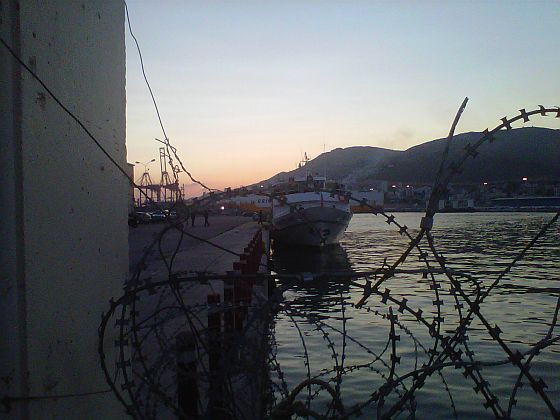
'We were forced to go back to a Greek port surrounded with bars and barbwire.' -- The Audacity of Hope

The New York Times reports:

With the propeller shafts of two ships mysteriously damaged, Greek authorities holding other vessels in port on government orders and an American boat turned back by the Greek Coast Guard just 20 minutes off the coast Friday, the international flotilla to Gaza has stalled.

Organizers say they see the long arm of Israel behind their improbable woes, and while Israeli officials have dismissed such accusations as so much conspiracy mongering, they have declined to deny them outright.

One year after Israeli commandos killed nine Turkish activists aboard the Mavi Marmara during an earlier flotilla, organizers had hoped to once again challenge the naval blockade of the Gaza Strip on the open seas, off the Gaza coast. It appears decreasingly likely, however, that the eight boats now preparing to sail will ever be able or allowed to leave port.

Echoing a majority view among participants here, Johnny Leo Johansen, a ponytailed Norwegian photographer and activist, put it this way: “It’s like they’ve moved the blockade from Gaza to Greece.”

The coast guard stopped the American boat, “The Audacity of Hope,” about one mile out to sea, quashing the initial excitement of the passengers, who were surprised to have been allowed to leave the harbor at all.

“We could see the handwriting on the wall, that they were going to try to shut down all the ports across the Mediterranean,” said Ann Wright, the lead organizer of the American boat.

After a complaint about improper documentation filed by an Israeli advocacy group, the boat had been held in port outside Athens on police orders. Inspectors visited it a week ago Friday, but the results of their inspection had yet to be provided. Without them, the ship could not legally set sail.

On Friday, the Greek Ministry of Citizen Protection decreed that all vessels in Greek ports were prohibited from sailing toward “the maritime area of Gaza.” No explanation was given, and ministry officials could not be reached for further comment.

The Americans decided to leave just the same. After chasing them down, a smiling, youthful coast guard captain leaned out his window and requested the ship’s inspection papers. Passengers leaned over the upper-deck railing of the American boat, chanting, “Let us sail to Gaza!” Others held a cardboard sign asking, “Is it Poseidon or Netanyahu?” (That is, a passenger explained, “Who is the king of the Aegean?”)

“The probability that the Greek government has already made a decision to not let us out of the port is probably quite high, I would think,” Ms. Wright said earlier this week. “It’s not surprising, in a way, that the Greek government has succumbed to the pressure.” She further suggested that Greece, in the throes of a protracted sovereign debt crisis, might be acceding to an Israeli “diplomatic offensive.”

The Israeli government, she noted, had held cabinet meetings on the subject of the flotilla, and several rounds of military exercises have been conducted in preparation for a confrontation. “I’m shocked that they would be spending so much time, money, energy,” Ms. Wright added, but in some ways, she has been pleased by the Israeli attention. “We couldn’t have dreamed for a better thing. Usually, governments don’t cooperate with us this way!”

On Thursday, Irish organizers announced they had pulled their Turkish-docked ship from the flotilla after the crew discovered damage to the propeller shaft, the result of what they assume to have been sabotage by underwater divers. Organizers said that the damage was discovered on a trial run, but that otherwise the vessel would have sunk at sea, endangering the passenger and crew.

Activists discovered nearly identical damage to a Greek-Swedish-Norwegian passenger boat earlier this week. That boat is now grounded for repairs, which are not expected to be completed before next week, organizers say.

Three boats with passengers principally hailing from Canada, Spain and the Netherlands were awaiting clearance to sail on Friday, and a cargo vessel was hoping to be permitted to load its cargo. All of the ships have ostensibly met the requirements of Greek authorities, according to Adam Shapiro, a flotilla organizer and spokesman.

But on Thursday, harbor officials barred a French boat from refueling, he said, an indication that Greek officials might find other justifications for retaining the other ships in port.

As of Friday morning, after more than a week in ports across Greece, no single ship appeared to have explicit clearance from the Greek authorities to set sail; like the American boat, a Greek-Swedish-Norwegian cargo ship was under police order to remain in port.

Organizers said the delays were not completely unanticipated, though they had hoped to meet less resistance. Should the vessels be permitted to sail, or if they depart unauthorized, organizers hope to rendezvous next week at a fixed location in the Mediterranean. But it remains unclear when more ships might set sail, or what an eventual flotilla might resemble.

“We’re going to do something,” Mr. Shapiro vowed. Still, he added, “It seems we’re already doing something, given the kind of response we’ve gotten.”

Asked about activists’ allegations that Israel was behind the apparent sabotage, Mark Regev, a spokesman for Israeli prime minister Benjamin Netanyahu, said: “These activists are not renowned for being an objective source of information.”

“These people have a tendency to blame Israel, to see Israel’s hand behind every calamity,” he went on. “And of course that cannot be true.” But when asked to deny their claims more categorically, he declined.

On Thursday, Prime Minister Netanyahu said in a speech that “sometimes, we not only need to deflect our enemies’ physical attacks, but also deflect the attack on our right to protect ourselves.” Speaking at the Israeli Air Force flight school graduation ceremony, Mr. Netanyahu thanked world leaders who in recent days had spoken out and acted “against the provocation flotilla,” and specifically commended the Greek prime minister George Papandreou, who he said has been closely cooperating with Israel in coordinating the moves related to the flotilla.

On Democracy Now! the Consul General of Israel in New York, refuses to deny Israeli role in the sabotage of flotilla boats:

Facebooktwittermail

Criminalising Palestinian solidarity

Maureen Murphy writes:

The United States government has criminalised the Palestinian people, and now it is increasingly treating US citizens who stand in solidarity with Palestine as criminals as well – including those courageously putting their lives on the line to break the siege on Gaza.

I am a Palestine solidarity activist in the US, and one of 23 US citizens who have been issued with a subpoena to appear before a federal grand jury as part of what the government has said is an investigation into violations of the laws banning material support to foreign “terrorist organisations”.

None of us have given money or weapons to any group on the State Department’s foreign terrorist organisation list. But what many of us have done is participate in or help organise educational trips to meet with Palestinians and Colombians resisting the US-funded military regimes they live under.

The goal of these trips is to learn about the human rights violations happening in these places and to bring those stories back home to the US, to educate people and to organise to change US foreign policy for the better.

Travel for such purposes should be protected by the First Amendment of the US Constitution. But a year ago the US Supreme Court decided in Holder vs. Humanitarian Law Project to dramatically expand the government’s definition of what constitutes material support for a foreign terrorist organisation.

Now the government considers travel to places like the West Bank and Colombia to be a predicate or justification for opening up an investigation and issuing search warrants to raid activists’ homes and seize their belongings. Political speech if made in a “coordinated way” can be construed as material support.

Facebooktwittermail

The blockade on Gaza began long before Hamas came to power

Mya Guarnieri writes:

The second Freedom Flotilla is slated to set sail by the end of the month in an attempt to challenge the Israeli blockade of the Gaza Strip. The act will call attention to the closure that the United Nations and human rights organizations have decried as a violation of the Fourth Geneva Convention, which prohibits the collective punishment of civilians.

According to the Israeli government — and most of the mainstream media — the blockade began in 2007, following the Hamas takeover of the Gaza Strip. The aim of this “economic warfare” was to weaken Hamas, a group that the Israeli government had once supported. Israel also sought to stop rocket fire and to free Gilad Shalit, the Israeli soldier who has been held in Gaza since 2006.

Four years on, none of these goals have been achieved.

Israel has achieved a minor victory on one front, however. Even critics use 2007 as the start-date of the blockade, unintentionally legitimizing Israel’s cause-and-effect explanation that pegs the closure to political events.

But the blockade did not begin in 2007, following the Hamas takeover of the Strip. Nor did it start in 2006, with Israel’s economic sanctions against Gaza. The hermetic closure of Gaza is the culmination of a process that began twenty years ago.

Facebooktwittermail

Torture crimes officially, permanently shielded

Glenn Greenwald writes:

In August, 2009, Attorney General Eric Holder — under continuous, aggressive prodding by the Obama White House — announced that three categories of individuals responsible for Bush-era torture crimes would be fully immunized from any form of criminal investigation and prosecution:  (1) Bush officials who ordered the torture (Bush, Cheney, Rice, Powell, Ashcroft, Rumsfeld); (2) Bush lawyers who legally approved it (Yoo, Bybee, Levin), and (3) those in the CIA and the military who tortured within the confines of the permission slips they were given by those officials and lawyers (i.e., “good-faith” torturers).  The one exception to this sweeping immunity was that low-level CIA agents and servicemembers who went so far beyond the torture permission slips as to basically commit brutal, unauthorized murder would be subject to a “preliminary review” to determine if a full investigation was warranted — in other words, the Abu Ghraib model of justice was being applied, where only low-ranking scapegoats would be subject to possible punishment while high-level officials would be protected.

Yesterday, it was announced that this “preliminary review” by the prosecutor assigned to conduct it, U.S. Attorney John Durham, is now complete, and — exactly as one would expect — even this category of criminals has been almost entirely protected, meaning a total legal whitewash for the Bush torture regime:

The Justice Department has opened full criminal investigations of the deaths in CIA custody of two detainees, including one who perished at Iraq’s notorious Abu Ghraib prison, U.S. officials said Thursday.

The decision, announced by Attorney General Eric H. Holder Jr., means continued legal jeopardy for several CIA operatives but at the same time closes the book on inquiries that potentially threatened many others. A federal prosecutor reviewed 101 cases in which agency officers and contractors interrogated suspected terrorists during years of military action after the Sept. 11, 2001, attacks but found cause to pursue criminal cases in only two. . . .

The two token cases to be investigated involve the most grotesque brutality imaginable: they apparently are (1) a detainee who froze to death in an American secret prison in Afghanistan in 2002 after being ordered stripped and chained to a concrete floor, and (2) the 2003 death of a detainee at Abu Ghraib whose body was infamously photographed by Abu Ghraib giving a thumbs-up sign.  All other crimes in the Bush torture era will be fully protected.

Facebooktwittermail

Bahrain to citizens living abroad: Spy on countrymen, no protests permitted

MSNBC reports:

Bahrainis living abroad have been ordered to spy on their countrymen in the wake of a deadly crackdown on pro-democracy demonstrators.

Documents containing “loyalty pledges” — which also require expats to promise they will not protest against the tiny Gulf state’s government — have been sent to students attending university in the U.K.

Some Bahrainis told msnbc.com that they feel abandoned by Western leaders in the face of an alleged campaign of intimidation that extends far beyond the country’s borders.

Alaa Shehabi writes:

For the first time in its history, Bahrain has embarked on mass military trials of hundreds of civilians on fatuous charges of crimes against the state. While more than 1,000 remain in detention, the opposition estimates that 400 are going through the process of military trials and 100 have been convicted so far. The swift summary justice churned out in these tribunals are a throwback to early 20th century Stalin show trials, designed to punish and humiliate dissenters. One of those being tried is my husband, Ghazi Farhan. On June 21, he was sentenced to three years imprisonment.

Having been born and educated in the UK, I moved to Bahrain in 2009 to marry Ghazi Farhan, a 31-year-old energetic businessman, leaving a respectable job in Cambridge to start a new family life in the land of my ancestors. Little did I imagine that in 2011, when the Arab Spring hit the shores of this island, it would be swiftly nipped in the bud, and would sweep my blossoming family along with it.

On April 12, on his way back from his lunch break, my husband was abducted from his office car park. Blindfolded, handcuffed and taken away by unknown plain-clothed men. Some 48 days later, he was summoned before the Orwellian-named “National Safety Court”, a military tribunal. He was charged with participating in an illegal assembly of more than five persons (having visited the Pearl Roundabout) and spreading false information on the internet (referring to a single Facebook comment). Therein began an extraordinary ordeal of Ghazi’s military trial and his sentencing.

Joseph Stalin introduced “the show trial” – secretive military tribunals that bypass the judiciary – during the Great Purge of the 1930s. It appears that Bahrain has taken a chapter straight out of Stalin’s textbook, in which verdicts are predetermined and then justified through the use of coerced confessions, obtained through torture and threats against defendents’ families. The only new addition to this chapter is that the government of Bahrain has insisted, since the 1980s, on airing these filmed confessions on state TV – often with the defendant apologising to the king. Ayat al Qurmuzi, a poet sentenced to one year’s imprisonment for reading a poem critical of the king, had one such confession aired, possibly to pave the way for some kind of royal pardon.

Credible reports from now-free detainees who were held with Ayat have said how a toilet brush was forced into her mouth. All those on trial are “traitors to the state”, says the relentless propaganda of hate speech, spewed on state media – a chapter in the Arab Tyrant’s manual that could have been written by Goebbels. The media has described protestors as “termites” and Shia as “the evil group”; they have dehumanised “the other”, who deserve treatment worse than animals.

Since March, hundreds have shared a similar experience to mine. There are several stages to the ordeal that are particularly distressing for all involved. The first stage is the sudden arrest, in a dawn raid or at a checkpoint, or in some cases, at work, and then they are taken away to an unknown location by unknown forces and for long periods of time. In Ghazi’s case, 48 days.

Meanwhile, Reuters reports:

As the summer heat sets in, most university students in Bahrain are eagerly looking forward to getting out of class. But 19 year-old Mohammed and his friends are struggling to get back in.

Local rights groups say over 400 mostly Shi’ite students have been expelled from Bahraini universities in recent months, charged with participating in the “unauthorized protests” which shook the Gulf island kingdom earlier this year.

Mohammed, a second year student at Bahrain University, described a string of student dismissals since March, in which officials used protesters’ own Facebook postings and YouTube videos against them to identify students who joined demonstrations or criticized the government online.

“There is an aggressive with-us-or-against-us mentality,” he said, declining to give his full name for fear of further government reprisals. “If you went out to the streets to ask for your rights, now you must be punished.”

Facebooktwittermail

Saudi Arabia worries about stability, security and Iran

Jason Burke reports:

It was a very discreet meeting deep in the English countryside. The main speaker was Prince Turki al-Faisal, one of Saudi Arabia’s best-known and best-connected royals. The audience was composed of senior American and British military officials. The location was RAF Molesworth, one of three bases used by American forces in the UK since the second world war. Now a Nato intelligence centre focused on the Mediterranean and the Middle East, the sprawling compound amid green fields was an ideal venue for the sensitive topics that Turki, former head of Saudi Arabian intelligence, wanted to raise.

After an anecdote about how Franklin D Roosevelt was told by a naked Winston Churchill that nothing between them or their countries should be hidden, Turki warmed to his theme: “A Saudi national security doctrine for the next decade.”

For the next half an hour, the veteran diplomat, a former ambassador to Washington and tipped to be the next foreign minister in Riyadh, entertained his audience to a sweeping survey of his country’s concerns in a region seized by momentous changes. Like Churchill, Turki said, the kingdom “had nothing to hide”.

Even if they wanted to, the leaders of the desert kingdom would have difficulty concealing their concern at the stunning developments across the Arab world. Few – excepting the vast revenues pouring in from oil selling at around $100 a barrel for much of the year – have brought much relief to Riyadh.

Chief among the challenges, from the perspective of the Saudi royal rulers, are the difficulties of preserving stability in the region when local autocracies that have lasted for decades are falling one after another; of preserving security when the resultant chaos provides opportunities to all kinds of groups deemed enemies; of maintaining good relations with the west; and, perhaps most importantly of all, of ensuring that Iran, the bigger but poorer historic regional and religious rival just across the Gulf from Saudi Arabia’s eastern provinces, does not emerge as the winner as the upheavals of the Arab spring continue into the summer.

In the second part of his report, Burke writes:

The Bridges bookshop and cafe, on Arafat Street in an upmarket residential area of the southern Saudi port city of Jeddah, is quiet this weekend afternoon. Three young women sit on the floor working on a 13,000-piece jigsaw. Among the well-thumbed books for browsing on the artfully slanted shelves, next to works on Islamic calligraphy and architecture, are biographies of Mahatma Gandhi, Che Guevara and Nelson Mandela.

Yet Asma, Amna and Dina, all 23, are no revolutionaries. As educated, English-speaking, iPod and iPad-carrying young Arabs, they are very much in the same demographic as those who organised the mass demonstrationprotests that ended the rule of President Hosni Mubarak in Egypt this year, but the three women are separated from their counterparts in Cairo by more than the Red Sea.

Images of the Arab spring streaming into Saudi Arabia on the ubiquitous satellite TV channels may have meant that “people are realising the importance of being politically aware”, Amna, a human resources management student, says. But, in the kingdom, “we don’t actually do anything”.

Such feelings explain, at least in part, why, while the rest of the Arab world is in ferment, Saudis, of whom 70% are under 30 and 35% are under 16, have remained largely quiet. Despite overseas attention focused on a few incidents of protest, scores of interviews over two weeks in deeply conservative areas, the capital, Riyadh, and relatively liberal Jeddah have revealed a country in which a growing desire for reform is a very long way from anything approaching mass dissent.

Facebooktwittermail

Clashes ease in Cairo, but underline Egypts fragile condition

The New York Times reports:

Clashes between the police and protesters that began Tuesday night and carried into Wednesday morning left more than 1,000 people injured in the worst violence to grip the capital since President Hosni Mubarak was forced from power in February.

The turmoil, which seemed to take almost everyone by surprise, demonstrated the fragile state of Egyptian society since the revolution, where almost any spark can ignite simmering tensions.

As the sun rose Wednesday over Tahrir Square, a now familiar tableau was revealed: sidewalks smashed to bits by protesters who hurled the pieces at the police, metal barricades dragged into the street, rubber bullets scattered around, and clusters of protesters declaring a sit-in in opposition to the heavy-handed tactics of the police.

“I am here today because I am appalled at how the police have treated protesters,” said Salma Samer, a 23-year-old student. “This is not what we called for when we took to the streets on January 25th. This is not the revolution we imagined.”

Meanwhile, McClatchy reports:

Egyptians largely reject U.S. involvement in Egypt and appear split on whether to extend the longstanding peace treaty with neighboring Israel. They overwhelmingly support the revolution and are eager to vote without delay, but haven’t yet identified a trusted party or politician to steer the nation toward their vision of an Islam-compatible democracy.

That’s the portrait emerging of Egypt’s millions-strong electorate as the country prepares for the first vote since the fall of President Hosni Mubarak, according to survey results released in recent weeks by U.S. polling firms. With no single group garnering more than 15 percent of public support and the majority of voters still undecided, the poll results augur a closely contested parliamentary election this fall.

Until this year, such detailed polling was unheard of here — the government strictly controlled what questions outside pollsters could ask. Anything that might have exposed Mubarak’s deep unpopularity and Egyptians’ pent-up rage over rampant corruption, police brutality and poverty was strictly off limits.

Now, however, polling firms have a mostly free hand to ask what they will — though they apparently still aren’t allowed to probe whether the Egyptian military, which runs the country, should continue receiving billions of dollars in aid from the United States. Surveyors have rushed in to take advantage, some even setting up permanent offices in Cairo. Poll workers are crisscrossing the country, popping up in urban slums and rural villages with questions on once-taboo topics.

Facebooktwittermail

The power that we have to make change when our governments are silent

Huwaida Arraf, Gaza Freedom Flotilla organizer, interviewed by PalestineStudiesTV:

I’ve talked a lot with the Israeli media and told them that for their viewers/listeners/readers, this should not be perceived as anti-Israel or anti-Jewish. There are Israelis on our action; there are Jews from different countries. Part of our action — a quarter of the American boat are Jewish Americans that are participating, because this is about equality of people — respecting everybody’s human rights irrespective of race, religion or ethnicity, and so we reject Israel’s efforts to make it about “us” or “them” as if we want to attack Israelis in any way. No, they can very much stand with us and it’s for their future as well as it is for Palestinians’ future…

While we are sailing towards Gaza, this action is not just about Gaza. Yes we want to open it, we want to end this prison-like closure of Gaza, but what’s happening in Jerusalem — the ethnic cleansing of Jerusalem, Palestinians being kicked out of their homes so that Jewish families can move in — that’s not any less severe. The continued confiscation of property in the West Bank; the demolition of large areas of land; the building of the apartheid wall — this is illegal, this is also repressive. And the situation of Palestinians inside Israel, inside the 1948 territories where — I also am an Israeli citizen, a Palestinian-Israeli — I am not treated as an equal because I am not Jewish. This is all part of what I call a colonial apartheid regime, and this needs to be dismantled if we are going to ever see peace in the region.

So while we are sailing towards Gaza, this more than just about Gaza. And I’ll go so far as to say this more than just about Palestine — it is about what people can do. Because this is very much a grass-roots, global civil society action. It is the power that we have to make change when our governments are silent. It’s about what we do every single day to create the kind of world that we want to live in. And so I hope that everyone that listens or sees what we are doing can recognize that and can decide in their own way how they can contribute.

Facebooktwittermail

Alice Walker on ‘the freedom ride of this generation’

Jesse Rosenfeld interviewed American author, Alice Walker, as she waits to depart as a passenger on The Audacity of Hope heading for Gaza.

Reflecting on her years of activism, it is clear that Walker sees a connection between civil rights in America, liberation from apartheid in South Africa and the Palestinian cause.

“Without the international community coming to the aid of the South African people they may very well still be under apartheid, and [without the support of progressive white people] we might still be under segregation in the United States.”

The comparison doesn’t end there: “settlers are the Klan,” she says definitively, referring to the notorious white supremacist terror organization. “They don’t have their white sheets because I guess they don’t need them.”

I mention to her that the leaders of the Palestine’s Arab Spring are discussing a campaign of attempted freedom rides on settler busses in the West Bank.

“I’m very pleased to hear that,” she says breaking into a big smile.

She then returns to the freedom ride conversation from the previous day. “I think the tactic on the Palestinian side is to draw attention to the Klanishness. It’s been so difficult for the world to understand who the settlers are and the problem with them taking more and more of the land,” she says, arguing that it’s a modus systemically rooted in the way Israel was founded.

“That’s the history of the settlement of Palestine; it started in 1948 and is continuing,” she adds connecting Israel’s creation of 750,000 Palestinian refugees in the founding of the state and current settler evictions of Palestinian families in Jerusalem and the West Bank.

Although blunt and unequivocal in her analysis, Walker switches gears, once again displaying her optimism. In a recent article, she details commitments and sacrifices made by white Jewish Americans in the civil rights movement. She says she detailed these to send a message directly to Israelis.

“It’s a way to remind them that their Jewishness can stand for something else, it doesn’t have to stand for beating up people, taking their land and destroying their culture,” she says. “[Israeli’s Jewish identity] could actually be about something very fabulous.’’

Facebooktwittermail

Israel cannot thwart Palestinian people-power

Haaretz reports:

As September draws nearer, the Israel Defense Forces has been conducting drills in order to contend with the possibility of a mass civilian uprising in the West Bank in the wake of the Palestinian bid to seek unilateral recognition in the United Nations.

“A non-violent protest of 4,000 people or more, even if they only march to a checkpoint or a settlement, and especially if the Palestinian police does not deter them, will be unstoppable,” one IDF officer claims. “Such a great number of determined people cannot be stopped by tear gas and rubber bullets.”

Another high ranking IDF official serving in the territories claimed that “if we are to face protests similar to those in Egypt or Tunisia, we will not be able to do a thing.”

On Tuesday, the Central Command completed its General Staff workshop which included all company officers and higher-ranking officials in both regular and reserve service who are set to serve in the West Bank by the end of the year. The officers attended lectures on dealing effectively with disorderly conduct and viewed presentations on protest-dispersal methods by both IDF and border police.

“At the end of the day, the decision is in the hands of the political echelon,” claims another commander, “it is fairly obvious that if there will be no progress on peace talks, the Palestinian police with whom we work very closely to prevent infiltrations will lose their patience.”

Facebooktwittermail

Costs of war: 225,000 killed, $3.2-4 trillion

On September 14, 2001, when President Bush shouted through a bullhorn to rescue workers at the ruins of the World Trade Center, he said: “I can hear you! I can hear you! The rest of the world hears you! And the people — and the people who knocked these buildings down will hear all of us soon!”

In response the workers shouted: “U.S.A.! U.S.A.! U.S.A.! U.S.A.! U.S.A.! U.S.A.! U.S.A.! U.S.A.! ”

But suppose Bush had added this: “And for every innocent life lost here, we will kill a hundred more innocent people. And we will get our vengeance — even if it means driving the country into economic ruin.”

Would the crowd have then fallen silent? Would Americans, still in shock, have realized that their government was seeking support for what amounted to a collective act of insanity?

The “Costs of War” report from the Watson Institute for International Studies at Brown University says:

The President of the United States has told the American people and the rest of the world that even as the U.S. withdraws some troops from Afghanistan and continues to withdraw from Iraq, the wars will continue for some years. The debate over why each war was begun and whether either or both should have been fought continues.

What we do know, without debate, is that the wars begun ten years ago have been tremendously painful for millions of people in Afghanistan, Iraq, and Pakistan, and the United States, and economically costly as well. Each additional month and year of war will add to that toll. To date, however, there has been no comprehensive accounting of the costs of the United States’ wars in Afghanistan, Iraq, and Pakistan. The goal of the Costs of War project has been to outline a broad understanding of the domestic and international costs and consequences of those wars. The Eisenhower Research Project based at Brown University assembled a team that includes economists, anthropologists, political scientists, legal experts, and a physician to do this analysis.

We asked:

  • What have been the wars’ costs in human and economic terms?
  • How have these wars changed the social and political landscape of the United States and the countries where the wars have been waged?
  • What will be the long term legacy of these conflicts for veterans?
  • What is the long term economic effect of these wars likely to be?
  • Were and are there alternative less costly and more effective ways to prevent further terror attacks?

Some of the project’s findings:

  • While we know how many US soldiers have died in the wars (just over 6000), what is startling is what we don’t know about the levels of injury and illness in those who have returned from the wars. New disability claims continue to pour into the VA, with 550,000 just through last fall. Many deaths and injuries among US contractors have not been identified.
  • At least 137,000 civilians have died and more will die in Afghanistan, Iraq, and Pakistan as a result of the fighting at the hands of all parties to the conflict.
  • The armed conflict in Pakistan, which the U.S. helps the Pakistani military fight by funding, equipping and training them, has taken as many lives as the conflict in neighboring Afghanistan.
  • Putting together the conservative numbers of war dead, in uniform and out, brings the total to 225,000.
  • Millions of people have been displaced indefinitely and are living in grossly inadequate conditions. The current number of war refugees and displaced persons — 7,800,000 — is equivalent to all of the people of Connecticut and Kentucky fleeing their homes.
  • The wars have been accompanied by erosions in civil liberties at home and human rights violations abroad.
  • The human and economic costs of these wars will continue for decades, some costs not peaking until mid-century. Many of the wars’ costs are invisible to Americans, buried in a variety of budgets, and so have not been counted or assessed. For example, while most people think the Pentagon war appropriations are equivalent to the wars’ budgetary costs, the true numbers are twice that, and the full economic cost of the wars much larger yet. Conservatively estimated, the war bills already paid and obligated to be paid are $3.2 trillion in constant dollars. A more reasonable estimate puts the number at nearly $4 trillion.
  • As with former US wars, the costs of paying for veterans’ care into the future will be a sizable portion of the full costs of the war.
  • The ripple effects on the U.S. economy have also been significant, including job loss and interest rate increases, and those effects have been underappreciated.
  • While it was promised that the US invasions would bring democracy to both countries, Afghanistan and Iraq, both continue to rank low in global rankings of political freedom, with warlords continuing to hold power in Afghanistan with US support, and Iraqi communities more segregated today than before by gender and ethnicity as a result of the war.
  • Serious and compelling alternatives to war were scarcely considered in the aftermath of 9/11 or in the discussion about war against Iraq. Some of those alternatives are still available to the U.S.

There are many costs of these wars that we have not yet been able to quantify and assess. With our limited resources, we focused on U.S. spending, U.S. and allied deaths, and the human toll in the major war zones, Afghanistan, Iraq and Pakistan. There is still much more to know and understand about how all those affected by the wars have had their health, economies, and communities altered by the decade of war, and what solutions exist for the problems they face as a result of the wars’ destruction.

The Costs of War Since 2001: Iraq, Afghanistan, and Pakistan” (PDF)

Facebooktwittermail

Israel attempts to sink flotilla ship, organizers claim

The Irish Times reports:

An Irish ship, the MV Saoirse , will not take part in the planned freedom flotilla which is preparing to sail to Gaza because it has been sabotaged, according to one of the ship’s intended passengers.

Speaking last night from the Turkish port of Göcek, Fintan Lane, the national co-ordinator of Irish Ship to Gaza organisation, said that the ship would not be able to sail as it had been “dangerously sabotaged”, according to the organising campaign.

He said that the damage to the ship was discovered on Monday night when the captain noticed that there was something wrong. Divers found that a piece was missing from one of the propeller shafts.

“This was the type of sabotage that endangered human life,” Mr Lane said last night. “They put divers under the boat who cut a piece out of the propeller shaft. That means that the damage would have happened gradually and what would have happened eventually is that the propeller would have come up through the bottom of the boat, caused a flood in the engine room and would have caused the boat to sink.”

Ynet adds:

The damage was very similar to that caused to the Juliano in Greece, Lane said, adding that the damage was most certainly intentional and a product of human intervention.

“Israel is the only party likely to have carried out this reckless action and it is important that the Irish government and the executive in Northern Ireland insist that those who ordered this act of international terrorism be brought to justice. This was carried out in a Turkish town and shows no respect for Turkish sovereignty and international law,” said Lane.

He added that the damage would take weeks and around 15,000 euro to fix, effectively preventing the ship from taking part in the flotilla.

Lane, who was on board Challenger 1 in last year’s flotilla, said: “The Freedom Flotilla is a non-violent act of practical and humanitarian solidarity with the people of Gaza, yet Israel continues to use threats and violence to delay its sailing. They attacked us in international waters last year; now they are attacking us in Turkish and Greek ports. There is no line that Israel won’t cross.”

Facebooktwittermail

Message from The Audacity of Hope: ‘We’re sulfur-free and ready to sail’

Press release from USTOGAZA:

Passengers on the U.S. Boat to Gaza, The Audacity of Hope, invite Greek and international media to inspect The Audacity of Hope at 3 pm Athens time on Thursday, June 30, in the town of Perama (next to Piraeus), 42 Democratis.

The entire boat will be open for view, photography, and video. The captain, crew, and passengers on the boat will be available for interviews and inspection. The cargo of the ship – 3,000 letters from Americans to the people of Gaza – will also be available for view, photographs, and video. Everything that will be on the boat when it sets sail, including food and passengers’ personal medications for use during their voyage, will be available for inspection.

The Audacity of Hope was inspected by Greek officials on Monday, June 27 after a complaint was lodged by an Israeli group that the vessel was not seaworthy. We have not yet received notification of their findings nor a copy of their report, but we are certain that our boat is up to code. Meanwhile, Israeli officials have made outrageous allegations that passengers on the flotilla will be bringing “sacks of sulfur” to pour on Israeli soldiers. Even Members of Israel’s own security cabinet have dismissed these charges as “media spin” and “public relations hysteria.”* We invite the media onto our boat to conduct a thorough inspection. We are confident that such an inspection will show that our boat is “sulfur-free” and ready to sail.

“On behalf of the 36 passengers and 4 crew on The Audacity of Hope, I invite the media to ask us anything, inspect anything, taste our food, look inside our bags” said Gale Courey Toensing, a passenger on the American boat. “Our voyage is totally transparent and we have nothing to hide. All we want to do is sail to Gaza with our cargo of letters from Americans to the people of Gaza.”

Facebooktwittermail

Hysteria, ‘hasbara’ and the flotilla

Larry Derfner writes in the Jerusalem Post:

I just love Israel’s “hasbara” campaign against Freedom Flotilla 2. I mean, butter wouldn’t melt in these people’s mouths.

“There is no humanitarian crisis in Gaza,” says Ehud Barak. Gazans are “importing televisions and plasma screens, and exporting agricultural products to the entire Arab world,” says IDF chief Benny Gantz.

Yes, Gaza is economically on the mend – but not because of Israel’s good intentions; rather, despite its bad intentions.

If it were up to the government, Gazans would still be unable to receive terrorist infrastructure equipment such as toys, musical instruments, heaters, newspapers, fishing rods, tractor parts, irrigation pipes and, of course, coriander, on relief trucks coming across the border.

Why did that policy change? What forced Israel to start letting everything through except construction equipment, which it fears Hamas might use to make bunkers? It was Freedom Flotilla 1, remember? It was the killing of nine Turks aboard the Mavi Marmara by Israeli commandos on May 31, 2010, after which Israel was compelled by international outrage to begin allowing all those previously banned weapons of mass destruction – cumin, ginger, dried fruit, industrial margarine, clothing fabric, sewing machines and more – into the Strip.

Likewise, if it were up to the government, Hosni Mubarak would still be ordering Egyptian troops to search out and destroy the tunnels built by Gazans to smuggle in goods. But to the government’s dismay, Mubarak was overthrown and Egypt’s new leadership is less eager to collaborate with our Gaza policy.

The result? “Sacks of cement and piles of gravel… are smuggled through hundreds of tunnels in double shifts, day and night, totaling some 3,000 tons a day… Streets are being paved and buildings constructed,” wrote The New York Times’ Ethan Bronner last weekend.

“Things are better than a year ago,” a leading activist in the Strip told him. “The siege on goods is now 60 to 70 percent over.”

So you see? No need for a flotilla, Gaza’s doing just fine, say Israeli hasbaratists, smiling through gritted teeth.

Incidentally, when Gantz said that Gaza exports agricultural produce, he neglected to mention that that’s all Israel allows Gaza to export – and not much produce, either, or for very long.

“Export from Gaza is prohibited,” wrote Gisha, a Tel Aviv-based NGO, in a pre-flotilla report last week. “Between November 2010 and April 2011, Israel exceptionally allowed export of a minimal amount of strawberries, flowers, peppers and tomatoes from Gaza to European markets. The average rate of export during that time was two truckloads per day… Since May 12, 2011, no trucks carrying goods for export have left the Strip.”

I think Freedom Flotilla 2, even without making much progress toward Gaza, is playing hell with Israel’s image – or, rather, inducing Israel to show off its worst self (much as Freedom Flotilla 1 did.) Once again, Israel has gone hysterical, it’s lost touch with reality.

Facebooktwittermail

Senator wants joint U.S.-Israeli special operations forces to attack flotilla

Military.com reports:

A U.S. senator wants U.S. special operations forces to help Israel halt a Gaza-bound international aid flotilla that includes a vessel carrying a number of American veterans, one of whom is a Sailor who served aboard the USS Liberty, the ship that Israel infamously attacked in 1967.

In a report drafted following a visit to Israel in early June, Sen. Mark Kirk, R-Ill., says the United States should “make available all necessary special operations and naval support to the Israeli Navy to effectively disable flotilla vessels before they can pose a threat to Israeli coastal security or put Israeli lives at risk.”

The U.S.-flagged ship, called “The Audacity of Hope” — the name of President Obama’s 2006 book — is currently docked in Greece and is supposed to set sail by the end of this week along with ships from Ireland, Spain, Italy, Greece and other countries. More than 30 Americans are booked for passage on the Audacity of Hope.

While Kirk is pushing for a direct U.S. military role in halting the flotilla, six Democratic congressmen want assurances from Secretary of State Hillary Clinton that she will work with Israel to ensure those aboard the American ship are not harmed.

The lawmakers, including ranking House Veterans Affairs Committee member Rob Filner, D-Calif., say they “wholeheartedly support” Israel’s duty to protect its citizens, but the “measures it uses to do so, as in the case with any other nation, must conform to international humanitarian and human rights law.”

An Open Letter to Illinois Senator Mark Kirk from three constituents responding to his call for U.S. Special Forces to attack a flotilla of ships that will sail to Gaza:

Senator Mark Kirk
524 Hart Senate Office Building
Washington DC, 20510

June 29th, 2011

Dear Senator Kirk,

We are Illinois residents writing to you from Athens, Greece. Just before leaving the United States, we wrote to inform your office about our intent to sail on “The Audacity of Hope,” as part of the U.S. Boat to Gaza project. In our letters, we explained why we were traveling to Gaza. We told you of our previous experiences living among Palestinians who lack access to basic necessities, such as clean water, because of the blockade. Referring to Gaza as the world’s largest open-air prison, we mentioned how hard it has been for people to rebuild after previous lethal assaults, especially the Operation Cast Lead attack which ended, after 23 days, on January 18, 2009. According to B’tselem, the foremost Israeli Human Rights Organization, Operation Cast Lead caused the deaths of 1,389 Palestinians in Gaza. Of those, 344 were children. Of the 13 Israelis who were killed, four were soldiers killed by friendly fire.

Knowing that you and your staff care deeply about the consequences of unemployment, poor education and dangerously limited health care delivery, we pointed out related statistics affecting people in Gaza where 45% of the population is unemployed and hospital administrators are sounding the alarm because they are running out of crucial medicines. Half of Gaza’s 1.6 million people are under age 18.

As you’ve recently noted, a flotilla of ships plans to arrive in Gaza. Our ship will carry 3,000 letters addressed to Gazan children and families. Other boats are carrying humanitarian assistance.

Greek authorities have been checking into various complaints which have stalled the flotilla’s progress. In our case, a complaint was lodged by the Israel Law Center, located in Tel Aviv, suggesting that our boat is not seaworthy. Two of the boats have been sabotaged while docked in the harbor, causing further delays.

Military.com reports that you said the United States should “make available all necessary special operations and naval support to the Israeli Navy to effectively disable flotilla vessels before they can pose a threat to Israeli coastal security or put Israeli lives at risk.”

You have an unusual opportunity to demonstrate thoughtful reconsideration of your earlier decision. Op-ed pieces have appeared in Israel’s Haaretz newspaper, encouraging the Israeli government to let the flotilla pass.

“There is nearly nothing which more effectively delegitimizes Israel — and makes Israel look more like an uncaring blockhead state — than does the siege of Gaza,” wrote Bradley Burston, Senior Editor of Haaretz and a former Israeli Defense Force medic. “The siege benefits Hamas in a thousand ways and Israel in none. But there is one thing that does the work of delegitimization even better: attacking civilians in order to protect the siege. Enter the 21st century. Before it’s too late. You’re not young commandos anymore… Do your nation a favor — act your age. The flotilla is not a terrorist fleet. It is not an arms shipment. The flotilla is, however, a statement about Israel, a judgment of its policies, and, in the end, the verdict will come directly from you.”

Senator Kirk, we are your constituents. It’s not too late for you to acknowledge that your earlier call for military action against us jeopardizes our safety and to reverse your claim which insinuates that we are dangerous people. We write with utmost respect for our collective responsibility to secure a better world, breaking the irrational cycle of military aggression and upholding basic human rights of all people.

Sincerely,

Kathy Kelly, Chicago IL
Max Suchan, Chicago IL
Robert Naiman, Champaign-Urbana

Facebooktwittermail