Category Archives: Palestinians

Why is Obama’s DOJ prosecuting a torture victim?

Josh Ruebner writes: Rasmea Odeh was brutally tortured into confessing a crime she did not commit. After 10 years of imprisonment, Odeh was exiled from her homeland, eventually immigrating to the United States from Jordan in 1994 as a legal resident and later becoming a naturalized citizen. For the past decade, she has gained the admiration and adulation of the Chicago community she selflessly serves, working as the associate director of the Arab American Action Network to defend civil liberties and promote immigrant rights. Last year, the Chicago Cultural Alliance bestowed on her its Outstanding Community Leader Award in recognition of her devoting “over 40 years of her life to the empowerment of Arab women.”

People such as Odeh, who demonstrate such a tremendous spirit of resiliency, capacity to overcome hardship and dedication to community empowerment, are often lauded by presidents during State of the Union addresses. Perhaps if Odeh was tortured, imprisoned and exiled by a regime the United States deemed hostile, then President Obama would be saluting her from the House gallery as an exemplar of humanity while members of Congress feted her with a standing ovation. But, because Odeh is Palestinian and her oppressor is Israel, she faces quite a different reception from the U.S. government: The Obama administration shamefully has filed immigration-related charges against Odeh that could result in her being stripped of her U.S. citizenship and deported from this country.

Last October, Department of Homeland Security agents arrested Odeh at her home after the Department of Justice dusted off her 10-year-old naturalization application to charge her with “unlawful procurement of naturalization” for allegedly omitting mention of her time in Israeli prison. The spuriousness of this charge is evident by the fact that Odeh has been quite frank in her public retelling of the torture she faced during her time in Israeli prisons. [Continue reading…]


Facebooktwittermail

Are these the first blooms of a ‘Palestinian summer’?

Ahmad Samih Khalidi writes: The new Palestinian “reconciliation” government is first and foremost a response to an overwhelming popular desire to end the seven-year-old rift between Fatah and Hamas – a split that has inflicted deep scars on the Palestinian polity and threatened to leave Gaza in permanent secession from the West Bank.

But it also reflects a new independent-mindedness on the part of the Palestinian Authority’s leadership, and a readiness to give precedence to the Palestinian national interest above other considerations. It is of course no coincidence that the realisation of this aim has followed the collapse of the last round of US-sponsored negotiations with Israel. Long accused of passivity, and an inability to take the initiative, the Palestinians appear to have finally decided to act in their own interest without seeking prior permission from friend or foe.

This new move chimes with other “unilateral” moves designed to upgrade the Palestinians’ status at the UN. This will change little on the ground, but the leadership believes it may slowly build up sufficient political and diplomatic momentum to help define a final resolution based on the two-state solution, otherwise unobtainable via the current negotiations. The appeal to the UN is not intended as a substitute for negotiations, but as a parallel track that involves neither threats nor force. It is also a path that Israel itself trod as a means to its own independence in 1947. [Continue reading…]

Facebooktwittermail

The Pope in Palestine

The Guardian reports: It is an image that will define Pope Francis’s first visit to the Holy Land as pontiff. Head bowed in prayer, the leader of the Catholic church pressed his palm against the graffiti-covered concrete of Israel’s imposing “separation wall”, a Palestinian girl holding a flag by his side. It was, as his aides conceded later, a silent statement against a symbol of division and conflict.

The powerful gesture was made minutes after an appeal to both sides to end a conflict that the pope said was “increasingly unacceptable”.

The unscheduled, conspicuous stop halfway through his three-day visit to the Holy Land, made en route to an open-air mass in Manger Square, Bethlehem, confirmed Francis’s reputation for determined independence. So too did his invitation to the Palestinian president, Mahmoud Abbas, and Israeli president, Shimon Peres, to join him in Rome to meet and pray together for peace – an unprecedented papal intervention in the stalled peace process. [Continue reading…]

Facebooktwittermail

Footage of Palestinian boys being shot is genuine, says Israeli rights group

The Guardian reports: The Israeli human rights group B’Tselem has concluded that footage capturing the moment two Palestinian teenagers were shot dead by Israeli soldiers despite posing no risk to them is “genuine and consistent”, contradicting Israeli army claims that the footage is likely to have been forged.

A short section of edited CCTV footage was released earlier this week showing Nadim Nawara, 17, and Mohammad Salameh, 16, being shot and killed. Since then Israeli military sources have been quoted anonymously on several occasions in the local media trying to undermine the tape’s credibility.

The two boys were killed on Thursday last week during a rally involving stone-throwing outside Ofer prison on the West Bank on “Nakba Day”, when Palestinians mark the mass displacement that occurred during the establishment of the Israeli state in 1948. [Continue reading…]

Facebooktwittermail

Video prompts look at killing of Palestinian teens

The Associated Press reports: Security-camera video showing two unarmed Palestinians crumpling to the ground during a lull in a stone-throwing clash with Israeli soldiers revived allegations by human rights activists Tuesday that the troops often use excessive force.

The Israeli rights group B’Tselem said the images back its findings that troops killed the teens without cause by firing live rounds from more than 200 meters away. The soldiers were in “zero danger” at the time, said Sarit Michaeli of B’Tselem.

Israeli Defense Minister Moshe Yaalon said, “It was a life-threatening situation, so the officers acted accordingly.”

He said he hadn’t seen the video, but alleged the images had been manipulated through editing.

Lt. Col. Peter Lerner, a senior spokesman, said preliminary findings show forces fired only rubber-coated steel pellets, a standard means of crowd control, and did not use live fire.

The United Nations and the U.S. State Department called on the Israeli authorities to conduct a transparent investigation. [Continue reading…]

Facebooktwittermail

The Idea of Israel and My Promised Land – review

Avi Shlaim reviews The Idea of Israel: A History of Power and Knowledge by Ilan Pappe and My Promised Land: The Triumph and Tragedy of Israel by Ari Shavit: Zionism achieved its greatest triumph with the establishment of the state of Israel in 1948. The Zionist idea and its principal political progeny are the subject of deeply divergent interpretations, not least inside the Jewish state itself. No other aspect of Zionism, however, is more controversial than its attitude towards the indigenous population of the land of its dreams. Chaim Weizmann, the first president of the state of Israel, famously said that it is by its treatment of the Palestinians that his country will be judged. Yet, when judged by this criterion, Zionism is not just an unqualified failure but a tragedy of historic proportions. Zionism did achieve its central goal but at a terrible price: the displacement and dispossession of the Palestinians – what the Arabs call the Nakba, the catastrophe.

The authors of these two books are both Israelis, but they approach their subject from radically different ideological vantage points. Ilan Pappé is a scholar and a pro-Palestinian political activist. He is one of the most prominent Israeli political dissidents living in exile, having moved from the University of Haifa to the University of Exeter. He is also one of the few Israeli students of the conflict who write about the Palestinian side with real knowledge and empathy.

Pappé places Zionism under an uncompromising lens. In his reading it was not a national liberation movement but a settler colonial project imposed on the Palestinians by force with the support of the west. From this premise it follows that the state of Israel is not legitimate even in its original borders, much less so within its post-1967 borders. To correct the injustice, Pappé advocates a peaceful, humanist and socialist alternative to the Zionist idea in the form of a binational state with equal rights for all its citizens. [Continue reading…]

Facebooktwittermail

Anti-Semitism should not be waved around like a propaganda tool

Donna Nevel and Marilyn Kleinberg Neimark write: This week the Anti-Defamation League – an organization with a long history of trying to silence and intimidate those who don’t share their unwavering support for Israel and its policies – published a survey ringing the alarm about anti-Semitism. Rather than advance our understanding of this serious issue, the survey seems predictably designed to stir up fear that Jew-hatred is a growing global phenomenon that puts the world’s Jews universally at risk, and that the biggest culprits are Muslims and Arabs, particularly Palestinians.

While some responses to the survey may well be of legitimate concern, many of its questions are pointedly designed to skew the results because they have little to do with revealing actual anti-Semitism, as defined, for example, by the US Holocaust Museum. For example, one question asked whether Jews think more highly of themselves than of other groups, and answering yes tallies points in the anti-Semitic column. But common sense suggests that almost anyone in the world would likely answer affirmatively about any other ethnic or religious community.

The most striking example of a leading question undergirds the ADL’s claim that the highest percentage of anti-Semitism is among Palestinians who live in the occupied territories. The ADL asked a group of people for whom the movement of goods, money and labor is controlled by Israel, “Do Jews have too much power in the business world?”. Were they really to be expected to answer anything but “yes”? [Continue reading…]

Facebooktwittermail

Palestinians forced to demolish own homes

f13-iconAl Jazeera reports: For the past two months, Hamzah Abu Terr has slept on the floor of his home. He gave his bed to his three small children whose room he was forced to destroy earlier this year, to avoid large demolition fines issued by the Israeli municipality.

“I had no choice,” said Hamzah, sitting on the couch at his home in East Jerusalem next to his eldest daughter. “It was either my hands or their bulldozers.”

The single father received a demolition order in 2001, after the extension – a kitchen and bedroom – to his one-room house was deemed illegal by the Jerusalem municipality. He spent the next 12 years fighting the order in Israeli courts, paying more than 100,000 shekels ($28,775) in fees and fines. He even had to sell his now ex-wife’s jewellery.

“I could not fight it anymore. I had to destroy it myself,” Hamzah told Al Jazeera. “The kids can’t understand this: Their father destroyed their room. They were angry, sad… confused.”

This pattern of illegal construction and demolition is common throughout East Jerusalem. According to the United Nations, a set of discriminatory laws, polices and practices applied to Palestinian residents makes building “legally” next to impossible. [Continue reading…]

Facebooktwittermail

Yarmouk and a contagion of doubt

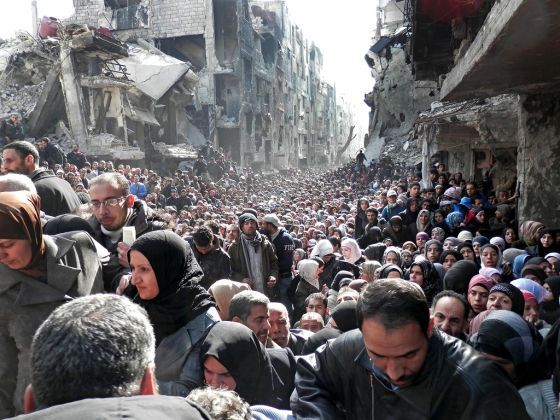
U.N. Denies That Syria Image Was Faked” and “U.N. Denies Altering Image of Palestinian Refugees in Damascus” — both headlines appeared in the New York Times on Tuesday and referred to doubts that have been expressed about the authenticity of what has become an iconic representation of suffering in Syria.

Yarmouk

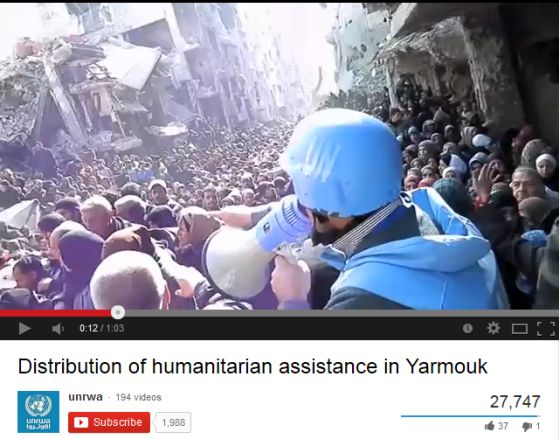
As the following screenshot taken from a video that the United Nations Relief and Works Agency (UNRWA) posted on YouTube and filmed at the same time as the photo above makes clear, the photograph’s authenticity is beyond doubt.

unrwa-yarmouk

Paradoxically, the fact that UN officials were put in a position where they needed to refute accusations that the photograph had been faked, and the New York Times’ own headlines, will quite likely have had the opposite of the intended effect. Where doubts may have previously been few, they are now just as likely to continue growing.

We live in an age of doubt and the internet is its engine — the very notion that something can be “beyond doubt” has itself become an object of doubt.

As someone who from a very early age was taught to question — I was lucky enough to have parents and teachers who recognized that questioning is a vital instrument of intelligence — the proliferation of doubt might to my eye look like a positive development. It might seem like a sign that people are less susceptible to manipulation by the political and corporate forces which shape popular thought. But I see little evidence that this is indeed the case.

On the contrary, the doubt that spreads so easily has less to do with critical intelligence and much more to do with suspicion and fear. The “fake” meme is much more contagious than any sober analysis.

Doubt and cynicism are held onto because they offer psychic armor for shielding ourselves from the dark forces controlling the world. The price, however, for those who employ this form of protection, is that it tends to render them immobile.

Yet clearly, the image of Yarmouk’s starving residents that got retweeted more than eight million times was not being passed around primarily by those who had doubts about what the photograph depicted.

As Chris Gunness, the spokesman for UNRWA said: “I saw that image and said, ‘This has the wow factor.’”

It is an image that resonates and does so for multiple reasons. Strange as it may sound, this is not only a news image but also a work of art.

In accordance with the principle of the “golden ratio” (or divine proportion), it is a perfectly balanced composition. It is a photograph that could just as easily be a painting.

More than simply capturing a moment of one day for one particular group of people, it seems to represent something timeless about the vulnerability of all people throughout history in times of war.

Within the skeletal remains of a city shattered by human brutality, we see that reinforced concrete is easier to destroy than the will to live.

Hope and desperation come together.

Facebooktwittermail

Why John Kerry’s peace mission should worry liberal Zionists

o13-iconPeter Beinart writes: As John Kerry’s bid to broker Israeli-Palestinian peace approaches its moment of truth, you can sense the desperation among liberal Zionists. “Kerry’s mission is the last train to a negotiated two-state solution,” declared Thomas Friedman in January.

“This is a watershed moment after which Israel will face a completely different situation – one which will be governed by new realities much less favorable than those Israel faces today,” argued the philanthropist S. Daniel Abraham that same month. Kerry himself has said that, “If we do not succeed now, we may not get another chance.”

I get it. You have to be blind not to see that liberal Zionists—those of us who believe in the legitimacy of a state dedicated to Jewish self-protection and the illegitimacy of Israel’s unjust, undemocratic control of the West Bank—are losing ground to one-staters at both ends. Kerry’s failure, which might spell the end of the American-led peace process itself, could turn that retreat into a rout.

But there’s a problem with being desperate for a deal: You lose your leverage over its content. Kerry and the rest of the Obama foreign policy team know that if they present a framework that Benjamin Netanyahu dislikes, he and the right-leaning American Jewish establishment will make their lives miserable. If, on the other hand, they present a framework that tilts against the Palestinians, the resulting Palestinian outrage will be far easier to withstand. That’s partly because Palestinians wield little influence in Washington. And it’s partly because we liberal Zionists—desperate to see Kerry succeed—have given every indication that we’ll support whatever he serves up, the particulars be damned.

The consequences of this political imbalance have been quietly playing themselves out for months now. Numerous press reports have suggested that Kerry is contemplating a framework that offers the Palestinians substantially less than what Bill Clinton offered them in December 2000 and what Ehud Olmert offered in 2008.

The Clinton parameters, for instance, called for Israeli troops to leave the Jordan Valley—the twenty-five percent of the West Bank that abuts its border with Jordan— within three years of a peace deal. Olmert was willing to withdraw them even faster

Mahmoud Abbas is also reportedly calling for a transition of three to five years. Netanyahu, by contrast, depending on whose reporting you believe, insists that Israeli troops must remain for ten or even forty years. 

And Kerry? Palestinian sources say he’s endorsed the ten-year timetable. According to the Washington Post, he’s suggested somewhere between five and fifteen

Kerry’s proposal, in other words, violates both the Clinton parameters and the understanding reached by Olmert and Abbas. Yet with rare exceptions, liberal Zionists aren’t protesting at all.

That’s just the beginning. When it comes to Jerusalem, the Clinton Parameters declared that, “the general principle is that Arab areas are Palestinian and Jewish ones are Israeli.” 

According to Bernard Avishai, Olmert and Abbas agreed to the same concept: “Jewish neighborhoods [of Jerusalem] should remain under Israeli sovereignty, while Arab neighborhoods would revert to Palestinian sovereignty.” 

And Kerry? In January, Israeli television reported that he had offered to locate the Palestinian capital in only one, relatively remote, neighborhood of East Jerusalem. (Either Isawiya, Beit Hanina, Shuafat or Abu Dis, which is not even in Jerusalem at all). Late last month, the Palestinians leaked that Kerry had again offered them a capital in Beit Hanina alone

Notice a pattern? Once again, assuming the reports are true, Kerry is pulling back from the principles established by both Clinton and Olmert. And once again, liberal Zionists are cheering him on.

Facebooktwittermail

Netanyahu is trying to force his imperious version of Zionism down Palestinian throats

o13-iconDavid Landau writes: In Israeli political conversation one often encounters a much-used maxim: “He [an Arab leader who has offered a concession] is not a member of the Zionist executive, you know. And he’s not planning to become one…”

In other words, the concession, if it is indeed real, flows out of the Arab country’s interests, not out of its leader’s conversion to Zionist belief, a scenario that is evoked as a sort of joke. The Arab leaders have their own narrative and they aren’t suddenly buying into Israel’s.

This maxim is didactic as well as amusing. It has helped generations of Israelis to understand where they are in the world, in relation to regional rivals.

Not anymore. Not since Prime Minister Benjamin Netanyahu has actually begun demanding from the Palestinians – and presumably from the Jews, too – that they accept and endorse his version of Zionist belief regarding the identity and historical role of the modern-day state of Israel.

“Israel is the nation-state of the Jewish people, where the civil rights of all citizens, Jews and non-Jews alike, are guaranteed,” is how Netanyahu detailed his demand in his speech to AIPAC last week. “The land of Israel is the place where the identity of the Jewish people was forged. It was in Hebron that Abraham blocked the cave of the Patriarchs and the Matriarchs. It was in Beit El that Jacob dreamed his dreams. It was in Jerusalem that David ruled his kingdom. We never forget that, but it’s time the Palestinians stopped denying history.”

The Palestinians, of course, flatly deny that the Bible stories are history or that they give Israel a claim over the Holy Land. They deny that modern-day Israel is the real-estate successor of Biblical Israel.

But so do some Jews. They love Israel and are loyal and devoted to it not because its present leader or previous Zionist leaders declared it to be “the nation-state of the Jewish people,” but rather as the strongly and determinedly defended haven for all Jews everywhere in the wake of the Holocaust, and as the one state where the Jewish religion and Jewish culture are central components of the national ethos.

That makes them Zionist, but with no allegiance to Netanyahu’s imperious version of Zionism, nor to his effort to force it down Palestinian throats. [Continue reading…]

Facebooktwittermail

Amnesty: Syria using starvation as ‘weapon of war’

n13-iconDPA reports: Syrian government forces are using starvation as a weapon of war, Amnesty International said Monday in a report detailing the siege of a Palestinian refugee camp on the outskirts of Damascus.

“Syrian forces are committing war crimes by using starvation of civilians as a weapon of war,” Amnesty’s Middle East director Philip Luther said.

The group said 128 people had died of starvation since regime forces imposed a complete blockade on the Yarmouk refugee camp in July.

“The harrowing accounts of families having to resort to eating cats and dogs, and civilians
attacked by snipers as they forage for food, have become all too familiar details of the horror story that has materialized in Yarmouk,” Luther added.

About 51 fell victim to inadequate medical care, Amnesty said, quoting information provided by the Palestinian Red Crescent and human rights groups.

The main hospital in the area, which carried out 600 operations a month before the siege, is now operating without any qualified surgeons or medical supplies, health workers told Amnesty.

Some 17,000 to 20,000 civilians are thought to remain in the camp, Amnesty said. [Continue reading…]

Facebooktwittermail

Armed militants retake Syria’s desperate Yarmouk refugee camp

n13-iconVice News reports: The world was horrified by a photograph of refugees lining up for aid in the destroyed Yarmouk refugee camp in Syria at the end of February. Since then attention has turned to events in Ukraine and Venezuela, but Yarmouk remains a desolate purgatory. The only thing left for the estimated 18,000 starving Palestinians still trapped in the camp to do is wait.

“We waited for the siege to end. We waited for the (relief) baskets to come. We waited for the world to notice us. All we do is wait and die,” one refugee told VICE News.

And that grim situation has just got worse. A brief ceasefire from the 14-month-long siege of Yarmouk — imposed by the Syrian regime in an attempt to starve out opposition militants — was secured by a fragile truce in late January. Then, last weekend, the fighters flooded back into the camp. The Syrian Army may invade next. [Continue reading…]

Facebooktwittermail

Palestinians besieged in Yarmouk

Yarmouk

The Guardian reports: It is a vision of unimaginable desolation: a crowd of men, women and children stretching as far as the eye can see into the war-devastated landscape of Yarmouk refugee camp in Damascus.

A photograph released on Wednesday by the UN agency for Palestinian refugees, UNRWA, shows the scene when thousands of desperate Palestinians trapped inside the camp on the edge of the Syrian capital emerged to besiege aid workers attempting to distribute food parcels.

More than 18,000 people are existing under blockade inside Yarmouk, enduring acute shortages of food, medicines and other essentials. Much of the camp has been destroyed by shelling, and attempts to deliver aid to those inside have been hampered by continued fighting in Syria’s three-year-old civil war.

United Nations workers have delivered about 7,000 food parcels over recent weeks, following negotiations between the Syrian government, rebel forces and Palestinian factions within the camp. The most recent delivery, of 450 parcels, was on Wednesday. The UN acknowledges that the level of aid is a “drop in the ocean”. [Continue reading…]

Facebooktwittermail

We must give the land back: America’s brutality toward Native Americans continues today

o13-iconSteven Salaita: I write often about liberating Palestine from Israeli occupation, a habit that evokes passionate response. I have yet to encounter a response that persuades me to abandon the commitment to Palestinian liberation.

I have, however, encountered responses that I consider worthy of close assessment, particularly those that transport questions of colonization to the North American continent. You see, there is a particular defense of Zionism that precedes the existence of Israel by hundreds of years.

Here is a rough sketch of that defense: Allowing a Palestinian right of return or redressing the ethnic cleansing of Palestinians in 1947-49 is ludicrous. Look what happened to the Native Americans. Is the United States supposed to return the country to them?

Israeli historian Benny Morris puts it this way: “Even the great American democracy couldn’t come to be without the forced extinction of Native Americans. There are times the overall, final good justifies terrible, cruel deeds.”

This reasoning suggests a finality to the past, an affirmation of tragedy trapped in the immutability of linear time. Its logic is terribly cliché, a peculiar form of common sense always taken up, everywhere, by the beneficiaries of colonial power.

The problems with invoking Native American genocide to rationalize Palestinian dispossession are legion. The most noteworthy problem speaks to the unresolved detritus of American history: Natives aren’t objects of the past; they are living communities whose numbers are growing.

It’s rarely a good idea to ask rhetorical questions that have literal answers. Yes, the United States absolutely should return stolen land to the Indians. That’s precisely what its treaty obligations require it to do. [Continue reading…]

Facebooktwittermail

Syria’s disintegration alarms Israel

a13-iconIan Black writes: Nearly three years into the war in Syria, the Israeli government is getting used to the idea that its northern neighbour is changing beyond recognition as the bloodiest chapter of the Arab spring takes its bloody course with no end in sight.

Unlike Jordan, Lebanon and Iraq, Israel – Syria’s enemy for 65 years – has not been inundated with hundreds of thousands of desperate refugees fleeing the conflict. But it is increasingly alarmed about the disintegration of the country and the rise of Jihadi-type groups in the uprising against Bashar al-Assad. Eventually, the fear is, they will turn their attention to Israel.

On the occupied side of the Golan Heights, wounded Syrians are being treated by the Israeli military – which has allowed limited media coverage to advertise its humanitarian activities. Outside Israel, it was reported this week that injured fighters are being questioned about the strength, weaponry and structure of Islamist brigades – indispensable detail on these little-known “new players” in the region.

Israeli officials, including the head of military intelligence, have been warning for months of the growing strength of groups such as Jabhat al-Nusra and the Islamic State in Iraq and the Levant. This has fed into European fears of “blowback” from Islamist fighters returning home after being bloodied in Syria. Israel is also talking up the risk from “Global Jihad” in the West Bank and the Gaza Strip – a local “war on terror” narrative that frames its view of the region and deflects pressure to make concessions to the Palestinians. [Continue reading…]

Facebooktwittermail

Chase Madar: The folly of arming Israel

Last year, Secretary of State John Kerry condemned Russia’s pledge to sell advanced antiaircraft weapons to Syria, noting that it would have “a profoundly negative impact on the balance of interests and the stability of the region.”  And really, who could argue that pouring more weapons into a heavily-armed corner of the globe, roiled by conflict, convulsed by civil strife and civil war, could do anything but inflame tensions and cost lives?

Yet Kerry’s State Department, in coordination with the Pentagon, has been content to oversee a U.S.-sanctioned flood of arms and military matériel heading into the region at a breakneck pace.  In December, the Defense Security Cooperation Agency (DSCA), which coordinates sales and transfers of military equipment, announced that it had approved the sale of more than 15,000 Raytheon-produced anti-tank missiles to Saudi Arabia under two separate agreements worth a combined $1 billion.  Last month, potential deals to sell and lease Apache attack helicopters to the embattled government of Iraq were also made public, in addition to an agreement that would send the country $82 million worth of Hellfire missiles.  At about the same time, the DSCA notified Congress of a possible $270 million sale of F-16 fighters to the United Arab Emirates (UAE).  All of this was on top of a potential $600 million deal to train 6,000-8,000 Libyan military personnel and a prospective $150 million agreement for Marines to mentor members of the UAE’s Presidential Guard Command, both of which were announced in January.  And let’s not forget that, last month, Congress also turned on the spigot to allow automatic weapons and anti-tank rockets to flow to rebel fighters in — wait for it — Syria.

Of course, Muslim nations around the region aren’t alone in receiving U.S. support.  The U.S. also plies Israel, the only nuclear power in the Middle East, with copious amounts of aid.  Since World War II, the Jewish state has, in fact, been the largest beneficiary of U.S. foreign assistance, almost all of it military, according to the Congressional Research Service.  Yet the topic is barely covered in the U.S.  Today, TomDispatch regular Chase Madar provides a remedy for that collective silence, taking us on a deep dive into what that aid means in Israel, Palestine, and Washington.  In the process, he explains why you’re unlikely ever to hear John Kerry suggest that sending weapons to Israel might have “a profoundly negative impact on the balance of interests and the stability of the region.” Nick Turse

Washington’s military aid to Israel
Fake peace process, real war process
By Chase Madar

We Americans have funny notions about foreign aid. Recent polls show that, on average, we believe 28% of the federal budget is eaten up by it, and that, in a time of austerity, this gigantic bite of the budget should be cut back to 10%. In actual fact, barely 1% of the federal budget goes to foreign aid of any kind.

In this case, however, truth is at least as strange as fiction. Consider that the top recipient of U.S. foreign aid over the past three decades isn’t some impoverished land filled with starving kids, but a wealthy nation with a per-head gross domestic product on par with the European Union average, and higher than that of Italy, Spain, or South Korea.

Consider also that this top recipient of such aid — nearly all of it military since 2008 — has been busily engaged in what looks like a nineteenth-century-style colonization project. In the late 1940s, our beneficiary expelled some 700,000 indigenous people from the land it was claiming.  In 1967, our client seized some contiguous pieces of real estate and ever since has been colonizing these territories with nearly 650,000 of its own people. It has divided the conquered lands with myriad checkpoints and roads accessible only to the colonizers and is building a 440-mile wall around (and cutting into) the conquered territory, creating a geography of control that violates international law.

“Ethnic cleansing” is a harsh term, but apt for a situation in which people are driven out of their homes and lands because they are not of the right tribe. Though many will balk at leveling this charge against Israel — for that country is, of course, the top recipient of American aid and especially military largesse — who would hesitate to use the term if, in a mirror-image world, all of this were being inflicted on Israeli Jews?

Continue reading

Facebooktwittermail