Category Archives: Israel

Bahrain King boasted of intelligence ties with Israel

Haaretz reports:

The Bahraini King bragged about intelligence contacts with Israel, and instructed that official statements stop referring to Israel as the “Zionist entity,” according to the latest trove of documents revealed by WikiLeaks.

On February 15, 2005, U.S. ambassador to Bahrain William Monroe met with the leader of the small kingdom, Hamad ibn Isa Al Khalifa – the same king whose position is now threatened by popular protests.

Monroe wrote to Washington the next day, saying the meeting was amiable and that the two sat near the fireplace on a cold and unusually wet day. Their conversation lasted about an hour and a half, and at some point moved to the subject of the Israeli-Palestinian conflict. The king said he was pleased with the developments in the peace process.

He also revealed to the ambassador that he had instructed his public information minister to stop referring to Israel in official statements of the kingdom as the “enemy” or the “Zionist entity.”

The Associated Press reports:

An international humanitarian organization said Thursday that Bahraini authorities turned hospitals into “places to be feared” during a deadly crackdown on anti-government protesters in the Gulf country.

Doctors Without Borders condemned the arrest of injured opposition supporters being treated at medical facilities. In a statement, the organization said Bahrain’s security forces used hospitals and health centers as “bait to identify and arrest those (protesters) who dare seek treatment.”

The capital’s Salmaniya medical complex, in particular, was at the center of the country’s turmoil, treating hundreds of injured demonstrators. The military took control of the facility, and doctors and patients there said soldiers and policemen interrogated and detained them.

The BBC reports:

The BBC has obtained images of alleged police brutality against peaceful protesters in the Bahraini capital Manama, where fears of a systematic crackdown on pro-democracy activists are growing.

Pictures sent by a human rights activist show police from Bahrain’s Interior Ministry, and others in plainclothes, their faces hidden by balaclavas.

The police are seen beating and kicking men who are handcuffed and hooded.

The attack occurred on the outskirts of the capital Manama last Wednesday, 30 March, on a busy stretch of road opposite a popular shopping mall.

Eyewitnesses, some of them crying, described a scene that one said “was like watching a horror film.”

But the attack is not isolated.

Facebooktwittermail

ElBaradei: We’ll fight back if Israel attacks Gaza

Ynet reports:

Former International Atomic Energy Agency chief Mohamed ElBaradei, who had previously announced his intetions to run for the presidency of Egypt, said Monday that “if Israel attacked Gaza we would declare war against the Zionist regime.”

In an interview with the Al-Watan newspaper he said: “In case of any future Israeli attack on Gaza – as the next president of Egypt – I will open the Rafah border crossing and will consider different ways to implement the joint Arab defense agreement.”

He also stated that “Israel controls Palestinian soil” adding that that “there has been no tangible breakthrough in reconciliation process because of the imbalance of power in the region – a situation that creates a kind of one way peace.”

Discussing his agenda for Egypt, ElBaradei said that distribution of income between the different classes in Egypt would be his most important priority if he were to win the upcoming elections.

Facebooktwittermail

Heading toward an Israeli apartheid state

Daniel Blatman writes:

It has been 60 years since the apartheid state was established in South Africa. In March 1951, a few years after the racist National Party came to power, racial segregation was anchored in law. As was common in other countries that adopted racist laws in the 20th century, those in South Africa were accompanied by “laundered” explanations.

Hitler declared after the Nuremberg Race Laws were passed in 1935 that they would create a suitable basis for a separate but worthy existence for Jews in Germany alongside German society. The race laws in South Africa established that people of different colors cannot exist when mixed with each other – only in separate, protected spaces.

The tsunami of racist laws passed by the Knesset in recent months is also being explained by reasoned and worthy arguments: the right of small communities to preserve their own character (the Acceptance Committees Law ); the state’s right to prevent hostile use of the funds it allocates to education and culture (the Nakba Law ); and the right to deny citizenship to persons convicted of espionage or treason (the Citizenship Law ). But I believe that as in other historical instances, the aim of this legislation is the gradual establishment of an apartheid state in Israel, and the future separation on a racial basis of Jews and non-Jews.

An apartheid state is not created in the blink of an eye. What was created in Germany in 1935 was the outcome of a long and sometimes violent debate, which had been ongoing since the middle of the 19th century, about the place of Jews in modern Germany and Europe. Indeed, the desire to isolate and distance the Jews from society – legally and socially – was part of the belief system of anti-Semites in Europe for decades before Hitler came into power.

In this respect the Nazi regime, along with other regimes that passed racial separation laws (among them those in Romania, Hungary, Italy and Vichy France in 1940 ), only anchored in legislation a reality that had already been enthusiastically received by the populace. Of course, when such laws were enacted, the regimes involved did not support or imagine that at the end of the road, a “final solution” was waiting in its Nazi format. However, once the seeds were sown, no one was able to figure out what fruit they would bear.

The historical background of the Israeli apartheid state-in-the-making that is emerging before our eyes should be sought in 1967. It is part of a process that has been going on for about 44 years: What started as rule over another people has gradually ripened – especially since the latter part of the 1970s – into a colonialism that is nurturing a regime of oppression and discrimination with regard to the Palestinian population. It is robbing that population of its land and of its basic civil rights, and is encouraging a minority group (the settlers ) to develop a crude, violent attitude toward the Arabs in the territories. This was exactly the reality that, after many years, led to the establishment of the apartheid state in South Africa. [continue reading…]

Facebooktwittermail

Egypt: Israel must pay us back for cut-price gas

Ynet reports:

Egyptian Foreign Minister Nabil al-Arabi stated Sunday that his country would demand that Israel pay the price differences for the reduced gas it purchased during the Hosni Mubarak era.

“We will honor everything we signed on and we’ll demand that they uphold it too,” he was quoted as saying in an interview to the Dream TV channel.

According to the minister, clause No. 8 in the Israel-Egypt peace agreement allows the parties to appoint a joint committee to discuss settling financial disputes, “and we will demand from Israel the price differences of the gas exported to Israel during the previous regime.”

Al-Arabi noted that the Camp David Accords do not include a clause on selling gas and oil to Israel for a reduced price, and that those who interpreted it that way were “wrong” or “wanted to interpret it that way”.

Al-Arabi, who is considered hostile towards Israel, is the first official to raise the possibility that Egypt would demand that Israel pay for the gas retroactively. These comments contradict remarks made by the new oil minister, who said Egypt wanted to enter negotiations with Israel on the possibility of raising the gas prices from now on.

The Egyptian foreign minister added that former President Mubarak was a “strategic treasure” for Israel, implying that this would not be the situation from now on. He also said that Iran should not be considered an enemy state.

Tehran Times reports:

Iranian Foreign Minister Ali Akbar Salehi has welcomed a proposal by his Egyptian counterpart Nabil el-Arabi that Cairo is willing to reestablish diplomatic ties with the Islamic Republic of Iran.

“Good relationship between the two countries will definitely help stability, security, and development in the region,” Salehi noted.

Salehi again praised the Egyptian revolution and said, “The Egyptian people by taking steps toward realizing their just demands opened a new chapter in the history of the country and again I congratulate them on this victory.”

Facebooktwittermail

Can Israel survive without anti-Semitism?

Avraham Burg writes:

In a very short time we will no longer be able to evade the real questions: Are we capable of apprehending our existence without the hatred of others? Do we really need external anti-Semitism as a means to define our inner identity? Think for a moment about a world in which Jews are not hated; about a utopia of peace in the Middle East, fraternity wherever our brethren live. Unreasonable? Definitely not! A hundred years ago, who believed in the existential transformations being played out before our eyes? Few, indeed.

A hundred years ago, Europe was awash in bloodshed that had lasted a thousand years, yet now it is a peaceful continent. Only a few months ago, the Middle East was one of the world’s largest repositories of nasty, bizarre dictatorships, yet today we are on the brink of what appears to be a historic and positive change. And with the world going into this mode, immediately or soon, will the Jewish people be able to survive without an external enemy? It’s not certain.

We have proven methods of coping with persecution, hatred and pogroms. But we don’t have a clue and don’t have experience when it comes to openness, acceptance and full equality for Jews, as for everyone else. That prospect threatens us in the deepest recesses of our being and confronts us with questions about our national existence as such, as “a people that shall dwell alone, and shall not be reckoned among the nations.” This being so, we tend to return to the sick, pathological molds which are so familiar to us: junkies of hatred, we isolate ourselves from the haters, real or imagined. As though the evil we know is preferable to the potential – and threatening – good.

From this point of view, the establishment of the State of Israel not only failed to solve the problems for the sake of which it was founded but, on the contrary, made them a great deal worse. Israel is the biggest shtetl in the history of the world. One big town around which walls of segregation and resentment rise higher every day, cutting it off from its surroundings. Few of us know any other existential reality apart from our unrelenting war with everyone, all the time and over all issues.

Facebooktwittermail

Israel may have squandered its last best chance for peace

Patrick Cockburn writes:

The bomb attack on a bus in Jerusalem this week killed one woman and wounded 24 people. The casualties were not high compared with similar bombings in the city over the last 20 years. I lived off the Jaffa Road for four years in the mid-1990s when bus bombings were common. I used to walk to look at the smouldering carcass of the latest bus to be hit, its metal panels bulging out from the force of the explosion. The latest bombing is having more impact than its predecessors because it is the first in Jerusalem for seven years. It comes just as there is an increase of violence between Israelis and Palestinians on the West Bank and in and around Gaza. None of this might have serious repercussions except that these incidents are happening just as the political landscape of the Arab world is being radically transformed to a degree that has not happened for half a century.

Suppose the uprisings across the Middle East had happened five years ago: Israel could not have been certain of the inaction of Arab leaders as it launched two limited wars. The Israeli bombardment and ground invasion of Lebanon in 2006 created a furious popular reaction in the region. But this did not much matter because power among Israel’s neighbours was in the hands of kings and presidents who covertly hoped that the Hezbollah movement in Lebanon would be destroyed or crippled.

The same thing happened during “Operation Cast Lead” in 2008-9 when Israel launched a three week-long air and land bombardment of Gaza which killed at least 1,200 Palestinians. Thirteen Israelis died during the conflict. Throughout, the Egyptian president Hosni Mubarak cooperated with Israel, in sealing off Gaza from the outside world. The political cost to Israel and the US was not high because condemnation by the “Arab street” – that patronising and dismissive term that encapsulates the media’s contempt for the Arab public – did not count.

This is not going to happen again in quite the same way. No wonder the Israeli establishment was aghast as it watched Mubarak being gradually forced from power. Israeli leaders bad-mouthed Barack Obama for not supporting the Egyptian leader more effectively. Egypt is not going to abrogate its peace treaty with Israel, but it is likely to react more forcefully than in the past to Israeli actions of which ordinary Egyptians disapprove.

Previous political calculations about the outcome of Israeli actions in the Middle East have all changed over the past three months. States like Egypt will no longer be politically neutered by being wholly under the control of a decrepit and unpopular ruler who was not going to go against US wishes. That said, the degree of change is still unclear. Elites that got rid of Ben Ali in Tunisia and Mubarak in Egypt and possibly, in the next few weeks, Ali Abdullah Saleh in Yemen, are doing so in order to make sure that uprisings do not turn into real revolutions.

The US has much the same aim. But it may not be able to achieve this if, in future, its tolerance of Israeli colonisation of the West Bank remains automatic. It has to grapple with the fact that in Turkey, Egypt and Pakistan – together with Saudi Arabia the three Muslim countries that matter most to the US – an average of 17 per cent of people view US policies favourably, according to a poll by the Pew Research Centre.

Democratisation in the Middle East was always going to produce governments that the US and Israel would not like.

Facebooktwittermail

Europeans are losing their illusions about Israel

Daud Abdullah writes:

In Europe, Israel has historically enjoyed a high level of support, not least because it was perceived as a progressive democracy in a sea of Arab backwardness. At the same time, most Europeans knew very little about the Israel-Palestine conflict: as recently as 2004, the Glasgow University Media Group found that only 9% of British students knew that the Israelis were the illegal occupiers of Palestinian land. Astonishingly, there were actually more people (11%) who believed that the Palestinians were occupying the territories.

However, according to a new poll by ICM for the Middle East Monitor, Europeans’ perception of Israel has changed decisively, and their understanding of the Israel-Palestine conflict, while still giving some cause for concern, has improved significantly. The survey of 7,000 people in Germany, France, Spain, Italy, the Netherlands and Britain reveals only a small minority (10%) now believe their countries should support Israel rather than the Palestinians, while many more, 39%, think they should not.

Facebooktwittermail

The new Israeli Left

Joseph Dana and Noam Sheizaf write:

As the controversial 443 highway, which connects Tel Aviv with Jerusalem by passing through the West Bank, begins to curve toward Israel’s capital, the eye is inevitably drawn to an imposing gray structure with massive concrete walls, part of the Ofer Military Prison. Commuters are barely aware of what takes place behind those walls, and that’s no accident—the Ofer compound, comprising a military court, detention center and prison, is just one of many black holes that enable Israelis to go on with their daily lives, unaware of the everyday realities of the occupation.

Inside, a man in shackles enters the courtroom. He is wearing a brown prison suit, and his exhausted eyes exchange glances with his wife. The two haven’t met outside the courtroom in more than a year, and for some reason the prison guards are frantically moving the wife so she doesn’t sit too close to her husband, who is officially a “security risk.” Soon the military judge, outfitted in a light green Israel Defense Forces (IDF) uniform and an army beret, enters the room and begins the proceedings.

This trial could be any one of the thousands that have taken place at Ofer. Israeli military justice is swift and unflinching: according to the Israeli human rights organization Yesh Din, the conviction rate at Ofer is an astounding 99.7 percent. Hearings are short, and apart from relatives who use the opportunity to see their loved ones, nobody bothers to attend or report on the proceedings. But today is different. The small courtroom is full, with twenty European diplomats—including the British general consul, Sir Vincent Fean—as well as a handful of Israelis who have become close to the prisoner through years of joint action.

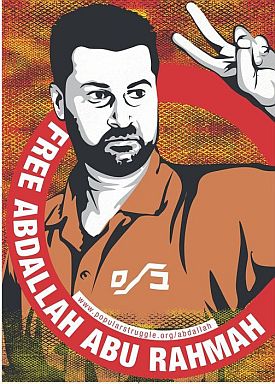
The prisoner, Abdallah Abu Rahmah, a 39-year-old schoolteacher and father of three, has already been convicted and has served a sentence for incitement and organizing illegal protests in the West Bank village of Bil’in. But after a prosecutor’s appeal, the judge ordered that he be kept in prison. Abu Rahmah would later receive an additional six months of prison time.

It wasn’t only friendship that brought the Israelis to Ofer. They see the case against Abu Rahmah as part of a new effort to crush unarmed resistance in the West Bank. For them, Abu Rahmah is not just another Palestinian activist. By leading the mostly nonviolent weekly protests in his village against Israel’s separation wall, he has become the face of a new uprising against the occupation and a key player in a kind of activism that has united Jews, Palestinians and people from around the world—one that carries a message of hope, something as unusual and unexpected in this part of the world as the recent uprisings that have toppled Arab tyrannies. It is a hope that can even penetrate the forbidding walls of the Ofer military compound.

Facebooktwittermail

Yaakov Amidror – in his own words

Ori Nir reports:

Israel’s Prime Minister Binyamin Netanyahu has reportedly decided to appoint an ultra-hawk, one of Israel’s leading national-religious icons, as his new national security adviser.

If media reports are correct, Netanyahu’s new pick for the important position is Major-General (res.) Yaakov Amidror, who in the past advocated for reoccupying the Gaza Strip and staying there “for many years.” Earlier this month, Amidror wrote that “negotiations with the Palestinians and even an agreement with the Palestinians (…) will not benefit Israel in any way as it faces the threats that might emerge in the future.”

Amidror retired from the IDF in 2002, after serving as the head of the analysis wing of Israel’s military intelligence and as the commander of the IDF’s academies. After retiring from the IDF, he wrote extensively for Israeli think tanks and daily newspapers. His paper trail leaves no doubt about his extreme views, which included vicious attacks on the New Israel Fund, sharp criticism of the Obama administration’s “naive” Middle East policy, and dismissive views regarding the viability and advisability of creating a Palestinian state in the West Bank and Gaza.

Amidror is associated with the ultra-right national-religions party “The Jewish Home.” In 2008, he headed a commission tasked with composing the party’s list for the general elections. The party, which is dominated by former National Religious Party (NRP) politicians, supports a “greater Israel” ideology and is considered the most authentic political representative of the ideological messianic settlers in the West Bank.

Facebooktwittermail

For just an extra $20 billion from US taxpayers, Israel can offer “stability” in defense against the Arab democratic threat

The Wall Street Journal reports:

Israel will need to boost military spending and may seek an additional $20 billion in U.S. security assistance to help it manage potential threats stemming from popular upheavals in the Arab world, Defense Minister Ehud Barak said Monday.

Still, he said Israel shouldn’t fear changes in the region or the risk of offering bold concessions in a renewed bid to achieve peace with the Palestinians.

“It’s a historic earthquake…a movement in the right direction, quite inspired,” Mr. Barak said in an interview with The Wall Street Journal, surveying the youthful revolts in Egypt, Tunisia, Libya and the Gulf. “It’s a movement of the Arab societies toward modernity.”

In the short term, however, Israel worries that adversaries Iran and Syria “might be the last to feel the heat” of regional unrest, he said, and that public pressure could push new leaders in Egypt away from that country’s 1979 peace treaty with the Jewish state.

“The issue of qualitative military aid for Israel becomes more essential for us, and I believe also more essential for you,” said Mr. Barak, a former prime minister. “It might be wise to invest another $20 billion to upgrade the security of Israel for the next generation or so….A strong, responsible Israel can become a stabilizer in such a turbulent region.”

Facebooktwittermail

Israel the biggest loser from the Arab democratic revolution

In an assessment of the winners and losers emerging from the Arab democratic revolution, Fawaz A Gerges writes:

Regionally, Israel is the biggest loser. It has put all its eggs into the basket of Arab dictators and autocrats, like Egypt’s deposed Hosni Mubarak. Israel fought tooth and nail to support Mr Mubarak, who played a key role in tightening the siege of Gaza and the noose around Hamas’s neck.

Time and again, the Israeli political class has proven to be its own worst enemy. Israel lost Iran 40 years ago because it put all its eggs in the Shah’s basket. It has just lost Turkey over the killing of nine activists on board a Gaza-bound Turkish aid ship.

And now Israel is likely to lose Egypt, a critical and pivotal neighbour whose Camp David peace agreement in the late 1970s consolidated Israel’s superiority in the region and undermined the official Arab state system.

Regardless of what governments emerge out of the rubble of political authoritarianism in the Arab world, they will have assertive foreign policies that challenge Israel’s hegemony and further colonisation of Palestinian lands.

Meanwhile, the leadership of the Palestinian Authority President Mahmoud Abbas, has lost all credibility in the eyes of the people there. The leaked negotiation documents obtained by al-Jazeera – offering wide-ranging concessions to the Israeli side – were the final nail in the PA’s coffin.

Resistance-based movements like Hamas and Hezbollah have gained more popularity at the expense of Abbas’s Palestinian Authority; they will emerge as major winners of the social turmoil unless Israel takes concrete steps to sign a peace settlement and withdraw from occupied Arab territories.

Facebooktwittermail

Obama’s tall order: a democratic Mideast that shares U.S. priorities

Tony Karon writes:

President Obama has reportedly told White House aides that he wants a “new Middle East policy” — one that urges beleaguered allies threatened by popular rebellions to “enact reforms that would satisfy the popular craving for change while preserving valuable partnerships on crucial U.S. interests, from soil security to counter-terrorism and containing Iran.”

But there’s not much “new” there, to be frank: The Obama Administration, like the Bush Administration before it, has consistently urged Arab allies to make reforms, while prioritizing U.S. regional concerns such as oil, counterterrorism, confronting Iran and protecting Israel. What is new, of course, is the fear that Washington’s influence in the Middle East, which had already been waning steadily in recent years, is tied almost exclusively to regimes that are looking a lot more like relics of the past than stewards of the future.
And there may be no easy way for the U.S. to switch horses carrying its baggage of priorities, or even to shape any emerging democratic order to meet its own strategic requirements. Indeed, the reason Washington is so wedded to autocratic regimes of dwindling legitimacy and authority in the Arab world is the fact that not all U.S. priorities are shared by the Arab public.

No country pumping oil is going to resist the urge to sell it on world markets, so a regime change won’t likely endanger energy supplies. And countries that face a problem of extremist terrorism directed at their own populations will likely cooperate on that front – while the logic of deterrence and consequences can persuade others to prevent their territory being used to stage terror attacks on third countries.

But the idea that the newly empowered Arab public is going to produce governments that will march in lockstep with the U.S. on issues such as Iran and Israel is simply fanciful.

Facebooktwittermail

The racist entity that is taking over Israel must be toppled

Sefi Rachlevsky writes:

The wretchedness of the law in the face of Rabbi Dov Lior has many meanings, and Lior’s refusal to be interrogated over his support for “The King’s Torah – The Laws for Killing Gentiles” – only marginally gets at the heart of the matter.

Thirty years ago, the terrorist organization known as the “Jewish Underground” was set up with the purpose of killing Arabs. The group’s head of operations, Menachem Livni – who was convicted on multiple counts of murder before being pardoned by the regime – testified at the time that the living spirit, the initiator, the religious instructor and the coordinator of the murders was Lior.

This was true for the murders the underground carried out, and was also true for the pressure he put on the murderers to blow up buses and their passengers. The law states that someone who dispatches murders should receive multiple life sentences, along with additional time for organizing the crime. But thanks to instruction from higher up, Lior was never imprisoned, put to trial and or even properly interrogated.

And so he continued: Baruch Goldstein, who murdered 29 Muslims at prayer in Hebron in 1994, saw Lior as his rabbi and counselor. After the Tomb of the Patriarchs massacre, Lior declared that “Baruch Goldstein was holier than the saints of the Holocaust.” The living spirit behind the religious edicts against Prime Minister Yitzhak Rabin, which lead to his 1995 assassination, was also, according to testimonies, Lior. Rabin’s assassin frequented Hebron, where he used to see Lior.

Rabbi Lior is not in prison. He currently serves as a municipal rabbi, the head of a Jewish court and the dean of a large IDF yeshiva. He also heads the Judea and Samaria rabbis committee. Thousands adhere to his commands, hundreds of thousands are taught his ideology, tens of thousands of shekels are paid to him by the Israeli taxpayer every month.

This utter aberration is no accident. The regime chose Lior. Tel Aviv is a dream world. The actual reality that has been instilled in Israel is Lior. Under King Lior, Israel has built a world where the Jews are citizens and the Arabs are not, both in the occupied territories and in Jerusalem; where a Jewish man is a citizen and his Arab neighbor is not. Most Jewish first-graders attend ultra-Orthodox and religious schools. The majority of them are educated along the lines of “The King’s Torah.” A Jew is human. A non-Jew is non-human. “Thou shalt not kill” does not apply to non-Jews. And this is not delivered in the form of incitement, but as a simple statement of a fact. As simple as calling a chair a chair.

There are no ifs, ands or buts about it. Either you’re with Lior or you’re against him. The rabbis who chose him are Lior. The education minister – who visited the Tomb of the Patriarchs hand in hand with the convicted terrorist Livni, whom he seeks to put in charge of educating the children who will be brought to Hebron – is Lior. The prime minister, who enslaves Israel to the racist world of the settlements, is Lior.

Facebooktwittermail

Israelis fear a peaceful intifada too large to crush

Officially, the main cause of concern the Egyptian revolution poses for Israel is that it might result in the end of the Israel-Egypt peace treaty. A much larger concern however, is that the Arab democratic revolution sweeping the region might inspire Palestinians in larger numbers than ever, to demand their political rights.

Israel’s military forces have had decades of practice containing and crushing uprisings on a smaller scale, but numbers matter. The rising spirit of people power is contagious and as we have witnessed in Tunisia, Egypt, Bahrain and now Libya, the brutality of an authoritarian state’s security apparatus is not enough to crush the desire for freedom in a population that has become fearless.

The Jerusalem Post reports:

Concerned by the prospect of the Palestinians replicating Egypt-style mass demonstrations with dozens of simultaneous marches and protests in the West Bank, the IDF is beginning to build rapid-response forces and to identify vantage points throughout the territories that could be used to contain such protests.

The IDF’s Central Command assesses that the Palestinians could resort to so-called nonviolent resistance, on a scale previously unknown to Israel, in the absence of peace negotiations.

While there is deemed to be some possibility that such demonstrations will take place in the near future in the spirit of Egypt, Tunisia and Iran, a senior officer said it was more likely that the Palestinian Authority would prevent this from happening until after elections in September.

One senior officer said commanders were discussing ways to counter and contain large demonstrations launched simultaneously in different parts of the West Bank.

“We are preparing different responses for different scenarios to think about what we will do if there are, for example, 30 marches of several thousand people each,” the officer said. “This is something we have yet to encounter.”

One step the IDF is taking is to set up rapid-response teams that can quickly maneuver throughout the West Bank and arrive at the scene of a demonstration in its early stages in an attempt to contain it. During the summer, the Border Police are expected to establish a new command in the West Bank after the Arava District is dismantled.

In addition, the IDF is locating strategic hilltops that can be used as vantage points from which the military could deploy reconnaissance and surveillance teams to track developments inside Palestinian towns and cities.

The concern is that in the event of multiple large-scale demonstrations, the IDF will not know how to effectively respond and contain the protests, which could lead to a high number of casualties. As a result, commanders have been instructed to prepare their soldiers mentally for how to respond in such scenarios.

Israel has been keeping a close eye on Palestinian cities in recent weeks since the revolution in Egypt, to ensure that the violence does not spread to the West Bank.

According to intelligence assessments, the Palestinians are currently interested in continuing with their plans to build up and reform the institutions they would require for statehood if they decided to make a unilateral declaration following elections in September.

Even after September, the IDF believes the PA will maintain its high-level and almost daily security coordination with the IDF. But, it is thought, the PA could, at the same time, allow and even possibly encourage civilians to launch so-called nonviolent resistance to delegitimize Israel.

Facebooktwittermail

Israel is America’s obnoxious drunk friend

Adbusters asks:

What do you do when your friend is blind drunk, slurring, staggering and boisterous as they fumble for their car keys? Do you cheer them on, slap them on their back and hand them another shot of whiskey? Of course not, no matter how much they may protest. And when it comes to America’s friendship with Israel, what is true for the ethics of bars holds true for international politics as well.

Israel is America’s obnoxious drunk friend. And for over half a century, America has been Israel’s bartender and enabler: each year dumping billions of dollars in military aid that is used to oppress Palestinians, handing out bribe money to Arab tyrants in exchange for the suppression of their people’s outrage and, most importantly, protecting Israel from the UN Security Council despite repeated, flagrant violations of international law. On Friday, America did it again by vetoing a Security Council resolution that would have declared Israel’s settlements illegal… all other members of the council, longstanding friends of Israel included, had voted in favor of the reprimand.

In the last thirty days, the power dynamics of the Middle East have changed irrevocably. Israel’s biggest ally in the region has been toppled, popular movements are sweeping neighboring countries and a new mood of self-governance has captured the imagination of the world’s citizens. It is time for Israel to sober up and face the reality that their aggressive militarism won’t work any more. Only America has the power to grab Israel’s car keys.

The Guardian reports:

Palestinians are planning a “day of rage” on Friday in response to the US wielding its veto against a UN security council resolution condemning Israeli settlements.

The US decision to use its veto has sparked a furious reaction in the West Bank and Gaza.

Anti-US rallies took place in the West Bank towns of Bethlehem, Tulkarem and Jenin this weekend after the 14-1 vote on the resolution, in which the US stood alone against the rest of the security council, including Britain, Germany and France. It voted in contradiction of its own policy.

In Gaza, Hamas described the US position as outrageous and said Washington was “completely biased” towards Israel.

Ibrahim Sarsour, an Israeli-Arab member of the Israeli parliament, the Knesset, said it was time to tell the US president, Barack Obama, to “go to hell”.

“Obama cannot be trusted,” he wrote in an open letter to the Palestinian president, Mahmoud Abbas. “We knew his promises were lies. The time has come to spit in the face of the Americans.”

Facebooktwittermail

Palestinians shout: ‘Obama, you despicable man, we want self-determination!’

Gideon Levy writes:

This weekend, a new member enrolled in Likud – and not just in the ruling party, but in its most hawkish wing. Located somewhere between Tzipi Hotovely and Danny Danon, U.S. President Barack Obama bypassed Dan Meridor and Michael Eitan on the right and weakened their position.

The first veto cast by the United States during Obama’s term, a veto he promised in vain not to use as his predecessors did, was a veto against the chance and promise of change, a veto against hope. This is a veto that is not friendly to Israel; it supports the settlers and the Israeli right, and them alone.

The excuses of the American ambassador to the UN won’t help, and neither will the words of thanks from the Prime Minister’s Office: This is a step that is nothing less than hostile to Israel. America, which Israel depends on more than ever, said yes to settlements. That is the one and only meaning of its decision, and in so doing, it supported the enterprise most damaging to Israel.

Moreover, it did so at a time when winds of change are blowing in the Middle East. A promise of change was heard from America, but instead, it continued with its automatic responses and its blind support of Israel’s settlement building. This is not an America that will be able to change its standing among the peoples of the region. And Israel, an international pariah, once again found itself supported only by America.

This should have disturbed every Israeli. Is that what we are? Alone and condemned? And all for the continuation of that worthless enterprise? Is it really worth the price? To hell with the UN and the whole world is against us?

We can’t wrap ourselves in this hollow iron dome forever. We must open our eyes and understand that if no country, aside from weakening America, supports this caprice of ours, then something fundamental is wrong here.

Israel, which is condemned by the entire world but continues merrily on its way, is a country that is losing its connection to reality. It is also a country that will ultimately find itself left entirely to its fate. That is why America’s decision harmed Israel’s interests: It continued to blind and stupefy Israel into thinking it can go on this way forever.

Jerry Haber writes:

In 1969, the United States voted with the rest of the Security Council to condemn Israel’s annexation of East Jerusalem and plans to build Jewish settlements in East Jerusalem. The Security Council “urgently calls once more upon Israel to rescind forthwith all measure taken by it which may tend to change the status of the City of Jerusalem.” And it explicitly mentioned expropriation of land.

Several days earlier, the US ambassador the United Nations had said in a speech to the UN:

The United States considers that the part of Jerusalem that came under the control of Israel in the 1967 war, like all other areas occupied by Israel, is occupied territory and hence subject to the provisions of international law governing the rights and obligations of an occupying Power. Among the provision of international law which bind Israel, as they would bind any occupier, are the provisions that the occupier has no right to make changes in law or in administration other than those which are temporarily necessitated by his security interests, and that an occupier may not confiscate or destroy private property. The pattern of behavior authorized under the Geneva Convention of 12 August 1949 and international law is clear: the occupier must maintain the occupied area as intact and unaltered as possible, without interfering with the customary life of the area, and any changes must be necessitated by the immediate needs of the occupation. I regret to say that the actions by Israel in the occupied portion of Jerusalem present a different picture, one which gives understandable concern that the eventual disposition of East Jerusalem may be prejudiced, and that the private rights and activities of the population are already being affected and altered. (Cited in Separate and Unequal: The Inside Story of Israeli Rule in East Jerusalem, by Amir S. Cheshin, Bil Hutman, and Avi Melamed (Cambridge: Harvard, 1999), pp. 46-7.

I should point out that this statement was made before a single Jewish settlement had been built outside of Jerusalem. The censure was in reaction to Israel construction of Jewish settlements over the Green Line in East Jerusalem – settlements that are now the “neighborhoods” of Ramot Eshkol and Ma’a lot dafna, East Talpiyot and Neveh Ya’akov.

AFP reports:

Around 3,000 Palestinians gathered in the West Bank city of Ramallah on Sunday to protest the US veto that nixed a Security Council resolution on Israeli settlements.

The crowd massed in Manara Square, a central traffic circle in the West Bank city, waving banners and shouting slogans against the American administration.

“Obama, you despicable man, we want self-determination!” shouted the demonstrators, many of them members of Palestinian president Mahmud Abbas’s Fatah party.

Ynet reports:

While the Palestinians continue to express their anger over the US veto against a UN vote condemning Israel’s settlement construction policy, new details have surfaced regarding the pre-veto discussions. Fatah elements claimed Saturday that US Secretary of State Hillary Clinton threatened to halt financial aid should the Palestinian Authority not withdraw its draft from the Security Council’s agenda. Nevertheless, Palestinian President Mahmoud Abbas stressed that the PA will not boycott the US.

A senior Fatah element told the Palestinian news agency Sama that Clinton threatened Abbas on Friday to cancel US aid. According to the source, US President Barack Obama told Abbas on Thursday night that no other American president has promoted the Palestinian issue more vigorously.

The Obama administration — which has yet to find a Bush policy it’s unwilling to promote — is continuing the practice of ideological exclusion (a Soviet-style policy of excluding political critics from entering the US). Omar Barghouti, author of Boycott, Divestment, Sanctions: The Global Struggle for Palestinian Rights, has been refused a visa for his upcoming speaking tour. He writes:

Ms. Clinton can sing the tunes of freedom all she wants when watching the news of Arab popular revolts from Morocco to Bahrain, but she is not fooling any average-intelligence person in the Arab world. US policy, especially after the veto cast yesterday against the most benign UN Security Council resolution, simply reiterating universal, long-held facts that Israel’s colonial settlements are illegal and thwart just peace, is being exposed to the new generation of restive, fearless, freedom-aspiring Arab youth as the main cause of their oppression, of buttressing and protecting the tyrants that have denied them all freedoms for decades. It has long been exposed, too, as the key partner of Israel in its occupation, colonialism and apartheid. Without US largess, Israel’s multi-tiered system of racist and colonial oppression cannot possibly survive.

Facebooktwittermail

US-Israeli interdependence?

Associated Press reports:

The top U.S. military officer says the relationship between the American and Israeli militaries is especially relevant while Mideast nations are steeped in unrest.

Adm. Mike Mullen, the chairman of the Joint Chiefs of Staff, discussed the instability in Egypt with Israeli President Shimon Peres on Monday. He said the American-Israeli alliance is “something we both depend on.”

As the recipient of $3 billion in military aid annually, it’s clear how Israel is dependent on the United States, but much less clear how the dependence is mutual. Perhaps Mullen had personal dependence in mind, given that his principal adviser, Dr Lani Kass, grew up in Israel and was a major in the IDF.

Facebooktwittermail

The democratic threat to the Jewish state

Ilan Pappe writes on why Israelis fear the prospect of becoming surrounded democratic Arab states.

Nonviolent, democratic (be they religious or not) Arabs are bad for Israel. But maybe these Arabs were there all along, not only in Egypt, but also in Palestine. The insistence of Israeli commentators that the most important issue at stake — the Israeli peace treaty with Egypt — is a diversion, and has very little relevance to the powerful impulse that is shaking the Arab world as a whole.

The peace treaties with Israel are the symptoms of moral corruption not the disease itself — this is why Syrian President Bashar Asad, undoubtedly an anti-Israeli leader, is not immune from this wave of change. No, what is at stake here is the pretense that Israel is a stable, civilized, western island in a rough sea of Islamic barbarism and Arab fanaticism. The “danger” for Israel is that the cartography would be the same but the geography would change. It would still be an island but of barbarism and fanaticism in a sea of newly formed egalitarian and democratic states.

In the eyes of large sections of Western civil society the democratic image of Israel has long ago vanished; but it may now be dimmed and tarnished in the eyes of others who are in power and politics. How important is the old, positive image of Israel for maintaining its special relationship with the United States? Only time will tell.

But one way or another the cry rising from Cairo’s Tahrir Square is a warning that fake mythologies of the “only democracy in the Middle East,” hardcore Christian fundamentalism (far more sinister and corrupt than that of the Muslim Brotherhood), cynical military-industrial corporate profiteering, neo-conservatism and brutal lobbying will not guarantee the sustainability of the special relationship between Israel and the United States forever.

Facebooktwittermail