Category Archives: Israel

Egyptian opposition leader: Egypt-Israel peace treaty must be renegotiated

Ynet reports:

After the Egyptian army stressed it was committed to observing all of Egypt’s international treaties, opposition leader Ayman Nour said Sunday, “The role of the Camp David accord has ended.”

In an interview with a Lebanese radio station, Nour, who served a lengthy jail sentence during deposed president Hosni Mubarak’s era, said Egypt “is a great country and must respect its agreements. As for Camp David – this is a unique issue with unique aspects – the people will decide on this matter.

“For all intents and purposes, Camp David is over, because it is an old treaty and its terms must be improved in a way that will correspond with Egypt’s interests,” said Nour, who is considered one of the more liberal opposition figures and has no ties to the Muslim Brotherhood.

“The Egyptian rights must be improved, because these rights – as they appear in the Camp David accord – are very modest,” he said.

Reuters reported today that a police officer tried to stab Ayman Nour while he was on tour in the southern town of Luxor. He was not hurt.

Meanwhile, Reuters also reports:

Egypt’s new military rulers will issue a warning on Monday against anyone who creates “chaos and disorder”, an army source said.

The Higher Military Council will also ban meetings by labor unions or professional syndicates, effectively forbidding strikes, and tell all Egyptians to get back to work after the unrest that toppled Hosni Mubarak.

The army will also say it acknowledges and protects the right of people to protest, the source said.

Protesters argued heatedly in Tahrir Square over whether to stay or comply with army orders to leave. “The people want the square cleared,” one group chanted. “We will not leave, we will not leave,” replied another.

Police officers, emboldened by Mubarak’s downfall, gathered outside the Interior Ministry to demand higher pay. Warning shots were fired in the air. No one was hurt.

Workers from the health and culture ministries staged demonstrations as Egyptians began venting pent-up frustrations.

Thousands of workers have staged strikes, sit-ins and protests over pay and conditions at firms and government agencies in fields such as steel, textiles, telecoms, railways, post offices, banks and oil and pharmaceutical companies.

Facebooktwittermail

Egypt in 2011 is not Iran in 1979

Hamid Dabashi writes:

The pro-Isreali neocons in the United States and their Zionist counterparts in Israel compare the Egyptian and Iranian revolutions because they are frightened out of their wits by a massive revolutionary uprising in a major Arab country that may no longer allow the abuse of the democratic will of a people for the cozy continuation of a colonial settlement called “Israel”.

Echoing the Israeli Prime Minister Binyamin Netanyahu, the Iranian neocon contingencies like Abbas Milani of the Hoover Institute think tank in California fear that the Muslim Brotherhood will take over the Egyptian revolution and create an Islamic Republic—habitually turning a blind eye to the fact that a fanatical “Jewish Brotherhood” has already created a Jewish Republic for more than sixty years in the same neighborhood.

Soon after Binyamin Netanyahu and Abbas Milani, and from precisely the opposite ideological direction, Ali Khamenei, the leader of the Islamic Republic and the vast petrodollar propaganda machinery at his disposal, celebrated what is happening in Egypt as a reflection of Khomeini’s will and legacy and the commencement of an “Islamic awakening”. Not so fast, interjected an almost instant announcement from the Egyptian Muslim Brotherhood. This was not an Islamic Revolution, they explained, but an Egyptian revolution that belonged to all Egyptians—Muslims, Christians, people from other ideological persuasions.

In between the frightful Zionist propaganda and Islamist wishful thinking myriads of other opinions have been aired over the last two weeks in one way or another measuring the influence of the Islamic Revolution in Iran over the revolutionary uprising in Egypt.

This is a false and falsifying presumption first and foremost because what happened in Iran during the 1977-1979 revolutionary uprising was not an “Islamic Revolution” but a violently and viciously “Islamised revolution”.

A brutal and sustained course of repression—perpetrated under the successive smoke screens of the American Hostage Crisis of 1979-1981 and the Iran-Iraq War of 1980-1988, and the Salman Rushdi Affair of 1989-1999—is the crucial difference between an “Islamic” and “Islamised” revolution.

A cruel crescendo of university purges, cultural revolutions, mass executions of oppositional forces, and forced exile, took full advantage of domestic and regional crisisis over the last three decades to turn a multifaceted, modern, and cosmopolitan revolution into a banal and vicious theocracy.

The CIA-sponsored coup of 1953, the massive arming of Saddam Hossein to wage war against Iran, and the creation of the Taliban as a bulwark against the Soviet occupation of Afghanistan, all engineered by the United States, and the continued armed robbery of Palestine by Israel have been the regional contexts in which the Islamic Republic destroyed all its ideological and political alternatives and created a malicious theocracy, consistently and systematically abusing regional crisis to keep itself in power.

That historical fact ought to be remembered today so no false analogy or anxiety of influence is allowed to mar the joyous and magnificent uprising of Tunisians and Egyptians to assert and reclaim their dignity in a free and democratic homeland.

There is no reason whatsoever to believe that Tunisians or Egyptians will allow such a treacherous kidnapping of their dreams and aspirations by one fanatical ideological absolutism or another.

What we are witnessing in Tunisia and in Egypt today, as we in fact have been over the last two years in Iran, is a people’s democratic will to retrieve their cosmopolitan political culture, wresting it from colonial (Tunisia), imperial (Egypt), or tyrannical (Iran) distortion, deception, and corruption.

Facebooktwittermail

The fear of freedom

As the train of democracy gathers steam in Egypt, there are those nearby who seem eager to throw themselves under its wheels.

No doubt an observer such as the Israeli historian, Benny Morris, is vain enough to imagine that he is not about to get run over but, on the contrary, hopes his grave warnings will encourage others to seize the train’s brakes and prevent an imminent catastrophe.

What is more likely to happen is that we will only need wait a matter of months before Morris and fellow fearmongers will be exposed as hysterical fools or intellectual rogues.

Morris believes that those of us in the West currently intoxicated by the glorious vision of democracy taking birth in Egypt, have only been able to indulge in such emotions because we don’t understand what Egyptians really want.

Alas, I fear, Westerners will see what most Egyptians actually think and want if and when the country holds free and fair general elections (perhaps in September-October). And I fear that they will be surprised—perhaps even shocked—by the results, and by what the Egyptian masses then say about what they actually think and want. I fear that at that point, “Death to Israel,” “Death to America,” and “Allahu Akbar” will drown out every democratizing and liberalizing chant.

But by then the genie will be well out of the bottle; by then, it will be too late.

Trapped inside a misanthropic Zionist mindset, Morris seems incapable of recognizing that at the core of the Egyptian and Tunisian revolutions, the driving force is not ideological. It is a universal and human demand for respect.

Sensing themselves newly visible on a world stage, ordinary Tunisians and Egyptians stood up, individually and collectively, and said: we refuse to be treated as less than human. We are reclaiming the dignity that is everyone’s birthright and will no longer tolerate the abuse of brutal rulers or the indifference of foreign powers. We demand to be heard and respected.

To the extent that the call from the dignity revolutions is being heard far beyond the Arab world, it resonates most with those who to differing degrees and for different reasons, share the same experience. That many of us live in democracies does little to diminish a sense that our governments do not represent our interests. And that so many of our fellow citizens respond to this reality with indifference only makes us envy the courage and imagination of people who do otherwise as they rise up, declare and discover: we have the power to change the world.

Facebooktwittermail

In Egypt the seeds of a new world order and the end of Western supremacy

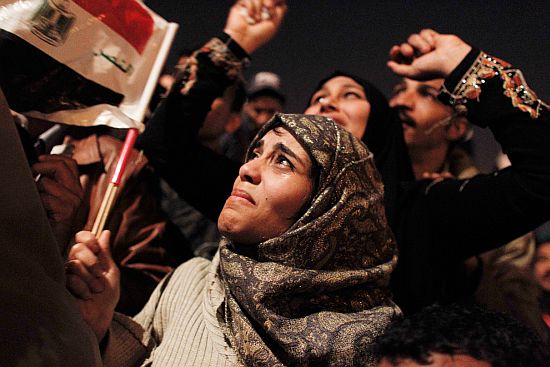
An Egyptian woman cries as she celebrates the news of the resignation of President Hosni Mubarak.

Some think the Middle East isn’t ready for democracy — in truth it’s the West that isn’t ready.

Nicholas Kristof duly notes:

Egyptians triumphed over their police state without Western help or even moral support. During rigged parliamentary elections, the West barely raised an eyebrow. And when the protests began at Tahrir Square, Secretary of State Hillary Rodham Clinton said that the Mubarak government was “stable” and “looking for ways to respond to the legitimate needs and interests of the Egyptian people.”

Commentators have repeatedly referred to the Obama administration playing catch-up during the Egyptian revolution, yet its seeming inability to track fast-changing events was merely an expression of its unwillingness to embrace the direction those events were heading.

Immediately after Hosni Mubarak resigned, Jake Tapper from ABC News tweeted that he couldn’t find anyone in the administration who thought that whatever comes next would be better for U.S. interests than Mubarak had been.

The dictator’s departure is not being celebrated in Washington. The leaders of the free world have a singular lack of enthusiasm for freedom.

The administration has not merely repeatedly stumbled, but has functioned as a dead weight, attempting to slow the pace of what may become the most significant transformation in world order since the birth of Western colonial power.

America’s friends in Israel have been equally unenthusiastic about the turn of events. After Mubarak’s defiant speech on Thursday night when he insisted he would sit out his term as president, “Israel breathed a sigh of relief,” according to Israeli commentator, Alex Fishman. The respite must have felt dreadfully brief.

But if Americans want to grasp the significance of the Egyptian revolution, they need look no further than this country’s much bloodier assertion of people power: the American revolution.

For the first time in Egypt’s history, the Egyptian people have made a declaration of sovereignty and claimed their right of self-governance. Is that not something that every person on the planet who cherishes life and liberty can joyfully celebrate?

As Western leaders now line up, having no choice but to express their support for the revolution, while sagely offering guidance and assistance in managing an “orderly transition” to a democratic system, they do so with a palpable ambivalence.

People power is in jeopardy of sweeping the Middle East and undoing the carefully constructed “stability” through which for most of the last century the West has managed the control of its most vital resource: oil.

Worse for the United States, the Egyptian revolution now undermines the US government’s ability to sustain an unswerving loyalty to the preeminence of Israel’s security interests.

A democratic Egyptian government will not have the autocratic latitude that until now enabled Mubarak’s complicity in the siege of Gaza or his willingness to participate in the charade of a peace process going nowhere.

Stepping back from the most obvious regional implications of what is now unfolding, there is a more far-reaching dimension.

When in 1990 President George HW Bush used the phrase “new world order”, his words had an ominous ring both because they implied that this would be an American-defined order but also — on the brink of the first Gulf War — a militarily-imposed order. The new order was synonymous with the dubious claim that the collapse of the Soviet Union represented an American “victory” in the Cold War.

A new world order worthy of the name, however, should represent something much more significant than the strategic reapportioning of power on a geopolitical level. It should involve the reapportioning of power through which global affairs become the people’s affairs. It should mean that international relations can no longer be conducted within the confines of intrinsically undemocratic arenas where ordinary people have no voice.

The people-power unleashed in Egypt has the potential to serve as a democratizing force that not only threatens autocratic leaders in the Middle East but also technocratic and nominally democratic leaders in the West — those whose complacent style of governance has depended on the political passivity of the populations they nominally serve while providing ready access for corporate interests to exercise their undemocratic influence.

The West, far from representing a model of democracy ripe for export has instead long been mired in a post-democratic phase where the foundational concept of demos, the people, has withered.

Individual wealth has supplanted the need for social solidarity as citizenship has been substituted by consumerism. Our material self-sufficiency has robbed us of the experience of mutual reliance and worn thin the fabric of society.

In a new world order, a new democracy might spread not just further east but also further west.

There is also a bittersweet note in this moment.

The Western exporters of democracy delivered the war in Iraq and yet as we witness events unfold in Egypt, it’s hard not to wonder what might have been possible had the people of Iraq, without Western help or hindrance, been allowed the same opportunity to claim their own freedom.

Facebooktwittermail

How the Egypt revolution could help Israel

The historian, Kai Bird, writes:

[T]he cold peace Israel has forged with Arab dictators is unraveling. This may, in the short term, empower Israeli Prime Minister Benjamin Netanyahu’s Likud ideologues who will argue that Arab democrats are out to “delegitimize” Israel. But in the long run, the emergence of an Arab democratic polity should convince Israeli voters that their leaders have become too complacent and too isolationist. After Tahrir, a majority of Israelis may conclude that they can’t live in the neighborhood without forging a real peace with their neighbors.

The separation wall was never a real answer to Israel’s security predicament, and it will be less so when a democratically elected government governs Egypt. The policy of separation — hafrada in Hebrew — had some short-term strategic viability when the largest Arab country was willing to police Israel’s southern border and keep Hamas penned up inside its Gaza prison. But no legitimate government in Cairo will be able to continue its complicity with the Gaza blockade — particularly not if the Muslim Brotherhood is a player in a new government.

In reality, Israel will come under renewed pressure to deal with both Hamas and the Palestinian Authority in the West Bank. Hamas’s ideology is certainly vile, but it won the last Palestinian legislative election in 2006 and has more or less observed a cease-fire with Israel since early 2009. In December 2010, the Hamas prime minister in Gaza, Ismail Haniyeh, announced that his party would abide by any peace settlement if it were to be ratified by a referendum of the Palestinian people. Furthermore, as we recently learned from Al Jazeera’s Palestine Papers — the leaked documents on the 2008 Abbas-Olmert talks — the two sides are not that far apart on a comprehensive peace settlement that would create a Palestinian state.

So here is the uplifting news: What is happening in Tahrir Square may actually propel the politicians in Washington, Jerusalem, and Ramallah to forge the Israeli-Palestinian peace deal that all of us know is there for the taking. And if that doesn’t happen? Absent a comprehensive peace settlement, Israel and the United States will find themselves increasingly isolated in the new Middle East.

Facebooktwittermail

The American-Israeli led anti-democratic alliance

“Never insult the Arabs,” advised Amos Gilead, former head of Israel’s Political-Military Bureau, speaking on Monday at the influential Herzliya national security conference.

But he wasn’t appealing for an improvement in Israeli-Arab relations since he only had a few Arabs in mind — Hosni Mubarak and other leaders “that are supporting stability and are coping with terror and have proven themselves along decades.”

As for Gilead’s views about the advance of democracy in the region, such a prospect presents nothing less than a path to hell.

“If we allow,” Gilead said, then edited himself realizing that democracy should not be presented as something Israel can allow (or forbid) and thus he continued in less instrumental terms, “or if there is democrative process in the Middle East, it will bring for sure — or, let’s say, quite sure — dictatorships which will make this area like hell.”

The Obama administration — which has yet to face any form of governmental pressure it was willing to resist — is now showing itself in much deeper sympathy with those voices who present democracy as a threat than those who claim democracy as their right.

The New York Times reports:

As the Obama administration gropes for the right response to the uprising in Egypt, it has not lacked for advice from democracy advocates, academics, pundits, even members of the previous administration. But few voices have been as urgent, insistent or persuasive as those of Egypt’s neighbors.

Israel, Saudi Arabia, Jordan and the United Arab Emirates have each repeatedly pressed the United States not to cut loose Egypt’s president, Hosni Mubarak, too hastily, or to throw its weight behind the democracy movement in a way that could further destabilize the region, diplomats say. One Middle Eastern envoy said that on a single day, he spent 12 hours on the phone with American officials.

There is evidence that the pressure has paid off. On Saturday, just days after suggesting that it wanted immediate change, the administration said it would support an “orderly transition” managed by Vice President Omar Suleiman. Secretary of State Hillary Rodham Clinton said that Mr. Mubarak’s immediate resignation might complicate, rather than clear, Egypt’s path to democracy, given the requirements of Egypt’s Constitution.

“Everyone is taking a little breath,” said a diplomat from the region, who spoke on the condition of anonymity because he was discussing private conversations. “There’s a sense that we’re getting our message through.”

While each country has its own concerns, all worry that a sudden, chaotic change in Egypt would destabilize the region or, in the Arab nations, even jeopardize their own leaders, many of whom are also autocrats facing restive populations.

Like frogs that refuse to jump out of pot of hot water because its temperature is only rising slowly, those autocrats and their Western allies who now equate stability with their ability to act as a judicious brake on change, have a will to survive that is guiding them down a path of self-destruction.

Slow but sure are the watchwords of the proponents of an “orderly transition” to democracy in Egypt. Yet even as they profess a desire to see democratic change unfold and claim no interest in dictating the outcome of a democratic process, this posture of non-interference is contradicted by a clear intent to dictate the pace of change. The will of the Egyptian people will be respected — but not just yet.

What the West is telling the Arab world is this: be patient living under dictators we like because if you get rid of them you’ll end up being ruled by dictators we don’t like. Now, as ever, the West treats Arabs as being incapable of building their own democracies.

But beneath this veneer of contempt lies a much deeper fear: that a Middle East made up of truly self-governing independent nations fully in control of resources upon which the West depends will no longer bow to Western interests. That’s a prospect the West dreads to contemplate.

Facebooktwittermail

Time for the United States to stop poisoning the Middle East

To assert that the United States has been poisoning the Middle East for decades might sound like too strong language to the ears of many Americans. Yet what kind of effect can we expect from the long-standing practice of supporting rulers who habitually torture their own people, other than a poisonous effect?

Much as we can celebrate the Egyptian revolution as an expression of the universal human desire for freedom, it is also the beginning of a process through which Egypt must detoxify itself.

The Obama administration still clings to the phrase orderly transition as though the process of change on which Egypt is just embarking might be as seamless as the changeless change which saw George W Bush’s departure from and Barack Obama’s arrival into the White House.

Real change is more disruptive. It can’t be stage-managed by Hosni Mubarak or his deputies.

Graham Fuller writes:

It had to come. Where, when, and how exactly one of many smoldering sparks in this agonized region might actually burst forth into the present conflagration was unknowable, but tension and anger was palpably rising over a long period.

Where all these uprisings across the region will go is still unknowable, but one thing is clear – the imperative to break the long and ugly pattern of harsh, incompetent, and corrupt rule that sucks optimism, hope, and creativity out of these societies and made them breeding grounds for radicalism.

What the people of the region demand is to be able to take control of their own lives and destinies. But that in turn depends on an end to the constant external intervention of the United States in the region.

In the near term, the prescription is stark – Washington must back off and leave these societies alone, ending the long political infantilization of Middle Eastern populations. We must end our incessant and obsessive efforts to intervene and micromanage the political life of foreign states based on a myopic vision of “American interests.”

Today the Middle East is the last redoubt in the world of regimes bought, maintained, and guided by Washington. Is it any wonder that this region is now the cauldron of numerous rebellions and anti-American expression?

And just why are we maintaining this damaging, hated quasi-imperial role in the Middle East? Is it for the oil? Yet what tin-pot dictator has ever refused us oil? Furthermore, we don’t even rely that much on Middle East oil – Saudi Arabia ranks only number three among our top five providers: Canada, Mexico, Saudi Arabia, Venezuela, and Nigeria.

Or is it perhaps all about Israel? Yet why should that state constitute the seeming touchstone of everything that we do in the region? After all, Israel is overwhelmingly the most powerful military state in the Middle East, acts at will in the Middle East under the protection of American veto, manipulates our own domestic politics in its favor, and is now run by the most inflexible and ultra-right-wing government in Israeli history, while soaking up more American foreign aid per capita than any other state. The US still backs Israel against the Palestinians in an Israeli occupation now into its fifth decade.

Facebooktwittermail

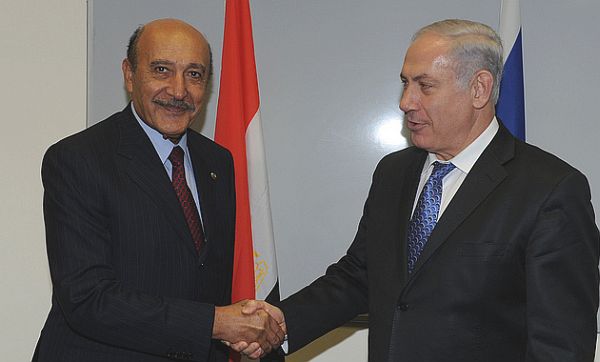
Omar Suleiman: Tel Aviv’s man in Cairo

The Daily Telegraph reports:

The new vice-president of Egypt, Omar Suleiman, is a long-standing favourite of Israel’s who spoke daily to the Tel Aviv government via a secret “hotline” to Cairo, leaked documents disclose.

Mr Suleiman, who is widely tipped to take over from Hosni Mubarak as president, was named as Israel’s preferred candidate for the job after discussions with American officials in 2008.

As a key figure working for Middle East peace, he once suggested that Israeli troops would be “welcome” to invade Egypt to stop weapons being smuggled to Hamas terrorists in neighbouring Gaza.

The details, which emerged in secret files obtained by WikiLeaks and passed to The Daily Telegraph, come after Mr Suleiman began talks with opposition groups on the future for Egypt’s government.

Facebooktwittermail

The death of Israeli democracy

Mya Guarnieri writes:

As Egyptians demand their freedom, I ask a Muslim in Jaffa if we will see the same in Israel. “I don’t think so,” he answers. “Even with all the mess here, we have democracy.”

But, do we? And for how much longer?

As we speak, the Knesset is debating one of a slew of anti-democratic bills. Some of the legislation targets Palestinian citizens of Israel – people like this man and his wife, who is quick to offer me coffee and her opinions.

If the Admissions Committee law passes, for example, this young couple and their three children could find themselves barred from living in certain communities and villages, even those built on public land. If the Nakba Bill is approved, organisations that commemorate the 1948 expulsion of Palestinians will be ineligible for public funds. This is a “watered down” version of the bill. The original version sought to imprison anyone who publicly marked the Nakba Day. Other legislation aims to silence individuals and groups that criticise the government.

The Israeli Democracy Institute (IDI) says that such bills pose “serious threats” to the country. Explaining that the death of democracy is “a gradual process,” the IDI, a non-partisan think-tank based in Jerusalem, warns: “People who are concerned but are waiting for the ‘moment of real danger’ to abandon their routines and take steps to defend democracy are making a mistake. The moment of real danger is now.”

Facebooktwittermail

In Bibiland Iran was Germany but now Egypt is Iran

After for several years being convinced that it was 1938, Israel’s Prime Minister Benjamin Netanyahu who appears to live in a time warp, has now decided that it’s 1979. Iran was Germany and now Egypt is Iran.

From Jerusalem, the prospect of Egyptians fully-armed with votes looks more dangerous than Iranians stockpiling enriched uranium.

Further evidence of Israel’s concerns in response to the dangerous proliferation of freedom in Egypt is that hundreds of Egyptian troops are now being rushed into Sinai, heading towards Sharm el-Sheikh — the location where Hosni Mubarak is rumored to be mounting his last stand. Under the Israel-Egypt peace treaty, Sinai is a demilitarized zone and thus the troop movement required and received Israel’s consent.

Mubarak has ordered his new prime minister to begin talks with the opposition to find out their specific demands and protesters, recognizing that “Down With Mubarak!” might not be specific enough are now adding that he needs to be out by Friday.

Protesters gathering at Tahrir Square are now having their IDs check by the army. Heba Fatma Morayef, a Human Rights Watch Egypt researcher, said: “When I asked why a soldier replied: ‘it’s to keep the police out and make sure none of the escaped criminals get in.'”

Fear of public expressions of solidarity with Egyptians, now extends from Gaza, to the West Bank, and to China.

Israeli officials are appealing to Egypt’s newly-appointed Vice President Omar Suleiman to maintain the siege on Gaza.

Meanwhile, Washington dithers — I mean, continues to monitor the situation.

After emerging from a White House meeting on Egypt on Monday, Marc Lynch, a foreign policy expert who blogs on the Middle East as Abu Aardvark, wrote on his Twitter feed: “as usual a lot of what you’re hearing about the administration’s policy is wrong.”

He then responded on the social network to a plea from the Cairo-based blogger and journalist Issandr El Amrani – who wrote: “@abuaardvark Since they can’t explain themselves clearly, perhaps you can translate for us!” – by summing up the Obama administration’s current stance in this simple Twitbite:

@arabist U.S. Egypt policy translated: keep army from using violence + get transition to a post-Mubarak real democracy, but not sure how.

One of the experts at the meeting told Politico:

While the administration is considering various options — including the possibility of at some point telling Mubarak privately it’s time to leave — “I don’t think they are there yet.”

Facebooktwittermail

Israel and the new Middle East

Gideon Levy writes:

As long as the masses in Egypt and in the entire Arab world continue seeing the images of tyranny and violence from the occupied territories, Israel will not be able to be accepted, even it is acceptable to a few regimes.

The Egyptian regime became an ally of the Israeli occupation. The joint siege of Gaza is irrefutable proof of that. The Egyptian people didn’t like it. They never liked the peace agreement with Israel, in which Israel committed itself to “respect the legitimate rights of the Palestinian people” but never kept its word. Instead, the people of Egypt got the scenes of Operation Cast Lead.

It is not enough to have a handful of embassies in order to be accepted in the region. There also have to be embassies of goodwill, a just image and a state that is not an occupier. Israel has to make its way into the hearts of the Arab peoples, who will never agree to the continued repression of their brothers, even if their intelligence ministers will continue to cooperate with Israel.

If there’s one thing shared by all factions of the Egyptian opposition, it is their seething hatred of Israel. Now their representatives will rise to power, and Israel will find itself in a difficult situation. Neither will anything remain of the virtual achievement that Netanyahu often paraded – the alliance with the “moderate” Arab regimes against Iran. A real alliance with Egypt and its sister-states can only be based on the end of the occupation, as desired by the Egyptian people, and not on a common enemy, as an interest of its regime.

Zvi Bar’el writes:

So what has happened so far? A corrupt president in Tunisia flees, to cheers from around the world. Protests erupt in Egypt, and gloom descends. Protests are held in Iran, and the world cheers. A prime minister is deposed in Lebanon, to fear and dread. An Iraqi president is overthrown in a military offensive, and it’s called democracy. Raucous demonstrations take place in Yemen, and they’re called interesting but not terribly important.

Why the different reactions? This is supposedly the new Middle East the West always wanted, but something still isn’t working out. This isn’t the Middle East they dreamed of in the Bush administration, and not what nourished Prime Minister Benjamin Netanyahu’s wildest dreams. A new, unexpected player has appeared: the public.

Up to now, the world has been divided into two camps: “complicated” countries where the government represents the public and every decision is subject to public oversight, and “easy” countries where business is conducted at the top and the public is just window dressing. The dividing line between the two has always been starkly clear. Everything north of the Mediterranean belonged to the first group and everything to the south and east to the second.

The north had political parties and trade unions, a left wing and a right wing, important intellectuals, celebrities who shaped public opinion, and of course, there was public opinion itself. In the south the division was simple. It was the distinction between moderates and extremists, meaning pro-Westerners and anti-Westerners.

If you’re a Saudi king who buys billions of dollars of American weapons, you’re pro-Western and therefore entitled to continue to rule a country without a parliament, one where thieves’ hands are amputated and women aren’t allowed to drive. If you’re an Egyptian president who supports the peace process, you’re pro-Western and have permission to continue to impose emergency rule in your country, jail journalists and opposition members, and fix elections.

Amos Harel writes:

The events of the last few days in Egypt – apparently the most important regional development since the Islamic revolution in Iran and the Egyptian-Israeli peace deal of 1979 – are also an expression of the decision-makers’ nightmare, the planners and intelligence agents in Israel.

While in other countries many are watching with satisfaction at what looks to be possibly the imminent toppling of a regime that denied its citizens their basic rights, the Israeli point of view is completely different.

The collapse of the old regime in Cairo, if it takes place, will have a massive effect, mainly negative, on Israel’s position in the region. In the long run, it could put the peace treaties with Egypt and Jordan in danger, the largest strategic assets after the support of the United States.

The changes could even lead to changes in the IDF and cast a dark cloud over the economy.

Western intelligence in general and Israeli intelligence in particular did not foresee the scope of change in Egypt (the eventual descriptor “revolution” will apparently have to wait a little longer). Likewise, almost all of the media analysis and academic experts got it wrong.

In the possible scenarios that Israeli intelligence envisioned, they admittedly posited 2011 as a year of possible regime change – with a lot question marks – in Egypt and Saudi Arabia, but a popular uprising like this was completely unexpected.

More than this, in his first appearance at a meeting last Wednesday of the Foreign Affairs and Defense Committee the new head of military intelligence Major General Aviv Kochavi said to member of Knesset, “There are currently no doubts about the stability of the regime in Egypt. The Muslim Brotherhood is not organized enough to take over, they haven’t managed to consolidate their efforts in a significant direction.”

If the Mubarak regime is toppled, the quiet coordination of security between Israel and Egypt will quickly be negatively affected. It will affect relations between Cairo’s relationship with the Hamas government in the Gaza Strip, it will harm the international forces stationed in Sinai.

It will mean the refusal of Egypt to continue to allow the movement of Israeli ships carrying missiles through the Suez canal, which was permitted for the last two years, according to reports in the foreign press, in order to combat weapons smuggling from Sudan to Gaza. In the long run, Egypt’s already-cold peace treaty with Israel will get even colder.

From the perspective of the IDF, the events are going to demand a complete reorganization. For the last 20 years, the IDF has not included a serious threat from Egypt in its operational plan.

In the last several decades, peace with Cairo has allowed the gradual thinning out of forces, the lowering of maximum age for reserve duty and the diversion of massive amounts of resources to social and economic projects.

The IDF military exercises focused on conflict with Hezbollah and Hamas, at most in collusion with Syria. No one prepared with any seriousness for a scenario in which an Egyptian division would enter Sinai, for example.

If the Egyptian regime falls in the end, a possibility that seemed unbelievable only two or three days ago, the riots could easily spill over to Jordan and threaten the Hashemite regime. On Israel’s two long peaceful borders there will then prevail a completely different reality.

Facebooktwittermail

Israel sees threat from “delegitimizers”

Reuters reports:

Foreign protests, boycotts, embargoes and sanctions, along with internal resistance, helped bring about the isolation and eventually the end of apartheid in South Africa in the 1990s.

Now Israelis fear pro-Palestinian, or anti-Israeli, activists are using the same tactics against their country, with increasing effect.

Carlos Santana, Gil Scott Heron, Elvis Costello, Gorillaz Sound System, the Klaxons, the Pixies, Faithless, Leftfield, Tindersticks, Meg Ryan and film director Mike Leigh have all decided not to go to Israel in recent months.

Some older, established acts — Paul McCartney, Elton John and Rod Stewart among them — have ignored boycott pressure.

The activist website boycottisrael.info keeps count.

Israeli analysts say pressure is brought to bear on artists by a global “delegitimisation network.”

White South Africa was ostracized in a campaign lasting years. Today, Facebook and Twitter can flash protest messages globally in seconds, putting pressure on entertainers to stay away from Israel, and drawing the attention of millions of fans.

Meanwhile, the Los Angeles Times reports:

The intent of the anonymous Internet video was unambiguous: “This person should be killed — and soon,” read a message underneath a photo of Israel’s deputy state prosecutor, Shai Nitzan.

His alleged offense? “Betraying” his Jewish roots by opening a criminal inquiry into racist threats and hate speech expressed on two Israel-based Facebook pages with statements in Hebrew such as “Death to Arabs.”

It was the latest, and most overtly violent, sign of what many here are calling a wave of intolerance toward people of different races, religions, orientations and viewpoints.

From rabbinical prohibitions against renting homes to “non-Jews” to government crackdowns on left-wing activists, Israelis are grappling with their nation’s identity and character.

Across the political spectrum, some see the struggle as a threat to Israel’s democratic ideals. Opposition leader Tzipi Livni, of the centrist Kadima party, warned that “an evil spirit has been sweeping over the country.” Defense Minister Ehud Barak said a “wave of racism is threatening to pull Israeli society into dark and dangerous places.”

Facebooktwittermail

Britain’s humiliation in Palestine

In The Observer, Rachel Cooke writes:

In 1999, shortly after his film about the British peace-keeping force in Bosnia, Warriors, was screened by the BBC, Peter Kosminsky received a letter. It was from an old soldier, who had found Warriors moving, and wanted to thank its director. At the end of the letter, though, was a line – thrown out more in hope than expectation – that caught Kosminsky’s eye. “You should do a film about the British soldiers who were in Palestine,” it said. “No one remembers us.”

As psychological bullets go, this one was well aimed. Kosminsky is nothing if not in the business of remembering. The kind of things that governments like to forget are his stock in trade. Down the years, he has made films on a variety of uncomfortable subjects, from the activities of the police in Northern Ireland (Shoot to Kill) and New Labour control-freakery (The Project), to British-born Muslim suicide bombers (Britz) and the suicide of Dr David Kelly (The Government Inspector), each one trailing controversy – if not always a sudden bout of recovered memory on the part of the establishment – in its wake. The soldier’s letter was duly passed to Kosminsky’s researchers, who began interviewing veterans.

Between 1945 and 1948, some 100,000 soldiers served in the British-controlled Mandate of Palestine. Kosminsky’s team spoke to around 80; he found the men’s stories to be both gripping and moving, so he carried on, wading next through letters, diaries, memoirs and history books. Slowly, a theme began to emerge. “The thing that came out most strongly,” he says, “was that the men all arrived in Palestine feeling incredibly pro-Jewish. A few of them had helped to liberate the [concentration] camps, so they had seen what had happened [to the Jews] with their own eyes. And everyone had heard the stories and seen the newsreels.

“When Jewish refugees arrived in Palestine off the boats, and were caged and beaten by British forces [the British placed strict limitations on Jewish immigration to Palestine], many soldiers didn’t like it all. They knew what these people had been through. Over time, though, the soldiers’ attitudes changed. Some of this was just the usual British support for the underdog; there’s no question that by 1948 [when Israel declared itself an independent state] the Arabs were perceived as that. But also, if you’re being attacked on a daily basis [by the Jewish resistance], if you’re under constant threat of kidnap, if you’re confined to barracks behind a lot of razor wire, your feelings are bound to change.”

Kosminsky’s first idea was to make a drama about a British soldier who would exemplify this shift. “I suppose it started out as standard Kosminsky fare, which was pointing the finger at Britain. First of all, these men don’t have a memorial; they’re forgotten. It’s only recently that they were allowed to march to the Cenotaph. When they came back to Britain, no one wanted to know; pulling out of Palestine was a terrible humiliation, a total defeat. Second, we were the colonial power in Palestine and, as in so many other examples of our retreat from Empire, we left it totally fucked up. Chaos. We washed our hands of it. I wanted to say: if you think the Israeli-Palestinian situation is not our problem, think again. We were there, we left, and 60 years later, it is still a problem.”

The trouble was, something else kept nagging away at him. “The more I read their stories, the more I began to be struck by some odd parallels,” he says. “For instance, if there’s a suicide bombing in Israel, usually the Israeli Defence Force immediately goes [to the West Bank or Gaza] and blows up the house of the bomber. I’d always assumed this tactic had been invented in the modern era. But in the veterans’ interviews, they described doing exactly the same thing. When a member of Etzel [the Israeli name for Irgun, the Zionist paramilitary group that operated in the Mandate of Palestine from 1931 until 1948] or Lehi [better known as the Stern Gang, another militant Zionist group] attacked them, the British would find the family home and dynamite it.”

On the other side stood the Irgun, as ruthless as any 21st-century terrorist organisation. When the King David Hotel in Jerusalem, which served as the British Mandatory authorities’ headquarters, was bombed in July 1946, 91 people died, many of them civilians. “They were extremely effective. You only have to compare the attack on the King David to something like the Brighton Bomb [in which the IRA killed five people] to see that. There’s a moving memoir by the colonial secretary, who survived. He spent a week attending the funerals of his friends, became unhinged and had to be invalided out. He lost his reason.”

Somewhere along the line, Kosminsky decided that his film would need to tell two stories: one set in the Mandate of Palestine, the other in Israel, 2011.

Eleven years later and the result of all this research and ambition is shortly to be screened on Channel 4. Was it worth it? I think it would have been worth it if it had taken him twice as long. The Promise, which will be screened in four parts, and runs to some seven and a half hours, is the best thing you are likely to see on television this year, if not this decade. It is not only that it is so exciting, moving, and full of exquisite performances; it’s also that the extraordinary detail and thoughtfulness of it – the sheer scale of the canvas on which its director works – subtly imparts so many emotional and factual truths that you feel your own allegiances, whatever they may be, suddenly shifting uneasily, sometimes on a minute-by-minute basis. Revelatory is an overused word, but The Promise is exactly that: the power of its storytelling will open eyes more effectively than any leaked document, any piece of rhetoric, any news bulletin.

Facebooktwittermail

The escalation in racism among Israeli students

Ynet reports:

Three weeks after the publication of a petition calling on Education Minister Gideon Sa’ar to take action against racism spreading within schools and the general public, teachers told Ynet about the harsh reality they are forced to face daily.

In one case, a 12th grade student of a northern Israeli school wrote “Death to the Arabs” on a test in civics class. In another case, a high school student from Tel Aviv stood up during class, and to the horror of his teacher declared that his dream is to volunteer for the Border Guard, “so that I can spray Arabs to death.” His friends welcomed the announcement with applause.

Moreover, civics teachers around the country have been finding graffiti on the walls of their classrooms, bearing slogans ranging from “Kahane was right” to “A good Arab is a dead Arab.” Other statements incite against the ultra-Orthodox sector and against refugees.

Facebooktwittermail

Could Egypt follow Tunisia?

Investors are often among the most sober of political analysts — after all, their single interest is in finding the safest and most profitable places to put their money and right now, Egypt does not look like such a location.

Reuters reports, “Cairo’s stock index tumbled to an 11-week low on Wednesday on fears of a contagion from the unrest that toppled Tunisia’s president and further volatility is expected as investors eye Egypt’s 2011 presidential election.”

At the same time, analysts say that the greater political freedom enjoyed by opposition groups in Egypt — relative to their Tunisian counterparts — serves as a pressure valve that can release political tension without undermining the Mubarak regime.

Even so, The Guardian now reports:

The Egyptian dissident Mohamed ElBaradei has warned of a “Tunisia-style explosion” in his country as self-immolation protests proliferated and anti-government activists announced plans for a nationwide “day of anger” next week.

But the former UN nuclear weapons chief stopped short of calling on his supporters to take to the streets, prompting scathing criticism from opposition campaigners who believe ElBaradei is squandering a rare opportunity to bring an end to President Hosni Mubarak’s three decades of autocratic rule.

Today Ahmed Hashem el-Sayed, 25, from the Mediterranean port city of Alexandria, died in hospital after setting himself alight on the roof of his home. It was the latest in a series of self-immolation incidents that have spread through Egypt over the past two days, after the Tunisian vegetable trader Muhammad Bouazizi’s self-immolation provided the catalyst for the toppling of his country’s president last week.

“What has transpired in Tunisia is no surprise and should be very instructive both for the political elite in Egypt and those in the west that back dictatorships,” ElBaradei told the Guardian. “Suppression does not equal stability, and anybody who thinks that the existence of authoritarian regimes is the best way to maintain calm is deluding themselves.”

Within hours of Elbaradei refusing to throw his weight behind street protests as he told The Guardian “I would like to use the means available from within the system to effect change, such as the petition we are gathering demanding political reform,” he expressed a different sentiment on Twitter: “Fully support call 4 peaceful demonstrations vs. repression & corruption. When our demands for change fall on deaf ears what options remain?”

Swiftly and sarcastically, Demagh MAK in Cairo responded: “@ElBaradei Are u going to join us in the streets or you just supporting on twitter #Egypt #Jan25?”

Not withstanding pro forma expressions of support for “democratic reform,” it seems unlikely the Obama administration would welcome the prospect of democracy in Egypt.

When President Obama addressed the Muslim world from Cairo in 2009 he did so without a murmur of criticism directed at his dictator host, Hosni Mubarak. If Mubarak was to fall from power or fail to successfully pass the presidency to him son Gamal, the inevitable result would be an Egyptian government in which the Muslim Brotherhood would wield significant power — a prospect that both Washington and Israel fear.

Facebooktwittermail

Stuxnet attack on Bushehr: Russia warns of ‘Iranian Chernobyl’

Following Saturday’s New York Times report that the Stuxnet malware targeting Iran’s nuclear program was a joint US-Israeli operation, the Daily Telegraph reports that Russian nuclear scientists are concerned that the Bushehr nuclear plant could suffer catastrophic damage.

Fuel rods were inserted in the new reactor at the end of November and the plant is due to start producing electricity in the coming weeks. Ralph Langner, whose German team first identified Iran’s nuclear program as Stuxnet’s target, says the plant’s steam turbine is vulnerable to attack and in November wrote: “If you blow a 1000 Megawatt turbine, you will very likely be able to see the impact by satellite imagery.”

Con Coughlin writes:

Russian scientists working at the plant have become so concerned by Iran’s apparent disregard for nuclear safety issues that they have lobbied the Kremlin directly to postpone activation until at least the end of the year, so that a proper assessment can be made of the damage caused to its computer operations by Stuxnet.

The Iranian government is bitterly opposed to any further delay, which it would regard as another blow to national pride on a project that is more than a decade behind schedule. While Western intelligence officials believe Iran’s nuclear programme is aimed at producing nuclear weapons, Iran insists the project’s goals are peaceful.

The Russian scientists’ report to the Kremlin, a copy of which has been seen by The Daily Telegraph, concludes that, despite “performing simple, basic tests” on the Bushehr reactor, the Russian team “cannot guarantee safe activation of the reactor”.

It also accuses the Iranian management team, which is under intense political pressure to stick to the deadline, of “not exhibiting the professional and moral responsibility” that is normally required. They accuse the Iranians of having “disregard for human life” and warn that Russia could find itself blamed for “another Chernobyl” if it allows Bushehr to go ahead.

While it’s natural that the Russians would be concerned about being blamed, in such a scenario it’s a bit difficult to see how US interests would be served if vital shipping lanes and America’s Gulf allies were also put in jeopardy.

An American expert in nuclear intelligence told the New York Times “that Israel worked in collaboration with the United States in targeting Iran, but that Washington was eager for ‘plausible deniability'” — plausible deniability that the US no longer has.

Does this raise the possibility that the US might need to discreetly intervene to prevent an Israeli-made disaster?

Facebooktwittermail

What was Israel’s connection to the AQ Khan nuclear network?

The New York Times reports that the Stuxnet worm which was designed to attack Iran’s nuclear enrichment program was a joint US-Israeli operation. One of the crucial elements in developing the plan was being able to test the malware’s ability to disable P-1 centrifuges — the type that Iran employs in cascades of thousands of centrifuges in it Natanz enrichment facility. Israel has row upon row of this type of centrifuge at its clandestine nuclear weapons production facility in Dimona.

The question is: how did Israel come to possess so many P-1 centrifuges? Did Israel obtain the centrifuges from AQ Khan?

The CIA was tracking the AQ Khan network for decades before it eventually shut it down in 2003. Douglas Frantz, co-author of Fallout: The True Story of the CIA’s Secret War on Nuclear Trafficking, told NPR: “By the time they finally acted in 2003, an enormous amount of the world’s most dangerous technology had been sold to the world’s most dangerous regimes. And that, in our view, was a policy failure, a policy failure of enormous proportions, really.”

Perhaps the most secretive part of the Stuxnet story centers on how the theory of cyberdestruction was tested on enrichment machines to make sure the malicious software did its intended job.

The account starts in the Netherlands. In the 1970s, the Dutch designed a tall, thin machine for enriching uranium. As is well known, A. Q. Khan, a Pakistani metallurgist working for the Dutch, stole the design and in 1976 fled to Pakistan.

The resulting machine, known as the P-1, for Pakistan’s first-generation centrifuge, helped the country get the bomb. And when Dr. Khan later founded an atomic black market, he illegally sold P-1’s to Iran, Libya, and North Korea.

The P-1 is more than six feet tall. Inside, a rotor of aluminum spins uranium gas to blinding speeds, slowly concentrating the rare part of the uranium that can fuel reactors and bombs.

How and when Israel obtained this kind of first-generation centrifuge remains unclear, whether from Europe, or the Khan network, or by other means. But nuclear experts agree that Dimona came to hold row upon row of spinning centrifuges.

“They’ve long been an important part of the complex,” said Avner Cohen, author of “The Worst-Kept Secret” (2010), a book about the Israeli bomb program, and a senior fellow at the Monterey Institute of International Studies. He added that Israeli intelligence had asked retired senior Dimona personnel to help on the Iranian issue, and that some apparently came from the enrichment program.

Facebooktwittermail