Category Archives: Israel

After the collapse of the Lebanese government — what next?

Lebanon’s government collapsed on Wednesday while Prime Minister Saad Hariri was in Washington. It wasn’t until today that he returned to Beirut.

Robert Fisk writes:

There are many who believe that Lebanon will now descend into a civil war, similar to the fratricidal conflict which it endured from 1976 to 1980. I doubt it. A new generation of Lebanese, educated abroad – in Paris, in London, in America – have returned to their country and, I suspect, will not tolerate the bloodshed of their fathers and grandfathers.

In theory, Lebanon no longer has a government, and the elections which were fairly held and which gave Saad Hariri his cabinet are no more. President Michel Suleiman will begin formal talks on Monday to try to create a new government.

But what does Hezbollah want? Is it so fearful of the Hague tribunal that it needs to destroy this country? The problem with Lebanon is perfectly simple, even if the Western powers prefer to ignore it. It is a confessional state. It was created by the French, the French mandate after the First World War. The problem is that to become a modern state it must de-confessionalise. But Lebanon cannot do so. Its identity is sectarianism and that is its tragedy. And it has, President Sarkozy please note, a French beginning point.

The Shias of Lebanon, of which Hezbollah is the leading party, are perhaps 40 per cent of the population. The Christians are a minority. If Lebanon has a future, it will be in due course be a Shia Muslim country. We may not like this; the West may not like this. But that is the truth. Yet Hezbollah does not want to run Lebanon. Over and over again, it has said it does not want an Islamic republic. And most Lebanese accept this.

But Hezbollah has made many mistakes. Its leader, Hassan Nasrallah, talks on television as if he is the President. He would like another war with Israel, ending in the “divine victory” which he claims his last war, in 2006, ended in. I fear the Israelis would like another war too. The Lebanese would prefer not to have one. But they are being pushed further and further into another war which Lebanon’s supposed Western friends seem to want. The Americans and the British would like to hurt Iran. And that is why they would like Hezbollah to be blamed for Mr Hariri’s murder – and for the downfall of the Lebanese government.

Nicholas Noe sees the greatest threat of war emanating from Israel, which having downgraded the threat from Iran, sees Hezbollah as its most immediate military threat. If such a war is to be averted, Washington will need more courage and imagination than have thus far been in evidence.

The Obama administration seems to believe that in order to stave off the logic of approaching war, it should try to manoeuvre Hezbollah into a tough position, thereby restraining it from pushing at the military red line. According to this thinking, to have accepted a Saudi-Syrian sponsored agreement regarding the Hariri tribunal actually would have only emboldened Hezbollah.

This approach is clearly less triumphal than during the heady Bush years (reflecting the changed balance of power in the Middle East as well as a less violence-focused mindset) but the overall direction is similar: throw whatever short-term pressure tools you have against the problem, rhetorically back up your narrow set of “friends” and hope for a miracle, since productive negotiations are essentially unrealistic – this time less because of “evil” opponents than an immovable Israeli ally.

The problem, however, is that Hezbollah will not be substantially boxed in by an indictment from the tribunal, since its domestic enemies are so militarily weak. Moreover, the party is apparently betting that an Israeli “pre-emptive” strike would overwhelm any domestic opposition, especially given Israel’s long history of obtusely, and sometimes wantonly attacking Lebanon as a whole.

Finally, the scent of domestic turmoil and indigenous opposition to Hezbollah is likely to entice Israel further into believing that the time is ripe for a strike against it.

All of which means the Obama administration really only has one good option. The current political breakdown in Lebanon will not be solved without bold steps towards peace that will involve concessions, especially, and perhaps most importantly, via the Syrian track.


Facebooktwittermail

Ashamed to be an Israeli

Amnon Danker, former editor of Israel’s popular Hebrew newspaper, Maariv, writes:

… I have felt lately that it has become shameful to be an Israeli, and a decent person must feel this shame and blush deeply and clear his throat and whisper to himself the question, what should we do, what should we do, for heaven’s sake, and perhaps even reach far-reaching conclusions.
Because it is fairly clear already that if our life here continues as it has been developing, then decent, moderate, balanced and humane people will not be able to live here. Before our eyes, with growing speed, Israeli society is changing, the political culture is changing, balances are disrupted and checks are tossed to the blazes, in the terrible wind that is blowing in our lives and quickly colouring them in darkening shades of black.

It seems that things that were bottled up in the Israeli soul, well hidden due to the shame, are suddenly erupting with a sense of release and capering in a disgraceful manner in full view. It is now permissible to be a racist, and permissible to take pride in it, and it is permissible to kick democracy and take pride in that, and it is permissible to cause injustice and exploitation and trample people’s rights, if the people in question are Arabs, and it is permissible to take pride in this too. There are MKs [members of Israel’s parliament] that engage in all this with great skill, and with smiles that cannot fail to send a shiver down one’s back. There are entire parties whose colour and music arouse shocking and horrific memories.

Sometimes I try to do the following exercise: To think that I went to sleep sometime in the 1980s or 1990s, and what I have been experiencing here recently is no more than a nightmare. After all, this cannot be. Not here. Not among Jews. And yet—it is happening.

When people comment on this venomously around the world, we object almost instinctively and say, no, that is too much already. It is only anti-Semitic hate propaganda. But with a hand on the heart — are we not becoming, from year to year, more and more like our monstrous caricature, which is drawn by our worst enemies? For really, where are we going? Think for yourselves, as unpleasant as this may be: Are we becoming more or less racist? More or less democratic? More or less decent? And alas, in our decline to brutality, within this terrible deterioration, if only we could at least take comfort in the fact that we were perhaps becoming worse and more contemptible, but also safer and better protected. But once again, with a hand on the heart: Is this true, or is it exactly the opposite?

For it is not only a disgrace to be an Israeli today, it is also deathly frightening. [Continue reading…]

[H/t Ann El Khoury.]

Facebooktwittermail

Does Israel wish it might become invisible?

Humiliating journalists might not be a good way of generating positive coverage for ones country, but perhaps the treatment of foreign reporters covering a speech by Prime Minister Benjamin Netanyahu had a different purpose: to try and persuade the world’s media to ignore Israel altogether.

Either that, or this and two other stories below represent the small but unsightly rips in a nation that has set itself on a path of self-destruction.

Dimi Reider posts a statement released by the Foreign Press Association in Israel:

The Foreign Press Association is outraged over the treatment members received at the hands of Israeli security personnel during Tuesday night’s invitation-only gathering with the prime minister. While we appreciate the need for security, it is not remotely acceptable to invite people for cocktails at a five-star hotel and then make them undress at the door.

Several members were forced to remove their underwear, waiting for as long as 20 minutes in this humiliating situation while security checked their documents. Others, including the bureau chief of The Wall Street Journal, were strip-searched and forced to take off their pants. A number of members walked out of the event in disgust following this despicable treatment.

It is incomprehensible that anyone would think such humiliating treatment is necessary at such an event. All GPO card holders are known to authorities and have already undergone extensive background checks. All participants emptied their pockets, submitted their equipment to inspection and went through metal detectors to enter.

The Shin Bet has its responsibilities but it must also operate within reasonable parameters. In a democratic country security services are not permitted to do as they please. For a government trying to usher in a new era of relations with the foreign media, it is a peculiar way to start. We are confident the prime minister would not accept such abusive security checks for his friends or family.

We ask for assurances that this will not happen again or we will respectfully decline further invitations.

Meanwhile, in the latest expression of rabbinical contempt for non-Jews, sterile Jewish couples are being discouraged from taking the risk of producing “barbaric offspring” which would result the use of Gentile sperm.

Rabbi Dov Lior, a senior authority on Jewish law in the Religious Zionism movement, asserted recently that a Jewish woman should never get pregnant using sperm donated by a non-Jewish man – even if it is the last option available.

According to Lior, a baby born through such an insemination will have the “negative genetic traits that characterize non-Jews.” Instead, he advised sterile couples to adopt.

Lior addressed the issue during a women’s health conference held recently at the Puah Institute, a fertility clinic. His conservative stance negated a ruling widely accepted by rabbis, which states that sperm donated by a non-Jew is preferable to that of an anonymous Jew, who might pose a genealogical risk.

“Sefer HaChinuch (a book of Jewish law) states that the character traits of the father pass on to the son,” he said in the lecture. “If the father in not Jewish, what character traits could he have? Traits of cruelty, of barbarism! These are not traits that characterize the people of Israel.”

And if that wasn’t enough, Richard Silverstein writes about a rabbinical appeal for the extermination of Palestinians.

Back in the days of the Shoah, one of the slogans of the Jew haters was: “Jews to the Ovens.” Now, it causes me anguish to say, we have Israeli Orthodox rabbis saying the same about the Palestinians.

Thanks to Cicero for pointing me to a shocking passage in an Israeli Orthodox “family magazine,” Fountains of Salvation, which suggests that Israel will create death camps for Palestinians in order to wipe them out like Amalek.

Facebooktwittermail

Israel’s public relations policy: never apologise, always confuse

Jesse Rosenfeld and Joseph Dana write:

Never believe the Israeli army killed an unarmed civilian until it’s officially denied. This paraphrasing of Mark Twain’s “never believe anything until it has officially been denied,” should become a mantra for journalists operating in the Middle East.

It is a point reinforced recently by the death of a West Bank Palestinian resident, Jawaher abu Rahmah, who died from tear gas exposure during the recent demonstration against Israel’s separation wall and land annexation in the village of Bil’in.

It has become an almost predictable pattern: a Palestinian civilian is killed during a demonstration or Israeli military incursion and the evidence and witness testimony clearly demonstrates Israeli culpability. Then, military sources give farfetched and contradictory statements that become the central focus in Israeli and American media reports.

Facebooktwittermail

The day there is no Iranian bomb

Didi Remez provides a translation of an op-ed by Sever Plocker that appeared in the Hebrew edition of Yedioth Ahronoth:

One of the most historically important statements to have been made in the past ten years in the State of Israel made headlines in the Israeli media on Friday for a single day. It elicited a few reactions and a few brief analyses — and disappeared. The statement was ascribed to (and was not subsequently denied by) the outgoing Mossad director, Meir Dagan.

Dagan, a suspicious super-cautious individual who routinely prefers to err on the side of pessimism, was quoted as having said: “Iran will not have nuclear military capability at least until 2015.” The reason cited for this: technical difficulties and malfunctions, which have stymied Tehran’s efforts to get its military nuclear program off the ground. For the sake of accuracy, and the Mossad relies on accuracy, the above-cited “technical difficulties and malfunctions” have already caused that initiative a few years’ worth of setbacks.

For more than a decade, Israel has been living under the thickening cloud of the Iranian nuclear bomb. The military, economic and even the social agendas in Israel have been directly influenced by it. The election of Netanyahu as prime minister (and Barak’s joining the coalition) were explained by the need to place at the head of the state and the security establishment people who would be capable of leading the people and the army in this decisive year in dealing with Iran. From time to time, in light of the foolish things that the two of them have done, public opinion was asked to be forgiving of them because of the weight of the Iranian threat that lay on their shoulders.

That was the case up until Friday, January 7, 2011. On that day, the world order was changed. The Iranian nuclear threat died. It keeled over. Because, if the director of the State of Israel’s Mossad is prepared to risk saying that Iran won’t have even a single nuclear bomb “at least until 2015,” that means that Iran is not going to have a nuclear bomb. Period.

Facebooktwittermail

Israel’s drift towards fascism

“[Benjamin Netanyahu] and each of the 41 MKs [members of Israel’s parliament] who voted for the establishment of a political committee to hunt the human rights organizations, will be remembered as being the ones who attempted to smash what is left of democracy in Israel and impose a fascist regime,” a group Israeli intellectuals wrote in a letter sent to all members of the Knesset this week.

The group included a number of Israel Prize laureates, among them professors Yehuda Bauer, Chaim Adler, Yermiyahu Yovel and Micha Ullman, Shulamit Aloni, David Tartakover, Danny Karavan and Ram Loevy. Signatories also included Prof. Haim Ben-Shahar, Prof. Yaron Ezrahi, the painter Yair Garboz, Prof. David Harel and authors Ronit Matalon, Sami Michael, Yehoshua Sobol, Sefi Rachlevsky and Yoram Kaniuk.

In issuing this grave warning, this group of prominent Israelis were willing to use a term that Israel’s critics overseas, even now, are largely hesitant to utter: fascist.

Time magazine reports:

If there were any doubt about the direction in which the government of Israel is headed, another clear marker emerged in the overheated air of a Knesset committee room on Monday.

On the table was a bill proposed by Yisrael Beiteinu (Israel Is Our Home), the right-wing party headed by Foreign Minister Avigdor Lieberman. The measure called for stripping the citizenship of any Israeli convicted of espionage, but the only Israelis under discussion were the country’s Arab minority. The move follows a loyalty oath that Lieberman would make a condition for acquiring citizenship; calls for bans on Jews from renting property to Arabs; and street demonstrations demanding prohibitions on dating between Arab boys and Jewish girls.
[…]
Taking a page from neighboring authoritarian states, Netanyahu encouraged support for the law, appointing a panel to investigate independent organizations that are critical of government actions. These include Breaking the Silence, a group of former Israeli soldiers that has published a book of testimonies detailing human-rights abuses, which the former soldiers say they witnessed while serving in the West Bank; the rights group B’Tselem, which documents abuses by settlers and security forces in the West Bank; Gisha, which monitors the plight of Palestinians caught between Hamas and Israeli collective punishment in the Gaza Strip; and Physicians for Human Rights Israel, which recently reported in gruesome detail the plight of African economic immigrants, who are commonly referred to “infiltrators.”

The measure passed by a more than 2-to-1 margin, prompting a stunned response from quarters both expected and not. Outside the government, a group of leading intellectuals issued a letter declaring that the bill’s supporters “will be remembered as being the ones who attempted to smash what is left of democracy in Israel and impose a fascist regime.” Even inside Netanyahu’s coalition, minister without portfolio Benny Begin, the arch-conservative son of Menachim Begin, told Israeli Radio that the measure broke from the conservatism he knew: “This decision sends a warning signal — here is darkness.”

Facebooktwittermail

The myth of “Good Israel” vs. “Bad Israel”

Liberal Zionists like Jeffrey Goldberg want to believe Israel is being corrupted by a number of course trends whose combined influence now threatens the secular democratic Israel that supposedly once represented a more authentic expression of the Jewish state.

Goldberg says:

I’m speaking here of four groups, each ascendant to varying degrees: The haredim, the ultra-Orthodox Jews, whose community continues to grow at a rapid clip; the working-class religious Sephardim — Jews from Arab countries, mainly — whose interests are represented in the Knesset by the obscurantist rabbis of the Shas Party; the settler movement, which still seems to get whatever it needs in order to grow; and the million or so recent immigrants from Russia, who support, in distressing numbers, the Putin-like Avigdor Lieberman, Israel’s foreign minister and leader of the “Israel is Our Home” party.

Noam Sheizaf writes:

This is a return to the old “good Israel” vs. “Bad Israel” theory. According to this idea, there are the peace-loving, democratic and liberal Israeli Jews, who represent the “real” values on which the country was born, and there are the “bad”, Sephardic Jews, Ultra-orthodox and Russian immigrants, who are to blame for all the current hiccups what was a model democracy until not that long ago. Goldberg is actually angry with them for taking away “his” Israel. I think he represents many in saying that

the Israel that I see today is not the Israel I was introduced to more than twenty years ago. The rise to power of the four groups I mentioned above has changed, in some very serious ways (which I will write about later) the nature and character of the Jewish state.

Let’s not deal with what some see as latent racism in these assumptions (I don’t think this is the case with Goldberg), and talk politics instead. First, Shas, is actually weaker than at any point since the mid nineties. The party is going through an internal crisis (some say it will split once its spiritual leader, Ovadia Yosef, passes away). The other Orthodox party, United Torah Judaism, has five seats – roughly the same number it always had. As for Avigdor Lieberman, the conventional wisdom is that only 60-something percent of his votes were from Russian immigrants and the rest came from ordinary middle class Jews. Pollsters claim that those middle class voters are the reason for Lieberman’s rise in the last elections (and probably, in the next ones).
We are left with Goldberg’s favorite target, the settlers. Contrary to the common belief, the settlers are also weaker than ever: the National Religious Party, which used to represent their interests, split into two, and the only real hard-core, rightwing party (The National Unity) has only four Knesset seats and was left out of the government by Netanyahu.

So, If the settlers and the orthodox might be so weak– or at least, not stronger than ever – how come we end up with the most racist, rightwing Knesset in the country’s history?

The answer is as simple as it is unpleasant: it’s Israel’s “good guys” that turned bad – and maybe they weren’t that good in the first place. The Israeli middle class, the good ole’ boys, are the ones supporting the racist bills in the Knesset and the anti-democratic initiatives. In other words, we always had Rabbis like Shmuel Eliyahu and members of Knesset like Kahane’s student Michael Ben-Ari. The difference is that now, we have Kadima and Likud backing them.

Facebooktwittermail

Is Lieberman the new Israeli mainstream?

Mitchell Plitnick writes:

In an interview given to Newsweek, Israeli Foreign Minister Avigdor Lieberman made the following, quite chilling statement: “I am the mainstream. When I started with my vision, I was really a small minority. Today we’re the third [largest] party in Israel.”

Lieberman is certainly no stranger to bluster, so it’s easy to dismiss this as more of Yvet’s (as he is called) hubris. But is that really the case? There’s a good deal of evidence to suggest that Lieberman is absolutely right.

Each piece of that evidence is another massive blow to the teetering ship that is Israeli democracy. The latest was a proposal introduced this past week by Lieberman’s party, Yisrael Beiteinu, to set up a Knesset committee to investigate the funding sources of progressive, and only left-wing, NGOs.

Israeli journalist and blogger Yossi Gurvitz likened the event to the burning of the Reichstag, implying that this was the point where Israel slipped from democracy to fascism. Gurvitz may be overstating the case (I’d certainly say he is), but he is not exaggerating how anti-democratic this action and this Knesset are. Nor can it be reasonably denied that, whether Gurvitz is right or not today, if Israel continues on its present course, there is no doubt he will be someday and probably not in all that distant a future.

Facebooktwittermail

Turks see US as biggest external threat, poll results show

Hürriyet Daily News reports:

Some 43 percent of Turks perceive the United States as the country’s biggest threat, followed by Israel, according to a broad survey carried out in December.

“This the highest ratio ever on the external threat question among our surveys,” Professor Özer Sencar, chairman of Ankara-based MetroPOLL Strategic and Social Research Center, told the Hürriyet Daily News & Economic Review on Wednesday.

“The U.S. foreign politics since the Iraqi invasion, the hood incident [the U.S. detention of Turkish soldiers during the Iraq war], the war in Afghanistan, repeated Armenian bills in the U.S. Congress and the negative statements that Turkish leaders make about the U.S. and Israel play a major role in this perception,” Sencar said.

Facebooktwittermail

War with Iran postponed — at least until after the 2012 US presidential election

Reuters reports:

Israel believes Iran will not be able to produce a nuclear bomb before 2015 and a top Israeli official has counseled against pre-emptive military strikes, intelligence assessments published Friday showed.

Given in a briefing by Mossad director Meir Dagan upon his retirement Thursday, the assessments pointed to new Israeli confidence in U.S.-led sanctions and covert action designed to discourage or delay Tehran’s uranium enrichment program.

They were also in line with Israeli Prime Minister Benjamin Netanyahu’s circumspection — echoing misgivings voiced more publicly by the Obama administration — about resorting to force against Iran, which denies seeking nuclear arms and has vowed to retaliate against Israel and U.S. interests for any such attack.

“Iran will not achieve a nuclear bomb before 2015, if that,” Dagan said, according to a transcript obtained by Reuters.

Facebooktwittermail

The Israeli equivalent of the burning of the Reichstag

Yossi Gurvitz writes:

The decision taken by the Knesset plenum yesterday, to create a parliamentary investigative committee for “the phenomenon of de-legitimization of the IDF in the world on the part of Israeli organization”, has nothing whatsoever to do with an investigation. Israel has investigative procedures: if there’s a suspicion of a crime, either the police or the GSS investigate it, and transfer the information they gather to the prosecution, which then decides if an indictment is in order; then the courts have their say – admittedly, all too often sounding suspiciously like the prosecution.

What the Knesset did yesterday was de-legitimizing of a political camp; an accusation of treason by one camp of another, masquerading as an investigation. The process was amazing: a few days ago, Faina Kirshenbaum, an MK of Yisrael Beitenu, tabled her motion, and it reached the Plenum with lightning speed. The person responding to Kirshenbaum’s motion on behalf of the government was Danny “The Chair” Ayalon, the deputy Foreign Minister and a member of Kirshenbaum’s party, who, displaying a rare height of cynicism, accused the left organizations of “trying to undermine Israeli democracy”. There was just one minor problem with Ayalon’s speech: As Minister Michael Eithan noted in shock and disgust (Hebrew), Ayalon had no business representing the government since it did not debate the issue and made no decision about it. But Eithan’s legalistic nitpicking belongs to a bygone era, the one before the “Second Zionist Revolution”, led by Avigdor Liberman and his pawns.

The Speaker of the Knesset, Rubi Rivlin, one of the last dew pillars of democracy in the current Knesset, savaged (Hebrew) the decision – supported by the right wing parties, but also by three Kadima MKs – and called it a show trial. And which voice is missing? Which dog did not bark? The voice of Binyamin Netanyahu, whose government did not debate Kirshenbaum’s decision yet supported it, and that of the Nobel Peace Prize winner and president, Shimon Peres. Apparently they had nothing to say.

What we saw last night was a final breaking of the rules of the games, the use of an investigation for the persecution of political rivals, the Israeli equivalent of the burning of the Reichstag. That, as may be recalled, was not just the torching of a physical building, but the excuse used by the revolutionary right to politically persecute their rivals, including elected deputies of the left parties (and, a few weeks later, also of the more moderate right wing parties). The taunting of the brownshirts of their rivals was reflected in MK Danny Danon’s victory chant yesterday: “You, my colleagues on the left, should hear today the words of the song: ‘sometimes the party is over’”. (Inarticulateness in the original).

And, yes: the democracy party in Israel is over. People who still mistakenly think Israel is the “only democracy in the Middle East” should be informed this title is no longer relevant. One doubts whether Ayalon, Kirshenbaum, Danon and the rest understand just how much aid they provide to the de-legitimization of Israel, but the process ought to be completed: finish off the legitimacy of the Zionist regime and the Liberman-Ayalon government. No loyalty must be shown to such a regime, if we hope to salvage something of what used to be Israel. If Israel is to live, the Zionist regime must pass away. This must be said everywhere, but particularly outside of Israel. As a long series of fascist regimes – from Italy through Germany to the Serbia of Milosevic – the people living under such regimes cannot save themselves, cannot wake out of the nightmare on their own, but require a strong external intervention. Since most Israelis love hating leftists, but love their vacations in Europe and their consumerism even more, let’s hope some heavy duty economical sanctions will do the job.

Facebooktwittermail

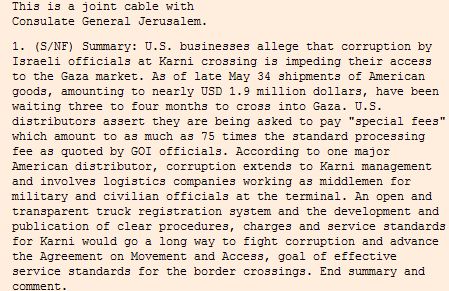
WikiLeaks: Israelis demanded bribes before allowing goods into Gaza

Reuters reports:

U.S. distributors accused Israel in 2006 of charging exorbitant fees to allow their goods into Gaza and an Israeli general admitted corruption existed at a major border crossing, a U.S. diplomatic cable shows.

The cable, obtained by WikiLeaks and published Thursday by the Norwegian newspaper Aftenposten, said frequent closures of the Karni crossing had “exacerbated the problem of access and appears to have forced up the cost of bribes” paid to Israelis.

The disclosures predate the 2007 armed takeover of the Gaza Strip, home to 1.5 million Palestinians, by Hamas Islamists hostile to the Jewish state. Israel has cited the Hamas threat in justifying a controversial blockade it has kept on Gaza, with Egyptian help.

“As of late May 34 shipments of American goods, amounting to nearly USD 1.9 million dollars, have been waiting three to four months to cross into Gaza,” said the cable, classified “secret” by the U.S. ambassador to Israel at the time, Richard Jones.

“U.S. distributors assert they are being asked to pay ‘special fees’ which amount to as much as 75 times the standard processing fee as quoted by GOI (Israeli government) officials.”

The cable quoted distributors for several U.S. companies complaining that payoffs were required to move their trucks to “a spot near the head of the so-called ‘Israeli line’,” which progressed more quicker to help Israelis supplying Palestinians.

“According to business contacts, allegations of corruption at Karni have a long history,” the cable said.

Facebooktwittermail

Another step towards fascism — Israeli parliament forms “committee of persecution”

Haaretz reports:

The Knesset plenum voted Wednesday to establish a parliamentary panel of inquiry to investigate left-wing Israeli organizations that allegedly participate in delegitimization campaigns against Israel Defense Forces soldiers.

The initiative, brought forth by Foreign Minister Avigdor Lieberman’s Yisrael Beiteinu faction, called primarily to investigate the sources of funding for these groups. The panel will essentially be charged with looking into where these groups have been attaining their funds, particularly whether this money is coming from foreign states or even organizations deemed to be involved in terrorist activities.

The knesset’s approval of the proposal comes after Attorney General Yehuda Weinstein ruled in August that no investigation should be launched against such groups. The initiative has been met with anger from both the opposition and human rights groups.

The discussion at the Knesset on Wednesday was charged, filled with heckling and interruptions. A significant number of security guards were on hand to prevent physical altercations between the opposing members of Knesset.

MK Fania Kirshenbaum (Yisrael Beiteinu ), who submitted the proposal, alleged during the debate that the groups targeted for investigation were to blame for foreign actions aimed at delegitimizing Israel and its officials.

“These groups provide material to the Goldstone commission [which investigated the Gaza war] and are behind the indictments lodged against Israeli officers and officials around the world,” Kirshenbaum said, referring to a series of arrest warrants issued over the last few years.

“They are trying to silence the very people who administrate the State of Israel’s foreign relations,” she declared. “These organizations are responsible for branding IDF soldiers as war criminals and encourage defamations.”

In her presentations, Kirshenbaum singled out one group which she claimed went into local Israeli schools to convince pupils that “joining the IDF is unethical” and to advise them how to dodge conscription. A panel of inquiry, said Kirshenbaum, would investigate just who was in charge of the bodies providing these Israeli groups with financial assistance.

While Yisrael Beiteinu had garnered a majority in favor of the proposal before it was brought to vote, the matter raised the ire of human rights groups and left-wing politicians alike.

Meretz MK Nitzan Horowitz called the initiative “a shame on the Knesset”, declaring Tuesday that: “The persecution campaign against human rights and citizens rights groups has reached a new low.”

The purpose of such a committee was essentially to silence criticism, Horowitz said, a move that should be seen as, “a brutal act of political persecution using a coalition majority and Knesset funding, under the legal guise of an investigation committee.”

“Human rights and citizens rights group save the honor of Israel in the world and maintain its character as a democratic state,” Horowitz said. “It is moves like that being led by Yisrael Beiteinu that lead to Israel’s delegitimization in the world and present Israeli democracy as fake. All to whom Israeli democracy is dear must oppose this committee of persecution.”

Sixteen human rights groups signed an open letter protesting the initiative, including ACRI, B’Tselem, Yesh Din, Machsom Watch, Adalah, Mossawa Center, Ir Amim and Hotline for Migrant Workers.

“Investigate us all, we have nothing to hide. You are invited to read our reports and our publications. We will be happy if for a change you relate in a germane way to our questions instead of trying to besmirch us. It did not work in the past and it will not work this time,” the letter said.

Facebooktwittermail

Israeli media acting like North Korean media

Didi Remez, whose blog is Coteret, provides a translation of an interview with the Israeli human rights attorney, Micheal Sfard, who appeared on Israel Defense Forces Radio yesterday morning.

Niv Raskin, IDF Radio: Now we turn to the IDF investigation on the death of protester Jawaher Abu Rahma. According to the IDF investigation, senior officers say it’s a kind of fabrication. The Bilin protester didn’t die of [tear] gas inhalation; she was a cancer patient. We want to talk about this issue with the family’s lawyer, Attorney Michael Sfard.

Attorney Michael Sfard: The IDF didn’t publish, its court journalists did.

Raskin: What do you mean?

Sfard: What I mean is that no IDF officer was willing to talk on-record. The IDF Spokesperson didn’t even put out a communiqué. Everything was done through journalists. They weren’t presented with even one document. I have never encountered such crazy fabricated blood libel.

Raskin: With your permission, let’s review the facts, at least as they were published. First, according to the reports, according to the investigation conducted by the IDF, there was no report of a wounded woman on Friday. According to those officers, at least, this casts doubt over whether she was at the protest at all.

Sfard: Niv, I don’t know where to start. There’s almost no word, no letter, of truth in the sentence you just uttered. And the most terrible thing is that I don’t know how Israeli media, which had the extraordinary courage to topple a Prime Minister [Olmert – DR] over corruption, acts like the North Korean media when it’s about something the IDF wants to achieve. There isn’t even one substantiating foundation for any of the components you described. Jawaher was at the protest. Dozens of people saw her there. I spoke to eyewitnesses who were beside her at the protest. Jawaher collapsed at the protest. She wasn’t sick like the IDF Spokesperson said on Friday. She didn’t have cancer as he’s saying today.

Raskin: Those officers ask why there aren’t photos of her at the protest when there dozens of photos from it.

Sfard: Because the IDF shot so much gas, that it was everywhere in the village and people all over were affected by it. The IDF has to this day refused order the opening of an [official] investigation. How is it supposed to obtain the photos? The Judge Advocate General hasn’t, until this very moment, ordered the opening of an investigation. So, on the one hand, they don’t open an investigation. On the other hand, they come up with these fabrications. If the IDF invested a tiny fraction of the energy it’s investing in fabrications, in investigating itself, lives would be saved because the IDF would know where its action were wrong.

Raskin: Let’s, with your permission, try to return to factual issues. The gaps in the timeline. According to the Palestinian medical reports, a blood sample was taken from Abu Rahme 40 minutes before she even arrived at the hospital. How does that work?

Sfard: Look at what we’re discussing. Do you know how many medical files I’ve seen where, under the pressure of a life threatening incident, someone wrote 2 instead of 3? That’s what’s important? According to what the IDF is telling journalists and journalists are telling us, is that she was a cancer patient. Is there one [real] journalist at Yediot this morning? Can the senior reporters — Nahum Barnea, Shimon Shiffer and Sever Plocker — ask the reporters and editors if they have one document substantiating the claim that she had leukemia? This is a farce! If we find an incorrect noting of a time, do we absolve the IDF of responsibility for her death?

Raskin: You’re criticizing the media?

Sfard: Of course.

Raskin: I’m not sure that’s the correct address. Someone gave them this version. Those were senior officers. Another allegation, they say, is that her clothes didn’t smell of tear gas, contradicting the Palestinian claims. They [also] talk about a quiet funeral, not the kind they have for Shahids [martyrs in Arabic — DR] and that the Palestinians usually know how to leverage [these funerals] for a PR advantage and that didn’t happen this time.

Sfard: Hold on, I want to understand, are you serious? The IDF is claiming that because it was a quiet funeral, she died from an illness and not by its hands? Is that a serious argument? So the IDF’s proof that she wasn’t at the protest is that there wasn’t rioting [at the funeral]? Look what’s become of us! I have to prove that there was or wasn’t a smell on Jawaher’s clothes when the IDF won’t investigate the incident? The IDF is talking about some kind of examination conducted by its officers. These aren’t people who know how to investigate.

Raskin: To summarize, bottom line, you’re saying that she wasn’t sick?

Sfard: What the hell? What sickness? She had an ear problem. We..really…her ear problem. Yesterday I got 20 calls from 20 reporters requesting an explanation what kind of problem she had with her ear. Let’s assume she had an ear problem. Does she deserve to die at a protest for it?

Raskin: A couple of days ago we spoke to her uncle who was with her at the protest. He said she was suffering from a kind of asthma and that she had suffered from respiratory problems over the past few years. That means that you can’t say she a clean medical record. Not that means anything. But it’s an important thing to say.

Sfard: Look, Niv. I’m not a Palestinian. I’m an Israeli and you’re an Israeli. I want to tell you..why not put out an orderly communiqué saying: ‘This is a tragic incident and we will investigate it. We use tear gas and other non-lethal weapons precisely so things like this won’t happen. We’ll look into how this happened.’ Then task the military police with a serious investigation, because a protester has died. This is important because, if an Israeli protester dies, it won’t matter what illness he had, the police will investigate seriously.

Raskin: Attorney Michael Sfard, representing the Abu Rahme family, thanks for joining us. I’ll just point out in this context that in contrast to what Attorney Sfard says, the item on the IDF investigation appears in all the [Israeli] media and not just in Yediot Aharonot, which Sfard attacked.

Facebooktwittermail

WikiLeaks: Israel told US it would keep Gaza near collapse

Reuters reports:

Israel told U.S. officials in 2008 it would keep Gaza’s economy “on the brink of collapse” while avoiding a humanitarian crisis, according to U.S. diplomatic cables published by a Norwegian daily on Wednesday.

Three cables cited by the Aftenposten newspaper, which has said it has all 250,000 U.S. cables leaked to WikiLeaks, showed that Israel kept the U.S. Embassy in Tel Aviv briefed on its internationally criticized blockade of the Gaza Strip.

The territory, home to 1.3 million Palestinians, is run by the Islamist Hamas group, which is shunned by the West over its refusal to recognize Israel, renounce violence or accept existing interim Israeli-Palestinian peace deals.

“As part of their overall embargo plan against Gaza, Israeli officials have confirmed to (U.S. embassy economic officers) on multiple occasions that they intend to keep the Gazan economy on the brink of collapse without quite pushing it over the edge,” one of the cables read.

Israel wanted the coastal territory’s economy “functioning at the lowest level possible consistent with avoiding a humanitarian crisis,” according to the November 3, 2008 cable.

Facebooktwittermail

How the Dubai debacle showcased Israeli arrogance and Mossad’s incompetence

In a feature article for GQ Magazine, Ronen Bergman, senior political and military analyst for the Israeli newspaper Yedioth Ahronoth, describes the rise and fall of Israel’s Mossad under the leadership of Meir Dagan.
“Dagan’s unique expertise,” Israeli prime minister Ariel Sharon once said, “is the separation of an Arab from his head.”

Under Dagan’s command, dozens of Mossad’s elite operatives are now fugitives as a result of the bungled assassination of the Hamas commander, Mahmoud Al-Mabhouh, in Dubai in January 2010.

The organization Dagan is credited with having resuscitated from a coma has now been thrown into disarray.

[I]n 2002, Prime Minister Ariel Sharon tapped Dagan, a former military commander with a reputation for ruthless, brutal efficiency, to restore the spy agency to its former glory and preside over, as he put it, “a Mossad with a knife between its teeth.” “Dagan’s unique expertise,” Sharon said in closed meetings, “is the separation of an Arab from his head.”

Notorious for his aggressive, verbally abusive style of leadership, he is an ideologically rigid man who, according to several people inside the organization, shows the door to anyone who dares to voice an opinion different from his. As one Mossad veteran told me, “It is extremely difficult to get your opinion heard in his presence, unless it supports his. He is unable to accept criticism or even another opinion. It’s almost as if he treats his opposition like an enemy.” Dagan is also reported to have stated on several occasions that he does not believe there is anyone within the Mossad today who is worthy to replace him.

Bergman provides a detailed account of the Dubai operation and the numerous mistakes made by the Israelis in spite of the risks they were running, operating in a hostile country.

As far as the Mossad is concerned, there are two types of countries in the world. There are “base countries” (essentially, the West), in which the Mossad, like most other intelligence agencies, is able to operate with relative ease. In these countries, operatives have access to multiple getaway routes in case of emergency (and there are Israeli embassies to escape to as a last resort); it is assumed that if a Mossad spy is caught in a base country, a discreet solution can likely be found with the assistance of the local intelligence services—an option referred to in the Mossad as the “soft cushion”). “Target countries,” however, are enemy states in which operating undercover is significantly more dangerous. There are no easy escape routes (and no friendly embassy to run to), and being caught in these countries will almost certainly result in physical torture and either a protracted jail term or, quite possibly, death.

[On January 19, 2010] Al-Mabhouh is expected to land in Dubai at 3 p.m. At 1:30, Kevin Daveron [who along with Gail Folliard and Peter Elvinger were the operation’s commanders — each of these being assumed names] leaves his hotel and heads to the team’s designated meeting place—the lobby of a different hotel, where none of the team members is staying, that was selected in advance for its convenient location. On the way to the meeting, he walks through the lobby of a third hotel and enters the rest­room. When he emerges, he is no longer bald but now has a full head of hair and is wearing glasses. The security camera outside the entrance to the men’s and women’s bathrooms was recording all of this in real time. Had an alert guard noticed what was going on, the mission might have ended quite differently, with the target alive and the team members imprisoned in a hostile country.

Gail Folliard also leaves her hotel and on her way to the meeting uses the same restroom entrance as Daveron, from which she too emerges in a wig. Oddly, Folliard and Daveron are the only ones at the meeting who have changed their appearances. Given that the operatives are under the constant gaze of security cameras throughout the city, the “new” Daveron and Folliard run the risk of being linked to the “old” Daveron and Folliard through the identity of the individuals they’ve met with and passed by throughout the day—the kind of mistake that is almost incomprehensible for an elite Mossad team to make.

Despite the fact that Dubai is a hostile environment—a distant Arab state with ties to Iran—many details of the mission suggest the Mossad treated it as if they were operating inside a base country. The use of Payoneer cards is one obvious example. For the most part, prepaid debit cards are only used domestically within the United States, and while Payoneer does issue debit cards that are valid internationally, these are relatively rare. That several of the team members were using the same type of unusual card issued by the same company—one whose CEO, Yuval Tal, is a veteran of an elite Israeli Defense Force commando unit—gave the Dubai police a common denominator to connect the various members of the team.

Why did the Mossad permit things to go so wrong in Dubai? In a word, the answer is leadership. Because Dagan refashioned the Mossad in his own image, and because he drove out anyone who was willing to question his decisions, there was no one in the agency to tell him that the Dubai operation was badly conceived and badly planned. They simply did not believe that a minnow in the world of intelligence services such as Dubai would be any match for Israel’s Caesarea fighters.* As one very senior German intelligence expert told me: “The Israelis’ problem has always been that they underestimate everyone—the Arabs, the Iranians, Hamas. They are always the smartest and think they can hoodwink everyone all the time. A little more respect for the other side—even if you think he is a dumb Arab or a German without imagination—and a little more modesty would have saved us all from this embarrassing entanglement.”

The Dubai fiasco caused a great deal of damage to Israel, to the Mossad, and to its relations with other Western intelligence organizations. It led to unprecedented revelations of Mossad personnel and methods, far more than any previous bungled operation. A number of states who believe that their passports were forged or otherwise misused by the agency have expelled Mossad representatives. The British response in particular was furious. And Israel’s long-standing security-and-intelligence cooperation with Germany has also been dealt a hugely damaging blow. In early June, the head of the Caesarea unit in the Mossad—who had been considered the leading contender to eventually replace Dagan—offered his resignation. As for Dagan’s future, before Dubai he had hoped that the liquidation of Al-Mabhouh would ensure yet another extension of his tenure as director of the agency. But that has not come to pass. At the time of this writing, it is assumed that he will not continue. And so the Mossad “with a knife between its teeth” likely is entering another period of confusion and self-doubt.

“There is no doubt Dagan received an organization on the verge of coma and brought it back to its feet,” one Mossad veteran of many years told me. “He increased its budget, won great successes, and most important, he rebuilt its pride. The problem is that multiplying its volume of activity many times over came with the price of compromising on security protocols. And along with success came hubris. Together, they brought the Dubai debacle. And now, in some areas, his successor will find a Mossad even worse off than Dagan found in 2002.”

*Most of the operatives here are members of a secretive unit within the Mossad known as Caesarea, a self-contained organization that is responsible for the agency’s most dangerous and critical missions: assassinations, sabotage, penetration of high-security installations. Caesarea’s “fighters,” as they are known, are the elite of the Mossad. They rarely interact with other operatives and stay away from Mossad headquarters north of Tel Aviv, instead undergoing intensive training at a separate facility to which no one else in the agency has access. They are forbidden from ever using their real names, even in private conversation, and—with the exception of their spouses—their families and closest friends are unaware of what they do. As one longtime Caesarea fighter recently told me, “If the Mossad is the temple of Israel’s intelligence community, then Caesarea is its holy of holies.”

Facebooktwittermail

The conventional right-wing wisdom in Israel

Yaniv Reich at Hybrid States notes:

A brilliant, must-see video by the Eretz Nehederet show in Israel.

What is most remarkable about this short satirical piece is how realistic it is. It can be considered satire, but it unfortunately reflects far too common thoughts that have infected Israeli critical thinking capacities. Like conservatives who can’t tell that Stephen Colbert is mocking them, I suspect a number of right-wing Israeli hacks will self-identify with this video. Maybe they’ll even try to redesign early childhood education around these innovative ideas.

Facebooktwittermail

Israeli military tries to cover up killing of an unarmed Palestinian protester

As was widely reported on Saturday, Jawaher Abu Rahmah, a 36 year-old Palestinian woman from Bilin, died after inhaling tear gas at a demonstration in the West Bank village on Friday.

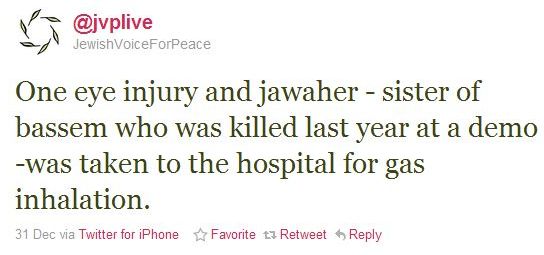
The moment at which Jawaher was evacuated by ambulance from the scene was recorded by Rebecca Vilkomerson Emily Schaeffer from Jewish Voice for Peace who tweeted: “One eye injury and jawaher — sister of bassem who was killed last year at a demo — was taken to the hospital for gas inhalation.”

Israeli Defense Forces officials are now propagating disinformation through a network of right-wing bloggers and stooges in the Israeli press, suggesting the Jawaher did not even attend the demonstration.

One such blogger, The Muqata, who attended an “exclusive” IDF briefing — exclusive, presumably, to bloggers willing to parrot whatever they were told — said: “We have never heard of anyone dying from inhaling tear gas…”

The U.S. Army Center for Health Promotion and Preventive Medicine warns that at a concentration of 2mg per cubic meter, CS gas “is immediately dangerous to life…” The Army advises, in the event of inhalation: “remove the victim to fresh air immediately; perform artificial respiration if breathing has stopped; keep the victim warm and at rest; seek medical attention immediately.”

The goal of the IDF and its apparatchiks is to sow doubt. But as Jerry Haber at The Magnes Zionist writes:

Even an idiot can see that the IDF is using the same “methodology” that Holocaust deniers use to raise questions about the number of Jews killed, or the presence of gas chambers to kill Jews, etc. That methodology is to “raise questions,” to “point out contradictions”, to suggest that the evidence is not convincing, to insinuate that those who make the claims are not to be trusted.

What is equally evident is that at a time when barely a day goes by without new evidence emerging of the racism which is endemic across Israel, the IDF feels acutely vulnerable when its disregard for human life is once again in the spotlight.

Denial is another name for desperation.

Facebooktwittermail