Category Archives: Israel

New Mossad chief to apologise for use of UK passports in Dubai killing

The Daily Telegraph reports:

The new head of Israel’s secret service, Mossad, is ready to apologise for the use of forged British passports during the assassination of a leading Hamas militant in Dubai.

Tamir Pardo, who took over as Mossad’s chief earlier this month, will also promise that Israeli agents will never again be allowed to use fake British documents during operations abroad.

Facebooktwittermail

Benjamin Netanyahu, inciter-in-chief

Yossi Gurvitz writes:

A strange dialogue took this place between grassroots rightwing activists and the government. A demonstration was held in Bat Yam under the slogan of fighting the Arabs, with an emphasis on the fear of “assimilation”, or, to use the more accurate and less laundered term, defilement of blood. One of the participants called for the killing of Jewish women who date Arabs. Even the Nazis didn’t go that far.

A significant number of the Bat Yam demonstrators appeared, one day later, in southern Tel Aviv. They even (Hebrew) carried the same placards: “Jews, Let’s win! The Daughters of Israel to the People of Israel”. There is no difference between the hate of the African refugees, against whom the demo in Tel Aviv was intended, and the hatred of Arabs; it’s the same hatred of non-Jews. While the southern Tel Aviv demo was officially against “foreign workers”, it was in southern Tel Aviv that five Israeli citizens, one of them an IDF veteran, were forced to evacuate their apartment, under threat of it being set on fire while they were inside (Hebrew). Their crime? Having the wrong blood. This was no idle threat, by the wat: Jewish terrorists of the Hatikva neighborhood – part of southern Tel Aviv – firebombed two apartments in 2008, because Arabs were residing there (Hebrew). This week, as the hate was on full burner, someone threw a burning tyre full of incendiaries into an Ashdod apartment, where five Sudanese refugees lived; they barely survived it (Hebrew).

As far as both the inciters and the crowd they gather care, there is no difference between the refugees and the Arbas: both of them foreigners, and both of them are considered to be a threat – psychologically if not actually.

Facebooktwittermail

Cables reveal Israel welcomed Hamas takeover of Gaza

If mainstream media reports and government statements could be relied upon, the Bush administration and the Israeli governments led by Ariel Sharon and then Ehud Olmert were perpetually of one mind — Washington simply mirrored Jerusalem. But newly-released cables indicate that when it came to views about Hamas’ control of Gaza, there was in 2007 a significant divergence of opinion. While a plan hatched by Elliot Abrams for a US-supported Fatah coup to unseat the democratically-elected Hamas government, was rapidly unraveling, the Israelis said they would be pleased to see Hamas assume complete control of Gaza.

A cable describing a June 12, 2007 meeting between US Ambassador Richard Jones and Israeli Military Intelligence Director Amos Yadlin indicated that Israel regarded Gaza as less of a threat than Iran, Syria or Hezbollah. At the height of the eight-day battle between Hamas and Fatah for the control of Gaza, the cable said:

The Ambassador commented that if Fatah decided it has lost Gaza, there would be calls for Abbas to set up a separate regime in the West Bank. While not necessarily reflecting a consensus GOI [Government of Israel] view, Yadlin commented that such a development would please Israel since it would enable the IDF to treat Gaza as a hostile country rather than having to deal with Hamas as a non-state actor. He added that Israel could work with a Fatah regime in the West Bank. The Ambassador asked Yadlin if he worried about a Hamas-controlled Gaza giving Iran a new opening. Yadlin replied that Iran was already present in Gaza, but Israel could handle the situation “as long as Gaza does not have a port (sea or air).” [Emphasis mine.]

Implicit in Yadlin’s remarks was the view that Hamas’ control of Gaza would make it easier for Israel to control the territory from the air with more frequent missile attacks.

As the US ambassador questioned the Israeli intelligence chief, one has to wonder whether either of them had been briefed on the Abrams plan.

In a report published by Vanity Fair in April 2008, David Rose wrote:

Vanity Fair has obtained confidential documents, since corroborated by sources in the U.S. and Palestine, which lay bare a covert initiative, approved by Bush and implemented by Secretary of State Condoleezza Rice and Deputy National Security Adviser Elliott Abrams, to provoke a Palestinian civil war. The plan was for forces led by [Palestinian Authority National Security Advisor Muhammad] Dahlan, and armed with new weapons supplied at America’s behest, to give Fatah the muscle it needed to remove the democratically elected Hamas-led government from power. (The State Department declined to comment.)

But the secret plan backfired, resulting in a further setback for American foreign policy under Bush. Instead of driving its enemies out of power, the U.S.-backed Fatah fighters inadvertently provoked Hamas to seize total control of Gaza.

Some sources call the scheme “Iran-contra 2.0,” recalling that Abrams was convicted (and later pardoned) for withholding information from Congress during the original Iran-contra scandal under President Reagan. There are echoes of other past misadventures as well: the C.I.A.’s 1953 ouster of an elected prime minister in Iran, which set the stage for the 1979 Islamic revolution there; the aborted 1961 Bay of Pigs invasion, which gave Fidel Castro an excuse to solidify his hold on Cuba; and the contemporary tragedy in Iraq.

Within the Bush administration, the Palestinian policy set off a furious debate. One of its critics is David Wurmser, the avowed neoconservative, who resigned as Vice President Dick Cheney’s chief Middle East adviser in July 2007, a month after the Gaza coup.

Wurmser accuses the Bush administration of “engaging in a dirty war in an effort to provide a corrupt dictatorship [led by Abbas] with victory.” He believes that Hamas had no intention of taking Gaza until Fatah forced its hand. “It looks to me that what happened wasn’t so much a coup by Hamas but an attempted coup by Fatah that was pre-empted before it could happen,” Wurmser says.

The botched plan has rendered the dream of Middle East peace more remote than ever, but what really galls neocons such as Wurmser is the hypocrisy it exposed. “There is a stunning disconnect between the president’s call for Middle East democracy and this policy,” he says. “It directly contradicts it.”

While media reports at that time described the fight between Hamas and Fatah as being a “Hamas coup”, the Israeli intelligence chief did not see Hamas’ attacks as “part of a premeditated effort to wipe out Fatah in Gaza.”

What is transparent in both the Abrams plan and also now revealed in several cables, is that when it comes to the partnerships Israel and the US have backed with the Palestinians, whether Palestinian leaders had political legitimacy or popular support was of little concern — the sole requirement was that Israel/US work with Palestinians willing to place Israel’s interests first. In other words, Israel wanted to back a Palestinian leadership which would be incapable of surviving without Israeli support.

In a June 11, 2007 meeting between the US ambassador and Yuval Diskin, the head of Israel’s internal security service, Shin Bet, the Israeli described a “very good working relationship” with a Palestinian intelligence chief, Tawfik Tirawi, who he described as “psychopathic, cruel, dangerous and prone to extreme mood swings.”

In the West Bank, Diskin said that ISA [Shin Bet] has established a very good working relationship with the Preventive Security Organization (PSO) and the General Intelligence Organization (GIO). Diskin said that the PSO shares with ISA almost all the intelligence that it collects. They understand that Israel’s security is central to their survival in the struggle with Hamas in the West Bank. [Emphasis mine.]

Facebooktwittermail

Israel takes urgent action to counter Palestine’s rising diplomatic status

Haaretz reports:

After reports reached Jerusalem that the Palestinian Authority is trying to persuade about a dozen European Union member states to upgrade the PA’s diplomatic status, the Foreign Ministry on Monday ordered every Israeli envoy abroad to begin “urgent” diplomatic activity. The aim is to thwart Palestinian efforts at drafting a United Nations resolution that would recognize a unilateral declaration of statehood and put international pressure on Israel to halt settlement construction.

Acting Foreign Ministry Director General Rafael Barak sent a classified cable to Israeli charges d’affairs, in which he called for an immediate public relations campaign at the bureaus of the premiers, foreign ministers and parliament in each country.

The PA is in the midst of three diplomatic activities aimed at the international community, Barak wrote in the cable: advancing a UN Security Council resolution condemning settlement construction, securing international recognition of a Palestinian state within the 1967 borders, and improving the diplomatic stance of Palestinian representatives in Europe, East Asia and Latin America.

Israeli officials expect Ecuador to shortly announce it is joining Brazil, Argentina, Uruguay and Bolivia in recognizing a Palestinian state within the 1967 borders. Deputy Foreign Minister Danny Ayalon called his counterparts in Mexico and Chile in the past few days and asked them not to make a similar move. He also asked senior officials in the Obama Administration to support Israel’s stance in Central and South America.

Akiva Eldar writes:

Attaining a permanent settlement with the Palestinians appears to be about as likely as the opening of an Iranian embassy in “united” Jerusalem. Almost no day goes by without some other country recognizing a Palestinian state within the 1967 borders. According to the WikiLeaks documents, even the Germans, Israel’s steadfast supporters in Europe, have lost their faith in the peaceful intentions of Benjamin Netanyahu’s government. Even loyal partner Ehud Barak and Nobel Peace laureate Shimon Peres have ceased to praise the “new Bibi.”

There is even the hope that the Labor ministers – who constitute the shriveled fig leaf of the prime minister – have discovered the emotion called shame and the option called opposition.

And then, just when it seemed that the deterioration in Israel’s international standing and the cracks at home would open the eyes of the Israeli public, the Jewish-American Superman soars in the skies over the Capital Hill.

He shows the Jewish-Israelis that there is no need to be frightened by the U.S. president, that there is no need to be unnerved by the Europeans and that the United Nations remains insignificant.

The Superman (or woman) strikes a winning blow against the claim of the “defeatists” that it is impossible to conduct negotiations over a piece of land while building on it at the same time. This figure proves that Israel can block U.S. efforts to advance negotiations toward the establishment of a Palestinian state, and then block the efforts of the international community to recognize such state. Our current Superman sells the illusion that the Jewish and Democratic state can exists indefinitely in the Middle East without bringing the violent conflict to an end.

This Superman is the chairman of the House Foreign Affairs Committee, Howard Berman.

Facebooktwittermail

The racist wave overflowing Israel

Ynet reports:

After a rabbis’ letter instructing Jews to not sell or rent apartments to Arabs, racist behavior reaches new low: An organization called Jews for a Jewish Bat Yam is expected to protest on Monday against the “assimilation of young Jewish women with Arabs living in the city or in nearby Jaffa.”
[…]
During the past week, posters have been hung around the city calling residents to come out and protest. Some of the posters explain: “I will not allow them to hit on my sister! What would you do if an Arab hit on your sister? Put an end to it! Recently we have learned of a grave phenomenon: Hundreds of girls from Bat Yam and the center get together with Arabs, they are integrated amongst us, their confidence rising. Put an end to it! Lower their confidence!”

Another poster reads: “Keeping Bat Yam Jewish. Arabs are taking over Bat Yam, buying and renting apartments from Jews, taking and ruining Bat Yam girls! Around 15,000 Jewish girls have been taken to villages! Jews, come on, let’s win!”

Facebooktwittermail

Threat of civil war looms in Lebanon

The Guardian reports:

More than six months of menacing political rhetoric is likely to reach a potent day of reckoning in Lebanon soon when indictments are handed down after a five-year investigation to determine who killed the fragile state’s former leader Rafik Hariri.

The indictments are almost certain to implicate at least three members of the militia group and political powerhouse Hezbollah in the 2005 assassination of the elder statesman and patron to the country’s Sunni Muslims.

The potential implications of that have taken Lebanon to a point that veterans of the country’s civil war had vowed never to allow again.

Tensions are palpable on the streets of Beirut, which has cast itself as a city that rose from the ashes of the 15-year conflict as a cosmopolitan and tolerant capital. Now, a generation on, residents of the city and enclaves around the country are demonstrably falling in behind sectarian positions. Many fear that bloodshed cannot be avoided.

“You are not wrong,” said a former president, Amin Gemayel, when asked about a sense of foreboding. “This is the most dangerous period in Lebanon for many, many years.”

“Israel cannot defeat Hezbollah in a direct engagement and the Lebanese guerrilla group would inflict heavy damage on the Israeli home front if war broke out, a former Israeli national security adviser said Thursday,” Reuters reports.

“Israel does not know how to beat Hezbollah,” said Giora Eiland, an army ex-general who served as national security adviser to former prime ministers Ariel Sharon and Ehud Olmert.

“Therefore a war waged only as Israel-versus-Hezbollah might yield better damage on Hezbollah, but Hezbollah would inflict far worse damage on the Israeli homefront than it did 4-1/2 years ago,” he told Israel Radio.
Echoing serving Israeli officials, Eiland said:

“Our only way of preventing the next war, and of winning if it happens anyway, is for it to be clear to everyone … that another war between us and Hezbollah will be a war between Israel and the state of Lebanon and will wreak destruction on the state of Lebanon.

Eiland went on to say: “Our only way of preventing the next war, and of winning if it happens anyway, is for it to be clear to everyone … that another war between us and Hezbollah will be a war between Israel and the state of Lebanon and will wreak destruction on the state of Lebanon.”

He calls this “effective deterrence,” but it can also be viewed as an effort to incite civil war by suggesting to Hezbollah’s enemies that if they don’t break Hezbollah’s power, then everyone in Lebanon will suffer the consequences.

The latest evidence of Israel’s efforts to interfere in Lebanese affairs was revealed yesterday.

Haaretz reports:

Lebanese television published Thursday photos of spy installations that the Lebanese Army had found in mountainous areas near Beirut, showing one of the devices bearing Hebrew writing.

The Lebanese Army said Wednesday it had uncovered two Israeli spy installations in mountainous areas near Beirut and the Bekaa Valley – one on Sannine mountain and another on Barouk mountain.

The photos released Thursday show a device bearing the words “mini cloud” in Hebrew, along with the name of the manufacturer – “Beam Systems Israel Ltd.” – in English.

According to reports, the installations included photographic equipment as well as laser and broadcast equipment.

Earlier Thursday, the Voice of Lebanon radio station reported that the explosion heard in Lebanon late Wednesday was an Israel Air Force operation aimed at destroying an espionage device it had installed off the coast of the city of Sidon.

Amos Harel and Avi Issacharoff add:

Since the beginning of 2009, Lebanese intelligence, with the aid of Hezbollah and apparently Iran, have been trying to uncover what has been called an extensive spy network operating on Israel’s behalf.

More than 100 Lebanese civilians and soldiers have been arrested as part of this effort, including fairly senior Lebanese Army officers.

According to Hezbollah, eavesdropping equipment was planted in the cars of the senior Hezbollah leadership.

Israel has never responded to the reports from Lebanon.

Reports from Lebanon need to be understood in the context of rising political tensions as The Hague’s Special Tribunal for Lebanon prepares to announce an indictment against senior Hezbollah officials in connection with the death of Prime Minister Rafik Hariri, the father of the current premier, Saad Hariri.

The discovery of further supposed Israeli spy activity in Lebanon serves Hezbollah interests by reminding the Lebanese public that Israel, not Hezbollah, is the real enemy.

Facebooktwittermail

Israel never really wanted peace

Elie Podeh writes:

To a great extent, Netanyahu and his cabinet are representative of Israeli society today. Public opinion polls point to increasing extremism, bordering on racism, in Jews’ opinion of Arabs, as well as to alienation and a distrust of the other side’s goals and intentions. Given these circumstances, it’s no wonder there is no public pressure on the government to advance the peace process and that there was no significant public response to the dramatic announcement that the talks had been suspended.

When it comes to peace, Israel’s position today is similar to its position after the wars of 1948 and of 1967: The potential for negotiations was there, but the cost was considered too high. Now, too, maintaining the status quo appears to be preferable to making changes that Israelis perceive as threatening, even if they do not necessarily pose a genuine danger.

In the past decade, Israel has faced a number of Arab initiatives: the Arab League peace plan, Syrian offers to negotiate, Palestinian willingness to move forward and even moderate declarations from Hamas. Successive Israeli governments responded to all of them with restraint and icy indifference (with the exception of the waning days of Ehud Olmert’s term as prime minister ).

Israel’s listless response to these proposals cannot be understood as coincidental or circumstantial; it is a pattern of behavior. And Israel has never proffered its own initiative that would indicate a desire for peace. This leads us to the unhappy conclusion that Israel – both its government and its people – are not really interested in peace; at most, they make the sounds of peace, but that is not enough.

Facebooktwittermail

Middle East peace process: Dead but not buried

In an age where the newspaper editorial has become an anachronism, few are worth reading. This, from The Guardian, is an exception and for that reason I include the whole piece.

The Middle East peace process died a quiet, undramatic death with the statement last week that the US had given up trying to persuade Binyamin Netanyahu to stop building on occupied land as a prerequisite to direct talks with the Palestinians. Few, however, are interested in burying the corpse.

The rightwing coalition under Mr Netanyahu is relaxed about the failure to restart the talks, because half the cabinet do not accept that they are occupying any land other than their own. And anyway, every day without a final status agreement is another day when the cement mixers can whirl and the cranes swivel. Palestinian leaders who recognise Israel are also reluctant to make good their pledges to resign, because they, too, would lose position, power and political meaning. Fatah has still legitimacy, but where would the Palestinian Authority be in Palestinian eyes other than as a surrogate for Israeli soldiers?

The US is unwilling to set a date for the funeral, because to recognise that a death had taken place would entail an inquest and an examination of 18 fruitless years of failed attempts. And that is the last thing a US president fighting re-election will do. The radical part of Barack Obama’s Middle East strategy has already been and gone. He has spent his political capital and needs to conserve the dimes in his pocket. All of these are compelling short-term reasons for doing nothing, for saying, as if this has not been said often enough in the past, that the time is not ripe, the leaders are too weak, the sides are not ready. But they are dreadful long-term ones. Israel will continue to impose its own one-state solution, with separate roads, and separate governance for Jew and Arab. The Palestinian leadership will continue weak and divided. The argument that Hamas and other militant groups use, that Israel makes territorial concessions only when it is forced to, will grow in resonance. And, inch by inch, the next conflict – be it in the form of a strike on Iran, or a third Palestinian uprising – will come closer. Doing nothing is not just the counsel of despair. In the asymmetry of relations between the growing state of Israel and the shrinking non-state of Palestine, doing nothing is a deeply partisan act.

There are political moves that could release the log jam. Israel’s Labour party could pull out of the coalition, making good on frequent threats to do so. If its leader, Ehud Barak, was right when he said that there is a contradiction between the structure of the government and the chance of promoting negotiations, and he is, then Labour should pull out. President Mahmoud Abbas should also consider steps that would end the current sham. If, in his words, he is presiding over an authority without any authority, and if he is right when he says that the PA’s very existence has made Israel’s occupation the cheapest ever, it is time to end this state of affairs. What exactly is there to lose? Disbanding the PA would mean a return to direct occupation, and seeking UN recognition of a Palestinian state, or handing over responsibility for the Palestinian territories to the UN, would attract a US veto. But if this US president or any future US president were pushed to the point at which the US could abstain in such a vote, all bets would be off.

The contradiction at the heart of US policy is that its support for Israel is unconditional. Even the offer of billions of dollars of aid did not turn Mr Netanyahu’s head, because he knew, if he refused, the flow of US money and weaponry would continue unabated. Any future US president, not just the current one, must calibrate the relationship with Israel as the US does with any other ally. The cost of each new housing unit built in occupied territory should be deducted off US aid. The realities that make such a measure inconceivable today do not lessen the case for such moves tomorrow. They make them compelling.

Facebooktwittermail

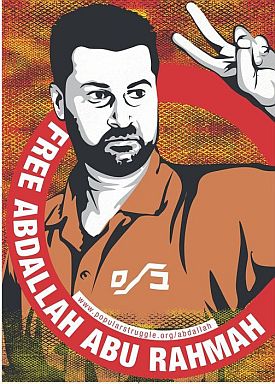
A message from Israeli military prison on International Human Rights Day

Majida Abu Rahmah writes:

A year ago tonight, on International Human Rights Day, our apartment in Ramallah was broken into by the Israeli military in the middle of the night and I was torn away from my wife Majida, my daughters Luma and Layan, and my son Laith, who at the time was only nine months old.

As the coordinator of the Bil’in Popular Committee against the Wall and Settlements I was convicted of “organizing illegal demonstrations” and “incitement.” The “illegal demonstrations” refer to the nonviolent resistance campaign that my village has been waging for the last six years against Israel’s Apartheid Wall that is being built on our land.

I find it strange that the military judges could call our demonstrations illegal and charge me for participating in and organizing them after the world’s highest legal body, the International Court of Justice in The Hague, has ruled that Israel’s wall within the occupied territories is illegal and must be dismantled. Even the Israeli supreme court ruled that the Wall’s route in Bil’in is illegal.

I have been accused of inciting violence: this charge is also puzzling. If the check points, closures, ongoing land theft, wall and settlements, night raids into our homes and violent oppression of our protests does not incite violence, what does?

Despite the occupations constant and intense incitement to violence in Bil’in, we have chosen another way. We have chosen to protest nonviolently together with Israeli and International supporters. We have chosen to carry a message of hope and real partnership between Palestinians and Israelis in the face of oppression and injustice. It is this message that the Occupation is attempting to crush through its various institutions including the military courts. An official from the Israeli Military Prosecution shamelessly told my Attorney, Gaby Lasky, that the objective of the military in my prosecution is to “put an end” to these demonstrations.

Facebooktwittermail

Israel progresses down the path to isolation

Peter Beinart facetiously congratulates Benjamin Netanyahu now that he’s thwarted President Obama’s Middle East peace efforts.

Now all you have to worry about is…Argentina. You see, Argentina just recognized a Palestinian state on 1967 borders. Brazil did so days earlier. Uruguay and Paraguay are expected to follow suit, and then Bolivia and Ecuador. Oh, and you have a small problem with rock stars: last year Elvis Costello and Carlos Santana cancelled Israel gigs because of the occupation, and more seem poised to follow. Dock workers are another worry: from Sweden to South Africa, they keep protesting the occupation and the Gaza blockade by refusing to offload Israeli goods. And then there’s Hanna King, the 17-year-old Swarthmore freshmen who along with four other young American Jews disrupted your speech last month in New Orleans because, as she told Haaretz, “settlements…are contrary to the Jewish values that we learnt in Jewish day school.” You should probably expect young Jews like her to protest all your big American speeches from now on.

I know, I know. You consider all this unfair, and in some ways it is. But when you’ve been occupying another people for 43 years, confiscating more and more of their land and denying them citizenship while providing it to your own settlers, it doesn’t do much good to insist that things are worse in Burma. Your only effective argument against the Elvis Costellos and Hanna Kings was that you were trying to end the occupation. That’s where Obama came in. As long as the U.S. president seemed to have a chance of brokering a deal, his efforts held the boycotters and protesters and Palestinian state-recognizers at bay. When Brazil and Argentina recognized Palestinian independence, the American Jewish Committee’s David Harris declared it “fundamentally unhelpful to the Arab-Israeli peace process.” But what if there is no peace process? What’s your argument then? Maybe you can tell the Ecuadorians that Israel deserves Hebron because Abraham bought land there from Ephron the Hittite.

Rest assured, the Obama administration won’t go along with these efforts to punish and isolate you. It may even denounce them. But as you may have noticed, the world doesn’t listen to America like it used to. Non-Americans have grown tired of hearing that only the U.S. can broker a deal, especially because you’ve now shown that to be false. And so the dam preventing countries and institutions from legitimizing Palestine and delegitimizing Israel may soon break. You didn’t like the American way? Get ready for the Brazilian way.

Facebooktwittermail

US ditches effort to get Israel to extend settlement slowdown

I guess Hillary Clinton already has her hands full overseeing the State Department’s UN credit card number theft operations along with coordinating cyber attacks on WikiLeaks — the Middle East peace process would just have to go on the back burner. There will be a statement tomorrow.

I wonder whether Israel still gets a free squadron of F-35 striker jets, for… well, just for being Israel. On the other hand, the US could consider offering firefighting equipment instead of fighter jets.

The decision to throw in the towel on getting a paltry three-month extension of the settlement slowdown is not “a retreat,” the Washington Institute for Near East Policy’s David Makovsky tells Politico. That’s true. You can only retreat if you first advance.

Laura Rozen reports:

The United States has decided to abandon an effort to persuade Israel to issue a new temporary West Bank settlement moratorium in order for direct Israeli-Palestinian peace talks to resume, U.S. officials said Tuesday.

“After consulting with the parties, we have determined that a moratorium extension will not at this time provide the best basis for resuming negotiations,” a U.S. official said on the condition of anonymity Tuesday.

“We are still going to continue our engagement with both sides on the core issues and we continue to work towards the goal of a framework agreement,” the official said.

“We hope, obviously, to get the parties to direct talks, but in the meantime, we will continue our engagement with both sides,” the official said, declining to use the word “proximity” in reference to the talks. “We are not changing course. We are still very much committed” to getting a framework agreement.

Secretary of State Hillary Clinton is due to make a statement Wednesday on the Middle East peace process. On Friday, Clinton will speak to the Saban forum, which will also be addressed by Palestinian Nation Prime Minister Salam Fayyad and Israeli Defense Minister Ehud Barak.

There will be “no dramatic change” in policy that Clinton announces, a second U.S. official said Tuesday on condition of anonymity.

State Department spokesman PJ Crowley insists: “The process has not stopped. We obviously recognize that, we face a difficult obstacle, and we will continue to engage the parties on the way forward.”

Meanwhile, Brazil and Argentina are showing another way forward which does not depend on the ineffectual Obama administration: recognizing the state of Palestine.

Facebooktwittermail

The Carmel catastrophe is burning all illusions in Israel

Turkish firefighters arriving in Israel after Netanyahu declares, 'We do not have what it takes to put out the fire, but help is on the way.'

Max Blumenthal puts the Carmel forest fire in context.

“When I look out my window today and see a tree standing there, that tree gives me a greater sense of beauty and personal delight than all the vast forests I have seen in Switzerland or Scandinavia. Because every tree here was planted by us.”
– David Ben Gurion, Memoirs

“Why are there so many Arabs here? Why didn’t you chase them away?”
– David Ben Gurion during a visit to Nazareth, July 1948

Four days after Israeli Prime Minister Benjamin Netanyahu announced plans to place thousands of migrant workers in a prison camp deep in the Negev Desert because, as he claimed, they pose a “threat to the character of [the] country,” a burning tree trunk fell into a bus full of Israeli Prison Service cadets, killing forty passengers. The tree was among hundreds of thousands turned to ash by the forest fire pouring across northern Israel, and which now threatens to engulf outskirts of Haifa, Israel’s third-largest city. Over the last four days, more than 12,300 acres have burned in the Mount Carmel area, a devastating swath of destruction in a country the size of New Jersey. While the cause of the fire has not been established, it has laid bare the myths of Israel’s foundation.

Israelis are treating the fire as one of their greatest tragedies in recent years. A friend who grew up in the Haifa area told me over the weekend that he was devastated by the images of destruction he saw on TV. His friend’s brother was among those who perished in the bus accident. Though he is a dedicated Zionist who supported Netanyahu’s election bid in 2008, like so many Israelis, he was furious at the response — or lack of one — by the government. “Our leaders are complete idiots, but you already know that,” he told me. “They invested so much to prepare for all kinds of crazy war scenarios but didn’t do anything to protect civilians from the basic things you are supposed to take for granted.”

On 3 December, Netanyahu informed the country, “We do not have what it takes to put out the fire, but help is on the way.” To beat back the blaze, Bibi has had to beg for assistance from his counterpart in Turkey, Recep Tayyip Erdogan, the Western-backed Palestinian Authority and Israel’s American and British patrons. Israel is a wealthy country which boasts to the world about its innovative spirit — its US-based lobbyists market it as a “Start-Up Nation” — but its performance during the forest fire revealed the sad truth: its government has prioritized offensive military capacity and occupation maintenance so extensively that it has completely neglected the country’s infrastructure, emergency preparedness and most of all, the general welfare of its citizens.

Facebooktwittermail

Israel on Iran: So wrong for so long

Justin Elliot looks back at Israel’s repeated predictions that Iran would soon acquire nuclear weapons.

Officials at the U.S. Department of State, we learned from the secret cables released by WikiLeaks last week, have serious questions about the accuracy — and sincerity — of Israeli predictions about when Iran will obtain a nuclear weapon. As one State official wrote in response to an Israeli general’s November 2009 claim that Iran would have a bomb in one year: “It is unclear if the Israelis firmly believe this or are using worst-case estimates to raise greater urgency from the United States.”

So we thought this was as good a time as any to look at the remarkable history of incorrect Israeli predictions about Iran — especially given that the WikiLeaks trove is being used to argue that an attack on Iran is becoming more likely.

According to various Israeli government predictions over the years, Iran was going to have a bomb by the mid-90s — or 1998, 1999, 2000, 2004, 2005, and finally 2010. More recent Israeli predictions have put that date at 2011 or 2014.

Facebooktwittermail

Carmel inferno proves Israel can’t afford war with Iran

Aluf Benn writes:

The enormous blaze that broke out on the Carmel will be remembered as the Yom Kippur War of the Fire and Rescue Service, who were not prepared to counter a disaster of such magnitude.

Yesterday it turned out that Israel is not prepared for war or a mass terrorist strike that would cause many casualties in the home front. The warning of the outgoing Military Intelligence Chief, Amos Yadlin, that the next war will be a lot more difficult than past experiences, and that Tel Aviv will be a front line, was not translated into the necessary preparation by the authorities assigned the protection of the civilians.

Under such circumstances, it is best for Israel not to embark on war against Iran, which will involve thousands of missiles being fired on the home front.

After the Second Lebanon War, which exposed how pathetic the civil defense system was, reports were written, exercises were held, but everything broke down under the stress of a real emergency on the Carmel range − an area that already experienced the trauma of Hezbollah missiles.

Yesterday Israel asked for help from Cyprus and Greece, and the air force traveled to France to bring fire retardants to make up for the material that had run out. In war time, it is doubtful whether Israel will be able to rely on the generosity and largess of its neighbors.

Joseph Dana adds:

Despite Israel’s international call for aid to help fight the raging wildfires in the north of the country, the Israeli army had plenty of extra soldiers to suppress the weekly unarmed demonstrations in Nabi Saleh, Ni’ilin and Bil’in. Instead of diverting all available resources to suppressing the fire, the government continued to devote resources to suppressing Palestinian non-violence in the West Bank. Even American neoconservative pundits have taken note of Israel’s reckless policy of resource management as displayed with the wildfire crisis. How long will the international community support these reckless decisions by the Israeli government? Why would the Israeli government make the decision to provoke unarmed Palestinian demonstrations with the negligent use of rubber bullets and tear gas at a time of national crises?

Facebooktwittermail

WikiLeaks: good for Israel

I didn’t come up with the headline — it’s from Israel’s pro-settler Arutz Sheva news network. And as their report makes clear, this favorable review of what has been described as a diplomatic 9/11, reflects the views of the Israeli government.

Just as Benjamin Netanyahu on September 11, 2001, said the attacks were a “good thing” for US-Israeli relations and then again in 2008 told an Israeli audience, “We are benefiting from one thing, and that is the attack on the Twin Towers and Pentagon,” it’s likewise reasonable to assume that he is similarly pleased with the repercussions of “Cablegate.” If for the past few days the diplomatic world has been thrown into disarray, the one country that so far remains unscathed is Israel.

WikiLeaks, on the other hand, having placed itself at the vanguard of a movement demanding transparency in global affairs, has so far failed to live up to the standard it is setting for others. They don’t need to jeopardize the security of their own operations, but they do need to explain the inner workings of the editorial process through which by releasing some cables and withholding others they are now feeding a narrative to the global media.

I’ll leave it others to construct elaborate theories on how WikiLeaks could be seen as a Mossad or CIA operation, but whether or not either or both intelligence organizations have played a role in shaping this story, one of its central features echoes the history of Israel and its use of a strategy of “divide-and-survive” across the Middle East.

In The American Interest earlier this year, Benjamin E Schwartz described this policy:

When American diplomats talk about the road to peace, few Israelis dare articulate one awkward truth. The truth is that Israelis have managed their conflict with the Arabs and the Palestinians for half a century not by working to unite them all, but either by deliberately and effectively dividing them, or by playing off existing divisions. By approaching matters in this way, Israelis have achieved de facto peace during various periods of their country’s history—and even two examples of de jure peace. It is because of divisions among Palestinians that Israelis survived and thrived strategically in 1947–48, and because of divisions among the Arab states that Israel won its 1948–49 war for independence. Divisions among the Arabs and divided competition for influence over the Palestinians allowed Israelis to build a strong state between 1949 and 1967 without having to contend with a serious threat of pan-Arab attack. It was because of divisions and the strength of Egypt amid those divisions that Anwar Sadat decided to make a separate peace in 1979. It was because of another set of divisions that King Hussein was able to do the same in 1994.

The results of Israeli statecraft did not produce an American-style comprehensive peace, and it did not produce peace with the Palestinians. It may not even have produced a lasting peace with Egypt and Jordan—time will tell. But it did produce peace in its most basic and tangible form: an absence of violence and the establishment of relative security. This is what peace means for the vast majority of Israelis, most of whom do not believe that their Arab neighbors will ever accept, let alone respect as legitimate, a Jewish state in geographical Palestine. And the way Israelis have achieved this peace is, in essence, through a policy of divide and survive.

Now, thanks to WikiLeaks, we see the Saudi king insulting the president of Pakistan, Egypt insulting Iran, America’s fear of Turkey — suspicions, fear and hostility pushed from the background into the foreground with no consequence more predictable than that these expressions of candor will be divisive and further erode the political authority of every player, except for one: Israel.

Meanwhile, if Israeli officials are discreet enough not to openly celebrate the divisions exposed by WikiLeaks, they have no hesitation in trumpeting their sense of vindication arising from the public display of hostility towards Iran expressed by so many of the region’s autocratic leaders.

Facebooktwittermail

Wikileaks on Israel, Iraq and the Iranian specter

Juan Cole writes:

A 2007 cable from then US ambassador to Israel to Secretary of State Condi Rice shows a) that the Israeli leadership did not want the US to withdraw from Iraq and b) that Israeli politicians think that even if Iran never used a nuclear weapon, just for it to have one would doom Israel.

Since the US is in fact withdrawing from Iraq, and will be mostly out by next year this time, we may conclude that the Israeli leadership is very nervous about Tel Aviv – Baghdad relations. That the new government being formed by Prime Minister-designate Nuri al-Maliki depends deeply on the support of Muqtada al-Sadr and his Sadrist movement, the most anti-Israel political force in Shiite Iraq, must petrify Prime Minister Netanyahu and his security cabinet. The likelihood of the Sadrists further coordinating with Lebanon’s Hizbullah party-militia is high. So the fall of Saddam did not in fact take away the Iraq file from consideration in Israel’s future.

As for Iran, US intelligence still cannot find evidence of a nuclear weapons program, and the UN inspectors again certified spring, 2010, that no nuclear material has been diverted from the Natanz facility to non-civilian purposes.

But the cable shed light on the thinking of high Israeli officials about why Israel cannot, as many US analysts have suggested, just live with an Iranian bomb if one is achieved. They believe that such a development would create a psychological nervousness in the Israeli public that would likely doom it as a Jewish state.

Facebooktwittermail

Wikileaks reveal Palestinian Authority’s complicity in the war on Gaza

“Israel is not the center of international attention,” Prime Minister Benjamin Netanyahu asserted shortly before the Wikileaks released a cache of 250,000 American diplomatic cables.

If he was confident that that was the case, why would Bibi draw attention to the fact? Perhaps because he knew that some of the leaks would serve his interests in multiple ways, not the least of which being that they further damage the credibility Mahmoud Abbas as top political representative of the Palestinian people. In other words, they would help reinforce Abbas’ position as a leader possessing enough authority to negotiate but not enough to make a deal.

It has long been claimed that Abbas supported Israel’s effort to topple Hamas through the war on Gaza. Wikileaks now provides hard evidence that the Palestinian Authority was indeed given advance notice of Operation Cast Lead.

At the end of May, 2009, Israel’s defense minister Ehud Barak met a Congressional delegation from the House Committee on Foreign Affairs led by Congressman Ackerman. In that meeting, Barak “explained that the GOI [Government of Israel] had consulted with Egypt and Fatah prior to Operation Cast Lead, asking if they were willing to assume control of Gaza once Israel defeated Hamas.” Naturally both parties declined, but the point is that they were then in a position to intercede and try and prevent the war — or, sit back and wait to see whether Israel would succeed in dislodging their common nemesis.

Having colluded with Israel in this way, the Palestinian Authority then put itself in a position to be blackmailed and subsequent reports suggest that this is indeed what happened when Israel later wanted to see the Goldstone Report blocked in the UN.

In October 2009, it was reported:

The Shaliab news agency quoted informed sources in Washington as saying that a meeting between PA representatives and an Israeli delegation took place in Washington last week to persuade the PA to withdraw its support for the Goldstone Report. This report could not be confirmed by TAAN.

The source told Shahab that the PA officials initially rejected the Israeli request, until Israeli officer Eli Ofarham showed up and displayed on his laptop a videotaped file showing Mahmoud Abbas urging Israel war minister Ehud Barak to continue the war on Gaza.

The sources also revealed that the PA official also listened to a recorded telephone conversation between director of the general staff office Dov Weissglas and Abbas’s aide Tayeb Abdelrahim in which the latter called on Israel to invade the refugee camps of Jabaliya and Al-Shati and said that the fall of those camps would end the rule of Hamas.

Weissglas, according to the record, said that this would lead to thousands of casualties among citizens, but Abdelrahim stressed that they all elected Hamas and chose their own destiny.

The comfort Netanyahu is drawing from the Wikileaks revelations goes much further. The Israeli claim that it belongs to a de facto alliance with so-called moderate Arab states with whom it shares an equal fear of a nuclear-armed Iran, is now clearly substantiated.

The Guardian reports:

King Abdullah of Saudi Arabia has repeatedly urged the United States to attack Iran to destroy its nuclear programme, according to leaked US diplomatic cables that describe how other Arab allies have secretly agitated for military action against Tehran.

The revelations, in secret memos from US embassies across the Middle East, expose behind-the-scenes pressures in the scramble to contain the Islamic Republic, which the US, Arab states and Israel suspect is close to acquiring nuclear weapons. Bombing Iranian nuclear facilities has hitherto been viewed as a desperate last resort that could ignite a far wider war.

The Saudi king was recorded as having “frequently exhorted the US to attack Iran to put an end to its nuclear weapons programme”, one cable stated. “He told you [Americans] to cut off the head of the snake,” the Saudi ambassador to Washington, Adel al-Jubeir said, according to a report on Abdullah’s meeting with the US general David Petraeus in April 2008.

Wikileaks has at this point (Sunday evening) released just 220 out of 251,287 leaked cables. They say the remaining cables will be released over the next few months. “The subject matter of these cables is of such importance, and the geographical spread so broad, that to do otherwise would not do this material justice.”

This will no doubt be an effective media strategy that serves to extend the story, but in the name of transparency, Wikileaks should explain how exactly they’ve arrived at their own cherry-picking process. As every news editor knows, picking and choosing what to highlight and when has as much if not more impact in shaping the news than the reporting itself.

If getting all this information into the public domain really serves the greatest interest, why the delay?

Facebooktwittermail

Israel to build internment camp for African refugees

Al Jazeera reports that Israel’s cabinet has voted to create a detention center in the Negev desert to house thousands of illegal immigrants who arrive each year, mostly from Africa.

Israeli officials have not said how many migrants already in Israel would be sent to the facility, which is expected to be built at or near the site of a former prison camp for Palestinians.

“We aren’t jailing or distancing them,” [Eyal] Gabai [the director-general of Netanyahu’s office] said. “They can have a good time, eat and drink. Not everyone who arrives in Israel must be allowed to work here.”

“Coming up with an asylum and immigration policy may mean having to absorb tens of thousands of non-Jewish refugees, threatening the character of the Jewish state”

He said Israel was seeking to avoid “unreasonable action” such as deporting migrants, which could put their lives in danger.

“This is a huge issue here and one that is getting bigger month by month,” Al Jazeera’s Sherine Tadros, reporting from Jerusalem, said.

“On one hand, [Israel] can’t be sending refugees and asylum seekers back because of their legal obligations under international conventions.

“On the other hand, coming up with an asylum and immigration policy may mean having to absorb tens of thousands of these non-Jewish refugees, threatening the Jewish character of the state.”

Facebooktwittermail