Category Archives: Israel

House Democrats call for release of one of the most notorious spies in Israel’s history

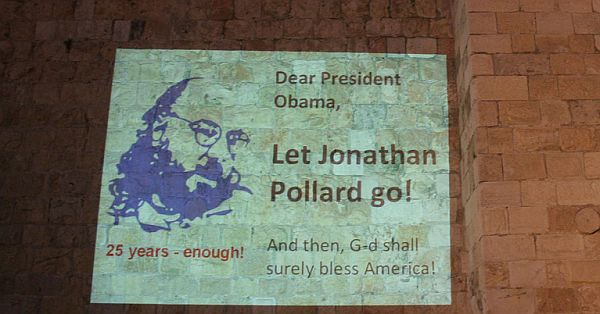
A “relentless” campaign by David Nyer, a Jewish Orthodox activist from Monsey, New York, has succeeded in winning significant support from House Democrats who are now calling on President Obama to release Jonathan Pollard.

Pollard is a former civilian intelligence analyst who was convicted of spying for Israel and through a plea bargain received a life sentence in 1987. He is believed to have caused incalculable damage to US national security.

Nyer’s campaign “struck gold” when he succeeded in winning the support of Rep. Barney Frank. The JTA reported:

Getting Frank was a coup, one congressional insider said, not only because he has a leadership position, but because his pronounced liberalism in other arenas adds credibility to an effort that has been identified in recent years with the Israeli and pro-Israel right.

Frank took up the cause because he long has believed that Pollard’s life sentence was disproportionate to the crime, his spokesman said.

“It is something he feels strongly about,” Harry Gural told JTA.

Launching the initiative at a Capitol Hill news conference Nov. 18, Frank listed two factors that made the matter timely: Pollard’s 25 years in prison as of Sundayand the parlous state of the Israeli-Palestinian peace process.

“The justification of this is the humanitarian one and the notion that the American justice system should be a fair one,” Frank said. “We believe that clemency after 25 years for the offenses of Jonathan Pollard would do that.

“My own hope is that if the president would do this, it would contribute to the political climate within the democracy of Israel and would enhance the peace process.”

Frank alluded to Obama’s low popularity in Israel where, fairly or not, the president has been saddled with a reputation as cool to Israeli interests.

The Jerusalem Post reports that Benjamin Netanyahu has asked the US to add Pollard’s release to the many other generous incentives the Obama administration have offered Israel in the hope of a 90 day, once only, extension to the settlement slowdown.

In “Why Pollard Should Never Be Released (The Traitor),” published in the New Yorker in January 1999, Seymour Hersh wrote:

A full accounting of the materials provided by Pollard to the Israelis has been impossible to obtain: Pollard himself has estimated that the documents would create a stack six feet wide, six feet long, and ten feet high. Rafi Eitan, the Israeli who controlled the operation, and two colleagues of his attached to the Israeli diplomatic delegation — Irit Erb and Joseph Yagur — were named as unindicted co-conspirators by the Justice Department. In the summer of 1984, Eitan brought in Colonel Aviem Sella, an Air Force hero, who led Israel’s dramatic and successful 1981 bombing raid on the Iraqi nuclear reactor at Osirak. (Sella was eventually indicted, in absentia, on three counts of espionage.) Eitan’s decision to order Sella into the case is considered by many Americans to have been a brilliant stroke: the Israeli war hero was met with starry eyes by Pollard, a chronic wannabe.

Yagur, Erb, and Sella were in Washington when Pollard was first seized by the F.B.I., in November, 1985, but they quickly left the country, never to return. During one period, Pollard had been handing over documents to them almost weekly, and they had been forced to rent an apartment in northwest Washington, where they installed a high-speed photocopying machine. “Safe houses and special Xeroxes?” an American career intelligence officer said, despairingly, concerning the Pollard operation. “This was not the first guy they’d recruited.” In the years following Pollard’s arrest and confession, the Israeli government chose not to cooperate fully with the F.B.I. and Justice Department investigation, and only a token number of the Pollard documents have been returned. It was not until last May [1998] that the Israeli government even acknowledged that Pollard had been its operative.

In fact, it is widely believed that Pollard was not the only one in the American government spying for Israel. During his year and a half of spying, his Israeli handlers requested specific documents, which were identified only by top-secret control numbers. After much internal assessment, the government’s intelligence experts concluded that it was “highly unlikely,” in the words of a Justice Department official, that any of the other American spies of the era would have had access to the specific control numbers. “There is only one conclusion,” the expert told me. The Israelis “got the numbers from somebody else in the U.S. government.”

Richard Perle? He was Assistant Secretary of Defense in the Reagan administration at that time and early in his career had been caught by the FBI passing classified information to the Israeli embassy in Washington.

Pollard’s American interrogators eventually concluded that in his year and a half of spying he had provided the Israelis with more than a year’s worth of the daily FOSIF reports from Rota [in Spain, the location of the Navy’s Sixth Fleet Ocean Surveillance Information Facility (FOSIF)]. Pollard himself told the Americans that at one point in 1985 the Israelis had nagged him when he missed several days of work because of illness and had failed to deliver the FOSIF reports for those days. One of his handlers, Joseph Yagur, had complained twice about the missed messages and had asked him to find a way to retrieve them. Pollard told his American interrogators that he had never missed again.

The career intelligence officer who helped to assess the Pollard damage has come to view Pollard as a serial spy, the Ted Bundy of the intelligence world. “Pollard gave them every message for a whole year,” the officer told me recently, referring to the Israelis. “They could analyze it” — the intelligence — “message by message, and correlate it. They could not only piece together our sources and methods but also learn how we think, and how we approach a problem. All of a sudden, there is no mystery. These are the things we can’t change. You got this, and you got us by the balls.” In other words, the Rota reports, when carefully studied, gave the Israelis “a road map on how to circumvent” the various American collection methods and shield an ongoing military operation. The reports provide guidance on “how to keep us asleep, thinking all is working well,” he added. “They tell the Israelis how to raid Tunisia without tipping off American intelligence in advance. That is damage that is persistent and severe.”


Facebooktwittermail

Stuxnet could cause Bushehr meltdown

On the eve of the release of a new IAEA report on Iran, officials linked to the UN nuclear oversight agency have added to speculation on the possible impact that the Stuxnet malware may have had on Iran’s nuclear program — including the possibility that it could lead to the meltdown of the reactor in the Bushehr nuclear power plant.

The Associated Press reports:

Iran’s nuclear program has suffered a recent setback, with major technical problems forcing the temporary shutdown of thousands of centrifuges enriching uranium, diplomats told The Associated Press on Monday.

The diplomats said they had no specifics on the nature of the problem that in recent months led Iranian experts to briefly power down the machines they use for enrichment — a nuclear technology that has both civilian and military uses.

But suspicions focused on the Stuxnet worm, the computer virus thought to be aimed at Iran’s nuclear program, which experts last week identified as being calibrated to destroy centrifuges by sending them spinning out of control.
[…]
Tehran has taken hundreds of centrifuges off line over the past 18 months, prompting speculation of technical problems.

A U.N official close to the IAEA said a complete stop in Iran’s centrifuge operation would be unprecedented to his knowledge but declined to discuss specifics.
[…]
Separately, another official from an IAEA member country suggested the worm could cause further damage to Iran’s nuclear program.

The official also asked for anonymity because his information was privileged. He cited a Western intelligence report suggesting that Stuxnet had infected the control system of Iran’s Bushehr reactor and would be activated once the Russian-built reactor goes on line in a few months.

Stuxnet would interfere with control of “basic parameters” such as temperature and pressure control and neutron flow, that could result in the meltdown of the reactor, raising the specter of a possible explosion, he said.

Facebooktwittermail

The Israelification of America

As the Transportation Security Administration faces a barrage of criticism, some indignant Americans are calling for the “Israelification” of US airports — as though the security procedures used in a tiny Middle Eastern ethnocracy with one international airport could easily be scaled up for America.

Ironically, Israelification is not what we need — it’s what we already have.

Consider the real outrages of the last decade that, simply because they were done in the name of national security, the majority of Americans found tolerable:

  • a global war on terrorism that led to massive increases in defense spending, the creation of multiple new intelligence and security agencies, and Washington’s enslavement to fear-based politics — that was OK;
  • with disregard for international law, the invasion of Iraq on a false pretext — that was OK;
  • the kidnapping, secret imprisonment and torture of individuals most of whom had nothing to do with 9/11 — that was OK;
  • the authorization of warrantless wiretaps — that was OK;
  • the implementation of a remote-controlled assassination program — that was OK;
  • in short, the normalization of war crimes all of which were deemed justifiable because of 9/11 — that was OK;
  • but “don’t touch my junk” — there are limits to what Americans will tolerate.

TSA administrators are no doubt frustrated by the fact that had the new pat-down procedures been implemented in late 2001, they would probably have been welcomed by a population that widely supported the idea of doing “whatever it takes” to stop “the terrorists.”

The problem, then and now, is that air transportation security is imagined to be about catching terrorists. On this count, the TSA seems to have a poor record.

At Slate, Juliet Lapidos notes:

In May, the Government Accountability Office released a report noting that SPOT’s [“Screening of Passengers by Observational Techniques”] annual cost is more than $200 million and that as of March 2010 some 3,000 behavior detection officers [BDOs] were deployed at 161 airports but had not apprehended a single terrorist. (Hundreds of illegal aliens and drug smugglers, however, were arrested due to the program between 2004 and 2008.) What’s more, the GAO noted that at least 16 individuals later accused of involvement in terrorist plots flew 23 different times through U.S. airports since 2004, but TSA behavior-detection officers didn’t sniff out any of them.

Does this imply that the TSA’s BDOs have yet to pinpoint the way a terrorist walks, talks, or dresses? The TSA’s “failure” in this instance might simply mean that the individuals who escaped their attention were not at those times actually doing anything suspicious.

The point is, there are justifiable and unjustifiable grounds to turn a person into an object of suspicion. A system that simply on the basis of religion, ethnicity or nationality, regards a person with suspicion, is unjust and will be ineffective. Indeed, a system which even regards its targets as “the terrorists” conjures up the false notion that it is dealing with a class of people rather than a class of behavior.

Which brings me back to my initial claim that the Israelification of America is already deeply entrenched. Israel’s fear of the Arab world has been transplanted into American consciousness to such a degree that we are moving toward the absurd conclusion that if this country operated even more like Israel than it already does, then we would be able to feel as safe as the Israelis do.

Living inside a fortress and defining ones existence in terms of threats posed by eternal enemies, is a good way of justifying spending more and more on increasingly elaborate fortifications. But those who invest deeply in this mindset and who profit from its perpetuation, have the least interest in exploring what we need to understand most: why our enemies think the way they do. Delve into that question, and the notion of eternal enmity quickly evaporates — thus the perpetuation of the myth that we are under threat not because of what we do but because of who we are.

Meanwhile, next time a TSA officer offends your dignity, spare a thought for the Palestinians who while passing through IDF checkpoints suffer vastly worse when attempting no more than to travel from one town to the next.

Facebooktwittermail

Evolving understanding of Stuxnet

Reporting on the latest findings on the design of the Stuxnet malware which targeted Iran’s nuclear program, the New York Times says that Ralph Langner — a German software engineer who has been one of the leading investigators — has identified two forms of attack directed at different targets.

In a statement Friday on his Web site, he described two different attack modules that are designed to run on different industrial controllers made by Siemens, the German industrial equipment maker. “It appears that warhead one and warhead two were deployed in combination as an all-out cyberstrike against the Iranian nuclear program,” he wrote.

In testimony before the Senate on Wednesday, federal and private industry officials said that the Iranian nuclear program was a probable target, but they stopped short of saying they had confirming evidence. Mr. Langner said, however, that he had found enough evidence within the programs to pinpoint the intended targets. He described his research process as being akin to being at a crime scene and examining a weapon but lacking a body.

The second code module — aimed at the [Bushehr] nuclear power plant — was written with remarkable sophistication, he said. The worm moves from personal computers to Siemens computers that control industrial processes. It then inserts fake data, fooling the computers into thinking that the system is running normally while the sabotage of the frequency converters is taking place. “It is obvious that several years of preparation went into the design of this attack,” he wrote.

In a separate report, the New York Times said:

The paternity of the worm is still in dispute, but in recent weeks officials from Israel have broken into wide smiles when asked whether Israel was behind the attack, or knew who was.

Langner says: “Stuxnet is like the arrival of an F-35 fighter jet on a World War I battlefield.”

Why would Israel target a civilian nuclear facility that is generally understood to pose no proliferation threat?

In line with its practice of paying selective attention to international opinion, Israel’s public position has been that Iran should not be “rewarded” for its defiance of the international community by being allowed to operate Bushehr. Moreover, there could also be a political motive for trying to prevent Bushehr from operating successfully, that being, to undermine the credibility of the nuclear program in the eyes of the otherwise widely supportive Iranian public.

Langner says that a cyber attack targeting a nuclear reactor is virtually impossible but that Bushehr’s steam turbine (located outside the containment facility) could be hit and that “Stuxnet can destroy the turbine as effectively as an air strike.”

Like everyone else, the Israelis understand that the most critical part of the infrastructure in Iran’s nuclear program is not made of steel or concrete — it is the expertise of Iran’s nuclear scientists and engineers. (For that reason, Israel’s covert war against Iran apparently includes a “decapitation” program aimed at eliminating the top figures in Iran’s nuclear operations.)

Since many of the skills required to run a civilian nuclear power program are presumably transferable to a military program, sabotage on any of Iran’s nuclear facilities will have the net effect of becoming a drain on the human resources available to advance the program as a whole.

The fact is, after decades of nuclear development, Iran still has precious little to show for its efforts. Keep in mind, the construction of Bushehr began 35 years ago and Iran’s nuclear program was launched in the 1950s!

Facebooktwittermail

U.S. and Israel: still no consensus on pressuring Iran

Tony Karon writes:

An open disagreement between Israel and the Pentagon in recent weeks has highlighted the dilemma President Barack Obama faces in making progress on Iran. Defense Secretary Robert Gates on Tuesday poured cold water on last week’s suggestion by Israeli Prime Minister that the only way Iran can be stopped from acquiring nuclear weapons is for the U.S. to threaten military action. Military action, Gates warned, would solve nothing; in fact it would be more likely to drive Iran to acquire nuclear weapons.

Netanyahu had warned, during a visit to the U.S., that “economic sanctions are making it difficult for Iran, but there is no sign that the Ayatullah regime plans to stop its nuclear program because of them.” The Israeli media reported that Netanyahu had told Vice-President Joe Biden, “The only way to ensure that Iran will not go nuclear is to create a credible threat of military action against it if it doesn’t cease its race for a nuclear weapon.”

Gates, however, turned Netanyahu’s argument on its head, warning that bombing Iran’s nuclear facilities would provide only a “short term solution,” setting the Iranians back two or three years. But any military strike would “bring together a divided nation [and] make them absolutely committed to obtaining nuclear weapons” via programs that would simply “go deeper and more covert.” Instead, Gates argued, “The only long-term solution to avoiding an Iranian nuclear weapons capability is for the Iranians to decide it’s not in their interest.”

Facebooktwittermail

An American bribe that stinks of appeasement

Robert Fisk writes:

In any other country, the current American bribe to Israel, and the latter’s reluctance to accept it, in return for even a temporary end to the theft of somebody else’s property would be regarded as preposterous. Three billion dollars’ worth of fighter bombers in return for a temporary freeze in West Bank colonisation for a mere 90 days? Not including East Jerusalem – so goodbye to the last chance of the east of the holy city for a Palestinian capital – and, if Benjamin Netanyahu so wishes, a rip-roaring continuation of settlement on Arab land. In the ordinary sane world in which we think we live, there is only one word for Barack Obama’s offer: appeasement. Usually, our lords and masters use that word with disdain and disgust.

Anyone who panders to injustice by one people against another people is called an appeaser. Anyone who prefers peace at any price, let alone a $3bn bribe to the guilty party – is an appeaser. Anyone who will not risk the consequences of standing up for international morality against territorial greed is an appeaser. Those of us who did not want to invade Afghanistan were condemned as appeasers. Those of us who did not want to invade Iraq were vilified as appeasers. Yet that is precisely what Obama has done in his pathetic, unbelievable effort to plead with Netanyahu for just 90 days of submission to international law. Obama is an appeaser.

The fact that the West and its political and journalistic elites – I include the ever more disreputable New York Times – take this tomfoolery at face value, as if it can seriously be regarded as another “step” in the “peace process”, to put this mystical nonsense “back on track”, is a measure of the degree to which we have taken leave of our senses in the Middle East.

Facebooktwittermail

Israel must choose between Enlightenment and Romanticism

Carlo Strenger and Menachem Lorberbaum write:

Political discourse in Israel is governed by the presumption that Israel needs to decide whether it will be a Western state or a Jewish state. Ostensibly the question is: should Israel be more Jewish or more democratic? And the subtext is that this a choice between a state governed by the language of individual human rights, or by a specifically Jewish language.

This assumption is false. Israel is not about to choose between being Jewish or being democratic but rather which of two European traditions to embrace: that of the Enlightenment with its emphasis on universal individual rights and division of powers, or that of political romanticism with its emphasis on the connection between an entity called ‘the nation’ and land.

Israel’s right wing, to an ever growing extent, tends toward the position that Israel should not approve the language of individual human rights accepted today in international politics, but that it should insist on its right to be a purely ethnic state.

Facebooktwittermail

Israeli Rabbi: ‘Jews should make the Arabs flee’

The Independent reports:

First they threatened to burn his house down. Then they pinned leaflets to his front door, denouncing him as a Jewish traitor. But Eli Tzavieli, an 89-year-old Holocaust survivor, is defiant. His only “crime” is to rent out his rooms to three Arab students attending the college in Safed, a religious city in northern Israel that was until recently more famous for Jewish mysticism and Madonna.

A campaign waged by Shmuel Eliyahu, the town’s radical head rabbi, culminating in a ruling barring residents from renting rooms to Israeli Arabs, means that Safed is fast emerging as a byword for racism.

“I’m not looking for trouble, but if there is a problem, I’ll confront it,” says Mr Tzavieli, a Jew who survived Nazi forced labour camps and whose parents perished in Auschwitz. “These [tenants] are great kids. And I’m doing my best to make them comfortable.”

Didi Remez provides a translation of an article from the Hebrew Maariv:

Rabbi Shmuel Eliyahu, Chief Rabbi, of Safed is staging a tenacious battle these days. In his sights: Arabs, “who are fighting a land war against us” and “who want to throw us into the sea,” according to the rabbi. In a recent Halachic ruling the rabbi forbid Safed residents from selling or renting their homes to Arabs. The ruling sparked a storm, but Eliyahu was unmoved. “Jews don’t have to run away from Arabs,” said the rabbi in his first comprehensive interview, to be published in full in the Ma’ariv weekend supplement. “Jews should make the Arabs flee.”

“One person in Safed rented his home to three Bedouins,” says Rabbi Eliyahu. “I went to visit him. The tenants asked me ‘why are you against us?’ I told them we don’t want to make Safed into an Arab city. Even if this were Tel Aviv I would object. How much more so when talking about the holy city of Safed. They told me ‘you’ve got to recognize the fact. This is life. This is reality. And I couldn’t believe my ears. The Arabs don’t even bother denying they’ve got a system. It’s so simple: One person moves into a Jewish neighborhood, pays a high price and all the Jews leave immediately. Naturally, they don’t want to live next door to them.

“Their behavior is unpleasant. They stuck an old Arab woman into a public housing neighborhood. In theory, it was harmless. But as soon as she arrived she started to harass us. Every Shabbat ten cars of Arabs would come. The whole village was at her house. They played music, made noise. They had the nerve to act in a Jewish neighborhood in a way they never would have dared act in their village.”

Was that an isolated incident? Not if you ask the holy rabbi. “It is a behavioral phenomenon. You can’t come to a quiet tourist town and feel like you’re in an Arab village. If you’re a guest, act like a guest. But if you want to feel like you own the place, then the Halacha says it is forbidden to rent a home to you.

As soon as there are more than three Arabs in a neighborhood, [in practical terms] it means the Jews will yield the center to them. Jews don’t need to run away from Arabs. Jews should make the Arabs flee.

Facebooktwittermail

The myth of American pressure

Osamah Khalil writes:

Recent reports that the administration of US President Barack Obama offered Israel a series of incentives to continue its limited ten-month moratorium on settlement building have sparked an outcry among Palestinians and their supporters. Although the concessions for halting the construction of new settlements for only ninety days are unprecedented, Washington’s inability to maintain consistent pressure on Israel fits into a much broader historical pattern. The conventional wisdom is that when Washington has exerted pressure on Israeli governments they have eventually succumbed to American demands. However, a closer reading of the historical record and declassified American archival documents reveals a more complex dynamic between the two allies.

In this essay I examine four major crises in the “special relationship” between the US and Israel: the 1949 Lausanne Conference; the 1956 Suez Crisis; the October 1973 War; and the 1991 Madrid Peace Conference. I demonstrate that while Israel has on occasion publicly acceded to American demands, privately it has received concessions and agreements that rewarded its intransigence and improved its negotiating position at the expense of Palestinian rights. I argue that American pressure was negligible when compared to the policy options available to the different presidential administrations. Finally, I offer recommendations for Palestinians and their supporters.

Facebooktwittermail

AIPAC bares all to quash Rosen lawsuit

Maybe the days of the Israel lobby are numbered — not because it’s about to fall apart but because the terms of discourse will change. That is, we will no longer be speaking about a “lobby” as such but more explicitly about the evidence that the state of Israel has effectively pulled off a soft coup and through its informal representatives in Washington assumed a controlling influence over significant parts of the US government.

To put the notion of America under Israeli control in perspective, imagine this: if at the height of the Cold War, hundreds of USG officials and political operatives inside Washington were discovered to have sympathies and close ties with the Soviet Union. No greater shock to the American political system would have been seen since the Civil War. The fact that Israel is characterized as a friendly state really does little to diminish the significance of the influence it wields in domestic American politics. No other foreign government enjoys a fraction of Israel’s power in the US.

Grant Smith writes:

On Nov. 8, 2010, the American Israel Public Affairs Committee (AIPAC) filed a massive 260-page motion [.pdf] in the District of Columbia Superior Court. It asks Judge Erik Christian to dismiss former AIPAC employee Steven J. Rosen’s $20 million defamation suit. In October the court dismissed all counts of the March 2009 lawsuit except for Rosen’s claim of harm over AIPAC statements to the press that he did not uphold its standards of conduct. Rosen and AIPAC have – until now – abstained from filing damaging information about the internal workings of AIPAC in court. AIPAC’s willingness to publicly air some extremely sordid and revealing content to get the remaining count thrown out before an alternative dispute resolution hearing begins in December is a sign that AIPAC is now fighting for its life, or – as one former AIPAC attorney put it – “reason for being.” If Rosen proves in court that AIPAC has long handled classified information while lobbying for Israel, the worn public pretense that AIPAC is anything but a stealth extension of the Israeli Ministry of Foreign Affairs – from which it emerged in 1951 – will end forever.

Rosen filed his civil suit after adverse judicial rulings made his (and coworker Keith Weissman’s) prosecution under the Espionage Act unlikely. Col. Lawrence Franklin pled guilty to passing classified national defense information to persons not entitled to receive it while Rosen and Weissman were indicted in 2005 for their role in the espionage affair. Although prosecutors reluctantly dropped [.pdf] their indictment in May 2009 – as AIPAC carefully notes in its filing – Rosen was never acquitted. Outstanding questions in the defamation suit about classified-information trafficking have now placed AIPAC in a bind. If AIPAC financially settles with Rosen, it will signal to the American people and attentive law enforcement officials that it is honoring a previous compensation deal to pay Rosen off after the spy flap subsided. On May 11, 2010, Rosen revealed an e-mail to Washington Post reporter Jeff Stein asserting that AIPAC promised “when this is over we will do right by Steve.” But it’s now far from clear whether AIPAC has the financial wherewithal or donors willing to honor such a – possibly illegal – commitment.

Facebooktwittermail

Washington’s shameless and slavish devotion to Israel

Mark Perry writes:

A legendary story from our early history has it that Thomas Jefferson so hated John Jay that he ordered Pierre L’Enfant — the civil engineer who designed our capital city — to excise any reference to Jay (including “J Street”) from his plans. The story is apocryphal, but the history behind it isn’t. For Jefferson, Jay was an arch appeaser: his 1795 treaty with Britain provided concessions to a nation we had defeated in our revolution. Jefferson wasn’t the only one who hated the treaty. While Jay’s agreement was ratified by the Congress, he was burned in effigy by New York and Philadelphia mobs and the treaty so stained his reputation that he was never considered for the presidency. Jefferson didn’t make the same mistake. When the Pasha of Barbary demanded ransom for U.S. ships he had seized, Jefferson sent a U.S. naval squadron to punish him. The resulting victory is now celebrated with a half-verse in the Marine Corps hymn (which celebrates the triumph on “the shores of Tripoli”) and a knock-out political slogan that energized a nation: “Millions for defense, but not one cent for tribute.”

If only Jefferson could see us now. This weekend, the Obama administration promised to turn over $3 billion in stealth fighters to Israel (supplementing the 20 F-35s it will buy with the $2.75 billion in “grants” it gets from Washington) and veto any U.N. resolution that questions Israel’s legitimacy — all in exchange for Israel’s pledge to extend a ten-month partial settlement moratorium for another 90 days. This is a bad idea. And it’s dangerous. There are differences, of course, between the events of the last 24 hours and the crisis that Jefferson faced in 1804. Then, we protested that we were “paying tribute,” now we are “providing incentives.” Then too, Israel is not making any “demands,” they are simply (in Israeli Prime Minister Netanyahu’s words) “insisting.” Oh — and let’s not forget — the pirates of Barbary were America’s “enemy.” That’s a lot different than now; Israel is our “friend.”

This administration’s decision would be shocking were it not so predictable. Back on October 20, State Department spokesman Andrew Shapiro reassured the press that a $60 billion U.S. arms transfer to Saudi Arabia would go forward because “Israel does not object…” Shapiro’s statement passed with nary an eye blink in L’Enfant’s city, where Israel’s approval is apparently required for America to do anything in the Middle East. But Shapiro’s tone-deafness is hardly limited to dime-a-dozen spokespersons. In the wake of General Petreaus’ controversial March testimony that the Israeli-Palestinian conflict “foments anti-American sentiment” (stop the presses), Hillary Clinton went out of her way to reassure Israelis that “we are committed to Israel’s security,” a soothing word-for-word mantra repeated by Barack Obama (July 6), Joe Biden (November 7) and any old American official behind a microphone (P.J. Crowley, August 4). The administration doesn’t get it: the question is not whether we are committed to Israel’s security, but whether they’re committed to ours.

The tone-deafness evidenced by Andrew Shapiro is now an all-consuming part of public policy, extending to every part of the American government — and beyond. When Elena Kagan testified during her confirmation hearings for the Supreme Court, she cited Israel jurist Aharon Barak as her model, because he was the “John Marshall of the State of Israel.” Kagan might well be a brilliant justice, but I would have thought she would cite Marshall as her model. Reminded that Barak was a judicial activist (and therefore not necessarily acceptable for some committee members), Kagan gave a ready explanation: “Israel means a lot to me,” she explained. Enough said. When David Petreaus was criticized by Israel advocates for his March testimony, he backtracked, asking neo-conservative Max Boot (in an email he carelessly sent to a blogger) whether it would help “if folks know that I hosted Elie Wiesel and his wife at our quarters last Sun night?” Petreaus is our nation’s most influential military officer since Eisenhower. Guess what? He’s afraid of Israel’s lobby. And when Angela Merkel addressed the U.S. Congress in November of 2009, she didn’t talk about American security, but Israeli security. “Security for the state of Israel is, for me, non-negotiable,” she said. “Whoever threatens Israel also threatens us.” Even senior aides to the otherwise pro-Israel Congress were puzzled. “Maybe she thought she was talking to the Knesset,” one of them said. Finally, Republican Eric Cantor recently told Israeli Prime Minister Benjamin Netanyahu that the new Republican majority would serve as “a check on the administration” in any dispute with Israel — a statement so astonishing that one pro-Israel journalist viewed it as not only unprecedented, but “extraordinary.”

Facebooktwittermail

Why America will come to regret the craven deal Obama is offering Netanyahu

Christopher Hitchens writes:

Those of us who keep an eye on the parties of God are avid students of the weekly Sabbath sermons of Rabbi Ovadia Yosef. In these and other venues, usually broadcast, this elderly Sephardic ayatollah provides an action-packed diet that seldom disappoints. A few months ago, he favored his devout audience with a classic rant in which he called down curses on the Palestinian Arabs and their leaders, wishing that a plague would come and sweep them all away. Last month, he announced that the sole reason for the existence of gentiles was to perform menial services for Jews: After that, he opined, their usefulness was at an end. A huge hubbub led to his withdrawal of the first of these diatribes. (I would be interested to know if this was on partly theological grounds. After all, the local Palestinians may still have some labor to perform before the divine plan is through with them.) The second sermon, so far as I know, still stands without apology. Why on earth should anybody care about the ravings of this scrofulous medieval figure, who peppers his talk of non-Jews in Palestine with comparisons to snakes, monkeys, and other lesser creations, rather as Hamas and Hezbollah refer to the Jews? Well, one reason is that he is the spiritual leader of the Shas Party, an important member of Prime Minister Benjamin Netanyahu’s coalition. Indeed, two key portfolios, of the Interior and of Construction and Housing, are held by Shas members named Eli Yishai and Ariel Atias.

Yishai recently delighted the Diaspora by saying that only those Jews who converted via the Orthodox route could carry “the Jewish gene.” Atias has expressed alarm about the tendency of Israeli Arab citizens to try to live where they please—or “spread,” as he phrases it—and has advocated a policy of segregation in housing within Israel proper. He also advocates the segregation by neighborhood of secular from Orthodox Jews, adding that he does not wish his own children to mix with their nonreligious peers. It is Yishai’s ministry that is famous for making announcements about new “housing” developments outside Israel itself and in legally disputed territory. Very often, Netanyahu himself has claimed to be taken by surprise at these announcements, which usually involve tense areas of Jerusalem. Thus the huge embarrassment inflicted on Vice President Joe Biden earlier this year, when fresh settlement construction was proclaimed in the middle of his high-level visit. And thus the undisguised irritation of President Obama and Secretary of State Hillary Clinton last week, when yet another round of such housing was scheduled while Obama was in Asia and Netanyahu was in the United States. Apparently, the latest high-level round of the peace process has included the modest and tentative suggestion to Israel that such disclosures be timed with greater tact and coordination in the future.

Facebooktwittermail

Cantor recants

MJ Rosenberg writes:

[Soon-to-be House Majority Leader Eric Cantor] has been an AIPAC cutout since he first was elected to office. He’s been to more AIPAC meetings than he can probably count. And he should have figured out by now that the lobby is extremely careful, obsessively careful, to always emphasize loyalty to the United States while simultaneously endorsing Israeli policies that undermine our foreign policy objectives.

AIPAC officials never, ever, say that when push comes to shove their loyalty is with Israel not the United States. In fact, the accusation that this is the case is the charge AIPAC hates most.

But the soon-to-be Majority Leader came right out and said it: Israel, right or wrong.

It took a few days for Cantor to understand how utterly offensive his statement was. (He might have heard from a few Tea Party types who, say what you will about them, tend to take their patriotism seriously.)

So today Cantor explained he was misunderstood. His inconvenient truth, his gaffe, was replaced by a laughable untruth.

This is how the Washington Post‘s Dana Milbank reports it:

Brad Dayspring, Cantor’s press guy, tells me Cantor’s promise that the Republican majority would “serve as a check on the administration” was “not in relation to U.S./Israel relations.”

Mmmm. So Cantor’s pledge to stand with Netanyahu against Obama was “not in relation to US/Israel relations” despite the context of Cantor’s statement — just before Netanyahu’s meeting with Clinton — and the fact that the person he was talking to was the Prime Minister of Israel.

So, what was Cantor’s pledge “in relation to”?

Was it in relation to either repealing “Don’t Ask, Don’t Tell” or the Bush tax cuts for millionaires? Maybe it was about farm subsidies.

Facebooktwittermail

Is America bribing Bibi or blackmailing him?

The Economist‘s Lexington blog says:

Until this weekend, most people assumed that Israel enjoyed an unconditional American promise to maintain its military edge, and a nearly unconditional promise to support it in the United Nations. Now it seems that President Obama is making the continuation of some of these things conditional on Israel’s acceptance of a three-month settlement freeze, during which Israel will be pressed to agree final borders with a putative Palestinian state in the West Bank. That could be construed as a less confrontational, and more subtle, but no less effective version of the way George Bush senior forced a reluctant Yitzhak Shamir to the 1991 Madrid peace conference by withholding loan guarantees. Maybe, just maybe, the Obama peace push in Palestine has stronger legs than jaded onlookers have realised.

Facebooktwittermail

How much is a three-month settlement freeze really worth?

The offer of a free squadron of F-35 joint strike fighters is “an offer hard to refuse” a senior Israeli defense official tells the Jerusalem Post, but Aluf Benn suggests the Obama administration wants more than a brief extension of the settlement freeze in return. The goal is a coalition shake-up.

To date, Netanyahu was able to obtain cabinet approval for all U.S. dictates The right wing ministers in his coalition were not enthusiastic and did not go out of their way to sell the decisions to the public, but neither did they oppose the prime minister publicly. Now the situation is different. Shas announced that it will abstain and Foreign Minister Avigdor Lieberman declared that “we will not agree to even a single day of freeze.” If Lieberman votes in favor or abstains, and it does not matter what his excuse will be, he will be called a pushover. So it appears that for the first time, Netanyahu will face a divided vote on an important political issue.

But this is precisely what the Americans want: They want Netanyahu to change the composition of his coalition, bring in Kadima in place of the right wing factions and replace Lieberman with Tzipi Livni. That way the world will see that he’s serious about negotiations with the Palestinians. Netanyahu has opted to date to maintain his alliance with the right, fearing that Lieberman would steal voters away from him and that Livni would try to undermine him and push him out of office. But as the 91st day approaches, it may be that he has no choice.

Facebooktwittermail

Israelis united by fear

Uri Avnery writes:

On Saturday evening, two weeks ago, we returned by taxi from the annual memorial rally for Yitzhak Rabin, and as usual got into a conversation with our driver.

Generally, these conversations flow smoothly, with lots of laughs. Rachel loves them, because they bring us face-to-face with people we don’t normally meet. The conversations are necessarily short, the people express their views concisely, without choosing their words. They are of many kinds, and in the background we generally hear the radio news, talk shows or music chosen by the driver. And, of course, the soldier-son and the student-daughter are mentioned.

But this time, things were less smooth. Perhaps we were more provocative than usual, still depressed by the rally, which was devoid of political content, devoid of emotion, devoid of hope. The driver became more and more upset, and so did Rachel. We felt that if we had not been paying customers, it might have ended in a fight.

The views of our driver can be summed up as follows:

There will never be peace between us and the Arabs, because the Arabs don’t want it.

The Arabs want to slaughter us, always did and always will.

Every Arab learns from early childhood that the Jews must be killed.

The Koran preaches murder.

Fact, wherever there are Muslims, there is terrorism. Wherever there is terrorism, there are Muslims.

We must not give the Arabs one square inch of the country.

What did we get when we gave them Gaza back? We got Qassam rockets!

There’s nothing to be done about it. Only to hit them on the head and send them back to the countries they came from.

According to the Talmudic injunction: He who comes to kill you, kill him first.

This driver expressed in simple and unvarnished language the standard convictions of the great majority of Jews in the country.

It is not something that can be identified with any one part of society. It is common to all sectors.

“Just because you’re paranoid doesn’t mean they aren’t after you,” Joseph Heller wrote and most Israelis believe.

In a way, whether this conviction in a Jewish island surrounded by a sea of enmity has a solid basis in reality is besides the point. If most Israelis believe in the impossibility of peace, that belief itself surely makes peace impossible. But it also begs the question of whether a Jewish state or any other state can have a solid foundation if that foundation is constructed from fear.

Paradoxically, the great demographic threat to Israel may turn out to result from too many Jews — Jews only capable of seeing themselves, their nation and the world through the prism of fear.

For an individual, if fear grows to a proportion where it shapes every feature of their life — if it colors their decisions, their perceptions and everything they think and feel — this is not a way of living but rather a condition that requires treatment. Why should a similar need not equally apply to a whole nation afflicted by the disease of fear?

Many Israelis might counter that so long as the Jewish state can retain its position of regional military supremacy, then it will retain the upper edge in a balance of fear and thus its only concern should be that Israel is able to engender more fear than it suffers. Yet this is the mindset of the survivalist whose fixation on danger has reduced life to the tremors of desperate isolation.

Facebooktwittermail

Netanyahu assumes command in Washington

After winning the US midterm elections, Israel’s prime minister Benjamin Netanyahu hardly needs to worry about holding his own coalition government together. The fact that he so transparently now has Washington in his pocket should duly impress anyone who might have doubted America’s willingness to tolerate its increasingly servile relationship with Israel.

Even so, after the announcement that 1,345 new housing units will be built for Jewish occupants in Israeli-occupied East Jerusalem, President Obama’s reaction — to suggest that this move is “unhelpful” during peace negotiations — set off alarm bells. The White House was swift to assure those concerned, that the administration is not stepping out of line.

On a conference call with American Jewish leaders today, a White House official said the administration hadn’t sought a confrontation with the Israelis over a new construction announcement.

President Barack Obama answered a question at a press conference on the subject straightforwardly but hadn’t specifically planned to make a statement criticizing new Israeli building, National Security Council official Dan Shapiro said on the call, according to a participant.

Perhaps the press can avoid causing Obama any further embarrassment by henceforth not asking questions on such sensitive topics.

Still, this administration remains an object of mistrust and so when Netanyahu met his leading representative in Washington a few days ago, Eric Cantor, the congressman and likely GOP majority leader assured his prime minister that the Republican party will now be able impose the required discipline.

Eric stressed that the new Republican majority will serve as a check on the Administration and what has been, up until this point, one party rule in Washington. He made clear that the Republican majority understands the special relationship between Israel and the United States, and that the security of each nation is reliant upon the other.

Unfortunately, a few Americans might be perplexed by this claim that the security of the United States is dependent on the security of Israel. Cantor believes “most Americans understand that Israel’s security is synonymous with America’s security.”

Mutual dependence and the security of these two nations being synonymous are not quite the same thing.

It’s easy to see that Israel is capable of having such a disruptive impact on the Middle East that this will damage US interests and in that sense that the US depends on Israel not to undermine its national security even more than it already does.

But to say that Israel’s security is synonymous with America’s security suggests another possibility. If our interests do indeed so perfectly overlap, then we really don’t need to think about Israel’s security. If America focuses on its own interests, Israel’s — in as much as their interests are identical — will be taken care of. In as much as our interests differ — well that’s Israel’s problem, not ours.

Facebooktwittermail

Did Bibi win the midterms?

James Traub writes:

It is widely believed in Israel that Netanyahu’s close aides have been demeaning Obama to the Israeli public through an orchestrated whispering campaign and that this accounts in part for Obama’s dismal poll ratings there. And he and his Likud party have longstanding ties to the Republican Party, which shares Likud’s faith in free markets, its deep suspicion toward most Arab regimes, and its low regard for the Palestinian sense of grievance. Conservative evangelicals, an important GOP constituency, also tend to be passionately pro-Israel. Thus after the new settlement flare-up, Daniel C. Kurtzer, a former U.S. ambassador to Israel, told the New York Times that with the Republicans now in the ascendant, Netanyahu “feels that he’s got a freer hand here.”

I called the office of Rep. Eric Cantor, the Republican whip and the leading GOP voice on Israel, to ask whether he felt this was so. Cantor has, among other things, suggested that aid to Israel be removed from the foreign-assistance budget so that his party could zero out funding to unfriendly countries while sparing Israel. Cantor was unavailable to talk, but I was sent remarks he had just made on talk radio-host Don Imus’s Imus in the Morning: “I don’t understand how the president wants to push our best ally in the Middle East into a posture of thinking that we’re not going to back their security.” Cantor said that “it is very controversial” to “slam our ally, Israel,” adding that “most Americans understand that Israel’s security is synonymous with America’s security.”

Actually, it’s extraordinary to think that any country’s security can be “synonymous” with that of the United States, though of course even this assumes that Netanyahu’s definition of Israel’s security is right, while that of, say, former prime ministers Ehud Olmert and Ariel Sharon, or aspiring prime minister Tzipi Livni, is wrong. Or is Cantor saying that Americans should automatically accept Israel’s own definition of its security? The United States doesn’t automatically accept even Britain’s definition of its own security. Whichever it is, the Israel-is-always-right wing of the Republican Party is in a much more powerful position today than it was two weeks ago, and Netanyahu would have every reason to believe that the GOP has his back. So much for those who say that the election had no effect on the conduct of foreign affairs.

Facebooktwittermail