Syria’s chemical weapons to be shipped in delicate U.S.-Danish operation

The Guardian reports: A Danish cargo vessel is due to load Syria’s chemical arms stockpile and transfer it to a specially adapted US ship in a delicate and unprecedented operation early in the new year, according to the world’s chemical weapons watchdog’s current plans.

The plans being drawn up by the Organisation for the Prohibition of Chemical Weapons (OPCW) have not been finalised. It is not yet clear, for example, whether the transfer between the two ships of about 500 tonnes of lethal chemicals, including nerve agents, will be done on sea or when both vessels are docked.

Both options have serious challenges. A sea transfer from one ship to another with such a hazardous cargo would be fraught with danger. But so far, no Mediterranean port has agreed to host the transfer on land, say weapons experts briefed on the plan by the OPCW yesterday in The Hague.

The US ship, the Maritime Administration MV Cape Ray, is being fitted in Norfolk, Virginia, with two field deployable hydrolysis systems (FDHS) that will neutralise the chemical weapons agents with the addition of fresh water and other reagents, such as sodium hydroxide and sodium hypochlorite. The Danish ship has so far not been identified but is believed to be a roll-on, roll-off (“ro-ro”) vessel like the Cape Ray.

The direct docking of the Cape Ray at the Syrian port of Latakia is not seen as an option given the hostile relations between Washington and Damascus.

If all goes according to plan, the chemical weapons should leave Latakia by the year’s end and the Cape Ray should be ready to sail by 4 January. It will begin processing the chemicals in international waters, but can only do so in calm seas. [Continue reading…]

Facebooktwittermail

Academics should boycott Israel: Growing movement takes next step

Steven Salaita, an associate professor of English at Virginia Tech, writes: In recent years, we have seen greater recognition in the United States that religious acrimony and ancient blood feuds are not the source of the Israel-Palestine conflict, whose progenitor in fact is Jewish colonization. As this recognition grows, along with corresponding support for Palestinian human rights, unprecedented pressure bears on Israel’s defenders to maintain the once-dominant narratives of Israeli victimhood and Palestinian terror.

These days, Israel is an extremely difficult state to defend.

It should be so. Israel continues to make a mockery of the “peace process” by constructing new settlements and insulting American leaders. It tolerates politicians who routinely make racist statements. And it continues to be in violation of at least 77 United Nations Resolutions and numerous provisions of the Fourth Geneva Convention.

The latest challenge to these violations comes from the Boycott/Divestment/Sanctions movement, which has attracted the attention of pro-Israel advocacy groups and the Israeli government itself, thus validating the efficacy of the tactic. A specific element of BDS, academic boycott, was recently ratified by the Association of Asian American Studies and enjoys overwhelming support among the membership of the American Studies Association, whose National Council today voted to affirm a resolution honoring the Palestinian call to boycott Israeli universities.

Although at first glance academic boycott seems vengeful and arbitrary, its mission is rigorous and ethical, perfectly concordant to comparable boycotts that earned widespread support in the United States (against apartheid South Africa, for instance, or Arizona when it refused to recognize Martin Luther King Jr. Day). [Continue reading…]

Facebooktwittermail

Do you love your country?

Yesterday I got a new pair of glasses and as the optician made sure they were spotless, I was amused to see she was using a cloth in the form of a small British flag — a Union Jack.

“It’s fortunate that the British don’t view their flag the same way Americans view theirs, otherwise I might take offense,” I told her. She seemed to have no idea what I meant as I alluded to American traditions regarding the respectful handling of Old Glory.

The ambiguity of British national identity is embedded right in the structure of the flag, with its English, Scottish, and Irish elements.

If Scotland votes in favor of independence next September, perhaps there should be a debate about whether the Union Jack retains its St Andrew’s Cross — St. Andrew being Scotland’s patron saint. Maybe the time will have come to toss out the name and concept of a United Kingdom.

Following yesterday’s parliamentary interrogation of the newspaper’s editor, Alan Rusbridger, by British MPs, The Guardian reported:

In perhaps the most unexpected exchange of the session, [Keith] Vaz [chairman of the home affairs select committee] asked Rusbridger if he loved his country – an apparent reference to critics of the Guardian who have accused it of weakening its security. Vaz [who was born in Aden, which is now part of Yemen] asked : “You and I were both born outside this country, but I love this country. Do you love this country?”

Rusbridger [who was born in Northern Rhodesia, which later became Zambia]: “I’m slightly surprised to be asked the question but, yes, we are patriots and one of the things we are patriotic about is the nature of democracy, the nature of a free press and the fact that one can, in this country, discuss and report these things.”

Vaz: “So the reason why you’ve done this has not been to damage the country, it is to help the country understand what is going on as far as surveillance is concerned?”

Rusbridger: “I think there are countries, and they’re not generally democracies, where the press are not free to write about these things, and where the security services do tell editors what to write, and where politicians do censor newspapers. That’s not the country that we live in, in Britain, that’s not the country that America is and it’s one of the things I love about this country – is that we have that freedom to write, and report, and to think.”

Mindful of the way his answer would be reported, Rusbridger did not hesitate to identify himself as a patriot, but even if this was not Vaz’s intention, the mere asking of the question brought to the hearing a tinge of McCarthyism.

As much as Britain has marched in lockstep with the United States since 9/11, its susceptibility to engage in slavish imitation has not extended as far as politicians or other public figures feeling duty-bound to sport Union Jack lapel buttons. Fortunately, for the British, the flag remains an ambiguous symbol.

If Rusbridger had been born in Edinburgh instead of Rhodesia, Vaz might have refrained from raising the question of patriotism. After all, if the vote on independence was phrased in the most emotive way, it could simply ask those being polled: which country do you love more: Britain or Scotland?

No doubt the voters themselves will largely be confronting more practical questions about economics and the future and their choice will not be wholly guided by sentiment.

Both in Britain and America and elsewhere, the ultimate test of patriotic loyalty goes far beyond love of country.

Are you willing to die for your country?

Even during an era in which martyrdom has become identified with religious extremism, not many Americans view the willingness to die while defending the United States as an expression of extremism. And yet those Americans who have been called on in recent years to demonstrate that willingness have disproportionately been under-privileged.

In contrast, those Americans who are willing to send other Americans to die for their country, have rarely even been willing to give up their job — let alone sacrifice their life — for the sake of the nation.

Before anyone makes a bold declaration about the extent and depth of their love of country, it’s worth asking: what do you mean by “love” and “country”?

Is this love simply another name for blind obedience? And do we confuse countries with their national emblems?

Wisely, Rusbridger qualified his love of Britain by identifying some of the things that make it lovable — such as freedom of expression and the ability to publish without seeking permission from a state censor. But the mere fact that he was being questioned was indicative of a trend being pushed by those who prize loyalty and obedience to state-defined interests, more than they prize a free and independent press.

Countries can change fast and one of the surest signs they are changing for the worse is when journalists are accused of being insufficiently patriotic.

Had Rusbridger been more blunt he might have said: I love what my country represents but not what it is becoming.

Facebooktwittermail

Israel not striving for peace, says former central bank chief

Haaretz reports: Former Bank of Israel Governor Stanley Fischer says that Israel is not looking for peace “to the extent that it should” and that it is “divided between those who want to settle the West Bank and those who seek peace.”

The rare public criticism of Israeli policy from the soft-spoken former governor, widely credited with navigating the successful Israeli economy of the past decade, came during a discussion of “Israel: the View from the Inside Out,” which convened on Tuesday evening at the Center on Law and Security of New York University’s School of Law. Participating in the panel alongside Fischer were former Supreme Court President Dorit Beinisch, Hebrew University Professor Moshe Halbertal and New Republic Literary Editor Leon Wieseltier, who moderated.

“The approach that we have to be strong because if we’re not strong we will be defeated is absolutely correct but it is not the only the part of national strategy,” Fischer said. “The other part is the need to look for peace, and that part is not happening to the extent that it should.”

“The country seems to me to be divided between those who want to settle the West Bank and those who seek peace. It is a huge challenge for the future for a country whose achievements are so extraordinary,” he added. [Continue reading…]

Facebooktwittermail

Hezbollah accuses Israel of assassinating senior commander in Beirut

Haaretz reports: The death of Hassan al-Laqis, a senior Hezbollah commander who was killed on Tuesday in what looks like a clean and especially professional assassination in Dahieh, the Shi’ite quarter of Beirut, is the biggest operational blow to the Lebanese organization since the death of Imad Mughniyeh. Mughniyeh, who was described as the Hezbollah chief-of-staff, was assassinated in Damascus in February 2008. At the time Hezbollah blamed Israel, which refrained from responding. On Wednesday morning the organization blamed Israel for the assassination of Laqis as well.

Laqis, one of Hezbollah’s veteran military leaders, has been familiar to Western intelligence services since the 1980s. Intelligence officials have described him in the past as a “brilliant mind” who played a combined role in the Shi’ite organization, which could be compared to the head of Israel Defense Forces’ research and development as well as technology and logistics branch.

Laqis was knowledgeable of and involved in all the organization’s operational secrets – from the acquisition and development of advanced weapons to the establishment of classified communication systems to Hezbollah’s operative plans. His death strips Hezbollah of a “intelligence source” – a person whose experience and widespread connections to Syrian and Iranian intelligence organizations served Hezbollah well for almost three decades. [Continue reading…]

Facebooktwittermail

Democractic, as long as you’re Jewish

Aeyal Gross writes: When discussing democracy in Israel, some people seek to distinguish between what happens within the Green Line and what happens beyond it – an undemocratic regime of occupation. They believe the occupation doesn’t weigh on Israel’s democratic character, both because it’s a temporary situation and because it has the distinction of taking place outside the state’s borders.

But the claim of temporariness has steadily eroded as the occupation nears its jubilee, and the claim that the situation is different and distinct from what happens inside the state has been eroding as well, given the similarity of many practices on both sides of the Green Line. This is exemplified by the cases of Susya and Umm al-Hiran.

The government’s decision to settle Jews on the lands of the Bedouin community of Umm al-Hiran entails evacuating and demolishing one of the state’s “unrecognized” villages – communities that, despite being inhabited by citizens of the state, have no master plan, and whose residents don’t receive basic services like water and sewage. Some of these unrecognized villages have existed since before the state was established, and some are the result of the expulsion of Bedouin citizens from their lands. Israel’s military government expelled Umm al-Hiran’s residents from their original village in 1956 and relocated them to the Nahal Yatir region. [Continue reading…]

Facebooktwittermail

NSA FOIA response claims data on vendor contracts ‘unsearchable’

Tim Cushing writes: Trying to pry information loose from the NSA is nearly impossible. The ODNI has been dropping documents related to the NSA’s various surveillance programs, but that’s as a result of a lawsuit, something that goes completely unacknowledged at the ODNI’s site. People requesting a peek into what the NSA has collected on them PERSONALLY have been universally met with a boilerplate response that “neither confirms nor denies” the existence of this data.

MuckRock has been filing dozens of FOIA requests in hopes of freeing up info on the many contractors employed by the NSA. Unsurprisingly, this has met with little success. While it did manage to secure 16 pages on French security firm Vupen, its other requests have been met with claims that no responsive documents have been found. This is hard to believe considering some of the requests are about known NSA contractors.

But one recent response went past baffling into the realm of the surreal in its assertion that the keywords MuckRock sought info on were just too “wide open” to be useful.

A search for overly broad keywords such as “CNO” and “computer network attack” would be tantamount to conducting a manual search through thousands of folders and then reading each document in order to determine whether the document pertains to a contract.

So, the agency that claims to be able to sift through millions of pieces of communications and data somehow claims it can’t wrangle its own data. Of course, the NSA can’t even search its own internal email, so asking it to run a keyword search for contract documents is probably out of the question. But this assertion by the NSA is a bit puzzling, as it almost implies a lot of what’s being searched for isn’t even digitized, as MuckRock points out. [Continue reading…]

Facebooktwittermail

The best and the brightest: More members with PhDs from U.S. universities in Rouhani’s cabinet than in Obama’s

Moisés Naím writes: Hassan Rouhani, Iran’s president, has more cabinet members with Ph.D. degrees from U.S. universities than Barack Obama does. In fact, Iran has more holders of American Ph.D.s in its presidential cabinet than France, Germany, Italy, Japan, Russia, or Spain — combined.

Take, for example, Rouhani’s chief of staff, Mohammad Nahavandian. He spent many years in the United States and has a Ph.D. in economics from George Washington University. Or Javad Zarif, the foreign affairs minister and chief negotiator in the recent nuclear deal between Iran and six global powers. He studied at the University of San Francisco and completed his doctorate at the University of Denver. For five years, he lived in New York and was Iran’s ambassador to the United Nations. Ali Akbar Salehi, head of Iran’s Atomic Energy Organization, has a Ph.D. in nuclear engineering from MIT. Mahmoud Vaezi, the communication minister, studied electrical engineering at Sacramento and San Jose State Universities and was enrolled in the Ph.D. program at Louisiana State University (he ultimately earned a doctorate in international relations at Warsaw University). Other cabinet members have advanced degrees from universities in Europe and Iran. Abbas Ahmad Akhoundi, the transportation minister, has a Ph.D. from the University of London, while President Rouhani got his from Glasgow Caledonian University in Scotland. The new government in Tehran, in other words, might well be one of the most technocratic in the world.

Does this matter? On the surface, perhaps not much. We all know how often the governments of the “best and the brightest” disappoint. And it’s important to keep in mind that many of these highly credentialed cabinet members were also active participants in former Iranian administrations and backed policies that earned Iran’s theocracy its bad name. [Continue reading…]

Facebooktwittermail

Guantánamo detainees claim Poland allowed CIA torture

The Guardian reports: Lawyers for two men subject to extraordinary rendition by the CIA told the European court of human rights (ECHR) on Tuesday that Poland, which permitted a secret “black” site to operate on its territory, should be held responsible for their torture.

The two-day hearing at Strasbourg was the first time a European country has been taken to court for allowing US agencies to carry out “enhanced” interrogation and “waterboarding” programmes. In a highly unusual legal move, the media and public were barred from the opening day’s session.

The military base at Stare Kiejkuty, north of Warsaw, it was revealed, had previously been used by German intelligence and later the Soviet army during the second world war. One of the men, it was alleged, was subjected to mock executions while hooded and otherwise naked. [Continue reading…]

Facebooktwittermail

French experts rule out Arafat poisoning

Al Jazeera reports: French investigators have concluded in a report that Yasser Arafat died of natural causes and ruled out the possibility that he was poisoned, a source told Al Jazeera.

“The analysis cannot lead us to affirm that Arafat died of polonium 210 poisoning,” reads the report, according to the source, who has seen it. The report comes to the same conclusion the French reached in 2004 – that Arafat died of a brain hemorrhage and an intestinal infection.

According to the forensic report presented in Paris to Suha Arafat, the widow of the late Palestinian leader, and her lawyer, Saad Djabbar, French investigators found traces of the radioactive element polonium 210, but concluded that Arafat died of natural causes.

The French tests, conducted independently and in secret as part of a murder investigation, appear to contradict Swiss findings , which “moderately supported” the possibility that polonium 210 was the cause of Arafat’s death. [Continue reading…]

Facebooktwittermail

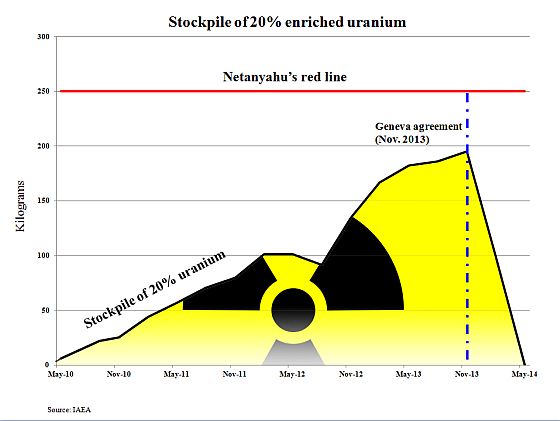
Iran nuclear deal respects Netanyahu’s red line

red-line

Graham Allison writes: Amidst the weeping and gnashing of teeth from the Prime Minister’s office after the interim agreement on Iran reached in Geneva, it is appropriate to pause to ask how President Obama’s interim agreement actually measures up on Israeli Prime Minister Netanyahu’s chosen yardstick.

Who can forget Netanyahu’s UN presentation last year where he made his best case to the world about the threat Iran’s nuclear program poses to international security. To vivify this danger, Bibi unveiled a graphic sketch of a bomb on which he demonstrably drew a red line.

As he explained in his UN speech then: “In the case of Iran’s nuclear plans to build a bomb, this bomb has to be filled with enough enriched uranium. And Iran has to go through three stages. The first stage: they have to enrich enough of low enriched uranium. The second stage: they have to enrich enough medium enriched uranium. And the third stage and final stage: They have to enrich enough high enriched uranium for the first bomb.”

Having set the stage, he then asked, “Where’s Iran?” As he answered: “Iran’s completed the first stage. It took them many years, but they completed it and they’re 70% of the way there. Now they are well into the second stage.” He then vowed that Iran would never be allowed to cross his red line to the third stage. “The red line must be drawn on Iran’s nuclear enrichment program,” he argued, “because these enrichment facilities are the only nuclear installations that we can definitely see and credibly target. I believe that faced with a clear red line, Iran will back down.” [Continue reading…]

Facebooktwittermail

What lessons do the success of Camp David and the failure of Oslo hold for America’s nuclear deal with Iran?

Marc Lynch writes: The Geneva P5+1 interim agreement with Iran is already the most important Middle Eastern diplomatic gambit since the Camp David Accords between Egypt and Israel and the Oslo Accords between the PLO and Israel. The “Joint Plan of Action” produced a monumental, symbolic breakthrough after years of frustrating diplomatic gridlock, and laid out a tantalizing glimpse of a very different Middle East. It has rapidly normalized relationships and practices which had very recently seemed unthinkable. A successful final status agreement on the Iranian nuclear program would be a monumental diplomatic accomplishment. But like Camp David and Oslo, Geneva is only an interim agreement which leaves a vast array of core issues unresolved — and offers a million opportunities for failure.

Camp David is the best-case analogy for Geneva, Oslo the worst-case analogy (and Munich is, of course, the black hole of analogies, a billion bad ideas gone supernova and sucking in everything that comes within its malevolent gravitational pull). Camp David suggests that implementation can be achieved against considerable odds, and in doing so galvanize radical strategic change in unpredictable directions. But Oslo suggests how easily Geneva can fail, given the opportunities it creates for spoilers to intervene and for implementation problems to sap its transformative power. That’s especially troubling since Geneva’s bargaining framework resembles Oslo’s more than anything else.

But it is a measure of Camp David’s success that few now recall that Egypt was for decades Israel’s most militarily dangerous foe and the strategic linchpin of a pan-Arab order. Most policy analysts in the mid-1960s (and, most likely, in the mid-1970s) would have considered the idea of an enduring, decades-long Egyptian-Israeli security partnership to be outrageously implausible. Camp David shows that a seemingly unthinkable strategic reorientation of leading rivals is entirely possible, if not likely, and that once achieved can be normalized remarkably quickly. [Continue reading…]

Facebooktwittermail

Zarif asks Saudi Arabia to work with Iran

Al Jazeera reports: Mohammad Javad Zarif, Iran’s foreign minister who is currently on a tour of the Gulf states, has appealed to Saudi Arabia to work with Iran towards achieving regional stability.

He said on Monday in Doha, Qatar, after visits to Kuwait and Oman for meetings on its recent nuclear deal with world powers that his goal was to assure Gulf Arab states that the deal was in their best interests.

“We believe that Iran and Saudi Arabia should work together in order to promote peace and stability in the region,” Zarif told AFP news agency.

Zarif suggested the deal should not be seen as a threat.

“This agreement cannot be at the expense of any country in the region,” he said on Sunday. [Continue reading…]

Facebooktwittermail

Jewish activists want to pray on Jerusalem’s Temple Mount, raising alarm in Muslim world

The Washington Post reports: A small but growing movement by Jewish activists demanding the right to pray at the site of their destroyed temple, in the heart of this disputed capital’s Old City, is creating a potentially explosive clash with the Muslim world, which considers the spot holy and bans Jews from public worship there.

Each week, hundreds of Jews ascend the creaky wooden ramp built above the Western Wall and enter what is often called the most contested real estate on Earth. Many then embark upon a game of hide-and-seek with their police escorts — whispering forbidden prayers while pretending to talk into cellphones, and getting in quick but banned bows by dropping coins and then bending to pick them up.

Their proposals, long dismissed as extremist, are now being debated in the Israeli parliament and embraced by an expansionist wing in the ruling coalition government of Prime Minister Benjamin Netanyahu.

These political leaders, many in Netanyahu’s party, want Israel to assert more, not less, control over the West Bank, East Jerusalem and the Old City, including the place known to Jews as the Temple Mount and to Muslims as Haram al-Sharif, or the Noble Sanctuary.

“We’re looking for it to be divided between Jews and Muslims,” said Aviad Visoli, chairman of the Temple Mount Organizations, which claims 27 groups under its umbrella. “Today, Jews realize the Western Wall is not enough. They want to go to the real thing.”

Two millenniums ago, this place was the site of the Jews’ Second Temple, destroyed in A.D. 70 by Roman legions under Titus, who cast the Jews into exile. The Western Wall, visited by 10 million people a year, is part of the remaining rampart built around the raised temple complex. Together, the wall and the site of the destroyed temple are the holiest landmarks in Judaism.

The same courtyard is home to al-Aqsa mosque, one of the oldest in Islam, and the Dome of the Rock, the golden landmark where tradition says the prophet Mohammad made his night journey to heaven.

For Palestinians and much of the Muslim world, any mention of changing the status quo at the site, the third-holiest in Islam, is incendiary. Protecting al-Aqsa has been a rallying cry for generations.

“This place belongs to the Muslim people, and no others have the right to pray here,” said Sheik Azzam al-Khatib, director of the Waqf, the Islamic trust that administers the site. Khatib said the mosque is a unifying symbol for the world’s 1.2 billion Muslims.

“If they try to take over the mosque, this will be the end of time,” Khatib warned. “This will create rage and anger not only in the West Bank but all over the Islamic world — and only God knows what will happen.” [Continue reading…]

Facebooktwittermail

UN falls short of feeding Syria’s hungry as winter bites

Reuters reports: The United Nations said on Tuesday it had delivered food to 3.4 million people in Syria in November, falling short again of its monthly target of 4 million as heavy fighting kept it from reaching hungry people in contested areas.

As winter bites, the number of children in Syria deemed vulnerable and in need of assistance has nearly quadrupled from a year ago to 4.3 million, the U.N. Children’s Fund (UNICEF) said.

“The scale of the humanitarian response needed for the looming winter is unprecedented,” it said in a statement.

U.N. aid chief Valerie Amos was to brief the Security Council on the humanitarian situation in Syria later on Tuesday amid deep concerns about lack of access to besieged civilians.

A U.N. document obtained by Reuters last week said around 250,000 people were beyond the reach of its aid convoys, in areas besieged by Syrian government forces or rebels. [Continue reading…]

Facebooktwittermail

Syria’s chemical weapon transport issues

Brown Moses Blog: Syria’s Deputy Foreign Minister Faisal Mekdad has told the BBC his government needs the international community to provide military equipment, to help transport their chemical weapons out of the country. Mr Mekdad was attending an Organisation for the Prohibition of Chemical Weapons meeting in The Hague.

The Assad Regime is required under the auspices of the UN Security Council to remove all chemical agent and the most toxic precursors about 630 tonnes in total from Syria by 31 Dec 13 and the less toxic precursors, around 700 tonnes by Feb 14. There appear to be 3 phases to the plan, firstly, to move the 1330 tonnes to the Port of Latakia, secondly to transport these chemicals to the MV Cape Ray presumably in the Mediterranean somewhere, and to commercial toxic waste destruction facilities and finally to destroy the most toxic by hydrolysis on the MV Cape Ray and the rest by normal convention toxic waste destruction at civilian facilities, by mid 2014 – all possible, well apparently, until yesterday’s 11th hour request by Minister Mekdad.

It is understood that most of the CW is North of Damascus and will have to move through a number of contested areas before it reaches Latakia. Sigrid Kaag head of the UN/OPCW in Damascus admitted on Sat 30 Nov 13 on BBC World Service that the route to the Port is currently blocked. It is the Regimes responsibility to deliver the CW, as per the CWC, to the Port whence it will be loaded onto ships to become the responsibility of the International Community under supervision of, and verification by the OPCW.

Phase 1 planning for the movement to the Port is an extremely complex military operation with many factors which must be worked through in finite detail, from force protection, to logistics, communications, capabilities required and many alternative options if things go wrong. Ideally, it would take a sophisticated military like the US or UK many days and weeks with great expertise to plan such an operation. One of the initial stages of military planning is working out whether you have enough ‘Troops to Task’ or forces available, to achieve the mission. It would appear at the 11th hour, rather than the First or Second, that the Regime planners have decided they do not have the ‘Troops for the Task’ and now require the International Community to supply, presumably Tanks, armoured personnel carriers etc in order to be able to achieve the mission. Even if the International community was minded to supply this hardware there is no way it could be handed over the Regime and trained on in order to deliver the CW to the Port by 31 Dec 13. But surely the UN and OPCW have been intermittently involved in this planning and this would be apparent at the outset, or are the Regime only involving them [UN/OPCW] when it is convenient? [Continue reading…]

Facebooktwittermail

What makes humans capable of horrific violence?

Tom Bartlett writes: The former battery factory on the outskirts of Srebrenica, a small town in eastern Bosnia, has become a grim tourist attraction. Vans full of sightseers, mostly from other countries, arrive here daily to see the crumbling industrial structure, which once served as a makeshift United Nations outpost and temporary haven for Muslims under assault by Serb forces determined to seize the town and round up its residents. In July 1995 more than 8,000 Muslim men, from teenagers to the elderly, were murdered in and around Srebrenica, lined up behind houses, gunned down in soccer fields, hunted through the forest.

The factory is now a low-budget museum where you can watch a short film about the genocide and meet a survivor, a soft-spoken man in his mid-30s who has repeated the story of his escape and the death of his father and brother nearly every day here for the past five years. Visitors are then led to a cavernous room with display cases containing the personal effects of victims—a comb, two marbles, a handkerchief, a house key, a wedding ring, a pocket watch with a bullet hole—alongside water-stained photographs of the atrocity hung on cracked concrete walls. The English translations of the captions make for a kind of accidental poetry. “Frightened mothers with weeping children: where and how to go on … ?” reads one. “Endless sorrow for the dearest,” says another.

Across the street from the museum is a memorial bearing the names of the known victims, flanked by rows and rows of graves, each with an identical white marker. Nearby an old woman runs a tiny souvenir shop selling, among other items, baseball caps with the message “Srebrenica: Never Forget.”

This place is a symbol of the 1995 massacre, which, in turn, is a symbol of the entire conflict that followed the breakup of Yugoslavia. The killings here were a fraction of the total body count; The Bosnian Book of the Dead, published early this year, lists 96,000 who perished, though there were thousands more. It was the efficient brutality in Srebrenica that prompted the international community, after years of dithering and half measures, to take significant military action.

While that action ended the bloodshed, the reckoning is far from finished. Fragments of bone are still being sifted from the soil, sent for DNA analysis, and returned to families for burial. The general who led the campaign, Ratko Mladic, is on trial in The Hague after years on the run. In a recent proceeding, Mladic stared at a group of Srebrenica survivors in the gallery and drew a single finger across his throat. Around the same time, the president of Serbia issued a nonapology apology for the massacre, neglecting to call it genocide and using language so vague it seemed more insult than olive branch.

Standing near the memorial, surrounded by the dead, the driver of one of those tourist-filled vans, a Muslim who helped defend Sarajevo during a nearly four-year siege, briefly drops his sunny, professional demeanor. “How can you forgive when they say it didn’t happen?” he says. “The Nazis, they killed millions. They say, ‘OK, we are sorry.’ But the Serbs don’t do that.”

Some Serbs do acknowledge the genocide. According to a 2010 survey, though, most Serbs believe that whatever happened at Srebrenica has been exaggerated, despite being among the most scientifically documented mass killings in history. They shrug it off as a byproduct of war or cling to conspiracy theories or complain about being portrayed as villains. The facts disappear in a swirl of doubts and denial.[Continue reading…]

Facebooktwittermail