Author Archives: Paul Woodward

Why the Taliban might win

Christian Science Monitor reports:

While current US counterinsurgency doctrine in Afghanistan broadly conforms with historical best practices, the Taliban enjoy a slew of advantages that historically correlate with insurgent success, according to a new study of 89 past and ongoing insurgencies worldwide.

Factors that favor the Taliban include receiving sanctuary and support in another country, learning to be more discriminating in targeting their attacks, and fighting a government that’s both weak and reliant on direct external support.

The historical trends suggest that the Achilles heel for the Taliban would be the loss of their Pakistani sanctuary, while the principal American vulnerability lies in Hamid Karzai’s anocracy, or weak, pseudodemocracy. The study, says the author, cannot be predictive, but can help the US address or exploit these vulnerabilities.

“A lot of the things being done in the current [US military] plan are along the lines of successful things we’ve seen in the study,” says Ben Connable, lead author “How Insurgencies End,” published by RAND Corp. in Washington. “The key is if the US recognizes it is working with an anocracy and recognizes the limits of that kind of government, you can work on solutions to that problem.”

Meanwhile, The Times reports:

Almost a quarter of the low-ranking Taleban commanders lured out of the insurgency in southern Afghanistan have rejoined the fight because of broken government promises and paltry rewards, a scathing report on reintegration claims.

Nato plans to spend more than $1 billion (£648 million) over the next five years tempting Taleban foot soldiers to lay down their arms.

But research by a Kabul-based thinktank warns that those efforts could make matters worse by swelling the ranks of the insurgency, exacerbating village level feuds and fuelling government corruption.

The report, titled Golden Surrender, by the independent Afghanistan Analysts Network, is highly critical of the British-backed Peace and Reconciliation Scheme (PTS), established in 2005, which it says has been left to flounder under bad leadership with neither the political nor the financial capital it required.

Facebooktwittermail

The looming risk of Egyptian democracy

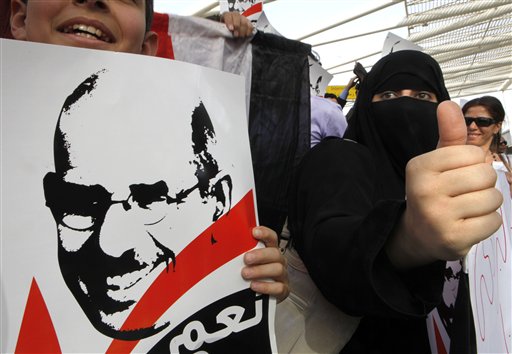
As the end of rule looms for Egypt’s autocratic leader, Christopher Dickey looks at the prospects for Hosni Mubarak’s replacement being a champion of democracy: the former IAEA director, Mohamed ElBaradei.

In the event that ElBaradei declares his candidacy for president, the Obama administration will face a dilemma: whether to support the rise of democracy on Israel’s borders if such a democracy would in all likelihood not be particularly Israel-friendly.

Mubarak’s regime has been propped up for decades by hundreds of millions of dollars a year in development assistance and well over $1 billion a year in military aid from Washington. That was a reward for its 1979 deal with Israel, which relies on Egypt to keep the peace. But Egypt’s stability and its commitments can no longer be taken for granted, as they have been for most of the last two decades, and the way Egypt navigates the potential chaos of the next few years could well set the course for the rest of the region.

So accustomed have we become to Egypt’s torpor that it’s easy to forget just how much weight it really carries in Arab culture and politics. Its population of more than 80 million is greater than Iraq, Syria, and Saudi Arabia combined. It could continue to try to muddle along on the same stagnant track with someone from the Mubarak establishment; it could slide toward chaos or Islamization, or have order imposed by a military regime like the one that ran Pakistan for most of the last decade. Or Egypt could actually start to lead the way toward a more democratic and progressive future for the whole Arab world. That’s where ElBaradei hopes to take it, and where his supporters pray they are heading.

These are nervous times, certainly, for anyone afraid of change. At the elegant bar of the Four Seasons Nile Plaza hotel in Cairo, the fin de règne mood hangs as heavy in the air as the smoke from Cuban cigars. For those with money, the country has never been so luxurious or so efficient; foreign investors continue to come, and the stock market continues to rise. But not much of that money trickles down, and the gap between rich and poor grows more striking every day. Twenty years ago, wealthy Cairenes lived among the people downtown or in nearby suburbs. Today they are secluded in gated communities—what ElBaradei calls “ghettos for the rich”—around golf courses built in the desert. Even among a group of businessmen with close ties to the government I heard grim speculation, over glasses of Spanish wine and plates of risotto, about some unseen, bloody revolution brewing among “the 60 million”: that three fourths of the population living in misery or on the edge of it.

There have been real revolutionary movements in the past. Radical Islamists murdered President Anwar Sadat in 1981, and Ayman al-Zawahiri, a member of that conspiracy, led a group known as Jamaa al-Islamiya in a terrorist campaign against the regime that lasted into the mid-1990s. After the government repressed, infiltrated, and obliterated his organization, Zawahiri fled the country to become, eventually, Osama bin Laden’s deputy and the man who actually runs Al Qaeda.

But most opposition groups are far less threatening. Indeed, the great paradox of the Egyptian police state lies in its long record cultivating a certain level of tame extremism—which it finds useful to justify its police tactics—while it crushes passionate moderation. It’s a cliché of Egyptian political commentary that if Mubarak did not have the Muslim Brotherhood to oppose him, he’d have to invent it. And ElBaradei has walked right into the middle of this political twilight zone.

The Mubarak government allows about 90 members of the “outlawed” Brotherhood to serve as “independents” in Parliament, where, with 20 percent of the votes, they make up the single largest opposition group. The Brotherhood, for its part, plays any angle it can, and has glommed onto the strongly secular ElBaradei. “I didn’t know a single Muslim Brother until I came [back] here. But the head of the Brothers’ parliamentary faction, Mohamed Saad el-Katatni, has come to my house a couple of times,” says ElBaradei, who adds that he was reassured when el-Katatni declared, “We are for a civil state, we are for democracy.”

Facebooktwittermail

U.S. targets an American abroad

Vicki Divoll, observes that President Obama’s de facto death sentence for the American Muslim cleric, Anwar al Awlaki, indicates that in its application of the law, this administration has a greater regard for Awlaki’s right to privacy than his right to life.

According to media reports, the United States has taken the apparently unprecedented step of authorizing the “targeted killing” of one of its citizens outside a war zone — though the government has not officially acknowledged it.

Unnamed intelligence and counter-terrorism sources told reporters that the Obama administration had added Anwar al Awlaki, a Muslim cleric born in New Mexico, to the CIA list of suspected terrorists who may be captured or killed. Awlaki, believed to be in hiding in Yemen, has been linked to Nidal Malik Hasan, the Ft. Hood, Texas, shooter, and to Umar Farouk Abdulmutallab, the Nigerian charged with trying to blow up an airliner in December.

The reports indicate that the administration had concluded Awlaki had taken on an operational role in terrorist attacks. His addition to the CIA list shouldn’t “surprise anyone,” according to one anonymous U.S. official quoted in the New York Times.

It is surprising, however. As a matter of U.S. law, had the administration wanted merely to listen to Awlaki’s cellphone conversations or read his e-mails, it would have needed to check with another branch of government — the judiciary. But to target him for death, the executive branch appears to have acted alone.

It adds up to this: Awlaki’s right to privacy exceeds his right to life.

Dennis Blair, the Director of National Intelligence, has indicated that Awlaki enjoys no special privileges simply by virtue of being America, and that might be so. Yet it’s hard to believe that Awlaki would now be in the CIA’s hit list were it not for three additional enabling factors: that he possesses an Arabic name, that he is a Muslim, and that he is not white.

Facebooktwittermail

Wave of fatal bombings widens divisions in Iraq

The New York Times reports:

A coordinated series of explosions struck a party headquarters, two mosques, a market and a shop in Baghdad on Friday, deepening the country’s turmoil amid a political impasse and a concerted military campaign against the leaders of Al Qaeda in Iraq.

The attacks, which killed at least 58 people and wounded scores more in Baghdad and elsewhere in Iraq, were the worst of an intermittent wave of bombings since the parliamentary election on March 7. The outcome of the vote remains unclear, as election officials prepare to conduct a partial recount in Baghdad and possibly other provinces.

The deadliest three bombings on Friday exploded in rapid succession near the headquarters of the political movement led by the Shiite cleric Moktada al-Sadr in Sadr City, the impoverished Shiite neighborhood in Baghdad that bears his family’s name.

Each Friday hundreds of his followers gather in an open square there for noon prayers, and they accounted for many of the victims.

Facebooktwittermail

Nuclear force without nuclear restraint

Military organizations, like muscles, atrophy unless they get regular exercise. And as much as the destructive power of the Cold War’s nuclear arsenals is credited with having prevented their use, there is no form of deterrence that can have as much appeal to the military as an actual show of force. The fear of disarmament is less a fear of military vulnerability than it is a fear of military redundancy.

So, when it comes to the prospects of global nuclear disarmament it should come as no surprise that the Pentagon won’t support the elimination of one class of weapons without first winning support for an alternative. Prompt Global Strike promises to be such an alternative and one with what to the military must seem like an irresistible appeal: the prospect that it can be put into use.

The New York Times now reports:

In coming years, President Obama will decide whether to deploy a new class of weapons capable of reaching any corner of the earth from the United States in under an hour and with such accuracy and force that they would greatly diminish America’s reliance on its nuclear arsenal…

Called Prompt Global Strike, the new weapon is designed to carry out tasks like picking off Osama bin Laden in a cave, if the right one could be found; taking out a North Korean missile while it is being rolled to the launch pad; or destroying an Iranian nuclear site — all without crossing the nuclear threshold. In theory, the weapon will hurl a conventional warhead of enormous weight at high speed and with pinpoint accuracy, generating the localized destructive power of a nuclear warhead.

Prompt Global Strike should be seen not merely as an alternative to nuclear weapons but as a means through which the US military can free itself from what is known as the nuclear taboo.

In his acceptance speech for the Nobel Prize in 2005, the nuclear strategist Thomas Schelling said:

There has never been any doubt about the military effectiveness of nuclear weapons or their potential for terror. A large part of the credit for their not having been used must be due to the “taboo” that Secretary of State [John Foster] Dulles perceived to have attached itself to these weapons as early as 1953, a taboo that the Secretary deplored.

The weapons remain under a curse, a now much heavier curse than the one that bothered Dulles in the early 1950s. These weapons are unique, and a large part of their uniqueness derives from their being perceived as unique. We call most of the others “conventional,” and that word has two distinct senses. One is “ordinary, familiar, traditional,” a word that can be applied to food, clothing, or housing. The more interesting sense of “conventional” is something that arises as if by compact, by agreement, by convention. It is simply an established convention that nuclear weapons are different.

True, their fantastic scale of destruction dwarfs the conventional weapons. But as early as the end of the Eisenhower administration nuclear weapons could be made smaller in explosive yield than the largest conventional explosives.

There were military planners to whom “little” nuclear weapons appeared untainted by the taboo that they thought ought properly to attach only to weapons of a size associated with Hiroshima, or Bikini. But by then nuclear weapons had become a breed apart; size was no excuse from the curse.

This attitude, or convention, or tradition, that took root and grew over these past five decades, is an asset to be treasured.

If Obama pushes forward with Prompt Global Strike — and all the indications seem to be that he will — then his promise of guiding the world towards a nuclear weapons-free age, will not only have been hollow, it may have signaled a new age of destruction.

And with a military that still espouses a belief in the value of full-spectrum dominance; that operates a Space Command (with an insignia inspired by Star Trek); that has just launched the X-37B that (denials notwithstanding) appears geared towards the weaponization of space — no one should imagine that the Pentagon’s appetite for exercising global power is any less now than it was while the neoconservatives were in charge.

Facebooktwittermail

How the FBI and the press attempted to destroy an innocent man

The one thing we know about President Obama’s view of the war on terrorism is that he doesn’t like the name. But when it comes to one of the longest running and unresolved debates — whether counter-terrorism is a law enforcement or a military issue — it’s unclear how far the current president departs, if at all, from his predecessor.

For Obama or anyone else considering that question, the case of the anthrax attacks in 2001 is instructive and if it is possible to deduce a “lesson learned” from this, it may well be that, as this administration demonstrates with some frequency, it is much easier to kill terrorist suspects than determine their guilt.

In the account laid out in by David Freed in The Atlantic, it appears that the United States Government with the willing assistance of the American media, when unable to prove that the American research scientist, Dr Steven J Hatfill, had any role whatsoever in the anthrax attacks, concluded that if under relentless pressure he eventually committed suicide, then his death could be regarded as an admission of guilt and the case could be closed.

The FBI’s efforts, if not by the letter of the law then at least in spirit, fall little short of attempted murder. The press were fully complicit in this exercise.

“I was a guy who trusted the government,” [Hatfill] says. “Now, I don’t trust a damn thing they do.” He trusts reporters even less, dismissing them as little more than lapdogs for law enforcement.

The media’s general willingness to report what was spoon-fed to them, in an effort to reassure a frightened public that an arrest was not far off, is somewhat understandable considering the level of fear that gripped the nation following 9/11. But that doesn’t “justify the sliming of Steven Hatfill,” says Edward Wasserman, who is the Knight Professor of Journalism Ethics at Washington and Lee University, in Virginia. “If anything, it’s a reminder that an unquestioning media serves as a potential lever of power to be activated by the government, almost at will.”

In February 2008, Reggie B. Walton, the U.S. District Court judge presiding over Hatfill’s case against the government, announced that he had reviewed secret internal memos on the status of the FBI’s investigation and could find “not a scintilla of evidence that would indicate that Dr. Hatfill had anything to do with” the anthrax attacks.

Four months later, the Justice Department quietly settled with Hatfill for $5.82 million. “It allowed Doc to start over,” Connolly, his lawyer, says.

For Hatfill, rebuilding remains painful and slow. He enters post offices only if he absolutely must, careful to show his face to surveillance cameras so that he can’t be accused of mailing letters surreptitiously. He tries to document his whereabouts at all times, in case he should ever need an alibi. He is permanently damaged, Hatfill says. Yet he still professes to love America. “My country didn’t do this to me,” he is quick to point out. “A bloated, incompetent bureaucracy and a broken press did. I wouldn’t be doing what I’m doing today if I didn’t still love my country.”

Much of Hatfill’s time these days is devoted to teaching life-saving medical techniques to military personnel bound for combat. They are his “band of brothers,” and the hours he spends with them, Hatfill says, are among his happiest. He also serves as an adjunct associate professor of emergency medicine at George Washington University.

Then there is his boat.

Hatfill has committed $1.5 million to building his floating genetic laboratory, a futuristic-looking vessel replete with a helicopter, an operating room to treat rural indigenous peoples, and a Cordon Bleu–trained chef. Hatfill intends to assemble a scientific team and cruise the Amazon for undiscovered or little-known plants and animals. From these organisms, he hopes to develop new medications for leukemia, and for tuberculosis and other diseases that have been growing increasingly resistant to existing antibiotics. Any useful treatments, he says, will be licensed to pharmaceutical companies on the condition that developing nations receive them at cost. Hatfill hopes to christen the boat within two years. Scientists at USAMRIID, where the FBI once suspected him of stealing anthrax, have expressed tentative interest in helping him mount his expedition.

In addition to suing the Justice Department for violating his privacy and The New York Times for defaming him, Hatfill also brought a libel lawsuit against Don Foster, Vanity Fair, and Reader’s Digest, which had reprinted Foster’s article. The lawsuit led to a settlement whose dollar amount all parties have agreed to keep confidential. The news media, which had for so long savaged Hatfill, dutifully reported his legal victories, but from where he stands, that hardly balanced things on the ledger sheet of journalistic fairness.

Three weeks after the FBI exonerated Hatfill, in the summer of 2008, Nicholas Kristof apologized to him in The New York Times for any distress his columns may have caused. The role of the news media, Kristof wrote on August 28, is “to afflict the comfortable and comfort the afflicted. Instead, I managed to afflict the afflicted.”

Many others who raised critical questions about Hatfill have remained silent in the wake of his exoneration. Barbara Hatch Rosenberg, the molecular biologist who spurred the FBI to pursue Hatfill, retired two years ago. Through a former colleague, she declined to be interviewed for this article. Jim Stewart, the television correspondent whose report compared Hatfill to Al Capone, left CBS in 2006. Stewart admitted in a deposition to having relied, for his report, on four confidential FBI sources. When I reached the former newsman at his home in Florida, Stewart said he couldn’t talk about Hatfill because he was entertaining houseguests. When I asked when might be a good time to call back, he said, “There isn’t a good time,” and hung up.

“The entire unhappy episode” is how Don Foster, the Vassar professor who wrote the Vanity Fair article, sums up Hatfill’s story and his own role in it. Foster says he no longer consults for the FBI. “The anthrax case was it for me,” he told me recently. “I’m happier teaching. Like Steven Hatfill, I would prefer to be a private person.”

Foster says he never intended to imply that Hatfill was a murderer, yet continues to stand by his reporting as “inaccurate in only minor details.” I asked if he had any regrets about what he’d written.

“On what grounds?” he asked.

“The heartache it caused Hatfill. The heartache it caused you and Vanity Fair.”

Foster pondered the question, then said, “I don’t know Steven Hatfill. I don’t know his heartache. But anytime an American citizen, a journalist, a scientist, a scholar, is made the object of unfair or inaccurate public scrutiny, it’s unfortunate. It’s part of a free press to set that right.”

This past February, the Justice Department formally closed its investigation of the 2001 anthrax attacks, releasing more than 2,500 pages of documents, many of them heavily redacted, buttressing the government’s assertion that Bruce Ivins was solely responsible for the anthrax letters.

When I asked FBI spokesperson Debra Weierman how much money had been spent chasing Hatfill, she said the bureau was unable to provide such an accounting. She would neither confirm nor deny that the FBI ever opened any administrative inquiries into the news leaks that had defamed him. The FBI, she said, was unwilling to publicly discuss Hatfill in any capacity, “out of privacy considerations for Dr. Hatfill.” Weierman referred me instead to what she described as an “abundance of information” on the FBI’s Web site.

Information about the anthrax case is indeed abundant on the bureau’s Web site, with dozens of documents touting the FBI’s efforts to solve the murders. Included is a transcript of a press conference held in August 2008, a month after Ivins’s suicide, in which federal authorities initially laid out the evidence they had amassed against him. But beyond a handful of questions asked by reporters that day, in which his last name is repeatedly misspelled, and a few scant paragraphs in the 96-page executive summary of the case, there is no mention anywhere on the FBI’s Web site of Steven Hatfill.

Visit msnbc.com for breaking news, world news, and news about the economy

Facebooktwittermail

Dare Israel go it alone in attacking Iran?

As some senior Israeli officials see signs the US may be willing to live with a nuclear-armed Iran, the Wall Street Journal says Israel is now considering unilateral military action.

Many Israeli military experts say Israel can easily cope with any military retaliation by Iran in response to a strike. Iran’s medium-range rockets would cause damage and casualties in Israel, but they aren’t very accurate, and Israel’s sophisticated missile-defense system would likely knock many out midflight. Israel has similarly proved it can handle attacks against Israel by Hezbollah and Hamas. Israel also hosts a contingent of U.S. troops attached to a radar system to help give early warning against incoming rocket attacks.

More worrying to Israeli strategic planners examining possible attack scenarios is the possibility that Iran would respond to an Israeli attack by ramping up support to groups battling U.S. troops in Iraq and Afghanistan, according to recently retired officials familiar with the military’s thinking on Iran. If American soldiers start dying in greater numbers as a result of an Israeli unilateral attack, Americans could turn against Israel.

Iran could also disrupt the world’s oil supply by cutting off exports through the Persian Gulf, roiling international oil markets.

“What will Americans say if Israel drags the U.S. into a war it didn’t want, or when they are suddenly paying $10 a gallon for gasoline and Israel is the reason for it,” says retired Brig. Gen. Shlomo Brom, former director of the Israeli army’s Strategic Planning Division.

And just as Israeli strategists weigh up that risk, so too Iranian strategists must be making some of the same calculations — ones that may well suggest that for Iran, the benefits of an Israeli attack may appear to outweigh the costs.

These benefits include:

  • the financial reward from a hike in oil prices
  • the silencing of the regime’s domestic critics
  • the deepening of ties between Turkey, Syria and the non-aligned international community
  • the further isolation of Israel, whose political vulnerability is far greater than its military vulnerability

Couple these to the fact that Israel might only succeed in doing limited damage to Iran’s nuclear facilities and it’s no wonder Mahmoud Ahmadinejad has seen little reason to temper his language.

So, as Iran’s Revolutionary Guard now begins large scale military maneuvers in the strategic Strait of Hormuz it is signalling not only its ability to deter an attack but its willingness to face one.

Facebooktwittermail

Obama administration looks beyond sanctions against Iran

David Ignatius sketches some of the details in the the sanctions regime being crafted by Stuart Levey, undersecretary of the Treasury for terrorism and financial intelligence, but he concedes that sanctions have rarely been effective instruments for changing policy.

For policymakers, the discussion is beginning to shift to the sensitive area suggested by Gates’s memo — the space between sanctions and outright military action. What options would the United States and its allies have, short of war, to raise the cost to Iran of pursuing a nuclear weapons program? Are there means of subverting, sabotaging or containing such a program without actually bombing Iranian facilities?

We won’t be hearing a lot of public discussion about this gray area. But that’s where senior officials will focus more of their energy in coming months, as they prepare for the possibility that Levey’s clever trap won’t work.

Is a “gray area” for the Obama administration the equivalent of the “dark side” Dick Cheney made infamous? Are we talking about kidnappings and assassinations? Having demonstrated his willingness to authorize extra-judicial detention and extra-judicial killing, is Obama getting ready to employ full-fledged state-sponsored terrorism?

Facebooktwittermail

American kleptocracy — How fears of socialism and fascism hide naked theft

At TomDispatch, William Astore writes:

America is not now, nor has it often been, a hotbed of political radicalism. We have no substantial socialist or workers’ party. (Unless you’re deluded, please don’t count the corporate-friendly “Democrat” party here.) We have no substantial fascist party. (Unless you’re deluded, please don’t count the cartoonish “tea partiers” here; these predominantly white, graying, and fairly affluent Americans seem most worried that the jackbooted thugs will be coming for them.)

What drives America today is, in fact, business — just as was true in the days of Calvin Coolidge. But it’s not the fair-minded “free enterprise” system touted in those freshly revised Texas guidelines for American history textbooks; rather, it’s a rigged system of crony capitalism that increasingly ends in what, if we were looking at some other country, we would recognize as an unabashed kleptocracy.

Recall, if you care to, those pallets stacked with hundreds of millions of dollars that the Bush administration sent to Iraq and which, Houdini-like, simply disappeared. Think of the ever-rising cost of our wars in Iraq and Afghanistan, now in excess of a trillion dollars, and just whose pockets are full, thanks to them.

If you want to know the true state of our government and where it’s heading, follow the money (if you can) and remain vigilant: our kleptocratic Houdinis are hard at work, seeking to make yet more money vanish from your pockets — and reappear in theirs.

Never has the old adage my father used to repeat to me — “the rich get richer and the poor poorer” — seemed fresher or truer. If you want confirmation of just where we are today, for instance, consider this passage from a recent piece by Tony Judt:

In 2005, 21.2 percent of U.S. national income accrued to just 1 percent of earners. Contrast 1968, when the CEO of General Motors took home, in pay and benefits, about sixty-six times the amount paid to a typical GM worker. Today the CEO of Wal-Mart earns nine hundred times the wages of his average employee. Indeed, the wealth of the Wal-Mart founder’s family in 2005 was estimated at about the same ($90 billion) as that of the bottom 40 percent of the U.S. population: 120 million people

Wealth concentration is only one aspect of our increasingly kleptocratic system. War profiteering by corporations (however well disguised as heartfelt support for our heroic warfighters) is another. Meanwhile, retired senior military officers typically line up to cash in on the kleptocratic equivalent of welfare, peddling their “expertise” in return for impressive corporate and Pentagon payouts that supplement their six-figure pensions. Even that putative champion of the Carhartt-wearing common folk, Sarah Palin, pocketed a cool $12 million last year without putting the slightest dent in her populist bona fides.

Facebooktwittermail

Sanctions-busting is in Dubai’s DNA

In The Guardian, Raymond Barrett writes:

Dubai – separated from Iran by the waters of the Gulf – has excelled as a channel for circumventing the variety of international sanctions that have built up over the decades. Be it restrictions on badly needed aviation spare parts, “dual use” electronics or blackballed financial institutions, Dubai is one of several major ventricles through which contraband and money flow in and out of Iran.

Yet Dubai has always preferred the term “re-exporting” to “sanctions busting”, and the process itself is relatively straightforward. Iranian firms establish legitimate trading concerns in Dubai’s Jebel Ali Free Zone or in the bustling district of Deira close to the city’s famous reek; prohibited items are then purchased, with Dubai listed as the final destination on the manifest. Depending on the scale of the enterprise, cargo planes or diesel-powered dhows then transport the goods to Iranian ports such as Bandar Abbas or Kish.

Dubai has long been a vibrant regional entrepot for trade, both legitimate and illicit, and this was a natural role for it to assume. Along with an estimated 400,000 Iranians living in Dubai, around 40% of the “local” population are ajam – an Arabic term used to denote emigrants from the southern coast of Iran who moved to Dubai more than a century ago.

Over the years, this Dubai connection has morphed into a $10bn-a-year import/export industry vital to both parties and supplying Iran with everything from electronics to cosmetics.

While much of the re-export trade involves innocuous consumer goods such as air-conditioners and tyres, criminal cases in US courts occasionally shine a light on “sanctions busters”. In the eyes of the US department of justice, the big fish that got away must be AQ Khan, the father of Pakistan’s nuclear bomb, who sold centrifuges used to enrich uranium to Tehran while using Dubai as the trans-shipment point.

As America’s desire to pursue sanctions has waxed and waned under different presidents, Dubai has rolled with the prevailing winds. When the shortlived “Persian detente” of the latter Clinton years changed to the “axis of evil” mantra of the junior Bush administration, Dubai demurred accordingly. The local authorities were always most welcoming when US officials swept into town calling for tougher enforcement of export controls and financial transactions. While such visits were sometimes followed by minor crackdowns, words alone were never going to get of rid of a business model embedded deep in Dubai’s DNA.

Facebooktwittermail

Dread surrounds Operation Hope

Jean MacKenzie writes:

It is being called Operation Omid.

The word omid means “hope” in Afghanistan’s Dari language. But, judging by the reaction of local residents, the coming U.S.-led military offensive against the Taliban in Kandahar could not be more inappropriately named.
In Kandahar, residents like Abdul Salaam, a farmer, feel more a sense of dread than hope about a military operation that is being billed as one of the largest in the war to date.

“Operation Omid will bring more insecurity, instead of peace,” said Salaam, who lives in the Maiwand district of Kandahar Province. “We have just seen that the opposition has accelerated its attacks. There are more and more explosions in the province. You cannot bring peace through war.”

Meanwhile, a report in The Sunday Times said:

The supreme leader of the Taliban, Mullah Mohammed Omar, has indicated that he and his followers may be willing to hold peace talks with western politicians.

In an interview with The Sunday Times, two of the movement’s senior Islamic scholars have relayed a message from the Quetta shura, the Taliban’s ruling council, that Mullah Omar no longer aims to rule Afghanistan. They said he was prepared to engage in “sincere and honest” talks.

A senior US military source said the remarks reflected a growing belief that a “breakthrough” was possible. “There is evidence from many intelligence sources [that] the Taliban are ready for some kind of peace process,” the source said.

Facebooktwittermail

Will not one but two Guantanamos define the American future?

At TomDispatch, Karen J. Greenberg writes:

On his first day in office, President Barack Obama promised that he would close the Bush-era prison at Guantanamo Bay, Cuba, “as soon as practicable” and “no later than one year from the date of this order.” The announcement was met with relief, even joy, by those, like me, who had opposed the very existence of Guantanamo on the grounds that it represented a legal black hole where the distinction between guilt and innocence had been obliterated, respect for the rule of law was mocked, and the rights of prisoners were dismissed out of hand. We should have known better.

By now, it’s painfully obvious that the rejoicing, like the president’s can-do optimism, was wildly premature. To the dismay of many, that year milestone passed, barely noticed, months ago. As yet there is no sign that the notorious eight-year-old detention facility is close to a shut down. Worse yet, there is evidence that, when it finally is closed, it will be replaced by two Guantanamos — one in Illinois and the other in Afghanistan. With that, this president will have committed himself in a new way to the previous president’s “long war” and the illegal principles on which it floundered, especially the idea of “preventive detention.”

For those who have been following events at Guantanamo for years, perhaps this should have come as no surprise. We knew just how difficult it would be to walk the system backwards toward extinction, as did many of the former lawyer-critics of Guantanamo who joined the Obama administration. The fact is: once a distorted system has been set in stone, the only way to correct it is to end the distortion that started it: indefinite detention.

Facebooktwittermail

Speculation dismounts on Obama Middle East peace plan

I claim no special knowledge of the inside workings of the Obama administration — merely an ear that notes the difference between substance and flatulence and to my ear what sounded like a farting contest started on April 7 with a column by David Ignatius: “Obama weighs new peace plan for the Middle East.”

According to Ignatius — which is to say, according to the nameless officials he had been talking to — Obama was “seriously considering” proposing a peace plan. Chatter, chatter, chatter.

Even as late as Thursday, Ignatius wasn’t ready to completely pull the plug on the story he’d started. After all, one of the primary reasons it had been taken so seriously was because it came from such an august columnist. A Middle East peace plan is on Obama’s foreign policy checklist and he’s “still working on it,” Ignatius wrote last week.

Even yesterday, Agence France Press reported: “Washington’s foreign policy echo chamber is reverberating with speculation that President Barack Obama could try to blow open the deadlock between Israelis and Palestinians with his own peace plan.”

Enough. The man has now spoken — Rahm Emanuel, that is.

The Jewish Telegraph Agency reports:

The time is not ripe for a U.S.-promoted Middle East peace plan, President Obama’s chief of staff said.

“A number of people have advocated that,” Rahm Emanuel said Monday on the Charlie Rose show on Bloomberg Television.

“That time is not now,” Emanuel said. The “time now is to get back to the proximity talks, have those conversations that eventually will lead to direct negotiations…”

I guess George Mitchell can carry on snoozing in the back of his limo as he waits to start shuttling between Jerusalem and Ramallah.

Facebooktwittermail

Nuclear terrorism and climate change

Graham Allison, who has for years been issuing graves warnings about the danger of nuclear terrorism, writes about last week’s nuclear security summit in Washington:

With all the immediate challenges demanding President Obama’s attention today, his choice to invest so much of his own mind-share and political capital in an issue seemingly so remote is remarkable.

We are accustomed to the triumph of the urgent over the important. In assembling the largest number of heads of foreign governments by an American president since FDR invited leaders to San Francisco to create the United Nations, this president demonstrated his ability to distinguish between the vivid and the vital.

The question remains: So what? How is the world different today? How will it be different a year from now?

To score this undertaking, it is necessary to assess performance on four dimensions. First, what is the single largest national security threat to the lives of American citizens? Far-fetched as it still appears to many, President Obama’s answer is unambiguous. As he said Monday: Nuclear terrorism is “the single biggest threat to U.S. security, short term, medium term and long term.”

Nuclear terrorism — a bigger threat to American security than climate change? Hardly.

The critical difference is that unlike the threat of nuclear terrorism, with climate change there will probably be no singlular event that will result in any particular political leader being called to task to explain how they could have allowed this unfolding calamity to happen.

So when it comes to the exercises in self-protection that consume a significant amount of time and energy for the world’s political leaders, the issue of nuclear terrorism is indeed more vexing than climate change. Obama’s attention to this issue does not — at least as far as I’m concerned — indicate his willingness to distinguish between the vivid and the vital.

Facebooktwittermail

Iran’s nuclear capabilities

Thomas Schelling, a Nobel laureate and an expert in nuclear strategy, spoke at the New America Foundation in Washington last week.

Having recently attended the highly influential Herzliya Conference in Israel, Schelling said:

I was impressed with how many Israelis speculate that what Iran wants to do is to get just about where Japan is in terms of nuclear capability. Get to where they could have a few bombs in a few months, or maybe a few weeks, but not overtly test anything to prove they have it and maybe not to claim they have it.

I don’t know where the Iranians might get that idea, but I’d heard about it for a couple of years from Americans who study Iranian apparent nuclear policy and it strikes me as an idea that might not occur to the Iranians but it strikes me as a good idea. I don’t see any way to make them back down from where they are, but it might be possible to persuade them not to take the final step…

Israel’s President Shimon Peres, who also attended the Herzliya Conference yet lacks the slightest nuance in his assessment of Iran’s intentions, yesterday declared that Iran poses a threat to the whole civilized world.

“A threat to the peace of the Jewish people always carries the danger of turning into a threat to the civilized world as a whole,” Peres said in Jerusalem on Sunday.

That’s a statement eerily reminiscent of something the Israeli historian, Martin van Creveld, said a few years ago while referring to Israel’s own nuclear arsenal: “We have the capability to take the world down with us. And I can assure you that that will happen before Israel goes under.”

Which begs the question, given that Israel has an arsenal of several hundred nuclear weapons and Iran so far has none: Of which state should we be more afraid?

In considering the Iranian nuclear threat, there is another reason for thinking that the Iranians may well have calculated that attaining a nuclear capability without assembling a nuclear arsenal is in their best interests — not simply because of the international ramifications but because of the regime’s own internally complex and fractious power dynamics.

For Iran to actually acquire the bomb and not simply the means to produce it, begs difficult questions of command and control. Could the regime withstand a potential power struggle that might ensue over how weapons might be dispersed and under whose authority? The prospect of the Iranian Revolutionary Guards becoming Iran’s nuclear masters might be sufficiently galling to everyone outside the IRG, that nuclear capability appears as full a measure of nuclear power that the Islamic state can safely handle.

When it comes to assessing Iran’s nuclear intentions there is an abundance of evidence that it is indeed a rational actor and virtually none that it operates in the thrall of an apocalyptic vision of the future.

Facebooktwittermail

Who’s behind the Gates memo leak?

The New York Times reports on a “secret three-page memorandum” that Defense Secretary Robert Gates sent to National Security Adviser Gen James Jones in January, warning that “the United States does not have an effective long-range policy for dealing with Iran’s steady progress toward nuclear capability,” according to unnamed officials who leaked the information.

The narrative line here which is presumably the line which was being fed to the New York Times‘ ever-obliging reporters, was that the there are gaps in the US strategy for dealing with Iran’s nuclear ambitions. It’s far from clear that this was actually the thrust of Gates’ memo.

[I]n his memo, Mr. Gates wrote of a variety of concerns, including the absence of an effective strategy should Iran choose the course that many government and outside analysts consider likely: Iran could assemble all the major parts it needs for a nuclear weapon — fuel, designs and detonators — but stop just short of assembling a fully operational weapon.

In that case, Iran could remain a signatory of the Nuclear Nonproliferation Treaty while becoming what strategists call a “virtual” nuclear weapons state.

To say that the US lacks a strategy here, is itself a statement so vague as to be meaningless. It lacks a strategy to prevent Iran becoming a virtual nuclear state? Or it lacks a strategy for dealing with Iran in such an eventuality? Or it lacks a strategy for dealing with the fact that it may not actually know whether Iran has acquired this form of nuclear capability?

There is no indication in this account that the New York Times reporters saw the memo (and it seems reasonable to infer that they did not), so as is so often the case, it’s likely that the most significant detail in this story is the one that will not be revealed: the identity of the senior official who is the primary source of the narrative.

Was it Dennis Ross? He’d certainly fit the profile of someone in the administration who probably feels like it’s time to change the subject and shift attention away from Israel and back to Iran. As another US official recently told Laura Rozen, “He [Ross] seems to be far more sensitive to Netanyahu’s coalition politics than to U.S. interests.”

Facebooktwittermail

Kucinich: White House assassination policy is extrajudicial

Jeremy Scahill writes in The Nation:

There has been almost universal silence among Congressional Democrats on the Obama administration’s recently revealed decision to authorize the assassination of a US citizen, Anwar al-Awlaki. Al-Awlaki, who now lives in Yemen, has been accused of providing inspiration for Umar Farouk Abdulmutallab, the alleged “underwear bomber,” and Major Nidal Malik Hasan, the alleged Fort Hood shooter. In recent weeks, there has been a dramatic surge in US government chatter about the alleged threat posed by al-Awlaki, with anonymous US officials accusing him of directly participating in terror “plots” (his family passionately disputes this).

Several Democrats refused, through spokespeople, to comment on the assassination plan when contacted by The Nation, including Senator Russ Feingold and Representative Jan Schakowsky, both of whom serve on the Intelligence Committees. Representative Jane Harman, who serves on the Homeland Security Committee, said recently that Awlaki is “probably the person, the terrorist, who would be terrorist No. 1 in terms of threat against us.”

An issue related to this assassination plan that has thus far received no attention is its implications for the court martial of Nidal Malik Hasan. If Anwar al-Awlaki was arrested and brought back to the United States, he would undoubtedly be a key witness in Hasan’s trial, given the widely reported email correspondence between the Texas shooter and Awlaki. Won’t killing a potential witness prejudice the outcome of the trial?

Facebooktwittermail

US Army researchers: Why the Kandahar offensive could backfire

At Wired, Nathan Hodge reports:

The southern Afghan province of Kandahar trusts the Taliban more than the government. And that’s according to a survey commissioned by the U.S. Army.

Kandahar is expected to be the focal point of operations for U.S. and NATO troops this summer, but a poll recently conducted by the Army’s controversial social science program, the Human Terrain System (HTS), is warning that rampant local corruption, and a lack of security, could undermine coalition efforts to win the support of the local population.

Among other things, the survey’s authors warned that a lack of confidence in the Afghan government “sets conditions for a disenfranchised population to respond either by not supporting the government due to its inability to deliver improvements in the quality of life or, worse yet, by supporting the Taliban.”

Facebooktwittermail