Author Archives: Paul Woodward

Does Gilbert Bigio make Israel look good?

Does Gilbert Bigio make Israel look good?

When Amos Radian, Israel’s Dominican Republic-based ambassador to the nations of the eastern Caribbean, spoke to the Jerusalem Post last week, he was unequivocal in expressing appreciation towards the Bigio family.
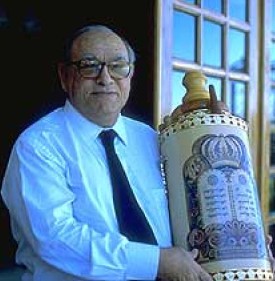
Gilbert Bigio, a Syrian Jew and honorary consul for Israel in Haiti also happens to be among the wealthiest men in that impoverished nation. The day before Israel’s relief team was due to arrive in Haiti, Ambassador Radian spoke to Reuven Shalom Bigio, son of the business magnate.

“Tomorrow the Israel Air Force is coming with two jets and 250 people and I have no place to put them,” Radian told Bigio. The response was swift as the Israelis were provided with Bigio-owned land to set up a field hospital. Radian said that the assistance provided “made us look so good”.

The billionaire industrialist’s loyalty to Israel is unquestionable. As the Jerusalem Post report said:

Gilbert Bigio’s own father came to Haiti in 1925 and was active in the Jewish community. He played a role in Haiti’s support for Israeli statehood in the November 1947 vote at the United Nations.

“Being in a city where there’s no synagogue, prayers are done at our house, Israel to us is the motherland. It’s the rock. It’s how we identify ourselves,” said Reuven Bigio. His father’s support for Israel’s mission here was immediate: “His desire to help was unconditional.”

Does the Bigio family have an unconditional desire to help Haitians? Not as far as one can tell.

In 2004, the Miami Herald reported on Haiti’s tiny and wealthy Jewish community and spoke to its de facto leader. Bigio saw no reason why the huge disparity between his own wealth and the poverty of those around him should breed in them any resentment.

Bigio, 68, lives in a big, beautiful house in Petionville, one of the few upscale neighborhoods in Port-au-Prince. Behind the well-guarded house is a luxurious swimming pool and a gazebo for outdoor parties.

Like most of the other Jews who remain in Haiti, Bigio is considered extremely wealthy in a country where 50 percent of the population is illiterate and 76 percent of children under 5 are underweight or suffer from stunted growth.

“I don’t think there’s resentment against people who are rich here,” says the retired businessman, who speaks English, French and Haitian Creole. “If you know how to manage success, people admire you instead of hate you.”

Cite Soleil, a seaside shantytown of more than 300,000 people residing in homes made of cinder blocks with tin roofs, has been described as poorer than India’s infamous slums of Calcutta. It is also the home of the Bigio business empire.

“Our purpose is to improve the quality of life of the communities we reach,” the GB Group says in its mission statement. A Haiti Information Project report from Cite Soleil published in January 2008 suggests otherwise.

While the surrounding residents of Cite Soleil are forced to literally eat dirt to stave off hunger, Bigio is a billionaire whose family supported the first coup against Aristide and reportedly helped to back the movement that forced his second ouster in 2004.

One need not look very far to see where Gilbert Bigio’s interests lie in relation to Cite Soleil. According to his own company’s web site his family maintains controlling interests in sixteen of Haiti’s largest companies. They are also the largest Haitian partner in the wireless communications giant Digicel, a mammoth company based in Ireland that has nearly cornered the cellular market in the Caribbean. Bigio’s family is not merely wealthy amidst a sea of poverty stricken residents in Haiti, his family represents the Über-wealthy who have benefited most since Aristide’s second ouster in 2004.

The Office of Foreign Assets Control of the US government blocked all of the Bigio family’s holdings in US banks following the brutal military coup against Aristide in 1991. Since Aristide’s second ousting in 2004, the financial wealth of the Bigio family along with those of other well off Haitian clans such as the Mevs, Brandts, Acras and Madsens have nearly doubled according to a confidential source at a private accounting firm.

Meanwhile, Israel’s image-boosting relief effort in Haiti is about to wrap up its operations – its medical and rescue team is set to return home by Thursday.


Facebooktwittermail

Israel at war

Israel at war

Yesterday I called attention to an article in Hebrew (appearing on an Israeli website) with the extraordinary headline: “The painful truth: Haiti’s disaster is good for the Jews.” Shmuel Sermoneta-Gertel has now translated the whole article which appears at Mondoweiss. It begins:

At a time when our country is under media attack on the basis of harsh and anti-Semitic reports, and we are forced to contend with terrorists who have assumed the winning image of victims of war, one could say that the Haiti disaster is the best thing that could have happened to us. So why are blood, destruction, poverty, hunger and orphans good for the Jewish State? First of all because global attention has been drawn elsewhere and the international media have a more interesting story to cover. Second, because every disaster-area needs a hero, and right now we are it. I must admit that I would not be surprised if the image aspect of setting up a hospital in Haiti, as well as the IDF rescue efforts, was given greater weight than humanitarian considerations. If I am right, then finally, someone in the Knesset has done the right thing, deciding to take advantage of the opportunity to prove to the world how kindhearted and capable we are. And if the Foreign Ministry manages to make further use of the Israeli success stories in Haiti and market them to the world, all the better. We can only hope that none of our talented politicians is caught in front of a camera saying “We showed the world. We were really awesome in Haiti,” or something like that – a distinct possibility considering the recent mess with the Turks. Better to be modest.

Those in Charge Don’t see Hasbara as Warfare

The tough question raised by our success in Haiti is why we do well in the media only when we have the opportunity to star in another country’s disaster, and not on a regular basis? After all, you can’t have a natural disaster every day. The answer to the question is a lack of concerted effort to garner sympathy from the countries of the world, alongside behaviour that actually creates antagonism, such as humiliating ambassadors on camera. Before criticizing current hasbara practice however, we must realize that our biggest problem lies in the way we approach the entire issue of image. First of all, our elected representatives see themselves as politicians rather than statesmen, and so prefer to focus on their own personal interests, rather than on those of the country. Every Israeli citizen is knows this, to the point that we can’t stand our own leaders, so why does it come as surprise that the rest of the world isn’t too crazy about us either? Second, those in charge of the country’s PR don’t see hasbara as warfare, just like any military operation, intended to safeguard and promote our national and security interests.

Depending on where you stand politically, hasbara is either Israel’s public diplomacy or pro-Israeli propaganda.

Let’s at this juncture set aside the issue of how obscene and self-defeating it is for some Israelis to turn a humanitarian relief effort in Haiti into a schmaltzy stage-show. What strikes me as particularly interesting in the argument that Tamir Haas is clumsily pressing is that once again we see how warfare has become the single lens through which Israelis see the world.

Hasbara is a form of warfare, Haas asserts, and I am reminded of Ariel Siegelman’s presentation of what he called a new kind of war as this American-Israeli reservist last year celebrated “victory” in Gaza:

After the Second Lebanon War, we learned some very valuable lessons. We learned that we had been living in an imaginary world and that the most dangerous type of war is the one that you call peace. We learned that we are not in fact in a “peace process” at all. We are at war…

The war is ongoing, with periods of more violence and periods of less violence, during which the enemy regroups and plans his next attack. When we feel the enemy is getting strong, we must be prepared to make preemptive strikes, hard and fast at key targets, with viciousness, as the enemy would do to us. Only then can we acquire, not peace, but sustained periods of relative calm.

If Tamir Haas and Ariel Siegelman happen to be two relatively unknown Israelis, what should concern those outside Israel is not whether their views exercise much influence but to what extent they reflect a generational mindset.

When war has become the principal force shaping life, there is indeed no peace process.

Facebooktwittermail

How Israel saved the world

How Israel saved the world

Dr Ariel Bar speaking from the Israeli field hospital in Haiti: “When we save the life of one person, we feel that we saved the world. So we saved the world several times in this mission.”

“No one but the Israeli’s have come to help any of our patients that are dying.”

Facebooktwittermail

Securing disaster: The US repeats past mistakes in Haiti

Securing disaster: The US repeats past mistakes in Haiti

One week after the devastating earthquake that struck Haiti on January 12, it’s now clear that the initial phase of the US-led relief operation has conformed to the three fundamental tendencies that have shaped the more general course of the island’s recent history. It has adopted military priorities and strategies. It has sidelined Haiti’s government and ignored the needs of the majority of its people. And it has proceeded in ways that reinforce the already harrowing gap between rich and poor. These three tendencies aren’t just connected, they are mutually reinforcing – and they look likely to continue to govern the imminent reconstruction effort unless determined political action is taken to avoid them.

Haiti is the only country where slaves won their own independence, in a war that left a third of the population dead and the economy in ruins. Today it is not only one of the poorest countries in the world, it is also one of the most polarised and unequal – in terms of wealth as well as access to political power. A small clique of rich and well-connected families continues to dominate the country and its economy, while the vast majority of the population live on less than $2 a day. [continued…]

Haiti earthquake: aid agencies fear child trafficking

Aid agencies continued to warn against adopting children from Haiti today, amid unconfirmed reports that a number of children who had gone missing from hospitals in the devastated country may have been trafficked.

An adviser for Unicef told reporters that about 15 children had disappeared from hospitals, presumed taken.

Jean Luc Legrand was quoted as saying: “Unicef has been working in Haiti for many years and we knew the problem with the trade of children in Haiti which existed before, and unfortunately many of these trade networks have links with the international adoption ‘market’.” [continued…]

More than 150,000 have been buried, Haiti says

Haiti’s government provided a preliminary assessment of the earthquake’s body count on Saturday, putting it at more than 150,000, and declared that the search for survivors trapped in the rubble would soon be coming to an end.

Marie-Laurence Jocelyn Lassegue, Haiti’s culture and communications minister, said that 150,000 bodies from the streets had been collected and buried in the past 11 days.

She also said that there were at least 250,000 people homeless and that 200,000 residents of Port-au-Prince and its outskirts had moved to the provinces since the earthquake hit. [continued…]

Facebooktwittermail

The return of the neocons

The return of the neocons

Technically, there is nothing “neo” about conservatives like Robert Kagan, the historian and another Washington Post columnist, or John Podhoretz, the editor of Commentary; each is a son of one of neoconservatism’s founding fathers. Indeed, no strain in American politics is so dynastic. It is akin to the right-wing Likud Party in Israel, whose religion and politics, world view, and succession rituals the neocons often share. The definitions, and analogy, are inexact, but both groups have recent ties to Europe and are haunted by the Holocaust, which has left them feeling wounded, suspicious, and sometimes bellicose, determined never again to be naive or to trust the world’s good intentions. Both spent decades in the po-litical wilderness before miraculously acquiring power; both begat “princes” who defied the normal generational tensions and allied themselves with their kingly fathers. When Bill Kristol rose to praise Irving that morning, he was really picking up his scepter.

Had you Googled “neoconservative” and “death” that day, four days after the 89-year-old Kristol expired, you’d have found lots on their long-rumored—and for some, much-anticipated and -savored—demise. On both the left and right, neoconservatism was deemed a spent force. Its ideas, Foreign Policy magazine had pronounced, “lie buried in the sands of Iraq.”

But obituaries can be premature. At the moment, in fact, the neocons seem resurrected. One of their own, Frederick Kagan of AEI (Robert’s younger brother), helped turn around the war in Iraq by devising and pushing for the surge there. More recent-ly, President Obama—whose foreign–policy pronouncements (nuanced, multi-lateral, interdependent) and style (low-key, self-critical, conciliatory, collegial) were a repudiation of neoconservative assertiveness—has swung their way, or so they believe. First, he’s sending an additional 30,000 troops to Afghanistan, nearly as many as leading neocons had sought. Then came his Nobel Prize acceptance speech, which, with its acknowledgment of the need for force, its nod to dissidents in Iran and elsewhere, and its talk about good and evil, was surprisingly congenial.

As if on cue, a Nigerian man with explosives in his crotch nearly brought down an American airliner over Detroit on Christmas Day, leaving the neocons feeling further vindicated and energized. Obama, who’d ratcheted up his rhetoric after an initial response that Bill Kristol and other neocons considered too tepid, had been “mugged by reality,” Kristol declared. It was an obvious homage to his father, who’d long ago defined “neocon” as a liberal to whom just that had happened. “Whether they praise or denounce Obama, the neocons are winning,” says Jacob Heilbrunn, a senior editor at The National Interest and author of They Knew They Were Right: The Rise of the Neocons (2008). “They’ve got him embracing the surge in Afghanistan and on the run for being ‘soft on terrorists.’ Either way, he ends up catering to them.” With Obama further weakened by an electoral repudiation in Massachusetts, that process might only intensify. [continued…]

Obama quietly continues to defend Bush’s terror policies

Although the FBI has acknowledged it improperly obtained thousands of Americans’ phone records for years, the Obama administration continues to assert that the bureau can obtain them without any formal legal process or court oversight.

The FBI revealed this stance in a newly released report, troubling critics who’d hoped the bureau had been chastened enough by its own abuses to drop such a position.

In further support of the legal authority, however, the Justice Department’s Office of Legal Counsel backed the FBI in a written opinion issued this month.

The opinion by the OLC — the section that wrote the memos that justified enhanced interrogation techniques during the last administration — appears to be yet another sign that the Obama administration can be just as assertive as Bush’s in claiming sweeping and controversial anti-terrorism powers. [continued…]

CIA deaths prompt surge in U.S. drone strikes

… officials deny that vengeance is driving the increased attacks, though one called the drone strikes “the purest form of self-defense.”

Officials point to other factors. For one, Pakistan recently dropped restrictions on the drone program it had requested last fall to accompany a ground offensive against militants in South Waziristan. And tips on the whereabouts of extremists ebb and flow unpredictably.

A C.I.A. spokesman, Paul Gimigliano, declined to comment on the drone strikes. But he said, “The agency’s counterterrorism operations — lawful, aggressive, precise and effective — continue without pause.”

The strikes, carried out from a secret base in Pakistan and controlled by satellite link from C.I.A. headquarters in Virginia, have been expanded by President Obama and praised by both parties in Congress as a potent weapon against terrorism that puts no American lives at risk. That calculation must be revised in light of the Khost bombing, which revealed the critical presence of C.I.A. officers in dangerous territory to direct the strikes. [continued…]

Editor’s Comment — The question that the New York Times‘ Washington-based reporters (true to form) fail to address is this: If the Khost bombing killed CIA officers who were critical in choosing the targets for drone attacks, how have subsequent targets been chosen? Are we supposed to believe that right in the aftermath of this huge blow to the CIA’s drone operation, a flood of valuable intelligence swept in?

How convenient… and improbable.

Facebooktwittermail

IDF to finally engage Goldstone, day late dollar short

IDF to finally engage Goldstone, day late dollar short

Ethan Bronner writes a N.Y. Times report on a new propaganda offensive by the IDF against the Goldstone Report. It seems Israel has finally decided to engage with the document’s claims that Israel may have committed war crimes during last year’s Gaza war. Of course, it could’ve done so by testifying to the UN investigative body so that Israel’s perspective could’ve been incorporated into the finished document. At the time, Israel evidently judged it could filibuster and disparage this effort, as they have so many previous international attempts to hold Israel accountable for its actions concerning the Palestinians. But for some reason, Goldstone has developed much more staying power than other similar past efforts. [continued…]

Editor’s Comment — Richard Silverstein does a nice job of critiquing the Bronner article — the only other thing I was struck by was the Netanyahu quote naming Israel’s three-pronged axis of evil: “We face three major strategic challenges: The Iranian nuclear program, rockets aimed at our civilians and Goldstone.”

Wow! Richard Goldstone, the diminutive and rather modest judge from South Africa, now poses an existential threat to Israel!

Or am I reading that the wrong way round? Maybe Netanyahu is moderating his rhetoric and conceding that Israel does not actually face external existential threats. Existential threats may well persist, but these would be the ones of Israel’s own making.

Facebooktwittermail

After the Massachusetts massacre

After the Massachusetts massacre

It was not a referendum on Barack Obama, who in every poll remains one of the most popular politicians in America. It was not a rejection of universal health care, which Massachusetts mandated (with Scott Brown’s State Senate vote) in 2006. It was not a harbinger of a resurgent G.O.P., whose numbers remain in the toilet. Brown had the good sense not to identify himself as a Republican in either his campaign advertising or his victory speech.

And yet Tuesday’s special election was a dire omen for this White House. If the administration sticks to this trajectory, all bets are off for the political future of a president who rode into office blessed with more high hopes, good will and serious promise than any in modern memory. It’s time for him to stop deluding himself. Yes, last week’s political obituaries were ludicrously premature. Obama’s 50-ish percent first-anniversary approval rating matches not just Carter’s but Reagan’s. (Bushes 41 and 43 both skyrocketed in Year One.) Still, minor adjustments can’t right what’s wrong.

Obama’s plight has been unchanged for months. Neither in action nor in message is he in front of the anger roiling a country where high unemployment remains unchecked and spiraling foreclosures are demolishing the bedrock American dream of home ownership. The president is no longer seen as a savior but as a captive of the interests who ginned up the mess and still profit, hugely, from it. [continued…]

The man Obama needs to fix America is … Karl Marx

There is something almost tragi-comic in Hillary Clinton’s use of the Berlin Wall as an analogy for China’s internet censorship. The Chinese Communist Party hardly shares the American view of Cold War history; the implication that unrestrained Googling will bring down authoritarian regimes is unlikely to persuade Beijing that internet censorship is a bad thing.

But while Winston Churchill’s metaphorical “iron curtain” separated western capitalism from the sclerotic planned economies of the socialist world, what lies behind the US secretary of state’s “information curtain” is the world’s most dynamic capitalist economy, providing credit on which the US’s own economy now depends. While the West endures anaemic growth rates and massive unemployment, China’s double-digit stimulus-based recovery is the envy of all.

The transition from third-world agrarian basket case to the world’s second largest economy in just three decades has been overseen by a Communist Party with a monopoly on power and complete dedication to the pursuit of wealth through capitalism. Its response to the recession was to inject hundreds of billions of dollars into infrastructure projects, consumer subsidies and measures to ensure that banks kept on lending.

Despite (indeed, perhaps because of) that programme’s evident success, doom-mongers abound in the western media. China will overheat; its property bubble will burst; it will be dragged down by over-capacity; the absence of democracy will strangle its entrepreneurs. And so on. But these prophecies are not new, and Chinese capitalism has proven remarkably resilient, nurtured by a government that is authoritarian but not unresponsive. [continued…]

Facebooktwittermail

British man held for fraud in Iraq bomb detectors

British man held for fraud in Iraq bomb detectors

The director of a British company that supplies bomb detectors to Iraq has been arrested on fraud charges, and the export of the devices has been banned, British government officials confirmed Saturday.

Iraqi officials reacted with fury to the news, noting a series of horrific bombings in the past six months despite the widespread use of the bomb detectors at hundreds of checkpoints in the capital.

“This company not only caused grave and massive losses of funds, but it has caused grave and massive losses of the lives of innocent Iraqi civilians, by the hundreds and thousands, from attacks that we thought we were immune to because we have this device,” said Ammar Tuma, a member of the Iraqi Parliament’s Security and Defense Committee.

But the Ministry of the Interior has not withdrawn the device from duty, and police officers continue to use them. [continued…]

Export ban for useless ‘bomb detector’

Iraq swears by bomb detector U.S. sees as useless

Despite major bombings that have rattled the nation, and fears of rising violence as American troops withdraw, Iraq’s security forces have been relying on a device to detect bombs and weapons that the United States military and technical experts say is useless.

The small hand-held wand, with a telescopic antenna on a swivel, is being used at hundreds of checkpoints in Iraq. But the device works “on the same principle as a Ouija board” — the power of suggestion — said a retired United States Air Force officer, Lt. Col. Hal Bidlack, who described the wand as nothing more than an explosives divining rod.

Still, the Iraqi government has purchased more than 1,500 of the devices, known as the ADE 651, at costs from $16,500 to $60,000 each. Nearly every police checkpoint, and many Iraqi military checkpoints, have one of the devices, which are now normally used in place of physical inspections of vehicles. [continued…]

Facebooktwittermail

Biden says U.S. will appeal Blackwater case dismissal

Biden says U.S. will appeal Blackwater case dismissal

Vice President Joseph R. Biden Jr. promised Iraqi leaders on Saturday that the United States would appeal the dismissal of manslaughter charges against five Blackwater Worldwide security contractors involved in a deadly shooting here that has inflamed anti-American tensions.

Mr. Biden, tasked by the Obama administration to oversee policy in Iraq, made the statement after a day of meetings with Iraqi leaders that dealt, in part, with a political crisis that has erupted over the March 7 parliamentary elections. American officials view the vote, a barometer of the durability of Iraq’s political system, as a crucial date in American plans to withdraw tens of thousands of combat troops from Iraq by the end of August.

The vice president expressed his “personal regret” for the Blackwater shooting in 2007, in which contractors guarding American diplomats opened fire in a crowded Baghdad traffic circle, killing 17 people, including women and children.

“A dismissal is not an acquittal,” he said after meeting President Jalal Talabani. [continued…]

Facebooktwittermail

Afghan president Hamid Karzai urges West to buy off the Taliban

Afghan president Hamid Karzai urges West to buy off the Taliban

After giving up on winning victory in Afghanistan by military means, the international community is resorting to the centuries-old method of buying its way out.

In London this week, Hamid Karzai, the Afghan president, will launch a British and American-backed plan for “reintegration” of the Taliban and call for international funding to offer jobs and bribes to bring insurgents in from the cold.

The conference, which starts on Thursday, will be the first big international gathering on Afghanistan since President Barack Obama announced his military strategy last month, including a surge of 30,000 American troops.

The aim was to accompany the surge with a new political strategy and ways for the Afghans to provide their own security by setting up local militias, which could include former Taliban. [continued…]

Facebooktwittermail

The Haiti I love is still there

The Haiti I love is still there

Far from being the looting mobs that some media have portrayed them as, hardly anyone who has witnessed the response of the Haitians to this great catastrophe has not been moved by their incredible resilience and solidarity and their intact sense of humor in the face of an unimaginable tragedy.

As all the pillars of the Haitian state — a state that has often seemed only able to rouse itself to parasitically victimize its own people when it did make its presence felt — collapsed around them, the Haitians helped one another, dug through rubble, prayed, sang and showed everyone who has watched them what the meaning of true perseverance in the face of adversity looks like, even though the losses have been tremendous and irreplaceable.

Micha Gaillard, a university professor and son of one of Haiti’s eminent historians, was one of the first political leaders I met while traveling to Haiti, and I recall him greeting me in his modest home in the Turgeau neighborhood as his charming wife, Katy, prepared us coffee. Katy passed away far too early a few years ago, and Micha died after the Palais de Justice collapsed on him, dying in what must have been agony after having been trapped for many hours. Three of the country’s foremost feminist thinkers — Myriam Merlet, Magalie Marcelin and Anne Marie Coriolan — also died that day. The damage to the country’s artistic heritage, from the almost-total collapse of the Episcopal Cathédrale Sainte Trinité, which boasted stunning indigenous murals by such eminent Haitian painters as Wilson Bigaud and Philome Obin, to the loss of much of the Nader art collection, probably the best private collection of Haitian art in the world, is incalculable.

Sometimes since I have returned to Haiti in the immediate aftermath of the earthquake, I have felt as if I would be overcome by despair. Looking at block after block of ruins throughout the capital’s downtown, or seeing the terrible death and destruction caused by the collapse of the Université de Port-au-Prince, ringed by weeping, desperate relatives of those lost, one almost wants to turn away.

But the Haitians, always the Haitians, keep one going, and seeing their dignity in this moment has made me love them and their battered country as never before. [continued…]

Editor’s Comment — Dignity is perhaps the most precious human resource on the planet and its distribution bears no relationship with the distribution of material wealth. Indeed, it is so often to be found in greatest abundance among those who possess the least. That’s why at times such as these, hands reached out in help should also offer respect.

Facebooktwittermail

‘The painful truth: Haiti’s disaster is good for the Jews’

‘The painful truth: Haiti’s disaster is good for the Jews’

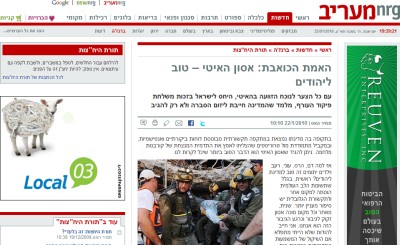
If I came up with a headline claiming the devastation in Haiti is “good for the Jews”, I could reasonably be accused of being anti-Semitic. But it’s not my headline. It comes from this report on a site run by Israel’s popular Hebrew daily, Maariv.

Every disaster needs a hero, the report says, and the heroes in Haiti are the Israelis.

The message that Israel is saving Haiti was likewise captured in an editorial cartoon in Yediot Aharonot which shows American soldiers digging for earthquake survivors. A voice from beneath the rubble calls out, “Would you mind checking to see if the Israelis are available?”

Bnei Akiva, the largest religious Zionist youth movement in the world, in partnership with Latet, an Israeli humanitarian aid organization, launched a Haiti appeal saying: “We are not only helping Haitians with their tragedy, but uniting the Jewish world and demonstrating the Jewish values of the State of Israel. We believe that it is a Jewish duty to help the people of Haiti. As the representative of the Jewish people, the State of Israel is leading the relief effort.”

An Associated Press article I linked to yesterday describing the exodus of Haitians fleeing from the ruins of Port-au-Prince, strangely was subsequently replaced by a report describing the rescue of a 22-year-old man by an Israeli search team 10 days after the earthquake leveled much of the capital.

In Haaretz, Bradley Burston writes:

Over the past week, the work of the Israeli medical team has become a kind of Rorschach for how people view Israel and Israelis. Most of the comment, it must be said, is supportive. Even on the part of those who cast the humanitarian misery in Gaza in contrast.

But for a shocking number of others, the bottom line is simple: Israel, and Israelis, can do no right.

In its most extreme form, there are those who have accused Israel of using the Haiti catastrophe as a new reservoir for harvesting organs.

But even many of those who shun blood libels, have seized on the Haiti mission to bash Israel, revealing in many cases a hatred – and a bigotry – that borders on the visceral.

Would Burston lump me in with the anti-Israel commentators? Maybe.

Do I think the Israeli doctors, nurses and rescue teams now working in Haiti are all toiling away purely in the service of Israel’s international image? I doubt it. I would expect that for most of these individuals, their response is like that of most of the other foreigners now providing relief to Haitians: it is above all a human response to human suffering.

Is there such a thing as an Israeli response or a Jewish response or an American response to human suffering? If so, it is laced with vanity.

To say this is what we do because this is who we are is to preen oneself in front of a mirror of self-praise. It is undignified. It spies a reward in someone else’s loss.

In this mirror, Israel now sees an image of itself as a big-hearted nation admired around the world for its humanitarian efforts in Haiti. But the self-satisfaction will be short-lived. Before long this glimmer of goodwill will once again be overshadowed by the enduring reality that in the minds of most Israelis the suffering of others seems just as likely to provoke callous indifference as it does an open heart.

The big Israeli heart shrivels at the sight of a Palestinian.

As Larry Derfner wrote in the Jerusalem Post:

… the IDF field hospital in Haiti is a reflection of something very deep in the national character.

But so is everything that’s summed up in the name “Gaza.” It’s the Haiti side of Israel that makes the Gaza side so inexpressibly tragic. And more and more, the Haiti part of the national character has been dwarfed by the Gaza part.

Gaza, too, is a matter of life and death – not just for the people who were trapped in the rubble there not long ago, but for Israel. When will this big-hearted nation stop being heartless to the people in Gaza?

Facebooktwittermail

Turkey: Newly exposed military coup planned to turn the clock back to 1923

Turkey: Newly exposed military coup planned to turn the clock back to 1923

The Turkish Armed Forces (TSK) hoped to take Turkey back to 1923, the time when the republic was proclaimed, after the staging of a coup d’état against the Justice and Development Party (AK Party) government, the Taraf daily reported on Thursday.

According to the coup plan — titled the Balyoz (Sledgehammer) Security Operation Plan — all the key posts in the country, public and private, would be occupied by active and retired members of the military to “get rid of every single threat to the secular order of the state.”

“The plan will be based on an objective to clean up all state and public posts [of individuals suspected of posing a threat to the secular order of Turkey] and return Turkey to its dynamism of 1923. All the assets and financial resources of individuals and groups suspected of involvement in acts of reactionaryism will be confiscated, and necessary steps will be taken to freeze their financial resources abroad,” stated the document.

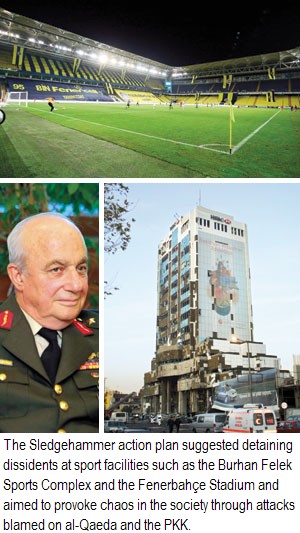
The armed forces also planned to take into custody and then arrest at least 200,000 individuals accused of reactionary activities in İstanbul after the coup. The total number of detainees around Turkey was estimated to reach 16 million, the plan stated. According to the document, individuals who stood against the coup would be taken into custody and brought to large sports facilities for interrogation. Among those facilities were the Burhan Felek sports complex and Fenerbahçe Stadium. The suspects would be questioned by security forces there and then would be sent to prisons. If the prisons were unable to accommodate all the arrestees, then military barracks would temporarily be turned into jails. [continued…]

120 al-Qaida suspects detained in Turkey

Turkish police launched a nationwide crackdown on suspected militants linked to the al-Qaida terror network on Friday, rounding up 120 people in simultaneous pre-dawn raids, the state-run Anatolia news agency reported.

It was not clear if Friday’s raids in 16 provinces in this NATO member and western ally country would amount to a major blow to homegrown Islamic militants.

Yeni Safak newspaper this week reported that Turkish police had recently seized video recordings of alleged Turkish al-Qaida militants in Taliban camps in Afghanistan, as well as alleged plans for attacks on Turkish soldiers in Kabul and on police in Turkey. It did not cite a source for the report. [continued…]

Facebooktwittermail

Helping the Haitians over there so that we don’t have to help them here

Haiti relocating homeless, port repairs needed

Haitians are fleeing their quake-ravaged capital by the hundreds of thousands, aid officials said Friday, as their government promised to help nearly a half-million more move from squalid camps on curbsides and vacant lots into safer, cleaner tent cities.

Aid officials said some 200,000 people have crammed into buses, nearly swamped ferries and set out even on foot to escape the ruined capital. For those who stay, foreign engineers have started leveling land on the fringes of the city for tent cities, supposedly temporary, that are meant to house 400,000 people. [continued…]

Editor’s Comment — As the US is in the process of sending 20,000 troops to Haiti, one has to wonder how their mission has been conceived. Is this first and foremost what it purports to be, a humanitarian endeavor? Or is the highest priority in the minds of US government planners to prevent a massive exodus? Is this all about helping the Haitians over there so that we don’t have to help them here? Is the Obama administration afraid of being accused of being soft on refugees?

Before there were even any American marines’ boots on the ground, the message from the skies was unambiguous: “Listen, don’t rush on boats to leave the country,” said Raymond Joseph, Haiti’s ambassador in Washington, in a broadcast to homeless and destitute Haitians repeated for hours on end. “If you do that, we’ll all have even worse problems. Because, I’ll be honest with you: If you think you will reach the U.S. and all the doors will be wide open to you, that’s not at all the case. And they will intercept you right on the water and send you back home where you came from.”

To heal Haiti, look to history, not nature

The sound of Haiti’s suffering is deafening now but behind it one can hear already a familiar music begin to play. Haiti must be made new. This kind of suffering so close to American shores cannot be countenanced. The other evening I watched a television correspondent shake his head over what he movingly described as a “stupid death” — a death that, but for the right medical care, could have been prevented. “It doesn’t have to happen,” he told viewers. “People died today who did not need to die.” He did not say what any Haitian could have told him: that the day before, and the day before that, Haiti had seen hundreds of such “stupid deaths,” and, over the centuries, thousands more. What has changed, once again, and only for a time, is the light shone on them, and the volume of the voices demanding that a “new Haiti” must now be built so they never happen again.

Whether they can read or not, Haiti’s people walk in history, and live in politics. They are independent, proud, fiercely aware of their own singularity. What distinguishes them is a tradition of heroism and a conviction that they are and will remain something distinct, apart — something you can hear in the Creole spoken in the countryside, or the voodoo practiced there, traces of the Africa that the first generation of revolutionaries brought with them on the middle passage.

Haitians have grown up in a certain kind of struggle for individuality and for power, and the country has proved itself able to absorb the ardent attentions of outsiders who, as often as not, remain blissfully unaware of their own contributions to what Haiti is. Like the ruined bridges strewn across the countryside — one of the few traces of the Marines and their occupation nearly a century ago — these attentions tend to begin in evangelical zeal and to leave little lasting behind.

What might, then? America could start by throwing open its markets to Haitian agricultural produce and manufactured goods, broadening and making permanent the provisions of a promising trade bill negotiated in 2008. Such a step would not be glamorous; it would not “remake Haiti.” But it would require a lasting commitment by American farmers and manufacturers and, as the country heals, it would actually bring permanent jobs, investment and income to Haiti.

Second, the United States and other donors could make a formal undertaking to ensure that the vast amounts that will soon pour into the country for reconstruction go not to foreigners but to Haitians — and not only to Haitian contractors and builders but to Haitian workers, at reasonable wages. This would put real money in the hands of many Haitians, not just a few, and begin to shift power away from both the rapacious government and the well-meaning and too often ineffectual charities that seek to circumvent it. The world’s greatest gift would be to make it possible, and necessary, for Haitians — all Haitians — to rebuild Haiti. [continued…]

Facebooktwittermail

Gates says Taliban must take legitimate Afghan role

Gates says Taliban must take legitimate Afghan role

The United States recognizes that the Taliban are now part of the political fabric of Afghanistan, Defense Secretary Robert M. Gates said here on Friday, but the group must be prepared to play a legitimate role before it can reconcile with the Afghan government.

That means, Mr. Gates said, that the Taliban must participate in elections, not oppose education and not assassinate local officials. [continued…]

Afghan insurgent outlines peace plan

One of the three main leaders of the Afghan insurgency, mercurial warlord Gulbuddin Hekmatyar, has a long history of switching sides, and once fought against his current Taliban allies.

Now, he has held out the possibility of negotiating with Afghan President Hamid Karzai and outlined a roadmap for political reconciliation, opening what could be the most promising avenue for Mr. Karzai’s effort to peacefully resolve the conflict.

It is far from certain that any talks with Mr. Hekmatyar will begin, let alone succeed. But in contrast to Taliban leader Mullah Omar and allied insurgent chief Sirajuddin Haqqani, who refuse any talks with Kabul as long as foreign troops remain in the country, Mr. Hekmatyar took a much more conciliatory line in a recent video.

“We have no agreement with the Taliban—not for fighting the war, and not for the peace,” said Mr. Hekmatyar, who commands the loyalty of thousands of insurgents. “The only thing that unites the Taliban and [us] is the war against the foreigners.” [continued…]

U.S. ambassador puts brakes on plan to utilize Afghan militias against Taliban

The U.S. ambassador to Afghanistan and senior Afghan officials have resisted moving forward with a bold and potentially risky initiative to support local militias in Afghanistan that are willing to defend their villages against insurgents, according to U.S. officials.

Their concerns have slowed the implementation of a key effort to provide security in places where there are relatively few NATO forces or Afghan police and Army units. U.S. military officials had wanted to get the initiative — developed under the leadership of Gen. Stanley A. McChrystal, the top commander in Afghanistan — off to a quick start this year.

The plan was to take advantage of the emergence of informal village security forces that were taking up arms against outside insurgents. The hope was that the new program could yield thousands of new security forces relatively fast, bridging the gap until more army and police forces could be trained. But before the initiative can be implemented on a broader scale, Ambassador Karl W. Eikenberry must approve the release of more money for it. [continued…]

Facebooktwittermail

Interview: Joe Sacco

Interview: Joe Sacco

When it comes to the world of cartooning, Joe Sacco is considered a luminary. Sacco, who is hailed as the creator of war-reportage comics, is the author of such award-winning books as Palestine and Safe Area Gorazde.

His latest work, Footnotes in Gaza, is an investigation into two little-known and long-forgotten massacres in 1956 in the southern Gaza Strip that left at least 500 Palestinians dead. It is a chilling look back at an unrecorded past and an exploration of how that past haunts and shapes the present – including the beginning of mass home demolitions in 2003 in Rafah.

Sacco navigates the fuzzy lines between memory, experience and visual interpretation almost seamlessly all while painting an intimate portrait of life under occupation and in spite of occupation – a life not only of repression and anger but one full of humour and resilience. [continued…]

Facebooktwittermail

Detainees will still be held, but not tried, official says

Detainees will still be held, but not tried, official says

The Obama administration has decided to continue to imprison without trials nearly 50 detainees at the Guantánamo Bay military prison in Cuba because a high-level task force has concluded that they are too difficult to prosecute but too dangerous to release, an administration official said on Thursday.

However, the administration has decided that nearly 40 other detainees should be prosecuted for terrorism or related war crimes. And the remaining prisoners, about 110 men, should be repatriated or transferred to other countries for possible release, the official said, who spoke on the condition of anonymity because he was not authorized to speak about the numbers.

There are just under 200 detainees left at the detention center.

President Obama established the task force shortly after his inauguration last year as part of his administration’s effort to deal with the detainee issues left behind by the Bush administration. It was facing a deadline of Friday to complete its work. [continued…]

Facebooktwittermail

Man claims terror ties in Little Rock shooting

Man claims terror ties in Little Rock shooting

A Tennessee man accused of killing a soldier outside a Little Rock, Ark., military recruiting station last year has asked a judge to change his plea to guilty, claiming for the first time that he is affiliated with a Yemen-based affiliate of Al Qaeda.

In a letter to the judge presiding over his case, the accused killer, Abdulhakim Muhammad, calls himself a soldier in Al Qaeda in the Arabian Peninsula and calls the shooting “a Jihadi Attack” in retribution for the killing of Muslims by American troops.

“I wasn’t insane or post traumatic nor was I forced to do this Act,” Mr. Muhammad said in a two-page, hand-printed note in pencil. The attack, which he said did not go as planned, was “justified according to Islamic Laws and the Islamic Religion. Jihad — to fight those who wage war on Islam and Muslims.”

It remains unclear whether Mr. Muhammad really has ties to Al Qaeda in the Arabian Peninsula, which President Obama has said is behind the attempted Christmas Day bombing of an American plane by a Nigerian man.

But if evidence emerges that his claim is true, it will give the June 1, 2009, shooting in Little Rock new significance at a time when Yemen is being more closely scrutinized as a source of terrorist plots against the United States.

Mr. Muhammad, 24, a Muslim convert from Memphis, spent about 16 months in Yemen starting in the fall of 2007, ostensibly teaching English and learning Arabic. During that time, he married a woman from south Yemen. But he was also imprisoned for several months because he overstayed his visa and was holding a fraudulent Somali passport, the Yemen government said. [continued…]

Facebooktwittermail