Category Archives: Editorials

Syria seen through the eyes of a British journalist and a Dutch jihadist

Emblematic of the feeble condition of Western political thought these days are the indications that there is more agreement about the evil of terrorism than there is about the value of democracy.

Witness an observation made recently by Patrick Cockburn, a British journalist admired by many on the Left, who wrote in The Independent:

The “war on terror” has failed because it did not target the jihadi movement as a whole and, above all, was not aimed at Saudi Arabia and Pakistan, the two countries that had fostered jihadism as a creed and a movement.

For those who want to distance themselves from the crude lexicon of Bush and Cheney, jihadism is supposedly a word with less charge, signalling that the term’s user is not on a crusade. Yet under this veneer of objectivity there is sometimes a surprising concordance with the neoconservative perspective.

Over a decade ago, I wrote:

Richard Perle, in quasi-theological terms, posits a “unity of terror.” In the same spirit, an editorial in Sunday’s Jerusalem Post, in reference to the terrorists who killed three Americans in Gaza this week, goes so far as to say:

Whether it was Hamas, Islamic Jihad, or perhaps even al-Qaida itself matters little and in fact tends to distract from what the West knows but often does not like to admit: The tentacles all belong to the same enemy.

Within this conception of terrorism, a phenomenon that is scattered across the globe has been turned into a beast of mythological proportions. The explicit connection is militant Islam, but whether the “tentacles” linking Islamic terrorists amount to concrete connections through finance and organization, or whether we are looking at bonds that have no more substance than a common cause or simply the common use of particular techniques of terrorism, these are all distinctions that the unitarians dismiss as distractions.

Cockburn now writes:

These days, there is a decreasing difference in the beliefs of jihadis, regardless of whether or not they are formally linked to al-Qa’ida central, now headed by Ayman al-Zawahiri. An observer in southern Turkey discussing 9/11 with a range of Syrian jihadi rebels earlier this year found that “without exception they all expressed enthusiasm for the 9/11 attacks and hoped the same thing would happen in Europe as well as the US”.

When a veteran reporter makes this kind of observation, even though he does not identify his source in any way at all, there will be many readers who treat Cockburn’s word (and thus that of an unidentified “observer”) as definitive. In so doing, they ignore the fact that this characterization of the Assad regime’s opponents perfectly mirrors the regime’s own propaganda.

One can treat Assad’s claim that he is fighting terrorists as a statement of fact. Or, one can treat it as a cynical and effective piece of political messaging — messaging one of whose purposes is to corral some sympathy from those in the West who, paradoxically, both vehemently reject the military adventurism that the neoconservatives initiated after 9/11 and yet also fully embrace a neoconservative view of unified terrorism.

When labels like jihadist and terrorist get used with sufficient frequency, the mere fact that the terms are used so frequently solidifies the sense that we know what they mean.

Any label applied to a person, however, calls out for a corrective: the voice of that person — a voice which may reinforce or undermine the stereotypes that repetition has created.

When it comes to the jihadists in Syria, we rarely hear what they have to say about themselves and if Cockburn is to be believed there’s little reason why we should be interested in hearing such individuals speak, since they all think alike and are all enemies of the West.

Earlier this year, a rare glimpse of foreign jihadists in Syria came in the form of an interview with a Dutch jihadist. Speaking in English, he provided a more nuanced picture of what has led young men like him to leave their families and join the fight against the Assad regime. Indeed, he spoke at length characterizing this more as a fight for Syrians than as one against their government.

His is just one voice. To what extent he can be taken as representative of others is open to question. Young men can easily be blinded by their own convictions or become servants of the agendas of others.

But while it’s perfectly reasonable to view with skepticism anyone’s claim that Islamic law would provide the panacea that can heal all of Syria’s wounds, the account that this former Dutch soldier gives of himself suggests to me that he knows his own mind.

He’s the kind of jihadist that both Patrick Cockburn and Bashar al-Assad would have you believe does not exist.


Facebooktwittermail

Under militia rule, Libya is beginning to disintegrate. Are the interventionists to blame?

o13-iconOwen Jones writes: It’s called the pottery store rule: “you break it, you own it”. But it doesn’t just apply to pots and mugs, but to nations. In the build-up to the catastrophic invasion of Iraq, it was invoked by Colin Powell, then US secretary of state. “You are going to be the proud owner of 25 million people,” he reportedly told George W Bush. “You will own all their hopes, aspirations and problems.” But while many of these military interventions have left nations shattered, western governments have resembled the customer who walks away whistling, hoping no one has noticed the mess left behind. Our media have been all too complicit in allowing them to leave the scene.

Libya is a striking example. The UN-authorised air campaign in 2011 is often lauded as a shining example of successful foreign intervention. Sure, the initial mandate – which was simply to protect civilians – was exceeded by nations who had only recently been selling arms to Muammar Gaddafi, and the bombing evolved into regime-change despite Russia’s protests. But with a murderous thug ejected from power, who could object?

Today’s Libya is overrun by militias and faces a deteriorating human rights situation, mounting chaos that is infecting other countries, growing internal splits, and even the threat of civil war. Only occasionally does this growing crisis creep into the headlines: like when an oil tanker is seized by rebellious militia; or when a British oil worker is shot dead while having a picnic; or when the country’s prime minister is kidnapped.

According to Amnesty International, the “mounting curbs on freedom of expression are threatening the rights Libyans sought to gain“. A repressive Gaddafi-era law has been amended to criminalise any insults to officials or the general national congress (the interim parliament). One journalist, Amara al-Khattabi, was put on trial for alleging corruption among judges. Satellite television stations deemed critical of the authorities have been banned, one station has been attacked with rocket-propelled grenades, and journalists have been assassinated. [Continue reading…]

Jones concludes: “No wonder western governments and journalists who hailed the success of this intervention are so silent. But here are the consequences of their war, and they must take responsibility for them.”

Once again we are offered a picture of Libya, the uprising against Gaddafi, and the chaos that has followed, as something in which the interventionists are all powerful and the Libyans themselves are like headless chickens set loose by Western overlords.

But here’s a radical idea: Maybe the anarchic state into which Libya has fallen is primarily the responsibility of its militia rulers.

If the only way of holding a country together is through the force of authoritarian rule, is that an argument in favor of authoritarianism or does it merely reveal the flimsiness of national identity?

The anti-interventionists who seem to feel nostalgic about the stability of Libya and Syria pre-2011, also seem to find it very easy to tolerate oppression which they themselves do not face.

No one enjoying democratic freedoms has the right or should have the audacity to believe that they can instigate someone else’s revolution. But the one thing on which most observers agree is that the uprisings in Libya and Syria were homegrown.

Facing well-armed government forces, the revolutionaries sought foreign support, just as Americans fighting for independence from Britain gladly accepted weapons and money from France.

Beneath a facade of anti-interventionist harmlessness (“It’s none of our business to interfere in the political affairs of others”) lurks an Orientalist contempt for Libyans and Syrians — populations whose political aspirations could apparently have continued being effectively suppressed by Gaddafi and Assad were it not for the meddlesome interference of Western neo-liberal interventionists.

When Owen says that those who supported NATO intervention in Libya should now “take responsibility,” it sounds like he’s expecting mea culpas in the form like this: intervention turns out to be a terrible thing. I promise to never support it again.

Yet those who argue that intervention in Libya was a terrible thing, need to present a credible supporting argument which I have yet to hear: why they believe Libya would now be in a better condition had NATO not become involved.

Absent the intervention, would Libyans now be living in relative peace, or, on the contrary, might Libya now more closely resemble Syria?

Facebooktwittermail

Devasting consequences of losing ‘knowledgeable elders’ in non-human cultures

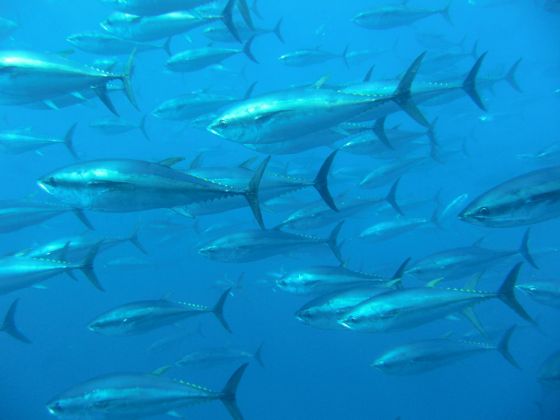
bluefin-tuna

Culture — something we generally associate with its expressions through art, music, literature and so forth — is commonly viewed as one of the defining attributes of humanity. We supposedly rose above animal instinct when we started creating bodies of knowledge, held collectively and passed down from generation to generation.

But it increasingly appears that this perspective has less to do with an appreciation of what makes us human than it has with our ignorance about non-human cultures.

Although non-human cultures don’t produce the kind of artifacts we create, the role of knowledge-sharing seems to be just as vital to the success of these societies as it is to ours. In other words, what makes these creatures what they are cannot be reduced to the structure of their DNA — it also involves a dynamic and learned element: the transmission of collective knowledge.

The survival of some species doesn’t simply depend on their capacity to replicate their DNA; it depends on their ability to pass on what they know.

Scuola Internazionale Superiore di Studi Avanzati: Small changes in a population may lead to dramatic consequences, like the disappearance of the migratory route of a species. A study carried out in collaboration with the SISSA has created a model of the behaviour of a group of individuals on the move (like a school of fish, a herd of sheep or a flock of birds, etc.) which, by changing a few simple parameters, reproduces the collective behaviour patterns observed in the wild. The model shows that small quantitative changes in the number of knowledgeable individuals and availability of food can lead to radical qualitative changes in the group’s behaviour.

Until the ’50s, bluefin tuna fishing was a thriving industry in Norway, second only to sardine fishing. Every year, bluefin tuna used to migrate from the eastern Mediterranean up to the Norwegian coasts. Suddenly, however, over no more than 4-5 years, the tuna never went back to Norway. In an attempt to solve this problem, Giancarlo De Luca from SISSA (the International School for Advanced Studies of Trieste) together with an international team of researchers (from the Centre for Theoretical Physics — ICTP — of Trieste and the Technical University of Denmark) started to devise a model based on an “adaptive stochastic network.” The physicists wanted to simulate, simplifying it, the collective behaviour of animal groups. Their findings, published in the journal Interface, show that the number of “informed individuals” in a group, sociality and the strength of the decision of the informed individuals are “critical” variables, such that even minimal fluctuations in these variables can result in catastrophic changes to the system.

“We started out by taking inspiration from the phenomenon that affected the bluefin tuna, but in actual fact we then developed a general model that can be applied to many situations of groups “on the move,” explains De Luca.

The collective behaviour of a group can be treated as an “emerging property,” that is, the result of the self-organization of each individual’s behaviour. “The majority of individuals in a group may not possess adequate knowledge, for example, about where to find rich feeding grounds” explains De Luca. “However, for the group to function, it is enough that only a minority of individuals possess that information. The others, the ones who don’t, will obey simple social rules, for example by following their neighbours.”

The tendency to comply with the norm, the number of knowledgeable individuals and the determination with which they follow their preferred route (which the researchers interpreted as being directly related to the appeal, or abundance, of the resource) are critical variables. “When the number of informed individuals falls below a certain level, or the strength of their determination to go in a certain direction falls below a certain threshold, the migratory pathway disappears abruptly.”

“In our networks the individuals are “points,” with interconnections that form and disappear in the course of the process, following some established rules. It’s a simple and general way to model the system which has the advantage of being able to be solved analytically,” comments De Luca.

So what ever happened to the Norwegian tuna? “Based on our results we formulated some hypotheses which will, however, have to be tested experimentally,” says De Luca. In the’50s Norway experienced a reduction in biomass and in the quantity of herrings, the main prey of tuna, which might have played a role in their disappearance. “This is consistent with our model, but there’s more to the story. In a short time the herring population returned to normal levels, whereas the tuna never came back. Why?”

One hypothesis is that, although the overall number of Mediterranean tuna has not changed, what has changed is the composition of the population: “The most desirable tuna specimens for the fishing industry are the larger, older individuals, which are presumably also those with the greater amount of knowledge, in other words the knowledgeable elders.” concludes De Luca.

Another curious fact: what happens if there are too many knowledgeable elders? “Too many know-alls are useless,” jokes De Luca. “In fact, above a certain number of informed individuals, the group performance does not improve so much as to justify the “cost” of their training. The best cost-benefit ratio is obtained by keeping the number of informed individuals above a certain level, provided they remain a minority of the whole population.”

Facebooktwittermail

The NSA, flight MH370, and the unknown

A few days ago I saw this headline: “Why don’t we just ask the NSA where the plane is?”

I expected a piece of pointed commentary or even that it came from The Onion. I assumed someone thought the international search for a missing plane should serve as a reminder that the NSA is not actually able to monitor everything happening on this planet.

It turned out, unfortunately, that the question came from a conspiracy theorist who was convinced that the only possible explanation for the NSA’s lack of helpfulness during the ongoing search for Malaysia Airlines Flight 370 was that the agency must be guarding some dirty secret.

For the rest of us — which is to say, people not inclined to believe that this plane was either shot down by the U.S. or that its passengers were abducted by aliens — the link to the NSA should provide a reality check.

However advanced the NSA’s capabilities are for globally tracking the movement of millions of microscopic electronic packets of information moving at close to the speed of light, it turns out that the movement of a great big hulk of metal carrying 239 people at less than 600MPH took place outside the NSA’s line of sight. (Neither is there any reason to assume that the US National Reconnaissance Office, through its satellite imagery, has secretly been the guardian of the truth about MH370.)

Those of us who spend too much time on the internet can easily succumb to a worldview within which the movement of information forms a global matrix to which seemingly everything is tied. We lose sight of the fact that what is known is dwarfed by an infinitely larger unknown.

We forget that most of what is forgotten is lost forever, and most of what is happening everywhere is never known.

I live in a region clad by vast tracts of forest where every day, trees fall unheard, unseen. Societies whose laws we may never learn govern the undergrowth. And beneath the forest, the skeletal remains of mountains whose height could never be measured have been ground into clay.

Earthquakes and volcanoes show the magnitude of events that can catch people by surprise, telling us that we don’t even know what is happening under our own feet. We don’t know what’s happening inside each cell in our body. We don’t know which neural networks are firing inside our brains right now or what these interior firework displays signify. We can’t remember everything we’ve ever said or heard. The events that form the fabric of our lives, turn out to be like glistening dew drops on a spider’s web. They disappear under the glare of a rising sun, never to be seen again.

* * *

The NSA and Google are co-conspirators, not in a formal sense, but in as much as they are jointly invested in the prevailing delusion of this age: that it is possible to know everything.

For the NSA, this fantasy is a tool for manipulating Congress — it implies that the only real obstacle to perfect security is adequate funding.

For Google, its mission to “organize the world’s information and make it universally accessible and useful” implies we live in a world governed by information (and Google’s beneficent hand) and that this information truly encompasses the world — and that its uncharted territories will soon be mapped.

This worldview not only fails to recognize the incomprehensible vastness of the unknown, but it also reinforces a view of human agency that makes us imagine we have the power to control all things.

Instead of seeing an issue like climate change as a consequence of our reckless behavior, which is to say, seeing it as an industrially triggered planetary convulsion, we risk seeing it as a technical problem which sooner or later is bound to yield to a technical solution.

But to see the true relationship between the known and the unknown is not only a vital form of realism; it’s also the only way of holding human grandiosity in check.

We do not live in a world that calls to be mastered; it demands to be met with humility. The Earth can survive without us, but we can’t survive without this planet. Only by recognizing that we are not on the brink of becoming all-seeing gods can we see our real place in the scheme of things.

Facebooktwittermail

How long before Palestinian nationalism gives way to the pursuit of equal rights inside a single state?

A Palestinian nationalist movement that has endured decades of failure is probably not about to expire. Indeed, the one thing that can be reliably inferred about the lesson of continuing failure is that failure, far from necessitating change, seems to inspire persistence.

If we have failed for this long, that’s no reason to give up now, since last year, the year before that, and the year before that, and on and on, dedication to this heroic fight has meant the willingness to enjoy no rewards.

Some might call that resistance; others might see it as an exercise in futility.

It’s perhaps worth remembering Thomas Kuhn’s succinct analysis (reiterating Max Planck) of the most common cause of a paradigm shift: the proponents of the old paradigm drop dead.

[A] new scientific truth does not triumph by convincing its opponents and making them see the light, but rather because its opponents eventually die, and a new generation grows up that is familiar with it.

The New York Times reports: When President Mahmoud Abbas of the Palestinian Authority visited the White House this week, he again heard dire warnings that the current moment could be the last chance for a two-state solution through negotiations with Israel.

Back home in Ramallah, Mr. Abbas’s own son has been telling him that last chance is already long gone, the negotiations futile. The son, Tareq Abbas, a businessman who has long shied away from politics and spotlights, is part of a swelling cadre of prominent Palestinians advocating instead the creation of a single state stretching from the Jordan River to the Mediterranean Sea in which Jews and Arabs would all be citizens with equal rights.

“If you don’t want to give me independence, at least give me civil rights,” Mr. Abbas, 48, said in a rare interview at his well-appointed apartment here as his father headed to Washington. “That’s an easier way, peaceful way. I don’t want to throw anything, I don’t want to hate anybody, I don’t want to shoot anybody. I want to be under the law.”

President Abbas, in a separate interview last month, said Israel’s continued construction in West Bank settlements made it impossible to convince Tareq that the two-state solution was still viable.

“I said, ‘Look, my son, we are looking for two-state solution and this is the only one.’ He said, ‘Oh, my father, where is your state? I wander everywhere and I see blocks everywhere, I see houses everywhere,’ ” the elder Mr. Abbas, 78, recalled. “I say, ‘Please, my son, this is our position, we will not go for one state.’ He says, ‘This is your right to say this, and this is my right to say that.’ Because he is desperate. He doesn’t find any sign for the future that we will get a two-state solution, because on the ground he doesn’t see any different.”

Such intergenerational arguments have become commonplace in the salons of Palestinian civil society and at kitchen tables across the West Bank as the children and grandchildren of the founders of the Palestinian national movement increasingly question its goals and tactics. [Continue reading…]

Facebooktwittermail

Russia’s apocalyptic nuclear Perimeter (aka ‘Dead Hand’)

“Russia is the only country in the world realistically capable of turning the United States into radioactive ash,” TV anchor Dmitry Kiselyov said on his weekly news show on state-controlled Rossiya 1 television on Sunday evening.

Kiselyov isn’t a household name in the U.S. but to describe him as Russia’s Glenn Beck would be a major understatement. Having been appointed by President Putin as head of the official Russian government-owned international news agency Rossiya Segodnya (Russia Today) which has 2,300 employees, Kiselyov is now one of the most prominent figures in Russian state media.

Kiselyov said that the creation of the new media entity was necessary to redress what he called an unfair international perception of Russia.

“The creation of a fair attitude toward Russia as an important country with good intentions – this is the mission of the new structure that I will be heading up,” he said in December.

The Associated Press reported in December:

When Ukrainians flooded the streets last week to protest their president’s shelving of a treaty with the European Union, Kiselyov lambasted Sweden and Poland, accusing them of encouraging massive protests in Kiev to take revenge for military defeats by czarist Russia centuries ago.

Kiselyov, who earned his degree in Scandinavian literature, rolled a clip of a Swedish children’s program called “Poop and Pee,” designed to teach children about their bodily functions. After the clip finished rolling, Kiselyov turned to the camera to suggest that this was the kind of European decadence awaiting Ukraine, if it signed a deal with the EU.

In Sweden there is “the radical growth of child abortions, early sex — the norm is nine years old, and at age 12 there is already child impotency,” he said after the clip rolled.

That reportage gained him few friends in Ukraine, where one man bounded over to hand “an Oscar for the nonsense and lies” of Dmitry Kiselyov to the state television correspondent standing on Kiev’s main square. He was brusquely pushed out of the shot before finishing his speech.

Kiselyov has also proven an avid attack dog on the issue of homosexuality, as international criticism over a Russian law banning gay “propaganda” reached a fever pitch this summer. The TV anchor said that homosexuals’ hearts should be buried or burned, and that gays should be banned from donating blood or organs, which were “unsuitable for the prolongation of anyone’s life.”

In Kiselyov’s comments last night, he highlighted the existence of the Soviet-built system of nuclear retaliation known as Perimeter which still exists and if ever activated would launch a devastating nuclear attack on the United States through commands controlled by artificial intelligence.

(Before anyone here starts writing some inane comment about why Russia has a right to destroy the U.S. if it has already been destroyed by the U.S., pause for second and think about what it means to have computer-controlled nuclear weapons. That opens up whole new nightmarish vistas in the domains of cyberwarfare, faulty algorithms, and the inadequate maintenance of aging systems. Personally, I have little confidence in human-controlled nuclear arsenals and even less in those that can be unleashed automatically.)

The system was reported on by Nicholas Thompson in 2009:

Valery Yarynich glances nervously over his shoulder. Clad in a brown leather jacket, the 72-year-old former Soviet colonel is hunkered in the back of the dimly lit Iron Gate restaurant in Washington, DC. It’s March 2009 — the Berlin Wall came down two decades ago — but the lean and fit Yarynich is as jumpy as an informant dodging the KGB. He begins to whisper, quietly but firmly.

“The Perimeter system is very, very nice,” he says. “We remove unique responsibility from high politicians and the military.” He looks around again.

Yarynich is talking about Russia’s doomsday machine. That’s right, an actual doomsday device — a real, functioning version of the ultimate weapon, always presumed to exist only as a fantasy of apocalypse-obsessed science fiction writers and paranoid über-hawks. The thing that historian Lewis Mumford called “the central symbol of this scientifically organized nightmare of mass extermination.” Turns out Yarynich, a 30-year veteran of the Soviet Strategic Rocket Forces and Soviet General Staff, helped build one.

The point of the system, he explains, was to guarantee an automatic Soviet response to an American nuclear strike. Even if the US crippled the USSR with a surprise attack, the Soviets could still hit back. It wouldn’t matter if the US blew up the Kremlin, took out the defense ministry, severed the communications network, and killed everyone with stars on their shoulders. Ground-based sensors would detect that a devastating blow had been struck and a counterattack would be launched.

The technical name was Perimeter, but some called it Mertvaya Ruka, or Dead Hand. It was built 25 years ago and remained a closely guarded secret. With the demise of the USSR, word of the system did leak out, but few people seemed to notice. In fact, though Yarynich and a former Minuteman launch officer named Bruce Blair have been writing about Perimeter since 1993 in numerous books and newspaper articles, its existence has not penetrated the public mind or the corridors of power. The Russians still won’t discuss it, and Americans at the highest levels — including former top officials at the State Department and White House — say they’ve never heard of it. When I recently told former CIA director James Woolsey that the USSR had built a doomsday device, his eyes grew cold. “I hope to God the Soviets were more sensible than that.” They weren’t.

The system remains so shrouded that Yarynich worries his continued openness puts him in danger. He might have a point: One Soviet official who spoke with Americans about the system died in a mysterious fall down a staircase. But Yarynich takes the risk. He believes the world needs to know about Dead Hand. Because, after all, it is still in place. [Continue reading…]

Facebooktwittermail

Which march would you join?

A reader here just left a comment complaining about my “frothing support for the heathens who took Kiev by force,” and said, “I wish the people of Crimea the best and hope the vote tomorrow goes for separation from the u.s. / e.u.”

I can only imagine what kind of Manichean worldview lurks behind the reference to “heathens,” but the general sentiment here seems to one that is not uncommon among stalwart critics of American power. It seems to work like this:

If a prominent political leader antagonizes the U.S. and its European allies (I refer of course to the well-known demons de jour: Fidel Castro, Slobodan Milošević, Hugo Chávez, Mahmoud Ahmadinejad, Muammar Gaddafi, Bashar al-Assad, Vladimir Putin) and that individual is then vilified in the media, the mere fact that this person is being targeted in this way is taken as a sign that he must be doing something right. He symbolizes the rejection of Western hegemony and is conferred honorary membership to a select group of über-rebels who have the courage take a dramatic stand defying Western imperialism.

I am not immune to experiencing this sentiment, since power needs to be poked in the eye occasionally, yet that doesn’t mean that we should ignore the failings of those who are doing the poking.

But that’s what all too often happens when criticism of the US/the West becomes an obsession: it makes authoritarian rule become excusable.

To anyone who thinks that tomorrow the people of Crimea are about to release themselves from the stifling grip of European influence in exchange for a warm embrace from Russia, I simply ask: who do you imagine you would have felt more comfortable marching alongside in Moscow today?

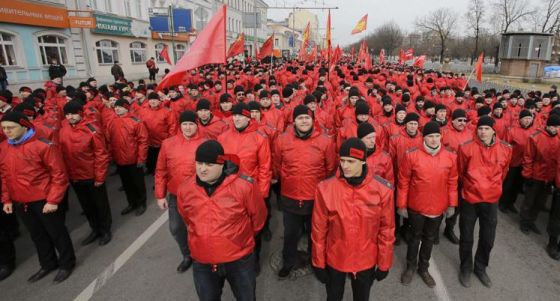
The disciplined young men in the “Brotherhood and Civil Resistance March,” or with activists like Ilya Yashin who have the guts to say: “We are patriots and Putin is Russia’s enemy”?

Brotherhood-and-Civil-Resistance

Reuters: “The pro-Russian patriotic procession was held to express support to Russian speakers living in Crimea and Ukraine and protest against the policies conducted by new Ukrainian authorities, according to organisers.”

Facebooktwittermail

Should Ukraine have given up its nuclear arsenal?

e13-iconThe Guardian reports: Ukraine’s prime minister Arseniy Yatsenyuk has accused Russia of demonstrating unacceptable “military aggression” which has “no reason and no grounds”.

Moscow has deployed 10,000 troops along its border with Ukraine, deepening the crisis in Crimea ahead of a last desperate effort by the US secretary of state, John Kerry, to broker a deal with his Russian counterpart, Sergei Lavrov, in London on Friday.

Yatsenyuk told the UN security council on Thursday he is convinced Russians do not want war. He urged Russia’s leaders to heed the people’s wishes and return to dialogue with Ukraine. “If we start real talks with Russia, I believe we can be real partners,” Yatsenyuk said.

He said Ukraine gave up the world’s third-largest nuclear arsenal in 1994 in exchange for guarantees of its independence and territorial integrity. After Russia’s recent actions, Yatsenyuk said, “it would be difficult to convince anyone on the globe not to have nuclear weapons”. [Continue reading…]

In an op-ed for the New York Times yesterday, John Mearsheimer wrote: The West has few options for inflicting pain on Russia, while Moscow has many cards to play against Ukraine and the West. It could invade eastern Ukraine or annex Crimea, because Ukraine regrettably relinquished the nuclear arsenal it inherited when the Soviet Union broke up and thus has no counter to Russia’s conventional superiority.

No doubt, if Israel’s leaders are ever pushed into a position where they need to defend retaining their own nuclear arsenal, they will surely be tempted to cite Professor Mearsheimer’s position — that giving up such weapons can turn out to be regrettable.

Let’s suppose, however, that Ukraine was still bristling with nuclear weapons — at its peak its arsenal was larger than those of Britain, France, and China combined — are we to imagine that its interim government would now be making veiled threats to incinerate Moscow? Are we to suppose that Russian forces would have stayed out of Crimea? After all, how many wars have Israel’s nuclear weapons prevented?

It seems just as likely that in the current situation, Putin would be arguing that Russia had no choice but take over the whole of Ukraine — not under the pretext of protecting ethnic Russians but in the name of defending global security, his argument being that in an unstable Ukraine, “loose nukes” pose a threat to everyone.

What seems regrettable is not that Ukraine gave up its nuclear weapons but that the security guarantees it was given for doing so appear to have been worthless.

Facebooktwittermail

Yarmouk and a contagion of doubt

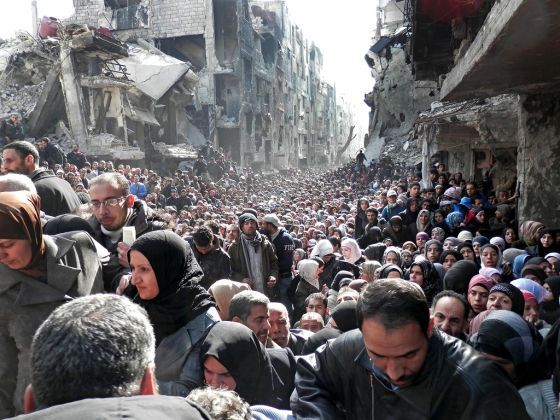
U.N. Denies That Syria Image Was Faked” and “U.N. Denies Altering Image of Palestinian Refugees in Damascus” — both headlines appeared in the New York Times on Tuesday and referred to doubts that have been expressed about the authenticity of what has become an iconic representation of suffering in Syria.

Yarmouk

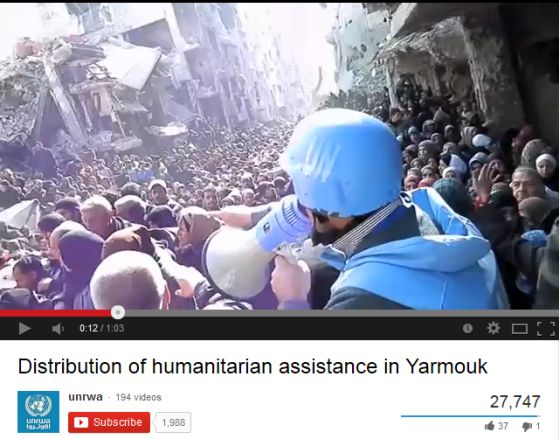
As the following screenshot taken from a video that the United Nations Relief and Works Agency (UNRWA) posted on YouTube and filmed at the same time as the photo above makes clear, the photograph’s authenticity is beyond doubt.

unrwa-yarmouk

Paradoxically, the fact that UN officials were put in a position where they needed to refute accusations that the photograph had been faked, and the New York Times’ own headlines, will quite likely have had the opposite of the intended effect. Where doubts may have previously been few, they are now just as likely to continue growing.

We live in an age of doubt and the internet is its engine — the very notion that something can be “beyond doubt” has itself become an object of doubt.

As someone who from a very early age was taught to question — I was lucky enough to have parents and teachers who recognized that questioning is a vital instrument of intelligence — the proliferation of doubt might to my eye look like a positive development. It might seem like a sign that people are less susceptible to manipulation by the political and corporate forces which shape popular thought. But I see little evidence that this is indeed the case.

On the contrary, the doubt that spreads so easily has less to do with critical intelligence and much more to do with suspicion and fear. The “fake” meme is much more contagious than any sober analysis.

Doubt and cynicism are held onto because they offer psychic armor for shielding ourselves from the dark forces controlling the world. The price, however, for those who employ this form of protection, is that it tends to render them immobile.

Yet clearly, the image of Yarmouk’s starving residents that got retweeted more than eight million times was not being passed around primarily by those who had doubts about what the photograph depicted.

As Chris Gunness, the spokesman for UNRWA said: “I saw that image and said, ‘This has the wow factor.’”

It is an image that resonates and does so for multiple reasons. Strange as it may sound, this is not only a news image but also a work of art.

In accordance with the principle of the “golden ratio” (or divine proportion), it is a perfectly balanced composition. It is a photograph that could just as easily be a painting.

More than simply capturing a moment of one day for one particular group of people, it seems to represent something timeless about the vulnerability of all people throughout history in times of war.

Within the skeletal remains of a city shattered by human brutality, we see that reinforced concrete is easier to destroy than the will to live.

Hope and desperation come together.

Facebooktwittermail

Blackwater in Ukraine? No, it was Alpha

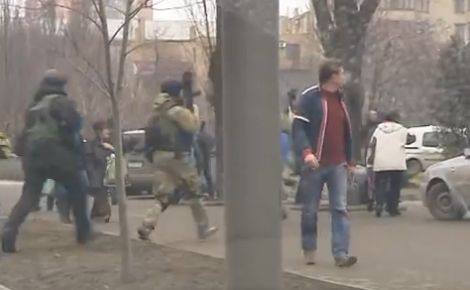
Yesterday I laid out a timeline suggesting how the Blackwater-in-Ukraine story may have evolved. I did not, however, attempt to identify the armed men in the video that has kept this rumor alive in social media.

Thanks to a reader who said that the Ukrainian press identified the armed men as “Спецназ (Alpha) СБУ,” I have been able to piece together the story.

The elite Alpha special operations unit is attached to the Security Service of Ukraine.

The reason for their appearance outside the regional administrative building in Donetsk was given in the following local press report, Преступности.Нет (English version):

In Donetsk day 3 March during the seizure of the regional state administration of protesters attacked the ex-Governor of area Andrey shishatskiy.

It is reported by channel «Donbass» on his Youtube page.

So, the footage shows a group of people, among them people with the Russian flag in his hands, and beat former Governor of Donetsk region Shishatskiy.

According to the TV company, beat it from the attackers, interferes with the police and the special forces of the security service of Ukraine covers of his departure.

As is known, today the building of the Donetsk regional Council were captured by a group of Pro-Russian activists, who declared about the illegitimacy of Kyiv and declared himself the new authorities in Donetsk region.

This is the video showing former Governor Shishatskiy being attacked. Although the Alpha unit is not shown, they can be seen in another news report on the same incident.

alpha-donetsk

Before any of the dozens of copies of the video labelled “USA military mercenary BlackWater in Ukraine (Donetsk)” appeared on YouTube, the same video had been posted with this title: “Alpha” – Donetsk. 03/03/2014. The video’s description says: “After the Russian provocations, Special Forces of Alpha security appeared in Donetsk.”

No mention of Blackwater.

Facebooktwittermail

‘Blackwater’ in Ukraine: The etiology of a conspiracy theory

(Update: I did a follow-up post on this. Two pieces on Blackwater in Ukraine is probably more than twice as many as the story merits.)

e13-iconOn February 28, soon after unidentified pro-Russian troops had seized control of Crimea, the Daily Beast blasted the headline: “Exclusive: Russian ‘Blackwater’ Takes Over Ukraine Airport.”

The presence in Crimea of well-armed and well-organized troops with no markings or identification was fueling lots of speculation about whether they were Russians. Josh Rogin believed he had part of the answer:

Private security contractors working for the Russian military are the unmarked troops who have now seized control over two airports in the Ukrainian province of Crimea, according to informed sources in the region.

“Private security contractors” isn’t very punchy for a headline and the name Blackwater has plenty of suitably sinister connotations, so the soldiers got dubbed as a Russian ‘Blackwater’ — no doubt the inclusion of that name also served as an effective traffic booster for the Daily Beast.

As the situation in Crimea rapidly changed, whether Rogin’s “informed sources” turned out to be reliable on this specific question quickly became a moot point. However, there’s every indication that his headline just as quickly morphed and took on a new life of its own.

For someone in Moscow, the irritation of seeing Russia’s operatives tarred with an infamous American name may have then given way to a much more interesting idea. Take away the quotes and make it Blackwater in Ukraine — there’s a story!

On March 2, a post appeared on a livejournal page belonging to “stbcaptain” which claimed, “According to our Ukrainian friends,” (“По информации наших украинских друзей”) up to 300 people employed by “Greystone Limited” had arrived at Kiev’s international airport that night, noting Greystone’s connection to Xe Services, formerly known as Blackwater.

Two days later, Voltaire Network, a favorite watering hole for conspiracy theorists, ran the headline, “US mercenaries deployed in Southern Ukraine.” The source for their brief report: Russian political scientist Alexander Dugin.

That Dugin’s name was linked to this story so early in its creation, is probably quite significant. While Voltaire refers to him simply as a political scientist, he is also the leading ideologist behind the Eurasia Movement seeking the restoration of the Russian Empire.

“Rather than rejecting totalitarian ideologies, Eurasianism calls upon politicians of the twenty-first century to draw what is useful from both fascism and Stalinism,” writes Timothy Snyder from Yale.

Dugin is committed to the break up of Ukraine. In a “letter to the American people on Ukraine” published on the website Open Revolt, which is affiliate with the white supremacist American Front, Dugin wrote on March 8:

Ukraine as it was during the 23 years of its history has ceased to exist. It is irreversible. Russia has integrated Crimea and declared herself the guarantor of the liberty of the freedom of choice of the East and South of Ukraine (Novorossia).

The same day that Voltaire posted its Dugan-sourced “U.S. mercenaries” story, a strange video appeared on YouTube, “USA military mercenary BlackWater in Ukraine (Donetsk),” posted on the obscure iRusTV channel. The video shows a group of men dressed in paramilitary gear, supposedly on the streets of the eastern Ukrainian city of Donetsk, running around in confusion.

Iran’s Press TV aired the video, claiming that locals were shouting “Blackwater!” at the armed men.

The shouting, however, is actually being directed at a civilian (a government worker perhaps), and the word which sounds vaguely like “Blackwater” is in fact Работай, which means “work” (as in “go back to work”).

The headline-hungry Daily Mail then leaped into the fray with “Has Blackwater been deployed to Ukraine? Notorious U.S. mercenaries ‘seen on the streets of flashpoint city’ as Russia claims 300 hired guns have arrived in country.

With the story now having received the imprimatur of the Western mainstream media, Moscow’s RT was ready to jump in, while assuming a cautious posture by adding plenty of ostensibly judicious caveats — the authenticity of the videos being “hard to verify” and so forth.

Ivan Fursov, writing his report as an RT “op-edge” column, says:

Surely these men were not Blackwater – simply because such a company does not exist anymore. It has changed its name twice in recent years and is now called Academi.

The latest article on the case, published by the Daily Mail, claims that though these people did look like professional mercenaries, they conducted the operation too openly.

Of course, such is the fodder for conspiracy theories: those planting the seeds don’t need to make any assertions of fact. All they need do is tease the imagination of an audience filled with febrile minds — the minds of people who are willing to believe almost any story if it happens to validate their own rigid worldview.

In what appears to be an organized effort to spread the propaganda, Blackwater in Ukraine videos are now being uploaded onto lots of new YouTube accounts.

Facebooktwittermail

This is what occupation looks like: Russian provocation and Serbian Chetniks in Crimea

e13-icon“We are often told our actions are illegitimate, but when I ask, ‘Do you think everything you do is legitimate?,’ they say ‘yes’,” President Vladimir Putin said at a press conference on Tuesday. “Then I have to recall the actions of the United States in Afghanistan, Iraq, and Libya, where they either acted without any U.N. sanction or completely distorted the content of such resolutions, as was the case with Libya.”

For many critics of U.S. military action over the last thirteen years, Putin’s words resonate deeply.

There’s no question that when U.S. Secretary of State John Kerry says, “You just don’t in the 21st century behave in 19th century fashion by invading another country on completely trumped up pre-text,” the hypocrisy in a top U.S. government official saying this, is glaring.

But here’s the problem: it’s starting to sound like for many of the people now chanting “Hypocrisy!”, they see hypocrisy as worse than occupation. Indeed, this insistence on focusing on the lack of integrity of Western political leaders is becoming an excuse to ignore or legitimize the Russian invasion of Crimea.

In his latest report from Crimea, Simon Ostrovsky offers a close-up view of the Russian occupation.

A Serb commander belonging to the Chetnik movement, controlling a checkpoint between Sevastopol and Simferpol and supporting the occupation, says — without a hint of irony — “it would be better to resolve this issue internally.” He sees himself and the Russians as part of this “internal” solution. (It should be noted that the Chetniks have a history of involvement in ethnic cleansing, mass murder and other war crimes.)

If a Serb, having traveled hundreds of miles to Crimea, identifies himself as part of an internal solution, this begs the question: how would he define external?

I guess an example would be OSCE observers invited by Ukraine’s interim government — that’s why they got shot at when they attempted to enter Crimea.

But here’s a final thought: if you think occupation is only a problem when it’s conducted by Americans or Israelis, then maybe it’s time to ask yourself whether you really understand the meaning of the word hypocrisy.

Facebooktwittermail

Russian media and ‘journalistic independence’

e13-iconA couple of days ago, Glenn Greenwald wrote:

American media elites awash in an orgy of feel-good condemnation in particular love to mock Russian media, especially the government-funded English-language outlet RT, as being a source of shameless pro-Putin propaganda, where free expression is strictly barred (in contrast to the Free American Media). That that network has a strong pro-Russian bias is unquestionably true. But one of its leading hosts, Abby Martin, remarkably demonstrated last night what “journalistic independence” means by ending her Breaking the Set program with a clear and unapologetic denunciation of the Russian action in Ukraine:

I imagine most readers here will have already seen Martin’s widely publicized statement. Clearly she was flattered by gaining Greenwald’s attention, whose remarks she featured at the beginning of her next show.

Even so, anyone who thinks that Martin’s statement should be taken as a sign that RT values journalistic independence, is ignoring the reality of the Russian media and the organization she works for and chooses to continue working for despite her opposition to the invasion of Crimea.

RIA Novosti reports: On Wednesday, Izvestia daily newspaper reported that a ruling United Russia party deputy is readying legislation that would, among other things, make it a crime to “allow publication of false anti-Russian information.”

Starting Wednesday, staff at RIA Novosti’s Moscow-based English-language desk was asked to decide whether they wanted to work at [the newly created] Rossiya Segodnya or accept compensation packages. The bulk of the writers and editors for the English-language service have opted for the latter option.

The new agency is to be headed by Dmitry Kiselyov, a notoriously outspoken conservative TV presenter, and will share its editor-in-chief, Margarita Simonyan, with the Kremlin-funded TV news channel RT.

RT, which was formerly known as Russia Today, has been at the center of controversy recently with two reporters at the channel “going rogue” to openly criticize Russia’s interventions in the southern Ukrainian province of Crimea in the past few days. Criticism of the Kremlin typically gets little to no attention on RT, while content devoted to negative aspects of life in Western countries makes up a substantial part of its broadcasts.

Kiselyov’s ascendancy appears to point to efforts by the Russian authorities to appeal more to ultra-conservative values, a trend best signaled by last year’s passage of a law banning the promotion of homosexual “propaganda” to minors.

In Kiselyov’s most notorious on-screen harangue, dating back to 2012, he suggested it would be advisable to “burn or bury the hearts of gays” who die in car crashes.

Facebooktwittermail

A Siberian giant virus and the butterfly effect

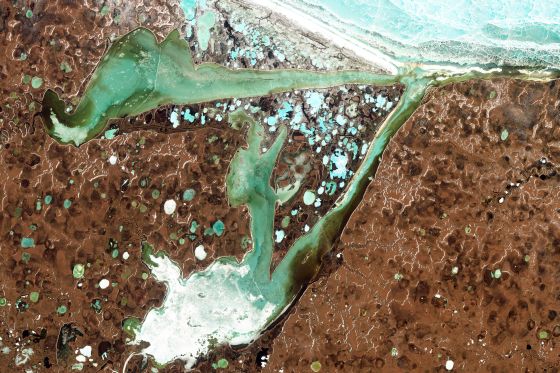
Omulyakhskaya and Khromskaya Bays lie along the northern Siberian coast, where permafrost blankets the land around the bays. Photo: NASA Earth Observatory

Omulyakhskaya and Khromskaya Bays lie along the northern Siberian coast, where permafrost blankets the land around the bays. Photo: NASA Earth Observatory

Embedded in the mud, glistening green and gold and black, was a butterfly, very beautiful and very dead.

“Not a little thing like that! Not a butterfly!” cried Eckels.

It fell to the floor, an exquisite thing, a small thing that could upset balances and knock down a line of small dominoes and then big dominoes and then gigantic dominoes, all down the years across Time. Eckels’ mind whirled. It couldn’t change things. Killing one butterfly couldn’t be that important! Could it? — Ray Bradbury, A Sound of Thunder, 1952

As one of the massive and probably irreversible consequences of climate change, the melting of the Northern Hemisphere’s permafrost is not an example of the butterfly effect. Yet the discovery of a giant virus which has come back to life after 30,000 years of frozen dormancy, suggests many possibilities including some akin to those envisaged by Ray Bradbury is his famous science fiction story.

Whereas his narrative required that the reader suspend disbelief by entertaining the idea of time travel, the thawing tundra may produce a very real kind of time travel if any viruses or other microbes were to emerge as new invasive species.

Rather than being transported geographically as a result of human activity, these will spring suddenly from a distant past into an environment that may lack necessary evolutionary adaptations to accommodate their presence.

We are assured that Pithovirus sibericum poses no threat to humans — it just attacks amoebas. But our concern shouldn’t be limited to fears about the reemergence of something like an ancient strain of smallpox.

The rebirth of a pathogen that could strike phytoplankton — producers of half the world’s oxygen — would have a devastating impact on the planet.

BBC News reports: The ancient pathogen was discovered buried 30m (100ft) down in the frozen ground.

Called Pithovirus sibericum, it belongs to a class of giant viruses that were discovered 10 years ago.

These are all so large that, unlike other viruses, they can be seen under a microscope. And this one, measuring 1.5 micrometres in length, is the biggest that has ever been found.

The last time it infected anything was more than 30,000 years ago, but in the laboratory it has sprung to life once again.

Tests show that it attacks amoebas, which are single-celled organisms, but does not infect humans or other animals.

Co-author Dr Chantal Abergel, also from the CNRS, said: “It comes into the cell, multiplies and finally kills the cell. It is able to kill the amoeba – but it won’t infect a human cell.”

However, the researchers believe that other more deadly pathogens could be locked in Siberia’s permafrost.

“We are addressing this issue by sequencing the DNA that is present in those layers,” said Dr Abergel.

“This would be the best way to work out what is dangerous in there.”

The researchers say this region is under threat. Since the 1970s, the permafrost has retreated and reduced in thickness, and climate change projections suggest it will decrease further.

It has also become more accessible, and is being eyed for its natural resources.

Prof Claverie warns that exposing the deep layers could expose new viral threats.

He said: “It is a recipe for disaster. If you start having industrial explorations, people will start to move around the deep permafrost layers. Through mining and drilling, those old layers will be penetrated and this is where the danger is coming from.”

He told BBC News that ancient strains of the smallpox virus, which was declared eradicated 30 years ago, could pose a risk. [Continue reading…]

Facebooktwittermail

Has Putin lost his mind?

When a professor of journalism refers to Julia Ioffe, a senior editor at The New Republic, putting on “a clinic with her writing and reporting on Russia and Ukraine,” I’m assuming that’s meant as a compliment — a way of signalling to his students and Twitter followers: this is what insightful journalism looks like:


This is how Ioffe’s clinic opens:

In Sunday’s New York Times, Peter Baker reported that German Chancellor Angela Merkel had tried talking some sense into Vladimir Putin. The Russian leader has an affinity for the Germans and Merkel especially: He served in the KGB in East Germany, where Merkel grew up. And yet, nothing:

Chancellor Angela Merkel of Germany told Mr. Obama by telephone on Sunday that after speaking with Mr. Putin she was not sure he was in touch with reality, people briefed on the call said. “In another world,” she said.

If you weren’t sure of the veracity of that little reportorial nugget, all doubt should’ve vanished after Putin’s press conference today.

Slouching in a fancy chair in front of a dozen reporters, Putin squirmed and rambled. And rambled and rambled. He was a rainbow of emotion: Serious! angry! bemused! flustered! confused! So confused.

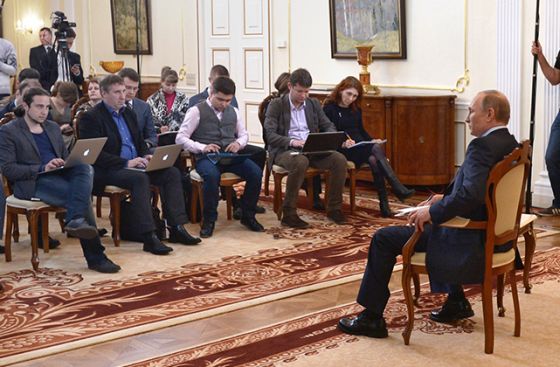
The Russian president, slouching in a fancy chair — that’s a very evocative image.

But Ioffe doesn’t just leave it to her word and her readers’ powers of imagination to conjure up a picture of the scene; she kindly provides a link. It’s what I’d call a cover-your-ass link, or a don’t-click-on-this link. Which is to say, writers sometimes make misleading statements or exaggerate, but then point to their source as though this will absolve them of any responsibility for misinforming their readers.

putin-chair

Do armrests make a chair fancy? That’s the only difference between Putin’s chair and the ones being used by the reporters — most of whom have laptops which are easier to use when elbows aren’t hitting armrests. As for Putin’s slouch, granted, he probably does not have every single lower vertebrae thrust hard against the chair’s back, but by that measure, who doesn’t slouch?

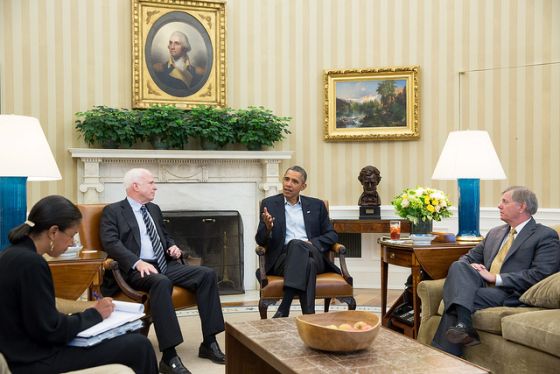
How about this president in his fancy chair? He didn’t even manage to put on a neck tie before he met his White House guests:

obama-chair

I’m all in favor of journalists adding narrative color to their reporting, but when it turns out that Putin wasn’t sitting in a fancy chair and he wasn’t slouching, why am I supposed to swallow Ioffe’s emphatic claim: “Putin has lost it”?

Aside from the circumstantial evidence for questioning Putin’s sanity — his posture and his self-aggrandizing chair — the substance of Ioffe’s diagnosis is rendered in her delivery of the Russian president’s rambling statement:

Victor Yanukovich is still the acting president of Ukraine, but he can’t talk to Ukraine because Ukraine has no president. Ukraine needs elections, but you can’t have elections because there is already a president. And no elections will be valid given that there is terrorism in the streets of Ukraine. And how are you going to let just anyone run for president? What if some nationalist punk just pops out like a jack-in-the-box? An anti-Semite? Look at how peaceful the Crimea is, probably thanks to those guys with guns holding it down. Who are they, by the way? Speaking of instability, did you know that the mayor of Dniepropetrovsk is a thief? He cheated “our oligarch, [Chelsea owner Roman] Abramovich” of millions. Just pocketed them! Yanukovich has no political future, I’ve told him that. He didn’t fulfill his obligations as leader of the country. I’ve told him that. Mr. Putin, what mistakes did Yanukovich make as president? You know, I can’t answer that. Not because I don’t know the answer, but because it just wouldn’t be right of me to say. Did you know they burned someone alive in Kiev? Just like that? Is that what you call a manifestation of democracy? Mr. Putin, what about the snipers in Kiev who were firing on civilians? Who gave them orders to shoot? Those were provocateurs. Didn’t you read the reports? They were open source reports. So I don’t know what happened there. It’s unclear. But did you see the bullets piercing the shields of the Berkut [special police]. That was obvious. As for who gave the order to shoot, I don’t know. Yanukovich didn’t give that order. He told me. I only know what Yanukovich told me. And I told him, don’t do it. You’ll bring chaos to your city. And he did it, and they toppled him. Look at that bacchanalia. The American political technologists they did their work well. And this isn’t the first time they’ve done this in Ukraine, no. Sometimes, I get the feeling that these people…these people in America. They are sitting there, in their laboratory, and doing experiments, like on rats. You’re not listening to me. I’ve already said, that yesterday, I met with three colleagues. Colleagues, you’re not listening. It’s not that Yanukovich said he’s not going to sign the agreement with Europe. What he said was that, based on the content of the agreement, having examined it, he did not like it. We have problems. We have a lot of problems in Russia. But they’re not as bad as in Ukraine. The Secretary of State. Well. The Secretary of State is not the ultimate authority, is he?

And so on, for about an hour. And much of that, by the way, is direct quotes.

Now compare this with an actual translated transcript of what Putin said: Continue reading

Facebooktwittermail

Pierre Omidyar’s role at First Look Media

Following a report on Pierre Omidyar’s involvement in Ukrainian politics, Glenn Greenwald felt obliged to explain why he knew nothing about this.

That’s because, prior to creating The Intercept with Laura Poitras and Jermey Scahill, I did not research Omidyar’s political views or donations. That’s because his political views and donations are of no special interest to me – any more than I cared about the political views of the family that owns and funds Salon (about which I know literally nothing, despite having worked there for almost 6 years), or any more than I cared about the political views of those who control the Guardian Trust.

There’s a very simple reason for that: they have no effect whatsoever on my journalism or the journalism of The Intercept. That’s because we are guaranteed full editorial freedom and journalistic independence. The Omidyar Network’s political views or activities – or those of anyone else – have no effect whatsoever on what we report, how we report it, or what we say.

I’m having a hard time squaring Greenwald’s description of the editorial independence of The Intercept with the following statements made by his colleague there, Jeremy Scahill, as reported by the Daily Beast:

The whole venture will have a lower wall between owner and journalist than traditional media. Omidyar, he says, wanted to do the project because he was interested in Fourth Amendment issues, and they are hiring teams of lawyers, not just to keep the staff from getting sued, but to actively push courts on the First Amendment, to “force confrontation with the state on these issues.”

“[Omidyar] strikes me as always sort of political, but I think that the NSA story and the expanding wars put politics for him into a much more prominent place in his existence. This is not a side project that he is doing. Pierre writes more on our internal messaging than anyone else. And he is not micromanaging. This guy has a vision. And his vision is to confront what he sees as an assault on the privacy of Americans.”

Facebooktwittermail

Grab great wildlife experiences while you can?

e13-iconPerhaps it should be called eco-catastrophe tourism: rushing to catch a glimpse of natural wonders before they disappear.

For under $4,000 you can visit Kenya to witness Africa’s wildebeest migration. But if you want to be able tell your grandchildren what it was like, don’t wait too long.

CNN lists “11 great wildlife experiences [that] could disappear within your lifetime,” and helpfully provides details about the tour operators and packages so that you can catch a glimpse of the last rhinoceros, polar bears, tigers, gorillas, and orangutans.

I guess each of these creatures is acquiring greater market value, the closer to extinction it comes.

I imagine that the tour operators and tourists feel that these enterprises are contributing towards the protection of species and their environments and to some extent that might be true.

There also seems to be a predatorial element at play. The hunters might only come away with photographs, videos, and memories, yet appealing to a desire to see something rare before it is lost, caters more to an acquisitive impulse than it contributes towards the prevention of species and habitat loss.

Facebooktwittermail

Selective outrage — there’s a lot of it going around

e13-iconJustin Doolittle writes: Wrapping up a two-day trip to Saudi Arabia recently, a high-ranking State Department official sharply criticized the ruling family’s egregious and intensifying human rights abuses.

“Lack of progress in Saudi Arabia has led to a great deal of frustration and skepticism in my government and in the international community,” an assistant secretary of state told reporters in Riyadh. “There hasn’t been sufficient action taken by the government to address the issues of justice and accountability,” this official asserted. “We heard from many people about people who are still unaccounted for, whose whereabouts and fates are unknown to their family members.”

The United States, justifiably incensed by the Saudi regime’s ongoing assault on human rights, is considering tabling a resolution at the March session of the U.N. Human Rights Council, which might include a call for an international investigation. “We understand growing concern, frustration, and skepticism among many in my country and many in the international community that has led to increasing calls for international investigation and an international process,” the visiting diplomat warned.

None of what you have just read actually happened, of course. In reality, the U.S. official is assistant secretary of state Nisha Biswal, she was speaking to reporters in Colombo, not Riyadh, and her blunt criticism was in reference to the government of Sri Lanka, not the ruthless, theocratic dictatorship that rules Saudi Arabia. [Continue reading…]

Among those who express most outrage about U.S. foreign policy, the most common refrain is that American officials are guilty of shameless hypocrisy. “[N]o government that only fumes selectively over fundamental issues of right and wrong deserves to be taken seriously,” Doolittle writes. Maybe not.

But shouldn’t the same standard then apply to those who are criticizing the U.S. government and its allies?

There are those whose outrage cannot be contained whenever the Israeli government bombs Gaza and yet offer barely a murmur when the Syrian government bombs its own cities. Why should their selective outrage be taken any more seriously than that of the U.S. government?

The fact is, if only those who are unblemished by hypocrisy have a right to speak out, then we would probably all have to remain silent.

Instead, we should probably be more concerned about whether the outrage is justifiable than whether the critic is without fault.

Facebooktwittermail