Category Archives: Editorials

Defending the unbreakable bond between Israel and Pennsylvania

When voters in Pennsylvania head to the polls this November to elect a new senator, Bill Kristol and his newly launched outfit want to make sure that the issue uppermost in the voters’ considerations is how great a friend of Israel their next senator will be — this is the first assignment adopted by the Emergency Committee for Israel (“we’re the pro-Israel wing of the pro-Israel community,” says Kristol) which is running this ad on Fox News and CNN:

This ad follows in the footsteps of an ad run earlier this year (before Congressman Joe Sestak won the Democratic primary) which says “keeping Israel safe helps keep America safe.”

For people like Bill Kristol and the rest of the gang that makes up the Israel lobby, keeping Israel safe keeps America safe, is a strong expression of the unbreakable bond that Israel’s Democratic and Republican subordinates all like to celebrate. Yet for others — and this may turn out to include a plurality of Pennsylvania voters — this is a message that has more than a hint of a mafia protection racket threat. If you want to sleep comfortably in Philadelphia or Pittsburgh, you’d better take care of Israel. It’s quite a sinister message.

Meanwhile, as Kristol’s emergency committee works to shore up the unbreakable bond between Pennsylvania and Israel, it seems like another bond — one they might have imagined would need no defense — is showing signs of disrepair.

In a report on discrimination against Palestinians in Jerusalem, Fox News veered dangerously off message. (H/t Matt Duss at Think Progress.)

When Joe Sestak won the Democratic primary in May, Jon Delano, political director of KDKA-TV in Pittsburgh, noted: “Sestak has done this all on his own. He has had no support from the Washington crowd. None whatsoever. This is a victory that he can savor all by himself.”

As the mid-term elections approach, the Israel lobby imagines it can leverage disenchantment with Obama in support of its cause, yet to the extent that the election is a contest between Washington insiders and outsiders, the lobby, as a pillar of the Washington establishment, will find itself on the wrong side of the divide.

Facebooktwittermail

When honesty gets dangerous, liars succeed

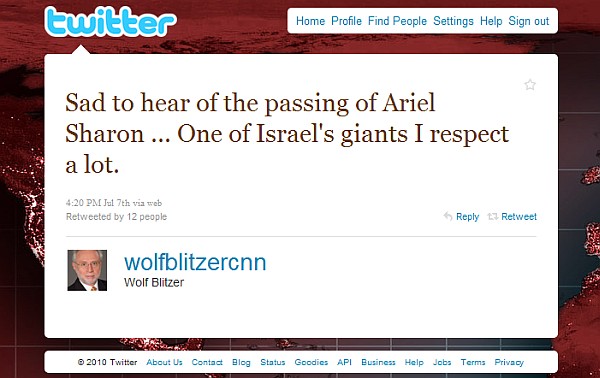
No, Ariel Sharon has not just died. But when he does, will Wolf Blitzer lose his job if he writes a tweet like the one above (a fake of course, created by yours truly)?

Certainly not, because as Glenn Greenwald correctly noted yesterday: “The speech prohibitions and thought crimes on the Middle East all run in one direction: to enforce ‘pro-Israel’ orthodoxies.”

Then again, Blitzer (who was at AIPAC and the Jerusalem Post before moving to CNN) will have no need to let his Zionist colors fly within the confines of a tweet. He’ll be content to report gushing praise for the former Israeli prime minister from President Obama or President Whoever, the day Sharon dies — a day when little if anything with be said in the Washington political/media establishment about Sharon’s personal responsibility in the slaughter of as many as 2,000 Palestinians killed in the Sabra and Shátila massacre in Beirut in 1982.

CNN’s Octavia Nasr, on the other hand, has been found guilty of praising Sayyid Mohammed Hussein Fadlallah, a man whose stature Sharon could never match — and for that offense, as has now been widely reported, the Lebanese-born journalist lost her job.

As Frances Guy, Britain’s ambassador to Lebanon, wrote in a blog post soon after Fadlallah’s death (a post she later removed “after mature consideration” according to the British Foreign Office):
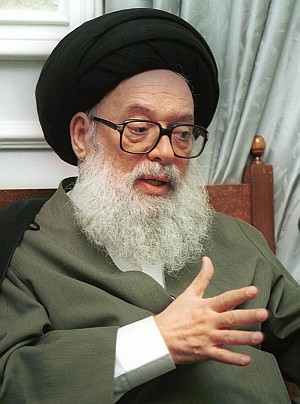
When you visited him you could be sure of a real debate, a respectful argument and you knew you would leave his presence feeling a better person. That for me is the real effect of a true man of religion; leaving an impact on everyone he meets, no matter what their faith. Sheikh Fadlallah passed away yesterday. Lebanon is a lesser place the day after but his absence will be felt well beyond Lebanon’s shores. I remember well when I was nominated ambassador to Beirut, a muslim acquaintance sought me out to tell me how lucky I was because I would get a chance to meet Sheikh Fadlallah. Truly he was right. If I was sad to hear the news I know other peoples’ lives will be truly blighted. The world needs more men like him willing to reach out across faiths, acknowledging the reality of the modern world and daring to confront old constraints. May he rest in peace.

So why did CNN’s Nasr lose her job for expressing sadness at Fadlallah’s death? After all, his name is not a household word outside the Middle East.

Nasr’s mistake may well not have been that she expressed appreciation for this particular eminent Shia cleric but that she referred to him as one of “Hezbollah’s giants.”

So here’s one of the many ironies in this incident: while the Israel lobby controls the mainstream media with a well-oiled censorship machine that would be the envy of Joseph Goebbels, freedoms that journalists are being terrorized to abandon are nevertheless being exercised inside the US military. At CNN Hezbollah cannot be mentioned without also being demonized, yet at CENTCOM there are those calling for the powerful militia to be brought in from the cold. As Mark Perry revealed last month, a recent Red Team report called for the integration of Hezbollah into the Lebanese Armed Forces.

As for Sayyid Fadlallah himself, Lebanon’s prime minister, Saad Hariri — an Arab leader of the variety much-loved in the West — praised the cleric as “a voice of moderation and an advocate of unity.”

One of the reasons Fadlallah has been condemned by successive US governments is because of his alleged connections to the 1983 bombing in Beirut that killed 241 American servicemen, yet Robert Baer, who was himself a CIA field officer in Beirut, says: “there never has been a shred of evidence that Fadlallah was responsible for the Marine bombing, other than his preaching against foreign occupation.”

Opposing foreign occupation — this indeed was Fadlallah’s principal offense.

In his New York Times obituary, Fadlallah’s “extremism” was supposedly evident when in 2002 he told the Daily Telegraph:

[The Palestinians] have had their land stolen, their families killed, their homes destroyed, and the Israelis are using weapons, such as the F16 aircraft, which are meant only for major wars. There is no other way for the Palestinians to push back those mountains, apart from martyrdom operations.

Which reminds me of a line I came across on Facebook recently: a terrorist is someone with a bomb but no air force.

Fadlallah was also guilty of questioning the Holocaust — a commonplace attitude in the Middle East that must surely perplex many in the West. Even so, that attitude is, I suspect, much more one of sentiment than historical perspective. The Holocaust, as a justification for the dispossession and slaughter of Palestinians, has as much relevance as do the childhood traumas of a murderer when recounted to the murder victim’s family. This is context that does nothing to color the crime. Indeed, Holocaust doubt, thus provoked, can be seen as a direct effect of Holocaust exploitation.

Perhaps Sayyid Fadlallah is best remembered not through a tweet or a State department classification but in his own words:

Throughout my life, I have always supported the human being in his humanism and [I have supported] the oppressed… I think it is the person’s right to live his freedom… and [it is his right] to face the injustice imposed on him by revolting against it, using his practical, realistic and available means to end the oppressor’s injustice toward him, whether it is an individual, a community, a nation, or a state; whether male or female. God created the people free; thus no one has the right to enslave people and no one has the right to enslave himself for others. Imam Ali said “do not be a slave of others, as God created you free.”

Facebooktwittermail

UAE ambassador confirms: Palestine is the core issue

During a stage interview with Yousel al Otaiba, the UAE ambassador to the United States, Jeffrey Goldberg made it clear that even when acting as a representative of The Atlantic and helping facilitate a forum in Aspen, Colorado, he still sees himself first and foremost as an Israeli.

When the ambassador pointed out that Iran’s nuclear program presents a greater risk to the UAE than it does to the US — the US being separated from Iran by two oceans — Goldberg requested clarification. Was he being addressed as an American or as a “representative of the Jewish people”? In Goldberg’s mind, to be Jewish means to have ones heart in Israel irrespective of where one might reside on the planet.

As Goldberg’s blog posts after the interview also made clear, when it comes to Iran, the topic that interests him above all else right now is pumping up support for a military strike against Iran. When the UAE ambassador pointed out that Palestine is the core issue in the region, Goldberg simply glossed over the fact.

This is the key section of the interview — the part Goldberg ignored, as did his friend Eli Lake at the Washington Times, when pumping out this week’s rendition of Israel’s Arabs-united-against-Iran narrative. Here the ambassador makes it clear that the only significant leverage Obama has on the issue of Iran is to push hard for the creation of a Palestinian state.

YOUSEF AL OTAIBA: I think President Obama has inherited two very difficult campaigns in Afghanistan and Iraq. He has inherited the worst financial crisis since 1929. He is now dealing with what seems to be an unfixable oil spill, not just environmentally, but economically, from an energy standpoint. So President Obama has his hands full.

Do I think he recognize the threat from Iran? Yes, I do. Do I think he has very limited options and not necessarily a lot of ability to fix it? Yes. I think President Obama is just constrained with the lack of resources and tools at his disposal. And if he’s heard anything from the Arab leaders that he talks to, most of them, and I’m fairly sure that King Abdullah when he was here mentioned the same thing.

For him to really make progress on the Iran issue and to deal with extremism and to deal with terrorism in the region, to deal with radicalized home-grown terrorism in the U.S., you need to address the peace process. That is the one core issue everyone tends to blame, and that’s what the people hang all their problems on.

Well, the Palestinians are, you know, they are — they don’t have a country, they are abused, they are oppressed, and the U.S. always sides with Israel. So the sooner U.S. appears to be objective and impartial and create a Palestinian state, we take that argument away from everyone, and that is in everyone’s best interest.

JEFFREY GOLDBERG: Why would that stop Iran from developing a nuclear weapon?

OTAIBA: It won’t stop. It will get you all the Arab countries more aligned on containing Iran because now they use Palestine as an excuse, and the Palestine issue is a deep political problem. And I’m not saying it’s only the U.S.’ fault, I’m saying it is as much Israel and Palestine’s fault for not making any progress on it themselves. But lack of their kind of commitment, the U.S. needs to step in and say, you need to do this. And you need to do this for your sake, for our sake, and for the region’s sake. [Emphasis mine.]

So, contrary to the claims being made by Jeffrey Goldberg and others in the Israel lobby, the principal call coming from the Arab world is not for the US to strike Iran but rather that it apply its influence on Israel and hasten the creation of a Palestinian state.

Facebooktwittermail

Who’s pushing to strike Iran?

[Update: See this post which confirms that Goldberg twisted the narrative here.]

After an exchange between the UAE ambassador to the US Yousef al-Otaiba and Jeffrey Goldberg on Tuesday we learn that “the UAE would sooner see military action against Iran’s nuclear program than see the program succeed” — at least that’s what Goldberg says.

But the ambassador also said: “There are many countries in the region who, if they lack the assurance the US is willing to confront Iran, they will start running for cover towards Iran.”

In other words, countries like the UAE will ultimately align themselves with whichever ends up being the most durable power in the region. Even so, autocratic rulers who rely on American support would naturally like the defender of their tenuous legitimacy to maintain its regional dominance.

The Washington Times quotes from the same exchange between Goldberg and al-Otaiba in Aspen:

“I think it’s a cost-benefit analysis,” Mr al-Otaiba said. “I think despite the large amount of trade we do with Iran, which is close to $12 billion … there will be consequences, there will be a backlash and there will be problems with people protesting and rioting and very unhappy that there is an outside force attacking a Muslim country; that is going to happen no matter what.”

“If you are asking me, ‘Am I willing to live with that versus living with a nuclear Iran?,’ my answer is still the same: ‘We cannot live with a nuclear Iran.’ I am willing to absorb what takes place at the expense of the security of the UAE.”

And this is how Goldberg interprets the UAE/Arab position:

It is not only Israel that fears the rise of a nuclear Iran; the Arabs, if anything, fear such a development to a greater degree. The Jews and Arabs have been fighting for one hundred years. The Arabs and the Persians have been going at for a thousand. The idea of a group of Persian Shi’ites having possession of a nuclear bomb scares Arab leader like nothing else — it certainly scares them more than the reality of the Jewish bomb.

Goldberg speaks for Netanyahu and the lobby, but the UAE government does not accept his interpretation of their ambassador’s remarks:

The UAE Assistant Foreign Minister for Political Affairs, Tareq al Haidan said today that the statements attributed by the Washington Times to the UAE Ambassador to the United States, Youssef al Otaiba “are not precise”.

“These statements came as part of general discussions held on the sidelines of an unofficial gathering and were taken out of their context in which Mr. Otaiba was speaking,” Mr al Haidanl said.

“Iran is a neighboring country and we maintain historic relations with it.” He stressed that “the UAE respects and believes in the sovereignty of other states and in the principle of non-interference, of all forms, in their internal affairs.”

“Already, the UAE declared, more than one time and in official statements issued by the Foreign Ministry, its position on the Iranian nuclear issue,” Mr al Haidan added.

“The UAE totally rejects the use of force as a solution to the Iranian nuclear issue and rather calls for a solution through political means that are based on the international legitimacy, transparency as well as the need for working, through the International Atomic Energy Agency [IAEA], on the right of all states to the peaceful use of nuclear energy.

“The UAE, at the same time, believes in the need of keeping the Gulf region free of nuclear weapons,” Mr al Haidan said.

As for whether the Arab world is as vexed about Iran as Goldberg claims, perhaps a clearer indication came from one of Israel’s few allies, Jordan, when King Abdullah spoke to the Wall Street Journal in April:

WSJ: What do you think when you look at Iran and international policy. There’s a lot of talk now about how active Iran is in Iraq as far as trying to push their political clients. Do you see it active in Hezbollah/Lebanon? In the Palestinian territories? Is the engagement track working?

HM KING ABDULLAH: Again, I look at it from a different angle. If there are those that are saying that Iran is playing mischief, then I say it is being allowed to play mischief. The platform they use is the injustice of the Palestinians and Jerusalem. So if you start taking those cards off the table, then Iranian influence on the Mediterranean through Hezbollah and Hamas in Gaza diminishes or becomes non existent. My view is that I am really against any military action in Iran, that is Pandora’s box. But by dealing with the core issue, that’s when you start taking cards away from the Iranian regime.

The core issue is Palestine — not an Iranian bomb — and a strike on Iran, that’s Pandora’s box.

Just because Obama put on a shameless performance yesterday to please the Israelis and the lobby, and just because there is no evidence that he is a man of principle, doesn’t mean he’s stupid. He knows what Pandora’s box looks like and he’s just as reluctant as anyone else to find out what it contains.

Facebooktwittermail

The war Israel can’t win

At The Daily Beast, historian Thaddeus Russell writes:

When Israeli Prime Minister Benjamin Netanyahu visits the White House Tuesday, President Obama will have the chance to be the first American president since the founding of Israel to ask The Question.

The Question is never addressed by Israel’s supporters and rarely raised by Israel’s detractors. But for those of us who are taxpayers in a nation that has been the state of Israel’s chief benefactor for 42 years — or those of us with Jewish ancestry — it is becoming the only question to ask. It is simple, self-interested, and fundamental: Does the existence of Israel make Americans and Jews safer?

And here is the paradox: Though support for Israel among Americans, and especially Jewish Americans, remains high according to recent Gallup polls, historical evidence says the answer to The Question is “no.”
“There was not a single act of Arab terrorism against Americans before 1968, when the U.S. became the chief supplier of military equipment and economic aid to Israel.”

The history of Israel and its relationship with the U.S. is infinitely complex, but there’s one damning fact that’s ignored as often as The Question: There was not a single act of Arab terrorism against Americans before 1968, when the U.S. became the chief supplier of military equipment and economic aid to Israel. In light of this fact, it’s difficult to credibly sustain the argument that Arab terrorism is spawned by Islam’s alleged promotion of violence and antipathy toward American culture or by a “natural” Arab anti-Semitism. It also suggests that no matter what policies Israel enacts to protect itself — even a withdrawal from the occupied territories or a two-state “solution” — it must be a perpetual wartime state.

Very few Americans today are aware that the question of American and Jewish self-interest was first raised at the time of Israel’s founding by officials in the highest levels of the U.S. government. In 1948, several members of Harry Truman’s Cabinet predicted that the creation of a Jewish state in the Middle East would spur Arab violence against Jews and Americans, advising the president to shun Israel.

These included Secretary of State George Marshall, Defense Secretary James Forrestal, and George Kennan, then the leading policy strategist in the State Department. They argued that if the United States helped to set up an independent Jewish nation it would provoke terrorist attacks on Americans and inaugurate an endless war between Arabs and Jews. “There are 30 million Arabs on one side and about 600,000 Jews on the other,” Forrestal told those in the administration who favored recognizing Israel. “Why don’t you face up to the realities?”

Israel apologists will plead that Thaddeus Russell’s commentary is one more instance among international efforts — rapidly gaining steam — to delegitimize Israel.

Strangely, in response to what is perceived as a campaign of degitimization, there is, as far as I’ve seen, no Israel legitimization campaign. Those mounting a defense, do nothing more than attack their critics — and usually do so with an unbridled viscousness.

For instance, Robin Shepherd, writing in the Jerusalem Post about a decision last week by the Methodist Church of Britain to launch a boycott against goods emanating from settlements in the West Bank and East Jerusalem, says:

Overall, a church that behaves in the manner of the Methodists has buried its credibility under a gigantic dunghill of intransigence, pedantry, lies and distortions.

But let us not allow this matter to rest with a mere recognition of whom and what they have chosen to become.

If the Methodist Church is to launch a boycott of Israel, let Israel respond in kind: Ban their officials from entering; deport their missionaries; block their funds; close down their offices; and tax their churches.

If it’s war, it’s war. The aggressor must pay a price.

While it’s often said that attack is the best form of defense, that principle does not hold in the art of persuasion (and rarely for that matter in national security). The ranks cheering an attack such as Shepherd’s are small and shrinking. Indeed, the more venomous Israel and its supporters become, the less sympathy the Jewish state will evoke and the closer we will move to a critical juncture: where the world has given up on Israel and Israel has given up on the world. At that point, Israel’s isolation becomes the world’s nuclear peril.

Facebooktwittermail

Israel bans parachutes from Gaza

If Hamas had plans to form a paratroopers brigade, these will now need to be put on hold.

Israel’s long-awaited release of its blacklist of items banned from importation into the strip include parachutes. How exactly parachutes might be used in Gaza, if the ban gets lifted, is hard to envisage. What’s the use of a parachute if you can’t fly?

As Israel eases its economic blockade on Gaza, the manner by which it does so exposes the multi-layered deceit with which the siege was imposed and now unravels.

In its new policy, Israel now specifies which items are banned rather than which are allowed entry. But a ban on arms and munitions and items which could be used to develop, produce or enhance the military capabilities of the Gaza militias, begs a rather obvious question: were any such items allowed into Gaza before the siege started four years ago?

Of course not. So the idea that Israel’s goal, now or ever, has simply been to stem the flow of weapons into Gaza, doesn’t add up. Indeed, if that had actually been Israel’s primary concern it would have avoided creating a situation in which the principal conduit for the flow of goods into the strip had been through an unmonitored system of tunnels. Now as always, the easiest way to regulate what comes in and out of the Palestinian enclave is through carefully controlled land crossings.

The siege has always been and still remains a method of subjugation. Its purpose is to crush the will of the population in the hope that this might drain support for the resistance.

Now, in its effort to present a softer face to the world in the wake of its brutal attack on the flotilla, Israel is letting Gazans eat chocolate. What it remains much more reluctant to do is open the economic barriers that would allow Gazans to manufacture or perhaps even export their own chocolate.

Ultimately though, this isn’t about what Palestinians can be allowed to import or export — it’s about the one thing Israel continues to withhold from Palestinians in both Gaza and the West Bank. It’s about freedom.

Facebooktwittermail

Petraeus: mission will be accomplished

Predicting what will happen in Afghanistan is about as wise as declaring “mission accomplished.” As he arrived to take over command of US forces in what has become America’s longest war, Gen David Petraeus might not have actually predicted the outcome of the war but he certainly narrowed what can be deemed an acceptable conclusion:

In a ceremony on the tree-shaded lawn in front of NATO headquarters in Kabul, Petraeus assumed command from Gen. Stanley A. McChrystal, who was fired last month after a magazine quoted him and his staff making critical remarks about Obama administration officials.

A general with a sterling reputation for military creativity and political acumen, Petraeus, 57, struck a determined tone in his remarks to fellow officers, foreign diplomats and Afghan officials, insisting “we are in this to win.”

“We’re engaged in a contest of wills. Our enemies are doing all that they can to undermine the confidence of the Afghan people,” he said.

Before he mentioned the Taliban, Petraeus described those enemies as “al-Qaeda and its network of extremist allies,” harking back to the justification for invasion nine years ago. He said his mission is to demonstrate to Afghanistan and the world that the extremists “will not be allowed to once again establish sanctuaries in Afghanistan from which they can launch attacks on the Afghan people and on freedom-loving nations around the world.”

“We must demonstrate to the people and to the Taliban that Afghan and [U.S. and coalition] forces are here to safeguard the Afghan people, and that we are in this to win,” he said. “That is our clear objective.”

This commitment to safeguard the civilian population has inevitably been called into question each time an operation results in civilian casualties, yet Petraeus is now under great pressure to make it easier for his troops to fight.

A few days before Gen McChrystal got fired, CJ Chivers, a former US marine who now reports for the New York Times, wrote:

It is an axiom of military service that troops gripe; venting is part of barracks and battlefield life. Troops complain about food, equipment, lack of sleep, delays in their transportation and the weather where they work.

Complaints about how they are allowed to fight are another matter and can be read as a sign of deeper disaffection and strains within the military over policy choices. One Army colonel, in a conversation this month, said the discomfort and anger about the rules had reached a high pitch.

“The troops hate it,” he said. “Right now we’re losing the tactical-level fight in the chase for a strategic victory. How long can that be sustained?”

The Los Angeles Times reports today:

At his Senate confirmation hearings last week, Petraeus said he foresaw no major shift in strategy in the Afghanistan war. But he has made it clear that even if the rules of engagement do not change, the nuances of how they are implemented will get a close new look.

Assuming command Sunday, Petraeus told his troops that while civilian safety remains a critical consideration, “as you and our Afghan partners on the ground get into tough situations, we must employ all assets to ensure your safety.”

It was a remark apparently intended to reassure troops that the safeguarding of Afghans was not to come at the expense of military lives.

The problem with this idea that a balance can be struck between reducing the risks faced by Afghan civilians without putting American soldiers at unnecessary risk is that it implicitly overstates the military’s commitment to a humanitarian mission. The Pentagon is assuming a posture as though it treats all lives as being of equal value, yet the truth — transparent to everyone — is that America regards its soldiers’ lives as being of vastly greater value than the those of the citizens in any of the nations the US has decided to “save.”

Embedded in this is what I call the evangelical conceit: I know better than you do, what’s good for you; you will become better than you are, if you become more like me. It is the antithesis of respect, but describes the mindset with which so many Americans venture into the world on their military and religions missions.

Facebooktwittermail

Mainstreaming realism

It was widely assumed that George Bush’s departure from Washington would coincide with a revival of strength for the reality-based community — the people the neocons swept aside for the sake of empire. But though the neocon dream was quick to perish, the reality-based community is still struggling to assert itself — at least inside the nation’s capital.

It turns out that Tampa, Florida, where CENTCOM is headquartered (and where General David Petraeus was in charge before being sent to Kabul), is more amenable to the expression of realism.

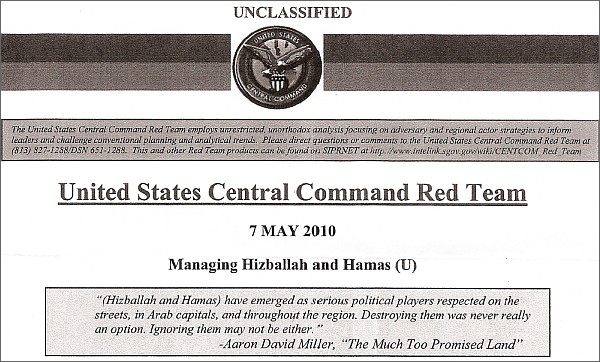
Since its publication in Foreign Policy yesterday, a report by Mark Perry has been causing a stir. In “Red Team — CENTCOM thinks outside the box on Hamas and Hezbollah,” Perry writes:

While it is anathema to broach the subject of engaging militant groups like Hizballah and Hamas in official Washington circles (to say nothing of Israel), that is exactly what a team of senior intelligence officers at U.S. Central Command — CENTCOM — has been doing. In a “Red Team” report issued on May 7 and entitled “Managing Hizballah and Hamas,” senior CENTCOM intelligence officers question the current U.S. policy of isolating and marginalizing the two movements. Instead, the Red Team recommends a mix of strategies that would integrate the two organizations into their respective political mainstreams. While a Red Team exercise is deliberately designed to provide senior commanders with briefings and assumptions that challenge accepted strategies, the report is at once provocative, controversial — and at odds with current U.S. policy.

Among its other findings, the five-page report calls for the integration of Hizballah into the Lebanese Armed Forces, and Hamas into the Palestinian security forces led by Fatah, the party of Palestinian Authority President Mahmoud Abbas. The Red Team’s conclusion, expressed in the final sentence of the executive summary, is perhaps its most controversial finding: “The U.S. role of assistance to an integrated Lebanese defense force that includes Hizballah; and the continued training of Palestinian security forces in a Palestinian entity that includes Hamas in its government, would be more effective than providing assistance to entities — the government of Lebanon and Fatah — that represent only a part of the Lebanese and Palestinian populace respectively” (emphasis in the original). The report goes on to note that while Hizballah and Hamas “embrace staunch anti-Israel rejectionist policies,” the two groups are “pragmatic and opportunistic.”

To call the Red Team report a “deliberately provocative piece” — as Spencer Ackerman describes it — is to misinterpret the intelligence team’s brief in providing what they do call “unorthodox analysis.”

A Red Team’s approach merely attempts to look at an issue from a broader perspective than the one that military culture engenders. The goal, nevertheless, is objectivity. This isn’t simply an exercise in creative thinking.

Consider, for instance, this uncontroversial observation in the report (written before the recent international outcry demanding a swift end to the siege of Gaza):

The hardships in Gaza may be radicalizing more people, especially the young, and increasing the number of potential recruits for HAMAS. This is the opposite effect Israel thought the blockade would have in Gaza, hoping instead that people would see HAMAS as the cause of their suffering and turn against it.

Yet even today while it is clear to rest of the world that Israel’s divide-and-rule strategy in Gaza has failed, Israel’s deputy foreign minister Danny Ayalon wrote on Twitter: “Our position is to differentiate between Hamas, the occupiers of Gaza, and the civilian population.”

Gaza under occupation — by Hamas!

Ayalon might imagine he’s cleverly modifying the concept of “occupation” but the twist will persuade no one in Gaza, which — an ease to the restrictions on the flow of goods notwithstanding — remains the world’s largest prison.

Indeed, the seeming intransigence of Hamas has been in response to this very fact: that the reward for the moderation that the Palestinian Authority has already exhibited and in whose footsteps Hamas is being implored to follow is not self determination but an occupation with no end in sight. In this respect, Hamas, far from representing the extreme position it is claimed to hold, exhibits a sober realism, which is to say, it sees little evidence that concessions by Palestinians are matched with concessions by Israel.

CENTCOM’s Red Team may have concerned themselves only with the issue of “mainstreaming” Hamas and Hezbollah yet the possibility of that happening may depend less on the internal workings of each Islamist organization and more on the extent to which realism can be mainstreamed inside Washington.

The Obama administration’s support for the Supreme Court’s recent ruling in favor of a ridiculously broad interpretation of the meaning of “material support” (as applied to so-called Foreign Terrorist Organizations and thus both Hamas and Hezbollah) is not a promising sign.

Facebooktwittermail

The limits of American power are like the borders of Israel

For much of the last decade, Rory Stewart has provided one of the wisest voices on Afghanistan. A theme he pounds away at relentlessly is the necessity to differentiate between what is desirable and what is possible.

Stewart, now a newly minted member of Britain’s parliament, writes in Der Spiegel:

The only way in which we could move beyond the counter-insurgency theory, or the hundred other theories which buttress and justify the Afghan war, is by rejecting their most basic underlying premises and objectives. Instead of trying to produce an alternative theory (on how to defeat the Taliban, create an effective, legitimate and stable Afghan state, stabilize Pakistan and ensure that al-Qaida could never again threaten the United States) we need to understand that however desirable such things might be, they are not things that we — as foreigners — can do.

We can do other things for Afghanistan but the West — in particular its armies, development agencies and diplomats — are not as powerful, knowledgeable or popular as we pretend. Our officials cannot hope to predict and control the intricate allegiances and loyalties of Afghan communities or the Afghan approach to government. But to acknowledge these limits and their implications would require not so much an anthropology of Afghanistan, but an anthropology of ourselves.

The cures for our predicament do not lie in increasingly detailed adjustments to our current strategy. The solution is to remind ourselves that politics cannot be reduced to a general scientific theory, that we must recognize the will of other peoples and acknowledge our own limits. Most importantly, we must remind our leaders that they always have a choice.

As simple as this message is, it is one that is virtually impossible for American leaders to hear, and even among those who grasp its truth it remains hard to bluntly acknowledge the fact.

The limits of American power are like the borders of Israel — reaching into terrain impossible to control yet just as difficult to relinquish.

And the struggle to adjust to reality is for Americans just as hard as it is for Israelis, since it depends on a resource severely depleted in both nations: humility.

Facebooktwittermail

The grim, relentless task of crushing of the Taliban and al Qaeda

John Bolton writes: “America’s Afghanistan policy is in chaos. Fear of another Vietnam is palpable, and our friends and adversaries worldwide sense it.”

Another Vietnam? If only the US might be so lucky! Vietnam was an exercise in nation building, interrupted by an American occupation, and then fairly swiftly brought to a peaceful conclusion after the US pulled out. The prospects for Afghanistan look much bleaker.

The fear of another Vietnam is more Bolton’s own — “I confess I had no desire to die in a Southeast Asian rice paddy,” he wrote in 1995 when explaining why he supported that war but declined to enter combat duty.

But at 61, Bolton still seems eager to prove his manhood and what better way than in another full-throated appeal for “a sustained military presence in Afghanistan devoted to the grim, relentless crushing of the Taliban and Al Qaeda.”

Americans “need to understand and agree to a ‘long war’.”

In the short war of World War II, Germany and Japan merely needed to be defeated (though more than 60 million people died in the process) — but the Taliban and al Qaeda must be crushed. Not because they pose a greater threat to the world than fascism but rather because they pose a greater affront to power.

This need to destroy an enemy thus aggrandized is inherently flawed in its design because it mirrors American vanity. Those who supposedly need to be crushed cannot be seen for what they are because their significance is seen utterly in terms of what their existence says about us.

Facebooktwittermail

The price of perpetual war

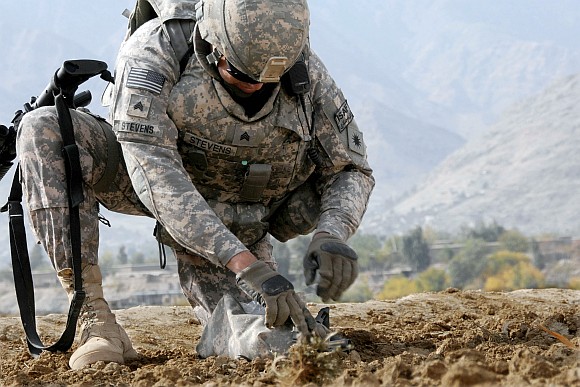
Sgt. Jason Stevens, a horticulturist with the California Army National Guard's 40th Infantry Division Agribusiness Development Team, gathers a soil sample from a field alongside the main road in Marawara, Afghanistan, Nov. 23, 2009. The ADT stopped in Marawara to meet with local farmers about their crop output and farming in the area, as well as to gather soil samples to learn how crop production might be increased in the area.

If wars could be won through slick advertising, no one would be better qualified to become the US commander in Afghanistan than General David Petraeus.

This is how he recently encapsulated his wisdom on counterinsurgency:

We have learned above all that, in campaigns such as those in Iraq or Afghanistan, the human terrain is the decisive terrain. We have to understand the people, their culture, their social structures and how systems to support them are supposed to work — and how they do work. And our most important tasks have to be to secure and to serve the people, as well as to respect them and to facilitate the provision of basic services, the establishment of local governance and the revival of local economies.

That’s a fine wish list — and to be fair, Petraeus makes no claims about the success of the US military in accomplishing these aims. Indeed, he concedes that success in the war is likely to go to whichever side is swifter to learn and adapt.

It might not quite rise to the level of being a law of physics, but the capacity for massive organizations to swiftly learn and adapt is about as great as the ability of oil tankers to make sudden U-turns. It doesn’t matter who’s in charge or how gifted he might be in charming the US Congress.

But Petraeus’ problems run deeper than the structural limitations of the military. As Andrew Bacevich makes clear, the US military is now suffering the corrupting effect of endless war. Far from seeing Gen Stanley McChrystal’s recently revealed contempt for civilian command as exceptional, Bacevich sees strong indications that the problem is systemic.

In the seemingly endless wars of the post-Sept. 11 era, a military that has demonstrated remarkable durability now shows signs of coming undone at the top. The officer corps is losing its bearings.

Americans might do well to contemplate a famous warning issued by another frustrated commander from a much earlier age.

“We had been told, on leaving our native soil,” wrote the centurion Marcus Flavius to a cousin back in Rome, “that we were going to defend the sacred rights conferred on us by so many of our citizens [and to aid] populations in need of our assistance and our civilization.” For such a cause, he and his comrades had willingly offered to “shed our quota of blood, to sacrifice our youth and our hopes.” Yet the news from the homeland was disconcerting: The capital was seemingly rife with factions, treachery and petty politics. “Make haste,” Marcus Flavius continued, “and tell me that our fellow citizens understand us, support us and protect us as we ourselves are protecting the glory of the empire.”

“If it should be otherwise, if we should have to leave our bleached bones on these desert sands in vain, then beware of the anger of the legions!”

Stanley McChrystal is no Marcus Flavius, lacking the Roman’s eloquence, among other things. Yet in ending his military career on such an ignominious note, he has, however clumsily, issued a warning that deserves our attention.

The responsibility facing the American people is clear. They need to reclaim ownership of their army. They need to give their soldiers respite, by insisting that Washington abandon its de facto policy of perpetual war. Or, alternatively, the United States should become a nation truly “at” war, with all that implies in terms of civic obligation, fiscal policies and domestic priorities. Should the people choose neither course — and thereby subject their troops to continuing abuse — the damage to the army and to American democracy will be severe.

Whether for an individual or an nation, change often hinges on reaching a point where the status quo is intolerable.

Over the last decade, perpetual war, far from becoming less tolerable has on the contrary become easier to ignore. It is the backdrop to normalcy — just like climate change — in a culture that barely has any sense of gravity.

Facebooktwittermail

The terrorist-naming game

On September 11, 2001, George Bush changed the way Americans look at the world and the success with which he accomplished this feat is evident in the fact that his perspective largely remains unchallenged — even among many of his most outspoken critics. Bush’s simplistic for-us-or-against-us formula was transparently emotive yet utterly effective.

For almost a decade, Americans have been told to look at the world through the lens of “terrorism” and while differences of opinion exist about whether the lens has too wide or narrow an angle or about the extent to which it brings things into focus, those of us who say the lens is so deeply flawed that it should be scrapped, remain in a minority.

The Obama administration may now refrain from using the term itself, preferring instead “violent extremists,” but the change is merely cosmetic (as are so many other “changes” in the seamless continuity between the Bush- and post-Bush eras).

A couple of days ago Philip Weiss drew attention to the fact that when former Israeli foreign minister Tzipi Livni described her parents as “freedom fighters,” Deborah Solomon, her interviewer in the New York Times, echoed Livni’s sentiment by saying that the fight for Israel’s independence took place in “a more romantic era.”

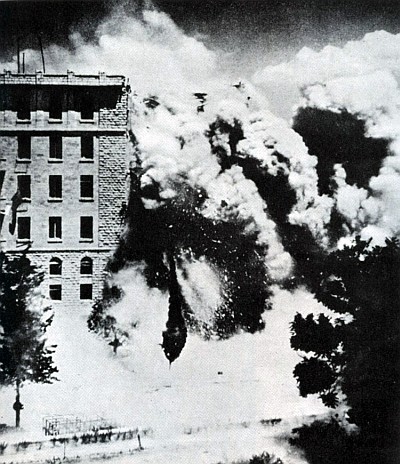
As Weiss notes, Livni’s parents belonged to the Irgun, the Zionist group which blew up the King David Hotel in Jerusalem on July 22, 1946, killing 91 and injuring 46.

The first public account of what had happened that day was accidentally released in advance of the bombing.

In By Blood and Fire, Thurston Clark writes:

“Jewish terrorists have just blown up the King David Hotel!” This short message was received by the London Bureau of United Press International (UPI) shortly after noon, Palestine time. It was signed by a UPI stringer in Palestine who was also a secret member of the Irgun. The stringer had learned about Operation Chick but did not know it had been postponed for an hour. Hoping to scoop his colleagues, he had filed a report minutes before 11.00. A British censor had routinely stamped his cable without reading it.

The UPI London Bureau chief thought the message too terse. There were not enough details. He decided against putting it on the agency’s wire for radio and press until receiving further confirmation that the hotel had been destroyed.

Despite the efforts of Irgun leaders to restrict knowledge of the target and timing of Operation Chick, there were numerous other leaks. Leaders in both the Haganah and Stern Gang knew about the operation. Friends warned friends. The King David had an extraordinary number of last-minute room cancellations. In the Secretariat [the King David’s south wing that housed the headquarters of the British government in Palestine], more than the usual number of Jewish typists and clerks called in sick.

The next day the British prime minister, Clement Attlee referred to the bombing as an “insane act of terrorism” while a few days later the US president, Harry Truman, wrote “the inhuman crime committed… calls for the strongest action against terrorism…”

That was 64 years ago. From the sheltered perch of the New York Times, that’s apparently far enough back in history that it can now be referred to as a “romantic era.”

It’s hardly surprising then that many observers with an interest in justice for Palestinians take offense at the New York Times’ complicity in papering over the reality of Jewish terrorism. Yet here’s the irony: the effort to promote an unbiased use of the term “terrorism” simply plays into the hands of the Israelis.

The word has only one purpose: to forestall consideration of the political motivation for acts of violence. Invoke the word with the utmost gravity and then you can use your moral indignation and outrage to smother intelligent analysis. Terrorists do what they do because they are in the terrorism business — it’s in their blood.

So, when Tzipi Livni calls her parents freedom fighters, I have no problem with that — she is alluding to what they believed they were fighting for rather than the methods they employed. Moreover, by calling people who planted bombs and blew up civilians in the pursuit of their political goals, “freedom fighters,” Livni makes it clear that she understands that “terrorism” is a subjective term employed for an effect.

When Ehud Barak a few years ago acknowledged that had he been raised a Palestinian he too would have joined one of the so-called terrorist organizations, he was not describing an extraordinary epiphany he had gone through in recognizing the plight of the Palestinians. He was merely being candid about parallels between groups such as the Irgun and Hamas — parallels that many Israelis see but less often voice.

The big issue is not whether the methods employed by Zionist groups such as the Irgun could be justified but whether the political goals these groups were fighting for were legitimate. Zionism would not have acquired more legitimacy if it had simply found non-violent means through which it could accomplish its goal of driving much of the non-Jewish population out of Palestine.

We live in an era in which “terrorism” — as a phenomenon to be opposed — has become the primary bulwark through which Zionism defends itself from scrutiny. Keep on playing the terrorist-naming game and the Zionists win.

Facebooktwittermail

The Obama administration adopts an imperious tone with Turkey

Philip H Gordon is the US Assistant Secretary of State at the Bureau of European and Eurasian Affairs. He sat down with an AP reporter this week to talk about Turkey.

Turkey is alienating US supporters and it needs to demonstrate its commitment to partnership with the West, Gordon says. “We think Turkey remains committed to NATO, Europe and the United States, but that needs to be demonstrated,” he said. “There are people asking questions about it in a way that is new, and that in itself is a bad thing that makes it harder for the United States to support some of the things that Turkey would like to see us support.”

“There are people…” Gordon say. And those people would be? Oh yeah — members of the United States Congress who serve at the pleasure of the Israel lobby.

Gordon cited Turkey’s vote against a U.S.-backed United Nations Security Council resolution on new sanctions against Iran and noted Turkish rhetoric after Israel’s deadly assault on a Gaza-bound flotilla last month. The Security Council vote came shortly after Turkey and Brazil, to Washington’s annoyance, had brokered a nuclear fuel-swap deal with Iran as an effort to delay or avoid new sanctions.

Some U.S. lawmakers who have supported Turkey warned of consequences for Ankara since the Security Council vote and the flotilla raid that left eight Turks and one Turkish-American dead. The lawmakers accused Turkey of supporting a flotilla that aimed to undermine Israel’s blockade of Gaza and of cozying up to Iran.

The raid has led to chilling of ties between Turkey and Israel, countries that have long maintained a strategic alliance in the Middle East.

Turkey’s ambassador to the United States, Namik Tan, expressed surprise at Gordon’s comments. He said Turkey’s commitment to NATO remains strong and should not be questioned.

“I think this is unfair,” he said.

Tan said Turkish officials have explained repeatedly to U.S. counterparts that voting against the proposed sanctions was the only credible decision after the Turkish-brokered deal with Iran. Turkey has opposed sanctions as ineffective and damaging to its interests with an important neighbor. It has said that it hopes to maintain channels with Tehran to continue looking for a solution to the standoff over Iran’s alleged nuclear arms ambitions.

“We couldn’t have voted otherwise,” Tan said. “We put our own credibility behind this thing.”

Tan said that Turkish Prime Minister Recep Tayyip Erdogan was expected to discuss these issues with President Barack Obama on the margins of a summit of world economic powers in Toronto on Saturday.

Gordon said Turkey’s explanations of the U.N. episode have not been widely understood in Washington.

“There is a lot of questioning going on about Turkey’s orientation and its ongoing commitment to strategic partnership with the United States,” he said. “Turkey, as a NATO ally and a strong partner of the United States not only didn’t abstain but voted no, and I think that Americans haven’t understood why.”

Just two weeks ago, before Gordon decided his primary duty was to placate the Israel lobby, in an interview with the BBC he rejected the suggestion that the US and Turkey have become strategic competitors in the Middle East.

“I think the United States and Turkey remain strategic partners,” he said. “We have so many interests in common. We can have disagreements, and there are things we disagree on, not least the vote on Iran at the United Nations. Throughout that process we have been frank with each other about our differences. We’ve explained to them why we think it was important for countries to vote yes in the Iran resolution. They have explained to us why they think the Tehran declaration was something worth pursuing. And we’ve explained to them what we think the shortcomings are. That’s what friends and partners do.”

But can friends be so overbearing that they issue demands for a demonstration of commitment to their partnership?

The US wants Turkey to help advance America’s agenda in the Middle East. Is the Obama administration helping advance Turkey’s agenda in the region? Turkey after all is now in a much stronger position to promote regional stability than any of its Western tutors.

As deeply in debt as the United States is, there is one currency that it can use without fear of ever running short and it’s a currency whose value is appreciated in every corner of the globe. It’s called respect. A little goes a long way.

Facebooktwittermail

Idiocy holds sway on the Supreme Court and inside the Obama administration

It seems hard to fathom but the evidence is now overwhelming: if someone repeats the word “terrorist” often enough their brain will become functionally useless.

Consider the Supreme Court’s decision on Monday in support of the Obama administration’s sweeping definition of “material support” as applied to so-called Foreign Terrorist Organizations (FTO) — a designation applied by the State Department.

If an NGO such as the Humanitarian Law Project (HLP) wants to train a group such as the Kurdistan Workers’ Party (PKK) on how to use humanitarian and international law to peacefully resolve disputes, then the HLP risks criminal prosecution. Why? Such training could help legitimize the PKK and also free up resources that it can dedicate to its terrorist activities.

Solicitor General Elena Kagan (who is nominated to become a Supreme Court Justice) argued the case for the Obama administration.

Kay Guinane described the decision:

The Court ruled that even though pure speech is entitled to a high level of constitutional scrutiny, it would forgo such scrutiny and defer to Congress and the executive branch, which asserted unsupported, theoretical findings that support aimed at countering violence can somehow indirectly support violence. The Court’s reasoning was that the matter involves national security.

With its overly deferential approach, the Court failed to fulfill its responsibilities in the checks-and-balances system that keeps our democracy healthy. If it had looked behind the broad generalizations cited by the government, it would have seen there are no facts either in the Congressional Record or elsewhere that support the Congressional or State Department “findings.” And even if there are some circumstances where conflict mediation and human rights training can be co-opted to support violence, it is not inevitable that it will happen in all cases.

For an obvious example of the fault in the findings, one need look no further than the Good Friday Accords that brought a lasting peace to Northern Ireland for the first time in more than eight centuries. For years, non-governmental organizations (NGOs) had worked to bring violent factions of Catholics and Protestants to the bargaining table. Their work behind the scenes was instrumental in persuading those groups — “terrorists” in the eyes of most of their captive civilian populations, as well as the governments seeking to disarm them — to put down their weapons and negotiate a peaceful resolution to 850 years of violence.

If the “material support” law had been in place, as authorized by the Supreme Court today, those organizations would have been criminals. And the people of Northern Ireland would likely still be victims of sectarian violence that only a very few supported.

“Orwellian” doesn’t begin to describe a law that makes it a crime to promote peaceful conflict resolution.

If the administration actually intends to uphold the law in the way they argue it should be applied, then the Israeli-Palestinian conflict can be expected to continue forever.

There is a rather broad consensus among foreign policy analysts in the US and Europe, that Hamas, a designated FTO, has far too much grassroots political support among ordinary Palestinians for the organization to be destroyed. Neither Israel’s war on Gaza nor it’s internationally supported siege of Gaza, succeeded in bringing the Islamist organization and democratically-elected government to its knees.

If the Obama administration wants to revive the Middle East peace process, sooner or later Hamas will have to be involved. It’s hard if not impossible to anticipate that those involved in the initial efforts to open dialogue with Hamas can avoid falling foul of the broad definition of “material support” that the Supreme Court has just upheld.

The Obama administration told the Supreme Court that the United States is engaged in an effort to “delegitimize and weaken” groups such as Hamas, yet it would behoove Washington and democratic governments everywhere to remember where political legitimacy springs from: not idiotic Supreme Court rulings, but the will of the people — and that includes the Palestinians.

Facebooktwittermail

America’s war and its illusive heroes

The Russian mystic, Gurdjieff, is said to have advised that if a spiritual seeker wants to guard his faith, he should avoid getting too close to a saint. Perfection can rarely withstand close scrutiny.

The same can be said of war heroes.

The legend of General Stanley McChrystal has been years in the making, but even now, at a moment when he has in his own words “compromised the mission,” there are aspects of his character that for the very same reasons that they cause him trouble also burnish his image as an American hero — the kind captured in the US Army’s ridiculous (and short-lived) slogan “Army of One.”

In a passage of his Rolling Stone profile, Michael Hastings recounts a scene where McChrystal and his badboy comrades let it all hang out during a fraternity-style rebellion. They are up against the stiff cultural challenges presented by Paris nightlife with its “Gucci” restaurants — “Gucci” in McChrystal’s mind is apparently an all-purpose metaphor for what to his eye are Europe’s aristocratic affectations.

The night after his speech in Paris, McChrystal and his staff head to Kitty O’Shea’s, an Irish pub catering to tourists, around the corner from the hotel. His wife, Annie, has joined him for a rare visit: Since the Iraq War began in 2003, she has seen her husband less than 30 days a year. Though it is his and Annie’s 33rd wedding anniversary, McChrystal has invited his inner circle along for dinner and drinks at the “least Gucci” place his staff could find. His wife isn’t surprised. “He once took me to a Jack in the Box when I was dressed in formalwear,” she says with a laugh.

The general’s staff is a handpicked collection of killers, spies, geniuses, patriots, political operators and outright maniacs. There’s a former head of British Special Forces, two Navy Seals, an Afghan Special Forces commando, a lawyer, two fighter pilots and at least two dozen combat veterans and counterinsurgency experts. They jokingly refer to themselves as Team America, taking the name from the South Park-esque sendup of military cluelessness, and they pride themselves on their can-do attitude and their disdain for authority. After arriving in Kabul last summer, Team America set about changing the culture of the International Security Assistance Force, as the NATO-led mission is known. (U.S. soldiers had taken to deriding ISAF as short for “I Suck at Fighting” or “In Sandals and Flip-Flops.”) McChrystal banned alcohol on base, kicked out Burger King and other symbols of American excess, expanded the morning briefing to include thousands of officers and refashioned the command center into a Situational Awareness Room, a free-flowing information hub modeled after Mayor Mike Bloomberg’s offices in New York. He also set a manic pace for his staff, becoming legendary for sleeping four hours a night, running seven miles each morning, and eating one meal a day. (In the month I spend around the general, I witness him eating only once.) It’s a kind of superhuman narrative that has built up around him, a staple in almost every media profile, as if the ability to go without sleep and food translates into the possibility of a man single-handedly winning the war.

By midnight at Kitty O’Shea’s, much of Team America is completely shitfaced. Two officers do an Irish jig mixed with steps from a traditional Afghan wedding dance, while McChrystal’s top advisers lock arms and sing a slurred song of their own invention. “Afghanistan!” they bellow. “Afghanistan!” They call it their Afghanistan song.

McChrystal steps away from the circle, observing his team. “All these men,” he tells me. “I’d die for them. And they’d die for me.”

Bands of brothers always impress each other with their willingness to engage in seemingly heroic acts of self-sacrifice. They also often allow the power of solidarity to dissolve the strength of individual judgement.

McChrystal may well suffer the affliction of every cult leader: that the mutual psychological reinforcement provided by a closed social system inside which one individual becomes idealized, is that the guru becomes blind to his own failings. In turn these failings become amplified because they engender no social penalty among a circle of uncritical admirers.

President Obama now has a problem. Interestingly, the most useful lifeline he’s been presented comes from the Afghan government which sees McChrystal as an ally. President Karzai’s spokesman Waheed Omer says that at this critical juncture “we hope that there is not a change of leadership in the international forces here in Afghanistan.”

If Obama wants to creatively change the subject then he could turn it into an opportunity to implement not merely a structural or strategic adjustment to a war that’s going nowhere. He could initiate a paradigm shift.

Just suppose the war in Afghanistan was approached from a radically new perspective: as though Afghanistan and its people matter.

It’s Afghanistan, stupid — not the war.

Change the subject from the war to Afghanistan and McChrystal is no longer this gigantic figure.

The central issue should be: what will best serve the interests of Afghanistan?

Any American who asks that question should in the very asking, have the humility and intelligence to recognize that, by definition, this is not a question an American can answer. What we can reasonably hope is that if we are ultimately seen as having served this troubled nation’s greater interests, this will also serve our own interests. The key, though, is to abandon the missionary’s conceit: that we know better.

The lesson of a decade of war should be that when it comes to Afghanistan we have learned next to nothing.

As Winston Churchill said: “Americans can always be counted on to do the right thing… after they have exhausted all other possibilities.”

Facebooktwittermail

Maverick McChrystal out of line again

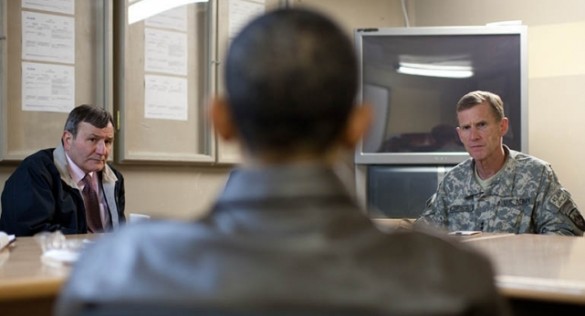
Gen Stanley McChrystal looks bemused at the sight of President Obama in a bomber jacket during a surprise visit to Afghanistan in March, 2010.

A Rolling Stone profile of Gen Stanley McChrystal due out on Friday “was a mistake reflecting poor judgment and it should have never happened,” the commander of US forces in Afghanistan now says.

It was a mistake to say what he and his staff said, or it was a mistake to make these remarks in the presence of a journalist?

The incident reveals the ambivalence Americans feel when it comes to the institutional power at the center of American democracy. Whatever keeps the wheels of Washington working smoothly, it isn’t candor.

Coming as I do from a country that has a real and ancient monarchy (for which I have little respect), during twenty-some years in the United States I’ve always viewed this country’s republican credentials with a certain measure of skepticism.

If at its conception America cast aside regal authority because of an unambiguous faith in the power of the people, why is it that so many Americans have such a gooey-eyed fascination with British royalty? Why the obsession with another form of royalty: celebrity? Why, in a supposedly egalitarian society, is such a high value attached to very visible displays of social status?

Americans seem to have had less interest in completely abandoning rule by a monarch than in modifying regal power and repackaging it in the quasi-regal institution of the presidency.

Having been crowned, a president always remains a president — even once out of office. He lives in a little palace, can never move around without being surrounded by a huge entourage of somewhat venal and sycophantic characters. And as in all forms of palace politics, those individuals who have wormed their way close to the center of power will do whatever they can to protect the status of the institution as they make frequent expressions of obeisance to the king-president.

But the concentration of power always involves the consolidation of power and so a president, just like any king, always needs to be on his guard, aware that one of his dukes or generals might pose a challenge.

Enter, Gen Stanley McChrystal.

McChrystal isn’t trying to stage a coup but he’s a repeat offender when it comes to upholding the most important principle in regal politics: never undermine the authority of the monarch or his highest officers.

National Security Adviser, Gen James Jones is a “clown.” Senior envoy Richard Holbrooke is a “wounded animal.” Joe Biden is “Bite me.” This is not language that can be uttered louder than a whisper in any palace.

As McChrystal heads to Washington for yet another dressing down, there’s one thing we can be sure of: President Obama won’t be wearing a bomber jacket when he lectures his top general. He’ll simply relying on the power of his throne — the Oval Office.

In his Rolling Stone profile of McChrystal, Michael Hastings writes:

The general prides himself on being sharper and ballsier than anyone else, but his brashness comes with a price: Although McChrystal has been in charge of the war for only a year, in that short time he has managed to piss off almost everyone with a stake in the conflict. Last fall, during the question-and-answer session following a speech he gave in London, McChrystal dismissed the counterterrorism strategy being advocated by Vice President Joe Biden as “shortsighted,” saying it would lead to a state of “Chaos-istan.” The remarks earned him a smackdown from the president himself, who summoned the general to a terse private meeting aboard Air Force One. The message to McChrystal seemed clear: Shut the fuck up, and keep a lower profile

Now, flipping through printout cards of his speech in Paris [in mid-April], McChrystal wonders aloud what Biden question he might get today, and how he should respond. “I never know what’s going to pop out until I’m up there, that’s the problem,” he says. Then, unable to help themselves, he and his staff imagine the general dismissing the vice president with a good one-liner.

“Are you asking about Vice President Biden?” McChrystal says with a laugh. “Who’s that?”

“Biden?” suggests a top adviser. “Did you say: Bite Me?”

When Barack Obama entered the Oval Office, he immediately set out to deliver on his most important campaign promise on foreign policy: to refocus the war in Afghanistan on what led us to invade in the first place. “I want the American people to understand,” he announced in March 2009. “We have a clear and focused goal: to disrupt, dismantle and defeat Al Qaeda in Pakistan and Afghanistan.” He ordered another 21,000 troops to Kabul, the largest increase since the war began in 2001. Taking the advice of both the Pentagon and the Joint Chiefs of Staff, he also fired Gen. David McKiernan – then the U.S. and NATO commander in Afghanistan – and replaced him with a man he didn’t know and had met only briefly: Gen. Stanley McChrystal. It was the first time a top general had been relieved from duty during wartime in more than 50 years, since Harry Truman fired Gen. Douglas MacArthur at the height of the Korean War.

Even though he had voted for Obama, McChrystal and his new commander in chief failed from the outset to connect. The general first encountered Obama a week after he took office, when the president met with a dozen senior military officials in a room at the Pentagon known as the Tank. According to sources familiar with the meeting, McChrystal thought Obama looked “uncomfortable and intimidated” by the roomful of military brass. Their first one-on-one meeting took place in the Oval Office four months later, after McChrystal got the Afghanistan job, and it didn’t go much better. “It was a 10-minute photo op,” says an adviser to McChrystal. “Obama clearly didn’t know anything about him, who he was. Here’s the guy who’s going to run his fucking war, but he didn’t seem very engaged. The Boss was pretty disappointed.”

Facebooktwittermail

US-Israeli relations improve — time to bulldoze Palestinian homes

Since US-Israeli relations are so famously cozy, maybe it’s time to extend the familial metaphor a bit further: Washington is a victim of domestic violence.

Every time the Obama administration reaches out to the Netanyahu government, it gets slapped in the face. Netanyahu has once again been invited to Washington — due to the poorly-time Mavi Marmara massacre he had to bail on a visit planned for early this month. He’s now due for his long-awaited kiss and make up session at the White House on July 6. But true to form, as soon as this was announced, word came from Jerusalem that 22 Palestinian homes are going to be bulldozed to clear space for a tourist center.

Another diplomatic snafu? On the contrary. These unfortunate “coincidences” have become so predictable that it’s hard to interpret them in any other way than as a calculated effort by Israeli officials to humiliate their American counterparts.

Just as some victims of serial abuse collude with their abuser by finding ways to excuse their partner’s violence, Washington’s tolerance of treatment that would be unthinkable coming from any other ally, is perpetually excused when the offending nation is Israel.

Haaretz now reports:

The Jerusalem municipal planning committee approved Monday a contentious plan to raze 22 Palestinian homes to make room for a tourist center that Palestinians fear would tighten Israel’s grip on the city’s contested eastern sector.

Jerusalem mayor Nir Barkat has asked the municipal planning committee earlier Monday to give preliminary approval to the plan which affects the neighborhood of Silwan in East Jerusalem, and risks more U.S.-Israeli friction.

Tensions have already been raised in Jerusalem, when conflict erupted during the meeting between committee members and the residents of Silwan. Silwan residents starkly objected to the plan and demanded the committee discuss their alternative plan, which does not include razing homes.

What will the White House say? That this is “unhelpful”? Hillary Clinton has already expressed her “dismay and disappointment.”

Just as the expansion of Jewish settlements on Palestinian land has been relentless, the Israeli assault on Washington perpetually expands the boundaries of impunity. The notion that Israel might go too far in testing the limits of American tolerance is repeatedly invalidated as Washington demonstrates that its diplomatic tool box is equipped with nothing more threatening than the occasional harsh word — and even those are in short supply and never particularly harsh.

Facebooktwittermail

Mordechai Vanunu: prisoner of conscience

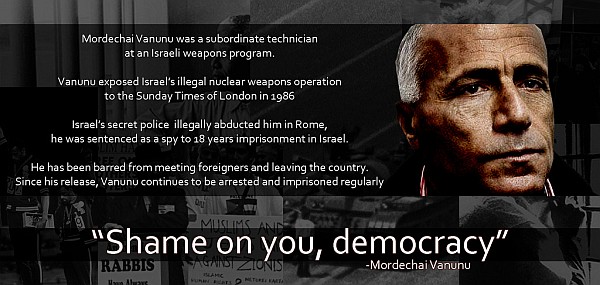
How many countries in the world are there where someone can be thrown in jail for talking to a foreigner? That was one of Mordechai Vanunu’s most recent “crimes” as a citizen in “the only democracy in the Middle East.”

Having spent 18 years in prison — more than 11 of those in solitary confinement — after revealing to the world Israel’s clandestine nuclear weapons program, Vanunu is now back in solitary confinement.

Amnesty International has rightly declared that he is a “prisoner of conscience,” and called for his immediate release.

The state persecution that Vanunu has suffered for decades and other details provide reason to suspect that he may the individual who in a report several days ago was simply referred to a Mr X.

A June 13 report in the Hebrew edition of Ynet (translated by Didi Remez, h/t to Richard Silverstein) said:

Nobody knows who Mr. X. is. Ynet has learned that a man has been imprisoned for some time in wing 15 of Ayalon Prison but nobody knows who he is and what charges he is being jailed for. Nobody talks to him, nobody sees him, nobody visits him, nobody knows he is in jail. “He was placed in full and complete separation from the outside world,” said an Israel Prison Service official.

To enter the wing where the detainee is being held, you have to pass the jailers on the southern side of the prison and go through double iron doors. Unlike regular separation wings, where prisoners can talk loudly between the cells or see the goings-on in the corridors with mirrors, wing 15 has only one cell without neighboring cells and without a corridor, so that whoever is jailed in it is completely isolated from any living being.

“I don’t know any other prisoner or IPS detainee held in such severe conditions of separation and isolation,” said a Prison Service official. “There is confidentiality surrounding the detainee in wing 15 in every respect, including his identity and the crimes he committed. I doubt even the jailers in charge of him know who he is. There is too much confidentiality surrounding him. It is scary that in 2010 a man is imprisoned in Israel without us even knowing who he is.”

The official said, “it is simply a person without a name and without an identity who was placed in complete and absolute isolation from the outside world. We don’t know if he gets visits, if he gets the rights that every detainee deserves by law and if anybody even knows he is in jail.” The IPS declined to divulge who the person jailed there is. Its spokesman, Lt. Col. Yaron Zamir, said: “The IPS does not provide information about locations and names out of security considerations.”

Mr. X. is being kept in the wing originally built in order to jail Prime Minister Rabin’s assassin, Yigal Amir. Amir was jailed in the same cell under heavy security, with security cameras in the cell until December 2006, when he was moved to the separate wing at Rimonim prison in the Sharon district. The cell in wing 15 is relatively large and, in the case of Amir, his family met him in the cell so that he would not have to be taken out during visits.

Amnesty confirms that Vanunu is being held in Ayalon Prison.

Earlier this year, Rannie Amiri wrote on Vanunu’s “Nobel stand”:

“He [Vanunu] has written letters to us this year and last year also, where he stated explicitly that he did not want to be a candidate for the Nobel Peace Prize. The reason he gave was that Simon Peres had received the Nobel Peace Prize, and Peres he alleged was the father of the Israeli atomic bomb and he did not want to be associated with Peres in any way.” – Geir Lundestad, Director of the Norwegian Nobel Institute and Secretary of the Norwegian Nobel Committee, 24 February 2010.

For the first time in the history of the Norwegian Nobel Committee, a preemptive request to withdraw a nomination—by the nominee—was made.

It was revealed last week that in a letter to the Committee, Mordechai Vanunu had asked for his candidacy to be rescinded. It was unusual enough for Geir Lundestad to acknowledge that a nomination had even been received, let alone publicly disclose Vanunu’s request. But for Vanunu—a man who should have been awarded the Peace Prize long ago—it was in full keeping with the dignity, integrity and uncompromising nature of one to whom the world owes a great debt.

Mordechai Vanunu – more than just a whistleblower

Vanunu worked as a technician at Israel’s Dimona nuclear plant in the Negev Desert from 1976-1985. In a 1986 interview with The Sunday Times, he courageously exposed, for the first time, his country’s clandestine nuclear activity. A week prior to the interview’s publication, he was lured by a Mossad agent from London to Rome, where he was apprehended and whisked off to Israel. In secret proceedings, Vanunu stood trial for treason, was swiftly convicted, and sentenced to 18 years behind bars. He spent more than 11 of them in solitary confinement.

Vanunu was released from Ashkelon’s Shikma prison in April 2004, unapologetic and unrepentant. “I am proud and happy to do what I did,” he said.

As for enduring nearly two decades of incarceration?
“I said to the Shabak [Shin Bet], the Mossad, ‘you didn’t succeed to break me, you didn’t succeed to make me crazy.’”
Conditions of his parole prohibited him from speaking with journalists, supporters, or non-Israelis of any kind. He was restricted from travelling within the country and barred altogether from leaving it.

In 2007, Vanunu was found to be in violation of his parole, in part for attempting to travel from Jerusalem to Bethlehem, and it landed him in jail for another three months. Being a convert to Christianity and an advocate for Palestinian rights did not help his case, but only served to increase the scorn heaped upon him by his countrymen.

Although the term “whistleblower” is usually appended to Vanunu’s name, the description is weak and understated. He was more like the “siren” that alerted the world to Israel’s undeclared nuclear bombs and the introduction of weapons of mass destruction to the Middle East.

Facebooktwittermail