Category Archives: Editorials

EDITORIAL: Does Joe Biden want Israel to attack Iran?

Does Joe Biden want Israel to attack Iran?

Or, let’s phrase the question another way: is Joe Biden stupid?

He might speak a bit more freely than politicians are supposed to in this day and age, but I don’t think Biden is stupid. And I don’t think he gave Israel a green light to attack Iran. This is the part of his interview with George Stephanopoulos aired yesterday where the issue came up:

George Stephanopoulos: [The Israeli] Prime Minister Netanyahu has made it pretty clear that he agreed with President Obama to give until the end of the year for this whole process of engagement to work. After that, he’s prepared to make matters into his own hands.

Is that the right approach?

Joe Biden: Look, Israel can determine for itself – it’s a sovereign nation – what’s in their interest and what they decide to do relative to Iran and anyone else.

Stephanopoulos: Whether we agree or not?

Biden: Whether we agree or not. They’re entitled to do that. Any sovereign nation is entitled to do that. But there is no pressure from any nation that’s going to alter our behaviour as to how to proceed.

What we believe is in the national interest of the United States, which we, coincidentally, believe is also in the interest of Israel and the whole world. And so there are separate issues.

If the Netanyahu government decides to take a course of action different than the one being pursued now, that is their sovereign right to do that. That is not our choice.

Stephanopoulos: But just to be clear here, if the Israelis decide Iran is an existential threat, they have to take out the nuclear programme, militarily the United States will not stand in the way?

Biden: Look, we cannot dictate to another sovereign nation what they can and cannot do when they make a determination, if they make a determination that they’re existentially threatened and their survival is threatened by another country.

Stephanopoulos: You say we can’t dictate, but we can, if we choose to, deny over-flight rights here in Iraq. We can stand in the way of a military strike.

Biden: I’m not going to speculate, George, on those issues, other than to say Israel has a right to determine what’s in its interests, and we have a right and we will determine what’s in our interests.

Earlier in the interview, Biden had reiterated that the US along with the other members of the permanent five plus one, Britain, China, France, and Russia, plus Germany, remain prepared to sit down and negotiate with Iran on its nuclear programme. Indeed, he went so far as to suggest that if Iran is willing to respond to the offer of engagement then this means that the regime has begun to change course and that “the protesters probably had some impact on the behavior of an administration that they don’t like at all.”

When pressed on whether the policy of engagement should now be put on hold, Biden insisted that the invitation was still out there and that “we have to wait to see how this sort of settles out.”

So what’s going on here? Biden wants to tell the Iranians we’re still ready to talk and at the same time he wants to tell the Israelis its OK if you go ahead and bomb Iran — we won’t get in your way?

Contrary to what the headlines suggest, the message I believe that Biden really wanted to drive home was that the administration remains committed to its policy of engagement.

When asked whether the US would modify its approach in response to choices Israel makes he said it would not. He said: “there is no pressure from any nation that’s going to alter our behavior as to how to proceed.”

By focusing on national sovereignty and Israel’s right to determine its own choices he was pointing to the fact that Israel and the US do not operate in tandem. And at a moment when Iran has been the focus of global condemnation he did not want it to appear that the US dictates what Israel can or cannot do.

If the Israeli government acts in a way that conflicts with America’s national interest then it should do so with the foreknowledge that this administration has already made it increasingly clear that it will not support Israel’s national interests at the expense of America’s national interest. Israel will no longer be treated like a rambunctious teenager that is given extra latitude by doting parents.

That’s a tough message — but it doesn’t readily reduce itself to a sensational headline.

Still skeptical about my interpretation? Well let’s consider another aspect of the conventional wisdom: Israel’s eagerness to strike Iran.

There has been no shortage of declarations by Israel’s hawkish leaders that would lead one to conclude that the only thing standing in the way of an attack was Washington. Hence, once provided with the requisite green light there would be nothing else holding Israel back. Indeed, with Obama’s policy of engagement now being viewed doubtfully by elements within most political camps, it might well appear that it’s no longer a question of if but simply when an attack will be launched.

But consider: isn’t this perception of Israeli-US power dynamics exactly the one that the Israelis would want sustained? On the one hand it perpetuates the image of Israel as lacking few internal inhibitions on its own use of military power. At the same time it maintains the expectation that whenever Israel launches an attack or starts a war it does so with American consent and collusion.

The one thing that Israel does not want unmasked is its own uncertainty: the fact that — all the bellicose rhetoric notwithstanding — it does not actually know whether it could effectively execute the military operation, nor is it confident that operational success would not also yield a strategic disaster.

John Bolton might be confident, but the confidence of a neocon sitting in Washington probably provides little comfort to anyone in Tel Aviv.

Facebooktwittermail

Editorial: Iran — the human story

Iran — the human story

No one gets a front-row seat in a revolution. It’s not a spectacle. You’re either out in the open, risking your life; lying low (or on the run), trying to save your life; or far enough away that the shouts, screams and gunshot, amount to no more than a faint murmur.

Except for now — wherever we are we have been sucked in by an illusion of proximity.

In a maelstrom of YouTube images and Tweets we march along with fearless demonstrators — without taking a step. We hear the gunfire, see the bloodshed and the baton blows — without suffering a scratch or breaking a sweat.

Are we simply revolutionary voyeurs?

To a degree yes, but underneath this fascination there is a deeper and more significant envy, shame and admiration.

Still, the images coming out of Iran have been confusing when refracted through multiple distorting political prisms.

Seen through a post-Bush, pro-diplomacy prism of pragmatic realism, Iran’s post-election turmoil has overturned a strategic chessboard upon which for several months all the pieces had been carefully placed and cautiously moved. The unexpected disarray has provoked a mix of paralysis and denial in which there is the expectation that after a week or two, things should return to “normal.”

As hundreds of thousands of Iranians protested the election results, Flynt Leverett and Hillary Mann Leverett, champions of the new realism that now shapes Washington’s approach to foreign policy, coldly suggested: “It is time for the Obama administration to get serious about pursuing [a genuine rapprochement] — with an Iranian administration headed by the reelected President Mahmoud Ahmadinejad.”

Dismissing claims that the election had been stolen, they said: “compared with the U.S. presidential election in Florida in 2000, the flaws in Iran’s electoral process seem less significant.” (The Iranians protest too much and we protest too little?)

Seen through a neoconservative, pro-Israel prism the uprising prompts acute ambivalence. The illegitimacy of Iranian state power is on full display yet the Islamic republic is almost certain to remain in tact. An Iran that can thoroughly be vilified is deemed preferable to one that acquires a moderate measure of moderation. As Daniel Pipes frankly put it: “while my heart goes out to the many Iranians who desperately want the vile Ahmadinejad out of power, my head tells me it’s best that he remain in office.”

And seen through an anti-imperialist prism, Iran looks like Lebanon’s 2005 Cedar Revolution writ large. Tehran’s “western-backed” revolutionary chic are a Trojan horse through which the West hopes to reassert its regional hegemony. As Seumas Milne warns: “the neutralisation of Iran as an independent regional power would be a huge prize for the US – defanging recalcitrants from Baghdad to Beirut – and a route out of the strategic impasse created by the invasion of Iraq.”

From each of these political angles the human story gets lost.

When unarmed women show their defiance towards baton-wielding militiamen we are witnessing a timeless battle. On one side are individuals risking their lives because they see their own fate as indivisible from that of others. On the other side are individuals who see their own interests as indivisible from those of the state and who have thereby abandoned loyalty to the dictates of their own conscience.

We see how high human beings — individually and collectively — can rise and in the very same moment how low they can fall.

We are moved and unsettled. Moved to see the boldness that frail individuals can muster. Unsettled to be reminded of the petty fearfulness that marks the distance between our own cosseted American lives and those lives now courageously at risk all across Iran.

Facebooktwittermail

EDITORIAL: Cheney, 9/11 and Mossad

Cheney, 9/11 and Mossad

Just suppose… as Dick Cheney launched his springtime assault in defense of the war on terrorism and the use of torture, that a new piece of information had come to light providing circumstantial evidence that there might indeed have been a connection between the 9/11 hijackers and Saddam Hussein.

The connection might be a bit tenuous, but suppose one of the principal hijackers had a cousin who had been on the payroll of Saddam’s Mukhabarat for 25 years and during that period he had received $300,000.

How likely is it that Cheney would dismiss such a connection, that he would accept the claim that the two cousins did not know each other well, and that he would agree that really this was the kind of connection to which no significance should be attached?

Since this is an imaginary scenario the answer must be purely speculative, but this much we do know: several men were brought close to death in the hope that under intense pressure they might divulge some scrap of information on a possible al Qaeda-Saddam connection.

We can take this much for granted: Someone who had spied for Saddam and who was related to a 9/11 hijacker would — if Dick Cheney had any say in the matter — at the very least face some serious questioning.

So why should we bother with this kind of idle speculation?

Here’s why.

Last July, Ali al-Jarrah was arrested by Hezbollah in Al-Marej in the Bekaa Valley, Lebanon. He was later handed over to Lebanese government security services and now sits in jail.

As the New York Times reported in February:

Lebanese investigators say he has confessed to a career of espionage spectacular in its scope and longevity, a real-life John le Carré novel. Many intelligence agents are said to operate in the civil chaos of Lebanon, but Mr. Jarrah’s arrest has shed a rare light onto a world of spying and subversion that usually persists in secret.

Mr. Jarrah’s first wife maintains that he was tortured, and is innocent; requests to interview him were denied.

From his home in this Bekaa Valley village, Mr. Jarrah, 50, traveled often to Syria and to south Lebanon, where he photographed roads and convoys that might have been used to transport weapons to Hezbollah, the Shiite militant group, investigators say. He spoke with his handlers by satellite phone, receiving “dead drops” of money, cameras and listening devices. Occasionally, on the pretext of a business trip, he traveled to Belgium and Italy, received an Israeli passport, and flew to Israel, where he was debriefed at length, investigators say.

At the start of the 2006 war between Israel and Hezbollah, Israeli officials called Mr. Jarrah to reassure him that his village would be spared and that he should stay at home, investigators said.

Since Jarrah’s arrest, Israeli spy rings have been falling like dominoes all across Lebanon. Ironically, the unraveling of Mossad’s intelligence network has resulted in part from technical assistance provided to the Lebanese by the Bush administration — assistance that was intended to target Syrians.

But what’s all of this got to do with 9/11?

It turns out that Ali al-Jarrah had a famous cousin: Ziad al-Jarrah, hijacker and pilot of United Airlines Flight 93, which crashed near Shanksville, Pennsylvania on September 11, 2001.

The New York Times says “the men were 20 years apart in age and do not appear to have known each other well.”

Maybe this isn’t the kind of connection that concerns Cheney and maybe Ziad knew nothing about his cousin’s 25 years of service to Mossad.

Still, it’s interesting. No?

Facebooktwittermail

EDITORIAL: Does the NYT‘s David Sanger know how to use the internet?

Does the NYT‘s David Sanger know how to use the internet?

No doubt every diligent reporter still needs a notebook and a telephone, but to read David E Sanger’s report, “Biblical Quotes Said to Adorn Pentagon Reports,” you have to wonder whether the New York Times‘s chief Washington correspondent actually knows how to use the internet.

I know, he did manage to find his way to Robert Draper’s article on GQ, but after that Sanger seemed to think that his time would be better spent listening to a goofball like Lawrence Di Rita than to spend just a few minutes drilling the web to find out more about “a general who worked on the Joint Staff.”

Even though Draper gave prominence to “Major General Glen Shaffer, a director for intelligence serving both the Joint Chiefs of Staff and the secretary of defense,” who crafted the evangelical war reports on which Draper’s article focuses, Sanger didn’t seem to think it was worth mentioning the general by name. It was sufficient to cite Di Rita who “said that he had no recollection of the biblical briefs, but that he doubted the famously acerbic and sometimes cranky secretary would have tolerated them for long, much less shared them with Mr. Bush.”

Given that Maj Gen Shaffer retired on August 1 2003, his handiwork clearly wouldn’t have been gracing the secretary of defense’s desk for very long however well or poorly it was received.

Much more relevant to Sanger’s report would have been a little biographical information about the nameless general. For instance, the fact that he serves on the board of directors of an evangelical Christian school in Texas and is on the board of trustees of an evangelical program supplier that sells seminars to churches around the world “and in chapels of all branches of the U.S. military.”

At the same time, Shaffer is maintaining the time-honored tradition of cashing in on his Pentagon connections by working as executive vice president of Kforce Government Solutions (KGS) which “provides innovative solutions to federal government.”

While Shaffer might not have been inclined to discuss with a New York Times reporter how his evangelical orientation affected his work in the Pentagon, it’s reasonable to assume that the general’s public service experience provides the foundation for his private sector day-to-day work. On that basis, Shaffer could have been pressed a bit — but only if Sanger had managed to track down. The KGS contact page would have been an obvious place to start. Clearly, Sanger didn’t even get that far.

Facebooktwittermail

EDITORIAL: The scapegoat with a savage bite

The scapegoat with a savage bite

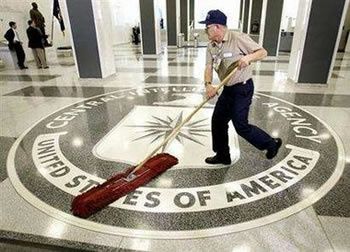
Everyone’s afraid of the CIA.

On PBS’s Washington Week last night, in a roundtable discussion on the Pelosi-CIA joust, there was a clear consensus among the assembled reporters: anyone who dares pick a fight with the CIA does so at their own peril and is almost certain to lose.

As is always the case, the only thing the press is interested in here is the fight — who, if anyone, is telling the truth is apparently of no consequence. It also appears that journalists — just as much as the White House and Congress — are afraid of challenging the agency. No one’s at risk of ending up with a bullet in the back of their head, but that isn’t because the CIA is benign — it just means it can exploit much subtler but equally effective methods for accomplishing its aims.

Consider for a moment that we supposedly live in a democracy. How can it be that the head of state, the executive and legislative branches of government and the erstwhile Fourth Estate should all be afraid of a single government agency?

Why is it that an agency that enjoys the medieval privilege of operating with a “black budget” in the ostensible interests of national security, nevertheless always seems able to lift the umbrella of secrecy as and when it serves its own interests?

After Nancy Pelosi accused the CIA of lying about briefing Congressional leaders on waterboarding, CIA Director Leon Panetta’s response was to publicly issue a statement to CIA employees. This was a multi-layered message.

Top layer: The agency didn’t lie. He said: “…our contemporaneous records from September 2002 indicate that CIA officers briefed truthfully on the interrogation of Abu Zubaydah, describing ‘the enhanced techniques that had been employed.’ ” (This isn’t a particularly solid statement. “Contemporaneous records” — so might there be other records that tell a different story? “CIA officers briefed truthfully” — briefed who truthfully? “Describing ‘the enhanced techniques that had been employed'” — why didn’t he put it in black and white: Nancy Pelosi was told by CIA officers that Abu Zubaydah was waterboarded?)

Next layer: I’m defending you guys (and want to be seen defending you — hence, he didn’t just send out the memo but also put it on the CIA web site). He said: “We are an Agency of high integrity, professionalism, and dedication. Our task is to tell it like it is — even if that’s not what people always want to hear. Keep it up. Our national security depends on it.”

Next layer: But I do have to cover my own ass: “Let me be clear: It is not our policy or practice to mislead Congress.”

Why should the employees of the CIA need reminding that they shouldn’t mislead — which is to say, lie to or deceive — Congress? Oh yes, because it’s already public knowledge that in 2005, even after having been requested by Rep. Jane Harman not to do so, they destroyed video tapes of the torture of Abu Zubaydah and Abd al-Rahim al-Nashiri — tapes that would almost certainly have been used as evidence if anyone is ever prosecuted for torture.

For the last seven years, the CIA has been playing what probably ranks as the most masterful political game in its history. When 9/11 should have posed an existential threat to the agency, instead it was able to distance itself from the Bush administration to such a degree that it ended up being perceived as the victim of a neocon vendetta. Former agents became honorary members of the anti-Bush movement with Valerie Plame as their poster child.

Even now, as the agency fends off demands for investigations into its use of torture, a defense narrative has already being wheeled into service. We were just honest government employers doing what we were asked to do. The real offenders were in Cheney’s office.

I have no problem with the idea that it is the decision-makers and architects of the torture program who should be held responsible. But that doesn’t mean that torturers and murderers get off the hook. Indeed, an agency that goes to such lengths to protect its own doesn’t just need reform; it needs breaking up.

Facebooktwittermail

The Pope in the Palestinian prison camp

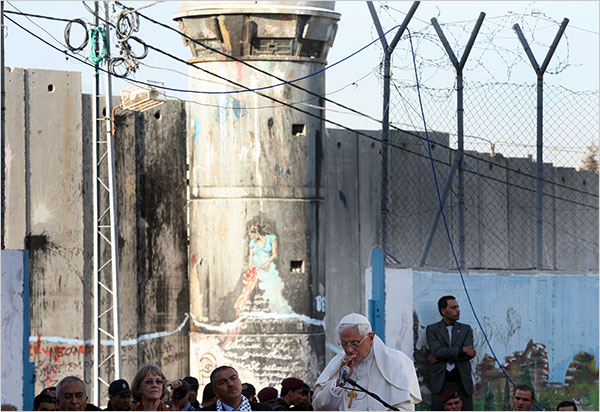
The Pope in the Palestinian prison camp

Has this image appeared widely in the media? I don’t honestly know, but I’ll assume it hasn’t. So the next question would be: why not?


(Source: The New York Times)

The New York Times ran an article with the headline: “In Bethlehem, Pope laments Israeli wall“. The perfect place to use the image above — the one their own photographer had provided. Right?

Wrong. Instead, they went with a poetic Getty image: little children peaking over a little wall. How enchanting!

Facebooktwittermail

EDITORIAL: Corruption: ‘the greatest single existential threat to Israel’

Corruption: ‘the greatest single existential threat to Israel’

At the web site of the neoconservative magazine, Commentary, Michael B Oren (who is in line to become Israel’s next ambassador to the United States) moves away from the standard position on existential threats to Israel. Seeing an array of existential threats, Oren says that among those, that posed by a nuclear-armed Iran would itself constitute “not one but several existential threats.” Even so, he does not see the risk of Israel being wiped off the map as preeminent among the dangers Israel faces.

This is where Oren locates the greatest threat to Israel’s survival:

Recent years have witnessed the indictment of major Israeli leaders on charges of embezzlement, taking bribes, money laundering, sexual harassment, and even rape. Young Israelis shun politics, which are widely perceived as cutthroat; the Knesset, according to annual surveys, commands the lowest level of respect of any state institution. Charges of corruption have spread to areas of Israeli society, such as the army, once considered inviolate.

The breakdown of public morality, in my view, poses the greatest single existential threat to Israel. It is this threat that undermines Israel’s ability to cope with other threats; that saps the willingness of Israelis to fight, to govern themselves, and even to continue living within a sovereign Jewish state. It emboldens Israel’s enemies and sullies Israel’s international reputation. The fact that Israel is a world leader in drug and human trafficking, in money laundering, and in illicit weapons sales is not only unconscionable for a Jewish state, it also substantively reduces that state’s ability to survive.

When it comes to Oren’s remedy, he sounds less than convincing:

…corruption must be rooted out through a revival of Zionist and Jewish values. These should be inculcated, first, in the schools, then through the media and popular culture. The most pressing need is for leadership.

Perhaps there’s another route — one that’s presumably compatible with Jewish values yet can make no claim to being specifically Judaic: the promotion of public integrity.

Corruption is the most glaring expression of a conflict between words and actions. The gap that separates what Israel’s leaders say from what they do is what renders their utterances worthless. But although such leaders are viewed with cynicism by those who have witnessed how deeply ingrained this lack of integrity has become, that cynicism can easily be washed away if promises are fulfilled through actions.

While Israel’s pathological political culture has been shaped by many powerful internal forces there has also been for many decades an external enabler: the United States.

Having previously given Israel’s leaders a free pass, the US could, if it chose, help break the cycle of corruption.

From an unexpected quarter an opportunity is now emerging through which Israel could reclaim some international faith in the value of its word.

Israel’s US-enabled policy of “nuclear ambiguity” has frayed beyond repair. A policy which was never anything more than a bargain of deceit does nothing more than give Israel an excuse for excluding itself from an international debate within which its unacknowledged nuclear arsenal is a central factor.

Now, the Obama administration’s top arms control negotiator, Assistant Secretary of State Rose Gottemoeller, has effectively declared that the era of nuclear ambiguity is over and that Israel’s nuclear arsenal cannot forever remain outside the regime of the nuclear non-proliferation treaty.

“Universal adherence to the NPT itself, including by India, Israel, Pakistan and North Korea … remains a fundamental objective of the United States,” Gottemoeller said at the UN on Tuesday.

The Jerusalem Post reported:

Former prime minister Ariel Sharon’s chief strategist, Dov Weisglass, said Gottemoeller’s comments were very alarming.

“If these statements indicate a change in American policy on this issue, I believe this may be the most worrisome development for Israel’s security in many years,” he told Army Radio.

The Washington Times reported:

Ms. Gottemoeller endorsed the concept of a nuclear-free Middle East in a 2005 paper that she co-authored, “Universal Compliance: A Strategy for Nuclear Security.”

“Instead of defensively trying to ignore Israels nuclear status, the United States and Israel should proactively call for regional dialogue to specify the conditions necessary to achieve a zone free of nuclear, chemical, and biological weapons,” she wrote.

The paper recommends that Israel take steps to disarm in exchange for its neighbors getting rid of chemical and biological weapons programs as well as Iran forgoing uranium enrichment.

If soon-to-be ambassador Oren is serious about reversing Israel’s problem with corruption, maybe he needs to put into practice the art of political leadership and press Prime Minister Netanyahu to take a bold political initiative by bringing Israel out of the nuclear closet.

Is this likely to happen? Hardly. Why? Because Israel does not perceive Iran so much as an existential threat as much as a strategic threat to its regional military dominance.

Entering the NPT and eventually disarming would not threaten Israel’s existence but would destroy its privileged status as a rogue nation able to resist international pressure.

If Obama really wants to sharpen his challenge to Netanyahu when they meet later this month, perhaps who can present him with this choice: keep your nuclear arsenal and learn how to live with a nuclear Iran, or, sign up for the creation of a non-nuclear Middle East. Nukes or no nukes. Which do you want?

Facebooktwittermail

Playing for Change

Playing for Change

A site that focuses so heavily on so much grim news from around the world needs once in a while to offer some inspiration. Here’s some from Mark Johnson, the creator of Playing for Change, whose goal is to unite people around the world through music — music performed by diverse and widely scattered musicians who listen to each other from afar and play together, their latest offering being a delightful Indian folk song: Chanda Mama

Facebooktwittermail

EDITORIAL: Churchill’s “we don’t torture” — except they did

Churchill’s “we don’t torture” — except they did

During last night’s news conference, President Obama took a less than subtle jab at his predecessor by citing Winston Churchill’s statement: “We don’t torture.” Whether the exact words that we’re so familiar with coming from George Bush’s mouth were ever also uttered by his English hero, I don’t know, but even if they were, it’s unfortunate that Obama would cite Churchill’s as quite such a principled stance. The British war record actually reveals a dark side even more chilling than the one Dick Cheney inspired.

In 2005, The Guardian reported on then newly-revealed records of Britain’s brutal treatment of Nazi prisoners — treatment that led to Britain being accused of operating concentration camps after World War Two had ended. Citing the British example is useful, but not for the purpose of showing that those who espouse high principles necessarily have the integrity to match their words with their actions.

And herein lies the fatal flaw of the conceit: we’re better than that. We don’t torture because we’re Americans.

In truth there is no failing from which Americans are immune. On the contrary, as Americans we’re just like anyone else — just like the British and so many others who under the pressure of a perceived necessity think that torture can be justified even while its use must remain a closely guarded secret.

In other words, if we argue that we must not torture, it should be because we recognize that Americans are just as capable as anyone else of tumbling down a moral spiral in which conscience and individual responsibility make themselves subordinate to a collective imperative.

The reason we should not torture terrorists isn’t because we operate on a higher moral plane than them, but because we know that we too are capable of descending into barbarity and moral depravity. We should not torture because we want to protect ourselves from our own demons.

Consider then the chilling British record:

The interrogation camp that turned prisoners into living skeletons

Despite the six years of bitter fighting which lay behind him, James Morgan-Jones, a major in the Royal Artillery, could not have been more specific about the spectacle in front of him. “It was,” he reported, “one of the most disgusting sights of my life.”

Curled up on a bed in a hospital in Rotenburg, near Bremen, was a cadaverous shadow of a human being. “The man literally had no flesh on him, his state of emaciation was incredible,” wrote Morgan-Jones. This man had weighed a little over six stones (38kg) on admission five weeks earlier, and “was still a figure which may well have been one of the Belsen inmates”. At the base of his spine “was a huge festering sore”, and he was clearly terrified of returning to the prison where he had been brought so close to death. “If ever a man showed fear – he did,” Morgan-Jones declared.

Adolf Galla, 36, a dental technician, was not alone. A few beds away lay Robert Buttlar, 27, a journalist, who had been admitted after swallowing a spoon handle in a suicide attempt at the same prison. He too was emaciated and four of his toes had been lost to frostbite.

The previous month, January 1947, two other inmates, Walter Bergmann, 20, and Franz Osterreicher, 38, had died of malnutrition within hours of arriving at the hospital. Over the previous 13 months, Major Morgan-Jones learned, 45 inmates of this prison, including several women, had been dumped at Rotenburg. Each was severely starved, frostbitten, and caked in dirt. Some had been beaten or whipped.

The same week that Major Morgan-Jones was submitting his report, a British doctor called Jordan was raising similar concerns at an internment camp 130 miles away. Dr Jordan complained to his superiors that eight men who had been transferred from the same prison “were all suffering gross malnutrition … one in my opinion dying”.

They included Gerhard Menzel, 23, a 6ft German former soldier who weighed seven stones, and was described as a living skeleton. Another, admitted as Morice Marcellini, a 27-year-old Frenchman, later transpired to be Alexander Kalkowski, a captain in the Soviet secret police, the NKVD. He weighed a little over eight stones, and complained that he had been severely beaten and forced to spend eight hours a day in a cold bath.

Prisoners complained thumbscrews and “shin screws” were employed at the prison and Dr Jordan’s report highlighted the small, round scars that he had seen on the legs of two men, “which were said to be the result of the use of some instrument to facilitate questioning”. One of these men was Hans Habermann, a 43-year-old disabled German Jew who had survived three years in Buchenwald concentration camp.

All of these men had been held at Bad Nenndorf, a small, once-elegant spa resort near Hanover. Here, an organisation called the Combined Services Detailed Interrogation Centre (CSDIC) ran a secret prison following the British occupation of north-west Germany in 1945.

CSDIC, a division of the War Office, operated interrogation centres around the world, including one known as the London Cage, located in one of London’s most exclusive neighbourhoods. Official documents discovered last month at the National Archives at Kew, south-west London, show that the London Cage was a secret torture centre where German prisoners who had been concealed from the Red Cross were beaten, deprived of sleep, and threatened with execution or with unnecessary surgery.

As horrific as conditions were at the London Cage, Bad Nenndorf was far worse. Last week, Foreign Office files which have remained closed for almost 60 years were opened after a request by the Guardian under the Freedom of Information Act. These papers, and others declassified earlier, lay bare the appalling suffering of many of the 372 men and 44 women who passed through the centre during the 22 months it operated before its closure in July 1947.

They detail the investigation carried out by a Scotland Yard detective, Inspector Tom Hayward, following the complaints of Major Morgan-Jones and Dr Jordan. Despite the precise and formal prose of the detective’s report to the military government, anger and revulsion leap from every page as he turns his spotlight on a place where prisoners were systematically beaten and exposed to extreme cold, where some were starved to death and, allegedly, tortured with instruments that his fellow countrymen had recovered from a Gestapo prison in Hamburg. Even today, the Foreign Office is refusing to release photographs taken of some of the “living skeletons” on their release.

Initially, most of the detainees were Nazi party members or former members of the SS, rounded up in an attempt to thwart any Nazi insurgency. A significant number, however, were industrialists, tobacco importers, oil company bosses or forestry owners who had flourished under Hitler.

By late 1946, the papers show, an increasing number were suspected Soviet agents. Some were NKVD officers – Russians, Czechs and Hungarians – but many were simply German leftists. Others were Germans living in the Russian zone who had crossed the line, offered to spy on the Russians, and were tortured to establish whether they were genuine defectors.

One of the men who was starved to death, Walter Bergmann, had offered to spy for the British, and fell under suspicion because he spoke Russian. Hayward reported: “There seems little doubt that Bergmann, against whom no charge of any crime has ever been made, but on the contrary, who appears to be a man who has given every assistance, and that of considerable value, has lost his life through malnutrition and lack of medical care”.

The other man who starved to death, Franz Osterreicher, had been arrested with forged papers while attempting to enter the British zone in search of his gay lover. Hayward said that “in his struggle for existence or to get extra scraps of food he stood a very poor chance” at Bad Nenndorf.

Many of Bad Nenndorf’s inmates were there for no reason at all. One, a former diplomat, remained locked up because he had “learned too much about our interrogation methods”. Another arrived after a clerical error, and was incarcerated for eight months. As Inspector Hayward reported: “There are a number against whom no offence has been alleged, and the only authority for their detention would appear to be that they are citizens of a country still nominally at war with us.”

Today, the older people of Bad Nenndorf talk about August 1 1945, the day the British arrived, with undisguised bitterness. A convoy of trucks pulled into the village, and the Tommies took over from an easygoing US infantry division. Within hours, the British had ordered everybody in the centre of the village to pack their belongings and leave. Bad Nenndorf was heaving with refugees from the bomb-ravaged ruins of Hanover, 18 miles to the east: hundreds of people were given 90 minutes to pack some food and valuables, and get out.

“We thought everyone would be allowed back in a few days,” recalls Walter Münstermann, now a retired newspaperman, but then a 14-year-old. “Then the soldiers started putting barbed wire fences around the centre of the village, and slowly we began to realise that this was going to be no ordinary camp.”

Walter and his neighbours realised that the centre of their village was being transformed into a prison camp when they heard that the British were converting a large, 40-year-old bath-house, ripping out the baths and installing heavy steel doors to turn each cubicle into a cell. They saw the first batch of prisoners arrive in the back of a truck. Later groups arrived at the village railway station in cattle trucks.

Ingrid Groth, then a seven-year-old, said locals claimed that if you crept up to the barbed wire at night, you could hear the prisoners’ screams. Mr Münstermann, who passed the main gate on his way to school each day, insists that the opposite was true: that it was a sinister place precisely because “you never, ever saw anyone, and you never heard a sound”. Among the people of Lower Saxony, Bad Nenndorf became known as das verbotene dorf – the forbidden village.
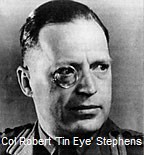
The commanding officer was Robin “Tin Eye” Stephens, 45, a monocled colonel of the Peshawar Division of the Indian Army who had been seconded to MI5 in 1939, and who had commanded Camp 020, a detention centre in Surrey where German spies had been interrogated during the war.

An authoritarian and a xenophobe with a legendary temper, Stephens boasted that interrogators who could “break” a man were born, and not made. Of the 20 interrogators ordered to break the inmates of Bad Nenndorf, 12 were British, a combination of officers from the three services and civilian linguists. The remaining eight included a Pole and a Dutchman, but were mostly German Jewish refugees who had enlisted on the outbreak of war, and who, Inspector Hayward suggested, “might not be expected to be wholly impartial”.

Most of the warders were soldiers barely out of their teens. Some had endured more than a year of combat, at the end of which they had liberated Belsen. Some represented the more unruly elements of the British Army of the Rhine, sent to Bad Nenndorf after receiving suspended sentences for assault or desertion. Often, Hayward said, they were the sort of individuals “likely to resort to violence on helpless men”.

The inmates were starved, woken during the night, and forced to walk up and down their cells from early morning until late at night. When moving about the prison they were expected to run, while soldiers kicked them. One warder, a soldier of the Welsh Regiment, told Hayward: “If a British soldier feels inclined to treat a prisoner decently he has every opportunity to do so; and he also has the opportunity to ill-treat a prisoner if he so desires”.

The Foreign Office briefed Clement Attlee, the prime minister, that “the guards had apparently been instructed to carry out physical assaults on certain prisoners with the object of reducing them to a state of physical collapse and of making them more amenable to interrogation”.

Former prisoners told Hayward that they had been whipped as well as beaten. This, the detective said, seemed unbelievable, until “our inquiries of warders and guards produced most unexpected corroboration”. Threats to execute prisoners, or to arrest, torture and murder their wives and children were considered “perfectly proper”, on the grounds that such threats were never carried out.

Moreover, any prisoner thought to be uncooperative during interrogation was taken to a punishment cell where they would be stripped and repeatedly doused in water. This punishment could continue for weeks, even in sub-zero temperatures.

Naked prisoners were handcuffed back-to-back and forced to stand before open windows in midwinter. Frostbite became common. One victim of the cold cell punishment was Buttlar, who swallowed the spoon handle to escape. An anti-Nazi, he had spent two years as a prisoner of the Gestapo. “I never in all those two years had undergone such treatments,” he said.

Kalkowski, the NKVD officer, claimed that toenails were ripped out and that he had been hung from his wrists during interrogation, with weights tied to his legs. British NCOs, he alleged, would beat him with rubber truncheons “while the interrogating officers went for lunch”. Hayward concluded, however, that “there was not a shred of evidence to support these allegations”.

Whatever was happening during the interrogations must have been widely known among many of the camp’s officers and men. In common with every CSDIC prison, each cell was bugged, so that the prisoners’ private utterances could be matched against their “confessions”.

Inspector Hayward’s investigation led to the courts martial of Stephens, Captain John Smith, Bad Nenndorf’s medical officer, and an interrogator, Lieutenant Richard Langham. The hearings were largely held behind closed doors. A number of sergeants – men who had carried out the beatings – were told they would be pardoned if they gave evidence against their officers. [continued…]

Facebooktwittermail

EDITORIAL: Who did Rep. Harman talk to?

Who did Rep. Harman talk to?

In 1963, the American Zionist Council (AZC) — regarded as the parent organization of American Israel Public Affairs Committee (AIPAC) — was under intense pressure from the Justice Department of the Kennedy administration to register under the Foreign Agents Registration Act due to the fact that it received funding from the Zionist Agency of Israel, a branch of the Israeli government. AZC resisted, making a plea to Justice officials that if it complied this “would eventually destroy the Zionist movement.” No doubt the memory still haunts AIPAC.

The upcoming trial of former AIPAC officials, Steven J. Rosen and Keith Weissman, accused of passing classified documents to Israeli officials, has escalated fears that a thorough examination of the organization’s operations might raise unwelcome questions about the nature of the pro-Israel lobby’s ties.

For that reason, as the Rep. Jane Harman story unfolds, one of the key unanswered questions is the identity of the Israeli agent that the California representative was taped talking to. If a request to intercede with the Justice Department on behalf of Rosen and Weissman, seeking lesser charges than the ones they still face, came from an AIPAC official, that would be one thing. If that official also happened to be an intelligence agent for the Israeli government, then the case has much farther reaching implications.

Interestingly (as David Corn pointed out), when interviewed on NPR this week, Harman initially claimed to have little recollection of the conversation that was wiretapped. “I can’t recall with any specificity a conversation I may have had four years ago.” But later in the interview, she was quite specific in recalling, “The person I was talking to was an American citizen.”

“I didn’t talk to some foreigner,” Harman said. But what about an Israeli agent who also happened to be an American citizen?

If the Israeli government, in contravention with a long-standing agreement not to do so, is in fact conducting intelligence operations inside the United States, it’s hard to imagine that it would not recruit American-Israelis for this purpose. Indeed, staff inside AIPAC with their excellent access to Capital Hill and the highest levels of recent administrations, would seem to be in an ideal position for gathering political intelligence.

Since 1985, after Jonathan Pollard, a US citizen, was convicted of spying on the US for Israel, Israel agreed that it would not conduct intelligence operations inside the United States. Whether it kept to that agreement is clearly open to question. Indeed, that this remains a live issue is apparent from the fact that in 2004 Israel secretly acknowledged to American officials that Pollard was not an isolated case.

In The Forward, in the wake of the Harman accusations, Nathan Guttman writes :

for close observers of the national security establishment, the real news was the extent of its suspicions of American Jewish supporters of Israel — up to and including its willingness to wiretap a member of Congress.

“It’s rooted deep in the system,” an official with an American Jewish organization said, “and it comes from the bottom up.”

The leaked transcripts hint, among other things, at the security establishment’s continued search for an Israeli mole that some reportedly believe remained uncaught after Jonathan Pollard, an American Jewish civilian naval intelligence analyst, was discovered engaged in massive espionage for Israel in 1985. More generally, the wiretap reflects the security establishment’s continuing concern about leaks of classified information to pro-Israel activists and Israeli agents who have shown themselves adept at obtaining nonpublic information from the government.

“We know that we are closely watched, that people might be listening to our phone calls. This is our working premise,” said a former senior Israeli official who was based in Washington in recent years. The official, who spoke on condition of anonymity due to the sensitivity of the issue, said he believed that suspicion toward Israel was prevalent in the military and intelligence establishments but was not common at the political and diplomatic levels.

The disclosure of the Harman wiretaps comes at a time when the government’s most elaborate attempt to crack down on alleged wrongdoings by pro-Israel activists is at a crossroads. The prosecution of two former AIPAC lobbyists, which began more than four years ago and is scheduled to go to trial June 2, is under review and, according to press reports, might be dropped altogether. The conversations involving Harman focused on attempts to put an end to the legal proceedings against the two former AIPAC staffers, Steve Rosen and Keith Weissman.

Although no formal explanation was provided from the National Security Agency for eavesdropping on the Harman conversation, it is widely believed that the wiretap was part of the investigation into the AIPAC case.

According to court records, wiretaps and surveillance in the Rosen-Weissman case began as early as 1999. From the indictment, which is now being reviewed by the attorney general’s office, it is clear that attempts to stop the flow of information to pro-Israel activists led to a wide- ranging counterintelligence operation in which Israeli diplomats and pro-Israel lobbyists were being followed and their conversations monitored. These conversations involved senior government officials who had been in touch with the subjects of the investigation. The U.S. District Court in the Eastern District of Virginia reviewed transcripts of these wiretaps in lengthy pretrial proceedings, and parts of them are expected to be presented if the case reaches trial.

Stephen Green, a Vermont-based writer who has chronicled the counterintelligence spats between the United States and Israel since the late 1970s, said the mistrust toward Israel stems from agents working on the cases and not from an overall anti-Israel ideology. “This has nothing to do with politics or with Israeli foreign policy. These are people who deal with these issues on a daily basis and become very, very upset,” Green said.

If the Justice Department does indeed drop the case against Rosen and Weissman, the person who arguably has the deepest personal interest in this is Larry Franklin, the former Defense Department official who was sentenced to serve 12 and a half years in prison for passing classified information to the AIPAC staffers without authorization.

Although he was sentenced in January 2006, Franklin has yet to be imprisoned. At the time of his conviction, he agreed to assist prosecutors and, according to David Frum, currently works as “a parking lot attendant in West Virginia.” Even so, he has been able to retain the services of one of Washington DC’s highest profile attorneys and no doubt if AIPAC dodges this bullet, Franklin will be wondering why or if he still deserves to go behind bars.

As for Representative Harman, since all sections of the media and fellow members of Congress have happily convinced themselves that this is a story about egregious government overreach and the need for diligent intelligence oversight, the chances that we’ll ever learn the identity of the American-Israeli agent she spoke to now appear slim. Unless of course there’s another useful leak…

Facebooktwittermail

EDITORIAL: AIPAC on trial

AIPAC on trial

As the Harman-AIPAC story unfolds all I can do at this point is make a few observations whose significance (or irrelevance) will become apparent in the future.

The questions that everyone predictably grab hold of in a situation like this are: Why is the story coming out now? Who’s interests are served by the timing?

In this case a supposedly telling coincidence is the fact that the story comes out in the middle of the waterboarding controversy and, lo and behold, it turns out Harman was the only Congressional leader who had objected to the interrogation program.

Well, Jeff Stein is quite emphatic in asserting that the story came out at this particular time for prosaic rather than political reasons. When asked why it came out now he said: “No special reason. The story was not ‘planted’ on me to influence any other events – in particular the looming AIPAC trial or things related to the NSA’s warrantless wiretapping program. I’ve known about it for some time but just not been able to pull it together until now for various reasons.” He also said, “The fact is, there is no ‘timing’ to any ‘leak.’ No sources ‘came forward,’ so to speak. I learned about this quite a while ago and was just recently able to turn my full attention to it.” Stein has a reputation as a methodical, diligent journalist and I’ll take his word for it on the timing.

Meanwhile, as everyone scrambles to try and figure out what’s going on here there are vying narratives that seem to have more to do with the observers preoccupations than they do with the story.

This is a story about AIPAC. It’s not about waterboarding or warrantless wiretaps.

There are those who, even if they don’t like AIPAC, nevertheless seem to think the AIPAC investigation rests on shaky legal ground and doubt that it will ever make it to trial. But that level of skepticism is hard to square that view with what are already established facts.

Larry Franklin is sitting in jail, serving a 13-year term. Two Israelis involved in the case hold or are about to enter key positions in the new Israeli government. Naor Gilon, who was alleged to receive classified information both from Franklin and then-AIPAC officials, Steve Rosen and Keith Weissman, has just been appointed as Foreign Minister Avigdor Lieberman’s chief of staff. Another Israeli official also involved in the case, former Mosad director, Uzi Arad, is expected to become Prime Minister Netanyahu’s national security adviser.

Unless this trial is avoided (might there be a plea bargain in the works?), this isn’t going to just be about the arcane Espionage Act. It’s going to be about how AIPAC works. Potentially, it’s going to be about whether AIPAC is genuinely an independent lobbying organization, or whether its operations have become so deeply entwined with those of Likud/Kadima-led Israeli governments that AIPAC should be legally treated as an agent of a foreign government.

Sources: wiretap recorded Rep. Harman promising to intervene for AIPAC

Lieberman taps Franklin case diplomat for top slot

The Harman-AIPAC story: a timeline

Lawmaker is said to have agreed to aid lobbyists

Jeff Stein takes the Harman story to MSNBC

Who listened to Harman? NSA or FBI?

More on that “suspected Israeli agent”

Are the Harman leaks fueled by her dissent on waterboarding?

Exclusive: Feds probe a top Democrat’s relationship with AIPAC

Facebooktwittermail

EDITORIAL: Power, humiliation and torture

Power, humiliation and torture

In the wake of 9/11, no phrase more succinctly projected the upwelling of popular jingoism across the United States than the words “Power of Pride.”

America needed to reassert its potency after experiencing the insult and humiliation of witnessing its power simultaneously centralized and instantaneously crushed when two drab towers acquired their national and international iconic significance in the very same moment that they collapsed.

As American power symbolically turned to a cloud of dust, its leaders scurried around in a desperate effort to salvage their authority and reclaim their dominance.

It now appears that central to that process was a calculated effort through which senior members of the Bush administration would restore their own pride and purge their own humiliation by torturing those who had collaborated in the attacks.
The fact that the CIA’s torture program was claimed to merely use “harsh interrogation” techniques was not simply a way of asserting that the legal threshold of torture had not been crossed. By using the term “interrogation” the issue of sadistic retribution was effectively screened out of consideration.

Even those who were critical of the approach the administration had adopted were inclined to confine those criticisms to questions such as whether these coercive methods would have any chance of yielding valuable intelligence. Alternatively they might press a patriotic argument by suggesting that torture was un-American.

The assumption inside the administration was that if its harsh methods could be presented as having been effective in preventing subsequent acts of terrorism, then pragmatic Americans would have less concern about the moral qualms of the administration’s critics — individuals who could be dismissed as civil liberties fanatics.

The moral question of whether the state can be allowed to use torture as a method of extra-judicial punishment and retribution rarely if ever entered the debate. But the evidence now suggests that it should.

We now learn that Khalid Sheikh Mohammed was waterboarded 183 times in March 2003 and Abu Zubaydah was waterboarded 83 times in August 2002.

The New York Times has reported:

Abu Zubaydah had provided much valuable information under less severe treatment, and the harsher handling produced no breakthroughs, according to one former intelligence official with direct knowledge of the case….

…the use of repeated waterboarding against Abu Zubaydah was ordered “at the direction of CIA headquarters,” and officials were dispatched from headquarters “to watch the last waterboard session.”

The memo, written in 2005 and signed by Steven G. Bradbury, who worked in the Office of Legal Counsel, concluded that the waterboarding was justified even if the prisoner turned out not to know as much as officials had thought.

And he did not, according to the former intelligence officer involved in the Abu Zubaydah case. “He pleaded for his life,” the official said. “But he gave up no new information. He had no more information to give.”

A line of command and a set of orders is one way of attempting to explain how it could come about that a man would be waterboarded day after day. Yet the significance of what was taking place at that time was implicit rather than explicit. What mattered most was what was left unstated.

Within a relatively short period, Zubaydah would have learned that as agonizing as waterboarding might be, it was something he could survive. In about the same amount of time, his torturers would have learned that there was no more information they could extract.

And yet the torture continued, day in, day out, multiple times a day.

Cheney knew. Bush knew. Rumsfeld knew.

Each day might yield no new intelligence but for those who had been most deeply humiliated by 9/11, unremitting waterboarding provided its own rewards.

To be able to say, “carry on” — with no reasonable justification — was to silently know: I have the power to exact retribution.

Facebooktwittermail

EDITORIAL: The scars of torture

The scars of torture

How much credit does President Obama deserve for releasing the torture memos?

Glenn Greenwald argues:

Other than mildly placating growing anger over his betrayals of his civil liberties commitments (which, by the way, is proof of the need to criticize Obama when he does the wrong thing), there wasn’t much political gain for Obama in releasing these documents. And he certainly knew that, by doing so, he would be subjected to an onslaught of accusations that he was helping Al Qaeda and endangering American National Security. And that’s exactly what happened, as in this cliché-filled tripe from Hayden and Michael Mukasey in today’s Wall St. Journal, and this from an anonymous, cowardly “top Bush official” smearing Obama while being allowed to hide behind the Jay Bybee of journalism, Politico‘s Mike Allen.

But Obama knowingly infuriated the CIA, including many of his own top intelligence advisers; purposely subjected himself to widespread attacks from the Right that he was giving Al Qaeda our “playbook”; and he released to the world documents that conclusively prove how that the U.S. Government, at the highest levels, purported to legalize torture and committed blatant war crimes. There’s just no denying that those actions are praiseworthy. I understand the argument that Obama only did what the law requires. That is absolutely true. We’re so trained to meekly accept that our Government has the right to do whatever it wants in secret — we accept that it’s best that most things be kept from us — that we forget that a core premise of our government is transparency; that the law permits secrecy only in the narrowest of cases; and that it’s certainly not legal to suppress evidence of government criminality on the grounds that it is classified.

Still, as a matter of political reality, Obama had to incur significant wrath from powerful factions by releasing these memos, and he did that. That’s an extremely unusual act for a politician, especially a President, and it deserves praise.

Really? I honestly don’t see it and I think that drawing a distinction between the act of releasing the memos and the act of throwing out a lifeline to those who might face prosecution is a way of decoupling what were actually interlocking actions.

The Obama administration had already stalled on releasing the memos. Had they continued to do so they would have put themselves in the position of appearing to be complicit in covering up a criminal conspiracy.

Central to that conspiracy was an effort to use evidence derived from observing the effects of the US military’s Survival, Evasion, Resistance and Escape (SERE) training.

In assessing the potential risk involved in the use of torture techniques such as waterboarding, the Department of Justice’s Office of Legal Council rested heavily on the proposition that if no lasting harm had been done to SERE trainees then neither would terrorist suspects be at risk.

In his memo to John Rizzo, Acting General Council of the CIA, Assistant Attorney General Jay Bybee wrote:

…the information derived from SERE training bears upon the impact of the use of the individual techniques and upon their use as a course of conduct. You have found that the use of these methods together or separately, including the use of the waterboard, has not resulted in any negative long-term mental health consequences. The continued use of these methods without mental health consequences to the trainees indicates that it is highly improbable that such consequences would result here. Because you conducted the due diligence to determine that these procedures, either alone or in combination, do not produce prolonged mental harm, we believe that you do not meet the specific intent requirement necessary to violate Section 2340A [the statute prohibiting the use of torture].

But the gaping hole in that argument was acknowledged by Steven Bradbury, a member of Bybee’s own staff, three years later:

Although we refer to the SERE experience below, we note at the outset an important limitation on reliance on that experience. Individuals undergoing SERE training are obviously in a very different situation from detainees undergoing interrogation; SERE trainees know it is part of a training program, not a real-life interrogation regime, they presumably know it will last only a short time, and they presumably have assurances that they will not be significantly harmed by the training.

What was obvious to Bradbury in 2005 somehow eluded Bybee’s grasp in 2002. Maybe it was because Bybee had spent too much time in the company of the likes of Dick Cheney, David Addington and Donald Rumsfeld.

It was Rumsfeld who had famously asserted that as someone who worked standing up, he couldn’t see the harm in forcing someone else to remain standing for many hours — as though it was neither here nor there whether the person standing was also naked, chained in position and being held in secret in a foreign country.

The point — and this is really the core issue in the whole torture debate — is that there is and always has been only one pressure point against which force is applied in the practice of torture, that being, the human mind. Its aim is to break the mind without breaking the body. Its successful practice requires that whatever scars are left behind are not clearly visible.

If its up to Obama, America will now “move forward” and the scars of torture will remain invisible.

The CIA however is bracing itself for examination.

The Washington Post reports:

For the first time, officials said yesterday that they would provide legal representation at no cost to CIA employees subjected to international tribunals or inquiries from Congress. They also said they would indemnify agency workers against any financial judgments.

The announcement appeared to be designed to soothe concerns expressed by top intelligence officials, who argued in recent weeks that the graphic detail in the memos could bring unwanted attention to interrogators and deter others from joining government service.

CIA Director Leon E. Panetta told employees that the interrogation practices won approval from the highest levels of the Bush administration and that they had nothing to fear if they followed the legal guidance from the Justice Department.

“You need to be fully confident that as you defend the nation, I will defend you,” Panetta said.

John Demjanjuk, the former Nazi death camp guard who is awaiting deportation from the United States before being sent to Germany to face trial for his part in the Holocaust, is being defended by lawyers who argue that putting the 89-year-old on trial would cause him pain amounting to torture.

If he does end up on trial, his defense may well suggest that we no longer live in a world where the Nuremberg defense is untenable.

As Barack Obama and Leon Panetta seem to be saying, “I was just following orders,” has now become an honorable American justification for torture.

Facebooktwittermail

EDITORIAL: Intelligence, information, truth and power

Intelligence, information, truth and power

When the Israel lobby launched its frantic campaign to obstruct the appointment of Chas Freeman as chairman of the National Intelligence Council (NIC), it was as though a notorious anti-Zionist was just about to torpedo US-Israeli relations. The idea that Ambassador Freeman could have played an important role in improving America’s national security and its position in the world apparently didn’t enter the minds of those who saw him as a threat.

Now that the furor has died down, Freeman has given an interview with Jim Lobe from the Inter Press Service and he outlines the approach that he had hoped to bring to the handling of intelligence and its role in government. What Freeman touches upon actually reaches far beyond the issue of intelligence and points to fundamental questions about how information is viewed and how its use shapes our lives.

This is how the issues were laid out in the interview:

Jim Lobe: Because much of the talk around Washington after your appointment – before, during and after your withdrawal – has so narrowly focused on a few issues, there was never much public debate about what you hoped to accomplish in the job of NIC chairman.

Chas Freeman: I was, frankly, approaching this with a fairly well thought out but still hypothetical focus on process with some additional questions of substance that I wanted to explore. I say hypothetical, because you never know until you encounter bureaucratic or other realities whether your notion of what needs to be done is in fact realistic or feasible.

But my sense was there have been several problems with the intelligence community and its output in recent years. Obviously, there’s been a problem of quality, illustrated along with the other problem – credibility – very nicely in the run-up to the Iraq War and the credulity with which the intelligence community responded to assertions by exile and special interest groups and others, and its willingness to slice and dice its conclusions to suit the political taste of its principal consumers.

Jim Lobe: What sorts of procedural changes were you thinking about implementing?

Chas Freeman: In general, I would’ve tried very hard to encourage members of the intelligence community to use classified information as a form of corroboration for information that is not classified, or is not terribly sensitive even if it is classified. In other words, I would urge analysts to write down rather than write up terms of levels of classification.

The theory here is that, whereas many people in the (NIC) have tended to see the value of intelligence as directly proportional to its level of classification, this, in fact, misunderstands the nature of intelligence. Intelligence is simply information that is relevant to statecraft or decision-making. If it’s on the front page of the Financial Times or Inter Press or has been stolen out of the Kremlin safe, the key question is what is its reliability and how much can you rely upon it in understanding the situation you confront and in forming policies to deal with that situation.

I must say much of the criticism of my appointment focused on the apparently horrifying possibility that I might actually produce intelligence that might not conform to political convenience or correctness but reached some other conclusion – intelligence that wouldn’t fit the preconceptions or policy preferences of its consumers. And that would be unacceptable.

The tendency to tie the value of intelligence to its level of classification is the product of a philosophical view of information that has profound implications.

The crucial issue is whether information is viewed as a repository of truth or power.

Is information valued because it illuminates understanding or because it can serve as a means to an end?

Information as a repository of power needs to be guarded and channeled in the most effective way. Its value becomes diluted through loss of ownership.

Information as a repository of truth acquires value if it can be tied to other information through a process of exchange. Its value is enhanced through the relinquishment of ownership.

Democracy rises or falls on its ability to sustain the free flow of information. As a practical necessity that flow needs to be managed yet if this is treated as an exercise in the control of power, democratic governance itself will be undermined.

Those who saw Freeman as a threat were looking through the prism of information-as-power. They thought he would be a gatekeeper who held back information that would serve their agenda while promoting the flow of information whose dissemination would act against their interests. What they failed to see was that Freeman never shared their presuppositions about the nature of information.

Facebooktwittermail

EDITORIAL: Who poses a greater threat to Israel? Mahmoud Ahmadinejad or Benjamin Netanyahu?

Who poses a greater threat to Israel? Mahmoud Ahmadinejad or Benjamin Netanyahu?

“In an interview conducted shortly before he was sworn in today as prime minister of Israel, Benjamin Netanyahu laid down a challenge for Barack Obama. The American president, he said, must stop Iran from acquiring nuclear weapons — and quickly — or an imperiled Israel may be forced to attack Iran’s nuclear facilities itself,” writes Jeffrey Goldberg.

In Haaretz, Aluf Benn presents a somber assessment of the likelihood that Israel will start a war with Iran:

“I promise that if I am elected, Iran will not acquire nuclear arms, and this implies everything necessary to carry this out,” Benjamin Netanyahu said before the elections. In other speeches Netanyahu described Iran’s nuclear program as “an existential threat for Israel,” and warned that it risked a second Holocaust. Does his return as prime minister necessarily bring Israel nearer to war with Iran?

In political circles the view is that yes, Netanyahu as prime minister brings Israel closer to war with Iran. Politicians in touch with Netanyahu say he has already made up his mind to destroy Iran’s nuclear installations.

In The National, I reviewed a recent assessment of the feasibility of an Israeli attack and some of its consequences:

In a recent study conducted by the Center for Strategic and International Studies in Washington, Abdullah Toukan predicted that an air assault by Israel on Iran’s nuclear facilities would involve 20 per cent of the high-end combat aircraft and all of the tankers from the Israeli air force.

“We can conclude that a military strike by the Israeli air force against Iranian nuclear facilities is possible, however, it would be complex and high risk in the operational level and would lack any assurances of a high mission success rate.”

The study also noted that Iran may have secretly acquired Russian air defence systems in which case an Israeli strike force would face a significantly elevated risk.

“The attrition rates of the Israeli air strike will be high, could go up to 20 to 30 per cent. For a strike mission of some 90 aircraft, the attrition could then be between 20 to 30 aircraft. A loss Israel would hardly accept in paying.”

The study also considered the possibility that Israel might choose instead to use conventionally-armed ballistic missiles to attack Iran.

Whatever the method of attack, the effects of radioactive fallout emitted by the Bushehr nuclear reactor, if it was destroyed, would be severe. “Most definitely Bahrain, Qatar and the UAE will be heavily affected by the radionuclides.

“Any strike on the Bushehr nuclear reactor will cause the immediate death of thousands of people living in or adjacent to the site, and thousands of subsequent cancer deaths or even up to hundreds of thousands depending on the population density along the contamination plume.”

Significantly, Goldberg writes:

Few in Netanyahu’s inner circle believe that Iran has any short-term plans to drop a nuclear weapon on Tel Aviv, should it find a means to deliver it. The first-stage Iranian goal, in the understanding of Netanyahu and his advisers, is to frighten Israel’s most talented citizens into leaving their country. “The idea is to keep attacking the Israelis on a daily basis, to weaken the willingness of the Jewish people to hold on to their homeland,” Moshe Ya’alon said. “The idea is to make a place that is supposed to be a safe haven for Jews unattractive for them. They are waging a war of attrition.”

What seems strikingly obvious is that the choices made by the Israeli government may well have the same effect and lead Jews in increasing numbers to conclude that Zionism has failed.

An attack on Iran when described as potentially successful — from Israel’s point of view — is likely to merely push back Iran’s nuclear program by a few years.

But what about the psychological impact of failure?

Where would Israel stand strategically in the event that it suffered significant losses while only doing limited damage to Iran’s nuclear facilities?

What would the mood be in Tel Aviv as its residents awaited a reprisal through a means and at a time of Iran’s choosing?

Israel’s nuclear reactor at Dimona is within range of missiles fired from Iran or Lebanon. Bennett Ramberg writing in Arms Control Today says:

… a successful strike on an operating Dimona reactor that breached containment and generated an explosion and fire involving the core would present effects similar to a substantial radiological weapon or dirty bomb. Although consequences would represent only a small fraction of the Chernobyl release, for Israel, a country the size of New Jersey with a population of some six million, the relative economic dislocation, population relocation, and immediate and lingering psychological trauma could be significant.

Whether or not Dimona ends up being attacked, Israel is doomed if it clings on to the idea that military invulnerability and security are the same.

Facebooktwittermail

EDITORIAL: Super top-secret scoop by an American magazine whose name can be revealed

Super top-secret scoop by an American magazine whose name can be revealed

If Deep Throat had been as paranoid as the Israelis maybe Richard Nixon would have managed to serve out his second term. Maybe the name “Watergate” would have never become infamous.

The Sudan raid story has been dribbling out over the last few days, a rumor here, a rumor there.

Apparently the Israelis got tired of the story getting so tangled.

Enough is enough, they said. We will have to provide a definitive account to an authoritative outlet.

I can now reveal that Israel’s most trusted messenger (at least at this moment) is Time magazine.

Humbled and honored that highly-placed Israeli security sources would provide Time with “exclusive details,” the magazine apparently went one step further than promising the standard anonymity to sources whose names can’t be revealed for the standard reasons. In this case the Israelis apparently needed to be so guarded that not only could they not reveal their own names, but (sources might have told me) they insisted that the journalists they were speaking to would also have to wrap themselves in the same cloak of anonymity.

Unnamed sources talk to unnamed journalists. There’s no risk that “TIME STAFF” will ever get a subpoena!

On the other hand, there’s not much chance we can expect tenacious investigative reporting from journalists who don’t get a byline.

How long would Bob Woodward and Carl Bernstein have toiled for if they had to work under the selfless byline of “Washington Post Staff Writers”?

As for the Big Story, did it contain any major revelations?

The official motive for the attack — and I’ll take this as official even though it doesn’t come in quotes but it does come as the second sentence, immediately after we’ve been told that we’re getting the straight dope from “two highly-placed Israeli security sources” — (drumroll):

The attack was a warning to Iran and other adversaries, showing Israel’s intelligence capability and its willingness to mount operations far beyond its borders in order to defend itself from gathering threats.

So there you have it. Iran now knows that any time it sends a small convoy of trucks through an isolated desert in north-east Africa, the trucks, drivers and cargo might get wiped out by a long-range stealth attack by Israeli fighter bombers.

Does this have implications for the security of Iran’s nuclear facilities?

Israel can knock out a convoy in Sudan, so, who knows what else it could do?

Knock out another convoy?

As for the question I raised yesterday, what did the Americans know and when did they know it?

Here’s the partial answer: “The Americans were notified that Israel was going to conduct an air operation in Sudan, but they were not involved.” And that’s a direct quote from… “a source.” Would that source be one of the highly-placed Israeli security sources? Maybe. Maybe not.

If the Americans got the heads-up from the Israelis that an operation was just about to take place in Sudan, did the Israelis know that the Americans had just or were just about to talk to the Sudanese?

It’s clearly in Israel’s interests to put out the message that Israel and the US see eye to eye at all times, but maybe someone at Time needs to track down an anonymous American source who’s willing to tell an anonymous reporter the American side of the story. Is that too much to ask?

Facebooktwittermail

EDITORIAL: The missing Mandela

The missing Mandela

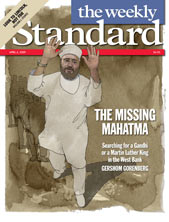
When the long sought solution to the Israeli-Palestinian conflict is being trumpeted from the cover of The Weekly Standard there’s every reason to scoff. Middle East peace has thus far not appeared high up on the neoconservative agenda and I really doubt that Bill Kristol and his cronies suddenly had some extraordinary change of heart.

What’s sad is that Gershom Gorenberg, who is clearly a man of integrity, chose to lend his support to the Israel apologists who happily massage their consciences by pretending that Palestinian violence is the one insurmountable obstacle to ending the conflict.

In a celebration of Israeli impotence we are presented with a mirage of peace in the form of an unfound Palestinian Mahatma. If only a Palestinian Gandhi emerged, anything would be possible.

It’s not that the appeal of a saintly leader of a non-violent resistance movement is lost on me, but the parallels between British India and Israel are beyond tenuous.

Gandhi’s resistance to British rule galvanized the support of a massive population governed by a tiny colonial elite who never had the pretense that Britain was reclaiming a long-lost homeland. To the British, India was a land brimming with resources that could be shipped back to the actual homeland and traded for handsome profits. By the end of World War Two, Britain was bankrupt and in a rush to free itself of what had become its colonial burdens. With or without a gentle shove from the Mahatma, the sun had already set on the British Empire.

As for Gandhi’s nominal success in non-violently waving goodbye to colonial rule, we should not forget that it was accompanied by the horrific failure of partition and a bloodbath in which as many as a million people died.

Another model of non-violent leadership that Gorenberg could have considered is that of the Dalai Lama.

After fifty years of principled resistance to Chinese rule, Tibetans are still no closer to winning autonomy. Thus far, the majority of the Dalai Lama’s followers remain loyal to the religious values that he practices and advocates, yet many are starting to wonder whether it is their pacifism that enables China to retain its firm grip on Tibet.

Of course the most obvious model of political leadership that Gorenberg should have mentioned is that of Nelson Mandela.

The problem is — at least from Gorenberg and The Weekly Standard‘s point of view — Mandela resolutely refused to renounce armed resistance. Apartheid didn’t end because its opponents adopted a spiritually enlightened non-violent perspective. It ended because white South Africans were forced to recognize they were clinging on to a politically unsustainable system.

Israelis still cling on to a politically unsustainable situation, but unlike white South Africans, they are still able to hold on to a security blanket stitched together by American military and economic aid and political protection.

President Obama might say that for Palestinians and Israelis “the status quo is unsustainable”, but unless the US takes away the security blanket, Israel will remain in its manipulatively infantile condition: vacillating between a manicured helplessness that occasionally gets punctuated by a violent tantrum.

Must Israel and its friends wait in frustration for an elusive Palestinian Mahatma or instead might an earnest search for an Israeli FW de Klerk be long overdue?

Facebooktwittermail

EDITORIAL: The rise of Israeli extremism

The rise of Israeli extremism

The cartoonist, Pat Oliphant, caused a stir this week with a cartoon (below) which Anti-Defamation League director, Abraham Foxman, said: “employs Nazi imagery by portraying Israel as a jack-booted, goose-stepping headless apparition. The implication is of an Israeli policy without a head or a heart.”

Did Oliphant go too far? Or was he merely using incendiary symbolism to draw attention to the ruthlessness of the Zionist war machine?

The role of the Israeli Defense Forces chief rabbi in portraying the war on Gaza as a religious war has been widely reported. Brig Gen Avichai Rontzki used a line from a classical Hebrew text and turned it into a war slogan: “He who is merciful to the cruel will end up being cruel to the merciful.”

Another rabbi, David Bar Hayim, conveyed a similar message in a broadcast on Israel National News TV where he cited scriptural authority when saying: “In a time of war, one does not distinguish between the different individuals on the enemy side of the fence, of the conflict. One has to fight the enemy … without any thought for such distinctions.” (A statement interestingly reminiscent of the Bush doctrine.) The rabbi also said: “I don’t believe that there are any innocent [Palestinian] civilians in this situation.”

Christopher Hitchens observes:

Peering over the horrible pile of Palestinian civilian casualties that has immediately resulted, it’s fairly easy to see where this is going in the medium-to-longer term. The zealot settlers and their clerical accomplices are establishing an army within the army so that one day, if it is ever decided to disband or evacuate the colonial settlements, there will be enough officers and soldiers, stiffened by enough rabbis and enough extremist sermons, to refuse to obey the order. Torah verses will also be found that make it permissible to murder secular Jews as well as Arabs. The dress rehearsals for this have already taken place, with the religious excuses given for Baruch Goldstein’s rampage and the Talmudic evasions concerning the assassination of Yitzhak Rabin. Once considered highly extreme, such biblical exegeses are moving ever closer to the mainstream.

The extremists are already on the march — literally. And they are being provided with the full support of the state of Israel.

Earlier this week, supporters of Rabbi Meir Kahane descended on the Israeli-Palestinian town of Umm al-Fahm (which was established in 1265).

A hundred militant Zionists, each protected by 25 Israeli police officers, had a simple message for the residents.

“We are going to conquer back Umm al-Fahm” and tell its residents that it is part of Eretz Yisrael (Greater Israel) and that “we are the owners of Eretz Yisrael.”

Just to be clear: Umm al-Fahm is within the 1967 borders of Israel and is populated by Arab Israeli citizens.

The demonstration was also reported by Al Jazeera:

Ynet later reported:

After deeming the Umm al-Fahm march a success, Israel’s extreme right announced it plans to publish regular reports on activities in Arab towns and villages.

“We intend on forming a monitoring committee to counter any infringements of the law in the Arab sector. The committee will be headed by Knesset Member Michael Ben Ari (National Union) and other right-wing activists will serve as members as well,” a rightist source told Ynet Tuesday.

Radical right-wing activist Itamar Ben Gvir explained: “The committee will be made up of subsections, with each section in charge of different things, like building violations, affiliation with terror groups, and infringing on Jewish freedom of movement.” The Right, he added, is now contemplating holding processions in other Arab towns as well.

While the majority of Israelis might identify themselves as secular, with militant nationalism on the rise, religious zealotry and military power have become fused together in the conception of an embattled state that needs show little restraint in its efforts to defend itself.

The spirit of Israel’s indomitable military might is captured in the video below: “Don’t Mess With The IDF.”

It’s tone might seem adolescent, yet it is adolescents and young adults who fill the ranks of the IDF and who celebrated the war in Gaza by adorning themselves with T-shirts that advocate shooting pregnant Muslim women. (Anyone seeing this video who understands Hebrew is welcome to explain the lyrics in a comment. The passage in English comes from The Matrix: Reloaded, which an Israeli reviewer said: “intentionally or not, is the most powerful pro-Israel movie since Cast a Giant Shadow — the story of the Independence War — and Operation Thunderbolt — the story of the Entebbe rescue.”)

Update: The soundtrack for this video combines “The Last Zionist” by Israeli rappers Subliminal and Hazel, followed by “We Are Still Here” by the Dutch DJ Korsakoff.

Facebooktwittermail