Category Archives: Issues

When Americans stop being killed in Iraq it stops being called a war

Just as the State Department defines “terrorism” in terms of threats to American lives and threats to America’s national security, the war in Iraq is ceasing to be a “war” because fewer and fewer Americans are dying — as though the only blood that supports life is American blood; as though life itself only truly qualifies as such when it carries the American brand.

From a US base near Khanaqin, the New York Times reports:

Somewhere else, miles away from a tiny desert outpost where American troops dozed in combat vehicles and brewed midnight pots of Dunkin’ Donuts coffee, another Iraq was seething. Iraqi bureaucrats and soldiers were killed by bullets and bombs. Iraqi army patrols were rocked by explosions.

But for the Americans camped out at this remote checkpoint, keeping watch over Iraqi soldiers and passing traffic, it was another quiet night of a quieted war.

They ate ribs and watched a slasher movie. They lifted weights and talked about Christmases spent in Hawaii. They took turns watching the headlights of watermelon trucks and oil tankers glide across the horizon of one of Iraq’s most violent and ethnically divided regions, noting routine radio chatter and shift changes in a logbook.

“It’s boring,” said Sgt. Bradley Jackson, sprawled out in a swamp-green Stryker vehicle, as he monitored the road to Khanaqin, a disputed town claimed both by Iraq’s Arab and Kurdish populations. “And that’s the way we like it.”

By no means is the fighting in Iraq over. American forces remain the targets of snipers’ bullets, rocket attacks, mortar launches and roadside bombs. Some soldiers are still shooting and hunting insurgents. Others are still dying, joining the ranks of the roughly 4,400 troops who have been killed since the United States invaded in 2003.

But largely, the newly renamed mission, Operation New Dawn, is a twilight war for the troops still living in dusty camps and sprawling corrugated bases across the country.

Facebooktwittermail

The struggle for East Jerusalem

Jesse Rosenfeld writes:

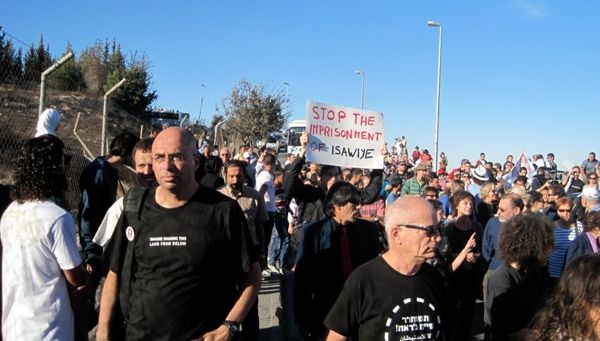
Half way down a hill, sandwiched between Jerusalem’s Hadassa hospital and Hebrew University, sits the compact and overcrowded occupied East Jerusalem village of Issawiya.

Before crossing the makeshift police checkpoint of concrete block obstacles at the edge of the University and entering the neighbourhood – which resembles more of a besieged West Bank refugee camp than a Jerusalem municipality – there is a clearly marked ‘Dead End’ street sign. On the main road leaving towards the hospital on the other side of the neighbourhood there is a wall of concrete cubes blocking any traffic, leaving just a narrow space for pedestrians to cross.

Although the Jewish dominated Hebrew University has expanded onto Issawiya’s land, the picture of Jerusalem from both places couldn’t be more different. While Israeli students attend classes oblivious to life beyond the ‘dead end’, Israeli security forces have orchestrated a campaign of regular night time arrest raids against Issawiya residents in an effort to halt growing popular resistance to segregation, home demolition and land confiscation.

The recent Israeli home demolitions, increasing the pressure on the already squeezed Palestinian community, have given rise to local youth organising ruckus street demonstrations, clashing with Israeli police and border guards at the neighbourhood checkpoints. Now the campaign has expanded and the youth of Issawiya have been joined by Israeli anti-occupation activists.

With Israel continuing to expand Jewish settlements in East Jerusalem, squeezing and displacing the Palestinian residents under the banner of an undivided Israeli capital (a claim rejected by most of the world), the Palestinian Authority has been powerless in defending the residents of their future capital. Meanwhile, despite murmurs of discontent from Washington and the international community, international diplomacy has proven just as ineffective in advocating for the rights of Jerusalem’s Palestinian residents.

Now, failed by national leadership and abandoned by an international community to the mercy of an Israeli government that is forcing them from sight in order to make way for Israeli control and settlement, Palestinian residents are taking it on themselves to defend their land, rights and presence. [Continue reading.]

Facebooktwittermail

Helen Thomas: thrown to the wolves

Danny Schechter writes:

In 1960, I was fixated on emulating the courageous media personalities of the times, from Edward R. Murrow to a distinctive figure I came to admire at presidential press conferences – a wire service reporter named Helen Thomas.

In recent years, my faith in the power of dialogue in politics has been severely tested – as, no doubt has hers – in an age where diatribes and deliberate demonization chills debate and exchanges of opposing views.

Once you are labeled and stereotyped – especially if you are denounced as an anti-Semite – you are relegated to the fringes, pronounced a hater beyond redemption, and even beyond explanation.

As the legendary Helen Thomas soon found out.

The rise of a legend

As a member in good standing of an activist generation, I saw myself more as an outsider in contrast to Helen’s distinctive credentials as an insider, as a White House bureau chief and later as the dean of the White House Correspondents’ Association.

Yet, beneath her establishment credentials and status, she was always an outsider too – one of nine children born to a family of Lebanese immigrants in Winchester Kentucky, who despite their Middle East origins were Christians in the Greek Orthodox Church.

She became a woman who broke the glass ceiling in the clubby, mostly male, inside-the-beltway world of big egos and self-important media prima donnas.

Her origins were more modest. She grew up in an ethnic neighborhood in Detroit.

Helen received her bachelor’s degree from Wayne State University in 1942, the year I was born. Earlier this year, her alma mater, of which she had taken so much pride in her achievements, canceled the award in her name.

A fall from grace

The withdrawal of her name from the prominent award was a striking gesture of cowardice and submission to an incident blown out of proportion that instantly turned Helen from a ‘she-ro’ to a zero.

The Simon Wiesenthal Center put her on their top ten list of anti-Semites after angry remarks she made about Israel went viral and exploded into a major story.

President Barack Obama who cheerfully brought her a birthday cake, later labeled her remarks as “reprehensible”.

You would think that given all the vicious ad hominems, Godwins and putdowns directed at him, he would be more cautious tossing slurs at others.

But no, all politicians pander to deflect criticism whenever the wind of enmity blows their way.

Now it was Helen who was being compared to Hitler in the latest furor. [Continue reading.]

Facebooktwittermail

My parents were executed under the unconstitutional Espionage Act — here’s why we must fight to protect Julian Assange

Robert Meeropol writes:

Rumors are swirling that the United States is preparing to indict Wikileaks leader Julian Assange for conspiring to violate the Espionage Act of 1917. The modern version of that act states among many, many other things that: “Whoever, for the purpose of obtaining information respecting the national defense with intent or reason to believe that the information is to be used to the injury of the United States” causes the disclosure or publication of this material, could be subject to massive criminal penalties. It also states that: “If two or more persons conspire to violate any of the foregoing provisions … each of the parties to such conspiracy shall be subject to the punishment provided for the offense which is the object of such conspiracy.” (18 U.S. Code, Chapter 37, Section 793.)

I view the Espionage Act of 1917 as a lifelong nemesis. My parents were charged, tried and ultimately executed after being indicted for Conspiracy to Commit Espionage under that act.

The 1917 Act has a notorious history. It originally served to squelch opposition to World War I. It criminalized criticism of the war effort, and sent hundreds of dissenters to jail just for voicing their opinions. It transformed dissent into treason.

Many who attacked the law noted that the framers of the Constitution had specifically limited what constituted treason by writing it into the Constituton: “Treason against the United States shall consist only in levying war against them, or in adhering to their enemies, giving them aid and comfort” (Article III, section 3). The framers felt this narrow definition was necessary to prevent treason from becoming what some called “the weapon of a political faction.” Furthermore, in their discussions at the Constitutional Convention they agreed that spoken opposition was protected by the First Amendment and could never be considered treason.

It appears obvious that the Espionage Act is unconstitutional because it does exactly what the Constitution prohibits. It is, in other words, an effort to make an end run around the Treason Clause of the Constitution. Not surprisingly, however, as we’ve seen in times of political stress, the Supreme Court upheld its validity in a 5-4 decision. Although later decisions seemed to criticize and limit its scope, the Espionage Act of 1917 has never been declared unconstitutional. To this day, with a few notable exceptions that include my parents’ case, it has been a dormant sword of Damocles, awaiting the right political moment and an authoritarian Supreme Court to spring to life and slash at dissenters.

Facebooktwittermail

US-trained militias ready to join forces with the Taliban

The Associated Press reported earlier this week:

Tribal militias allied with the government helped block a Taliban advance in this corner of northwest Pakistan close to the Afghan border, but their success has come at a price: the empowerment of untrained, unaccountable private armies that could yet emerge as a threat of their own.

Tensions are emerging between authorities and the dozens of militias that they helped to create predominantly in and near the northwest tribal regions. Operating from fortress-like compounds with anti-aircraft guns on the roofs, the militiamen have made it clear that the state now owes them for their sacrifices. They show photos on their cell phones of Taliban they killed and point to the scrubland outside, with graves of relatives who died in the fight.

The leader of the largest militia near the town of Matani, a wealthy landowner named Dilawar Khan, warns that he will stop cooperating with police unless he gets more money and weapons from authorities. Speaking to The Associated Press, he adds what could be a veiled threat to join the militants.

“Time and time again, the Taliban have contacted us, urging us to change sides,” he said.

The New York Times now reports:

Rival militant organizations on both sides of the Afghanistan-Pakistan border have increasingly been teaming up in deadly raids, in what military and intelligence officials say is the insurgents’ latest attempt to regain the initiative after months of withering attacks from American and allied forces.

New intelligence assessments from the region assert that insurgent factions now are setting aside their historic rivalries to behave like “a syndicate,” joining forces in ways not seen before. After one recent attack on a remote base in eastern Afghanistan, a check of the dead insurgents found evidence that the fighters were from three different factions, military officials said.

In the past, these insurgent groups have been seen as sharing ideology and inspiration, but less often plans for specific missions.

Now the intelligence assessments offer evidence of a worrisome new trend in which extremist commanders and their insurgent organizations are coordinating attacks and even combining their foot soldiers into patchwork patrols sent to carry out specific raids.

Facebooktwittermail

Former CIA chief: ‘I thank god every day for the continuity’ between Bush and Obama

On CNN on Sunday, former Bush officials lined up to praise President Obama:

Former Central Intelligence Agency Director Michael Hayden, a retired Air Force general, also argued that Obama’s approach has been, by and large, the same — regardless of campaign rhetoric.

“When one is in office, it’s, as the admiral has suggested, when one is in office, that responsibility weighs pretty heavily. And so we’ve seen a powerful consistency between two administrations trying to deal with this problem,” Hayden said. “Actually, I’ve seen it over two administrations, and I thank god every day for the continuity.”

“Regardless of which side of the political spectrum you come from or what your political views might be, these threats are very real and very serious. And we have to — have to deal with them in a very serious way,” [ former National Intelligence Director and retired Navy Vice Admiral Michael] McConnell added.

Facebooktwittermail

New York art shoppers protected from seeing the word ‘Gaza’

Does this say more about the sensitivities of the Gagosian Gallery’s wealthy patrons or its owner, Larry Gagosian, or do they each find the mention of Gaza (and by implication, reference to Israel’s inhumane treatment of Gaza’s residents) offensive?

At the New York Times, Robert Mackey reports:

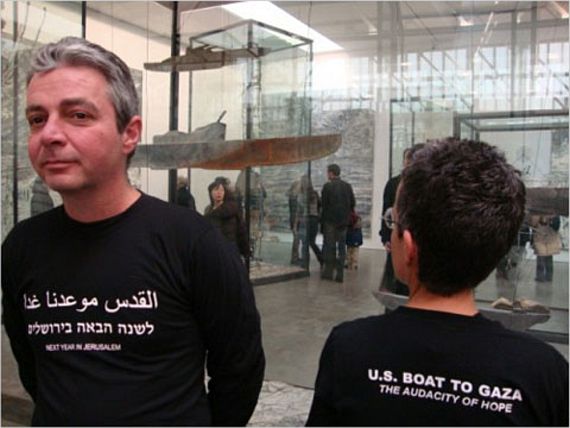
Four activists were forced to leave an art gallery in New York this month for wearing T-shirts promoting an effort to include an American boat in the next blockade-challenging Gaza flotilla.

The incident came on the final day of an exhibition at the Gagosian Gallery called “Next Year in Jerusalem,” featuring pieces by the German artist Anselm Kiefer on the subject of Nazi Germany and the Holocaust.

The T-shirts worn by the activists repeated the show’s title, which is borrowed from a Jewish prayer, in English, Hebrew and Arabic, on the front and said “U.S. Boat to Gaza” and “The Audacity of Hope” on the back. (As The Lede explained in a previous post, the American activists plan to call their boat the Audacity of Hope, echoing the title of a book by President Obama.)

As Claudia Roth Pierpont reported in an account of the incident on the New Yorker’s Web site last week, the gallery, on West 24th Street, called the police, and force was used to eject one bystander who asked the officers why the activists were being ordered to leave.

Facebooktwittermail

2011: A Brave New Dystopia

Chris Hedges writes:

The two greatest visions of a future dystopia were George Orwell’s “1984” and Aldous Huxley’s “Brave New World.” The debate, between those who watched our descent towards corporate totalitarianism, was who was right. Would we be, as Orwell wrote, dominated by a repressive surveillance and security state that used crude and violent forms of control? Or would we be, as Huxley envisioned, entranced by entertainment and spectacle, captivated by technology and seduced by profligate consumption to embrace our own oppression? It turns out Orwell and Huxley were both right. Huxley saw the first stage of our enslavement. Orwell saw the second.

We have been gradually disempowered by a corporate state that, as Huxley foresaw, seduced and manipulated us through sensual gratification, cheap mass-produced goods, boundless credit, political theater and amusement. While we were entertained, the regulations that once kept predatory corporate power in check were dismantled, the laws that once protected us were rewritten and we were impoverished. Now that credit is drying up, good jobs for the working class are gone forever and mass-produced goods are unaffordable, we find ourselves transported from “Brave New World” to “1984.” The state, crippled by massive deficits, endless war and corporate malfeasance, is sliding toward bankruptcy. It is time for Big Brother to take over from Huxley’s feelies, the orgy-porgy and the centrifugal bumble-puppy. We are moving from a society where we are skillfully manipulated by lies and illusions to one where we are overtly controlled.

Orwell warned of a world where books were banned. Huxley warned of a world where no one wanted to read books. Orwell warned of a state of permanent war and fear. Huxley warned of a culture diverted by mindless pleasure. Orwell warned of a state where every conversation and thought was monitored and dissent was brutally punished. Huxley warned of a state where a population, preoccupied by trivia and gossip, no longer cared about truth or information. Orwell saw us frightened into submission. Huxley saw us seduced into submission. But Huxley, we are discovering, was merely the prelude to Orwell. Huxley understood the process by which we would be complicit in our own enslavement. Orwell understood the enslavement. Now that the corporate coup is over, we stand naked and defenseless. We are beginning to understand, as Karl Marx knew, that unfettered and unregulated capitalism is a brutal and revolutionary force that exploits human beings and the natural world until exhaustion or collapse.

Facebooktwittermail

America’s leading liberal Zionists are losing faith in Israel

Earlier this month, Tom Friedman bemoaned the fact that Israel’s leadership has become “disconnected from reality”.

Then came the New Yorker‘s David Remnick warning Israelis about the way the American Jewish community is changing:

A new generation of Jews is growing up in the US. Their relationship with Israel is becoming less patient and more problematic. They see what has happened with the Rabbinical Letter [proscribing rental and sale of property to Arabs], for example. How long can you expect that they’ll love unconditionally the place called Israel? You’ve got a problem.

And now comes Israel’s most loyal American liberal defender, Jeffrey Goldberg.

Before Christmas, Goldberg was fretting that the possibility of a two-state solution is slipping out of reach:

I would like someone in the Netanyahu government to please explain the plan here. It would make things so much easier to understand if we just knew the plan. Is the plan to continue settling Judea and Samaria [the West Bank] so that there is no chance whatsoever of creating a Palestinian state? And if this is the plan, then what happens to those Palestinians who are being denied a state? Will they be absorbed into democratic Israel, thus bringing about an end to the idea that there should be a single small country on earth where Jews can be a majority? Or are they going to be denied democratic rights, in which case, well, Israel as we know it will cease to exist. Or is there some other plan? Or — maybe — there is no plan.

And now Goldberg is acknowledging his grimmest fear: that Israel can all too easily dispense with democracy.

As I wrote last week, there’s very little Israel’s right-wing government has done in the past year or so to suggest that it is willing to wean itself from its addiction to West Bank settlements, and the expansion of settlements bodes ill for the creation of a Palestinian state — and the absence of Palestinian statehood means that Israel will one day soon confront this crucial question concerning its democratic nature: Will it grant West Bank Arabs the right to vote, or will it deny them the vote? If it grants them the vote, this will be the end of Israel as a Jewish state; if it denies them the vote in perpetuity, it will cease to be a democratic state.

I will admit here that my assumption has usually been that Israelis, when they finally realize the choice before them (many have already, of course, but many more haven’t, it seems), will choose democracy, and somehow extract themselves from the management of the lives of West Bank Palestinians. But I’ve had a couple of conversations this week with people, in Jerusalem and out of Jerusalem, that suggest to me that democracy is something less than a religious value for wide swaths of Israeli Jewish society. I’m speaking here of four groups, each ascendant to varying degrees:The haredim, the ultra-Orthodox Jews, whose community continues to grow at a rapid clip; the working-class religious Sephardim — Jews from Arab countries, mainly — whose interests are represented in the Knesset by the obscurantist rabbis of the Shas Party; the settler movement, which still seems to get whatever it needs in order to grow; and the million or so recent immigrants from Russia, who support, in distressing numbers, the Putin-like Avigdor Lieberman, Israel’s foreign minister and leader of the “Israel is Our Home” party.

Let’s just say, as a hypothetical, that one day in the near future, Prime Minister Lieberman’s government (don’t laugh, it’s not funny) proposes a bill that echoes the recent call by some rabbis to discourage Jews from selling their homes to Arabs. Or let’s say that Lieberman’s government annexes swaths of the West Bank in order to take in Jewish settlements, but announces summarily that the Arabs in the annexed territory are in fact citizens of Jordan, and can vote there if they want to, but they won’t be voting in Israel. What happens then? Do the courts come to the rescue? I hope so. Do the Israeli people come to the rescue? I’m not entirely sure. There are many Israelis who value democracy, but they might not possess the strength to fight. Does American Jewry come to the rescue? Well, most of American Jewry would be so disgusted by Israel’s abandonment of democratic principles that I think the majority would simply write off Israel as a tragic, failed experiment.

Facebooktwittermail

Most Palestinian prisoners held by Israel are denied access to an attorney

Amira Hass reports:

As many as 90 percent of Palestinian prisoners being interrogated by the Shin Bet security service are prevented from consulting with an attorney, even though civilian and military legislation state clearly that such prohibition should be rarely applied, according to a report published by the Public Committee Against Torture in Israel and the Palestinian Prisoners’ Society.

The Shin Bet says it has legal clearance to keep certain detainees from lawyers.

According to Dr. Maya Rosenfeld, the author of the study, during prolonged periods when prisoners are kept from meeting with lawyers, the Shin Bet utilizes interrogation methods that run contrary to international law, Israeli laws and Israeli commitments to avoid such methods.

Among these interrogation methods are tying prisoners for a long time to a chair with their hands behind the back, sleep deprivation, threats (usually of harming family members ), humiliation and being kept for long periods in unsanitary cells.

Facebooktwittermail

Iranian general murdered in Israel’s Ayalon prison?

Richard Silverstein writes:

New and astonishing developments in the case of Prisoner X, known to a source within Ehud Barak’s inner circle as Ali Reza Asgari, retired Iran Revolutionary Guard general and former deputy defense minister.

I exposed the name of Prisoner X here a few weeks ago. Today, brings news from Israel that Asgari is dead in his cell. According to the standard version, he committed suicide in his cell within the past week or so. Ynet reported the suicide story and noted that it was under gag order. Of course, this story was erased from the internet, but I’m posting a copy of the article which was taken down from the Ynet site.

What is so interesting about this story is that you have to combine two different articles (the second from Haaretz) to gain more insight into what really happened here. The Haaretz article, which was not removed under gag order because it was written in a sufficiently vague form that it could slip under the gag order, noted that there are investigations of those who die while in secret detention (the case with Asgari). One of the considerations in such an inquiry is whether a “government agency” may have caused the death:

Did such an agency have an interest in silencing the detainee? And if so, was a death declared a “suicide,” really murder? In the case of the death of a prisoner under special treatment [held by the security services], why it was not within the power of the Prison Service to prevent the suicide or some other form of violent death. [Emphasis added]

I should also confirm at this point that my original source for this story reaffirms specifically that it is Asgari, and not some other secret security prisoner who died. My source, I should add, only confirms the “official” government version that he committed suicide and not that he was murdered.

Assuming that the prisoner was indeed Asgari, I wouldn’t be quick to dismiss the claim that he committed suicide. Prolonged isolation, most likely accompanied by intermittent torture, with no prospect of release or a trial, would easily sap anyone’s will to live.

Meanwhile, a new report reveals the barbaric conditions in which Israel keeps prisoners in isolation — conditions one would expect to find used by a brutal authoritarian regime in a third world country.

A classified report by the Israel Bar Association obtained by Haaretz provides a glimpse into the harrowing conditions prisoners separated from the main jail population must endure.

According to the document, which is the first external review of the Prison Service, the isolation wings at the Ayalon and Shikma prisons are not fit for human habitation and “look more like a dungeon,” while most solitary cells in prisons across the country are “crammed, rancid with smells of sewer and mold, and infested with insects.”

“It’s difficult to ignore the feeling that isolation as practiced today serves a function of punishment rather than imprisonment,” wrote the authors of the report, Michael Atia – chairman of the prison service committee at the Israel Bar Association, and Moran Kabalo – chief of criminal law for the IBA.

Facebooktwittermail

A provocative blueprint for peace in the Mideast

Ilan Pappé writes:

The one-state solution has a troubled history. It began as a soft Zionist concept of Jewish settlers, some of whom were leading intellectuals in their community, who wished to reconcile colonialism and humanism. They were looking for a way that would not require the settlers either to return to their homelands or to give up the idea of a new Jewish life in the “redeemed” ancient homeland. They were also moved by more practical considerations, such as the relatively small number of Jewish settlers within a solid Palestinian majority. They offered binationalism within one modern state. They found some Palestinian partners when the settlers arrived in the 1920s but were soon manipulated by the Zionist leadership to serve that movement’s strategy and then disappeared into the margins of history.

In the 1930s, notable members among them, such as Yehuda Magnes, were appointed as emissaries by the Zionist leadership for talks with the Arab Higher Committee. Magnes and his colleagues genuinely believed, then and in retrospect, that they served as harbingers of peace, but in fact they were sent to gauge the impulses and aspirations on the other side, so as to defeat it in due course. They existed in one form or another until the end of the Mandate. Their only potential ally, the Palestine Communist Party, for a while endorsed their idea of binationalism, but in the crucial final years of the Mandate, adopted the principle of partition as the only solution (admittedly due to orders from Moscow rather than out of a natural growth of its ideology). So by 1947, there was no significant support for the idea on either the Zionist or Palestinian side. Moreover, it seems that there was no genuine desire locally or regionally to look for a local solution and it was left to the international community to propose one.

The appearance in 1947 of the one-state solution as an international option is a chapter of history very few know about or bother to revisit. It is worth remembering that at one given point during the discussions and deliberations of UNSCOP (the United Nations Special Committee on Palestine, February to November 1947), those members of the UN who were not under the influence of either the United States or the USSR—and they were not many—regarded the idea of one state in Palestine as the best solution for the conflict. They defined it as a democratic unitary state, where citizenship would be equal and not determined on the basis of ethnicity or nationality. The indigenous population was defined as those who were in Palestine at that time, nearly two million people who were mostly Palestinians. When their idea was put in a minority report of UNSCOP (the majority report was the basis for the famous [or infamous] Resolution 181 of November 29, 1947), half of the then members of the UN General Assembly supported it, before succumbing to pressure by the superpowers to vote in favor of the partition resolution. It is not surprising in hindsight that people around the world, who did not feel, like the Western powers did, that the creation of a Jewish state at the expense of the Palestinians was the best compensation for the horrors of the Holocaust, would support the unitary state. After all the Jewish community in Palestine was made of newcomers and settlers, and were only one-third of the overall population. But common decency and sense were not allowed to play a role where Palestine was concerned.

Facebooktwittermail

Kissinger’s entire career was a series of massacres and outrages

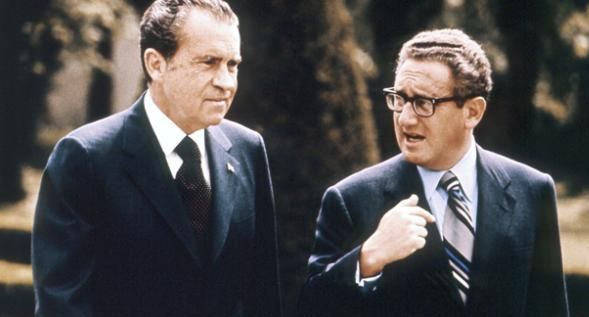
In 1973, moments after the Israeli prime minister, Golda Meir asked President Nixon to press the Soviet Union to permit Jews to emigrate and escape persecution there, Nixon’s national security adviser, Henry Kissinger, addressed the question.

“The emigration of Jews from the Soviet Union is not an objective of American foreign policy,” Kissinger said emphatically. “And if they put Jews into gas chambers in the Soviet Union, it is not an American concern. Maybe a humanitarian concern.”

From the audio tape, it is clear that Nixon was concerned about pressure he would face from the American Jewish community on this issue.

Since the tapes were made public earlier this month, prominent members of the Jewish community have been lining up to speak in Kissinger’s defense — an effort, they say, which is intended to put Kissinger’s callousness in context.

“The Nixon Tapes should not change history’s verdict on the important contributions and ultimate legacy of Henry Kissinger,” said the Anti-Defamation League’s Abraham Foxman.

Christopher Hitchens, having in recent years been distracted by 9/11, returns to the subject of Kissinger, and asks, “what if we did, indeed, accept the invitation to ‘remember the context of his entire life’?”

Here’s what we would find: the secret and illegal bombing of Indochina, explicitly timed and prolonged to suit the career prospects of Nixon and Kissinger. The pair’s open support for the Pakistani army’s 1971 genocide in Bangladesh, of the architect of which, Gen. Yahya Khan, Kissinger was able to say: “Yahya hasn’t had so much fun since the last Hindu massacre.” Kissinger’s long and warm personal relationship with the managers of other human abattoirs in Chile and Argentina, as well as his role in bringing them to power by the covert use of violence. The support and permission for the mass murder in East Timor, again personally guaranteed by Kissinger to his Indonesian clients. His public endorsement of the Chinese Communist Party’s sanguinary decision to clear Tiananmen Square in 1989. His advice to President Gerald Ford to refuse Alexander Solzhenitsyn an invitation to the White House (another favor, as with spitting on Soviet Jewry, to his friend Leonid Brezhnev). His decision to allow Saddam Hussein to slaughter the Kurds after promising them American support. His backing for a fascist coup in Cyprus in 1974 and then his defense of the brutal Turkish invasion of the island. His advice to the Israelis, at the beginning of the first intifada, to throw the press out of the West Bank and go for all-out repression. His view that ethnic cleansing in former Yugoslavia was something about which nothing could be done. Forget the criminal aspect here (or forget it if you can). All those policies were also political and diplomatic disasters.

We possess a remarkably complete record of all this, in and out of office, most of it based solidly on U.S. government documents. (The gloating over Bangladesh comes from July 19, 1971.) And it’s horribly interesting to note how often the cables and minutes show him displaying a definite relish for the business of murder and dictatorship, a heavy and nasty jokiness (foreign policy is not “a missionary activity”) that was by no means always directed, bad as that would have been, at gratifying his diseased and disordered boss. Every time American career diplomats in the field became sickened at the policy, which was not seldom, Kissinger was there to shower them with contempt or to have them silenced. The gas-chamber counselor is consistent with every other version of him that we have.

When in 2001 Hitchens took on the noble if perhaps quixotic endeavor of attempting to have Kissinger put on trial for war crimes and crimes against humanity, who could have anticipated that the polemicist would soon become so severely blown off course, or that almost a decade later the octogenarian would probably outlive his most furious and much younger critic.

The Trials of Henry Kissinger (2002)

Facebooktwittermail

Israel jails peaceful protester for riding a bike

Joseph Dana writes:

Of all the criminals involved with the 2008 Gaza war, an Israeli leftist will be going to jail for riding his bike against the war in Tel Aviv. Tel Aviv Magistrates court judge Yitzhak Yitzhak convicted Israeli leftist Jonathan Pollak of illegal assembly for his participation in a January 2008 Critical Mass ride against the siege on Gaza and then sentenced him to three months imprisonment that will begin on January 11th, 2011. Pollak was the only one detained at the said protest, and was accused of doing nothing other than riding his bicycle in the same manner as the rest of the protesters. The conviction activates an older three-month suspended sentence imposed on Pollak in a previous trial for protesting the construction of the Separation Barrier. An additional three month prison term was also imposed for the current conviction, which will be served concurrently. His imprisonment is part of a clear strategy of silencing dissent in the Israeli left.

Jonathan Pollak is one of the founders of the Israeli leftist group “Anarchists Against the Wall“, which join weekly unarmed Palestinian protests throughout the West Bank against the Separation Wall and the Occupation. Since 2008, he has served the media coordinator of the Popular Struggle Coordination Committee, an Palestinian umbrella organization designed to garner media attention for the unarmed struggle in the West Bank.

Pollak gave the following statement in court today:

Your Honor, once found guilty, it is then customary for the accused to ask the court for leniency, and express remorse for having committed the offence. However, I find myself unable to do so. From its very beginning, this trial contained practically no disagreements over the facts. As the indictment states, I indeed rode my bicycle, alongside others, through the streets of Tel Aviv, to protest the siege on Gaza. And indeed, while riding our bicycles, which are legally vehicles belonging on the road, we may have slightly slowed down traffic. The sole and trivial disagreement in this entire case revolves around testimonies heard from police detectives, who claimed I played a leading role throughout the protest bicycle ride, something I, as well as the rest of the Defense witnesses, deny.

As said earlier, it is customary at this point of the proceedings to sound remorseful, and I would indeed like to voice my regrets regarding one particular aspect of that day’s events: if there is remorse in my heart, it is that, just as I argued during the trial, I did not play a prominent role in the protest that day, and thus did not fulfill my duty to do everything within my power to change the unbearable situation of Gaza’s inhabitants, and bring to an end Israel’s control over the Palestinians.

His Honor has stated during the court case, and will most likely state again in the future, that a trial is not a matter of politics, but of law. To this I reply that there is hardly anything to this trial except political disagreement. This Court may have impeded the mounting of an appropriate defense when it refused to hear arguments regarding political selectiveness in the Police’s conduct, but even from the testimonies which were admitted, it became clear such a selectiveness exists.

The subject of my alleged offense, as well as the motivation behind it were political. This is something that cannot be sidestepped. The State of Israel maintains an illegitimate, inhuman and illegal siege on the Gaza Strip, which still is occupied territory according to international law. This siege, carried out in my name and in yours as well, sir, in fact in all of our names, is a cruel collective punishment inflicted on ordinary citizens, residents of the Gaza strip, subjects-without-rights under Israeli occupation.

In the face of this reality, and as a stance against it, we chose on January 31st, 2008, to exercise the freedom of speech afforded to Jewish citizens of Israel. However, it appears that here in our one-of-many-faux-democracies in the Middle East, even this freedom is no longer freely granted, even to society’s privileged sons.

I am not surprised by the Court’s decision to convict me despite having no doubt in my mind that our actions on that day correspond to the most basic, elementary definitions of a person’s right to protest.

Indeed, as the Prosecution pointed out, a suspended prison sentence hung over my head at the time of the bicycle protest, having been convicted before under an identical article of law. And, although I still maintain I did not commit any offense whatsoever, I was aware of the possibility that under Israeli justice, my suspended sentence would be imposed.

I must add that, if His Honor decides to go ahead and impose my suspended prison sentence, I will go to prison wholeheartedly and with my head held high. It will be the justice system itself, I believe, that ought to lower its eyes in the face of the suffering inflicted on Gaza’s inhabitants, just like it lowers its eyes and averts its vision each and every day when faced with the realities of the occupation.

In a profile for The Independent, Donald Macintyre wrote:

[Pollak] attended the first of very many demonstrations as a months-old babe-in-arms at the huge mass rally in Tel Aviv calling for an end to the first Lebanon war in 1982. What makes him and his Israeli comrades unusual, however, is the decision to go beyond mere demonstrations to, as he himself puts it, “crossing sides, moving from protest to joining resistance”.

A high school dropout at 15, he was a teenage animal right activist, a cause with few Israeli adherents – and most of those Israelis who were part of it were anarchists. Very much part of Tel Aviv’s young counterculture in the politically relatively relaxed Nineties, Mr Pollak became one too. He remains an anarchist and a vegan, still a strong believer in animal rights, which he sees as consistent with his wider politics. For him, “racism, chauvinism, sexism, speciesism all come from the same place of belittling the other”, he said.

A few minor brushes with the law appear to have been enough to convince the army that he was not suitable material for compulsory military service. “I don’t think they wanted me any more than I wanted them,” he said. He spent two years in the Netherlands, living in a squat, before being deported back to Israel.

By this time, the second intifada was at its peak, and Mr Pollak found himself drawn, despite the dangers for a young Israeli of visiting the West Bank at the time, to the unarmed dimension of the Palestinian cause – including, most significantly, the very first anti-barrier protests in the West Bank village of Jayyous.

According to [Ayed] Morrar [the director of Budrus], a long-term opponent of armed uprising, “Jonathan… is a man trying to prove that those who believe in occupation cannot claim to be humanitarian or civilised. He also wants to prove that resisting oppression and occupation does not mean being a terrorist or killing”.

Facebooktwittermail

Israel’s central role in ‘the new Cold War’

Even if Britain has yet to enact promised changes to the law in order to protect Israeli war criminals from facing the risk of arrest while visiting the UK, it would appear that some form of understanding is already in place so that Tamir Pardo, the new head of Mossad, will be able to visit in January.

An outline of some of the key issues on Pardo’s agenda when he meets Britain’s intelligence chiefs reveals the depth of Mossad’s operations across the Middle East. It also reveals that Israel sees itself having a pivotal role in what Pardo is branding “the new Cold War” between Russia and the West.

The Daily Telegraph reports:

[Pardo] is expected to brief officials on Mossad’s plans to provide Britain and Nato with increased intelligence over Iran’s nuclear weapons programme. Mossad has a network of undercover agents in the country.

He also intends to increase Mossad’s role in Yemen and to spearhead the hunt for al-Qaeda’s new chief of military operations, Saif al-Adel, who Mossad believe is based in Somalia.

At the same time he wants to expand Mossad’s watch over the SVR, Russia’s foreign intelligence service, which is an increasing presence in Syria and Turkey – and is using both countries as launch pads from which to enter Europe. In his first briefing to senior staff after he took up his new post, Mr Pardo said Mossad had a key role to play in helping the West win what he called “the new Cold War”.

With Mossad conducting operations in Iran, Yemen and Somalia, Israel sees itself as an indispensable partner with the United States in the enduring global conflict through which each nation now defines its identity and upon which each has become economically dependent. No two nations on the planet are more threatened by the possibility of peace.

Facebooktwittermail

An open letter from Gaza: two years after the massacre, a demand for justice

An open letter published by The Palestine Telegraph:

We the Palestinians of the Besieged Gaza Strip, on this day, two years on from Israel’s genocidal attack on our families, our houses, our roads, our factories and our schools, are saying enough inaction, enough discussion, enough waiting – the time is now to hold Israel to account for its ongoing crimes against us. On the 27th of December 2008, Israel began an indiscriminate bombardment of the Gaza Strip.

The assault lasted 22 days, killing 1,417 Palestinians, 352 of them children, according to main-stream Human Rights Organizations. For a staggering 528 hours, Israeli Occupation Forces let loose their US-supplied F15s, F16s, Merkava Tanks, internationally prohibited White Phosphorous, and bombed and invaded the small Palestinian coastal enclave that is home to 1.5 million, of whom 800,000 are children and over 80 percent UN registered refugees. Around 5,300 remain permanently wounded.

This devastation exceeded in savagery all previous massacres suffered in Gaza, such as the 21children killed in Jabalia in March 2008 or the 19 civilians killed sheltering in their house in the Beit Hanoun Massacre of 2006. The carnage even exceeded the attacks in November 1956 in which Israeli troops indiscriminately rounded up and killed 275 Palestinians in the Southern town of Khan Younis and 111 more in Rafah.

Since the Gaza massacre of 2009, world citizens have undertaken the responsibility to pressure Israel to comply with international law, through a proven strategy of boycott, divestment and sanctions. As in the global BDS movement that was so effective in ending the apartheid South African regime, we urge people of conscience to join the BDS call made by over 170 Palestinian organizations in 2005. As in South Africa the imbalance of power and representation in this struggle can be counterbalanced by a powerful international solidarity movement with BDS at the forefront, holding Israeli policy makers to account, something the international governing community has repeatedly failed to do. Similarly, creative civilian efforts such as the Free Gaza boats that broke the siege five times, the Gaza Freedom March, the Gaza Freedom Flotilla, and the many land convoys must never stop their siege-breaking, highlighting the inhumanity of keeping 1.5 million Gazans in an open-air prison.

Facebooktwittermail

The corrupt system that turns American generals into war profiteers

When corruption has become systemic, it no longer gets called corruption.

When America’s decorated military elite believe that retirement means that it is now their turn to line their pockets by profiting from the United States’ profligate arms spending, we are witnessing what the Boston Globe refers to with the blandest of euphemisms: a routine fact of life.

When a country is in dire economic condition, it’s government running a massive deficit and yet it still expands its military spending, we are witnessing the effect of the “disastrous rise of misplaced power” possessed by the military-industrial complex — a danger about which Dwight D. Eisenhower cautioned America, yet his warning went unheeded.

An hour after the official ceremony marking the end of his 35-year career in the Air Force, General Gregory “Speedy’’ Martin returned to his quarters to swap his dress uniform for golf attire. He was ready for his first tee time as a retired four-star general.

But almost as soon as he closed the door that day in 2005 his phone rang. It was an executive at Northrop Grumman, asking if he was interested in working for the manufacturer of the B-2 stealth bomber as a paid consultant. A few weeks later, Martin received another call. This time it was the Pentagon, asking him to join a top-secret Air Force panel studying the future of stealth aircraft technology.

Martin was understandably in demand, having been the general in charge of all Air Force weapons programs, including the B-2, for the previous four years.

He said yes to both offers.

In almost any other realm it would seem a clear conflict of interest — pitting his duty to the US military against the interests of his employer — not to mention a revolving-door sprint from uniformed responsibilities to private paid advocacy.

But this is the Pentagon where, a Globe review has found, such apparent conflicts are a routine fact of life at the lucrative nexus between the defense procurement system, which spends hundreds of billions of dollars a year, and the industry that feasts on those riches. And almost nothing is ever done about it.

The Globe analyzed the career paths of 750 of the highest ranking generals and admirals who retired during the last two decades and found that, for most, moving into what many in Washington call the “rent-a-general’’ business is all but irresistible.

From 2004 through 2008, 80 percent of retiring three- and four-star officers went to work as consultants or defense executives, according to the Globe analysis. That compares with less than 50 percent who followed that path a decade earlier, from 1994 to 1998.

In some years, the move from general staff to industry is a virtual clean sweep. Thirty-four out of 39 three- and four-star generals and admirals who retired in 2007 are now working in defense roles — nearly 90 percent.

And in many cases there is nothing subtle about what the generals have to sell — Martin’s firm is called The Four Star Group, for example. The revolving-door culture of Capitol Hill — where former lawmakers and staffers commonly market their insider knowledge to lobbying firms — is now pervasive at the senior rungs of the military leadership. [Continue reading.]

Facebooktwittermail