Category Archives: Iran

Lula’s new world order

In a world long dominated by Western powers, the global order has been one shaped by coercion. Although the twentieth century saw the end of formal colonialism — the most overt coercive system — the perpetuation of economic colonialism has meant that the United States and its allies still expect to have the final word on most issues of global importance.

It seems natural then as a new global order emerges, Western domination will not get replaced by another form of domination — the Western coercive paradigm itself will be rejected. This indeed, is the new approach to diplomacy that is being pioneered by Brazil and Turkey.

If Barack Obama really embodied a new way of thinking, we’d have reason to hope that he’d be nimble enough to adapt to the momentous period of change that is now unfolding, yet so far all the indications are that whatever his personal abilities might be, he remains firmly tethered to an arthritic diplomatic and political establishment.

The nuclear swap deal just struck by Brazil, Turkey and Iran could be grasped as an unexpected but welcome opportunity. Instead, Washington’s guarded response barely conceals the fact that it sees it own power as being usurped.

In the Financial Times, Jonathan Wheatley notes that the deal may vindicate Brazilian diplomacy and prove the skeptics wrong.

The idea that Iran would abandon its alleged nuclear weapons programme in favour of a peaceful nuclear energy programme in response to amicable talks rather than under the threat of UN-backed sanctions seemed unrealistic, even naïve. But it may well have paid off. Even a US official conceded today that the latest news was “potentially a good development.”

If so, Celso Amorim, Brazil’s foreign minister, can be forgiven some self-satisfaction. “We are holding conversations in a respectful manner and with conviction . . . Our language is not that of pressure. Our language is that of persuasion, friendship and cooperation,” he told reporters in Tehran on Monday.

Al Jazeera notes:

The recent visit by Luiz Inacio Lula da Silva, Brazil’s president, to Iran is part of a broad multilateral foreign policy that he believes is commensurate with his nation’s ever-growing importance in a changing world axis.

Brazil under Lula’s eight year reign has promoted trade between Israel and Latin America, while supporting talks with Hamas and Palestinian statehood. It has balked at US urges for sanctions on Iran over their nuclear programme, which Washington believes has nefarious intentions, while on Sunday it brokered an agreement in which Tehran exchanges low-enriched uranium for nuclear fuel.

Diplomatic ties have been created with more than 40 nations, including North Korea, and Brasilia maintains good relations across divides, for instance with foes Venezuela and Colombia.

Like India, Brazil is advocating for a permanent seat at the UN Security Council and wants reform of the International Monetary Fund (IMF) to better represent developing nations.

For as Lula said in an interview with Al Jazeera this week, international geopolitics is shifting and global governance needs to change with it.

The impact of the agreement on Israel — where coercion is generally regarded as the only effective tool of persuasion — was summed up by Yossi Melman:

The agreement on the transfer of Iran’s enriched uranium, achieved via Turkish-Brazilian mediation, is an important victory for Iranian diplomacy and a debacle for Israeli policy. The deal reduces the chances, which were slim to begin with, of new sanctions being imposed on Iran, and makes a military strike against Iran even less feasible.

Zvi Bar’el notes:

Turkey is the deal’s big winner. Trade between Iran and Turkey already stands at $10 billion annually, so if sanctions were imposed on Tehran, Turkey would suffer a massive blow to its economy – and Prime Minister Recep Tayyip Erdogan’s party would suffer a major political setback. Alternatively, should Turkey decide not to uphold the sanctions, it might find itself in a crisis with the United States and Europe. Hence the tremendous effort Turkey made to achieve the deal, despite American warnings that Iran might be using Turkey in order to buy time.

Why did Iran choose to see Turkey as an “honest broker” and make the deal with it instead of with the permanent Security Council members? The two countries’ good relations are not free of suspicion, but both Iran and Turkey have adopted a policy of expanding their influence in the Middle East, influence of the sort that relies on cooperation rather than competition.

The closer ties between Turkey and Syria, Iran’s ally; the similar attitude that Turkey and Iran have toward Hamas; their shared interests in Iraq; and a similar view of radical Islamic terrorism all combined with Turkey’s disappointment over European views of its candidacy to join the European Union to create a confluence of interests that, for the time being, trumps their disagreements. Moreover, from an ideological standpoint, Iran prefers Turkey to the U.S.: Any concession to Washington or its Security Council partners would be perceived as a surrender.

The Wall Street Journal adds:

China welcomed Iran’s new nuclear fuel-swap agreement, saying the deal supports Beijing’s long-held position that the international dispute over Iran’s nuclear ambitions can be resolved through diplomacy rather than sanctions or force.

“We hope this will help promote a peaceful settlement of the Iranian nuclear issue through dialogue and negotiation,” foreign ministry spokesman Ma Zhaoxu said Tuesday at a regular press briefing. “We believe dialogue and negotiation is the best approach to settle the Iranian nuclear issue.”

Under the deal arranged by Brazil and Turkey, Iran will ship out some of its uranium to Turkey, have it enriched and then shipped back to Iran for use in a medical research reactor. Western powers want to keep Iran from enriching uranium on its own soil, because it fears that fuel will end up being used for nuclear weapons, which Tehran denies. The latest deal is a weakened version of one that was negotiated last October but fell through after Iran’s government didn’t approve it.

For China, a deal brokered by Brazil and Turkey is in line with its broader vision of a more multipolar world order not dominated by Washington.

Julian Borger thinks that Iran might have overplayed its hand.

The initial western response to the new Turkish-Brazilian-Iranian uranium swap deal was akin to a chess player realising loss is inevitable. There was an awkward silence and quietly spreading panic as western capitals looked a few moves ahead and could not think of a way of escaping the trap they had fallen into. The deal would have to be accepted, even though it did little to slow down Iran’s nuclear drive, and the push for sanctions in New York would deflate.

And then, the Iranian foreign ministry decided to speak. The spokesman, Ramin Mehmanparast, declared: “Of course, enrichment of uranium to 20% will continue inside Iran.”

The announcement was stunning. Iran’s justification for beginning 20% enrichment in February, was that it needed the material to make medical isotopes for the Tehran research reactor, although it was unclear how the Iranians were going to fabricate the necessary rods. Under this new deal, the rods will be provided free of charge. What then would be the civilian use of Iran’s home-enriched uranium?

For those already convinced Iran is working its way to breakout nuclear weapons capacity, the point of enriching to 20% is clear. In engineering terms it is a lot more than half way to 90% weapons-grade material, and an important test of the reliability of Iran’s centrifuges in reaching that goal.

Within minutes, the western capitals, tongue-tied over their response for the first few hours, began to rally.

But if Washington hoped that there might at least be unity in the expression of Western reservations about the deal, that hope was swiftly undermined as the French President Nicholas Sarkozy said he sees this development as a “positive step.”


Facebooktwittermail

Lula and Erdogan demonstrate their diplomatic clout

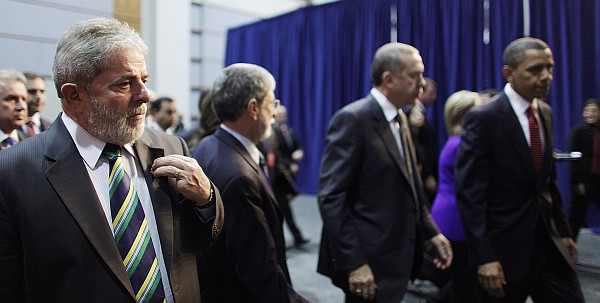
If President Obama had accomplished what Brazil and Turkey are about to pull off — a deal through which Iran will exchange its stockpile of enriched uranium in return for fuel rods for a medical research reactor — then the US media would be hailing this as a diplomatic breakthrough. Instead, this is being described as a possible obstacle to sanctions. The New York Times reports:

Brazilian and Turkish government officials said Sunday that their leaders had brokered a tentative compromise with Iran in the international standoff over Iran’s nuclear program, a development that could undermine efforts in the United Nations to impose new sanctions on the Iranians.

A spokesman for the Turkish Foreign Ministry said that after 17 hours of talks in Tehran, ministers from Brazil, Iran and Turkey had reached an agreement on the “principles” to revive a stalled nuclear fuel-swap deal backed by the United Nations.

The spokesman, speaking on condition of anonymity, said the deal would be presented to the leaders of the countries for “final touches,” with a statement on the agreement expected as early as Monday. The exact terms, notably the amount of nuclear fuel to be swapped, were not revealed.

The Turkish prime minister, Recep Tayyip Erdogan, canceled an official visit to Azerbaijan late Sunday and instead joined officials in Tehran in what was seen as a sign of progress in the talks.

Laura Rozen adds:

[A] Washington Iran expert said the fact that the alleged nuclear deal was connected to Lula’s meeting with the Iranian Supreme Leader, as opposed to with the Iranian president, may be significant.

That signals that Khamenei “is endorsing the deal,” the National Iranian American Council’s Trita Parsi said, adding it may reduce the bouts of Iranian domestic political infighting that have plagued earlier rounds of negotiations that failed to hold up. “That means this is no longer Ahmadinejad’s nuclear deal, this is Khamenei’s nuclear deal.”

The Financial Times said:

Iran’s supreme leader on Sunday praised Luiz Inácio Lula da Silva for defying US calls to close ranks against the Islamic regime as the Brazilian leader arrived in Tehran seeking to mediate in the crisis over Iran’s nuclear ambitions.

“Brazil in recent years [under Mr Lula] has differed from previous years,” Ayatollah Ali Khamenei told his visitor. He called on “independent” countries to assert their roles in global affairsnd help to change the UN so it does not favour powerful states.

Facebooktwittermail

Preparations for a military strike on Iran

Ten days ago, the New York Times published a story about a memo on Iran from Defense Secretary Robert Gates to National Security Adviser Gen James Jones.

David E Sanger and Thom Shanker reported on the contents of this memo, yet neither of them possesses a copy of the memo, nor have they read it, nor did they even report directly on its contents. In fact, it was not until after their story appeared that they received official confirmation of the memo’s existence.

In an interview on National Public Radio, when asked what the memo said, Sanger neglected to mention that he had never set eyes on the document. Were he to have made that clear, he could not have presumed to say anything about what the memo said — merely what he had been told about what it said. To position his source as the gatekeeper and shaper of the report would make it rather obvious that Sanger was a willing tool of a senior administration official, but no self-respecting journalist wants to be seen prostituting his services.

Sanger’s NPR interviewer, Warren Olney, also appeared willing to collude in this charade by skirting around the fact that the reporter had not set eyes on the memo, but nevertheless Olney pressed Sanger on the issue of his source’s agenda:

Olney: Can you say anything at all about the motivations of the people that revealed this memo to you?

Sanger: Um, no, the only thing I would say is that I would caution people against — I would do this in many kinds of story — the assumption that somebody just dropped off word of this memo in front of us.

A classified memo in an unmarked manila envelope could be dropped off, but how exactly would word of such a memo be “dropped off”?

Sanger wants to dispel an image of his being a passive recipient of information he is being fed, yet given that he has no means to independently interpret the contents of the memo and contrast that interpretation with the one being provided by his primary source, what he recounts is merely his source’s angle.

As I wrote when the article came out, the identity of Sanger’s source may be more significant than the existence of the memo. If it turns out that it was Dennis Ross, then the New York Times may yet again be serving a role in preparations for military action.

Flynt Leverett and Hillary Mann Leverett write:

We do not know who leaked the Gates memo. But the “senior officials” who did so were clearly seeking to use their selective description to catalyze more robust planning for potential military strikes against Iranian nuclear targets — the very option that Gates has consistently opposed.

This explains Gates’s public claim that his memo had been “mischaracterized” by the leaker. It also explains [Defense Undersecretary Michele] Fluornoy’s later statement that an attack against Iran is “off the table in the near term.” (Though, after White House intervention, Gates’s spokesman walked back Flournoy’s comment.)

The reality is that a cadre of senior National Security Council officials — including Deputy National Security Adviser Tom Donilon and Dennis Ross, senior director for the central region (including Iran) — is resisting the adoption of containment as the administration’s Iran strategy.

For some, containment is problematic because it would be interpreted in Israel and pro-Israeli circles here as giving up on preventing Iran from becoming a nuclear threshold state. Republicans could use this to label Obama as weak on national security.

Others in this camp may actually believe that Washington should be preparing for military action against Iran.

As Ross told us before he returned to government service in the Obama administration, President George W. Bush’s successor would probably need to order military strikes against Iranian nuclear targets.

Pursuing diplomatic initiatives early in Obama’s tenure, Ross said, would be necessary to justify potential military action to domestic and international constituencies.

That is precisely what the administration has done — first, by pursuing halfhearted diplomatic initiatives toward Tehran, then, when Iran did not embrace them, blaming Iran for the impasse.

Adopting containment as the administration’s posture toward Iran might undermine some White House officials’ efforts to prepare the political ground for an eventual presidential decision approving military strikes.

We have also heard former Bush administration officials close to Vice President Dick Cheney take note of the recent rise in U.S. public support for military action against Iran, as measured by some opinion polls.

Against that backdrop, these Republicans say, Obama — “a Chicago pol”— could ultimately see his way clear to ordering military strikes.

Facebooktwittermail

Israel’s indispensable enemies

The brutality with which the Iranian authorities have suppressed political dissent since last June’s disputed presidential election has been widely reported. The Washington Post now reveals that the political turmoil has had another effect: it has resulted in a new supply of intelligence as disaffected officials leak information about Iran’s nuclear program.

As a result, a National Intelligence Estimate being prepared for President Obama which was due out last fall is not expected to be completed until August.

The revisions to the NIE underscore the pressure on the U.S. intelligence community to produce an accurate assessment of Iran’s nuclear ambitions as President Obama pursues a policy aimed at preventing the country from acquiring an atomic bomb. The community’s 2007 assessment presented the startling conclusion that Iran had halted its work on developing a nuclear warhead, provoking enduring criticism that the report had underestimated the Iranian threat.

Officials briefed on the new version, which is technically being called a “memo to holders” of the first, say it will take a harder tone. One official who has seen a draft said that the study asserts that Iran is making steady progress toward nuclear weapons capability but that it stops short of concluding that the Islamic republic’s top leaders have decided to build and test a nuclear device.

There is little question that Iran sees strategic value in making its nuclear intentions hard to decipher, but let’s for the sake of argument assume that its goal is to put itself in the same position as Japan: not to assemble a nuclear arsenal but to have the means to do so at short notice. Could such a capability pose an existential threat to Israel (or anyone else)?

Israeli leaders have already made it clear that they draw no distinction between a nuclear armed Iran and an Iran that has nuclear weapons capability, yet this may say less about the nature of an Iranian threat than it does about the nature of Zionism. Deprive Israel of its existential threats, and the necessity for a Jewish state becomes less imperative. Take away the fear of annihilation and Jewish identity will lose one of its most unifying attributes.

Israel might fear its enemies, yet can it survive without them?

Facebooktwittermail

Obama administration looks beyond sanctions against Iran

David Ignatius sketches some of the details in the the sanctions regime being crafted by Stuart Levey, undersecretary of the Treasury for terrorism and financial intelligence, but he concedes that sanctions have rarely been effective instruments for changing policy.

For policymakers, the discussion is beginning to shift to the sensitive area suggested by Gates’s memo — the space between sanctions and outright military action. What options would the United States and its allies have, short of war, to raise the cost to Iran of pursuing a nuclear weapons program? Are there means of subverting, sabotaging or containing such a program without actually bombing Iranian facilities?

We won’t be hearing a lot of public discussion about this gray area. But that’s where senior officials will focus more of their energy in coming months, as they prepare for the possibility that Levey’s clever trap won’t work.

Is a “gray area” for the Obama administration the equivalent of the “dark side” Dick Cheney made infamous? Are we talking about kidnappings and assassinations? Having demonstrated his willingness to authorize extra-judicial detention and extra-judicial killing, is Obama getting ready to employ full-fledged state-sponsored terrorism?

Facebooktwittermail

Sanctions-busting is in Dubai’s DNA

In The Guardian, Raymond Barrett writes:

Dubai – separated from Iran by the waters of the Gulf – has excelled as a channel for circumventing the variety of international sanctions that have built up over the decades. Be it restrictions on badly needed aviation spare parts, “dual use” electronics or blackballed financial institutions, Dubai is one of several major ventricles through which contraband and money flow in and out of Iran.

Yet Dubai has always preferred the term “re-exporting” to “sanctions busting”, and the process itself is relatively straightforward. Iranian firms establish legitimate trading concerns in Dubai’s Jebel Ali Free Zone or in the bustling district of Deira close to the city’s famous reek; prohibited items are then purchased, with Dubai listed as the final destination on the manifest. Depending on the scale of the enterprise, cargo planes or diesel-powered dhows then transport the goods to Iranian ports such as Bandar Abbas or Kish.

Dubai has long been a vibrant regional entrepot for trade, both legitimate and illicit, and this was a natural role for it to assume. Along with an estimated 400,000 Iranians living in Dubai, around 40% of the “local” population are ajam – an Arabic term used to denote emigrants from the southern coast of Iran who moved to Dubai more than a century ago.

Over the years, this Dubai connection has morphed into a $10bn-a-year import/export industry vital to both parties and supplying Iran with everything from electronics to cosmetics.

While much of the re-export trade involves innocuous consumer goods such as air-conditioners and tyres, criminal cases in US courts occasionally shine a light on “sanctions busters”. In the eyes of the US department of justice, the big fish that got away must be AQ Khan, the father of Pakistan’s nuclear bomb, who sold centrifuges used to enrich uranium to Tehran while using Dubai as the trans-shipment point.

As America’s desire to pursue sanctions has waxed and waned under different presidents, Dubai has rolled with the prevailing winds. When the shortlived “Persian detente” of the latter Clinton years changed to the “axis of evil” mantra of the junior Bush administration, Dubai demurred accordingly. The local authorities were always most welcoming when US officials swept into town calling for tougher enforcement of export controls and financial transactions. While such visits were sometimes followed by minor crackdowns, words alone were never going to get of rid of a business model embedded deep in Dubai’s DNA.

Facebooktwittermail

Iran’s nuclear capabilities

Thomas Schelling, a Nobel laureate and an expert in nuclear strategy, spoke at the New America Foundation in Washington last week.

Having recently attended the highly influential Herzliya Conference in Israel, Schelling said:

I was impressed with how many Israelis speculate that what Iran wants to do is to get just about where Japan is in terms of nuclear capability. Get to where they could have a few bombs in a few months, or maybe a few weeks, but not overtly test anything to prove they have it and maybe not to claim they have it.

I don’t know where the Iranians might get that idea, but I’d heard about it for a couple of years from Americans who study Iranian apparent nuclear policy and it strikes me as an idea that might not occur to the Iranians but it strikes me as a good idea. I don’t see any way to make them back down from where they are, but it might be possible to persuade them not to take the final step…

Israel’s President Shimon Peres, who also attended the Herzliya Conference yet lacks the slightest nuance in his assessment of Iran’s intentions, yesterday declared that Iran poses a threat to the whole civilized world.

“A threat to the peace of the Jewish people always carries the danger of turning into a threat to the civilized world as a whole,” Peres said in Jerusalem on Sunday.

That’s a statement eerily reminiscent of something the Israeli historian, Martin van Creveld, said a few years ago while referring to Israel’s own nuclear arsenal: “We have the capability to take the world down with us. And I can assure you that that will happen before Israel goes under.”

Which begs the question, given that Israel has an arsenal of several hundred nuclear weapons and Iran so far has none: Of which state should we be more afraid?

In considering the Iranian nuclear threat, there is another reason for thinking that the Iranians may well have calculated that attaining a nuclear capability without assembling a nuclear arsenal is in their best interests — not simply because of the international ramifications but because of the regime’s own internally complex and fractious power dynamics.

For Iran to actually acquire the bomb and not simply the means to produce it, begs difficult questions of command and control. Could the regime withstand a potential power struggle that might ensue over how weapons might be dispersed and under whose authority? The prospect of the Iranian Revolutionary Guards becoming Iran’s nuclear masters might be sufficiently galling to everyone outside the IRG, that nuclear capability appears as full a measure of nuclear power that the Islamic state can safely handle.

When it comes to assessing Iran’s nuclear intentions there is an abundance of evidence that it is indeed a rational actor and virtually none that it operates in the thrall of an apocalyptic vision of the future.

Facebooktwittermail

Who’s behind the Gates memo leak?

The New York Times reports on a “secret three-page memorandum” that Defense Secretary Robert Gates sent to National Security Adviser Gen James Jones in January, warning that “the United States does not have an effective long-range policy for dealing with Iran’s steady progress toward nuclear capability,” according to unnamed officials who leaked the information.

The narrative line here which is presumably the line which was being fed to the New York Times‘ ever-obliging reporters, was that the there are gaps in the US strategy for dealing with Iran’s nuclear ambitions. It’s far from clear that this was actually the thrust of Gates’ memo.

[I]n his memo, Mr. Gates wrote of a variety of concerns, including the absence of an effective strategy should Iran choose the course that many government and outside analysts consider likely: Iran could assemble all the major parts it needs for a nuclear weapon — fuel, designs and detonators — but stop just short of assembling a fully operational weapon.

In that case, Iran could remain a signatory of the Nuclear Nonproliferation Treaty while becoming what strategists call a “virtual” nuclear weapons state.

To say that the US lacks a strategy here, is itself a statement so vague as to be meaningless. It lacks a strategy to prevent Iran becoming a virtual nuclear state? Or it lacks a strategy for dealing with Iran in such an eventuality? Or it lacks a strategy for dealing with the fact that it may not actually know whether Iran has acquired this form of nuclear capability?

There is no indication in this account that the New York Times reporters saw the memo (and it seems reasonable to infer that they did not), so as is so often the case, it’s likely that the most significant detail in this story is the one that will not be revealed: the identity of the senior official who is the primary source of the narrative.

Was it Dennis Ross? He’d certainly fit the profile of someone in the administration who probably feels like it’s time to change the subject and shift attention away from Israel and back to Iran. As another US official recently told Laura Rozen, “He [Ross] seems to be far more sensitive to Netanyahu’s coalition politics than to U.S. interests.”

Facebooktwittermail

The over-rated middle way

“Obama to take middle course in new nuclear policy,” a headline in the Washington Post declares.

There are a few instances where “middle” signals danger — he was driving drunk down the middle of the road — but generally speaking, middle is supposed to be good. But when the Post tells us Obama is going to take a “middle course” on nuclear weapons, this is one of those perverse instances where the newspaper editors seem to want to direct readers away from the story.

Obama’s going down the middle — not too much, not too little. Yawn, let’s move on to the next story. Oh yeah, but just in case you make it to paragraph three, it’s worth mentioning that the US wants Iran to understand that even as a non-nuclear state, it could be targeted by America’s nuclear arsenal.

That‘s a middle course?! Unless you happen to be in the Iranian government in which case it might sound more like an urgent call to develop a nuclear deterrence capability.

A year after his groundbreaking pledge to move toward a “world without nuclear weapons,” President Obama on Tuesday will unveil a policy that constrains the weapons’ role but appears more cautious than what many supporters had hoped, with the president opting for a middle course in many key areas.

Under the new policy, the administration will foreswear the use of the deadly weapons against nonnuclear countries, officials said, in contrast to previous administrations, which indicated they might use nuclear arms against nonnuclear states in retaliation for a biological or chemical attack.

But Obama included a major caveat: The countries must be in compliance with their nonproliferation obligations under international treaties. That loophole would mean Iran would remain on the potential target list.

At Foreign Policy, Josh Rogin notes that Obama has made yet another reversal on a campaign position. No doubt under the sway of Pentagon and defense industry pressure, he now wholeheartedly embraces the biggest defense boondoggle of them all: missile defense.

For an Obama team that has been skeptical of the past U.S. administrations’ efforts to rapidly deploy ballistic missile-defense systems around the world, missile defense sure does get star billing in the United States’ newly released report on overall nuclear strategy.

The document claims that missile defense is critical to allowing the United States to shift away from nuclear weapons, especially now that the U.S. will no longer threaten to use nukes to retaliate against non-nuclear attacks, such as from chemical or biological weapons.
[…]
The NPR itself was careful to mention missile defense as only one of several capabilities needed to counter non-nuclear attacks.

But Secretary Clinton was less careful.

“It’s no secret that countries around the world remained concerned about our missile-defense program,” Clinton said, explaining that the NPR weighs in on “the role [missile defense] can and should play in deterring proliferation and nuclear terrorism.”

Ok, so now missile defense can deter chemical attacks, biological attacks, proliferation of nuclear technology, and suitcase bombs?

Regardless, the document makes clear that with fewer nukes to be deployed once the new START agreement goes into effect, and with the role of nuclear weapons now limited to responding to nuclear threats, the administration is now looking to missile defense, among other technologies, to fill in the gap.

“As the role of nuclear weapons is reduced in U.S. national security strategy, these non-nuclear elements will take on a greater share of the deterrence burden,” the review reads.

Outside experts doubted that the NPR’s suggested shift toward a reliance on missile defense would provide any deterrence for most types of chemical and biological attacks or the use of a nuclear device by a terrorist.

“If they deliver them by missile, fine, but that’s not likely to be the case,” said Peter Huessy, president of Geostrategic Analysis, a defense consulting firm. “If our biggest threat is terrorists using nukes, then of course deterrence doesn’t apply and missile defense doesn’t apply either.”

Huessy also commented on Obama’s embrace of missile defense in the NPR, which seems out of line with the criticism he leveled when running for president in 2008.

“I certainly see a pivot in the sense of what people expected,” he said. “Missile defense is now front and center in America’s security policy. That’s’ certainly a shift from Obama’s campaign rhetoric.”

If there’s one lesson that 9/11 could have taught us in — oh, let’s say a few seconds — it should have been that in an age of asymmetric warfare, missile defense is a giant waste of money. Yet the only lesson we can draw almost a decade later is that when it comes to the flagrant misuse of tax dollars, so long as it’s done in the name of that holiest of holies, defense, American taxpayers will remain blithely indifferent.

Facebooktwittermail

Sadrists hold key to Iraq’s political future

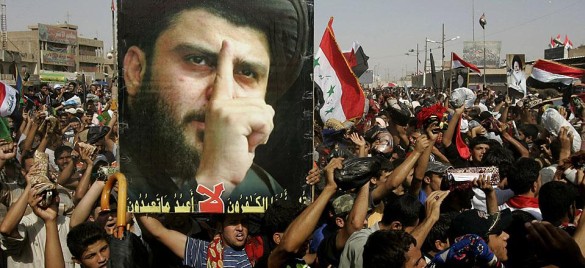
As if to mock America’s role in the future of Iraq, the single point of continuity since the fall of Saddam has been the rising power of Moqtada al Sadr. Even after his movement seemed to have been bludgeoned into submission and he took refuge in Iran, this period of dormancy during which the rough-mannered Shiite leader has focused on elevating his spiritual authority also appears to have served to help him consolidate his political power.

The Guardian reports:

The first in what could be the most crucial series of discussions to form Iraq’s new government took place early last week outside the country’s borders in the Iranian Shia shrine city of Qom.

Sitting cross-legged on the floor was a familiar firebrand in a black turban, Moqtada al-Sadr. Across from him was a delegation from the office of Iraq’s prime minister, Nouri al-Maliki. They had come to seek a detente – and more importantly to find a way, any way, that the exiled cleric, who maintains an overlord’s hold over more than two million Shia Iraqis, would support Maliki being returned to office.

It was a triumphant moment for Sadr, who had been hounded out of town in 2007 by Maliki and the US army and marginalised as a spent force by American officials and most of the prime minister’s inner sanctum. Now, here he was being courted by his persecutors. In the two weeks since the 7 March general election, with the ballots steadily falling Ayad Allawi’s way and power slipping from the grasp of the supremelyconfident incumbent leader, Sadr had been transformed from a pariah into a potential kingmaker.

Juan Cole adds:

Al-Hayat reports in Arabic on the emergence of the Sadr Movement as the largest Shiite party within the Shiite fundamentalist coalition, the Iraqi National Alliance. The Free Independent (al-Ahrar) party that represented the Sadrists won 38 seats out of the 70 that the INA garnered, making the Islamic Supreme Council of Iraq, the Islamic Virtue Party and other Shiite religious components of the list much smaller and less weighty in the coalition’s deliberations.

No sooner, the article says, than the election tallies began coming in did the government of Prime Minister Nuri al-Maliki begin gradually releasing Sadrist prisoners who had been in Iraqi penitentiaries for years. Al-Hayat’s sources say that in Babil Province, orders were received from the government to release members of the Sadr Movement, in an attempt to mollify that group.

Sadrist leader Liqa’ Al-Yasin said that the Sadrists have now become the spinal column of the Iraqi National Alliance. He said that the movement had demonstrated that it had a large public base, and asserted that that base is cultured, aware, and abiding by the principles both of Islamic Law and the Nation. Al-Yasin said that the Sadrists would work for the liberation of Iraq and the realization of national sovereignty. [Translation: they want US troops out of their country tout de suite.] He adds that other goals are to gain the release of prisoners and to take some of the burdens off the shoulders of ordinary citizens. Sadrist leaders said that “the next phase will concentrate on political action to end the Occupation altogether.

Facebooktwittermail

Dubai tells spies to clear out

Newsweek reports:

Police in the Persian Gulf emirate of Dubai have advised all foreign spies to get out of town—and preferably out of the region—within a week. Although it is widely known in international spy circles, news of the expulsion threat has received little circulation beyond media in the Arab world. However, Gulf News, a newspaper based in Dubai, said the demand that foreign spies leave the area was confirmed to it by Lt. Gen. Dahi Khalfan Tamim, Dubai’s police chief and leader of the investigation into the Mahmoud al-Mabhouh murder.

“Those spies that are currently present in the Gulf must leave the region within one week. If not, then we will cross that bridge when we come to it,” Tamim reportedly said. When asked whether the spies he was talking about were holders of European passports, Tamim said “Europeans and others,” but offered no further details.

Gulf News says:

The ultimatum indicates that Dubai Police are aware of the identities of spies operating in the UAE and the Gulf region and appears to be a warning of exposure if they do not comply.

If Dubai is really serious about kicking out its resident spies, the consequences will be far reaching.

As Zvi Bar’el noted earlier this month:

Dubai has several masks. It helps Iran, but behind its back it provides the United States with an opportunity to gather intelligence about that country. The U.S. Consulate in Dubai also operates as a station for gathering information and enlisting agents. A few years ago the U.S. State Department wanted to close the consulate, but the CIA succeeded in convincing it to leave it open and even to boost the number of employees so that it could handle the hundreds and perhaps thousands of Iranians who come to request visas.

It’s not only the U.S. intelligence services that love Dubai: The tremendous scope of commerce and the large number of companies and foreign agencies there are an excellent cover and an appropriate disguise for any city of spies.

Dubai has now replaced 20th-century Istanbul, Nicosia, Casablanca and Berlin as a hotbed of spying activity. Russians exchange information with Pakistanis, Afghans and Chechens trade tactics, members of Hezbollah convert illegal money and diamonds in bank transactions “for widows and orphans,” and all while enjoying car races and performances by international artists.

Facebooktwittermail

Time for George Mitchell and the US to step aside

Among commentators unable to see beyond the bankrupt perspective that the United States has the indispensable role of mediating a Middle East peace agreement (if such an agreement is ever to be reached), much is being made about Joe Biden’s tough words “behind closed doors”. Laura Rozen quotes from a Yedioth Ahronoth report:

People who heard what Biden said were stunned. “This is starting to get dangerous for us,” Biden castigated his interlocutors. “What you’re doing here undermines the security of our troops who are fighting in Iraq, Afghanistan and Pakistan. That endangers us and it endangers regional peace.”

The vice president told his Israeli hosts that since many people in the Muslim world perceived a connection between Israel’s actions and US policy, any decision about construction that undermines Palestinian rights in East Jerusalem could have an impact on the personal safety of American troops fighting against Islamic terrorism.

Help us fight the war on terrorism, Biden admonishes his Israeli friends. But we are, they think but in this instance are too polite to say. That’s why we’re taking over East Jerusalem. We’re fortifying the front-line.

It seems to me that the crux of the issue is not the latest upset; it is that the so-called peace process has always rested on an unbalanced foundation. Which is to say, Israel will only accept the direct involvement of third parties that have a clear bias in their favor.

If President Obama wanted to do something truly radical, it might not have to take the form of applying pressure — pressure that would be fiercely and effectively resisted by the Israel lobby. On the contrary, it could be to acknowledge that American efforts have failed — not only his own but those of all his predecessors — and that there comes a point when failure has been so persistent and become so predictable, that it is time to step aside.

There is someone else waiting in the wings, eager to step in — a man who regards dialogue as the essence of politics and who can make a stronger claim to be even-handed than anyone in the United States or Europe: Brazil’s President Lula da Silva. He also happens to be the most popular political leader in the world.

Ahead of his visit to the Middle East next week, where his first stop will be in Israel, Lula was interviewed by Haaretz:

Lula was one of the first leaders to host President Mahmoud Ahmadinejad after Iran’s blood-stained election of June 2009. Brazil was also one of only five countries to abstain from an International Atomic Energy Agency vote last November on a condemnation of Iran.

He is set to visit the Islamic Republic in May, where his hosts will repay him in kind for the red carpet he laid out for them in Brasilia last November. When asked how he’ll be able to win over the Israelis, whose vantage point is related to the trauma of the Holocaust, Lula replies: “I spoke with the president of Iran and made it clear to him that he cannot go on saying that he wants Israel’s liquidation, just as it is untenable for him to deny the Holocaust, which is a legacy of all humanity. I added that the fact that he has differences with Israel does not allow him to deny or ignore history.”

In a way that will undoubtedly disturb those who will host him in Israel next week, Lula draws a direct association between the failure to advance Israeli-Palestinian peace and his planned visit to Tehran; between the need to ensure that Iran will not manufacture nuclear weapons and the need to resolve the Middle East conflict; and between the failed attempts at mediation led by international players, first and foremost the United States, and the need to bring in fresh new players – Brazilians, in all likelihood.

“I talked about Iran with many leaders, and particularly with those whose countries have a seat on the Security Council,” he explains. “The Americans, the French, the British, the Russians and the Chinese all want to advance the Middle East peace process. But I also feel that the parties to the conflict and the people involved in the process have long since grown tired of it. So, the time has come to bring into the arena players who will be able to put forward new ideas. Those players must have access to all levels of the conflict: in Israel, in Palestine, in Iran, in Syria, in Jordan and in many other countries that are associated with this conflict. This is the only way we will be able to advance Israeli-Palestinian peace, and at the same time be able to say clearly to Iran that we are against the manufacture of nuclear weapons.”

Lula does not overlook any of the elements in this comprehensive linkage when asked about the fact that Israeli patience regarding Iran seems to have worn thin. “The leaders I spoke to believe that we must act quickly, otherwise Israel will attack Iran. I do not want Israel to attack Iran, just as I do not want Iran to attack Israel. In an orderly world, people have to learn to talk to one another.” Here he seems to be alluding critically to the “proximity talks” about to get underway between Israel and the Palestinian Authority.

“The appropriate partners from each country have to be found, and more serious talks conducted,” he continues. “The importance of talks between third- and fourth-rank officials [does not hold] even 1 percent of the importance of tete-a-tete talks between leaders. Politics is mainly contact. People have to look at each other, sense each other. A leader has to look into the eyes of his interlocutor instead of communicating with him through lower-level individuals.”

The Brazilian president says he is disappointed that all that remains of the Oslo Accords is “Nobel Prizes and photographs of people hugging each other,” as well as the fact that the Annapolis conference of November 2007, in which Brazil participated, did not have any follow-up. “This gives me serious doubts: Who really wants peace in the Middle East? Who has an interest in achieving a solution and who would like the conflict to continue? The impression is that someone is constantly working here as though he has hidden enemies, people who simply do not want an agreement to be reached.”

Lula describes himself as a negotiator, not an ideologue, a person who manages to get along with both Hugo Chavez and George W. Bush, with Shimon Peres and Mahmoud Ahmadinejad. He says he has never read a book in his life, even though everyone admires his “supreme wisdom” and “creative mind.” As a chairman of the workers union during the years of military rule in Brazil, he encountered and resolved many difficult conflicts.

“I was born into the politics of dialogue, I became president of this country through dialogue and I have conducted my entire presidency by means of dialogue. I believe that through dialogue we will succeed in solving all the conflicts which today appear to be unsolvable,” he says.

He is well aware that he will be regarded as “naive” by his Israeli interlocutors. He is also familiar with the counter-rhetoric of Prime Minister Benjamin Netanyahu – who likens Ahmadinejad to Hitler, Iran to the Nazi regime and the world of 2010 to that of 1938. Lula’s assertive response is likely to surprise even those familiar with his arguments: “Anyone who compares Ahmadinejad and modern-day Iran to Hitler and the Nazis is having the same kind of radicalism of which Iran is being accused. Anyone who takes that line is not contributing in the least to the peace process which we want to create for the sake of the future. You cannot do politics with hate and resentment. Anyone who wants to do politics with hate and resentment should get out of politics. Nobody can rule a country through the liver. You have to rule a country with your head and your heart. Other than that, it’s best to stay somewhere else other than in politics

No doubt many veterans of the peace process would scoff at the notion that the Brazilian leader might succeed where those who have made this undertaking their professions have consistently failed. But if there is one place failure should succeed it is in the cultivation of humility.

As for the Israelis, there seems little prospect that they have the stomach for a genuinely even-handed approach and if they were to decline such an offer then that is undoubtedly their prerogative. They should be given these options: fair mediation or splendid isolation.

Claudio Lottenberg, the president of Sao Paulo’s Albert Einstein Hospital and a leader of Brazil’s Jewish community notes: “Lula is an important rising player in the international arena, and Israel should take account of this. It is important for Israel to have partners and allies besides the United States.”

But not only is Lula an important figure; Brazil itself clearly has much to teach a world which must become a multicultural success if it is to have any future at all.

Lula’s ambition to make a deep imprint in the Middle East goes beyond his country’s international status, to what he describes proudly as “a long Brazilian history of peace and a life of brotherhood in a region of diverse cultures. More than 120,000 Jews live here in full harmony with 10 million Arabs. It would seem that people can learn from us.” Brazil terms itself “the world’s largest Lebanese country” (some six million of Brazil’s Arabs are of Lebanese origin), “the second-largest African country in the world” (after Nigeria), and also the second-largest Italian and Japanese countries. It is a huge blend of peoples and cultures that do not know the meaning of friction.

You’d be hard-pressed to find someone in Rio de Janeiro who hasn’t heard of Saara Street, where Jews and Arabs sell clothing, toys and other items side by side. Whenever tension in the Middle East rises, local television crews show up to film the Brazilian version of coexistence. “All Brazilians are brothers,” they say – hence their ability, in their view, to bring brotherhood to all other nations.

Facebooktwittermail

U.S. changing focus of Iran policy

The Los Angeles Times reports:

After keeping a careful distance for the last year, the Obama administration has concluded that the Iranian opposition movement has staying power and has embraced it as a central element in the U.S.-led campaign to pressure the country’s clerical government.

Administration officials and some allied governments believe that a combination of domestic unrest and international sanctions targeting Iran’s Revolutionary Guard offers the best hope for forcing Tehran to yield on its nuclear program, and could even lead to a change in the government.

The administration has made the shift at a time when it is facing sharp domestic criticism over President Obama’s failed initiative to launch negotiations with Iran and its perceived unwillingness to strongly back the opposition movement. Meanwhile, the protests sparked by June’s disputed presidential election in Iran grew despite a tough crackdown.

This new approach is not a sure thing: It is far from clear that squeezing the Revolutionary Guard, a sprawling military organization that has vast business interests and is close to President Mahmoud Ahmadinejad, would seriously damage it or strengthen the opposition, as the administration hopes. And despite high-profile encouragement by Secretary of State Hillary Rodham Clinton and other U.S. officials, many opposition activists fear that Washington’s embrace will bring more harm than good.

“Just leave us alone, please,” one activist in Tehran pleaded.

Facebooktwittermail

The Iranian riddle

Trita Parsi writes:

Iran is the 21st century equivalent of 1930s Russia — a riddle wrapped in a mystery inside an enigma. The Iranians haven’t stumbled upon this mystifying state coincidentally, and the enigma isn’t the result of outsiders’ failure to try to understand them. Rather, the Iranian government has a deliberate policy aimed at confusing the outside world about its goals and decision-making processes. “There is an intention out there to confuse,” a noted Iranian professor told me in Tehran a few years ago. The rulers in Tehran think that opacity and the perception of unpredictability buy them security.

Given that intent, it is hardly surprising that Washington has had such a difficult time formulating a successful Iran policy. Right now, the Obama Administration is embarking on the sanctions track, pursuing both a U.N. Security Council resolution, as well as measures by a coalition of the willing that would go beyond anything imposed by the U.N. The idea is that a tough sanction regime would hit the Iranian government — and especially the Islamic Revolutionary Guards — while sparing Iran’s population.

Yet despite what they say, few in Washington believe sanctions alone will alter Iran’s behavior. They have never worked as well as they might in Iran; rhetoric has only served to raise tensions further. The experience of the Bush Administration shows that the combination of sanctions and rhetoric about regime change — remember the “Axis of Evil?” — helped strengthen the hands of Iran’s hard-liners. It vindicated Tehran’s paranoia and reduced options available to the U.S. If the Iranian regime thinks that the real aim of U.S. policy is to topple it, it is hardly likely to make the conciliatory policy changes — for example, on its nuclear program — that the U.S. seeks.

So what should Washington do? A starting point should be to recognize that the U.S. is no longer dealing with an Iran that merely simulates indecisiveness. On the contrary, Iran seems genuinely irresolute and paralyzed by the Khamenei government’s loss of legitimacy and continued conflicts both within the élite and between the government and the people.

Facebooktwittermail

Israel’s game of bluff

Didi Remez has translated parts of a column by Nahum Barnea that appeared in Hebrew in Yediot‘s Friday political supplement. Barnea considers the assessments by Dr. Moshe Vered who published a study last year on possible scenarios that would result from an Israeli military strike on Iran’s nuclear facilities.

Barnea goes on to say:

The game is now approaching the critical stage, the “money time.” Netanyahu and Barak are waving the military card. “All the options are on the table,” they say, accompanying the sentence with a meaningful look. There are Israelis, in uniform and civilian clothes, who take them seriously. The Obama administration is troubled. It is no accident that US Chairman of the Joint Chiefs of Staff Admiral Michael Mullen was sent here, to make it clear that the US was vetoing a military strike. It is no accident that Barak was invited to Washington and Vice President Biden will be coming here on Monday. He is not only coming to visit Yad Vashem.

I find it difficult to believe that Netanyahu will undertake such a weighty and dangerous decision. It is more reasonable to assume that he and Barak are playing “hold me back.” On the day they will be called upon to explain why Iran attained nuclear weapons, they will say, each on his own, what do you want from me, I prepared a daring, deadly, amazing operation, but they—the US administration, the top IDF brass, the forum of three, the forum of seven, the forum of ten—tripped me up. They are to blame.

Netanyahu and Barak know: there is no military operation more successful, more perfect, than an operation that did not take place.

Netanyahu has upgraded Ahmadinejad to the dimensions of a Hitler. Against Hitler, one fights to the last bunker. This is what Churchill did, and Netanyahu wants so badly to be like Churchill. His credibility—a sensitive issue—is on the table. If he retreats, the voters will turn their back on him. Where will he go? In his distress, he may run forward.

The fascinating side of this story is that very few Israelis would appear to believe their prime minister. If they believed him, they would not run in a frenzy to buy apartments in the towers sprouting like mushrooms around the Kirya. In the event that Iran should be bombed, the residents of the towers would be the first to get it. If they believed [Netanyahu], the real estate prices in Tel Aviv would drop to a quarter of their current value, and long lines of people applying for passports would extend outside the foreign embassies.

Given that, as Barnea notes, Israelis can tell Netanyahu is bluffing, there seems little reason to doubt that the Israeli prime minister’s bluff is equally transparent to both Washington and Tehran.

Washington feels obliged to play along in order to make the Israeli threat seem credible. Tehran in turn needs to show that it will not bow to foreign pressure and thus the likely effect of Israel’s threats is to make the Iranian nuclear program advance more quickly than it would have minus the pressure.

How can this possibly serve Israel’s interests? In terms of thwarting Iran’s nuclear program it doesn’t, but this is not the Jewish state’s primary goal. What it wants more than anything else is to promote division across the region and thereby undermine the power of the opponents of Zionism.

Come the day that “the Iranian threat” turns out to have been overstated, a new threat will emerge. Israel cannot survive without its beloved enemies.

Facebooktwittermail

Brazil rebuff for Iran sanctions drive

The Financial Times reports:

Brazil delivered a wounding blow to Washington’s hopes of international consensus for sanctions on Iran on Wednesday when its president declared his opposition to such measures hours before meeting Hillary Clinton, US secretary of state.

In an indication of Brazil’s growing self-confidence on the international stage – and its effort to chart a path independent of Washington – Luiz Inácio Lula da Silva stated his backing for Iran’s nuclear programme, as long as it remained purely peaceful.

The US and its partners say that Iran is seeking nuclear weapons capacity, while the United Nations nuclear watchdog recently suggested Tehran could be working on a warhead.

But in spite of strong condemnation of the nuclear programme by the European Union and Russia in recent days and Mrs Clinton’s visit to Brazil, in which she will focus on the Iran file, Mr Lula da Silva remained unmoved.

Facebooktwittermail

Why Iran’s top spy isn’t meddling in Iraq — for now

Among the many intriguing pieces of information about Qassem Suleimani, the head of Iran’s Quds Force, in this profile by Christopher Dickey, is this: Suleimani along with many other senior figures in the Quds Force actually supported Mir Hossein Mousavi in last summer’s presidential election.

The text message was cryptic and sent through an intermediary, but its spookiness has become legendary among the Americans tasked with trying to stabilize Iraq. The moment was May 2008, and once again all hell was breaking loose. Shiite militias had gone to battle against each other. The fighting threatened to spread to Baghdad. Gen. David Petraeus and Ambassador Ryan Crocker were scrambling to find somebody to broker a truce. Then the text message was passed to the American commander. “General Petraeus,” it began, “you should know that I, Qassem Suleimani, control the policy for Iran with respect to Iraq, Lebanon, Gaza, and Afghanistan.” Within days it was Suleimani who brokered the truce.

What surprised Petraeus and Crocker was not the Iranian’s role. They knew that already. It was the blunt confidence with which Suleimani stated it. As the head of the infamous Quds Force, he commands all the Iranian Revolutionary Guard Corps (IRGC) operations outside Iran’s borders—whether covert, overt, or outright terrorist. In the fractious politicking almost certain to follow Iraq’s parliamentary elections on Sunday, this 53-year-old Iranian general could pull the strings that make or break the new government in Baghdad.

Long before America’s troops occupied Iraq, Suleimani’s forces occupied the shadows. In the buildup to the U.S.-led invasion, he was the go-to guy for much of the Iraqi Kurdish and Shiite opposition to Saddam Hussein. Suleimani’s networks of agents, collaborators, military advisers, client militias, and secret informers give him a degree of power that is difficult to gauge, but it often seems proconsular: “I, Qassem Suleimani,” his text read, like an emperor’s decree. And his real message in 2008 was that he could turn up the heat, or turn it down, at will.

Facebooktwittermail

Is Israel really prepared to go it alone?

Reuters reports:

Israel’s perspective on Iran’s nuclear program differs from that of the United States, and the two may part ways on what action to take, Israeli Defense Minister Ehud Barak said on Friday.

Washington’s clout over its Middle East ally is under scrutiny after Israel’s veiled threats to attack Iran preemptively if international diplomacy fails to rein in Tehran’s uranium enrichment, a process with bomb-making potential.

The United States this week said it did not want to hurt the Iranian people with “crippling” sanctions against Iran’s energy sector, measures Israeli Prime Minister Benjamin Netanyahu has described as the only viable diplomatic solution.

“There is of course a certain difference in perspective and a difference in judgment and a difference in the internal clock, a difference in capabilities,” Barak told the Washington Institute for Near East Policy think-tank, when asked about Israeli-U.S. discussions about Iran.

“I don’t think that there is a need to coordinate in this regard. There should be understanding on the exchange of views, but we do not need to coordinate everything,” said Barak, who was in Washington for strategic talks.

Yet again, we are supposed to believe that Israel is prepared to go it alone and take on Iran.

Israel can destroy a nuclear reactor in Iraq; it can destroy one under construction in Syria; it wipe out a weapons convoy in Sudan; it can kill a Hezbollah commander with a bomb in Damascus; it can smother a Hamas commander with a pillow in Dubai; and it can flatten Southern Lebanon and Gaza.

Therefore, Israel’s ready to go to war with Iran… or, it loves to show off its power when it perceives the risk of doing so is minimal. If that was the case with Iran, we wouldn’t be weighing the chances of an Israeli attack — we’d be looking at the results of such an action.

Facebooktwittermail