In a quiet street in the Sheikh Jarrah district of occupied East Jerusalem 88-year-old Rifka al-Kurd is explaining how she came to live in the house she and her husband built as Palestinian refugees in the 1950s. As she speaks, three young ultra-orthodox Jewish settlers swagger in to stake their claim to the front part of the building, shouting abuse in Hebrew and broken Arabic: “Arab animals”, “shut up, whore”.
There is a brief physical confrontation with Rifka’s daughter as the settlers barricade themselves in to the rooms they have occupied since last winter. That was when they finally won a court order to take over the Kurd family’s extension on the grounds that it was built without permission – which Palestinians in Jerusalem are almost never granted. It is an ugly scene, the settlers’ chilling arrogance underpinned by the certain knowledge that they can call in the police and army at will.
But such takeovers of Palestinian homes in Sheikh Jarrah have become commonplace, and the focus of continual protest. The same is true in nearby Silwan, home to upwards of 30,000 Palestinians next to the Old City, where 88 homes to 1,500 Palestinians have been lined up for demolition to make way for a King David theme park and hundreds of settlers are protected round the clock by trigger-happy security guards.
Throughout the Arab areas of Jerusalem, as in the West Bank, the government is pressing ahead with land expropriations, demolitions and settlement building, making the prospects of a Palestinian state ever more improbable. More than a third of the land in East Jerusalem has been expropriated since it was occupied in 1967 to make way for Israeli colonists, in flagrant violation of international law.
Israel’s latest settlement plans were not “helpful”, Barack Obama ventured on Tuesday. But while US-sponsored Israeli-Palestinian negotiations go nowhere and attention has been focused on the brutal siege of Gaza, the colonisation goes on. It is also proceeding apace in Israel proper, where the demolition of Palestinian Bedouin villages around the Negev desert has accelerated under Binyamin Netanyahu.
About 87,000 Bedouin live in 45 “unrecognised” villages, without rights or basic public services, because the Israeli authorities refuse to recognise their claim to the land. All have demolition orders hanging over them, while hundreds of Jewish settlements have been established throughout the area.
The Israeli writer Amos Oz calls the Negev a “ticking time bomb”. The village of Araqeeb has been destroyed six times in recent months and each time it has been reconstructed by its inhabitants. The government wants to clear the land and move the Bedouin into designated townships. But even there, demolitions are carried out on a routine basis.
The U.S. government is to move an additional $400 million worth of military equipment to emergency storage in Israel over the next two years.
The equipment, which includes so-called smart bombs, will stand at Israel’s disposal in an emergency.
The U.S. Congress approved the hike last month, which will bring the value of American military equipment stockpiled in Israel to $1.2 billion by 2012. The story was first reported this week by Defense News magazine’s reporter in Israel, Barbara Opall-Rome.
The U.S. stores equipment in Israel by virtue of a special clause in U.S. foreign aid law governing war reserves stockpiles for allies. According to the clause, the equipment can be utilized by American forces throughout the world, and also, in an emergency, by the military in the country where the equipment is stored.
The clause was originally intended to allow South Korea use of American equipment in case of a surprise attack by North Korea.
The type of equipment stockpiled in Israel is determined through dialogue between the Israel Defense Forces and the U.S. Army’s European Command. The issue was raised in discussions last week during the visit by the IDF’s logistics and technology chief, Maj. Gen. Dan Biton, at the Pentagon in Washington.
The agreement between the two armed forces also includes conditions under which the IDF may use the equipment. It is believed that a great deal of the equipment will include precision weapons launched from the air.
IDF Chief of Staff Gabi Ashkenazi said this week that in Israel’s future wars, much more precise weaponry will be needed to strike urban targets from the air without injuring civilians.
During Operation Cast Lead, 81 percent of the missiles and bombs launched from the air on and by IDF artillery were of the precision type.
Use of the the American equipment is allowed with permission of the American administration; Israel used such U.S. weaponry during the Second Lebanon War.
Ahead of a New Orleans address to the General Assembly [GA] of the Jewish Federations of North America, sources quoted Prime Minister Benjamin Netanyahu as having said that there is fundamental support for Israel within the United States.
“We may have lost Thomas Friedman, but I don’t think we lost America,” Netanyahu was quoted as saying.
I was getting ready to leave for the airport, when my wife caught me unawares. This was the first inkling I would have of something I was to learn again and again:
Where it comes to any issue of the Mideast conflict, and where it comes to questions relating to the complex relations between the U.S. Jewish community and Israel, you can either answer in three hours, or in one sentence. This was hers:
“You know what it is – American Jews are divesting from Israel.”
This is what I was to see in Los Angeles, San Francisco, Marin County, Portland and Seattle. It’s not that they’re getting involved in significant numbers in the divestment movement. It’s that American Jews are divesting emotionally. They are quietly – but in terms of impact, dramatically – withdrawing altogether.
Not just Jews. Americans. And the younger they are, that is, the more crucial they are to Israel’s future, the more likely they are to divest.
The sharpest signal of what last week’s elections meant for Jews came not from Washington but from New Orleans, Nova Scotia and Australia.
In New Orleans, Israeli Prime Minister Benjamin Netanyahu delivered a speech Monday calling for moving beyond sanctions to mounting a “credible military threat” against Iran as a means of avoiding war.
“Containment will not work,” Netanyahu said in his address to the General Assembly of the Jewish Federations of North America.
The prime minister’s remarks echoed the precise terminology used by Sen. Lindsey Graham (R-S.C.) in Nova Scotia two days earlier, when he told the Halifax International Security Forum that “containment is off the table.” The likely new majority leader in the U.S. House of Representatives, Rep. Eric Cantor (R-Va.), referred to a “credible military threat” in the days before the election.
It was a clear sign that Netanyahu feels empowered by the Republican sweep last week of the House of Representatives to trump the Obama administration’s emphasis on peacemaking with the Palestinians with his own priority: confronting Iran.
First they took Washington, now they’ll take Jerusalem? With victory in the congressional elections less than a day old, Florida Senator Marco Rubio (Rep.) who considers himself a ‘Tea Party’ member, is set to arrive in Israel on Sunday. Rubio’s visit so soon after the election win is a move that strengthens assessments that the congress in its current form will continue where it left off – at least where Israel is concerned.
The pro-Israeli AIPAC lobby applauded the election results, congratulated the winners and said: “It is abundantly clear that the 112th Congress will continue America’s long tradition of staunch support for a strong, safe and secure Israel and an abiding friendship between the United States and our most reliable ally in the Middle East.”
AIPAC expressed satisfaction over the fact that most pro-Israel senators were reelected and sent messages of congratulations to senators and congress members from both parties.
In a speech delivered to the Republican Jewish Coalition in June, soon after the Mavi Marmara flotilla massacre, Rubio said:
If Israel’s right to self-defense is undermined by efforts to lift its legal and necessary blockade of Gaza, which serves to stop Hamas from arming itself with deadly weapons, there will be lasting consequences, not just for Israel but also for the United States and ultimately for the world.
Israel’s enemies are — or will soon be — America’s enemies as well. They are emboldened any time they sense any sort of daylight between the United States and Israel. And now more than any other time, it is important that America has a firm and clear relationship with Israel.
In late August, Rubio said on Fox News (as he has said repeatedly) that Israel is America’s “best friend in the world.”
“Affirmation of Israel’s Jewishness… is the very foundation of peace, its DNA,” claims Michael Oren, Israel’s ambassador to the United States.
Well, if that’s really true then one can only conclude that Israel will never exist in peace — not because it will fail in getting the affirmation it demands from its Palestinian neighbors but because Jews themselves can’t agree on the nature of Israel’s Jewishness. And if Jews can’t agree on this, what business does Israel have in demanding such recognition from anyone else?
When Hillary Rubin immigrated from the U.S. to Israel, the granddaughter of Holocaust survivors and descendant of a famed Zionist visionary felt that she had finally arrived in her true home.
But now that religious authorities are questioning the 29-year-old Michigan native’s Jewish pedigree and refusing to recognize her marriage, she’s having second thoughts.
Rubin is at the center of a deepening rift between the world’s two biggest Jewish communities – the American and Israeli. Religious life in Israel is dominated by the strict ultra-Orthodox establishment, which has growing political power and has become increasingly resistant to any inroads by the more liberal movements that predominate among American Jews.
Many Americans – whose faith is seen by the ultra-Orthodox as blurred by intermarriage and fading adherence to tradition – are feeling rejected and unwelcome.
“I feel like I am caught in the middle of these two worlds,” said Rubin, who was raised in a liberal Jewish home in a Detroit suburb. “On the one hand I’m far too traditional for American society. On the flip side, I am not religious enough for the rabbinate in Israel.”
It’s a far cry from the days when American Jews looked to Israel as a source of pride and inspiration and Israel could rely on America’s Jews as a source of unconditional moral support and fundraising. With ultra-Orthodox Jews the fastest growing sector in Israel, often holding the balance of power in coalition governments, open strains between the communities are now far more common.
Over the summer, a proposed law that would have consecrated the Orthodox monopoly over conversion in Israel caused an uproar among Diaspora Jews. Prime Minister Benjamin Netanyahu was forced to shelve the bill in hopes of finding a compromise.
Last week, American and Israeli Jewish leaders held a conference in Jerusalem aiming at ironing out their differences. But the closed-door sessions were tense and all sides stuck to their positions, said one participant, American Rabbi Jerome Epstein, of the Conservative movement.
He warned that the conflict could “tear the people apart” if no compromise is found.
“There are a lot of Americans who normally would not get involved in Israeli politics but who are saying, ‘What you are doing is delegitimizing me. It is not enough to want my support and want my money, you have to be willing to recognize me as a human being and as a Jew,’ and they feel that is not happening,” he said.
But an Israeli state that delegitimizes Palestinians who can prove their ancestral and property claims and that depends on tax dollars paid by non-Jewish Americans — that’s OK?
“Ambiguity,” the key word used in describing Israel’s relationship vis-a-vis nuclear weapons, existed from the start. “There was a secret even before there was anything to hide,” states Avner Cohen, an Israeli-born philosopher and historical researcher who is an expert in Israel’s nuclear policy, in his new book.
“During the early 1950s, and even before then, there were those in Israel who dreamed about a nuclear project, but in reality there was almost nothing,” explains Dr. Cohen in an interview with Haaretz, from his Washington, D.C. home. “Some students were sent overseas to study nuclear physics, and a group started to look for uranium in the Negev. There was none. Nonetheless, this small group, which merely had a vision, already maintained a cult of secrecy.
“In those years, there was not yet an international regime against nuclear proliferation – this was a decade before the nuclear Non-Proliferation Treaty. But even then, when theoretically anything was allowed, there was a sense of taboo. That the subject could not be discussed. [David] Ben-Gurion and [Shimon] Peres understood that in this sphere you don’t really want to state your objectives precisely. The sense was that designating goals would, in itself, stir an argument, and that it was better to avoid such debates, both internal and external. The idea was that it was crucial not to raise these questions.”
For Cohen, ambiguity in this realm is not merely a theoretical subject, it is the central issue which has fashioned his life. After an academic article he authored was disqualified by military censors in the 1990s, he left Israel. After publishing a book called “Israel and the Bomb” (Columbia University Press, 1999 ), an investigation was launched against him and he was barred from returning to Israel for several years. Cohen even played a certain role in the Yitzhak Yaakov affair – the case in which Yaakov, a retired IDF brigadier general, was indicted and detained for more than a year for harming national security by writing two books on Israel’s weapons development program.
Cohen’s newest work, “The Worst-Kept Secret: Israel’s Bargain with the Bomb” (Columbia University Press, 2010 ), is dedicated to two figures who represent two different poles in Israel’s culture of nuclear secrecy: Yaakov, who tried to share “prohibited” memories with the world and paid for it with a long detention, and Shalheveth Freier, a top official in the Israel Atomic Energy Commission (IAEC ), and one of the people who created the secret with their own hands.
In his new book, Cohen calls on Israel and Israelis to discuss anew the policy of ambiguity and its implications. In his view, for the past several years, the costs of such a policy have outweighed its utility. He does not believe that Israel should disarm, but rather that it should, in clear, simple terms, acknowledge these weapons and talk about them. That is precisely what he is trying to do in his research, and in this present article. Cohen is currently conducting research in the U.S. (right now he is a senior fellow at the James Martin Center for Nonproliferation Studies at the Monterey Institute of International Studies ); his book (unlike this article ) was not submitted to the Israeli censor.
Jerusalem is ready to renew its offer to pay millions of dollars to any African or Western country willing to absorb the influx of migrants attempting to infiltrate Israel, a senior official said on Wednesday.
During deliberations with his political-security cabinet, Prime Minister Benjamin Netanyahu ordered the Foreign Ministry to renew its contacts with Western and African states to see if any would be willing to take in these migrant workers.
The Foreign Ministry has already held a round of talks on the matter with a number of states with whom Israel has diplomatic relations, but has not yet received a sufficient response to the request. Even those states willing to take in migrant workers are not prepared to absorb the numbers of people presented by Israel.
Netanyahu also ordered the defense establishment to begin immediate construction of a barrier on the Egyptian border and said he expected a report on the matter within a month. The works were due to start in July, but following disagreements on budgeting have been delayed by over three months.
The premier also said that alternatives needed to be found to reduce the flow of infiltrators before the barrier was in place.
The barrier is meant to prevent Islamic militants, drug dealers, African migrants and other asylum seekers from entering Israel from Egypt. At least 1,000 people enter the country illegally from Egypt each month, according to Israeli estimates.
As President Obama’s Middle East peace initiative appears destined for failure, there is increasing speculation that a third intifada may follow, but whereas the first two Palestinian uprisings took place primarily inside the occupied territories, the third uprising may well start inside Israel. The Israeli-Arab town of Umm al Fahm is now a tinder box.
Israeli police and stone-throwing Arabs clashed in northern Israel yesterday as a group of Jewish right-wing extremists tried to march through the Arab-Israeli town of Umm al Fahm.
Two Arab legislators were injured in the violence. Afu Aghbaria, an Arab MP with the joint Jewish-Arab Communist party, said he had been hit in the leg.
Haneen Zoubi, a parliament member who has received hundreds of death threats since her participation in an aid flotilla to Gaza in the summer, also was among those hurt.
Ms Zoubi reported being hit in the back and neck by rubber bullets as she fled the area after police opened fire. In an interview with The National, she said she believed that she had been specifically targeted by police snipers after they identified her.
Israel deployed a secret police “mistaravim” unit (a Hebrew term meaning “disguised as an Arab”) in Umm al Fahm. In the image below, at least half a dozen such undercover operatives can be seen taking down demonstrators. The one on the far left appears to be firing a hand gun. The image is grabbed from news footage in a sequence that starts 38 seconds into the video shown below.
Israeli border police tactics in this week’s clashes in Umm al Fahm are being scrutinised.
The concentration and intensity of stun grenades and tear gas volleys unleashed on a few hundred Israeli Arab was unprecedented in many observers’ experience.
The police say they launched it as soon as the first stones were thrown. One Israeli Arab Knesset member claims the stones were thrown by undercover Israeli police masquerading as Arabs in the crowd.
Israeli Channel 2 reported claims the tear gas volleys were fired in such a way because the crowd had just started turning on a suspected undercover police officer.
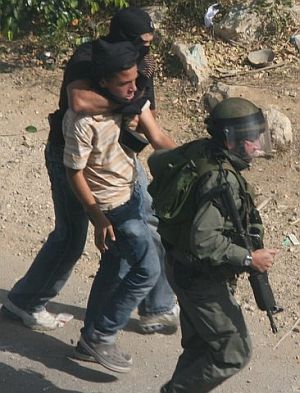
As Sameer Bazbaz captured in this sequence later [see image on the right], the undercover police were very active later, hiding among the crowd then pouncing on Israeli Arabs as uniformed colleagues swarmed to join them.
The undercover officer shown in the image above with his right arm firmly gripped around a teenager’s neck appears to be the same individual who can be seen at the beginning of the video above who 10 seconds in, can be seen at the road’s edge apparently picking up a stone to throw at Israeli police.
Israel is conducting secret negotiations with the U.S. on establishing the future borders of a Palestinian state, the London-based Arabic language daily Asharq al-Awsat reported on Friday.
According to the report, Palestinian sources confirmed that the two sides discussed an option wherein Israel may lease lands in East Jerusalem from the Palestinians in exchange for the establishment of an independent Palestinian state.
Israel would lease the territories from the Palestinian state for a period of 40 to 99 years.
The Palestinian sources said that the talks are an American initiative that has been going on for some time in order to obtain an understanding with Israel regarding the terms surrounding a future Palestinian state.
The Palestinian Authority apparently has only recently been made aware of the talks and hasn’t been given the details of the proposal.
An Egyptian source told the newspaper that the negotiations are “more quiet than secret, and are meant to try to save the peace process.”
Neither the Prime Minister’s Office nor the U.S. government agreed to comment on the report.
Israel in secret negotiations with the US? I guess this confirms what has long appeared to be the case: that the Palestinians are regarded as being peripheral to the conflict. But I really don’t know what to make of this lease proposal. Britain held Hong Kong on a lease, but once the lease expired Hong Kong went back to China. Somehow I don’t see a Palestinian state ever having quite as much leverage as China. Neither, given its disregard for UN resolutions, do I see Israel feeling a heavy obligation to honor a legal contract limiting its occupation of East Jerusalem. The Israelis’ interests have always seemed to be focused on the so-called facts no the ground rather than legal issues of ownership.
It’s hard to kill something that’s already dead, but the formation of an Israeli Tea Party will have one predictable effect: give Benjamin Netanyahu yet another reason to disregard Washington’s desperate appeals for concessions.
Likud activists who oppose the settlement freeze have set up a protest movement against the peace process and the continued construction moratorium in the West Bank. The group is modeled after the far-right conservative Tea Party movement in the United States.
The Israeli group will hold a rally Sunday at the Zionist Organization of America House in Tel Aviv, under the banner “Saying No to Obama,” where they plan to protest Prime Minister Benjamin Netanyahu’s policy and the American pressure on Israel to renew the settlement construction freeze.
Likud activists said yesterday that their Tea Party will be the opening shot in their efforts to stop the peace process entirely.
Think of a town in Austria. Or perhaps France. A mountainous, ancient major district town, with a college situated in the middle of it, whose students include quite a few Jews. The town priest calls an “emergency meeting,” funded by the government and held in the municipal cultural center, attended by 400 sympathetic citizens, including 18 priests from the area, calling for a ban on renting apartments to Jewish students.
The deputy mayor supports the meeting. The priest says sweetly: “I have nothing against Jews, but they shouldn’t live in our town. Let them study in their yeshivas, not with us.”
Residents of the town complain: “The Jews don’t respect the place on Sundays,” the public park has been turned into a “pigsty,” the hospital has become a “dangerous place.” Renting apartments to Jews, the priests warn, will hurt property values, and lead to the danger that our pure children will convert. A few young men harass Jews and beat them up; the Jews say they live in great fear.
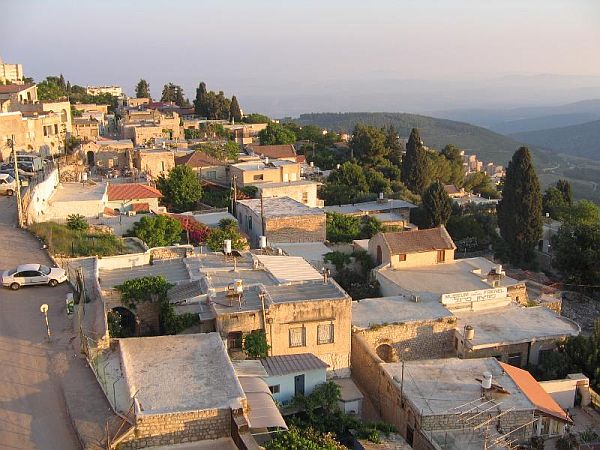
If this took place in France, and even more so in Germany, it sounds quite bad. But this all happened in Safed – and against Arabs. If it had happened in Europe, Jewish organizations would shout to the high heavens, Israel would recall its ambassador for consultations. The president of the country, whether it be France or Austria, would hurry to the tainted city and do everything possible to calm things down. They would apologize to the Jewish students and instruct the police to see to their safety. The priests would be tried for anti-Semitism.
Imagine this: You want to move to a new town but before you can do so, you’ll have to submit an application to a committee that has to approve admission of new residents. And not just that — you can be excluded for the simple reason that in the committee’s opinion, you wouldn’t fit in. “Sorry, you’re not the kind of person suitable to live in our town.”
That will be the effect of a new law now moving through Israel’s parliament, and once enacted it will be used to keep Israeli Palestinians out of Jewish towns.
The Knesset’s Constitution, Law and Justice Committee on Wednesday unanimously approved a bill which gives the right to absorption committees of small communities in Israel to reject candidates if they do not meet specific criteria.
The bill has sparked wide condemnation and many believe it to be discriminatory and racist, since it allows communities to reject residents if they do no meet the criteria of “suitability to the community’s fundamental outlook”, which in effect enables them to reject candidates based on sex, religion, and socioeconomic status.
The bill is due to be presented before the Knesset plenum in the coming weeks.
Israeli Arab MKs were outraged by the proposal and walked out on the committee’s discussion of it.
MK Talab al-Sana (United Arab List – Ta’al) called the bill racist and said it was meant to prevent Arabs from joining Israeli towns. MK Ahmed Tibi (United Arab List – Ta’al) compared the bill to racist laws in Europe during World War Two, and the two told the committee members before leaving the hall: “We will not cooperate with this criminal law – you have crossed the line.”
The committee’s chairman, David Rotem (Yisrael Beiteinu), responded to claims the bill was meant to reject Arabs from joining Israeli towns. “In my opinion, every Jewish town needs at least one Arab. What would happen if my refrigerator stopped working on a Saturday?”
Rotem’s disdainful comment is strongly reminiscent of Rabbi Ovadia Yosef’s recent claim: “Goyim were born only to serve us.” The sense of invulnerability these men exude as bigotry slides off their tongues, goes beyond arrogance. It amounts to a scathing contempt for humanity.
Why is it that a country that defines itself in terms of existential threats and the need to provide a safe refuge for the Jewish people, nevertheless seems strangely remiss in securing its own autonomy?
Even if Israel stands out as the preeminent military power in the Middle East, it has only been able to acquire this status through its dependence on the United States. It often masks that dependence by behaving like a brash teenager who is secretly terrified by the thought of leaving home.
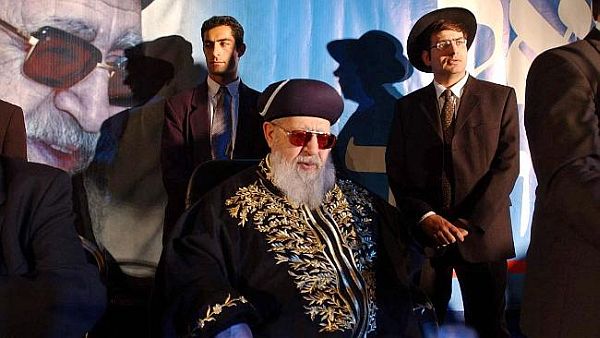
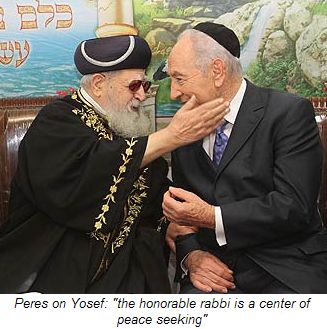
Last week, Rabbi Ovadia Yosef, the former Sephardi Chief Rabbi of Israel and spiritual leader of the Shas party — part of Netanyahu’s ruling coalition — made his latest inflammatory statement. In August Yosef called for the annihilation of the Palestinian people. This time he showed his contempt for humanity — at least that rather large portion which happens not to be Jewish, the Goyim.
Goyim were born only to serve us. Without that, they have no place in the world; only to serve the People of Israel …Why are gentiles needed? They will work, they will plow, they will reap. We will sit like an effendi [lord] and eat…
Yosef’s comments and the lack of censure they received from Israeli politicians, drew swift criticism from the Anti-Defamation League (ADL) Director Abraham Foxman and David Harris, executive director of the American Jewish Committee. Foxman warned that this might have a detrimental effect on Israel’s relations with American Jewry.
While leaders of the American Jewish community acknowledged the damage Yosef’s words could cause, they did not attempt to analyse them.
The Israeli-born anti-Zionist activist and musician, Gilad Atzmon suffers no such reservations.
In just a few words Rabbi Yossef expresses the depth of Judaic contempt towards labour.
The senior Rabbi provides us with a devastating glimpse into the Judaic alienation from these aspects of the human condition and human experience. In an unequivocal manner, Rabbi Yosef depicts a clear dichotomy: Jews are the master race and the Goyim are nothing but a work force. The Goyim are there to sweat and struggle while the Jew is ‘sitting’ and ‘eating.’ I guess that Rabbi Yossef has managed, in just a few words, to portray the intrinsic relationships between Judaism and Capitalism.
But in fact, Rabbi Yossef didn’t invent anything new here — his Saturday sermon sounds familiar enough to me. Karl Marx in his paper “On The Jewish Question,” identified aspects of Jewish ideology at the heart of Capitalism: “It is mankind (both Christians and Jews) that needs to emancipate itself from Judaism.”
Marx managed to identify an inclination towards exploitation at the heart of Jewish culture.
However, being a humanist, Marx wanted to believe that mankind (Jews and others) could overcome this tendency. Many early Zionists too, were also convinced that in Zion, Jews would liberate themselves and eventually become a nation like other nations, through productivity and labour.
Seemingly though, Rabbi Ovadia Yosef is not that impressed with either Marx, or some of the ideals within the early Zionist dream: Rabbi Yossef is brave (or foolish) enough to sketch the inherent bond between Jewish culture and Capital.
The only question that is still open is, for how long can the rest of humanity tolerate that kind of Rabbinical arrogance?
Meanwhile, the publication of a “millionaire’s list” last week, revealed Netanyahu’s complete dependence on foreign money for his fundraising efforts. His office in an attempt to explain his donor preferences released a statement in which they made the implausible claim: “His approach is that funds should be raised abroad so as not to put anyone in a potential conflict of interests, and this is the reason he prefers donations from abroad.”
On Capitol Hill, U.S. Rep. Eric Cantor, the Republican whip and the only Jewish Republican in the House of Representatives, is concerned that a GOP-led Congress which aims to cut foreign aid could make Israel vulnerable, since it receives more aid than any other country. A possible solution would be that aid to Israel be part of the US defense budget, adding new meaning to the idea that Israel and US interests are indivisible.
Israel demands that it be recognized as a Jewish state by the Palestinians. “Affirmation of Israel’s Jewishness…, is the very foundation of peace, its DNA,” says Israel’s ambassador to the US, Michael Oren. Yet in the shadow of this fixation on Jewish identity, we see a singular lack of interest in autonomy expressed through a religious leader’s contempt for work, a prime minister’s appetite for foreign money, and a Congressman’s concern that the umbilical chord tying Israel to the US not suffer any interruption or constriction in the steady supply of US tax dollars required for supporting the Jewish state.
Where in this condition is any understanding of the real meaning of sovereignty? Might not Israel’s greatest existential threats be the ones of its own making?
Hardline Israeli Foreign Minister Avigdor Lieberman has commissioned a report on how to prepare for a nuclear-armed Iran as doubt mounts about the efficacy of preventive action, an Israeli source said on Monday.
Publicly, Israel has pledged to deny the Iranians the means to make a bomb but its previous, centrist government also discreetly drew up “day after” contingency plans should Tehran’s uranium enrichment pass the military threshold.
At the time, rightist opposition leader Benjamin Netanyahu called for Israel to consider preemptive strikes against its arch-foe’s nuclear sites. Now prime minister, Netanyahu has reined in such rhetoric while not ruling out the use of force.
In a sign the government is examining a full range of options, Lieberman, the most hawkish member of Netanyahu’s coalition, has ordered ministry strategists to draft a paper on “what to do if we wake up and discover the Iranians have a nuclear weapon,” said the senior Israeli political source, who declined to be named due to the sensitivity of the matter.
Considering the fact that Israeli leaders have been sounding the alarm about Iran’s “imminent” acquisition of nuclear weapons for over a decade, it’s a bit late in the day to be working on a “day after” plan. Indeed, it suggests rather strongly that despite warning that another Holocaust might be just around the corner, the leaders of a nation protected by its own arsenal of around 200 nuclear weapons has never been quite as afraid of Iran as they claimed.
Dubai Police Chief Tuesday confirmed the arrest in Canada of a suspect, believed to be involved in the assassination of Hamas commander Mahmoud Al Mabhouh last January.
Speaking to reporters, Lieutenant General Dahi Khalfan Tamim said Canadian authorities have arrested another suspect who is connected to the murder of Al Mabhouh that took place in a Dubai Hotel on January 19.
Lt Gen Dahi refused to give further details, but according to Al Ittihad Arabic daily, the suspect was one two people caught by the hotel’s CCTV cameras wearing tennis gears as they staked out Al Mabhouh’s room in the Bustan Rotana Hotel.
Update: Richard Silverstein reports: “Israel’s Channel 10 has revealed that the alias of the arrested Mossad agent is Eric Rassineux. His passport is displayed here. It is the first Israeli source also to confirm that Canada is holding him.”
Israel secretly staged a training exercise last week to test its ability to quell any civil unrest that might result from a peace deal that calls for the forcible transfer of many Arab citizens, the Israeli media has reported.
The drill was intended to test the readiness of the civil defence units, police, army and prison service to contain large-scale riots by Israel’s Arab minority in response to such a deal.
The transfer scenario echoes a proposal by Avigdor Lieberman, Israel’s far-right foreign minister, for what he has called a “population exchange”. Mr Lieberman proposes land swaps that would force many of Israel’s 1.3 million Arab citizens into a future Palestinian state in return for annexation into Israel of most of the Jewish settlements in the West Bank. The scheme has been widely criticised as a violation of international law.
He outlined his proposal to the United Nations General Assembly last month. Although Benjamin Netanyahu, Israel’s prime minister, said he was not consulted about the speech, he did not admonish Mr Lieberman. The training exercise has fuelled fears among Israel’s Arab minority that the government might be hoping to pressure Mahmoud Abbas, the president of the Palestinian Authority (PA), to agree to land and population swaps as part of US-sponsored peace negotiations, which have stalled.
“It’s 1938 and Iran is Germany and it’s racing to arm itself with atomic bombs,” Benjamin Netanyahu declared four years ago.
By 1942, Germany had snared itself in the disastrous Battle of Stalingrad — but let’s allow Netanyahu some latitude with his metaphor and assume that it’s still 1938 and that Iran’s race has merely suffered a few interruptions.
So, it’s still 1938 and Iran’s Hitler has come to Israel’s border to survey the nation he intends wiping off the map.
In anticipation of this historic moment, Aluf Benn wrote last month:
Netanyahu will have a one-time opportunity to stop the new Hitler and thwart the incitement to genocide. Ahmadinejad will pay his first visit to Lebanon and devote an entire day to a tour of the southern part of that country. He will visit sites where Hezbollah waged battles against Israel and, according to one report, he will also pop over to Fatima Gate, just beyond the border fence at Metula. The route is known, the range is close and it is possible to send a detail across the border to seize the president of Iran and bring him to trial in Israel as an inciter to genocide and Holocaust denier.
The media effect will be dramatic: Ahmadinejad in a glass cage in Jerusalem, with the simultaneous translation earphones, facing grim Israeli judges. In the spirit of the times, it will also be possible to have foreign observers join them (David Trimble of the Turkel commission was a leader of the “try the Iranian president” initiative ).
There are also operational advantages: Iran will hesitate to react to its president’s arrest by flinging missiles, out of fear for their leader’s life. It will also be possible to capture Hezbollah leader Hassan Nasrallah, who will no doubt emerge from his hiding place and accompany Ahmadinejad. Israel will have high-ranking hostages it will be able to exchange for Gilad Shalit.
And if the world has any complaints, it will be reminded that the Americans invaded Panama in order to arrest its ruler Manuel Noriega – and only for dealing drugs, a far smaller offense than incitement to genocide.
Of course, the idea also has disadvantages. Ahmadinejad might be killed in the action and Iran would embark on a cruel war of revenge. The precedent of arresting leaders would endanger Israeli personages suspected abroad of crimes against humanity or murder (according to the Goldstone report and the flotilla report ). Ahmadinejad could be acquitted and make Israel look like a bully and Netanyahu a fool.
Nevertheless, how can Netanyahu refrain from an action to stop Hitler’s heir, when the year is already 1939, if not 1940? According to Netanyahu’s reasoning, if he refrains from acting history will condemn him for “not preventing a crime,” as with Margalit Har-Shefi, who didn’t stop Yigal Amir from assassinating Yitzhak Rabin.
Benn’s point was not to advocate a reckless course of action but to underline the difference between rousing rhetoric and statesmanship.
For all those inside and outside Israel who swallowed Netanyahu’s rhetoric however, this is a telling moment to reflect on the proposition that the clown from Tehran — provocative as he might be — can seriously be compared to Hitler. Anyone who still clings to this notion must now consider its corollary: that if Ahmadinejad is Hitler, then Netanyahu — through his inaction — turns out to be a Chamberlain not Churchill.
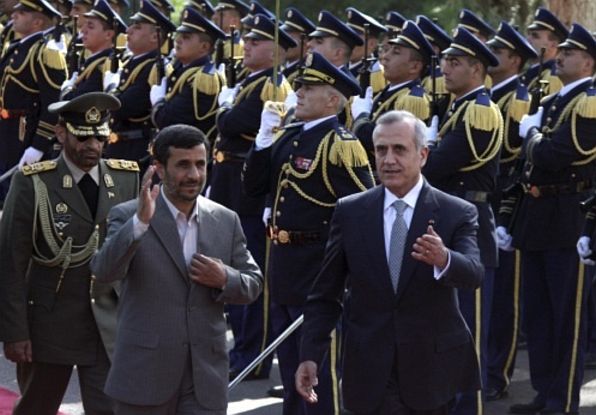
So how truly significant is it that Iran’s president is currently now enjoying all the honors of a visiting head of state (even though he isn’t one)?
Rhami Khouri puts the drama in perspective and says:
[Ahmadinejad’s] visit represents a blow to Washington’s strategy of bringing Lebanon firmly into its orbit.
For most Arab governments, the Iranian-Hizbullah connection represents everything they fear for their own incumbency: armed Shiite movements inside countries where mostly Sunni Muslim Arabs dominated public life; popular resistance movements that do battle according to their own strategic calculations; Iranian meddling in Arab affairs; and, Arab mass movements that connect with compatriots across the region in their common opposition to and defiance of conservative Arabs, Israel and the US itself.
So at some levels it is understandable why so many people in the region and abroad are making a lot of noise about the Iranian president’s visit to Lebanon. At another level, though, that of substance vs. symbolism, this is a pretty routine event that does not necessarily break new ground, but mainly reflects and emphasizes existing political realities that generate frenzied, nearly hysterical, reactions on both sides.
The irony is that by elevating his importance on the international stage while his real challenges come from home, no one serves Iran’s president as more effective publicists than do Israel and the United States.
Ahmadinejad has never been more unpopular in Iran, not only with the public but also his conservative allies and the clergy. By going to Lebanon, he is going to one of the last places where the Islamic Republic still has genuine support. When he speaks in Bint Jbeil, unlike in Iran, schools won’t be closed and civil servants won’t be threatened with dismissal unless they attend the president’s speech. People will voluntarily turn up because they genuinely support the Islamic republic and will pay respect to almost any senior Iranian politician.
By going to Lebanon, Ahmadinejad will primarily be using the occasion to try to strengthen his support back home with the public, and with the Revolutionary Guards, whose support is important to him. He will also be trying to outshine his rivals such as Ali Larijani and Hashemi Rafsanjani by using the trip to say that he is the true face of Iran abroad, and not them.
This development will also benefit supreme leader Ali Khamenei, who is most probably very concerned about Ahmadinejad’s flagging popularity.
What is important to note is that such a visit did not take place when Khatami was president. If anyone deserves to be in southern Lebanon, it is him, and not Ahmadinejad. Israel evacuated southern Lebanon in May 2000 on Khatami’s watch, not Ahmadinejad’s.
However, Khamenei did not send Khatami to southern Lebanon because he was not worried about his unpopularity. In fact, compared with Ahmadinejad, he was far more popular. The opposite is true about Ahmadinejad and this is why Khamenei, for the sake of his regime, is sending him there.
The RealNews Network has an interesting report on Ahmadinejad’s posture as an anti-capitalist.
This website or its third-party tools use cookies, which are necessary to its functioning. By closing this banner, you agree to the use of cookies.

In a quiet street in the Sheikh Jarrah district of occupied East Jerusalem 88-year-old Rifka al-Kurd is explaining how she came to live in the house she and her husband built as Palestinian refugees in the 1950s. As she speaks, three young ultra-orthodox Jewish settlers swagger in to stake their claim to the front part of the building, shouting abuse in Hebrew and broken Arabic: “Arab animals”, “shut up, whore”.




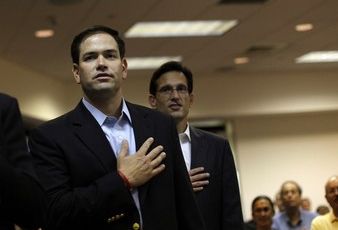 First they took Washington, now they’ll take Jerusalem? With victory in the congressional elections less than a day old, Florida Senator Marco Rubio (Rep.) who considers himself a ‘Tea Party’ member, is set to arrive in Israel on Sunday. Rubio’s visit so soon after the election win is a move that strengthens assessments that the congress in its current form will continue where it left off – at least where Israel is concerned.
 When
When 
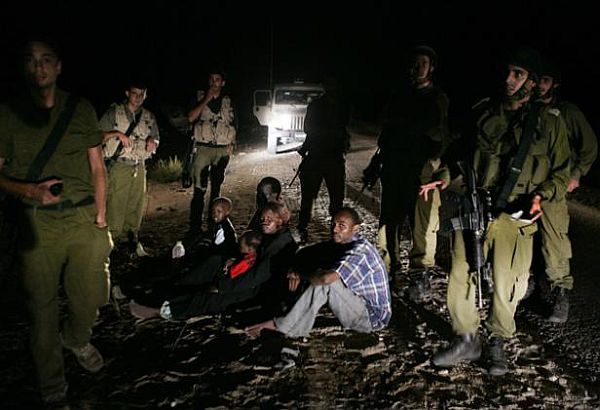

 Israeli police and stone-throwing Arabs clashed in northern Israel yesterday as a group of Jewish right-wing extremists tried to march through the Arab-Israeli town of Umm al Fahm.
 The police say they launched it as soon as the first stones were thrown. One Israeli Arab Knesset member claims the stones were thrown by undercover Israeli police masquerading as Arabs in the crowd.
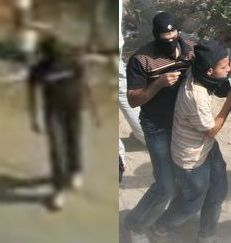 The undercover officer shown in the image above with his right arm firmly gripped around a teenager’s neck appears to be the same individual who can be seen at the beginning of the video above who 10 seconds in, can be seen at the road’s edge apparently picking up a stone to throw at Israeli police.

 Even if Israel stands out as the preeminent military power in the Middle East, it has only been able to acquire this status through its dependence on the United States. It often masks that dependence by behaving like a brash teenager who is secretly terrified by the thought of leaving home.