Carlo Strenger has an interesting op-ed in Haaretz. It’s worth reading the whole piece (part of which appears below). Comments of mine follow.
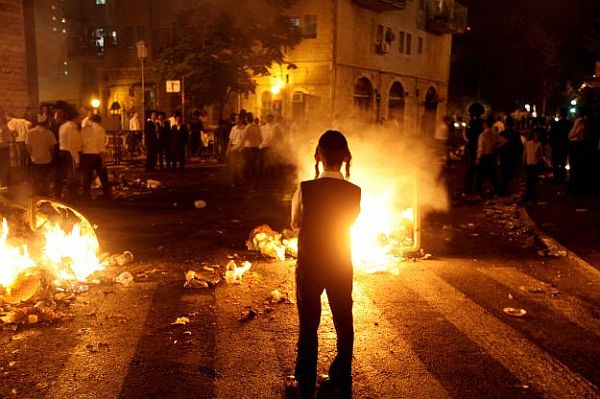
There is nothing left to say about how bad, harmful and useless the new citizenship law is: Labor Party Minister Isaac Herzog has warned that it is another step towards fascism; legal experts like Mordechai Kremnitzer have pointed out that it doesn’t serve any identifiable purpose except making Arabs feeling even less at home in Israel. Likud Ministers Benny Begin and Dan Meridor have pointed out how harmful the law is for the relation with Israeli Arabs and for Israel’s standing in the world.
Both Shas and Yisrael Beiteinu have already declared that they see this law as just a first step in a general attempt towards ensuring loyalty to the state by legislation. The time has come to ask what really stands behind this rising tide. The obvious answer seems to be that it is directed against both Israel’s Arab citizenry, whom Avigdor Lieberman is alienating and insulting almost every day, and Palestinians who want to gain Israeli citizenship.
But I think that this is not the whole story. Consider this strangest of alliances between Yisrael Beiteinu and Shas; one is a completely secular, ultra-nationalist, the other an ultra-Orthodox party. What do they have in common? Why are they lately so effectively cooperating with each other, together with other extreme-right parties?
I believe that what unites them is less a fear of Israel’s enemies (and Israel does have enemies). It is a visceral hatred for the Western values and the liberal ethos. They all hate freedom; they all hate the idea of critical, open discourse, in which ideas are discussed according to their merit. They keep criticizing what they see as the liberal bias of the media and academia, and they have made sustained attempts to curtail freedom of speech at the universities.
Lieberman’s disdain for these ideas breaks through at every possible moment: lately he has insulted French Foreign Minister Bernard Kouchner and Spanish Foreign Minister Miguel Moratinos, telling them they should take care of their own problems in Europe before they come to advise Israel. This has been typical of him for a long time: Lieberman thinks that Israel should turn east; that it should no longer define itself as a Western country, and should finally shake off Israel’s original commitment to be part of the Western world.
Shas has made clear for decades that it just plays along with democracy; that it doesn’t believe in the idea of citizens thinking critically: they believe that only their spiritual leader, Ovadia Yossef, must determine what is right and what is wrong. Other ultra-rightists have been feeling for a long time that the commitment to universal values is undermining their program for the greater Israel in which Palestinians should have no political rights.
They cannot stand the idea that a liberal democracy should be based on rational legislation and is open to criticism by all. They are furious that tribal loyalty is not above criticism. Just lately, national religious rabbis have claimed that studying at universities is a danger for young religious people, because they internalize too many enlightenment values.
We are really talking about a right-wing anti-liberal coalition united by an instinctive hatred against the idea that there are universal standards of rationality and of morality. They do not want to hear criticism of their worldviews that relies on ideas that have, for a long time, been common to the free world. What we are seeing is a fight about Israel’s cultural and political identity.
For many liberal Israelis, the proposed new citizenship law represents a red line which once crossed will lead inexorably to the end of Israeli democracy. The foundation of that fear is the conviction that Israel has a democracy to lose.
Point out the contradictions inherent in the idea of a Jewish democracy, which by its nature grants preferential rights to Jews, and the liberal-Zionist shrug is to say, it’s a work in progress. No democracy is perfect.
Still, a real threshold has emerged and it consists above all in matters of perception: Israel is becoming a state which no longer serves and is instead threatening the needs of liberal Jewish identity — an identity in which neither half is meant to subvert the other.
Israel is ceasing to be a Jewish state and turning into a state for some Jews.
One could argue that this has long been the case, since for most Jews Israel is either an imaginary life insurance policy or of no particular relevance to their own lives. Even so, what has sustained Israel is the importance of the idea of a Jewish state in the minds of most Jews, irrespective of where they choose to live.
In this context, the Palestinians are irrelevant. They are peripheral to a conversation that has less to do with contested rights than it has to do with contested Jewish identity.
No wonder the peace process has gone nowhere. The wrong parties have been engaged in negotiations.
There is no Israeli consensus because there is no Jewish consensus. The tribe no longer exists (if it ever did) but rather than confront that fact, it has been hidden behind a veil: the unquestionable need for a Jewish state.
As the need for a Jewish state becomes untethered from Jewish identity, no wonder there is a drive to chain it to the law.
Israeli Arab MK Ahmed Tibi was quick Sunday to condemn the Cabinet’s approval of a controversial proposal requiring non-Jews seeking citizenship to pledge allegiance to Israel as a Jewish and democratic state.
“The government of Israel has become subservient to Yisrael Beiteinu and its fascist doctrine,” said Tibi. “No other state in the world would force its citizens or those seeking citizenship to pledge allegiance to an ideology.”
“Israel has proven that it is not equal and is a democracy for Jews and not for Arabs,” he added.
The amendment is one of the promises Prime Minister Benjamin Netanyahu made to Yisrael Beitenu in the coalition agreements. Since coming into government Yisrael Beitenu has advanced a long list of “loyalty” laws, which many consider to be discriminatory against Israel’s Arab citizens.
Remember this day. It’s the day Israel changes its character. As a result, it can also change its name to the Jewish Republic of Israel, like the Islamic Republic of Iran. Granted, the loyalty oath bill that Prime Minister Benjamin Netanyahu is seeking to have passed purportedly only deals with new citizens who are not Jewish, but it affects the fate of all of us.
From now on, we will be living in a new, officially approved, ethnocratic, theocratic, nationalistic and racist country. Anyone who thinks it doesn’t affect him is mistaken. There is a silent majority that is accepting this with worrying apathy, as if to say: “I don’t care what country I live in.” Also anyone who thinks the world will continue to relate to Israel as a democracy after this law doesn’t understand what it is about. It’s another step that seriously harms Israel’s image.
In June 2006, Elliot Doxer, an employee at an internet company in Boston, sent an email to a foreign consulate. “I am a Jewish American who lives in Boston,” he allegedly wrote. “I know you are always looking for information and I am offering the little I may have.” He also wrote that he wanted “to help our homeland and our war against our enemies.”
Let’s take a wild guess: he was referring to the Jewish homeland and communicating with the Israeli consulate. That’s the assumption made by the Jerusalem Post and just about everyone else — even though court documents only refer to “Country X.”
As the victim of an FBI sting operation, Doxer now faces the prospect of 20 years in jail and a $250,000 fine if convicted.
But here’s the interesting bit. In response to Doxer’s approach, the consulate informed US law enforcement officials and then assisted the FBI with its investigation.
So what’s a would-be spy to do?
Don’t trust your local Israeli consulate?
Don’t ask for compensation?
Make sure you have extremely valuable intelligence?
Acquire Israeli citizenship before you do anything else?
The next Jonathan Pollard might now be reconsidering his options.
The U.S. has been wooing Netanyahu for weeks with offers including a squadron of F-35 fighters, support for a long-term Israeli troop presence in a new Palestinian state, and a pledge to veto any anti-Israel resolutions passed by the United Nations Security Council. The U.S. also is offering access to its satellites that could provide early warning of attacks.
To the Palestinians, the White House is pledging support for their position on the exact location of borders for a future state in exchange for a promise to continue negotiating even if Israel refuses to extend the construction moratorium.
Although the Obama administration was expected to eventually give out incentives to keep the negotiations alive, diplomats and other observers say they are surprised that it has offered so much, so early for such a small victory: a commitment by both sides to keep talking.
“From the left to the right, people are saying that the administration is looking desperate,” said Robert Danin, a former U.S. official and an advisor to former British Prime Minister Tony Blair, an envoy to the region for the United Nations, U.S., European Union and Russia.
Making a hint that they will be used to bomb Iran, he described them as being “one of the answers” for dealing with the “problem” of Tehran.
Israel will get the jets at a discount, pay for them with US tax dollars (through recession-proof military aid), while also likely profiting from F-35 production — it has expressed an interest in manufacturing 25% of the wings of the more than 3,000 aircraft Lockheed expects to build.
The jets won’t be delivered until about 2016, but by that point Israel’s war-mongers no doubt feel optimistic that there will be a war-friendly Republican administration in place — though whether GOP control of the White House is necessary to serve Israel’s needs, is highly debatable.
The disclosure of the details of a letter reportedly sent by President Barack Obama last week to Benjamin Netanyahu, the Israeli prime minister, will cause Palestinians to be even more skeptical about U.S. and Israeli roles in the current peace talks.
According to the leak, Obama made a series of extraordinarily generous offers to Israel, many of them at the expense of the Palestinians, in return for a single minor concession from Netanyahu: a two-month extension of the partial freeze on settlement growth.
A previous 10-month freeze, which ended a week ago, has not so far been renewed by Netanyahu, threatening to bring the negotiations to an abrupt halt. The Palestinians are expected to decide whether to quit the talks over the coming days.
Netanyahu was reported last week to have declined the U.S. offer.
The White House has denied that a letter was sent, but, according to the Israeli media, officials in Washington are privately incensed by Netanyahu’s rejection.
The disclosures were made by an informed source: David Makovsky, of the Washington Institute for Near East Policy, a close associate of Dennis Ross, Obama’s chief adviser on the Middle East, who is said to have initiated the offer.
The letter’s contents have also been partly confirmed by Jewish U.S. senators who attended a briefing last week from Ross.
According to Makovsky, in return for the 60-day settlement moratorium, the U.S. promised to veto any UN Security Council proposal on the Israeli-Palestinian conflict over the next year, and committed to not seek any further extensions of the freeze. The future of the settlements would be addressed only in a final agreement.
The White House would also allow Israel to keep a military presence in the West Bank’s Jordan Valley, even after the creation of a Palestinian state; continue controlling the borders of the Palestinian territories to prevent smuggling; provide Israel with enhanced weapons systems and security guarantees and increase its billions of dollars in annual aid; and create a regional security pact against Iran.
A USB memory stick carrying the Stuxnet malware is believed to have provided intruders with access to Iran’s nuclear program. The same technique was used in November 2008 to break into CENTCOM, providing a foreign government with unfiltered access to the Pentagon’s command of the wars in Iraq and Afghanistan. Did both attacks come from the same source?
Cyber warfare has quietly grown into a central pillar of Israel’s strategic planning, with a new military intelligence unit set up to incorporate high-tech hacking tactics, Israeli security sources said on Tuesday.
Israel’s pursuit of options for sabotaging the core computers of foes like Iran, along with mechanisms to protect its own sensitive systems, were unveiled last year by the military intelligence chief, Major-General Amos Yadlin.
The government of Prime Minister Benjamin Netanyahu has since set cyber warfare as a national priority, “up there with missile shields and preparing the homefront to withstand a future missile war”, a senior source said on condition of anonymity.
Back in 1997, when the US did not overtly support political assassinations, President Clinton intervened to save the life of Khalid Meshaal. The Hamas political bureau chief had been poisoned by Mossad operatives (carrying stolen Canadian passports) on the streets of Jordan’s capital, Amman.
Clinton wasn’t trying to help Hamas but knew that a peace treaty he had helped broker between Israel and Jordan would be in jeopardy if Prime Minister Netanyahu thought he could disregard the sovereignty of Jordan and carry out assassinations with impunity. Likewise, neither King Hussein nor the Canadian government believed that Israeli actions showing a flagrant disregard for the authority of their respective governments could go unanswered.
Netanyahu would probably have found Clinton’s pressure unpersuasive were it not for the fact that the Israeli operatives had already been arrested. In exchange for their release, the Israelis supplied the antidote that saved Meshaal’s life while also releasing the Hamas spiritual leader Sheikh Ahmed Yassin.
Then came 9/11.
Before long, Yassin had been assassinated, the US was using Israeli methods of torture in its campaign against an amorphous Islamic threat, Israel’s own war crimes were sanctioned by the US in the name of the war on terrorism, and the use of stolen foreign passports by Mossad agents committing murder on foreign soil provoked nothing more than a diplomatic slap on the wrists.
The willingness of this and the previous administration to allow Israel to disregard international law shows that even if the Israel lobby can no longer flourish like a night flower, its power is barely diminished. Even so, the appearance of the Stuxnet malware should be a wake-up call to every government around the world that refuses to place Israel’s national interests above its own.
In its conception, Stuxnet can be viewed very much like a targeted killing — but one designed to attack silently and leave no trace of its origin.
It’s creators understood that they had designed an exceedingly dangerous weapon and so they made sure its damage could be contained. But it seems not to have worked according to plan and so caution got tossed out of the window. Apparently, Israel did what it has done so many times before: pursued what it regarded as its own interests with an utter disregard for the international consequences.
The original infection method, which relied on infected USB drives, included a counter that limited the spread to just three PCs, said [Liam] O Murchu [operations manager with Symantec’s security response]. “It’s clear that the attackers did not want Stuxnet to spread very far,” he said. “They wanted it to remain close to the original infection point.”
O Murchu’s research also found a 21-day propagation window; in other words, the worm would migrate to other machines in a network only for three weeks before calling it quits.
Those anti-propagation measures notwithstanding, Stuxnet has spread widely. Why?
Kaspersky’s [Roel] Schouwenberg [a senior antivirus researcher] believes it’s because the initial attack, which relied on infected USB drives, failed to do what Stuxnet’s makers wanted.
“My guess is that the first variant didn’t achieve its target,” said Schouwenberg, referring to the worm’s 2009 version that lacked the more aggressive propagation mechanisms, including multiple Windows zero-day vulnerabilities. “So they went on to create a more sophisticated version to reach their target.”
That more complex edition, which O Murchu said was developed in March of this year, was the one that “got all the attention,” according to Schouwenberg. But the earlier edition had already been at work for months by then — and even longer before a little-known antivirus vendor from Belarus first found it in June. “The first version didn’t spread enough, and so Stuxnet’s creators took a gamble, and abandoned the idea of making it stealthy,” said Schouwenberg.
In Schouwenberg’s theory, Stuxnet’s developers realized their first attempt had failed to penetrate the intended target or targets, and rather than simply repeat the attack, decided to raise the ante.
“They spent a lot of time and money on Stuxnet,” Schouwenberg said. “They could try again [with the USB-only vector] and maybe fail again, or they could take the risk of it spreading by adding more functionality to the worm.”
O Murchu agreed that it was possible the worm’s creators had failed to infect, and thus gain control, of the industrial systems running at their objective(s), but said the code itself didn’t provide clear clues.
What is clear, O Murchu said in a news conference Friday morning, is that Stuxnet evolved over time, adding new ways to spread on networks in the hope of finding specific PLCs (programming logic control) hardware to hijack. “It’s possible that [the attackers] didn’t manage to get to all of their targets [with the earlier version],” O Murchu said. “The increased sophistication of Stuxnet in 2010 may indicate that they had not reached their target.”
With the proliferation of Stuxnet, Schouwenberg said that the country or countries that created the worm may have themselves been impacted by its spread. But that was likely a calculated risk the worm’s developers gladly took.
And that risk may have been quite small. “Perhaps they knew that their own critical infrastructure wouldn’t be affected by Stuxnet because it’s not using Siemens PLCs,” Schouwenberg said.
The danger now posed by Stuxnet is not simply through its direct proliferation but by virtue of the fact that it provides a blueprint that can be adapted by other parties who would otherwise lack the resources to create malware this sophisticated from scratch.
What might have been conceived as a tool to prevent the creation of a weapon of mass destruction could itself be turned into a WMD.
“Stuxnet opened Pandora’s box,” said Ralph Langner, a German researcher whose early analysis of the worm’s ability to target control systems raised public awareness of the threat. “We don’t need to be concerned about Stuxnet, but about the next-generation malware we will see after Stuxnet.”
Sean McGurk, director of the U.S. National Cybersecurity and Communications Integration Center at the Department of Homeland Security, said that the department posted its first report to industry recommending steps to mitigate the effects of Stuxnet on July 15. But “not even two days later,” he said, a hacker Web site posted the code so that others could use it to exploit the vulnerabilities in Microsoft.
“So we know that once the information is out in the wild, people are taking it and they’re modifying it,” he said.
In other words, what started as an Israeli cyber attack on nuclear installations in Iran could end up crashing the US powergrid or causing havoc anywhere else on the globe.
Even before Stuxnet loomed over the horizon, serious warnings were being issued about the United States’ vulnerability to a crippling cyber attack, yet thus far none of those raising the alarm have pointed to the ways in which Israel’s cyber warfare capabilities may now indirectly or directly threaten the United States and its interests.
– – –
Late last year, 60 Minutes reported on America’s vulnerability to a major cyber attack.
Ever since speculation began, suggesting that Israel is the source of the Stuxnet malware, there has been a buzz of excitement in the Zionist corner of the blogosphere. The DEBKAfile — trusted source for pro-Israel fantasists all over the world — declared that if it turns out that millions of Iranian industrial units have been hit, “this cyber weapon attack on Iran would be the greatest ever.”
Glee at such a prospect is not shared by observers who lack the Zionist pathological obsession with Iran.
Stephen Spoonamore, a veteran cybersecurity consultant interviewed by NPR said: “I can think of very few stupider blowback decisions” than to release code that controls most of the worlds’ hydroelectric dams or many of the world’s nuclear plants or many of the world’s electrical switching stations.
The Stuxnet computer worm has wreaked havoc in China, infecting millions of computers around the country, state media reported this week.
Stuxnet is feared by experts around the globe as it can break into computers that control machinery at the heart of industry, allowing an attacker to assume control of critical systems like pumps, motors, alarms and valves.
It could, technically, make factory boilers explode, destroy gas pipelines or even cause a nuclear plant to malfunction.
The virus targets control systems made by German industrial giant Siemens commonly used to manage water supplies, oil rigs, power plants and other industrial facilities.
“This malware is specially designed to sabotage plants and damage industrial systems, instead of stealing personal data,” an engineer surnamed Wang at antivirus service provider Rising International Software told the Global Times.
“Once Stuxnet successfully penetrates factory computers in China, those industries may collapse, which would damage China’s national security,” he added.
Another unnamed expert at Rising International said the attacks had so far infected more than six million individual accounts and nearly 1,000 corporate accounts around the country, the official Xinhua news agency reported.
Jeffrey Carr, author of “Inside Cyber Warfare,” describes what he believes is the first example of Stuxnet’s destructive power: the loss of India’s INSAT-4B communications satellite which shut down in July. The satellite’s control systems use Siemens S7-400 PLC and SIMATIC WinCC software, both of which are targeted by Stuxnet.
If speculation that Stuxnet was created by Israel has been driven by the circumstantial evidence that Israel’s nemesis Iran appears to have been the primary target, there is now some subtle but concrete evidence again pointing in Israel’s direction.
Buried in Stuxnet’s code is a marker with the digits “19790509” that the researchers believe is a “do-not infect” indicator. If the marker equals that value, Stuxnet stops in its tracks, and does not infect the targeted PC.
The researchers — Nicolas Falliere, Liam O Murchu and Eric Chen — speculated that the marker represents a date: May 9, 1979.
“While on May 9, 1979, a variety of historical events occurred, according to Wikipedia “Habib Elghanian was executed by a firing squad in Tehran sending shock waves through the closely knit Iranian Jewish community,” the researchers wrote.
Elghanian, a prominent Jewish-Iranian businessman, was charged with spying for Israel by the then-new revolutionary government of Iran, and executed May 9, 1979.
Deep inside the computer worm that some specialists suspect is aimed at slowing Iran’s race for a nuclear weapon lies what could be a fleeting reference to the Book of Esther, the Old Testament tale in which the Jews pre-empt a Persian plot to destroy them.
That use of the word “Myrtus” — which can be read as an allusion to Esther — to name a file inside the code is one of several murky clues that have emerged as computer experts try to trace the origin and purpose of the rogue Stuxnet program, which seeks out a specific kind of command module for industrial equipment.
Not surprisingly, the Israelis are not saying whether Stuxnet has any connection to the secretive cyberwar unit it has built inside Israel’s intelligence service. Nor is the Obama administration, which while talking about cyberdefenses has also rapidly ramped up a broad covert program, inherited from the Bush administration, to undermine Iran’s nuclear program. In interviews in several countries, experts in both cyberwar and nuclear enrichment technology say the Stuxnet mystery may never be solved.
There are many competing explanations for myrtus, which could simply signify myrtle, a plant important to many cultures in the region. But some security experts see the reference as a signature allusion to Esther, a clear warning in a mounting technological and psychological battle as Israel and its allies try to breach Tehran’s most heavily guarded project. Others doubt the Israelis were involved and say the word could have been inserted as deliberate misinformation, to implicate Israel.
The same report cites Shai Blitzblau, the technical director and head of the computer warfare laboratory at Maglan, an Israeli company specializing in information security, who said he was “convinced that Israel had nothing to do with Stuxnet.”
“We did a complete simulation of it and we sliced the code to its deepest level,” he said. “We have studied its protocols and functionality. Our two main suspects for this are high-level industrial espionage against Siemens and a kind of academic experiment.”
Did Blitzblau present his findings at this week’s VB Conference in Vancouver where Stuxnet was the focus of attention? No — which is not surprising given his vacuous claim to have studied the code at its deepest level while other experts say it will take months to penetrate the thousands of lines of code contained in a 500kB piece of software.
As for why Israeli programmers would have inserted clues about about authorship deep inside the malware, the most obvious explanation would be the most prosaic: pride.
Even when the utmost secrecy is called for, there are those who cannot resist the temptation to leave their mark.
As for the significance of another finding — June 24, 2012 is the “kill date” after which the worm will refuse to execute — again, we can only speculate.
Is this the cut-off point for Israel’s campaign of cyber warfare against Iran after which will come the time for real war? Right in the run up to the 2012 US presidential election.
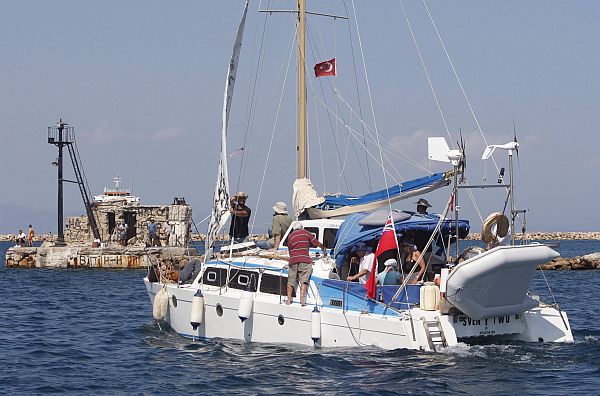
If many Israelis thought the approach of the Mavi Marmara flotilla looked like an imminent attack by a Turkish armada, a British-flagged catamaran carrying nine Jewish activists on their way to Gaza surely posed no threat to the Jewish state — or did it?
The IDF couldn’t take any chances and so as the Irene approached Gaza early today, Israeli commandos intercepted the latest waterborne menace and took over the boat, thankfully without killing anyone.
“The boarding of the yacht was without incident, and no violence of any kind was used by neither the passengers on board nor the Israel naval forces,” the IDF Spokesperson blog declared.
Israeli activist and former Israel Air Force pilot Yonatan Shapira saying that there were “no words to describe what we went through during the takeover.”
Shapira said the activists, who he said displayed no violence, were met with extreme IDF brutality, adding that the soldiers “just jumped us, and hit us. I was hit with a taser gun.”
“Some of the soldiers treated us atrociously,” Shapira said, adding that he felt there was a “huge gap between what the IDF spokesman is saying happened and what really happened.”
Meanwhile, Yossi Levy, an Israeli foreign ministry spokesman who has been carefully trained in the Avigdor Lieberman school of diplomacy encapsulated the government’s position in a string of insults.
The Foreign Ministry expressed its anger against the Israelis and Jews who took part in the sail. According to a ministry official, “They poured fuel into the bonfire of hatred against Israel worldwide. We don’t expect Israelis to be patriotic, but they should definitely not act as Hamas followers.”
The official criticized former pilot Yonatan Shapira and the Holocaust survivor who took part in the flotilla.
“This former pilot, who has joined the ranks of Hamas and sprays hateful graffiti [“FreePalestine“] on the walls of the Warsaw Ghetto, is not a pilot but an astronaut. A Holocaust survivor who sanctifies the name of the Jews’ murderers and takes time to justify those who don’t accept Israel’s right for sovereignty has probably not learned anything from the terrible past.”
Reuben Moscowitz begged to differ as he expressed disbelief that “Israeli soldiers would treat nine Jews this way. They just hit people.”
“I as a Holocaust survivor cannot live with the fact that the State of Israel is imprisoning an entire people behind fences,” Moscowitz said, adding that “it’s just immoral.”
“What happened to me in the Holocaust wakes me up every night and I hope we don’t do the same thing to our neighbors,” Moscowitz said, adding that he was comparing “what I went through during the Holocaust to what the besieged Palestinian children are going through.”
An AFP report earlier today reveals that the Stuxnet malware has been found at Iran’s nuclear power plant at Bushehr. (All the blockquotes below are from the AFP report.)
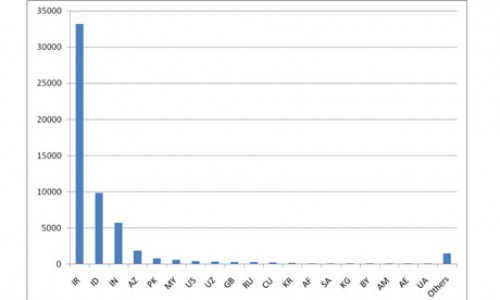
Iranian officials confirm that 30,000 industrial computers in Iran have been hit by Stuxnet yet deny that Bushehr was among those infected.
That might be what Iranian officials believe, but whether it’s a belief based on fact is another matter.
As we get further into this report, it becomes apparent there is a high probability both that Bushehr has been penetrated and that the malware may still be active.
Siemens said its software has not been installed at the plant, and an Iranian official denied the malware may have infected nuclear facilities.
Siemens might not know that its software was installed at the plant, but thanks to a UPI photograph, we know that Bushehr control systems do indeed run on Siemens’ WinCC SCADA system. The warning shown below says: “WinCC Runtime License: Your software license has expired. Please obtain a valid license.”
This is what Ralph Langner, a German industrial security expert, saw as a red flag indicating that the plant is vulnerable to a cyber attack.
“This virus has not caused any damage to the main systems of the Bushehr power plant,” Bushehr project manager Mahmoud Jafari said on Iran’s Arabic-language Al-Alam television network.
“All computer programmes in the plant are working normally and have not crashed due to Stuxnet,” said Jafari, adding there was no problem with the plant’s fuel supply.
The official IRNA news agency meanwhile quoted him as saying the worm had infected some “personal computers of the plant’s personnel.”
And no infected personal computers have been hooked into the plants control system?
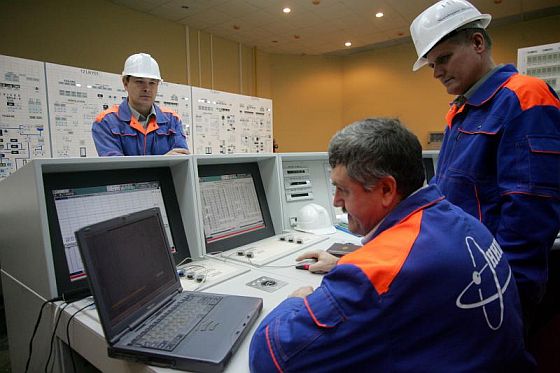
As indicated in this photograph showing Russian contractors inside Bushehr, the path from a personal computer to the plant’s control system is short and direct.
As for the fact that Bushehr’s control system has not crashed, the fact that the project manager cites this as evidence that the system is malware-free suggests that he does not understand how Stuxnet is designed. Stuxnet monitors process conditions and until those conditions have been met, everything should work fine. This is not like a virus that slows down an operating system.
Given the inside knowledge that Stuxnet’s creators required, it seems quite likely that the moment they would want it to kick into action — assuming that Bushehr was the intended target — would be a moment at which a catastrophic system failure could be attributed to a flaw in the facility’s construction, design or operation. A failure, for instance, as the plant approaches its intended full operational generation capacity. The 1000 megawatt plant is expected to have reached only 40% capacity by the end of December.
Telecommunications minister Reza Taqipour said “the worm has not been able to penetrate or cause serious damage to government systems.”
Again, this statement suggests a lack of understanding about Stuxnet’s highly targeted design and the fact that it is designed not to cause damage elsewhere.
Mahmoud Liayi, head of the information technology council at the ministry of industries said:
…industries were currently receiving systems to combat Stuxnet, while stressing Iran had decided not to use anti-virus software developed by Siemens because “they could be carrying a new version of the malware.”
“When Stuxnet is activated, the industrial automation systems start transmitting data about production lines to a main designated destination by the virus,” Liayi said.
“There, the data is processed by the worm’s architects and then engineer plots to attack the country.”
If this is the official consensus, Iranian facilities such as Bushehr are as vulnerable now as they were before anyone knew about Stuxnet. Liayi’s statement suggests that Stuxnet is being viewed as a tool of espionage designed to facilitate rather than execute sabotage.
In an interview on Bloomberg TV, Richard Falkenrath suggested that Israel is the most likely source of the Stuxnet malware which seems designed to cripple industrial facilities in Iran.
Falkenrath is currently the Deputy Commissioner of Counter-Terrorism for the NYPD and held several positions in the George W Bush White House including Deputy Assistant to the President and Deputy Homeland Security Advisor.
The Associated Press says that experts from Iran’s nuclear agency met this week to discuss how to combat the Stuxnet attack on Iranian facilities, according to the semi-official ISNA news agency.
The director of the Information Technology Council of the Industries and Mines Ministry has announced that the IP addresses of 30,000 industrial computer systems infected by this malware have been detected, the Mehr New Agency reported on Saturday.
“An electronic war has been launched against Iran,” Mahmoud Liaii added.
“This computer worm is designed to transfer data about production lines from our industrial plants to (locations) outside of the country,” he said.
He also announced that a working group composed of representatives from the Communications and Information Technology Ministry, the Industries and Mines Ministry, and the Passive Defense Organization has been set up to find ways to combat the spyware.
Graph shows concentration of Stuxnet-infected computers in Iran as of August. Source: Symantec
Eugene Kaspersky, co-founder and chief executive officer of Kaspersky Lab, says that the creation of Stuxnet marks the beginning of the new age of cyber-warfare.
Speaking at the Kaspersky Security Symposium with international journalists in Munich, Germany, Kaspersky described Stuxnet as the opening of “Pandora’s Box.”
“This malicious program was not designed to steal money, send spam, grab personal data, no, this piece of malware was designed to sabotage plants, to damage industrial systems,” he said.
“I am afraid this is the beginning of a new world. [The] 90’s were a decade of cyber-vandals, 2000’s were a decade of cybercriminals, I am afraid now it is a new era of cyber-wars and cyber-terrorism,” Kaspersky added.
Among industrial security experts who are convinced that Iran is the target of the Stuxnet attack, a debate has opened up around which facility the malware was designed to strike.
Frank Rieger, a German researcher with GSMK, a Berlin encryption firm, suggests that the Natanz enrichment facility looks like the most likely target. He laid out his reasoning to the Christian Science Monitor.
• Stuxnet had a halt date. Internal time signatures in Stuxnet appear to prevent it from spreading across computer systems after July 2009. That probably means the attack had to be conducted by then – though such time signatures are not certain.
• Stuxnet appears designed to take over centrifuges’ programmable logic controllers. Natanz has thousands of identical centrifuges and identical programmable logic controllers (PLCs), tiny computers for each centrifuge that oversee the centrifuge’s temperature, control valves, operating speed, and flow of cooling water. Stuxnet’s internal design would allow the malware to take over PLCs one after another, in a cookie-cutter fashion.
“It seems like the parts of Stuxnet dealing with PLCs have been designed to work on multiple nodes at once – which makes it fit well with a centrifuge plant like Natanz,” Rieger says. By contrast, Bushehr is a big central facility with many disparate PLCs performing many different functions. Stuxnet seems focused on replicating its intrusion across a lot of identical units in a single plant, he says.
Natanz also may have been hit by Stuxnet in mid-2009, Rieger says. He notes that “a serious, recent, nuclear accident” was reported at that time on WikiLeaks, the same organization that recently revealed US Afghanistan-war documents. About the same time, the BBC reported that the head of Iran’s nuclear agency had resigned.
Lending some credence to the notion that Stuxnet attacked more than a year ago, he says, is the International Atomic Energy Agency’s finding of a sudden 15 percent drop in the number of working centrifuges at the Natanz site.
Even though Natanz would seem like a logical target to choose if the objective of the attackers was to disrupt Iran’s nuclear program, Rieger’s inference — that the halt date preventing Stuxnet spreading means the attack had to take place before July 2009 — is questionable, for at least two reasons.
Firstly, given that the designers had a very specific target, their aim is likely to have been to penetrate that target while trying to limit the proliferation of the malware and thus reduce the risks of the operation’s exposure.
As previously reported, another German industrial security expert, Ralph Langner, has speculated that the Bushehr nuclear reactor is the most likely target. He bases this theory on various pieces of circumstantial evidence.
Firstly, it is known that Bushehr uses the Siemens SCADA systems that Stuxnet targets and that access to these systems available to Russian contractors working on the facility would allow the malware to be installed through USB memory sticks.
Secondly, photographic evidence shows that the facility had very weak cyber security.
A journalist’s photo from inside the Bushehr plant in early 2009, which Langner found on a public news website, shows a computer-screen schematic diagram of a process control system – but also a small dialog box on the screen with a red warning symbol. Langner says the image on the computer screen is of a Siemens supervisory control and data acquisition (SCADA) industrial software control system called Simatic WinCC – and the little warning box reveals that the software was not installed or configured correctly, and was not licensed. That photo was a red flag that the nuclear plant was vulnerable to a cyberattack, he says.
“Bushehr has all kinds of missiles around it to protect it from an airstrike,” Langner says. “But this little screen showed anyone that understood what that picture meant … that these guys were just simply begging to be [cyber]attacked.”
The picture was reportedly taken on Feb. 25, 2009, by which time the reactor should have had its cybersystems up and running and bulletproof, Langner says. The photo strongly suggests that they were not, he says. That increases the likelihood that Russian contractors unwittingly spread Stuxnet via their USB drives to Bushehr, he says.
“The attackers realized they could not get to the target simply through the Internet – a nuclear plant is not reachable that way,” he says. “But the engineers who commission such plants work very much with USBs like those Stuxnet exploited to spread itself. They’re using notebook computers and using the USBs to connect to one machine, then maybe going 20 yards away to another machine.”
Langner also cites international concern about the Bushehr reactor becoming operational.
This is a somewhat weaker strand of his argument. After all, the existence of this Russian-fueled reactor was widely seen as a demonstration of the fact that Iran could, it it chooses, have a civilian nuclear energy program without any need for a uranium enrichment program.
There is however another argument that can be made in which Bushehr becomes the target of cyberwarfare, even if it might not be a vital node in Iran’s nuclear program. In this scenario, Stuxnet would not be designed to perform its function until the reactor becomes fully operational. At that point, the malware would not simply stop the reactor working — it would trigger a Chernobyl-type nuclear meltdown.
Why would the attackers want to precipitate such a catastrophic event?
In the hope that such an “accident” would make the Iranian government look unfit to safely operate any kind of nuclear program.
To undermine Iranian domestic support for the program.
To alienate Iran from its Gulf neighbors who would be exposed to the fallout.
When John Bolton was last month melodramatically counting the days left for Israel to launch a missile strike on Bushehr, it was ostensibly because once the plant was fueled the Israelis would no longer be willing to risk the lives of so many in the region. With Gulf shipping lanes also closed down for an indeterminate period after an Israeli strike, the global economic impact would be severe.
On the other hand, in the event that Israel struck but did not fire a single missile and could not be shown to be responsible, the results of its own cost-benefit analysis — vastly different from that of the US — might make a devastating cyber attack on Bushehr seem well worth the risk.
In an analysis of Israel’s expanding cyberwarfare capabilities, Scott Borg, director of the US Cyber Consequences Unit, which advises various Washington agencies on cyber security, told Reuters last year that an Israeli attack on an Iranian nuclear facility could employ “malware loitering unseen and awaiting an external trigger, or pre-set to strike automatically when the infected facility reaches a more critical level of activity.”
The decision by Iranian authorities to announce that they have an ongoing investigation on how to thwart Stuxnet, suggests that they may now also be reassessing the risks of bringing Bushehr online as a fully operational facility.
Postscript: Even though discussion on the whole subject of Stuxnet’s purpose and origin is at this point highly speculative, some readers may view my suggestion that the goal is to cause a Chernobyl-type disaster to be a particularly wild conjecture. Maybe it is, but here’s a little more of my thinking on why that would be a plausible objective.
There is little reason to doubt that Israeli leaders from across the political spectrum are serious in their stated objections to Iran’s nuclear program. (Whether those objections correspond with Iran’s genuine nuclear ambitions is another question, as is the question of whether a nuclear-armed Iran would actually pose an existential threat to Israel.)
Among analysts inside and outside Israel there is a broad consensus that military action aimed at crippling Iran’s nuclear facilities would accomplish no more than cause a setback of a few years in the program. The same applies to sabotage.
Given the broad national support the nuclear program has, there is also reason to doubt that regime change would necessarily result in Iran’s enrichment program being scrapped.
What those who fear a nuclear-armed Iran hope to see is a credible political shift as a result of which Iran’s nuclear intentions are no longer in doubt and are demonstrably peaceful. (Which is to say, an ideal end-state similar to the one adopted by South Africa when it chose to abandon nuclear weapons — an ironic comparison of course, given that it was Israel that helped South Africa become a nuclear-armed state.)
For that reason, coercion (through sanctions) and military force are both potentially counterproductive in that pressure generally produces resistance.
On the other hand, the desired outcome might be reached if the Iranians through their own volition came to the conclusion that the costs of nuclear development outweighed the benefits. A catastrophic “accident” might be instrumental in bringing about a change of perspective through which for Iran as a nation, nuclear power lost most of its appeal.
Needless to say, if such an accident was exposed to be the result of an Israeli cyber attack, the plan would dangerously backfire.
Do intelligence agencies come up with such reckless plans? All the time.
Inveterate gamers will no doubt see another possibility here — that Stuxnet is part of a psy-ops plan designed to provoke a greater fear of catastrophic damage than it can actually cause. Possibly, but to identify and then exploit four Windows vulnerabilities suggests that the creators of this malware were willing to employ every possible resource at their disposal. In other words, they were seriously intent on doing damage — not just provoking fear.
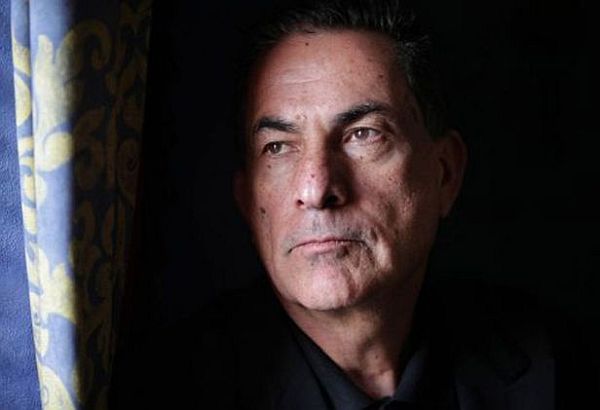
Johann Hari interviews Gideon Levy: “the most hated man in Israel — and perhaps the most heroic.”
Any conversation about the region is now dominated by a string of propaganda myths, [Levy] says, and perhaps the most basic is the belief that Israel is a democracy. “Today we have three kinds of people living under Israeli rule,” he explains. “We have Jewish Israelis, who have full democracy and have full civil rights. We have the Israeli Arabs, who have Israeli citizenship but are severely discriminated against. And we have the Palestinians in the Occupied Territories, who live without any civil rights, and without any human rights. Is that a democracy?”
He sits back and asks in a low tone, as if talking about a terminally ill friend: “How can you say it is a democracy when, in 62 years, there was not one single Arab village established? I don’t have to tell you how many Jewish towns and villages were established. Not one Arab village. How can you say it’s a democracy when research has shown repeatedly that Jews and Arabs get different punishments for the same crime? How can you say it’s a democracy when a Palestinian student can hardly rent an apartment in Tel Aviv, because when they hear his accent or his name almost nobody will rent to him? How can you say Israel is a democracy when? Jerusalem invests 577 shekels a year in a pupil in [Palestinian] East Jerusalem and 2372 shekels a year in a pupil from [Jewish] West Jerusalem. Four times less, only because of the child’s ethnicity! Every part of our society is racist.”
“I want to be proud of my country,” he says. “I am an Israeli patriot. I want us to do the right thing.” So this requires him to point out that Palestinian violence is – in truth – much more limited than Israeli violence, and usually a reaction to it. “The first twenty years of the occupation passed quietly, and we did not lift a finger to end it. Instead, under cover of the quiet, we built the enormous, criminal settlement enterprise,” where Palestinian land is seized by Jewish religious fundamentalists who claim it was given to them by God. Only then – after a long period of theft, and after their attempts at peaceful resistance were met with brutal violence – did the Palestinians become violent themselves. “What would happen if the Palestinians had not fired Qassams [the rockets shot at Southern Israel, including civilian towns]? Would Israel have lifted the economic siege? Nonsense. If the Gazans were sitting quietly, as Israel expects them to do, their case would disappear from the agenda. Nobody would give any thought to the fate of the people of Gaza if they had not behaved violently.”
He unequivocally condemns the firing of rockets at Israeli civilians, but adds: “The Qassams have a context. They are almost always fired after an IDF assassination operation, and there have been many of these.” Yet the Israeli attitude is that “we are allowed to bomb anything we want but they are not allowed to launch Qassams.” It is a view summarised by Haim Ramon, the justice minister at time of Second Lebanon War: “We are allowed to destroy everything.”
After coming away from a dinner hosted by American Jewish leaders for Mahmoud Abbas, Roger Cohen comes away “convinced the United States is on the brink of a diplomatic fiasco.”
Less than a month after President Obama put the imprimatur of a White House ceremony on renewed Israeli-Palestinian talks, the negotiations are close to breakdown. If that happens, as Netanyahu and Abbas know, Obama would look amateurish.
The two leaders need the United States, an incentive to avoid humiliating Obama. But with just a couple of days to the expiration Sunday of an Israeli freeze on settlement construction in the West Bank, both sides are digging in. Despite Obama’s public plea to Netanyahu — “It makes sense to extend that moratorium” — the Israeli government seems to have rejected a formal extension.
That would be a terrible mistake. Obama should fight it until the last minute. His international credibility is on the line.
Cohen regards Netanyahu’s decision on whether he will call for a three-month extension of the settlement “freeze,” “a test case of Israeli seriousness about peace.”
Really?
This is how serious the settlement freeze has been so far.
In the third quarter of 2009, before the restrictions were imposed last November, there were 2,790 settlement homes in various stages of construction, according to Israel’s Central Bureau of Statistics. The number rose to 2,955 in the last quarter of 2009, reflecting a last-minute surge of housing starts in the days leading up to the freeze.
In the first quarter of 2010, with the freeze in full effect, the number stood at 2,517.
That means that even months into the halt, the number of homes under construction had declined by only about 10 percent.
So, the continuation of a modest slow down in settlement expansion for three months will prove Netanyahu’s serious about peace?
Who knew peace could come be promised that easily?
At that point it was already understood that the Stuxnet computer worm was almost certainly targeting Iran since that was the location of 60% of the computer systems affected. Moreover, since the worm targets Siemens SCADA (supervisory control and data acquisition) management systems that control energy utilities, and since its design strongly suggested that it had been created for sabotage, it seemed likely that the specific target was Iran’s nuclear program.
A German team of industrial cyber security experts who have analyzed the way the worm operates now claim that it may have been designed to attack the newly operational Bushehr nuclear reactor.
Ralph Langner envisages that the highly sophisticated attack would have required a preparation team that included “intel, covert ops, exploit writers, process engineers, control system engineers, product specialists, military liaison.”
Since reverse engineering chunks of Stuxnet’s massive code, senior US cyber security experts confirm what Mr. Langner, the German researcher, told the Monitor: Stuxnet is essentially a precision, military-grade cyber missile deployed early last year to seek out and destroy one real-world target of high importance — a target still unknown.
“Stuxnet is a 100-percent-directed cyber attack aimed at destroying an industrial process in the physical world,” says Langner, who last week became the first to publicly detail Stuxnet’s destructive purpose and its authors’ malicious intent. “This is not about espionage, as some have said. This is a 100 percent sabotage attack.”
On his website, Langner lays out the Stuxnet code he has dissected. He shows step by step how Stuxnet operates as a guided cyber missile. Three top US industrial control system security experts, each of whom has also independently reverse-engineered portions of Stuxnet, confirmed his findings to the Monitor.
“His technical analysis is good,” says a senior US researcher who has analyzed Stuxnet, who asked for anonymity because he is not allowed to speak to the press. “We’re also tearing [Stuxnet] apart and are seeing some of the same things.”
Other experts who have not themselves reverse-engineered Stuxnet but are familiar with the findings of those who have concur with Langner’s analysis.
“What we’re seeing with Stuxnet is the first view of something new that doesn’t need outside guidance by a human – but can still take control of your infrastructure,” says Michael Assante, former chief of industrial control systems cyber security research at the US Department of Energy’s Idaho National Laboratory. “This is the first direct example of weaponized software, highly customized and designed to find a particular target.”
“I’d agree with the classification of this as a weapon,” Jonathan Pollet, CEO of Red Tiger Security and an industrial control system security expert, says in an e-mail.
Langner’s research, outlined on his website Monday, reveals a key step in the Stuxnet attack that other researchers agree illustrates its destructive purpose. That step, which Langner calls “fingerprinting,” qualifies Stuxnet as a targeted weapon, he says.
Langner zeroes in on Stuxnet’s ability to “fingerprint” the computer system it infiltrates to determine whether it is the precise machine the attack-ware is looking to destroy. If not, it leaves the industrial computer alone. It is this digital fingerprinting of the control systems that shows Stuxnet to be not spyware, but rather attackware meant to destroy, Langner says.
Langer speculates that Iran’s Bushehr nuclear power plant may have been the Stuxnet target. He also writes: “The forensics that we are getting will ultimately point clearly to the attacked process — and to the attackers. The attackers must know this. My conclusion is, they don’t care. They don’t fear going to jail.”
If Bushehr was indeed the target, it may have presented itself first and foremost as a target of opportunity. From the point of view of governments with an interest in sabotaging Iran’s nuclear program, Bushehr would not be the most attractive target, but access provided to Russian contractors may have made it the easiest target.
Last September, Reuters reported: “Israel has been developing ‘cyber-war’ capabilities that could disrupt Iranian industrial and military control systems.”
So let’s assume that using Stuxnet, Israel has indeed launched the world’s first precision, military-grade cyber missile. What are the implications?
1. Iran has been served notice that not only its nuclear facilities but its whole industrial infrastructure is vulnerable to attack. As Trevor Butterworth noted: “By demonstrating how Iran could so very easily experience a Chernobyl-like catastrophe, or the entire destruction of its conventional energy grid, the first round of the ‘war’ may have already been won.”
2. The perception that it has both developed capabilities and shown its willingness to engage in cyberwarfare, will serve Israel as a strategic asset even if it never admits to having launched Stuxnet.
3. When it comes to cyberwarfare, Israel ranks as a major global power. It’s own tiny infrastructure makes it much less vulnerable to attack than is the sprawling infrastructure of the United States. It’s highly developed military IT industry means that it not only has great domestic human resources but that Israeli IT specialists, through research and employment, have the best possible access to most of the leading development facilities and vendors around the world.
4. As a cyber arms race takes off, we should not imagine that it will be like other arms races where power resides more in capabilities than in the use of those capabilities. “Whereas nuclear weapons have been used twice in human history, cyber weapons are employed daily and there is therefore an existential need to create some form of regulatory system that allows more than implicit deterrence,” says Robert Fry.
5. If AQ Khan demonstrated the ease with which a nuclear proliferation network can operate, the fact that the raw material upon which cyberwarfare is based is arguably the most easily transferable object on the planet — computer code — means that in certain ways the era of cyberwarfare may prove to be more dangerous than the nuclear era.
6. In the strategic landscape of cyberwarfare the most dangerous player may turn out to be a small but highly developed fortress-state that feels threatened by much of the rest of the world; that neither trusts nor is trusted by any of its allies; that sees its own stability enhanced by regional instability; that has seen its own economic fortunes rise while the global economy suffers; and that views with contempt the notion of an international community.
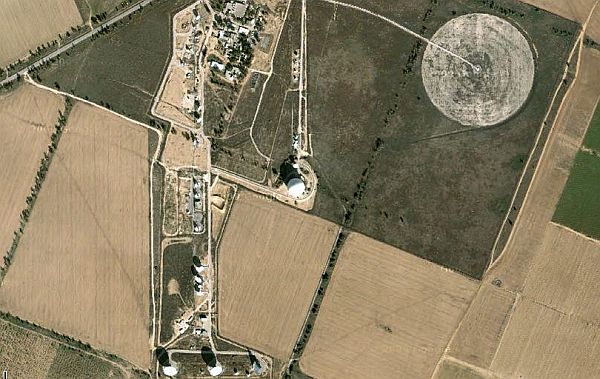
Israel’s most important intelligence-gathering installation is only a 30km drive into the Negev desert from Beersheba prison – where those taking part in the Gaza aid flotilla were briefly detained this June. The base, hidden until now, has rows of satellite dishes that covertly intercept phone calls, emails and other communications from the Middle East, Europe, Africa and Asia. Its antennas monitor shipping and would have spied on the aid ships in the days before they were seized.
Israel’s powerful position in the Middle East is often associated with its armed forces, nuclear weapons arsenal or covert (Mossad) operatives. But just as important is its intelligence gathering – monitoring governments, international organisations, foreign companies, political organisations and individuals. Most of this happens at the installation in the Negev a couple of kilometres to the north of the kibbutz of Urim. Our sources, close to Israeli intelligence, know the base first-hand. They describe lines of satellite dishes of different sizes, and barracks and operations buildings on both sides of the road (the 2333) that leads to the base. High security gates, fences and dogs protect the facility. As you can see on the internet, the satellite images of the base are quite clear. A practised eye easily discerns the signs of an electronic surveillance base. A large circle in the farmland shows the site of a direction-finding antenna (HF/DF) for monitoring shipping.
The Urim base was established decades ago to monitor Intelsat satellites that relay phone calls between countries. It expanded to cover maritime communications (Inmarsat), then rapidly targeted ever more numerous regional satellites. As such, says intelligence specialist Duncan Campbell, it is “akin to the UK-USA pact’s Echelon satellite interception ground stations”. The Echelon system is a network of interception stations around the world, set up in 1996 by the US, Britain, Canada, Australia and New Zealand. Satellite phones used by the Gaza-bound aid ships were easy targets for this hi-tech equipment.
Israel’s Central Bureau of Statistics released numbers today which show that almost a third of the population is under 15 years old.
What can we expect from the next generation?
A new poll reveals how deeply entrenched bigotry is in Israel.
A survey of Israeli teens revealed that most believe that Palestinian Israelis do not currently enjoy equal rights and, according to most of those holding that view, should not be granted equal rights.
Among those 15-18 year old Jewish Israelis polled, 50% said they would object to being placed in a classroom with one or more Palestinian Israelis. 32% do not want to be educated alongside students with special needs and 23% said they would not want gays or lesbians in their class.
96% of the teens want Israel to be a Jewish and democratic state and although almost a quarter of Israelis are not Jewish, 41% of those polled said that Israelis who are opposed to their nation being defined as a Jewish state, should be stripped of their citizenship.
Any glimmers of hope? 24% said they would refuse to perform military service in the West Bank.
Does that reflect significant opposition to the occupation? I suspect not. More likely it is mostly simply another expression of an aversion for Palestinians.
As for reports that Israel’s demographic make-up might be changing due to a surge of new immigrants, it turns out that only 14,572 arrived in 2009, contributing to a modest 1.7% growth in Israel’s Jewish population. At the same time, Zionists who perceive a Palestinian population controlled through occupation as a “demographic threat,” will find no comfort in the fact that Israel’s own Muslim population is growing at 2.8%.
The CIA took an internal poll not long ago about friendly foreign intelligence agencies.
The question, mostly directed to employees of the clandestine service branch, was: Which are the best allies among friendly spy services, in terms of liaison with the CIA, and which are the worst? In other words, who acts like, well, friends?
“Israel came in dead last,” a recently retired CIA official told me the other day.
Not only that, he added, throwing up his hands and rising from his chair, “the Israelis are number three, with China number one and Russia number two,” in terms of how aggressive they are in their operations on U.S. soil.
Israel’s undercover operations here, including missions to steal U.S. secrets, are hardly a secret at the FBI, CIA and other U.S. intelligence agencies. From time to time, in fact, the FBI has called Israeli officials on the carpet to complain about a particularly brazen effort to collect classified or other sensitive information, in particular U.S. technical and industrial secrets.
FBI sources indicate that the increase in Mossad activity is a major problem, particularly when Israelis are posing as U.S. government officials, but they also note that there is little they can do to stop it as the Justice Department refuses to initiate any punitive action or prosecutions of the Mossad officers who have been identified as involved in the illegal activity.
Giraldi also recounts a recent incident in which a man who identified himself as an Israeli government official, threatened a survivor of the USS Liberty attack, “saying that the people who had been killed on board had gotten what they deserved.”
Israel’s official line has always been that the incident in which 34 US servicemen were killed and 170 wounded during the Israeli attack on the clearly-flagged American naval vessel in 1967, was an accident.
The status quo, though sub-optimal, presents no imminent danger to Israel. What Israelis want from an agreement is something they have learned either to live without (Palestinian recognition) or to provide for themselves (security). The demographic threat many invoke as a reason to act — the possibility that Arabs soon might outnumber Jews, forcing Israel to choose between remaining Jewish or democratic — is exaggerated. Israel already has separated itself from Gaza. In the future, it could unilaterally relinquish areas of the West Bank, further diminishing prospects of an eventual Arab majority. Because Israelis have a suitable alternative, they lack a sense of urgency. The Palestinians, by contrast, have limited options and desperately need an agreement.
In any event, Abbas will return to a fractured, fractious society. If he reaches a deal, many will ask in whose name he was bartering away Palestinian rights. If negotiations fail, most will accuse him of once more having been duped. If Netanyahu comes back with an accord, he will be hailed as a historic leader. His constituency will largely fall in line; the left will have no choice but to salute. If the talks collapse, his followers will thank him for standing firm, while his critics are likely in due course to blame the Palestinians. Abbas will be damned if he does and damned if he doesn’t. Netanyahu will thrive if he does and survive if he doesn’t. One loses even if he wins; the other wins even if he loses. There is no greater asymmetry than that.
Videos of Palestinian leaders asking the Israeli public to join them as “partners for peace” were coordinated and co-implemented by the Palestinian arm of the Geneva Initiative, the organization’s director confirmed.
The first phase in a mass-media campaign – funded by USAID – “aims to counter the myth that there is no partner on the Palestinian side,” director of the Israeli branch Gadi Baltiansky explained.
Three clips were released on Israeli TV on Sunday featuring Palestinian members of the peace delegation to Washington, each declaring themselves a “partner for peace.”
“Shalom to you in Israel, I know we have disappointed you, I know we have been unable to deliver peace for the last 19 years,” chief PLO negotiator Saeb Erekat says in his short appearance, while Yasser Abed Rabbo warns of the “dangers for both of us” if talks fail.
Following attacks on Israeli settlers in the West Bank on Tuesday and Wednesday, the Wall Street Journal reported:
Mahmoud Ramahi, a Hamas lawmaker based in the West Bank, said he believes this week’s attacks were likely calculated to cause a rift between Palestinian Authority security forces and Israeli forces and show that Hamas is still a vibrant force on the ground that cannot be ignored.
“This proves that the only way to deal with Hamas is for the Palestinian Authority to sit with Hamas and make a reconciliation deal to build a common strategy. Hamas is a reality,” he said. “The United States and the Palestinian Authority have to sit and talk with it.”
Hamas’s political leaders, such as Mr. Ramahi, say they aren’t privy to discussions within the group’s military wing. That apparent division underscores the diffuse power structure the group cultivates. Hamas’s military wing claimed responsibility for both of this week’s attacks and on Thursday promised more.
The orders to carry out the attacks could have come from any number of different power centers. The group’s top leaders are based in Damascus. The leadership there tends to adopt a harder, more militant line. But it is also thought to be heavily influenced by Syria, which can, if it desires, rein the group in, according to analysts.
The group’s leadership in Gaza, which has to live with any retaliation from Israel, has tended to be more pragmatic and moderate. Just hours before Tuesday’s attack, Hamas authorities in Gaza arrested a group of militants from another faction inside the territory trying to fire rockets into Israel.
This week’s attacks could also have been ordered or carried out by a militant cell operating on its own initiative. Israeli security officials believe a small number of militants in the West Bank are directly controlled by Hezbollah or Iran. In the past, Hamas’s leadership has claimed responsibility for attacks carried out by other factions, said retired Brig. Gen. Shalom Harari, a former Israeli intelligence officer who has been studying Hamas for a quarter century.
“Hamas’s infrastructure in the West Bank has been very heavily hurt by ongoing operations by the Palestinian Authority and the Israeli army the last two or three years, and not many cells are left there that can operate,” said Gen. Harari. “If it’s really Hamas, then this is a sleeping cell that they kept for special occasions.”
Hours before peace talks were set to begin in Washington, Jewish settlers defiantly announced plans on Thursday to launch new construction in their West Bank enclaves in a test of strength with Palestinian Islamists.
Naftali Bennett, director of the settlers’ YESHA council, told Reuters settlers would begin building homes and public structures in at least 80 settlements, breaking a partial government freeze on building that ends on September 26.
“The idea is that de facto it (the freeze) is over,” Bennett said, criticizing the U.S.-sponsored Israeli-Palestinian talks as aiming for a “phony peace” and rejecting Palestinian demands for a halt to settlement building on land they want for a state.
This website or its third-party tools use cookies, which are necessary to its functioning. By closing this banner, you agree to the use of cookies.





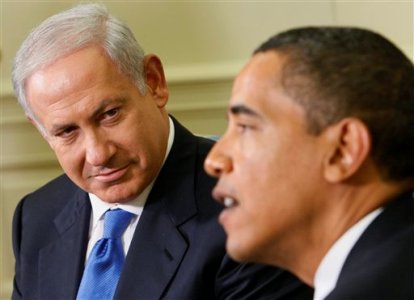 The disclosure of the details of a letter reportedly sent by President Barack Obama last week to Benjamin Netanyahu, the Israeli prime minister, will cause Palestinians to be even more skeptical about U.S. and Israeli roles in the current peace talks.

 An
An 




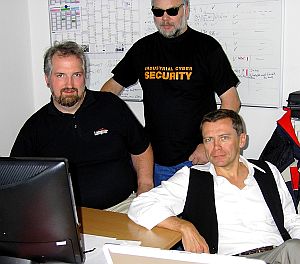 A German team of industrial cyber security experts who have analyzed the way the worm operates now claim that it may have been designed to attack the newly operational Bushehr nuclear reactor.