Category Archives: Israel

The fountainhead of global strife

If the Obama administration had been as visionary as Obamamania promised it might be, Chas Freeman might not have merely been briefly offered the post of chair of the National Intelligence Council; he could have become a fine Secretary of State. Instead, the Israel lobby made sure he gained no position at all, but by doing so ensured that he would retain the freedom to speak with more candor than any government official ever dares.

In a speech he delivered yesterday in Norway, Freeman laid out the US role in seeking and obstructing Middle East peace, with a clarity and style rarely found in foreign policy discourse.

Islam charges rulers with the duty to defend the faithful and to uphold justice. It demands that they embody righteousness. The resentment of mostly Muslim Arabs at their governing elites’ failure to meet these standards generates sympathy for terrorism directed not just at Israel but at both the United States and Arab governments associated with it.

The perpetrators of the September 11, 2001, terrorist attack on the United States saw it in part as reprisal for American complicity in Israeli cruelties to Palestinians and other Arabs. They justified it as a strike against Washington’s protection of Arab governments willing to overlook American contributions to Muslim suffering. Washington’s response to the attack included suspending its efforts to make peace in the Holy Land as well as invading and occupying Afghanistan and Iraq. All three actions inadvertently strengthened the terrorist case for further attacks on America and its allies. The armed struggle between Americans and Muslim radicals has already spilled over to Pakistan, Yemen, Somalia, and other countries. Authoritative voices in Israel now call for adding Iran to the list of countries at war with America. They are echoed by Zionist and neo-conservative spokesmen in the United States,

The widening involvement of Americans in combat in Muslim lands has inflamed anti-American passions and catalyzed a metastasis of terrorism. It has caused a growing majority of the world’s 1.6 billion Muslims to see the United States as a menace to their faith, their way of life, their homelands, and their personal security. American populists and European xenophobes have meanwhile undercut liberal and centrist Muslim arguments against the intolerance that empowers terrorism by equating terrorism and its extremist advocates with Islam and its followers. The current outburst of bigoted demagoguery over the construction of an Islamic cultural center and mosque in New York is merely the most recent illustration of this. It suggests that the blatant racism and Islamophobia of contemporary Israeli politics is contagious. It rules out the global alliances against religious extremists that are essential to encompass their political defeat.

Freeman went on to say:

Vague promises of a Palestinian state within a year now waft through the air. But the “peace process” has always sneered at deadlines, even much, much firmer ones. A more definitive promise of an independent Palestine within a year was made at Annapolis three years ago. Analogous promises of Palestinian self-determination have preceded or resulted from previous meetings over the decades, beginning with the Camp David accords of 1979. Many in this audience will recall the five-year deadline fixed at Oslo. The talks about talks that begin tomorrow can yield concrete results only if the international community is prepared this time to insist on the one-year deadline put forward for recognizing a Palestinian state. Even then there will be no peace unless long-neglected issues are addressed.

Peace is a pattern of stability acceptable to those with the capacity to disturb it by violence. It is almost impossible to impose. It cannot become a reality, still less be sustained, if those who must accept it are excluded from it. This reality directs our attention to who is not at this gathering in Washington and what must be done to remedy the problems these absences create.

Obviously, the party that won the democratically expressed mandate of the Palestinian people to represent them — Hamas — is not there. Yet there can be no peace without its buy-in.

Peacemaking must engage those who are willing to use violence. Yet this assertion — whose truth is so obvious — is still being treated as a bold idea.

The narrative of peace promoted through the Bush era and still being propagated by Obama, suggests that peace is somehow produced by rallying together everyone who is willing to denounce violence — as though those who are willing to use violence will lose that capacity if they can be sufficiently marginalized. But on the contrary, political marginalization invariably has the opposite effect as those whose grievances are ignored, look for increasingly extreme means to make themselves heard.

Facebooktwittermail

Terrorism is like advertising — it short-circuits the rational mind

Update below

If there’s just one lesson we can draw from the last decade it is this: utter the word “terrorism” and thought grinds to a halt, perceptions become blinkered and the power of human intelligence is suddenly put on hold.

Consider the attack near Hebron in the West Bank yesterday in which four Israelis were gunned down by Palestinian gunmen.

A report in the Jerusalem Post conveys a particularly harrowing moment in the attack’s aftermath as volunteers from Zaka, the Israeli community emergency response network, arrived at the scene of the shooting.

Zaka volunteer Momy Even-Haim was dispatched to the scene of the attack with his colleagues, when to his horror he discovered that his wife was among the dead.

“We saw a crying volunteer, and at first we did not understand what was happening — he has seen many disasters before,” Zaka volunteer Isaac Bernstein told The Jerusalem Post.

“Then he started shouting, ‘That’s my wife! That’s my wife!’ We took him away from the scene immediately,” Bernstein added. Even-Haim was taken to his home in Beit Hagai by his colleagues.

Tragedy takes infinite forms. Those in closest proximity can never be expected to respond rationally but from a distance, rationality is not only possible — it is essential.

Instead though, this attack — like so many before — has produced a series of highly predictable knee-jerk responses.

The White House issued a statement saying:

The United States condemns in the strongest possible terms the terrorist attack today perpetrated by Hamas in which four Israelis were killed in the southern West Bank. We express our condolences to the victims’ families and call for the terrorists behind this horrific act to be brought to justice. We note that the Palestinian Authority has condemned this attack. On the eve of the re-launch of direct negotiations between Israelis and Palestinians, this brutal attack underscores how far the enemies of peace will go to try to block progress. It is crucial that the parties persevere, keep moving forward even through difficult times, and continue working to achieve a just and lasting peace in the region that provides security for all peoples.

Is Washington already ahead of Israel in identifying the culprits?

That seems unlikely. Much more likely is that the White House is content to parrot press reports in which representatives of Hamas are quoted claiming responsibility for the attack. If Hamas claims responsibility, its claim will be accepted at face value; if it were to deny responsibility, it’s denial would be treated with skepticism. That’s the way the “analytical” process works.

Israeli press reports are less clear on the matter.

In Haaretz, Avi Issacharoff and Amos Harel report:

Even though no official claim of responsibility was made, the investigation by the security services of Israel and the Palestinian Authority suggest that the culprits were a cell which identifies itself, more or less, with Hamas. Fauzi Barhum, one of the spokesmen for the group in the Gaza Strip, did not openly claim responsibility for the attack, but hinted that his group was behind the shooting.

“The resistance continues everywhere,” he said.

In recent months the Hamas leadership in the Gaza Strip and Damascus has pressed West Bank-based teams of gunmen to resume the attacks in an effort to make it more difficult on the Palestinian Authority and stir up tension with Israel.

Two months ago a large Hamas network was uncovered in the southern Hebron Hills, a “sleeper cell” that was revived, whose members are suspected of murdering an Israeli policeman in a similar shooting incident, along the same route, several kilometers from the spot of last night’s terror attack.

A cell which identifies itself “more or less” with Hamas — that’s pretty vague. Moreover, a previously unknown group calling itself the Al-Haq (“Rights”) Brigades has claimed responsibility for Tuesday’s shooting, according to the Ma’an news agency.

As for Issacharoff and Harel’s claim that a Hamas cell was responsible for the June Hebron Hills shooting, that also is far from clear. When suspects were arrested by Israel’s internal security services, Shin Bet, Haaretz reported:

It is unclear… who is responsible for the establishment of this group, which is reportedly affiliated to Palestinian President Mahmoud Abbas’ Fatah movement. Israeli security sources have been examining the possibility that the gunmen behind the June 14 attack were from various Palestinian militant groups.

Whether or not Hamas had a role in yesterday’s attack it is too soon to tell. And even if some or all of the gunmen turn out to belong to the movement does not necessarily reveal a great deal about the level of command and control or political motives for the attack.

Whatever the motives, the outcome itself has opened political opportunities to each constituency that now portrays itself as a victim.

Given that the attack took place in an area controlled by the IDF, President Abbas could have taken the opportunity to point out that the attack underlines the fact that there can ultimately be no security solution to the political conflict. Instead, Palestinian security services have been quick to launch what is being described as one of the largest arrest waves of all time in the West Bank.

Hamas lawmaker Omar Abdel-Raziq said more than 150 members had been detained, and others had been summoned to police stations for questioning.

He accused Abbas of trying to please the Israelis.

“These are political arrests,” he said. “They are trying to tell the Israelis that they are capable of doing the job after the attack.”

At the funerals of the four Israelis killed, settler leaders took the opportunity to push for settlement expansion, call for vengeance (a call which has already been acted upon), deny the existence of the Palestinian people and make a thinly-veiled appeal for ethnic cleansing:

Rabbi Dov Lior of Kiryat Arba eulogized the victims saying that “this is a grave tragedy for the families, for the people of Israel and for the state. God, avenge the spilled blood of your servants.”

“There is an army, which must be used,” Rabbi Lior continued. “The mistake is to think that an agreement can be reached with these terrorists. Every Jew wants peace, but these evildoers want to destroy us. We need to give them the right of return and return them to the countries from which they came.”

When President Obama tries to press Benjamin Netanyahu to extend the so-called settlement freeze, the Israeli prime minister will no doubt tell him solemnly that in light of recent events, his hands are well and truly tied.

They shoot and we build has become the settlers’ slogan — one that is almost certainly to Netanyahu’s liking.

Update: In a conversation I just had with Hamas expert, Mark Perry, he made the point that when it comes to identifying armed militants in the West Bank, the Al Qassam Brigade (affiliated with Hamas) and the Al Aqsa Brigade (affiliated with Fatah) are virtually indistinguishable in most of the area, but particularly in Hebron. The clearest differentiation in armed groups is between those who are on the Palestinian Authority’s payroll and those who aren’t.

Mark also pointed out that if the Obama administration was not trapped inside its own terrorism rhetoric, they could point out that the attack underlines the unnecessary vulnerability that Israeli’s expose themselves to by grabbing Palestinian land and building settlements.

Facebooktwittermail

How to kill gentiles and influence people: Israeli rabbis defend book’s shocking religious defense of killing non-Jews

Max Blumenthal reports:

When I went into the Jewish religious book emporium, Pomeranz, in central Jerusalem to inquire about the availability of a book called Torat Ha’Melech, or the King’s Torah, a commotion immediately ensued. “Are you sure you want it?” the owner, M. Pomeranz, asked me half-jokingly. “The Shabak [Israel’s internal security service] is going to want a word with you if you do.” As customers stopped browsing and began to stare in my direction, Pomeranz pointed to a security camera affixed to a wall. “See that?” he told me. “It goes straight to the Shabak!”

As soon as it was published late last year, Torat Ha’Melech sparked a national uproar. The controversy began when an Israeli tabloid panned the book’s contents as “230 pages on the laws concerning the killing of non-Jews, a kind of guidebook for anyone who ponders the question of if and when it is permissible to take the life of a non-Jew.” According to the book’s author, Rabbi Yitzhak Shapira, non-Jews are “uncompassionate by nature” and should be killed in order to “curb their evil inclinations.” “If we kill a gentile who has has violated one of the seven commandments… there is nothing wrong with the murder,” Shapira insisted. Citing Jewish law as his source (or at least a very selective interpretation of it) he declared: “There is justification for killing babies if it is clear that they will grow up to harm us, and in such a situation they may be harmed deliberately, and not only during combat with adults.”

Meanwhile, Associated Press reports:

An influential Israeli rabbi known for his vitriolic pronouncements against Arabs says Palestinians and their leader should “perish from this world.”

Israel Army Radio quoted Ovadia Yosef Sunday as saying the Palestinians were “evil, bitter enemies of Israel” and Palestinian President Mahmoud Abbas should be struck with a plague. He made the remarks in a Saturday night sermon.

Haaretz adds:

The United States on Sunday condemned remarks by the spiritual leader of Israel’s leading ultra-Orthodox party, Rabbi Ovadia Yosef, who said the Palestinians should “perish”.

“We regret and condemn the inflammatory statements by Rabbi Ovadia Yosef,” U.S. State Department spokesman Philip J. Crowley. “These remarks are not only deeply offensive, but incitement such as this hurts the cause of peace.”

Facebooktwittermail

Iran enhances its capacity to shut down the global oil supply

The lesson of the famous Millennium 2002 Challenge was that a cumbersome military machine that over-invests in high tech weaponry is vulnerable to swarming attacks. In the $250 million war game such an attack resulted in most of the US fleet being sunk within hours.

With the development of the F-35 Joint Strike Fighter — the most expensive defense program ever — going ahead, it looks like the Pentagon is still stuck in the past. Iran on the other hand — the country that grasps the jugular vein through which most of the world’s oil supply flows (the Strait of Hormuz) — today made clear that it knows exactly how to flex its muscles in that arena and it will do so with vessels designed for lethal swarming.

AFP reports:

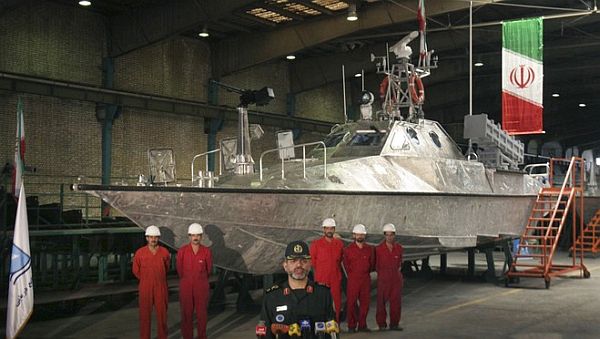
Iran began mass-producing two high-speed variants of missile-launching assault boats on Monday, warning its enemies not to “play with fire” as it boosts security along its coastline.

The inauguration of the production lines for the Seraj and Zolfaqar speedboats comes a day after President Mahmoud Ahmadinejad unveiled Iran’s home-built bomber drone, which he said would deliver “death” to Iran’s enemies.

The United States expressed concern about the Islamic republic’s growing military capabilities.

Iran’s state news agency IRNA reported that the Seraj (Lamp) and Zolfaqar (named after Shiite Imam Ali’s sword) boats would be manufactured at the marine industries complex of the defence ministry.

Defence Minister Ahmad Vahidi opened the assembly lines, saying the vessels would help to strengthen Iran’s defences, IRNA said.

“Today, the Islamic Republic of Iran is relying on a great defence industry and the powerful forces of Sepah (Revolutionary Guards) and the army, with their utmost strength, can provide security to the Persian Gulf, the Sea of Oman and Strait of Hormuz,” Vahidi said.

He issued a stern warning to Iran’s foes.

“The enemy must be careful of its adventurous behaviour and not play with fire because the Islamic Republic of Iran’s response would be unpredictable,” IRNA quoted him as saying.

“If enemies attack Iran, the Islamic Republic of Iran’s reaction will not be restricted to one area. The truth of our defence doctrine is that we will not attack any country and that we extend our hand to all legitimate countries.”

Meanwhile, in yet another response to Jeffrey Goldberg’s prediction of an Israeli attack on Iran, the former UN chief weapons inspector, David Kay, suggests that Israel is using the issue in order to press the Obama administration to ease its pressure on settlements and the need to make concessions to the Palestinians.

… Israel is engaged in psychological warfare with the Obama administration — and it only partly concerns Iran.

With regard Iran, Israel clearly understands that any unilateral military action it took against Iran without U.S. knowledge and support could have consequence of strategic importance for Israel and might even make an attack on Iran of limited benefit. Israel would much rather have the U.S. with it in an attack on Iran, or, even better, would be if the U.S. executed the attack entirely on its own.

But beyond Iran, of probably greater importance to the current Israeli government is avoiding the Obama administration pushing it into a choice between settlements and territorial arrangements with the Palestinians that it is unwilling to make and permanent damage to its relationship with the U.S. Hyping the Iranian nuclear program and the need for early military action is a nice bargaining counter. The U.S. certainly cannot join or lead an attack on Iran while pushing the Israeli government to the brink on settlements and concessions to the Palestinians. Or if the U.S. wants to avoid an imminent Israeli strike, it must make concessions to Israel on the Palestinian issues.

Facebooktwittermail

Israeli attack on Iran not imminent

If there was a ministry of information it would release reports like this: “US Assures Israel That Iran Threat Is Not Imminent.” But why would Washington need to create such an agency when the New York Times so gladly provides the service?

In a report transparently written as a quasi-official response to Jeffrey Goldberg’s “The Point of No Return,” we learn that contrary to all the feverish speculation about an imminent strike on Iran, it turns out everything’s cool.

And maybe it is — though the Times’ Mazzetti and Sanger could do more credible reporting if they made an effort not to sound like a mouthpiece for the administration.

The one priceless quote in their article comes from Gary Samore, President Obama’s top adviser on nuclear issues, who when referring to an anticipated one year “dash time” that the Iranians would need to convert nuclear material into a working weapon, said: “A year is a very long period of time.”

Israeli officials said their assessments were coming into line with the American view, but they remain suspicious that Iran has a secret enrichment site yet to be discovered.

American officials said, in contrast to a year ago, that Iran’s nuclear program was not currently the central focus of discussions between top leaders in Washington and Jerusalem. During the last visit to Washington by Prime Minister Benjamin Netanyahu of Israel in early July, the Iranian program was relatively low on the agenda, according to one senior administration official.

The next time Netanyahu takes questions from the press, maybe someone can ask him whether he agrees with the White House’s assessment about the nature of time and that a year is indeed a very long period.

Another issue the article touches upon is the breakout capacity for the long-delayed National Intelligence Estimate. Since the White House seems eager to say what the NIE will say even before its been released, can we interpret this as an effort to shape the report that is itself supposed to shape the administration’s policy?

Finally, just to be sure that the Israel lobby does not become too despondent when they hear another war might not be just around the corner (despite their best efforts), the article closes by saying:

Even as American and Israeli officials agree that the date that Iran is likely to have a nuclear weapon has been pushed into the future, that does not mean that Israel has abandoned the idea of a possible military strike.

American officials said that Israel was particularly concerned that, over time, Iran’s supreme leader could order that nuclear materials be dispersed to secret locations around the country, making it less likely that an Israeli military strike would significantly cripple the program.

So have no fear — the option of a strike is still on the table, or to be precise, at some indeterminate point in the future there might be a strike and it could happen sooner rather than later because at some point (future or past) the Iranians could hide everything and maybe they already have secret facilities in which case the opportunity to destroy them has already past. Clear?

Facebooktwittermail

Goldberg willing to bet on a “better” chance that Israel will strike Iran

Fox News reports:

Israel has until the weekend to launch a military strike on Iran’s first nuclear plant before the humanitarian risk of an attack becomes too great, former U.S. Ambassador to the United Nations John Bolton said Tuesday.

A Russian company is expected to help Iran start loading nuclear fuel into its plant starting on Saturday, after which an attack on the Bushehr reactor could trigger harmful radiation, which Israel wants to avoid, Bolton said. So unless the Israelis act immediately to shut down the facility, it will be too late.

“Once it’s close to the reactor … the risk is when the reactor is attacked, there will be a release of radiation into the air,” Bolton told FoxNews.com. “It’s most unlikely that they would act militarily after fuel rods are loaded.”

The attack Iran story gets increasingly bizarre. Now we have neocon commentators like Bolton watching the clock as though this was some kind of sporting event and at the same time, presenting Israel as a thoroughly responsible player. While Israel might be willing to destabilize the whole region, it wouldn’t want to risk spreading nuclear fallout into the Gulf. But as Marsha Cohen points out, the risks from fallout would not simply be humanitarian — they would be economic:

Besides the catastrophic human and environmental toll of such an attack, the sea lanes through which much of the world’s oil supplies pass would be endangered.

Iranians know this. In 1980, Iran bombed Iraq’s Osirak nuclear power plant before it contained any radioactive material. Osirak was quickly repaired by the French contractors who built it. Eight months later Osirak was partially destroyed by Israeli jets, aided by Iranian intelligence.

Meanwhile, at The Atlantic, Jeffrey Goldberg and Robin Wright are now placing bets on the likelihood of an attack — not in the next few days, but the coming months.

“By July next year, I’ll wager that neither Israel nor the United States will have bombed Iran,” says Wright.

“I, of course, believe that there is a better than 50 percent chance Israel will strike …Iran by this time next year,” says Goldberg.

Note the phrasing chosen by the man who just a few days ago expressed “profound, paralyzing ambivalence” about whether on attack on Iran would be a good idea. He doesn’t now simply reiterate his expectation that an attack is more likely but that it looks like a “better” than 50 percent chance.

Casually chosen words? Maybe, but if Goldberg was being asked how likely another 9/11 attack might be and he thought it more likely than not to happen, I doubt that he would say there is a better than 50 percent chance of such an attack, would he?

Facebooktwittermail

Is Israel’s legitimacy under challenge?

Henry Siegman writes:

When a state’s denial of the individual and national rights of a large part of its population becomes permanent — a permanence that has been the goal of Israel’s settlement project from its very outset (and that many believe has been achieved) — that state ceases to be a democracy. When the reason for that double disenfranchisement is that population’s ethnic and religious identity, the state is practicing a form of apartheid or racism. The democratic dispensation that Israel provides for its mostly Jewish citizenry cannot hide its changing (or changed) character. A political arrangement that limits democracy to a privileged class and keeps others behind military checkpoints, barbed-wire fences and separation walls does not define democracy. It defines its absence.

The claim that Israel is the incarnation and defender of Jewish values is contradicted by its treatment of an Arab population that has now lived for over two generations under Israel’s military subjugation – treatment that Moshe Arens, a former Likud Defense and Foreign Minister, has warned is turning that population into a permanent underclass of “carriers of water and hewers of wood.” It is entirely at odds with Biblical admonitions and Prophetic exhortations warning against injustices committed by the privileged and the powerful against the stranger and the powerless.

Israel’s problem is not the Palestinian or Arab refusal to recognize it as a Jewish state. It is, rather, the increasing difficulty of Jews familiar with Jewish values to recognize it as a Jewish state. Rather than demanding that Palestinians declaim on Israel’s democratic and Jewish identity, or conjuring non-existent threats to Israel’s existence, Netanyahu and his government would be better advised adjusting Israel’s policies toward a people that has lived under its unforgiving military occupation in a way that honors their country’s democratic and Jewish beginnings. That would contribute far more to its “legitimacy” and to its long-range security than its present undemocratic and very un-Jewish course.

Whether it is in response to a purported campaign of de-legitimization against Israel or a more broadly defined “new anti-Semitism”, the ploy that Israel’s defenders employ is invariably the same: it is to deflect criticism of Israeli actions by treating them as attacks on Jewish identity.

It is not what we do; it is who we are — and that we are powerless to change.

Facebooktwittermail

Harvard University cuts its losses and dumps all investments in Israel

Update: Harvard explains Israel share sales: it wasn’t divestment, it’s just that Israel is no longer an emerging market (Business Insider).

Did the Boycott, Divestment and Sanctions for Palestine movement just make a historic advance? Harvard University has sold close to $40 million of shares in Israeli companies:

In another blow to Israeli shares, the Harvard Management Company notified the US Securities and Exchange Commission (SEC) on Friday that it had sold all its holdings in Israeli companies during the second quarter of 2010. No reason for the sale was mentioned. The Harvard Management Company manages Harvard University’s endowment.

Harvard Management Company stated in its 13-F Form that it sold 483,590 shares in Teva Pharmaceutical Industries Ltd. (Nasdaq: TEVA; TASE: TEVA) for $30.5 million; 52,360 shares in NICE Systems Ltd. (Nasdaq: NICE; TASE: NICE) for $1.67 million; 102,940 shares in Check Point Software Technologies Ltd. (Nasdaq: CHKP) for $3.6 million; 32,400 shares in Cellcom Israel Ltd. (NYSE:CEL; TASE:CEL) for $1.1 million, and 80,000 Partner Communications Ltd. (Nasdaq: PTNR; TASE: PTNR) shares for $1.8 million.

Some commentators plausibly argue that Harvard’s decision was purely financial and not a political decision. Indeed, were it actually an explicit act of divestment there would surely have been a carefully crafted statement explaining their decision.

Even so, the effectiveness of the BDS movement may well depend less on persuading capital to move with principal (it never does) but on companies, institutions, artists and other players coming to the self-interested conclusion that doing business with Israel is bad for business.

Facebooktwittermail

A campaign for war with Iran begins

In response to Jeffrey Goldberg’s Atlantic article, “The Point of No Return,” Trita Parsi writes in Salon:

Whether characterizing it as “mainstreaming war with Iran” or “making aggression respectable,” Goldberg’s article serves to create a false narrative that claims that the two failed meetings held between the U.S. and Iran last October constitute an exhaustion of diplomacy, that deems the Obama administration’s crippling, indiscriminate sanctions on Iran a failure only weeks after they’ve been imposed, and that then leaves only one option remaining on the table: an American or Israeli military strike. And on top of that, if President Obama doesn’t green light a bombing campaign, Israel will have no choice but to bomb itself, even though it isn’t well-equipped to do so, according to Goldberg.

It is important to note that the aim of this unfolding campaign may not be to pressure Obama into military action. It could just as much serve to portray Obama as weak and indecisive on national security issues that are of grave concern to the U.S. and that are of existential nature to Israel. This portrayal will give the Republicans valuable ammunition for the November congressional elections as well as for the 2012 presidential race.

Indeed, the likely political motivation for this unfolding campaign should not be underestimated. Just as much that the building blocks of the Iraq war were put into place under the Clinton years — most importantly with the passage of the Iraq Liberation Act in 1998 — serious preparation for selling an Iran war to the American public under a Republican president (Palin?) in 2013 must be undertaken now, both to establish the narrative for that sell and to use the narrative to remove any obstacles in the White House along the way.

Facebooktwittermail

You must do what we can’t, because if you don’t, we will

There are those who would have us believe that:

[O]ne day next spring, the Israeli national-security adviser, Uzi Arad, and the Israeli defense minister, Ehud Barak, will simultaneously telephone their counterparts at the White House and the Pentagon, to inform them that their prime minister, Benjamin Netanyahu, has just ordered roughly one hundred F-15Es, F-16Is, F-16Cs, and other aircraft of the Israeli air force to fly east toward Iran — possibly by crossing Saudi Arabia, possibly by threading the border between Syria and Turkey, and possibly by traveling directly through Iraq’s airspace, though it is crowded with American aircraft.

Worried about an Israeli attack on Iran? That’s the idea.

You must do what we can’t, because if you don’t, we will.

This is how some Israelis are trying to twist Washington’s arm to get the US to attack Iran.

A more honest way of making the argument would be to say this: If the US won’t attack Iran, then Israel will — even though it won’t accomplish its military objectives and it will open Pandora’s box. Desperate nations sometimes do desperate things. You have been warned.

Another name for this: blackmail.

It’s hard to counter an irrational argument when the irrationality is intentional. Such are the means by which someone like erstwhile Israeli army corporal and current Atlantic commentator, Jeffrey Goldberg, attempts to persuade his readers — not through cogent reasoning based on clear evidence, but by an insidious form of argument that has the clarity of slime.

Consider the way he tries to close his case for an attack on Iran — even while avoiding saying straight out that he supports such a course of action.

The United States must not take the risk of letting Israel attack Iran because if President Obama orders US forces to attack instead, this would be the most patriotic thing to do. Obama would not be serving Israel’s interests; he would be defending Western civilization.

Based on months of interviews, I have come to believe that the administration knows it is a near-certainty that Israel will act against Iran soon if nothing or no one else stops the nuclear program; and Obama knows — as his aides, and others in the State and Defense departments made clear to me — that a nuclear-armed Iran is a serious threat to the interests of the United States, which include his dream of a world without nuclear weapons. Earlier this year, I agreed with those, including many Israelis, Arabs — and Iranians — who believe there is no chance that Obama would ever resort to force to stop Iran; I still don’t believe there is a great chance he will take military action in the near future — for one thing, the Pentagon is notably unenthusiastic about the idea. But Obama is clearly seized by the issue. And understanding that perhaps the best way to obviate a military strike on Iran is to make the threat of a strike by the Americans seem real, the Obama administration seems to be purposefully raising the stakes. A few weeks ago, Denis McDonough, the chief of staff of the National Security Council, told me, “What you see in Iran is the intersection of a number of leading priorities of the president, who sees a serious threat to the global nonproliferation regime, a threat of cascading nuclear activities in a volatile region, and a threat to a close friend of the United States, Israel. I think you see the several streams coming together, which accounts for why it is so important to us.”

When I asked Peres what he thought of Netanyahu’s effort to make Israel’s case to the Obama administration, he responded, characteristically, with a parable, one that suggested his country should know its place, and that it was up to the American president, and only the American president, to decide in the end how best to safeguard the future of the West. The story was about his mentor, David Ben-Gurion.

“Shortly after John F. Kennedy was elected president, Ben-Gurion met him at the Waldorf-Astoria” in New York, Peres told me. “After the meeting, Kennedy accompanied Ben-Gurion to the elevator and said, ‘Mr. Prime Minister, I want to tell you, I was elected because of your people, so what can I do for you in return?’ Ben-Gurion was insulted by the question. He said, ‘What you can do is be a great president of the United States. You must understand that to have a great president of the United States is a great event.’”

Peres went on to explain what he saw as Israel’s true interest. “We don’t want to win over the president,” he said. “We want the president to win.”

Israel only wants what’s good for America — and we’re supposed to believe that, even while few if any Israelis could be persuaded that America only wants what’s good for Israel.

The truth is that everyone gets to define their own interests so let’s ignore the obsequious crap from Peres and consider Goldberg’s core claim: that Israel is gearing up to strike Iran.

Even if Goldberg is participating in a neocon game of bluff, the only kind of bluff worth engaging in is one that has credibility. To make a credible argument that Israel has the intention of going it alone, Goldberg would have to present the outline of a credible plan of attack. He doesn’t even try.

Israeli planes would fly low over Saudi Arabia, bomb their targets in Iran, and return to Israel by flying again over Saudi territory, possibly even landing in the Saudi desert for refueling—perhaps, if speculation rife in intelligence circles is to be believed, with secret Saudi cooperation.

And he prefaces this “plan” by saying Israel only gets one try. That’s not even a back-of-an-envelope war plan. It’s more like a Twitter war plan.

Five years ago Kenneth Pollack dismissed the idea that Israel could attack Iran on its own. I don’t see any reason to doubt that his analysis on the military logistics of an attack still remains sound. Indeed, there seem to be plenty of Israeli analysts who concede that Israel simply does not have the option of going it alone. Even Goldberg quotes an unnamed Israeli general who says: “This is too big for us.”

In The Persian Puzzle: The Conflict Between Iran and America, Pollack wrote:

[T]he United States … should not count on Israel to conduct a counterproliferation strike for us. It is almost certainly the case that Israel would be willing to absorb the diplomatic costs of a strike, would be prepared to deal with Iran’s retaliation in the form of either terrorist attacks or missile strikes on Israel, and probably is not overly concerned about Iranian behavior in Iraq. The problem for Israel is much simpler: Iran is too far away. Most of the known Iranian nuclear facilities are around 1,000 miles away from Israel. Its Jericho II ballistic missiles could reach these targets, but they lack the payload, accuracy, and numbers to be able to significantly damage (let alone destroy) more than one or two of the large Iranian nuclear facilities, which leaves the matter to the Israeli Air Force. Even assuming that Israeli aircraft were to fly directly to Iran, overflying Jordan and Iraq, the only aircraft in its inventory that could reach Iran’s known nuclear sites are its 25 F-151 strike fighters. (Israel would need to set up aerial refueling stations at three to five locations between Israel and the Iranian targets for its roughly 350 F-16s to be able to participate, which would be practically impossible.) Because the F-151s would have to carry a considerable amount of fuel, they could not carry a great deal of ordinance. Given the size of the various Iranian nuclear facilities, it would not be possible for Israel to destroy all of them in a single raid as it did Osiraq. Nor would it be politically, militarily, or logistically possible for Israel to sustain multiple such strikes over the many days, if not weeks, it would take for all its F-151s to accomplish the job. [My emphasis.]

The neocon game of bluff will only box in the Obama administration if the Israeli “threats” are treated seriously. A more appropriate response would seem to be to focus on the limits of Israeli military action — unless that is one imagines that Israel would launch a nuclear attack on Iran, which to my mind is wildly implausible. (If Israel wants to permanently seal its global pariah status, the first offensive use of nuclear weapons since Nagasaki is a sure way.)

Goldberg reports, but apparently didn’t take seriously, the observations of some Israelis who given their positions of military command seem to merit close attention:

Gabi Ashkenazi, the Israeli army chief of staff, is said by numerous sources to doubt the usefulness of an attack, and other generals I spoke with worry that talk of an “existential threat” is itself a kind of existential threat to the Zionist project, which was meant to preclude such threats against the Jewish people. “We don’t want politicians to put us in a bad position because of the word Shoah [Holocaust],” one general said. “We don’t want our neighbors to think that we are helpless against an Iran with a nuclear bomb, because Iran might have the bomb one day. There is no guarantee that Israel will do this, or that America will do this.”

The message Netanyahu, Goldberg and other panic-stricken Zionists are unintentionally sending out is that come the day Iran acquires a nuclear weapon, Israelis may as well back their bags and abandon the Jewish state.

That probably won’t happen because in such an event Israel will “discover” what many Israelis no doubt already think: that retired General John Abizaid was right when he said that the United States and its allies can “live with” a nuclear-armed Iran. “Let’s face it — we lived with a nuclear Soviet Union, we’ve lived with a nuclear China, and we’re living with nuclear powers as well,” Abizaid told an audience at the Center for Strategic and International Studies.

That was true in 2007 and it’s true now. It’s also true that spineless politicians remain the playthings of fear-mongers who are addicted to war.

Facebooktwittermail

Iran targeted in cyber attack

Last September, Reuters reported: “Israel has been developing “cyber-war” capabilities that could disrupt Iranian industrial and military control systems. Few doubt that covert action, by Mossad agents on the ground, also features in tactics against Iran. An advantage of sabotage over an air strike may be deniability.”

Now it seems, such an attack may have occurred in recent months.

“Looks like this malware was made for espionage,” was the assessment of industry analyst Frank Boldewin when describing the recently discovered computer worm, known has Stuxnet. It targets Siemens SCADA (supervisory control and data acquisition) management systems that control energy utilities, transportation, and other vital systems. Elias Levy, senior technical director with Symantec Security Response, said: “The most we can say is whoever developed these particular threats was targeting companies in those geographic areas,” when explaining why this particular trojan has had its greatest impact in Iran.

It is just two months since the newly-created United States Cyber Command based at Fort Meade, Maryland, became operational. The creation of CYBERCOM is ostensibly a response to the United States’ vulnerability to cyber attacks. “Given our increasing dependency on cyberspace, this new command will bring together the resources of the department to address vulnerabilities and meet the ever-growing array of cyberthreats to our military systems,” Defense Secretary Robert Gates said in a statement.

But as Robert Fry, a former Deputy Commanding General of coalition forces in Iraq, notes, “the speed of cyber operations places a premium on first strike and so inverts the Clausewitzian principle of the inherent advantage of defense.” Thus, as Federal Computer Week points out: “CYBERCOM also oversees offensive cyber capabilities, and that involves developing weapons and the doctrine that governs when and how those weapons can be used.”

Did we just witness one of the opening shots in a cyber war against Iran? Stuxnet is, according to Andy Greenberg, “the first publicly-known threat, aside from occasional unattributed reports, to target the long-vulnerable infrastructure systems.” As such, the most likely instigator of such an attack would be a hostile government.

The question is: which government? Israel and/or the United States have to be the prime suspects.

Facebooktwittermail

Tree that sparked deadly border clash on Israeli side, says UN

My reference yesterday to an Israeli soldier having been on the Lebanese side of the Israel-Lebanon border turns out to have been incorrect.

The Guardian reports:

The tree that sparked a deadly confrontation between Israeli and Lebanese troops along the tense border between the two countries was on Israeli territory, the UN has said.

Five people died in the most serious clash between the two countries since the war of 2006.

Unifil, the UN force that has monitored the border since the ceasefire that ended that conflict, said that investigations had established that the tree, which Israeli troops were cutting down when Lebanese forces fired on them, was south of the “blue line” which marks the border.

“Following the exchange of fire between the Lebanese army and the Israeli army across the blue line in El Adeisse, the Unifil investigators were on the ground and commenced investigations,” it said. “The investigations are still ongoing and the findings will be intimated on [their] conclusion.

“Unifil established, however, that the trees being cut by the Israeli army are located south of the blue line on the Israeli side.”

Unifil confirmed that Israel had notified it of its intention to carry out routine maintenance work on trees along the border, and that Unifil passed the information on to the Lebanese army.

The Lebanese army admitted that its soldiers opened fire on troops from the Israeli Defence Forces (IDF) in the confrontation.

In a statement issued to the news agency AFP, a spokesman said: “The Lebanese army opened fire first at Israeli soldiers who entered Lebanese territory… This constituted defence of our sovereignty and is an absolute right.”

An Israeli battalion commander was shot dead and another officer seriously wounded. In Israeli shelling that followed, three Lebanese soldiers and a Lebanese journalist were killed.

The IDF claimed that its forces were the subject of a planned ambush, citing the presence of Lebanese media close to the border. “We have reason to believe this was planned in advance,” an IDF spokeswoman, Avital Leibovich, said. She added that the initiative could have come from Lebanese army units under the influence of the Islamist militant organisation Hezbollah.

Most analysts agreed that the incident was likely to be contained rather than flaring into an ongoing conflict along the tense border.

The dead Israeli soldier, Lieutenant Colonel Dov Harari, a 45-year-old father of four, was to be buried in the coastal city of Netanya later today.

Meanwhile, a Palestinian militant was killed in an air strike in Gaza early today. Sharif Abdel Hadi Abbey, 22, died and two others were injured in the strike close to Khan Younis, according to Palestinian souces. The IDF said aircraft had fired at Palestinians approaching the Gaza border fence.

Facebooktwittermail

Hezbollah Secretary General Sayyed Hassan Nasrallah’s speech delivered in Lebanon today

The following speech by the Hezbollah leader, Hassan Nasrallah was delivered today via video feed in front of a large crowd in Beirut. The translation provided below came in tweets (hence the format below) from Roqayah at iRevolt who did instant translating and tweeting while watching the broadcast.

We are celebrating our victory over the biggest terrorist army in the Middle East (i.e. Israeli Army).

I was going to begin my words with the words covering the July War but what happened today on the Land of Heroes (South Lebanon)

On the border with the Palestinians and the fight with our heroic Lebanese army;

[The Sayyed is now dividing his speech; 1st he will speak about the war, 2nd the tribunal and lastly what shall happen after.]

Since the war stopped there have 14,000 incidents wherein the Israeli’s have broken resolution 1701

The Israeli’s are always accusing Hezb’Allah of breaking the rules but we are telling the UN that the Israeli’s should respect 1701

What we saw today is another example of the Israeli’s breaking resolution 1701 (i.e. Lebanese Army border incident)

One of the Lebanese Press Personnel was killed today but this is not new to the Israeli’s as they have been killing people from the media

Since the start of this incident today, all of Hezb’Allah’s personnel have been put on high alert.

We put all Hezb’Allah personnel and fighters under the order of the Lebanese Army; Whatever you need,we are next to you & where you want us

Anything the Army Command needs from us, everything is under their disposal. We have also called Nebih Berri,Hariri and Sleiman

After we watched how the Lebanese army is suffering, we just stood by because anything done must use wisdom.

All of Lebanon will not forgive or forget any invasion or rule-breaking. We are not afraid of you (talking to Israelis) or your threats

The Lebanese Army fought with dignity & high spirits (in regards to the incident today).The Israeli’s accused the Leb. Gov’t of instigation

The Resistance is next to the army, ready at any time; staying in our country and our cities.

All the Lebanese citizens in the South are not afraid, unlike the people in Northern Israel who began to flee.

Today,we salute the Lebanese Army. We salute the Army Commander, especially after it was recently Army Day (3eid el Jesh)

Today we are watching; There are martyrs from the Lebanese Army and civilian martyrs.

Hezb’Allah is very patient today but we are ready. This is because we must be ready in case the Army needs our help.

If the Army,the Resistance and the people face the Israeli’s then we will be able to stop them.

Thank God that the issue finished right away (in regards to the incident today).

Sayyed Hassan said that if Hezb’Allah intervened they would accuse the Resistance of stepping in because of the STL [the United Nations’ Special Tribunal for Lebanon].

I will say this before all the politicians, all the Arabs and all the world – we cannot get away from our tradition, morals .

Any place which the Israeli enemy hits the army from now on the Resistance will not stand

We might be patient now but I will be straight forward; Any hand which will extend to the Lebanese army to harm it,we will cut!

Every good person will take this decision. The Resistance has the honor to protect the country the same way.

What happened today occurred before all of the world. This has been transpiring for four years; 316 Lebanese injured in 4 years.

The Resistance has destroyed 4M cluster-bombs. Until now we have millions of cluster-bombs still in the ground (planted by Israel)

We need to have the Lebanese Gov’t pressure the UN in order to get the maps from Israel as to where they’ve planted cluster-bombs

Israel has been working to get into all facets and workings of Lebanese via spy’s. The most dangerous being that of our communication system

This is much bigger than what people know as of now (spy cells).

What this means is that we have found more than 100 spy’s, many of whom have high positions. Who have worked long w/ Israel

Many of these individuals are well respected in our society. By finding these 100+ spies it is a big hit ag. the Israeli’s

The Resistance will stay under the control of the Leb.Army,those of whom found these spies.We’ll continue to find out more ab. the spies

We should not stop or remain silent if we find a spy. We should not cover anyone because of his status. We should not wait to execute them

This is another war; Many of these spies helped Israel during the 2006 – they slaughtered the Lebanese people by aiding Israel.

Whomever wants to stop another war in Lebanon must not allow Israel to recruit spies.

We have to work on a strategy to free the Kfar Sheba and all other lands occupied by Israel.

We must face the Israeli’s in order to free our last occupied land (Kfar Sheba/Shebaa Farms)

The Army, the Resistance and the people create the victory. Everyday Lebanon faces Israel in dif. ways

For the last week we have been hearing Askenazi stating that Hezb’Allah assassinated Hezb’Allah. As you know and I know, he is no journalist

Ashkenazi is the Commander of the Israeli Army; We hear the Israel media, how they are talking about the Int’l Court and Lebanon

The Israeli media were speaking happily in terms of how Hezb’Allah will be indicted; They spoke about how the Lebanese will fight together

We spoke,weeks ago,and told everyone – including friends of Lebanon – about the dangerous plan Israel is preparing for Lebanon.

[iRevolt: Damn it. My feed is out. Bear with me folks, I apologize for the inconvenience!
Back up]

We have clear accusations that Israel assassinated Rafik Hariri

Now because some may consider talking about the STL and the indicted – some may consider this increases tension.

For this reason I will delay this part; For now we will focus on our accusations ag. Israel.

During the last few months we did our utmost to do the following: 1st, it is clear where we are headed.

We have appointed a team/committee which will study and look at all details. On Monday I will present to you clear evidence

I will prove that Israel,via its spies,since 1993 has been using the political situations in Lebanon to its advantage.

Today,on the anniversary of your victory in the 2006 war,we have a right to accuse Israel of assassinating Rafik Hariri.

My accusations will be based on evidence. I say to you today – We accuse the Israeli enemy of assassinating Rafik Hariri in 2005.

On Monday I will provide evidence. I will answer all those people who say ‘you are accusing Israel,why don’t you provide evidence?’

After this press conference the Lebanese Gov’t cannot say ‘ I do not want to know the truth’.

We are ready to cooperate with the Lebanese Gov’t. If we cooperate with one another then we will save Lebanon from a division

We in Lebanon, have called for putting together a governmental committee or any committee and find out who created false witnesses.

What is the problem in forming a committee to question the false witnesses? Don’t we have a right to call on a committee?

I would like to tell you that Hezb’Allah will stand ready and committed to contribute

Regarding the issue of war and the current situation,we all realize the aims of the 2006 war were. The main aim to crush the Resistance

Crushing the Resistance is part of many steps to be taken to “draw a new Middle East” – All related to Palestine,Iran and Syria etc

We were part of the scheme to create a “new Middle East”.

A journalist had told Sayyed Hassan that there is a plan to “crush Hezb’Allah”, a simple decision.

One of the Arab officials,I will not mention names,who was part of the Arab Delegation which traveled to NY

This Arab figure told me that when they arrived to NY they were welcomed by John Bolton. He asked the Arab figure “what are you here for?”

Bolton stated “This war will only stop once Hezb’Allah is crushed or once Hezb’Allah announces it will surrender” – This is a quote

This war was about crushing the Resistance. So,here comes the miscalculations – I would like to speak to the Israeli Enemy

You will continue to make miscalculations and mistakes. You,the enemy,are a mistake.

Noam Chomsky stated that all Israeli wars on Lebanon were Israeli decisions with American approval, all but he 2006 war.

The 2006 war was an American decision with Israeli implementation.

In the 2006 war they waited for the Resistance to collapse or run away but they found that the fighters were like high mountains.

They waited to see the Lebanese Army dismantled but the witnessed them uphold honor, dignity and sacrifice.

They wanted to the Lebanese to surrender but they found out that you are honorable and shall stay like this.

They thought ghat other religious sects besides those in the South or East may abandon the Resistance. However they were also proven wrong

The Mosques, Churches and Synagogues opened their doors for the Lebanese.

Yes,we stood and we confronted and we all achieved victory. I will now continue with the story between Bolton.

After 10 days, 13 days, 14 days passed – the situation changed in South Lebanon. The rockets continued to be launched ag. Israel

The humans fought; this is to see how small the Israeli minds are. They waged battle in Bint Jbeil for what?

In 2000 we celebrated the victory in Bint Jbeil so Israel waged an attack on Bint Jbeil because I said:

The Israeli enemy is easier to penetrate than a spiders web.

Back to the story – The Arab member of the delegation exited the meeting held in NY and was approached by Bolton.

Bolton told the official that they wish to end the war. Bolton stated that The Israeli’s said they are incapable of continuing the war

The official said “No one can say that the security council stopped the war.The Israeli’s were crushed,they wanted the war to end.”

On the 25th of May,2000 – people in Syria and Iran helped us, but no one can say that they ended the war for us.

We achieved our territory. God only helped us, God only. No one else helped us. Our people, our martyrs, our solidarity.

When the whole world was against you, you were the ones who imposed on Israel to end the war so it will not end in a catastrophe for Israel

We used a new equation which protect our country; The possibility of war always exists because Israel is hostile in nature.

Normally, those who have experience have a right to be cautious and be afraid for Lebanon. But,does this mean a war is knocking on the door?

This is not clear yet.The Israeli enemy does not need an excuse when they want to wage war.Our responsibility for our country is to be ready

Today the Israeli’s initiated the confrontation yet THEY file a complaint.If no one vetoes then we may witness a res. which condemns Lebanon

When Israel commits massacres they are not condemned.

I want to end by saying that we must raise a new equation which protects the country. The Israeli’s believe what I say

For many reasons the Israeli’s have the information and they believe what I say.

I will not say anything new; land for land, navy for navy (the same equation). We will not reveal our capabilities in terms of the air force

We will use “constructive ambiguity” for the sake of protecting the country. We may put Lebanon in danger if we reveal certain issues.

I want to say that you will send the message to the Israeli’s. We found that the Israeli’s are focusing on the people of Lebanon

The Israeli’s are responding to our targeting of the Israeli front – we were able, based on facts and truth.

The Israeli’s wanted to wage a psychological war on the Lebanese front, to create an atmosphere of fear.

When the Israeli’s targeting the Imam Hassan (AS) compound,did it contain ammunition or weapons? or a civilian apt. building?

More than 100 Lebanese,Palestinian and Syrian labor workers were targeted. The Israeli’s do not need an excuse. They target civilians

After the 2006 war the Israeli’s will abandon the Resistance,that they are sick. Does any person become sick of preserving his dignity?

August 14th, the Lebanese returned to their destroyed homes. Our message to the enemy tonight and to those who make miscalculations:

The most honorable people cannot abandon the path of the Resistance!

Facebooktwittermail

Israeli provocation on Lebanese border could trigger new war

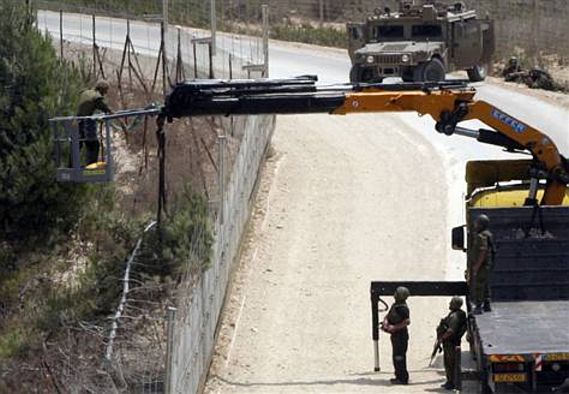
An Israeli soldier being dangled like bait on the Lebanese side of the Israel-Lebanon border today.

Update below

Border clashes between Israeli and Lebanese troops have left three Lebanese soldiers and a journalist dead. Lebanon’s Hezbollah TV, Al Manar, reports one high-ranking Israeli officer has been killed but this has not been confirmed by the Lebanese army or UN troops stationed in southern Lebanon.

As the photo above makes clear, this was a blatant act of provocation by Israeli forces — no one accidentally strayed over the border. This is more like kids tossing matches to find out whether a brush fire will start.

Tony Karon writes:

Should a new war break out, Israel is determined to strike a more devastating blow more quickly than it did during the last conflict, in which it failed in its objective of destroying Hizballah. It has publicly warned that it would destroy Lebanese civilian infrastructure, and that Syria, as Hizballah’s armorer, would not be off-limits. But Hizballah believes its capacity to fire missiles into Tel Aviv is key to restraining Israel from returning to finish off the Shi’ite militia. And, of course, amid regional tensions over Iran’s nuclear program, members of the self-styled “axis of resistance” — Iran, Syria, Hamas and Hizballah — have deepened their alliance, raising the possibility of any one of those groups joining the fray should any of the others come under attack from Israel or the U.S.

Although all of the main players have good reason to avoid initiating another war right now, the Crisis Group warns that “tensions are mounting with no obvious safety valve.” At some point, Hizballah’s growing deterrent could cross Israel’s red line. And the Western diplomatic boycott of the resistance camp is cause for alarm because there are no effective channels through which the various antagonists can be made to understand how their actions could produce unintended consequences — in the tragic tradition of Middle Eastern wars that erupted in part because the adversaries failed to understand one another’s intentions. Indeed, after proclaiming his movement’s “divine victory” in standing up to Israel’s 2006 offensive, a feat that made him a hero on the streets of the Arab world, Hizballah leader Sheik Hassan Nasrallah did admit that had he known Israel would respond with a full-blown invasion, he would have avoided the provocation of snatching the Israeli troops that started the showdown.

The danger posed by the lack of communication channels between the resistance camp and the Israelis explains why British Prime Minister David Cameron, a recent guest at the White House, last week went to Ankara to urge Turkey to maintain its ties with Israel and use its ties to the likes of Syria to facilitate communication that could mitigate an outbreak. Turkey has been pilloried in some quarters in the West — and certainly in Israel — for its diplomatic rapprochement with the likes of Syria, Iran and Hamas, but Cameron’s appeal was a tacit admission that the continuing Bush-era policy of refusing to engage with the region’s designated “radicals” has sharply diminished the ability of the U.S. and the European Union to influence events in the Middle East. Peace talks between Palestinian Authority President Mahmoud Abbas and the Israelis are all very well, but Abbas is not at war with Israel, nor would he be even if a new round of fighting broke out in Gaza.

While it is widely assumed that Hezbollah would have a critical role to play in the event that Israel launches or instigates an attack on Iran, it likewise follows that the IDF will be tempted to decisively neutralize this threat preemptively. The problem, for Israel, is this: what happens if a preemptive attack fails, meaning, Israel comes under even heavier rocket attack than it did in 2006 and that Hezbollah survives an even more brutal onslaught than it suffered in that war? In such an outcome, the idea of subsequent military action against Iran becomes even more implausible than it already is.

Update: Ynet reports:

IDF Lieutenant Colonel Dov Harari, 45, was killed in the border skirmish with the Lebanese army Tuesday.

Harari was an IDF reservist who served as a battalion commander in the sector where the clash took place. Another Israeli commander sustained serious wounds in the skirmish, the army said.

The fact that Al Manar reported this fatality hours before it was confirmed by the IDF, suggests that Hezbollah continues to effectively monitor Israeli communications.

Haaretz provides the quaint explanation that the violence was triggered “over a move by Israeli soldiers to trim some hedges along the border,” though the Jerusalem Post said: “Other reports said the Israeli soldiers were attempting to plant cameras.”

Facebooktwittermail

Drums of war: Israel and the “axis of resistance”

In a new report, the International Crisis Group warns that the situation in the Levant, four years after the last war between Israel and Hezbollah, is exceptionally quiet and uniquely dangerous.

Of all the explanations why calm has prevailed in the Israeli-Lebanese arena since the end of the 2006 war, the principal one also should be cause for greatest concern: fear among the parties that the next confrontation would be far more devastating and broader in scope. None of the most directly relevant actors — Israel, Hizbollah, Syria and Iran — relishes this prospect, so all, for now, are intent on keeping their powder dry. But the political roots of the crisis remain unaddressed, the underlying dynamics are still explosive, and miscalculations cannot be ruled out. The only truly effective approach is one that would seek to resume — and conclude — meaningful Israeli-Syrian and Israeli-Lebanese peace talks. There is no other answer to the Hizbollah dilemma and, for now, few better ways to affect Tehran’s calculations. Short of such an initiative, deeper political involvement by the international community is needed to enhance communications between the parties, defuse tensions and avoid costly missteps.

Four years after the last war, the situation in the Levant is paradoxical. It is exceptionally quiet and uniquely dangerous, both for the same reason. The build-up in military forces and threats of an all-out war that would spare neither civilians nor civilian infrastructure, together with the worrisome prospect of its regionalisation, are effectively deterring all sides. Today, none of the parties can soberly contemplate the prospect of a conflict that would be uncontrolled, unprecedented and unscripted.

Should hostilities break out, Israel will want to hit hard and fast to avoid duplicating the 2006 scenario. It will be less likely than in the past to distinguish between Hizbollah and a Lebanese government of which the Shiite movement is an integral part and more likely to take aim at Syria — both because it is the more vulnerable target and because it is Hizbollah’s principal supplier of military and logistical support. Meanwhile, as tensions have risen, the so-called “axis of resistance” — Iran, Syria, Hamas and Hizbollah — has been busy intensifying security ties. Involvement by one in the event of attack against another no longer can be dismissed as idle speculation.

Reporting from Beirut, Borzou Daragahi adds:

a clandestine intelligence war between the Jewish state and the Iranian-backed militant group continues unabated, officials and security experts say.

Now, a strengthening Lebanese government is helping Hezbollah bust alleged spy cells, sometimes using tools and tradecraft acquired from Western nations eager to build up Lebanon’s security forces as a counterweight to the Shiite group, which since a 2008 power-sharing agreement has been a member of the governing coalition.

Although security officials here say they’re using newfound tools to ferret out spies watching Hezbollah, just like they would against anyone attempting to infiltrate the country, Western observers express concern.

“There are deep Israeli worries that anything the West gives the Lebanese armed forces and the Internal Security Forces could be used against them,” said Mara Karlin, a former Lebanon specialist at the U.S. Defense Department, now a researcher at the Johns Hopkins School of Advanced International Studies.

The United States and its Western allies play a delicate balancing game in Lebanon. Since 2006, Washington has given nearly $500 million in military aid to Lebanese security forces and has allocated $100 million for 2011, making Lebanon the second-largest recipient of American military aid per capita after Israel.

U.S. Assistant Secretary of Defense Alexander Vershbow met officials in Lebanon on Monday, emphasizing that continuing U.S. aid and training would allow the army to “prevent militias and other nongovernment organizations” from undermining the government.

Patrick Seale describes an initiative by Saudi Arabia’s King Abdullah:

King Abdallah bin Abdulaziz’s four-nation tour this week must be seen as a bold attempt to defuse a dangerous regional situation and assert the autonomy of Arab decision-making free from external interference.

According to Arab and Western diplomatic sources, the Saudi monarch’s visits to Egypt, Syria, Lebanon and Jordan have had several ambitious aims: to head off the threat of renewed civil war in Lebanon; to consolidate Syrian-Lebanese relations; to encourage Fatah-Hamas reconciliation at a decisive moment in Palestinian fortunes; and to signal to Washington the Arabs’ disillusion with President Barack Obama’s Middle East policy, still grossly biased towards Israel.

The volatile Lebanese situation seems to have been the immediate trigger for the King’s wide-ranging diplomatic initiative. Hezbollah and its local opponents, notably diehard Christians and hard-line Sunni members of Prime Minister Saad Hariri’s Forward Movement, have engaged in a war of words — which seemed in imminent danger of degenerating into violence. At issue were their different attitudes towards the UN Special Tribunal for Lebanon (STL).

According to some alarmist reports, the STL is preparing to indict a number of Hezbollah members for the murder of former Prime Minister Rafik Hariri on 14 February 2005. Pointing to the recent uncovering of several Israeli spy rings in Lebanon — notably in the sensitive communications sector — Hassan Nasrallah, Hezbollah’s secretary-general, denounced the STL as an Israeli plot and vowed pugnaciously never to surrender any of his members to its jurisdiction. Hezbollah’s opponents, on the other hand, claim that unless the STL brings Rafik Hariri’s murderers to justice — whoever they may be — there can be no internal peace.

The issue extends far beyond Lebanon because Hezbollah clearly sees the reports as a sinister bid to blacken the resistance movement, spark internal fighting, and provide Israel with an opportunity to attack Lebanon, as it did in 2006, in a further attempt to destroy Hezbollah.

A tripartite summit in Beirut of King Abdallah, Syria’s President Bashar al-Asad and Lebanon’s President Michel Suleiman — together with numerous side meetings — has somewhat reduced tensions and calmed fears of war. Among the implicit consequences of these contacts are Saudi Arabia’s recognition of the legitimacy of Syria’s involvement in Lebanon, as well as a warning to Israel that any further aggression would face a united Arab front.

Facebooktwittermail

Is Payoneer under US investigation for role in Dubai murder?

The Wall Street Journal reports:

American investigators, cooperating in a probe of the January assassination of a top Palestinian leader in Dubai, have identified a handful of U.S.-based companies believed to have been used to transfer money to suspects in the case, a finding that brings international authorities closer to identifying who funded the operation.

The findings show American authorities playing a bigger role in the investigation than previously revealed. The case is especially delicate for the U.S., because Dubai police have said their prime suspect in the case is Mossad, the intelligence service of Israel, a key U.S. ally.

International investigators see money transfers made through the U.S. companies as key clues in a globe-spanning manhunt aimed at identifying more than two dozen suspects in the case, according to officials familiar with the matter.

The U.S. companies identified by investigators include Internet-based businesses that match freelance job-seekers with employers and process payments between the two sides. Authorities have identified financial transfers from several of these intermediary businesses into prepaid, cash-card accounts used by suspects in the Dubai killing, according to international investigators.

U.S. authorities say they don’t believe the intermediary companies had any way of knowing the money would be used in the plot, according to a U.S. official familiar with the investigation.

Instead, U.S. investigators believe, suspects might have posed as freelancers in order to get money in a way that obscured their funding source, and used the money for operational expenses, such as buying plane tickets.

The next step in the investigation would be to determine who the employers were in the transactions.

Representatives of several companies identified in the probe said they hadn’t been contacted by U.S. authorities and weren’t aware of any investigation.

Note that the report says “several companies” — it does not say “all the companies” — which leaves open the possibility that Payoneer, the New York-based company run by the former IDF special ops commando, Yuval Tal, is indeed under investigation.

In March Al Jazeera reported: “The UAE central bank is investigating how 24 suspects obtained credit cards from US company, Payoneer. Although registered in the US, Payoneer’s employees are mostly in Israel, this creating a stir on the internet about possible Mossad connections.”

In March, Gulf News reported:

The Payoneer connection unveils a network of links to Israel, specifically its intelligence community.

Its CEO is Yuval Tal, an Israeli citizen who, according to media reports, described himself as a former Israeli special forces commando in a 2006 Fox News interview.

Clips of the interview on video sharing websites have been removed.

However, a person who said he met Tal a couple of times but did not want to be named told Gulf News that “there is no question in my mind that Yuval has contacts with [Israel’s spy agency] Mossad”.
He recalled a conversation Tal had with attendees of a Jewish charity event in New York, where he spoke of his connections with Mossad.

“Yuval was entertaining a small group of people with tales of his IDF [Israeli Defence Forces] exploits… Specifically, he was commending Israeli intelligence and how Mossad and [Israel’s internal security agency] Shin Bet always gave him great information on his commando raids. He said his ‘colleagues’ are tracking [Hamas leaders Khaled] Mesha’al and [Esmail] Haniyeh’s movements almost every day,” he said.

Payoneer is held by three venture capital firms: Greylock Partners, Carmel Ventures, and Crossbar Capital.
Greylock, which has offices in the US, India and Herzliya, Israel, was established by Moshe Mor, a former military intelligence captain in the Israeli army.

Carmel Ventures is an Israeli venture capital fund based in Herzliya. Crossbar Partners is run by Charlie Federman, who is also managing director of the BRM Group, a venture capital fund also in Herzliya that was founded by Nir and Eli Barkat, the former of whom is the mayor of occupied Jerusalem.

Facebooktwittermail

Israeli youth being raised on racism

Max Blumenthal reports:

On July 26, Israeli police demolished 45 buildings in the unrecognized Bedouin village of al-Arakib, razing the entire village to the ground to make way for a Jewish National Fund forest. The destruction was part of a larger project to force the Bedouin community of the Negev away from their ancestral lands and into seven Indian reservation-style communities the Israeli government has constructed for them. The land will then be open for Jewish settlers, including young couples in the army and those who may someday be evacuated from the West Bank after a peace treaty is signed. For now, the Israeli government intends to uproot as many villages as possible and erase them from the map by establishing “facts on the ground” in the form of JNF forests. (See video of of al-Arakib’s demolition here).

One of the most troubling aspects of the destruction of al-Arakib was a report by CNN that the hundreds of Israeli riot police who stormed the village were accompanied by “busloads of cheering civilians.” Who were these civilians and why didn’t CNN or any outlet investigate further?

I traveled to al-Arakib yesterday with a delegation from Ta’ayush, an Israeli group that promotes a joint Arab-Jewish struggle against the occupation. The activists spent the day preparing games and activities for the village’s traumatized children, helping the villagers replace their uprooted olive groves, and assisting in the reconstruction of their demolished homes. In a massive makeshift tent where many of al-Arakib’s residents now sleep, I interviewed village leaders about the identity of the cheering civilians. Each one confirmed the presence of the civilians, describing how they celebrated the demolitions. As I compiled details, the story grew increasingly horrific. After interviewing more than a half dozen elders of the village, I was able to finally identify the civilians in question. What I discovered was more disturbing than I had imagined.

Arab Negev News publisher Ata Abu Madyam supplied me with a series of photos he took of the civilians in action. They depicted Israeli high school students who appeared to have volunteered as members of the Israeli police civilian guard (I am working on identifying some participants by name). Prior to the demolitions, the student volunteers were sent into the villagers’ homes to extract their furniture and belongings. A number of villagers including Madyam told me the volunteers smashed windows and mirrors in their homes and defaced family photographs with crude drawings. Then they lounged around on the furniture of al-Arakib residents in plain site of the owners. Finally, according to Matyam, the volunteers celebrated while bulldozers destroyed the homes.

“What we learned from the summer camp of destruction,” Madyam remarked, “is that Israeli youth are not being educated on democracy, they are being raised on racism.” [Read Max’s full report which includes photos.]

Facebooktwittermail

The student who lost an eye protesting in Israel — but none of her vision

“I guess I can be grateful to the IDF for giving me the chance to see the world in a new way.”

This is Emily Henochowicz’s wry observation after having been hit in the face by a tear gas cannister fired by a soldier in the Israeli Defense Forces in Jerusalem on May 31. The impact destroyed her left eye.

The 21-year old art student from Maryland evinces no bitterness but has mixed emotions:

“I’m happy all these things are happening, that people are listening to me and looking at my work [ — the New York–based Center for Constitutional Rights is considering hosting a show of her art work],” she says. But she knows the attention is because of who she is. “I have just the right ethnicity and nationality for this to be a bigger case,” she says. If the person hit “were Palestinian,” she adds, “it is very unlikely they would get the same response. It’s just the way the world works.”

The Village Voice describes what happened after the young American was shot.

Stuart Henochowiz raced to Jerusalem, and for the week his daughter was in the hospital — the canister had also broken several bones in her skull and knocked out a tooth — he slept in a chair at the foot of her bed. The situation was worrisome enough even without all the guns nearby. “Emily was in one room with another patient, and next door was one of the prisoners from the flotilla,” he recalls. “There were four soldiers there with their submachine guns in front of that room. While I was in the darkened room with Emily, this soldier comes in with a nurse, dangling his submachine gun.” Dr. Henochowicz says he knew that the soldier was just following orders, but “the thought of her facing a submachine gun at night, after everything she’d been through — I didn’t appreciate the lack of tact.”

Adding to the situation were comments from one doctor and nurses who spoke, he says, “with racism that was straight out of the 1930s.”

“There was one doctor who was explaining Emily’s CT scan,” Dr. Henochowicz recalls, “and what they’d done with the surgery, and then he asked me, in Hebrew, ‘Are you Jewish? Because, then, how could your daughter be involved in such an activity?’ ”

Several nurses, he says, tried to explain Middle East politics in terms they thought he would relate to. “You have your blacks — and we have our Palestinians,” he says they told him. He adds, “They thought I should think of Palestinians in the same way. And I told them, ‘We don’t really think that way in the States anymore! We have a black president.’ And I told them I voted for him and gave money to his campaign, and they replied, ‘You mean, Hussein Obama?’ ”

At least, he says, “they come honestly by their racism. It’s right there. They don’t sugar-coat it. They just come out and say it.” And despite everything, the hospital was used to dealing with acts of war and terrorism and gave his daughter decent medical care.

But Stuart Henochowicz says he’s outraged by what he calls “a basic lack of decency” from the Israeli government. He says he knows that “Israel takes a very hard line,” and so he thinks the military’s stance is that “her face got in the way of the canister.” But, he adds, “these people are fathers. Couldn’t they even bother to ask, ‘Gosh, how is she doing?’ No one from the Israeli government would even talk to me. No one. Why is that? You might not agree with me, or with Emily, but why didn’t they even call me?”

Facebooktwittermail