Category Archives: Israel

The terrorist-naming game

On September 11, 2001, George Bush changed the way Americans look at the world and the success with which he accomplished this feat is evident in the fact that his perspective largely remains unchallenged — even among many of his most outspoken critics. Bush’s simplistic for-us-or-against-us formula was transparently emotive yet utterly effective.

For almost a decade, Americans have been told to look at the world through the lens of “terrorism” and while differences of opinion exist about whether the lens has too wide or narrow an angle or about the extent to which it brings things into focus, those of us who say the lens is so deeply flawed that it should be scrapped, remain in a minority.

The Obama administration may now refrain from using the term itself, preferring instead “violent extremists,” but the change is merely cosmetic (as are so many other “changes” in the seamless continuity between the Bush- and post-Bush eras).

A couple of days ago Philip Weiss drew attention to the fact that when former Israeli foreign minister Tzipi Livni described her parents as “freedom fighters,” Deborah Solomon, her interviewer in the New York Times, echoed Livni’s sentiment by saying that the fight for Israel’s independence took place in “a more romantic era.”

As Weiss notes, Livni’s parents belonged to the Irgun, the Zionist group which blew up the King David Hotel in Jerusalem on July 22, 1946, killing 91 and injuring 46.

The first public account of what had happened that day was accidentally released in advance of the bombing.

In By Blood and Fire, Thurston Clark writes:

“Jewish terrorists have just blown up the King David Hotel!” This short message was received by the London Bureau of United Press International (UPI) shortly after noon, Palestine time. It was signed by a UPI stringer in Palestine who was also a secret member of the Irgun. The stringer had learned about Operation Chick but did not know it had been postponed for an hour. Hoping to scoop his colleagues, he had filed a report minutes before 11.00. A British censor had routinely stamped his cable without reading it.

The UPI London Bureau chief thought the message too terse. There were not enough details. He decided against putting it on the agency’s wire for radio and press until receiving further confirmation that the hotel had been destroyed.

Despite the efforts of Irgun leaders to restrict knowledge of the target and timing of Operation Chick, there were numerous other leaks. Leaders in both the Haganah and Stern Gang knew about the operation. Friends warned friends. The King David had an extraordinary number of last-minute room cancellations. In the Secretariat [the King David’s south wing that housed the headquarters of the British government in Palestine], more than the usual number of Jewish typists and clerks called in sick.

The next day the British prime minister, Clement Attlee referred to the bombing as an “insane act of terrorism” while a few days later the US president, Harry Truman, wrote “the inhuman crime committed… calls for the strongest action against terrorism…”

That was 64 years ago. From the sheltered perch of the New York Times, that’s apparently far enough back in history that it can now be referred to as a “romantic era.”

It’s hardly surprising then that many observers with an interest in justice for Palestinians take offense at the New York Times’ complicity in papering over the reality of Jewish terrorism. Yet here’s the irony: the effort to promote an unbiased use of the term “terrorism” simply plays into the hands of the Israelis.

The word has only one purpose: to forestall consideration of the political motivation for acts of violence. Invoke the word with the utmost gravity and then you can use your moral indignation and outrage to smother intelligent analysis. Terrorists do what they do because they are in the terrorism business — it’s in their blood.

So, when Tzipi Livni calls her parents freedom fighters, I have no problem with that — she is alluding to what they believed they were fighting for rather than the methods they employed. Moreover, by calling people who planted bombs and blew up civilians in the pursuit of their political goals, “freedom fighters,” Livni makes it clear that she understands that “terrorism” is a subjective term employed for an effect.

When Ehud Barak a few years ago acknowledged that had he been raised a Palestinian he too would have joined one of the so-called terrorist organizations, he was not describing an extraordinary epiphany he had gone through in recognizing the plight of the Palestinians. He was merely being candid about parallels between groups such as the Irgun and Hamas — parallels that many Israelis see but less often voice.

The big issue is not whether the methods employed by Zionist groups such as the Irgun could be justified but whether the political goals these groups were fighting for were legitimate. Zionism would not have acquired more legitimacy if it had simply found non-violent means through which it could accomplish its goal of driving much of the non-Jewish population out of Palestine.

We live in an era in which “terrorism” — as a phenomenon to be opposed — has become the primary bulwark through which Zionism defends itself from scrutiny. Keep on playing the terrorist-naming game and the Zionists win.


Facebooktwittermail

Obama about to get tough with Netanyahu?

Preemptive reporting of news that has yet to happen is an irritating phenomenon in and of itself. Accounts about policy statements that yet to be released or about meetings that have yet to take place are transparent ways in which journalists allow themselves to be led by officials who believe that it is a government’s right to control the way its actions are described.

But then there’s a special class of preemptive reporting — reporting things that could conceivably happen but will be less likely to happen if a report itself then prompts a denial. For instance, staff for the Israeli prime minister could describe to an Israeli journalist the worst case scenario of what might result in the upcoming Obama-Netanyahu meeting in the White House. The Israel lobby, duly alerted, will then kick into gear and force White House staff to placate their fears before the meeting has even occurred.

Of course I have no way of knowing whether the following report from Yediot Ahronoth is example of such conniving, but it certainly sounds like it. A translation of the Hebrew article comes from Didi Remez:

The lifting of the blockade on the Gaza Strip and permission for Palestinians to leave the Gaza Strip freely through Israeli border crossings. These are the unequivocal demands that President Barack Obama is expected to make during his meeting with Prime Minister Binyamin Netanyahu in the White House in two weeks.

If anyone thought that lifting the economic blockade of the Gaza Strip would satisfy the Americans, it is now clear to them that is only the beginning. Reliable sources who have been apprised of the preparations that the White House is making for the meeting between Obama and Netanyahu revealed that the demands are much more significant. While Obama voiced his satisfaction with the relief measures that Israel announced, he believes that the situation in which more than a million and a half inhabitants of the Gaza Strip are living is intolerable.

The American president is particularly angry that the inhabitants are not free to leave the Gaza Strip. He sees that as a kind of “collective punishment.” Political sources say that Netanyahu, who has chosen not to change the situation with the Gaza Strip, now finds himself under a great deal of international pressure and must act under pressure from the United States.

Obama also intends to examine the issue of extending the construction freeze with Netanyahu. It may be assumed that Netanyahu will make a continuation of the construction freeze conditional upon going over to direct talks with Abu Mazen.

But considering the firm demands to be made in the private meetings, White House officials are planning quite a warm reception for Netanyahu. Obama’s advisers are preparing quite a few “photo ops” in which the president and Netanyahu will be seen together in public. According to the plan, they will go out into the Rose Garden, which overlooks Obama’s office, where they will answer questions from the media.

Reliable sources say that one of the reasons for the special effort is requests from Jewish Democrats running in the interim Congressional elections this coming November, who are urging the White House to provide them with “friendly pictures” of Obama and Netanyahu.

So all the lobby needs is a few friendly pictures? No way!

Facebooktwittermail

The Obama administration adopts an imperious tone with Turkey

Philip H Gordon is the US Assistant Secretary of State at the Bureau of European and Eurasian Affairs. He sat down with an AP reporter this week to talk about Turkey.

Turkey is alienating US supporters and it needs to demonstrate its commitment to partnership with the West, Gordon says. “We think Turkey remains committed to NATO, Europe and the United States, but that needs to be demonstrated,” he said. “There are people asking questions about it in a way that is new, and that in itself is a bad thing that makes it harder for the United States to support some of the things that Turkey would like to see us support.”

“There are people…” Gordon say. And those people would be? Oh yeah — members of the United States Congress who serve at the pleasure of the Israel lobby.

Gordon cited Turkey’s vote against a U.S.-backed United Nations Security Council resolution on new sanctions against Iran and noted Turkish rhetoric after Israel’s deadly assault on a Gaza-bound flotilla last month. The Security Council vote came shortly after Turkey and Brazil, to Washington’s annoyance, had brokered a nuclear fuel-swap deal with Iran as an effort to delay or avoid new sanctions.

Some U.S. lawmakers who have supported Turkey warned of consequences for Ankara since the Security Council vote and the flotilla raid that left eight Turks and one Turkish-American dead. The lawmakers accused Turkey of supporting a flotilla that aimed to undermine Israel’s blockade of Gaza and of cozying up to Iran.

The raid has led to chilling of ties between Turkey and Israel, countries that have long maintained a strategic alliance in the Middle East.

Turkey’s ambassador to the United States, Namik Tan, expressed surprise at Gordon’s comments. He said Turkey’s commitment to NATO remains strong and should not be questioned.

“I think this is unfair,” he said.

Tan said Turkish officials have explained repeatedly to U.S. counterparts that voting against the proposed sanctions was the only credible decision after the Turkish-brokered deal with Iran. Turkey has opposed sanctions as ineffective and damaging to its interests with an important neighbor. It has said that it hopes to maintain channels with Tehran to continue looking for a solution to the standoff over Iran’s alleged nuclear arms ambitions.

“We couldn’t have voted otherwise,” Tan said. “We put our own credibility behind this thing.”

Tan said that Turkish Prime Minister Recep Tayyip Erdogan was expected to discuss these issues with President Barack Obama on the margins of a summit of world economic powers in Toronto on Saturday.

Gordon said Turkey’s explanations of the U.N. episode have not been widely understood in Washington.

“There is a lot of questioning going on about Turkey’s orientation and its ongoing commitment to strategic partnership with the United States,” he said. “Turkey, as a NATO ally and a strong partner of the United States not only didn’t abstain but voted no, and I think that Americans haven’t understood why.”

Just two weeks ago, before Gordon decided his primary duty was to placate the Israel lobby, in an interview with the BBC he rejected the suggestion that the US and Turkey have become strategic competitors in the Middle East.

“I think the United States and Turkey remain strategic partners,” he said. “We have so many interests in common. We can have disagreements, and there are things we disagree on, not least the vote on Iran at the United Nations. Throughout that process we have been frank with each other about our differences. We’ve explained to them why we think it was important for countries to vote yes in the Iran resolution. They have explained to us why they think the Tehran declaration was something worth pursuing. And we’ve explained to them what we think the shortcomings are. That’s what friends and partners do.”

But can friends be so overbearing that they issue demands for a demonstration of commitment to their partnership?

The US wants Turkey to help advance America’s agenda in the Middle East. Is the Obama administration helping advance Turkey’s agenda in the region? Turkey after all is now in a much stronger position to promote regional stability than any of its Western tutors.

As deeply in debt as the United States is, there is one currency that it can use without fear of ever running short and it’s a currency whose value is appreciated in every corner of the globe. It’s called respect. A little goes a long way.

Facebooktwittermail

Where kindness is a crime

Max Blumenthal reports:

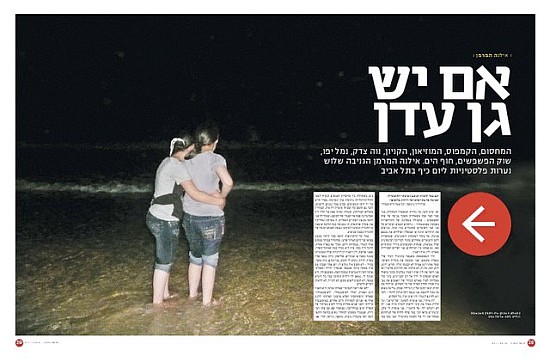
In a May 7 article, Haaretz reporter Ilana Hammerman described in dramatic detail a crime she had methodically planned and committed. In defiance of laws supposedly related to Israel’s security, Hammerman picked up three teenage Palestinian girls in their village in the West Bank, took them through the Betar checkpoint, and drove them into Tel Aviv. There they ate ice cream, visited the mall and museum, and played in the sea. Even though the girls lived just a few kilometers from the beach, Israel’s military occupation had prevented them from ever visiting it before their illegal “day of fun.”

Hammerman wrote in her account of the experience, “If There Is A Heaven:”

“The end was wonderful. The last photos show them about two hours after the trip to the flea market, running in the darkness on Tel Aviv’s Banana Beach. They didn’t want to stop for even a minute at the restaurant there to have a bite to eat or something to drink, or even to just relax a bit. Instead they immediately removed their sandals again, rolled up their pants and ran into the water. And ran and ran, back and forth, in zig-zags, along the huge beach, ponytails flying in the wind. From time to time, they knelt down in the sand or crowded together in the shallow water to have their picture taken. The final photo shows two of them standing in the water, arms around each others’ waists, their backs to the camera. Only the bright color of their shirts contrasting with the dark water and the sky reveals that the two are Yasmin and Aya, because Lin was wearing a black shirt.”

But the fun ended as soon as a group called The Legal Forum for the Land of Israel filed a request with Israeli Attorney General Yehuda Weinstein demanding that Hammerman be prosecuted for breaking the country’s “Law of Entry to Israel” forbidding Israelis from assisting Palestinians in entering Israel. If Weinstein agrees to the request, Hammerman could face as much as two years in prison.

Facebooktwittermail

Let the flotillas through

In the Jerusalem Post, Larry Derfner writes:

The Iranians say the ship Infants of Gaza is due to sail on Sunday, carrying humanitarian aid and 10 pro- Palestinian activists to the Gazan shore.

The Lebanese say two more relief ships, one of them carrying just women passengers, will leave soon for Cyprus and go on from there to Gaza.

Israel has sworn to stop the ships, saying Gaza cannot become an “Iranian port.”

Navy commandos are preparing to face suicide bombers.

I feel another fiasco in the making, only this time we’re in much worse shape because we’re still reeling from the one with the Mavi Marmara. So if these Iranian and Lebanese ships come sailing toward Gaza, I say we let them through.

It’ll be a victory for Iran, Lebanon and Hamas and a humiliation for Israel, as well as for the moderate West Bank Palestinians. The problem is that if we forcibly stop the ships, especially if there’s bloodshed, which there well may be, it’ll be an even greater victory for the Islamists and an even worse humiliation for Israel and the West Bankers. There’s a clear downside to ending the blockade, but there’s no future at all in maintaining it.

The folks on the flotillas have discovered our weak spot. They’re attacking us at our least defensible point – our control over the Palestinians and their coast in Gaza, which the world opposes. These flotillas are turning our own military power against us. There are more relief ships getting ready to go to Gaza than there are captains to steer them – and the passengers will be not only Islamists, but also many decent, reasonable people, including Jews, who believe they’re doing what’s best for Palestinians and Israelis both.

“The experience of the Free Gaza Movement over the past few years, which sent half a dozen boat expeditions to deliver humanitarian aid to Gazans, suggests to many that in-your-face confrontation is the most effective way to challenge Israel and force it to change its policies,” Rami Khouri, the liberal editor-at-large of Lebanon’s Daily Star, wrote on Wednesday. “I suspect that the Free Gaza Movement’s siege-breaking ships will go down in modern history as critical elements in the struggle for justice in Palestine, aiming for conditions that allow Jews, Christians and Muslims… to live in this land with equal rights.”

Khouri suggests:

Jews, Christians and Muslims may well remember the challenge and collapse of the Israeli siege of Gaza as that pivotal moment in the struggle between Zionism and Arabism in Palestine. The ships to come will clarify this in due course, because they do not challenge Israel’s existence or security, but only its inhumanity towards the Palestinians.

If this does indeed turn out to have been such a pivotal moment it will in large measure be because the world’s attention was drawn not by the siege-challengers themselves but by Israel’s irrational and unconscionable use of violence — and the Jewish state’s proclivity to make self-defense, self-destructive.

The Western media’s lack of interest in the Freedom Flotilla was perfectly evident from the fact that there were only two mainstream media journalists aboard — Paul McGeough and Kate Geraghty from the Sydney Morning Herald who secured berths at the last minute. Had the IDF not attacked the Mavi Marmara and killed civilians, this particular challenge to the siege would have been nothing more than a one day story in much of the global press — and a rather minor one at that. The Netanyahu government can take full “credit” for having given this act of civil disobedience its lasting importance. If the Israelis still fail to recognize that fact, the depth of their stupidity is staggering.

Larry Derfner is no doubt very well-intentioned in his appeal that Israel’s leaders now come to their senses, but he’s clearly realistic and without optimism when he says: “I’d feel safer if this government, as a matter of principle, tried to take as little action as possible. On everything, even the little things, but certainly on something with as much potential for catastrophe as a confrontation at sea with ships from Iran and Lebanon.”

Meanwhile, DPA reports:

Council of Europe parliamentarians Thursday called on Israel to completely lift its siege of the Gaza Strip, days after Prime Minister Benjamin Netanyahu ordered an ease of the land blockade.

“Without prejudice to its own security,” Israel should allow goods to be delivered to the coastal enclave by land and sea, so Palestinians can enjoy “normal living conditions,” a resolution adopted by a large majority of the Parliamentary Assembly of the Council of Europe (PACE) said.

PACE, consisting of parliamentarians from the 47 members of the Council of Europe, meets four times a year to debate topical issues and give policy advice to the European Parliament in Strasbourg.

The parliamentarians also criticized the Israeli raid of a Gaza- bound aid flotilla last month as a breach of international law, calling it “manifestly disproportionate.”

Facebooktwittermail

US-Israeli relations improve — time to bulldoze Palestinian homes

Since US-Israeli relations are so famously cozy, maybe it’s time to extend the familial metaphor a bit further: Washington is a victim of domestic violence.

Every time the Obama administration reaches out to the Netanyahu government, it gets slapped in the face. Netanyahu has once again been invited to Washington — due to the poorly-time Mavi Marmara massacre he had to bail on a visit planned for early this month. He’s now due for his long-awaited kiss and make up session at the White House on July 6. But true to form, as soon as this was announced, word came from Jerusalem that 22 Palestinian homes are going to be bulldozed to clear space for a tourist center.

Another diplomatic snafu? On the contrary. These unfortunate “coincidences” have become so predictable that it’s hard to interpret them in any other way than as a calculated effort by Israeli officials to humiliate their American counterparts.

Just as some victims of serial abuse collude with their abuser by finding ways to excuse their partner’s violence, Washington’s tolerance of treatment that would be unthinkable coming from any other ally, is perpetually excused when the offending nation is Israel.

Haaretz now reports:

The Jerusalem municipal planning committee approved Monday a contentious plan to raze 22 Palestinian homes to make room for a tourist center that Palestinians fear would tighten Israel’s grip on the city’s contested eastern sector.

Jerusalem mayor Nir Barkat has asked the municipal planning committee earlier Monday to give preliminary approval to the plan which affects the neighborhood of Silwan in East Jerusalem, and risks more U.S.-Israeli friction.

Tensions have already been raised in Jerusalem, when conflict erupted during the meeting between committee members and the residents of Silwan. Silwan residents starkly objected to the plan and demanded the committee discuss their alternative plan, which does not include razing homes.

What will the White House say? That this is “unhelpful”? Hillary Clinton has already expressed her “dismay and disappointment.”

Just as the expansion of Jewish settlements on Palestinian land has been relentless, the Israeli assault on Washington perpetually expands the boundaries of impunity. The notion that Israel might go too far in testing the limits of American tolerance is repeatedly invalidated as Washington demonstrates that its diplomatic tool box is equipped with nothing more threatening than the occasional harsh word — and even those are in short supply and never particularly harsh.

Facebooktwittermail

White House welcomes empty promise from Israel on Gaza

“Today, the United States welcomes the new policy towards Gaza announced by the Government of Israel, which responds to the calls of many in the international community. Once implemented, we believe these arrangements should significantly improve conditions for Palestinians in Gaza, while preventing the entry of weapons,” the White House press secretary’s office said in a statement released on Sunday morning.

And what, one might wonder, is the substance of the new policy that Washington is so swift to praise? This is what an Israeli official told Haaretz: “we will allow the entry of food items, house wares, writing implements, mattresses and toys. Beyond that, we have not said a thing.” The Los Angeles Times notes: “the government has yet to specify what items will be banned or when the changes will take effect.”

The Guardian says:

Aid agencies have cautioned that concrete implementation of any relaxation of the siege could be hampered by Israeli foot-dragging. “The siege must be ended, not just eased,” said UN spokesman Chris Gunness. “Otherwise Israel continues to be in breach of international law.”

Gisha, an Israeli human rights organisation, said in a statement: “A policy consistent with international law would allow free passage of raw materials into Gaza, export of finished goods, and the travel of persons not just for ‘humanitarian’ reasons but also for work, study, and family unity – subject only to reasonable security checks.”

Ziad al-Zaza, a Hamas cabinet minister, called the Israeli move a “deception”. The blockade must be lifted completely “to allow Gaza to import all necessary materials, particularly cement, iron, raw materials for industry and agriculture, as well as import and export between Gaza and the world”, he said.

Meanwhile, if Israel is adopting a more liberal approach to Gaza, this wasn’t evident on Saturday.

Haaretz reported:

German Development Aid Minister Dirk Niebel was denied entry into the Gaza Strip during his current visit to Israel, German officials said Saturday evening.

A ministry spokesman said talks had continued to the last moment with Israeli officials over Niebel’s aim to visit the Palestinian areas.

Niebel, who arrived in Israel earlier Saturday, had hoped to visit a sewage treatment plant being financed with German development aid.

Speaking on the second German TV network ZDF program”heute” (today) Saturday evening, Niebel expressed his anger about being denied entry.

“I would have wished for a clear political signal would be sent for an opening and for transparency,” said Niebel, of Germany’s liberal Free Democratic Party (FDP).

“Sometimes the Israeli government does not make it easy for its friends to explain why it behaves the way it does,” he added.

Niebel said that Israel’s latest announcement on easing the Gaza blockade was “not sufficient” and that Israel must “now deliver” on its pledge.

Beyond that, the government in Jerusalem should be “clear about how Israel, within an international context, wants to cooperate with its friends in the future as well,” the German minister said.

The United States has no fear of meeting a similar rebuff. As far as one can tell, George Mitchell has no interest in visiting Gaza.

Facebooktwittermail

Mordechai Vanunu: prisoner of conscience

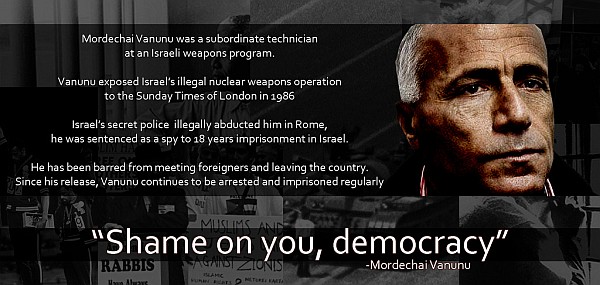
How many countries in the world are there where someone can be thrown in jail for talking to a foreigner? That was one of Mordechai Vanunu’s most recent “crimes” as a citizen in “the only democracy in the Middle East.”

Having spent 18 years in prison — more than 11 of those in solitary confinement — after revealing to the world Israel’s clandestine nuclear weapons program, Vanunu is now back in solitary confinement.

Amnesty International has rightly declared that he is a “prisoner of conscience,” and called for his immediate release.

The state persecution that Vanunu has suffered for decades and other details provide reason to suspect that he may the individual who in a report several days ago was simply referred to a Mr X.

A June 13 report in the Hebrew edition of Ynet (translated by Didi Remez, h/t to Richard Silverstein) said:

Nobody knows who Mr. X. is. Ynet has learned that a man has been imprisoned for some time in wing 15 of Ayalon Prison but nobody knows who he is and what charges he is being jailed for. Nobody talks to him, nobody sees him, nobody visits him, nobody knows he is in jail. “He was placed in full and complete separation from the outside world,” said an Israel Prison Service official.

To enter the wing where the detainee is being held, you have to pass the jailers on the southern side of the prison and go through double iron doors. Unlike regular separation wings, where prisoners can talk loudly between the cells or see the goings-on in the corridors with mirrors, wing 15 has only one cell without neighboring cells and without a corridor, so that whoever is jailed in it is completely isolated from any living being.

“I don’t know any other prisoner or IPS detainee held in such severe conditions of separation and isolation,” said a Prison Service official. “There is confidentiality surrounding the detainee in wing 15 in every respect, including his identity and the crimes he committed. I doubt even the jailers in charge of him know who he is. There is too much confidentiality surrounding him. It is scary that in 2010 a man is imprisoned in Israel without us even knowing who he is.”

The official said, “it is simply a person without a name and without an identity who was placed in complete and absolute isolation from the outside world. We don’t know if he gets visits, if he gets the rights that every detainee deserves by law and if anybody even knows he is in jail.” The IPS declined to divulge who the person jailed there is. Its spokesman, Lt. Col. Yaron Zamir, said: “The IPS does not provide information about locations and names out of security considerations.”

Mr. X. is being kept in the wing originally built in order to jail Prime Minister Rabin’s assassin, Yigal Amir. Amir was jailed in the same cell under heavy security, with security cameras in the cell until December 2006, when he was moved to the separate wing at Rimonim prison in the Sharon district. The cell in wing 15 is relatively large and, in the case of Amir, his family met him in the cell so that he would not have to be taken out during visits.

Amnesty confirms that Vanunu is being held in Ayalon Prison.

Earlier this year, Rannie Amiri wrote on Vanunu’s “Nobel stand”:

“He [Vanunu] has written letters to us this year and last year also, where he stated explicitly that he did not want to be a candidate for the Nobel Peace Prize. The reason he gave was that Simon Peres had received the Nobel Peace Prize, and Peres he alleged was the father of the Israeli atomic bomb and he did not want to be associated with Peres in any way.” – Geir Lundestad, Director of the Norwegian Nobel Institute and Secretary of the Norwegian Nobel Committee, 24 February 2010.

For the first time in the history of the Norwegian Nobel Committee, a preemptive request to withdraw a nomination—by the nominee—was made.

It was revealed last week that in a letter to the Committee, Mordechai Vanunu had asked for his candidacy to be rescinded. It was unusual enough for Geir Lundestad to acknowledge that a nomination had even been received, let alone publicly disclose Vanunu’s request. But for Vanunu—a man who should have been awarded the Peace Prize long ago—it was in full keeping with the dignity, integrity and uncompromising nature of one to whom the world owes a great debt.

Mordechai Vanunu – more than just a whistleblower

Vanunu worked as a technician at Israel’s Dimona nuclear plant in the Negev Desert from 1976-1985. In a 1986 interview with The Sunday Times, he courageously exposed, for the first time, his country’s clandestine nuclear activity. A week prior to the interview’s publication, he was lured by a Mossad agent from London to Rome, where he was apprehended and whisked off to Israel. In secret proceedings, Vanunu stood trial for treason, was swiftly convicted, and sentenced to 18 years behind bars. He spent more than 11 of them in solitary confinement.

Vanunu was released from Ashkelon’s Shikma prison in April 2004, unapologetic and unrepentant. “I am proud and happy to do what I did,” he said.

As for enduring nearly two decades of incarceration?
“I said to the Shabak [Shin Bet], the Mossad, ‘you didn’t succeed to break me, you didn’t succeed to make me crazy.’”
Conditions of his parole prohibited him from speaking with journalists, supporters, or non-Israelis of any kind. He was restricted from travelling within the country and barred altogether from leaving it.

In 2007, Vanunu was found to be in violation of his parole, in part for attempting to travel from Jerusalem to Bethlehem, and it landed him in jail for another three months. Being a convert to Christianity and an advocate for Palestinian rights did not help his case, but only served to increase the scorn heaped upon him by his countrymen.

Although the term “whistleblower” is usually appended to Vanunu’s name, the description is weak and understated. He was more like the “siren” that alerted the world to Israel’s undeclared nuclear bombs and the introduction of weapons of mass destruction to the Middle East.

Facebooktwittermail

Israel’s Secret Weapon

A BBC documentary, “Israel’s Secret Weapon,” which first aired in 2003 just weeks before the start of the war in Iraq, examines Israel’s nuclear weapons program, the secrecy in which it has always been shrouded, and the ruthless measures through which Israel’s “nuclear taboo” is enforced. The film reveals:

  • The brutality with which Mordechai Vanunu, Israel’s most famous political prisoner has been treated. By the time this film was made, Vanunu had been held in solitary confinement for longer than any prisoner in the West.
  • The mafia-like power wielded by the ulta-secret Yechiel Horev, who as Director of Security of the Defense Establishment was committed to ensuring that Vanunu never be permitted to leave Israel.
  • The deception through which Israel concealed the most sensitive areas of the Dimona nuclear facility from scrutiny by American inspectors.
  • The cover-ups and threats that have forced injured Dimona workers to maintain their silence about accidents, injuries and sickness caused their exposure to nuclear materials.
  • Israel’s biological and chemical weapons program that appears to have involved the use of chemical weapons in Gaza.
  • The blanket refusal by members of the Bush administration to discuss any questions relating to Israel’s large stock of weapons of mass destruction just as Washington was insisting that an active WMD program in Iraq (which of course turned out to be non-existent) necessitated war.
  • Facebooktwittermail

    Interview with Ken O’Keefe

    Ken O’Keefe, an activist who was on board the Mavi Marmara, is interviewed by Mark Dankof on his podcast, The Ugly Truth.

    (During the first ten minutes of the broadcast, Phil Tourney, a survivor from the USS Liberty, describes the circumstances in which Israel attacked that American intelligence vessel in 1967.)

    In a statement O’Keefe released soon after his expulsion from Israel, he said:

    I said this straight to Israeli agents, probably of Mossad or Shin Bet, and I say it again now, on the morning of the attack I was directly involved in the disarming of two Israeli Commandos. This was a forcible, non-negotiable, separation of weapons from commandos who had already murdered two brothers that I had seen that day. One brother with a bullet entering dead center in his forehead, in what appeared to be an execution. I knew the commandos were murdering when I removed a 9mm pistol from one of them. I had that gun in my hands and as an ex-US Marine with training in the use of guns it was completely within my power to use that gun on the commando who may have been the murderer of one of my brothers. But that is not what I, nor any other defender of the ship did. I took that weapon away, removed the bullets, proper lead bullets, separated them from the weapon and hid the gun. I did this in the hopes that we would repel the attack and submit this weapon as evidence in a criminal trial against Israeli authorities for mass murder.
    I also helped to physically separate one commando from his assault rifle, which another brother apparently threw into the sea. I and hundreds of others know the truth that makes a mockery of the brave and moral Israeli military. We had in our full possession, three completely disarmed and helpless commandos. These boys were at our mercy, they were out of reach of their fellow murderers, inside the ship and surrounded by 100 or more men. I looked into the eyes of all three of these boys and I can tell you they had the fear of God in them. They looked at us as if we were them, and I have no doubt they did not believe there was any way they would survive that day. They looked like frightened children in the face of an abusive father.

    But they did not face an enemy as ruthless as they. Instead the woman provided basic first aid, and ultimately they were released, battered and bruised for sure, but alive. Able to live another day. Able to feel the sun over head and the embrace of loved ones. Unlike those they murdered. Despite mourning the loss of our brothers, feeling rage towards these boys, we let them go. The Israeli prostitutes of propaganda can spew all of their disgusting bile all they wish, the commandos are the murders, we are the defenders, and yet we fought. We fought not just for our lives, not just for our cargo, not just for the people of Palestine, we fought in the name of justice and humanity. We were right to do so, in every way.

    Facebooktwittermail

    Syria’s Bashar al-Assad warns of Middle East war

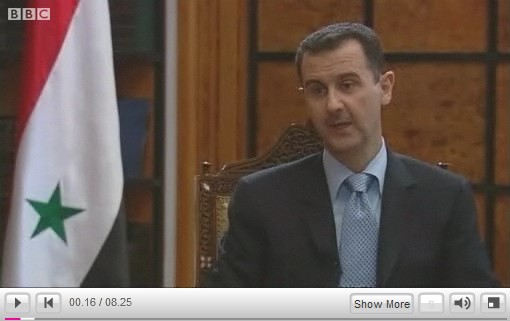
    The BBC’s Middle East editor, Jeremy Bowen interviewed Syrian President Bashar al-Assad who says Israel’s raid on the Gaza aid flotilla has increased the risk of war in the Middle East.

    A few days before the Israeli attack on the Mavi Marmara, Charlie Rose did a full length interview with the Syrian president which is well worth watching. He’s a serious and articulate strategic thinker.

    Assad gets far less attention in the US media than he deserves. To some extent this may result from his reserved manner and the perception that he rules in the shadow of his father, the late Hafez al-Assad, but to a larger extent I see it as standard-fare Washington contempt for Syria itself. Perennially branded a rogue state, a relatively minor oil producer, Syria is a country that interests America no more than can be measured by its willingness (or unwillingness) to bow to American pressure.

    But Assad belongs to and is articulating the vision of a new generation of regional leaders who recognize that the fate of the Middle East rests firmly in the hands of those who refuse to define themselves on the basis of their relationship with the United States.

    Facebooktwittermail

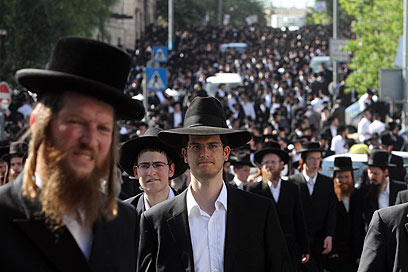
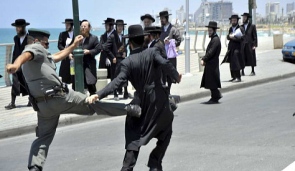
    100,000 ultra-Orthodox Jews rally in Jerusalem in support of segregation

    “It’s like putting Americans and Africans together. They can’t study together with such huge mental differences,” an ultra-Orthodox Jewish parent said when explaining why he cannot allow his daughters to share a classroom with Sephardi Jewish girls.

    It’s hard to countenance the concept of a “demographic threat” and treat it as socially acceptable without also opening the door to other forms of bigotry that a liberal Zionist cannot possibly tolerate.
    This is the dilemma many Israelis now face: How do you justify the idea that the rights of a non-Jewish minority can be restricted (this being a practical necessity if Israel is to remain a Jewish state), and then stand up in defense of religious and racial pluralism when ultra-Orthodox Jews insist that the “purity” of their children will be tainted if they are forced to share classrooms with Sephardi Jews?

    Today, as 100,000 ultra-Orthodox Jews protested in Jerusalem in support of segregation, many Israelis probably feel conflicted about which particular demographic threat now poses the greatest danger to Israel.

    The liberal commentator, Yossi Sarid, expresses what I take to be commonplace Israeli secular Jewish contempt for and exasperation with the ultra-Orthodox when he writes: “[T]he rebellious Haredim must be put in their place.”

    Last December, Haaretz reported:

    The Ashkenazi students of the ultra-Orthodox Beit Yaakov girls’ school in [the West Bank settlement] Immanuel stayed home on Wednesday, yet again, as part of an organized protest against the decision by the Education Ministry and High Court to end the segregation between Sephardi and Ashkenazi students.

    “No court ruling or Education Ministry decision can bring the two groups together,” an Immanuel resident said Wednesday.

    “It’s like putting Americans and Africans together. They can’t study together with such huge mental differences,” he said.

    Some 70 Ashkenazi students of the Beit Yaakov girls’ school stopped attending classes two days before the Hanukkah holiday – in protest of the ministry’s efforts to force the ultra-Orthodox school to rescind the segregation, in keeping with the High Court ruling.

    The father of one Mizrahi student was in no doubt about the basis for discrimination: “The Ashkenazis think they’re more intelligent than we are, but what really bugs them is our skin color.”

    Sami Michael, an Israeli author who grew up in Baghdad and settled in Israel in 1949 when he was 23, notes that even in the darkest days in Iraq, Egypt and Lebanon, they never separated Jews from Muslims and Christians in schools.

    On segregation in Immanuel he writes:

    My nerves are tingling and my flesh is crawling as I write these lines. This is a small story about two girls attending the same school who became friends and who are now required, by racist order, to wear school uniforms of different colors.

    They have been forbidden to come in contact with each other and in order to make the prohibition concrete, a fence covered with an opaque cloth has been stretched between them. They preserve their friendship by passing notes through a hole in the fence.

    This story did not happen in the days of apartheid South Africa or in the dark times before the civil rights movement in the United States or in a ghetto in an insane Europe during World War II.

    The two schoolgirls wearing uniforms of different colors are Jewish girls from the Israeli settlement of Immanuel in the West Bank, which is flourishing under the flag and armed protection of the Israel Defense Forces. The school also receives funding courtesy of the Israeli taxpayer.

    The two schoolgirls’ crime is their different ethnic origins. One is an Ashkenazi Jew, whose family’s roots are in Europe, and her friend is a Mizrahi Jew, whose family comes from Middle Eastern and North African countries. Was it for this that the state of Israel forged its path through rivers of the blood of its sons and its enemies?

    Even in the darkest days in Iraq, Egypt and Lebanon, they never separated Jews from Muslims and Christians in schools.

    One of the initiators of the segregation in Immanuel commented: “This isn’t ethnic separation, but rather religious.” He was right, but only partially. Indeed, this separation is not ethnic but rather “racist,” a word rarely used, even by those of courageous and honest determination.

    The Supreme Court’s justices, whom I see as the last bastion of democracy in Israel, used the term “discrimination.”

    To my regret, intellectuals whose voice resounds from time to time from here and abroad have sealed their lips. They and the vast majority of Israeli society used to think of “discrimination” as something unclean. What? Here? In our enlightened country?

    Along came the righteous Supreme Court justices, headed by Edmond Levy and Hanan Melcer, who smashed the taboo and used the despised word “discrimination.”

    Let us imagine for a moment a school, say in Germany or Britain, which puts up a separation fence for “religious” reasons, as the Immanuel racists claimed, and compels the Jewish students to wear a uniform of a different color. What a ruckus we would be raising!

    I have personally met the current head of the Jewish community in Tehran and I have conversed with many Iranian expatriates in Europe and the United States. I am also in touch with combative elements in Iran. I can attest that Jewish schoolchildren and students living in Iran today are not required to wear clothing of a different color.

    How has it happened that rabbis, at least in Immanuel, are even more benighted than the ayatollahs we excoriate and abominate day and night? And why have the intellectuals here mostly disappeared?

    Facebooktwittermail

    Credibility, once shredded, is impossible to piece together again

    “The man who ordered the attack on the aid flotilla to Gaza, set up the inquiry, chose its members and determined its mandate, has announced its outcome even before it has started,” wrote Chris Doyle, noting Benjamin Netanyahu’s visible satisfaction, confident that he has mounted an effective response to international pressure.

    If the only audience the Israeli prime minister needed to satisfy was made up by the likes of Jeremy Ben-Ami and Barack Obama, Netanyahu could indeed take satisfaction as he proves how easy it is to win unprincipled support.

    On the day of the Mavi Marmara massacre, J Street’s president Ben-Ami issued a statement which included this:

    There will undoubtedly be calls in the coming days for a UN investigation into today’s events. A credible, independent commission appointed by the Israeli government should provide the world with a full and complete report into the causes and circumstances surrounding the day’s events and establish responsibility for the violence and bloodshed.

    The world? And which world would that be?

    There is nothing mysterious about the nature of credibility, but if the Israeli government and members of the pro-Israel lobby and the Obama administration assign themselves the exclusive role of being the arbiters of “credibility” then the term as applied has itself lost credibility.

    The real arbiters of credibility have to include the Turkish government and the Turkish people. In its May 31 statement and a statement issued yesterday, J Street makes no reference to them.

    Indeed, echoing those who see all Israeli violence as justifiable we hear J Street repeat the mantra, Israel has the right to self-defense.

    Given that there has not been a single call for Israel to renounce its right to self-defense, this reiteration of Israel’s “defensive” posture implicitly endorses the claim that the attack on the Mavi Marmara in international waters was itself an act of self-defense.

    The New York Times editorial board — not renowned for its political courage — managed to be bold enough to say that on this matter Israel cannot simply investigate itself. The paper has called for an inquiry overseen by The Quartet and says that Israeli and Turkish representation would have to be included: “That is in Israel’s clear interest. And it is in Turkey’s clear interest. The Obama administration should be pressing both its allies to embrace the idea.”

    Anyone who now holds the position that this is Israel’s business and Israel can somehow impartially investigate itself, apparently regards the families of the dead as irrelevant.

    But as an editorial in Haaretz makes clear, a move by Netanyahu that J Street, the Obama administration and other Israeli apologists have welcomed, does not meet the credibility test even inside Israel.

    The government’s efforts to avoid a thorough and credible investigation of the flotilla affair seem more and more like a farce. The conclusions of an ostensible probe are intended to justify retroactively the decision to blockade Gaza, to forcibly stop the Turkish aid flotilla in international waters and to use deadly force on the deck of the Mavi Marmara.

    To make the costume seem credible, the Prime Minister’s Bureau asked a retired Supreme Court justice, Yaakov Tirkel, to chair the committee. Alongside him will sit foreign observers in order to legitimize the conclusions in international public opinion. Prime Minister Benjamin Netanyahu even pledged to testify before the committee, together with Defense Minister Ehud Barak, other ministers and the chief of staff, so “the truth will come out.”

    The truth that Netanyahu wishes to bring out involves the identity of the flotilla’s organizers, its sources of funding and the knives and rods that were brought aboard. He does not intend to probe the decision-making process that preceded the takeover of the ship and the shortcomings that were uncovered. As far as Netanyahu is concerned, it will be enough for television channels to broadcast footage of dark-suited jurists, and politicians addressing them, to present the semblance of an “examination.”

    But Netanyahu’s panel will have no powers, not even those of a government probe, and its proposed chairman does not believe in such a panel. In an interview to Army Radio, Tirkel said there is no choice but to establish a state committee of inquiry. He opposed bringing in foreign observers and made clear that he is not a devotee of drawing conclusions about individuals and dismissing those responsible for failures. When a Haaretz reporter confronted Tirkel about these remarks, the former justice evaded the question saying, “I don’t remember what I said.”

    The disagreements that erupted at the week’s end between Netanyahu and his deputy, Strategic Affairs Minister Moshe Ya’alon, over the question of whether Ya’alon was updated in time about the action underscored the suspicion of serious faults in the decision-making process with regard to the flotilla. Instead of being part of the whitewash, Tirkel, whose dodging of his earlier statements does him no honor, should return his mandate to the prime minister and demand that Netanyahu establish a government committee of inquiry with real powers. The public, as Netanyahu said, has a right to know the truth.

    Facebooktwittermail

    Did Israel target Raed Salah in the Mavi Marmara raid?

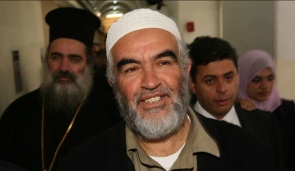
    In an Al Jazeera documentary on the Israeli assault on the Mavi Marmara, it is claimed that Sheikh Raed Salah, head of the northern branch of the Israeli-Arab Islamic Movement, was the target of an attempted assassination during the raid.

    (Video cannot be viewed in the U.S.)

    AJ commentary: Meanwhile, a recording surfaced [from Cultures of Resistance] that appeared to suggest that some activists had been deliberately targeted in advance of the raid.

    Durmus Aydin, Vice Chairman, IHH organization said: “In the pictures there were picture of the Raed Salah. Instead of killing Raed Salah, they killed other one. They’ve killed another people who looks like Raed Salah. And then Raed Salah said that when they killed that guy, the soldier was telling the others, ‘We finished off Raed Salah’.”

    The Alternative Information Center adds:

    Shortly after the Freedom Flotilla was attacked, rumors circulated that Sheikh Salah had been critically injured, hospitalized or even killed. The Israeli Ministry of Foreign Affairs stated that he had suffered only minor injuries.

    It has been widely reported, however, that during a hearing shortly before his release at the Ashkelon Magistrates’ Court, Salah stated, “The [Israeli] soldiers tried to kill me. They shot in the direction of someone they thought was me.”

    Born in 1958 in the city of Umm al-Fahm in the Haifa area, Salah was known for his poetry before becoming involved with the Islamic Movement.

    Today, the Islamic Movement in Israel acts on three tracks: religious, social and national. In 1989, the party decided to participate in municipal elections for the first time. Sheikh Salah succeeded in being elected mayor of Umm al-Fahm that year, and was re-elected to the position twice during the 1990s.

    A long-time advocate of the right of return for Palestinian refugees, Sheikh Salah has non-violently protested against the Israeli occupation for decades. His primary focus has been on reinforcing and rebuilding destroyed mosques throughout Israel, and more specifically, protecting the al-Aqsa Mosque in Jerusalem’s Old City. The Israeli authorities have arrested Sheikh Salah on numerous occasions for his promotion of Palestinian human rights.

    Facebooktwittermail

    In a different voice: a letter from Israel

    Ronen Shamir, a professor of sociology and law who chairs the Department of Sociology and Anthropology at Tel Aviv University, writes in Today’s Zaman:

    The truth must be said: The present-day Israeli regime is not interested in peace. The Israeli establishment has become prisoner to an ever growing public of Jewish fanatics — informed by messianic visions of Greater Israel — who over the years not only irreversibly settled in the occupied West Bank, with state funding, but have also penetrated the ranks of army officers, the civil service and the government. The outcome is that the current Israeli regime is firmly grounded in a religiously guided, ultranationalist and xenophobic worldview, one which is bound to bring calamity to the whole region, including Israel.

    Deteriorating relations with Turkey are, sadly, an inevitable outcome of a siege mentality common among Israelis. For many, criticism of Israel’s policies from abroad is not heeded as yet more proof that “the world is against us” in general and that “the world is anti-Semitic” in particular. The Israeli regime, for its part, fosters this view, one that deliberately obscures the crucial difference between criticism of Israeli policies and a principled stand against Israel’s right to exist. The two become one in the Israeli media, the Israeli political propaganda machine, and ultimately, in the Israeli mind. Things became worse when criticism came from Turkey. Over the course of less than two years, following a string of events that reached its tragic climax last month, Turkey has been systematically demonized by the Israeli government. Relying on and further fostering well-embedded stereotypes of Muslims among Israeli Jews, Turkey — abstracted and depicted as a homogenous social-political entity — is now portrayed as the natural ally of militant and radical Islamists around the world.

    It is in the context of such a cynical trope, at this dangerous juncture, that I wish to express my personal apology to the Turkish people for the deadly attack on the flotilla. It is also at this point in time that I believe it important to remember that there are many Israelis who are shocked and dismayed by the way Israel is governed, by the continuous blockade of Gaza and by Israel’s unwillingness to put an end to its occupation and repression of the Palestinian people. There are also many Israelis who understand and lament the folly involved in losing a long-time ally like Turkey, another step along a suicidal road that is leading us into an abyss.

    Facebooktwittermail

    The UN and Red Cross agree: the siege of Gaza is unsustainable — it must end

    Although President Obama acknowledges that the situation in Gaza is “unsustainable”, he refuses to draw the obvious conclusion and insist that Israel’s siege must end. But if it can’t continue, it must end, right?

    The International Committee of the Red Cross and the UN are happy to adopt Obama’s term (unsustainable) but are less willing to equivocate. Indeed, the Red Cross has gone even further and accuses Israel of breaking international law through its use of collective punishment.

    As the ICRC has stressed repeatedly, the dire situation in Gaza cannot be resolved by providing humanitarian aid. The closure imposed on the Gaza Strip is about to enter its fourth year, choking off any real possibility of economic development. Gazans continue to suffer from unemployment, poverty and warfare, while the quality of Gaza’s health care system has reached an all-time low.

    The whole of Gaza’s civilian population is being punished for acts for which they bear no responsibility. The closure therefore constitutes a collective punishment imposed in clear violation of Israel’s obligations under international humanitarian law.

    “The closure is having a devastating impact on the 1.5 million people living in Gaza”, said Béatrice Mégevand-Roggo, the ICRC’s head of operations for the Middle East. “That is why we are urging Israel to put an end to this closure and call upon all those who have an influence on the situation, including Hamas, to do their utmost to help Gaza’s civilian population. Israel’s right to deal with its legitimate security concerns must be balanced against the Palestinians’ right to live normal, dignified lives.”

    The international community has to do its part to ensure that repeated appeals by States and international organizations to lift the closure are finally heeded.

    Likewise, the UN is pushing for the blockade not merely to be “eased” or — to use Tony Blair’s language — made “softer” (suggestive of a more compassionate collective punishment?). No, the siege must end.

    [T]he UN said Tuesday that an international consensus has emerged demanding that Israel lift the blockade of Gaza Strip and replace it with a “different and more positive strategy.”

    “The flotilla crisis is the latest symptom of a failed policy,” said Robert Serry, the UN special envoy for Middle East peace process.

    “The situation in Gaza is unsustainable and the current policy is unacceptable and counter-productive, and requires a different, more positive strategy,” Serry said during a UN Security Council session on the Middle East.

    The closure and blockade of the Gaza Strip needs to come to an end,” he said. “There is now a welcome international consensus on Gaza.”

    Facebooktwittermail