Category Archives: Israel

FBI called in over Hamas murder

The National reports:

Dubai authorities have asked the FBI to investigate the links between suspects in the murder of the Hamas leader Mahmoud al Mabhouth and their American-issued payment cards, an FBI source confirmed yesterday.

The investigation will seek to discover the source of the funds used in the January 19 assassination at a Dubai hotel, particularly to establish if there is a link to Israel or its intelligence agency Mossad. Thirteen of the 27 suspects used prepaid MasterCards issued by MetaBank, a regional American bank, to purchase plane tickets and book hotel rooms, according to Dubai Police.

Facebooktwittermail

Hamas-Israel prisoner swap negotiations collapse

Der Spiegel reports:

Germany’s foreign intelligence agency has reached an impasse in its efforts to secure the release of Israeli soldier Gilad Shalit, who has been held captive in the Gaza Strip since 2006. The chief negotiator for the Palestinian militant group Hamas has told SPIEGEL that he is no longer willing to take part in talks.

Mahmoud Zahar, 64, is sitting in an armchair in the corner of a huge room on the ground floor of his house in the Tel al-Hawa neighborhood of Gaza City. On the other side of the room stands a massive desk, and beyond that a Toyota off-road vehicle. This space serves Zahar as a reception room, an office and a garage, all rolled into one. Zahar looks like a lonely man.

He feels betrayed by Israel’s Prime Minister Benjamin Netanyahu. In the spring of last year, Netanyahu asked Germany’s foreign intelligence agency, the Bundesnachrichtendienst (BND), to act as a go-between in the negotiations with the militant Islamist group Hamas over the possible release of the soldier Gilad Shalit, who was abducted and taken to the Gaza Strip in 2006. Zahar, who is a senior Hamas leader in the Gaza Strip, became the BND’s contact person on the Hamas side. Now he has had enough. “I am not ready to negotiate anymore,” Zahar told SPIEGEL.

Facebooktwittermail

Turkmenistan snubs former Mossad agent as Israel envoy

Haaretz reports:

For the past four months Turkmenistan has been stalling over the appointment of a former spy and close confidant of Foreign Minister Avigdor Lieberman as Israel’s first ambassador to the country, Haaretz has learned.

Israel in October nominated Reuven Dinel, a close associate of Lieberman and a former employee of the Mossad as its envoy to the Central Asian state.

But in a rare diplomatic snub, Turkmenistan has withheld approval the posting.

“They are hoping that we’ll take the hint and nominate someone else,” one senior diplomat told Haaretz.

Behind the rejection may lie an embarrassing episode that has dogged Dinel for more than a decade. In 1996 the Mossad man was expelled from Moscow after Russian security forces caught him accepting classified satellite photographs from senior army officers.

Facebooktwittermail

At what point will the West dump Israel?

For those of us who view the Israeli-Palestinian conflict as being an issue of injustice, there’s plenty of reason to believe no resolution is in sight simply because justice is one of the weakest among the principles governing world affairs. To this extent, Israeli leaders can feel confident in their sense of impunity.

But there is another line Israel crosses at its peril: where its actions conflict with the commercial interests of its allies. Israel can be a moral liability but it cannot be a financial liability.

US taxpayers have every reason to feel that Israel, as the largest single recipient of US foreign aid, is already a massive financial liability. Even so, since most of those tax dollars get plowed straight back into the US defense industry, Washington is unlikely to become more attentive to the concerns of ordinary American citizens than it is to the interests of its corporate sponsors.
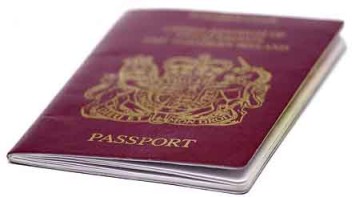
Nevertheless, there is now reason to think that with the murder of Mahmoud al Mabhouh in Dubai, Israel crossed a line that strains the limits of Western tolerance. Western governments would have paid scant attention to this event were it not for one egregious error by Mossad: its flagrant disregard for the integrity of foreign passports.

For many international travelers from Western countries, a passport might seem like nothing more than an obligatory document of no extraordinary value, yet in many ways these carefully bound and embossed permits are the lubricants of globalization. Swift passage through immigration control is one of the things that keeps the wheels of business turning smoothly.

But anyone traveling to the Middle East on an EU or Australian passport will now face a new level of scrutiny from immigration officers intent on blocking the passage of Israeli assassins.

Dubai’s police chief Lt Gen Dahi Khalfan Tamim announced on Monday that any travelers suspected of being Israeli, even if they hold passports from another country, will now be barred from entry into the UAE.

Asharq Al-Awsat reports that any foreign traveler visiting Lebanon who has a Jewish name will now be placed under surveillance.

Major General Wafiq Jizzini, director general of the Lebanese Public Security, said: “When someone comes to Lebanon on a foreign passport and the name of his family indicates that he is of Jewish origin, the border center sends the information to the central information office at the General Directorate of the Public Security. Afterward, the directorate observes this person who would have already registered his address in Lebanon. Both the visiting person and the one who receives him at the airport are observed.”

Israeli leaders such as Israel’s minister of industry, trade and labor, Binyamin Ben-Eliezer, who still regard the Dubai murder as a victory for Israel, have further reason to question that conclusion as fallout from the operation has now reached the United Nations General Assembly.

On Friday, the only countries willing to side with Israel in opposing a resolution that makes a renewed call for the investigation of war crimes committed during Israel’s war on Gaza, were the United States, Canada, Micronesia, Nauru, Panama, and Macedonia.

Australian government sources informed the Sydney Morning Herald that there was a direct connection between the UN vote and the Dubai affair:

Britain, France and Germany have all recently expressed anger at Israel after their passports were caught up in the Dubai plot.

One Department of Foreign Affairs source told the Herald there was no doubt the decision to abstain was intended as a sign to Israel not to take Australian support for granted.

“A number of things made it easier for us to switch our vote,” the source said.

“Firstly, the Americans helped the Palestinians to soften the wording of this resolution compared to the last one. Secondly, a number of other countries had indicated that they were toughening their own positions on Goldstone. But there is no question that the debacle surrounding our passports being used in Dubai helped to make up the government’s mind to abstain. The final decision was taken late on Friday, Australian time, just a few hours before the vote.

“Our pattern in the past has been to vote with the US when it comes to Israel, to show as much support for Israel as possible.

“We were also aware that the UK’s decision to vote in favour of the resolution was influenced by the fact that so many of their citizens had been caught up in the Dubai assassination.”

Israelis would do well to remember that even among their most effusive supporters, an allegiance to business invariably trumps all others.

Facebooktwittermail

Two Dubai murder suspects entered the US

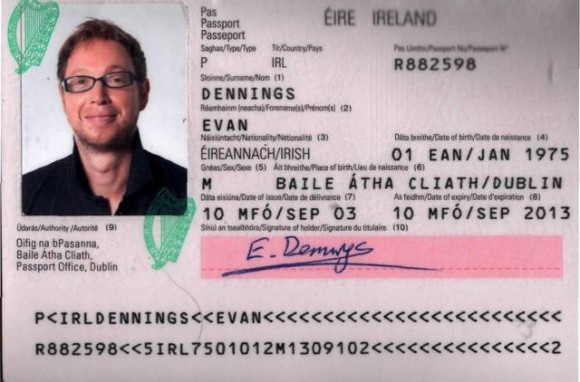
A murder suspect, traveling as an Irishman Evan Dennings, entered the US on January 21, a day after Mahmoud al Mabhouh’s body was discovered in Dubai.

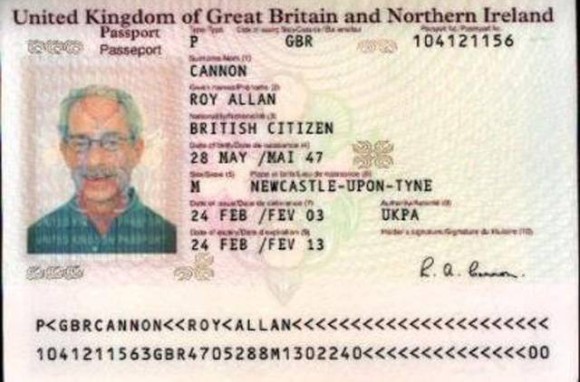
Roy Allan Cannon, entered the US on February 14.

The Wall Street Journal reports:

At least two of the 26 suspects sought by Dubai police for the alleged killing of a top Hamas leader appear to have entered the U.S. shortly after his death, according to people familiar with the situation.

Records shared between international investigators show that one of the suspects entered the U.S. on Feb. 14, carrying a British passport, according to a person familiar with the situation. The other suspect, carrying an Irish passport, entered the U.S. on Jan. 21, according to this person. Senior Hamas leader Mahmoud al-Mabhouh’s body was found in a Dubai hotel room on Jan. 20.

There aren’t records of either man leaving the U.S., though investigators can’t be sure the two are still in the country, according to this person. Since the two were traveling with what investigators believe to be fraudulently issued passports, they may have traveled back out of the U.S. with different, bogus travel documents.

The suspected U.S. travel broadens to American shores the international manhunt triggered by Dubai’s investigation into the death of Mr. Mabhouh. Dubai police have already identified two U.S. financial companies they believe issued and distributed several credit cards used by 14 of the suspects in the alleged killing.

Facebooktwittermail

Mossad returns to its ‘glory days’

The Times reports:

Would you be prepared to cross-dress? And kill a guest in an adjacent hotel room? If the answer to these questions is a resounding “yes”, and you can also act, enjoy luxury international travel with a twist and can carry off a convincing Irish or Australian accent, then the job could be yours.

The Israeli spy agency Mossad may be the target of international reproach since it allegedly killed the Hamas leader Mahmoud al-Mabhouh in a Dubai hotel this month, but at home emerging details of the operation have generated Mossad mania.

It has never been more popular in Israel, with stores selling out of Mossad memorabilia and its official website reporting a soaring number of visitors interested in applying to become agents. “Mossad has been restored to its glory days,” said Ilan Mizrahi, a former deputy director of the agency, which is located in the affluent beach town of Herzliya, north of Tel Aviv.

One of the signature elements of cult psychology is that the more a group is vilified, the more self-righteous it becomes. The outsiders’ opprobrium, far from provoking shame or doubt, has the opposite effect: it is treated as a vindication of the cult’s sense of superiority.

Facebooktwittermail

Is Israel really prepared to go it alone?

Reuters reports:

Israel’s perspective on Iran’s nuclear program differs from that of the United States, and the two may part ways on what action to take, Israeli Defense Minister Ehud Barak said on Friday.

Washington’s clout over its Middle East ally is under scrutiny after Israel’s veiled threats to attack Iran preemptively if international diplomacy fails to rein in Tehran’s uranium enrichment, a process with bomb-making potential.

The United States this week said it did not want to hurt the Iranian people with “crippling” sanctions against Iran’s energy sector, measures Israeli Prime Minister Benjamin Netanyahu has described as the only viable diplomatic solution.

“There is of course a certain difference in perspective and a difference in judgment and a difference in the internal clock, a difference in capabilities,” Barak told the Washington Institute for Near East Policy think-tank, when asked about Israeli-U.S. discussions about Iran.

“I don’t think that there is a need to coordinate in this regard. There should be understanding on the exchange of views, but we do not need to coordinate everything,” said Barak, who was in Washington for strategic talks.

Yet again, we are supposed to believe that Israel is prepared to go it alone and take on Iran.

Israel can destroy a nuclear reactor in Iraq; it can destroy one under construction in Syria; it wipe out a weapons convoy in Sudan; it can kill a Hezbollah commander with a bomb in Damascus; it can smother a Hamas commander with a pillow in Dubai; and it can flatten Southern Lebanon and Gaza.

Therefore, Israel’s ready to go to war with Iran… or, it loves to show off its power when it perceives the risk of doing so is minimal. If that was the case with Iran, we wouldn’t be weighing the chances of an Israeli attack — we’d be looking at the results of such an action.

Facebooktwittermail

US can’t get no satisfaction from Syria and Iran

At his blog, Syria Comment, Joshua Landis writes:

President Bashar al-Assad and Mahmoud Ahmadinejad, who was in Damascus today, threw down the gauntlet. Only the day before Hilary Clinton warned Syria “to begin to move away from the relationship with Iran,” and stop supporting Hizbullah, Hamas, and ex-Baathists in Iraq. For several years, Syria has been told to “flip” and break from Iran if it expects to be allowed out of diplomatic and economic isolation. Israel has made Syria’s break with Iran a condition for peace with Damascus.

Today, Assad came out forcefully and defiantly to end any talk of separation.

“We must have understood Clinton wrong because of a bad translation or our limited understanding, so we signed the agreement to cancel the visas,” Assad said. “I find it strange that they (Americans) talk about Middle East stability and peace and the other beautiful principles and call for two countries to move away from each other,” he added.

Ahmadinejad, for his part, held up his hand with his thumb and index finger only a centimeter apart to indicate how little separated the positions of both countries.

The Washington Post reported:

The presidents of Iran and Syria on Thursday ridiculed U.S. policy in the region and pledged to create a Middle East “without Zionists,” combining a slap at recent U.S. overtures and a threat to Israel with an endorsement of one of the region’s defining alliances.

Ah, more threats to Israel… except Ahmadinejad’s threat was more nuanced than the Post report implies and it was made conditional on the possibility that Israel might launch another war. The Iranian president said:

I call on the Zionists to return to their senses and to recognize the legitimate rights of the people of the region and to respect them and to understand that if they continue to go down the wrong path, which they have traveled in the past, there will be no place for them in our region.

In other words, if Zionists insist on disregarding the rights of Palestinians and on making war with their neighbors, they are not welcome in the Middle East. What a reckless and unreasonable statement!

Facebooktwittermail

Mossad tries to restore its images

Even among Israelis who welcomed news of the assassination of the Hamas commander Mahmoud al-Mabhouh, there must have been growing disquiet that the faces of so many Mossad operatives would have since become so widely known. So much exposure for a clandestine operation has to be bad, doesn’t it?

It now appears that Mossad has enrolled the services of Haaretz in order to do some damage control.

The Israeli newspaper reports:

The passport photographs of the agents who assassinated Mahmoud al-Mabhouh in Dubai were doctored so the agents would not be identified, a Haaretz probe has discovered.

The discovery casts doubt on claims that the espionage agency that carried out last month’s hit on the senior Hamas operative committed grave errors.

Various features of the people in the photographs, such as eye color or the line of a lip, were changed – slightly enough so as not arouse suspicion at passport control, but still enough that the real agent could not be recognized.

According to the Dubai police, only a few of the agents were caught on security cameras without their disguises. However, it had been assumed until now that publication of the photos of the 26 agents had blown their cover. Now it appears that the Dubai police still do not have viable information about their real appearance.

In an era where investigative journalism has largely become a thing of the past, it’s hard not to scoff when one reads that a newspaper has conducted a “probe”. Some intrepid reporters dug deep and pulled out the truth and now they can proudly display their discovery.

In this case, I would counter that there is more to be discovered by reasoning than revelation.

I’ll start with this — a wild piece of conjecture in which I have absolute confidence: the “espionage agency” that Haaretz stuck its probe into was Mossad — no other spy shop would dole out sensitive information to Israeli reporters.

Secondly, the idea that Haaretz actually discovered that there were discrepancies between the appearances of the Mossad agents and the images on their passports is absurd. (I don’t care how careful an analysis of the CCTV images might be it ain’t going to pick up differences in eye color and the like.) Such discrepancies may exist in reality, but there seem to be only two ways Haaretz could know about them. Either, in a friendly meeting with a Mossad officer the newspaper was shown two sets of photographs: one being the ones used in the passports and the other showing the undoctored appearances of the operatives — but I have my doubts that Mossad would be that candid. Much more likely was a friendly phone call from a trusted source inside the agency, saying: you know those photos of all our guys plastered over all the newspapers? We doctored them. Our guys are safe. No one will be able to recognize them. The intrepid Haaretz reporters would not have been so impertinent as to ask for some proof.

In sum, what we can reliably infer from this report is that Mossad is busy working the media. Its cover may or may not have been blown but at the very least it wants to reassure concerned Israelis that the much praised and feared agency remains rock solid.

Meanwhile, while one thrust of Mossad’s PR drive is pushing the message that its operatives identities are well protected, another thrust is actually promoting their images — as “young, pretty and dangerous“. The message: assassination is sexy and it doesn’t have to interfere with an Israeli woman’s plans to start a family. “Rumors that women are used by the Mossad mostly as [sexual] bait are greatly exaggerated,” Ynet reassures its readers.

Facebooktwittermail

Do you have to be Jewish to report on Israel for the New York Times?

Jonathan Cook, writing at Mondoweiss, provides some fascinating insights into the reasons for the entrenched bias in Western reporting on Israel-Palestine conflict. He explains why the case of Eitan (“Ethan”) Bronner — the New York Times Jerusalem bureau chief whose son’s enrollment in the Israeli army recently provoked a brief debate inside the newspaper about conflicts of interest — is far from unusual. Cook spoke to a Jerusalem-based bureau chief who anonymously shared these observations:

He calls Bronner’s situation “the rule, not the exception”, adding: “I can think of a dozen foreign bureau chiefs, responsible for covering both Israel and the Palestinians, who have served in the Israeli army, and another dozen who like Bronner have kids in the Israeli army.”

He added that it is very common to hear Western reporters boasting to one another about their “Zionist” credentials, their service in the Israeli army or the loyal service of their children. “Comments like that are very common at Foreign Press Association gatherings [in Israel] among the senior, agenda-setting, elite journalists.”

My informant is highly critical of what is going on among the Jerusalem press corps, even though he admits the same charges could be levelled against him. “I’m Jewish, married to an Israeli and like almost all Western journalists live in Jewish West Jerusalem. In my free time I hang out in cafes and bars with Jewish Israelis chatting in Hebrew. For the Jewish sabbath and Jewish holidays I often get together with a bunch of Western journalists. While it would be convenient to think otherwise, there is no question that this deep personal integration into Israeli society informs our overall understanding and coverage of the place in a way quite different from a journalist who lived in Ramallah or Gaza and whose personal life was more embedded in Palestinian society.”

And now he gets to the crunch: “The degree to which Bronner’s personal life, like that of most lead journalists here, is integrated into Israeli society, makes him an excellent candidate to cover Israeli political life, cultural shifts and intellectual life. The problem is that Bronner is also expected to be his paper’s lead voice on Palestinian political life, cultural shifts and intellectual life, all in a society he has almost no connection to, deep knowledge of or even the ability to directly communicate with … The presumption that this is possible is neither fair to Bronner nor to his readers, and it’s really a shame that Western media executives don’t see the value in an Arabic-speaking bureau chief living in Ramallah and setting the agenda for the news coming out of the Palestinian territories.”

All true. But I think there is a deeper lesson from the Bronner affair. Editors who prefer to appoint Jews and Israelis to cover the Israeli-Palestinian conflict are probably making a rational choice in news terms — even if they would never dare admit their reasoning. The media assign someone to the Jerusalem bureau because they want as much access as possible to the inner sanctums of power in a self-declared Jewish state. They believe – and they are right – that doors open if their reporter is a Jew, or better still an Israeli Jew, who has proved his or her commitment to Israel by marrying an Israeli, by serving in the army or having a child in the army, and by speaking fluent Hebrew, a language all but useless outside this small state.

Yes, Ethan Bronner is “the rule”, as my informant notes, because any other kind of journalist — the goyim, as many Israelis dismiss non-Jews — will only ever be able to scratch at the surface of Israel’s military-political-industrial edifice. The Bronners have access to power, they can talk to the officials who matter, because those same officials trust that high-powered Jewish and Israeli reporters belong in the Israeli consensus. They may be critical of the occupation, but they can be trusted to pull their punches. If they ever failed to do so, they would be ejected from the inner sanctum and a paper like the NYT would be forced to replace them with someone more cooperative.

Read the whole piece.

Facebooktwittermail

The Dubai-Payoneer connection

As I noted below, the New York-based company Payoneer is linked to Israel in a number of ways, not least through it’s Israeli CEO, Yuval Tal, a former member of an elite combat unit of the Israel Defense Forces and former Vice President of Business Development for the Tel Aviv-based technology company, Radware. Tal describes how Payoneer operates in this video.

As Clayton Swisher notes:

Mr Tal did not exactly conceal his prior affiliations when he appeared on Fox News during the 2006 Lebanon war. He opined then that “this is a war that Israel cannot afford to lose”.

If Tal or his Payoneer firm are in any way involved in the conspiracy to help a foreign intelligence service (like, say providing Mossad operatives with credit cards), he may soon find himself in his own battle with little prospects of winning – in a US courtroom.

The Federal Bureau of Investigation (FBI) is the lead agency with statutory authority and responsibilities for investigating foreign espionage activities on US soil. It’s a job they take seriously and with a proven record of not shying away from the numerous instances when America’s special ally played foul.

As an initial inquiry, I imagine case agents will subpoena all financial records associated with the fraudulently issued credit cards. This would include the original credit card applications, which requires such things as a delivery address (to mail the card to), social security numbers, dates of birth, and employment information.

If the applications were made on paper, then the documents may contain all manner of evidence, from handwriting samples to fingerprints. There will be a similar trail to pore over if the applications were made over the phone or electronically via computer.

I also smell money laundering, as the money was supposedly dumped into prepaid accounts to conceal its purpose and origination. So US investigators may even want to tap in on the US treasury department’s crack financial investigator, Financial Crimes Enforcement Network (FINCEN).

Beneath an article about Payoneer appearing at TechCrunch, a commenter suggests: “payoneer is definitely in the legal gray area when it comes to the patriot’s act, anti-money laundering, and a host of other laws around ‘know your customer'”
Tal answers:

Payoneer is meticulously compliant with all federal, state and MasterCard regulations, including AML, BSA, Patriot act, KYC etc. There is nothing grey about it. As a certified MasterCard Member Service Provider we undergo rigorous ongoing diligence related, among others, to our regulatory compliance level.

If Payoneer comes under investigation, the FBI and US government regulatory agencies will not simply take Tal at his word. They will want to know exactly how Payoneer cards could be used by individuals with false identification.

Facebooktwittermail

Dubai money trail leads back to Israel

Although the Israeli government has yet to confirm its role in the murder of Mahmoud al Mabhouh, the Dubai police have provided further evidence through financial records that connect the crime to Israel.

The company Payoneer Inc., based in New York, has been named in the case – a company that helps facilitate Taglit-Birthright Israel trips. Payoneer provides financial services for trip participants and as the Wall Street Journal reports, the company’s chief executive, Yuval Tal, is a former Israeli special-forces soldier.

Dubai police said Wednesday they had identified credit cards used by 14 of the suspects to book hotel rooms and pay for air travel. Police named the issuing bank as MetaBank, a unit of Meta Financial Group Inc., a financial company based in Storm Lake, Iowa.

The bank said it had no comment “because we are trying to confirm the accuracy of statements by the press.”

Dubai police identified cards issued by Britain’s Nationwide Building Society, IDT Finance of Gilbraltar, and Germany’s DZ Bank AG. A Nationwide spokesman told the Associated Press that bank officials were “investigating the reports and have no further comments.” The other European companies weren’t reachable late Wednesday.

Dubai also identified a company called Payoneer Inc., based in New York, though it wasn’t clear what precise role authorities believe that company played. In a chart released to reporters, authorities suggested the company distributed the cards on behalf of MetaBank.

According to its Web site, Payoneer offers online payment solutions, including arranging for employers to pay overseas workers through money transfers into prepaid MasterCard debit-card accounts. Payoneer is based in New York, but has offices in Tel Aviv.

The company’s chief executive, Yuval Tal, appeared as a commentator on the Lebanon war in 2006 on Fox News, identifying himself as a former Israeli special-forces soldier. Mr. Tal wasn’t available to comment.

Facebooktwittermail

Dubai police name new suspects in Hamas murder

Gulf News reports:

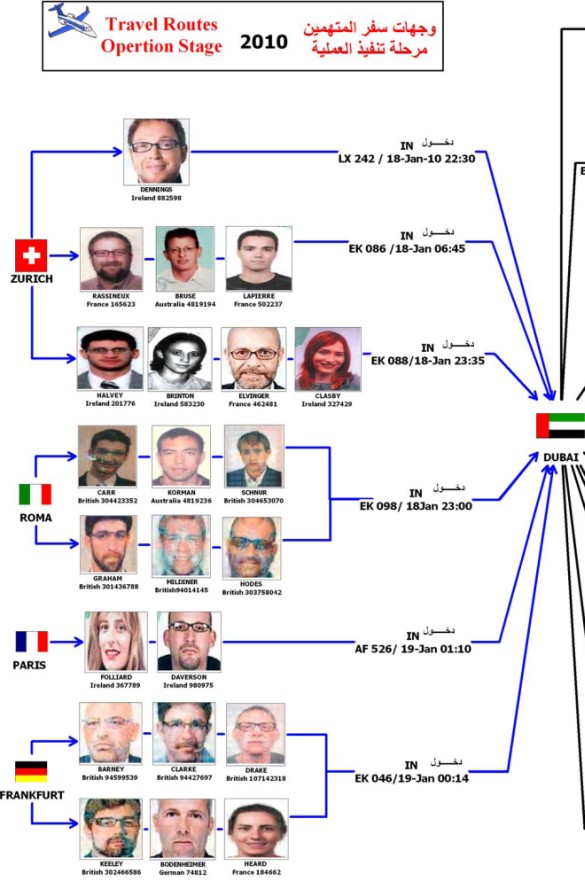
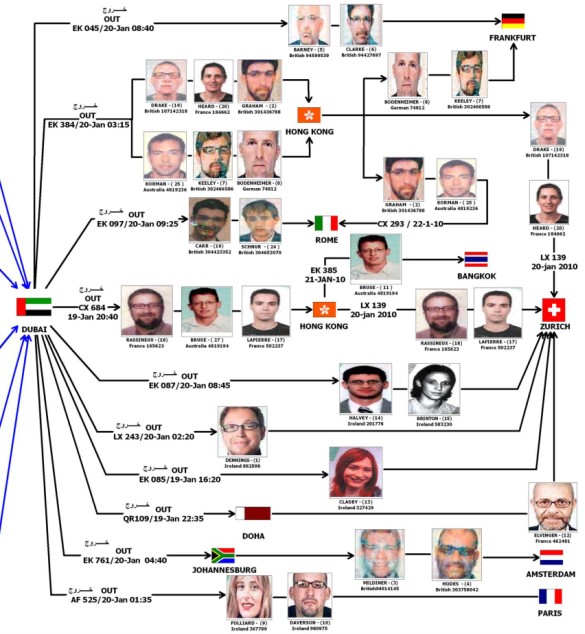
Police revealed 15 more suspects in the Al Mabhouh murder case on Wednesday. The extensive investigation has led to a total of 26 suspects so far involved in the murder of the Hamas official Mahmoud Al Mabhouh at a Dubai hotel. In addition to the previously released list of 11 suspects, Dubai Police has now identified another six suspects, who include a woman who used British passports, a man and three women travelling on Irish passports, two men who used French passports, and three people with Australian passports. The Australians included a woman.


Newly-released video of some of the murder suspects:

With the travel movements and photographs of 26 suspected Mossad operatives now appearing in the international media, how long will it be before one of the murder suspects is arrested? Moreover, since Mossad’s assassination unit apparently included around just 50 agents, one would imagine that with half of them now in hiding (or getting reconstructive plastic surgery to change their appearances) the unit has, for the time being, rendered itself inoperative.

Meanwhile, The Independent reports:

Israeli foreign minister Avigdor Lieberman yesterday flatly rebuffed David Miliband’s request for cooperation with an investigation into the use of forged British passports in the assassination of a Hamas leader.

The request for assistance came as the total number of fake British passports believed to have been used in last month’s assassination rose from six to eight. But private discussions on the sidelines of an EU meeting in Brussels – and an identical request from Irish foreign minister Micheál Martin – yielded no concessions on the Israeli side.

A statement from Mr Lieberman’s office reiterated that there was “no proof” of Israeli involvement in the affair. “If someone would present information beyond articles in the media, we would relate to it,” he is said to have told Mr Miliband. “But since there is no such information, there is no need to deal with the matter.”

A report in the Los Angeles Times, recounting an interview that an Israeli journalist, Ronen Bergman, gave on Israeli Army Radio on Monday, indicates that Mossad has been amazingly slow in covering its tracks:

A man walked in to the interior ministry in Cologne, Germany on June 16, 2009, and claimed that he was Michael Bodenheimer, an Israeli citizen, descended of a German family that had been persecuted by the Nazis.

He applied for German citizenship, saying he wished to leave Israel and emigrate to Germany. He presented documents, including his parents’ German marriage certificate, said he lived in the community of Liman and also gave an address in Herzliya.

The documents must have been convincingly authentic, and two days later, in a model of bureaucratic efficiency that seems atypical (even for Germany), the passport had been issued.

The photograph on the passport is the one now in the papers as one of the assassins, but it is most definitely not that of the Michael Bodenheimer who does live somewhere else in Israel.

The Israeli one is a yeshiva master, an ultraorthodox Jew living in Bnei Brak. His parents were, in fact, born in Frankfurt, Germany, but that’s where the similarity ends. He has Israeli citizenship and evidently American too, but not German.

The new Bodenheimer gave an address in Herzliya. Bergman said the German authorities didn’t check it out. But had they done so, they would have found that he had an apparent shell company in his name with offices in Herzliya.

“Michael Bodenheimer Ltd.” belonged to a group of offices opened by a different company called “Top Office” located on the same floor.

Top Office, says Bergman, is apparently a company that provides individuals and small businesses with an office and secretary at a respectable location.

Bergman said he paid the business address a visit on Friday night, together with the Der Spiegel correspondent in Israel, he told the radio.

He took a picture of the sign saying “Michael Bodenheimer Ltd,” and called the number for Top Office. An American-accented woman answered, sounded very surprised and hung up after saying she didn’t work on the Sabbath.

By Sunday morning, says Bergman, both companies were gone. The signs had been removed.

And the guard — the same one from Friday night — was awfully jittery and tried to shoo them away.

Finally, The Guardian reports on a British man whose identity was stolen by Mossad decades ago:

The infamous 1979 assassination of the Palestinian who masterminded the Munich massacre was carried out using a forged British passport belonging to a 27-year-old council worker living in a small flat in south London, the Guardian can reveal.

Peter Derbyshire, who at the time was running leisure centres for Lambeth council, found himself being questioned by special branch over the assassination of Ali Hassan Salameh, chief of operations for Black September, the terrorist organisation behind the hostage attack at the 1972 Olympics that resulted in the death of 11 Israeli athletes.

Derbyshire, who now runs a travel company in the French Pyrenees, told the Guardian: “I received a call at work from someone who said: ‘I’m from ­special branch. I’m inside your apartment. Can you come home?'”

He returned to find his flat in Balham, south London, had been turned upside down by two special branch officers. He was interrogated for hours by the police, who asked detailed questions about his history and political affiliations.

Eventually they told him his passport number had been used by a man named Peter Scriver in the murder of Salameh in Beirut.

Facebooktwittermail

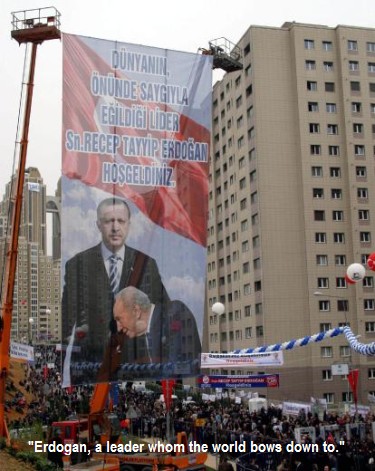
Peres shown bowing to Erdogan

In an interview with the Spanish newspaper El Pais, published on Monday, Turkey’s Prime Minister Recep Tayyip Erdogan said that the Davos incident in which he clashed with Israel’s President Shimon Peres a year ago soon after Israel’s war on Gaza, led to a new Turkish approach to foreign policy.

“That opened a new approach to foreign relations,” he said. “We have a philosophy of strength. It is a foreign policy with a backbone.”

In a graphic response to the insult to Turkey’s ambassador to Israel shown by Israel’s Deputy Foreign Minister Danny Ayalon last month, a poster depicting Peres bowing before Erdogan was briefly unfurled in Istanbul this week.

Agence France Presse reports:

A huge poster showing Israel’s president bowing to the Turkish prime minister was hung from an Istanbul crane Sunday in the latest round of sniping between the two nations.

The picture, unfurled from a crane in a city suburb, combined an image of Turkish Prime Minister Recep Tayyip Erdoğan standing upright with one of Shimon Peres leaning forward; making it look like the Israeli president was bowing.

Erdoğan was due to visit the area to inaugurate a new road network, and officials from his office had the poster removed before he arrived, the Akşam newspaper said on its Web site.

It was not clear who was behind the stunt, the newspaper said, though it appeared to be retaliation for the public dressing down given to the Turkish ambassador to Israel last month.

Facebooktwittermail

Netanyahu faces double intifada from Palestinians and settlers

In Haaretz, Aluf Benn writes:

Prime Minister Benjamin Netanyahu is busy day and night, preparing Israel for a fateful confrontation with Iran. But his real problem may occur elsewhere. The territories are heating up, with the Palestinians escalating their protests against the settlements and the separation fence. The settlers, meanwhile, can smell Netanyahu’s weakness and are undermining the authority of the state.

Two events in recent days indicate the threat of an outburst: the protest in Bil’in, which Palestinian Prime Minister Salam Fayyad participated in, where some of the 1,000 demonstrators tore apart a short portion of the fence; and the invasion of dozens of right-wing activists into the ancient synagogue of Na’aran, saying “we will return to Jericho and Nablus.” In both incidents, the violence was limited and no one was injured. But the struggle over the West Bank has transitioned to a new stage.

Fayyad, the former darling of official Israel, is proving to be Netanyahu’s most problematic rival. The one-time economist and technocrat has gradually become a politician – enjoying exposure, kissing children, stepping up to the head of the “White Intifada,” as dubbed by researchers Shaul Mishal and Doron Matza in their article in Haaretz this week. On Monday, the Palestinian government adopted a plan of action for “non-violent opposition” to the settlements and the fence.

Fayyad’s White Intifada is different from its predecessors. It has a clear political goal: Declaring a Palestinian state within the 1967 borders by the summer of 2011. By then, Fayyad will have completed the building of national institutions and will work on gaining international recognition through a diplomatic pincer movement on Netanyahu. He is receiving enthusiastic approval from the U.S. administration as a successful manager. Some 2,600 Palestinian policemen have already graduated from the training course run by U.S. General Keith Dayton in Jordan and are back in the territories, expecting to serve an independent state, not as subordinate agents of an Israeli occupation. The foreign ministers of France and Spain, in a joint article published yesterday in Le Monde, called to expedite the establishment of a Palestinian state and complete its recognition by October 2011.

The readiness of PA security forces to step outside the role of being occupation subcontractors is not evident to Jesse Rosenfeld:

Israeli invasions of PA territory have increased since the summer, hitting Ramallah regularly for the past few months to arrest popular struggle leaders and international solidarity activists, and raiding the offices of grassroots anti-occupation movements. While usually it is impossible to go more than two blocks in the West Bank Palestinian political centre without seeing armed PA forces, when the Israelis come into town, they are ordered back to their barracks and are nowhere to be seen. I witnessed this countless times while living in Ramallah.

Meanwhile, Israeli military assassination missions against resistance in Nablus resumed on 26 December, with three men linked to the Fatah movement being killed in cold blood while PA security forces connived with the Israeli military and were nowhere to be seen. Hamas spokesperson Sami Abu Zuhri was quoted by Maan news agency speculating that there was PA involvement in the assassination and warning that “resistance should be encouraged, not plotted against”.

Meanwhile, Haaretz reports:

French Foreign Minister Bernard Kouchner and his Spanish counterpart Miguel Moratinos are promoting an initiative by which the European Union would recognize a Palestinian state in 18 months, even before negotiations for a permanent settlement between Israel and the Palestinian Authority are concluded.

According to senior European diplomats and senior Israeli officials, Israel has relayed its opposition to the initiative – warning that it would undermine any chance of a successful peace process.

A senior European diplomat noted that Israel was informed about the initiative several weeks ago, a fact confirmed by a senior Israeli official. The Israeli official said the initiative is being spearheaded by Kouchner who recruited the support of the Spanish foreign minister, whose country also currently holds the rotating European Union presidency.

Israeli sources say the two foreign ministers are preparing an article they intend to publish together in some of the main European dailies. The main message of the article is that the European Union should recognize a Palestinian state before the completion of negotiations, under the assumption that such a declaration will be made by Palestinian Authority President Mahmoud Abbas.

Facebooktwittermail

Israel’s policy of divide and survive

Back in the days when hazy-eyed neoconservatives stood like prophets laying out their vision of a democratic wave of Biblical proportions sweeping across the Middle East, Israel was supposedly the actualization of what elsewhere might be possible.

The problem was that since it came into existence, all the evidence suggested that the Jewish state, far from serving as a liberating force in the region, had actually done the opposite. It became the prime legitimizer of autocracy and stagnation.

Benjamin E Schwartz, in an article in the latest edition of The American Interest magazine, describes how Israel, rather than striving for a sustainable peace with its neighbors, sees its ability to survive as dependent on its ability to be divisive.

For a state that believes its legitimacy will always be questioned, survival is a higher imperative than stability and the pacification of threats more valuable than peace.

The power of Schwartz’s essay derives as much as anything from the fact that he is clearly in sympathy with the Zionist enterprise. His is neither an apology nor a criticism; it is a clinical analysis.

He writes:

When American diplomats talk about the road to peace, few Israelis dare articulate one awkward truth. The truth is that Israelis have managed their conflict with the Arabs and the Palestinians for half a century not by working to unite them all, but either by deliberately and effectively dividing them, or by playing off existing divisions. By approaching matters in this way, Israelis have achieved de facto peace during various periods of their country’s history—and even two examples of de jure peace. It is because of divisions among Palestinians that Israelis survived and thrived strategically in 1947–48, and because of divisions among the Arab states that Israel won its 1948–49 war for independence. Divisions among the Arabs and divided competition for influence over the Palestinians allowed Israelis to build a strong state between 1949 and 1967 without having to contend with a serious threat of pan-Arab attack. It was because of divisions and the strength of Egypt amid those divisions that Anwar Sadat decided to make a separate peace in 1979. It was because of another set of divisions that King Hussein was able to do the same in 1994.

The results of Israeli statecraft did not produce an American-style comprehensive peace, and it did not produce peace with the Palestinians. It may not even have produced a lasting peace with Egypt and Jordan—time will tell. But it did produce peace in its most basic and tangible form: an absence of violence and the establishment of relative security. This is what peace means for the vast majority of Israelis, most of whom do not believe that their Arab neighbors will ever accept, let alone respect as legitimate, a Jewish state in geographical Palestine. And the way Israelis have achieved this peace is, in essence, through a policy of divide and survive.

Schwartz then lays out in some detail the mechanisms through which Israel has implemented its divisive strategy — a strategy in which the control of Palestinian land, or at least the ability to rapidly enter and dominate it, is seen as a military prerequisite for defending Israeli land.

He concludes:

As a tiny country, Israel can only defeat its more numerous adversaries by breaking them into manageable pieces, or by behaving so that already broken pieces stay that way. Indeed, its geopolitical predicament mirrors that of the original Hebrew polity. It was the unity of hostile empires—Assyrian, Babylonian, Greek and Roman—that doomed ancient Israelite kingdoms. When its neighbors were divided, the First and Second Jewish Commonwealths did rather well.

There are three lessons here for American diplomats. First, Israelis will be reluctant to promote Palestinian social and economic unity, even if it is an essential precondition for strengthening Mahmoud Abbas’s moderate Fatah Party. The barriers and checkpoints that choke off the West Bank’s economic life and undermine Abbas’s popularity simultaneously inhibit rival Hamas from organizing its operatives. The Israelis have removed a good many checkpoints in recent months, and the local economy has thrived as a result. So far there have been few negative security implications. But American officials should expect that Israel will restore a greater degree of control if violence increases, and that there are strict limits to how far it will go to loosen its grip on the West Bank even without evidence of security deterioration.

Second, while the peace that America seeks—two states cooperating to ensure their mutual security—is the ideal political solution, it is operationally irrelevant so long as it also appears to be an improbable outcome. Governance in the West Bank is increasingly devolving to the local level, which critically undermines the Palestinian national project. Yet Israelis will allow and even promote this arrangement so long as local rule ensures near-term stability. Indeed, it benefits Israel for local rulers to be strong enough to control their own people, but weak enough not to challenge the Jewish state. It makes even more sense to the extent that anything better is judged to be unattainable for the foreseeable future.

Third, the geography of the land between the Mediterranean and the Jordan River, combined with the nature of contemporary warfare, dictate that Israel requires the presence of a security force it can trust in Palestinian territory. This means that the occupation will continue until Israelis come to trust the Palestinians, or at least some of them. Ultimately, this trust is the only viable foundation for a two-state solution. In the absence of it, American diplomats can expect all ambitious “high politics” peace initiatives to remain ethereal abstractions, Israelis to continue managing the conflict as they have long done and Palestinians to grow ever more fragmented. This is a formula for a local political life that may be nasty and brutish, but not necessarily short.

Or, to put Israel’s dilemma in slightly different terms which lead to the same conclusion: how can the Zionist state dispossess, divide and dis-empower the Palestinian people and then win their respect? After all, trust and respect do go hand in hand.

Facebooktwittermail

Israel’s smiling PR drive

In The Guardian, Seth Freedman writes:

Israel’s latest conscripts in the fight to improve the country’s image have been unveiled: ordinary Israeli citizens. Armed only with a government-issued hasbara pamphlet and a winning smile, they will be sent to wage war with their detractors, in an effort to present Israel as a benign, democratic utopia whose only achilles heel is poor public relations.

Into the breach has stepped a phalanx of Israeli spin doctors, who have devised a campaign in which they want all Israelis to participate when travelling overseas by “telling about the beautiful Israel you know”. To that end, three television commercials are currently being aired which mock the foreign media for its portrayal of the country. In one, a French newsreader is shown confusing Independence Day fireworks and flypasts with military action on Israel’s streets. “Fed up with how we’re portrayed abroad?” asks the advert. “You can change the picture.”

The ministry for public diplomacy goes to great lengths instructing Israelis how to conduct themselves when engaged in PR on behalf of the state: first listen, then speak; maintain eye contact; use relaxed body language and tone; don’t preach; ask questions; answer points raised; stick to two or three messages you want to convey; and maintain a sense of humour. If such rules are followed, the campaign literature suggests, there is a strong chance of winning over even the staunchest adversary.

Hasbara is seen as a vital weapon in Israel’s arsenal, both by government officials and ordinary Israelis. According to a poll, 85% of Israeli citizens want to help promote the country’s image abroad, and in itself there is nothing wrong with taking such a patriotic stance. However, as has been seen time and again with Israel’s attempts at hasbara, more often than not the campaigns are based more on witch-hunts and whitewashes than honest debate over the most thorny issues surrounding the state.

In order to enhance the efforts of its citizen diplomats, maybe Israel’s ministry of public diplomacy should set up a website where Israelis heading overseas can first validate the integrity of their passport information — provide that extra bit of reassurance for anyone who’s nervous about being mistaken as a Mossad operative. It could be tricky though. How does one government agency plausibly provide such a guarantee when it appears that two other government agencies have already been involved in identity theft?

Facebooktwittermail

Is Israel a small penis or a limp penis?

Having thought a lot about Israel, I’ll confess I’ve never pictured it as a penis – of any particular size.

But on second thoughts, that’s not actually true. The wars on Lebanon and Gaza did evoke a sense that the Jewish state regards war as a type of Viagra, so I guess if war is Viagra that does indeed make Israel a penis — one that has difficulty maintaining an erection.

With that in mind the new Size Doesn’t Matter campaign aimed at promoting Israel (h/ts to Richard Silverstein and Dimi Reider) could be seen as an effort to convince young North American Jews that Israel is not suffering from erectile dysfunction. A trip to Israel — well that’s like giving or receiving a blow job, though the metaphor gets a little confusing at this point.

What the hell am I talking about?

Watch this video sponsored by the Canadian Council for Israel and Jewish Advocacy:

I have little doubt that when the makers of this video debated its merits, someone said that it would be sure to go viral.

Indeed, I along with many others are now making that happen. But even though “going viral” is supposed to be an online marketing success, it’s worth remembering where the metaphor comes from. In this case, did the promoters of Israel really want an image of their beloved state to spread like a contagious disease?

And one small footnote — the “size doesn’t matter” claim turns out to be a little disingenuous: the map of Israel in the video includes Gaza and the West Bank as part of Greater Israel. Apparently size really does matter.

Facebooktwittermail