Yasmine El Rashidi writes: In Tahrir on November 25 the Islamist researcher and political analyst Ibrahim El Houdaiby told a group of us: “It would have taken a completely different direction had the Brotherhood come out last weekend and put their weight behind the people.” Even Islamists and some preachers and veiled women spoke of their disappointment with the Brotherhood; they hoped that it wouldn’t win the polls of the following week.
Still, the liberal parties were not able to find much support from the underclass, whether in poor urban districts or rural Egypt. They could not penetrate the decades-old informal networks that have long been dominated by family and tribal alliances, religious affiliations, or agents of the former regime. Even if they had succeeded, the most prominent of the liberal coalitions, the Egyptian Bloc, was headed by the Free Egyptians Party, founded by the telecom tycoon Naguib Sawiris, whose popularity plummeted in June when he tweeted a cartoon of Mickey and Minnie Mouse wearing Muslim gowns and headdresses—Mickey with a bushy beard, and Minnie in a face veil. “Mickey and Minnie after…,” he wrote.
In the weeks following, a full-scale campaign was launched against him by Islamists, urging people to boycott his businesses. In a matter of weeks, 304,000 subscribers left his telecom provider, Mobinil, for local competitors; his company suffered losses of 96 percent for the third quarter of 2011. Even among some liberal Egyptians, Sawiris’s tweet was seen as going too far: “We are a largely Muslim country, Sawiris has to remember and respect that.” In response to the cartoon, a Coptic friend posted on Facebook a message that “the revolution was about unity, not such attacks.”
Amid all this, the Salafi Al-Nour Party has preached in favor of its puritan form of Islam, and a state governed by its principles—one with the same religious restrictions as Saudi Arabia—as the answer to the country’s social and economic woes. The Salafists swiftly followed the lead of the Muslim Brotherhood, providing free and subsidized goods and services to the poor, and focusing their campaign messages on the price of food and cost of living. We don’t know how much the party’s appeal was hurt or enhanced by the fact that its campaign posters didn’t feature pictures of its female candidates, and instead had an image of a rose above their printed names. At a political rally in a public square in Alexandria, it covered a statue of a mermaid with a cloth. But it appealed to Egyptians who spoke the language of the street and believed, among other things, that ultimately, the future of Egypt is in “the hands of Allah.”
In the days since the initial election results were released, the liberals have been discussing how to regroup and prepare for the weeks and voting rounds ahead. Many liberal Muslims and Copts are talking about what the future might hold, including immigration. The Islamist parties, for their part, are anxious not to be grouped together. The FJP has firmly stated that it will not enter an alliance with the Salafis, who themselves have said they will not walk in the shadow of the Brotherhood. (Before the elections, the two groups had agreed on a code of proper behavior during them, but they have not entered into a political alliance.)
In months to come, Egypt’s first freely elected parliament will probably be as fragmented as the political landscape that preceded it. During what will be a period of immense pressure, the Muslim Brotherhood will most likely emerge as a mediator and perhaps the ally of the parliament’s liberal coalition. The military, for its part, will undoubtedly continue to have a hand in the country’s affairs, whether overtly through a provision of the constitution, or through tactical pacts with factions in parliament. Having waited since 1928 for this moment, the Brotherhood can be expected to wait another few years before attempting to make any drastic or fundamental changes in the social and cultural life of the Egyptian state.
Author Archives: News Sources
Does airport security really make us safer?
Charles C. Mann writes: Not until I walked with Bruce Schneier toward the mass of people unloading their laptops did it occur to me that it might not be possible for us to hang around unnoticed near Reagan National Airport’s security line. Much as upscale restaurants hang mug shots of local food writers in their kitchens, I realized, the Transportation Security Administration might post photographs of Schneier, a 48-year-old cryptographer and security technologist who is probably its most relentless critic. In addition to writing books and articles, Schneier has a popular blog; a recent search for “TSA” in its archives elicited about 2,000 results, the vast majority of which refer to some aspect of the agency that he finds to be ineffective, invasive, incompetent, inexcusably costly, or all four.
As we came by the checkpoint line, Schneier described one of these aspects: the ease with which people can pass through airport security with fake boarding passes. First, scan an old boarding pass, he said—more loudly than necessary, it seemed to me. Alter it with Photoshop, then print the result with a laser printer. In his hand was an example, complete with the little squiggle the T.S.A. agent had drawn on it to indicate that it had been checked. “Feeling safer?” he asked.
Ten years ago, 19 men armed with utility knives hijacked four airplanes and within a few hours killed nearly 3,000 people. At a stroke, Americans were thrust into a menacing new world. “They are coming after us,” C.I.A. director George Tenet said of al-Qaeda. “They intend to strike this homeland again, and we better get about the business of putting the right structure in place as fast as we can.”
The United States tried to do just that. Federal and state governments embarked on a nationwide safety upgrade. Checkpoints proliferated in airports, train stations, and office buildings. A digital panopticon of radiation scanners, chemical sensors, and closed-circuit television cameras audited the movements of shipping containers, airborne chemicals, and ordinary Americans. None of this was or will be cheap. Since 9/11, the U.S. has spent more than $1.1 trillion on homeland security.
To a large number of security analysts, this expenditure makes no sense. The vast cost is not worth the infinitesimal benefit. Not only has the actual threat from terror been exaggerated, they say, but the great bulk of the post-9/11 measures to contain it are little more than what Schneier mocks as “security theater”: actions that accomplish nothing but are designed to make the government look like it is on the job. In fact, the continuing expenditure on security may actually have made the United States less safe.
Christmas fading in the Holy Land
Khaled Diab writes: In the land that put Christ in Christmas, Christianity is shrinking.
Less than a century ago, Christians comprised nearly 10 percent of the population of Palestine (now Israel and the Palestinian territories). In 1946, the figure was around 8 percent. Today, Christians make up about 4 percent of the West Bank’s population, although there are still a few Christian-majority villages, such as Taybeh, whose skyline is dominated by church spires and whose businessmen produce the only Palestinian beer. In Israel, though Christians make up 10 percent of its Palestinian population, they only constitute 2.5 percent of the total population. In Gaza, the Christian minority is even smaller, representing just 1 percent of the population.
One major factor in the decline of Christianity here: the Israeli-Palestinian conflict. The Arab-Israeli war of 1948 caused hundreds of thousands of Palestinians to flee or be driven out of their homes, most never to return – and each subsequent war has led to more Palestinians leaving. Today, though Palestinians are often materially better off than other Arabs, restrictions on movement, lack of economic opportunity, unemployment and the constant indignity of living under occupation prompt many to seek out new homes. Palestinian Christians, relatively better educated that Palestinian Muslims and sharing a common religion with the West, have generally been better placed to leave the region.
“Many Christians prioritize their religion over their nationality, thus feeling at home in Western Christian countries as immigrants,” says Ameer Sader, who teaches English and works as a young guide at the National Museum of Science and Technology in Haifa.
“Also, the fertility rate among Christians is the lowest within Israel and Palestine, playing a role, however small it is, in their decline,” he added.
But the exodus is not solely a Christian phenomenon.
“What is often ignored is the huge number of young Muslims who are leaving. And don’t forget there are more Palestinian Muslims living abroad than Christians,” says Dimitri Karkar, a Palestinian Christian businessman. Karkar lives in Ramallah, which has grown with the influx of refugees from other parts of historic Palestine and Israel’s continued annexation of East Jerusalem. Once a small village, Ramallah has become the de facto administrative capital of Palestine, where about a quarter of its population today is Christian.
Another factor: Christian charities and missionaries, who often do valuable work here, also have played an unwitting role in the exodus of Christians.
“I think that an awful lot of well-meaning Christians in the West, whether they are in America, Britain or other places, have poured a lot of money into the West Bank, and specifically into the churches and ministries here,” observes Richard Meryon, director of Jerusalem’s Garden Tomb, which is locked in a spiritual/territorial dispute with the nearby Church of the Holy Sepulchre over the exact location of the crucifixion, burial and resurrection of Jesus.
This outside aid, he notes, “is causing a hemorrhaging of Palestinian believers,” because many are given assistance to move to the West to study but, once there, decide never to return. At the same time, he points out, the numbers of foreign believers and Messianic Jews who believe in Jesus are rising.
And not all Christian activity has been “well-meaning.” For example, so-called Christian Zionists are passionately, even virulently, pro-Israeli, and many come to the Holy Land (some on Harley Davidsons) to express their support. They show rather less interest in the Christians who actually live there.
Republican presidential contender Newt Gingrich seems to even doubt they exist. In an apparent bid to court the Christian Zionist and pro-Israel right, Gingrich made the outrageous claim that “We have invented the Palestinian people,” as if the Palestinians I encounter every day here are figments of the imagination.
The youngest prisoner held at Guantánamo
Mohammed el Gorani was born in Saudi Arabia in 1986 but since his parents were from Chad, he didn’t have the rights of a Saudi. In the hope of advancing himself he traveled to Pakistan where he studied English with the goal of being able to return and work in a hotel in Mecca. Instead, at the age of 14 he ended up being sent to Guantanamo for seven years and then “repatriated” to Chad, where he had never lived nor spoke the language.
Gorani told his story to Jérôme Tubiana and what happened after he arrived in Karachi.
I planned to go home after those six months. But two months after my arrival, there was 9/11. I didn’t pay attention – I was very busy with my lessons. Every day, I woke up, went to school, ate lunch, played football with the neighbourhood kids, studied, prayed. Every Friday, I went to pray in a big mosque not far from the house. Most of the people praying there were Arabs, because the imam was Saudi and spoke a good Arabic. One Friday, at the beginning of the sermon, we saw a lot of soldiers surrounding the mosque. After the prayers, they started questioning the people. They were looking for Arabs. They asked me: ‘Saudi?’
‘No, Chadian.’
‘Don’t lie, you’re Saudi!’ It must have been because of my accent. They put me on a truck and covered my head with a plastic bag. They took me to a prison, and they started questioning me about al-Qaida and the Talibans. I had never heard those words.
‘What are you talking about?’ I said.
‘Listen, Americans are going to interrogate you. Just say you’re from al-Qaida, you went with al-Qaida in Afghanistan, and they’ll send you home with some money.’
‘Why would I lie?’
They hung me by my arms and beat me. Two white Americans, in their forties, arrived. They were wearing normal clothes. They asked: ‘Where is Osama bin Laden?’
‘Who’s that?’
‘You’re fucking with us? You’re al-Qaida, yes!’ They kept using the F-word.
I didn’t understand this word but I knew they were getting angry. A Pakistani was in the room, behind the Americans. When they asked if I was from al-Qaida, he nodded, to tell me to say yes. I wasn’t doing it, so he got mad. The Americans said: ‘Take him back!’ The Pakistani was furious: ‘They’re looking for al-Qaida, you have to say you’re al-Qaida!’ Then they put the electrodes on my toes. For ten days I had them on my feet. Every day there was torture. Some of them tortured me with electricity, others just signed a paper saying they had done it. One Pakistani officer was a good guy. He said: ‘The Pakistani government just want to sell you to the Americans.’ Some of us panicked, but I was kind of happy. I loved to watch old cowboy movies and believed that Americans were good people, like in the movies, it would be better with them than with the Pakistanis, we’d have lawyers. Maybe they’d allow me to study in the US, then send me back to my parents.
They started taking detainees away every night, by groups of twenty. We didn’t know where they were going to, but we thought the US. One day, it was my group’s turn. The Pakistanis took away our chains and gave us handcuffs ‘made in the USA’. I told the other detainees: ‘Look, we’re going to the US!’ I thought the Americans would understand that the Pakistanis had cheated them, and send me back to Saudi.
So my hands were tied in the back and a guard held me by a chain. We were twenty, with maybe fifteen guards. They covered our eyes and ears, so I couldn’t see much. When they took off our masks, we were at an airport, with big helicopters. Then the movie started. Americans shouted: ‘You’re under arrest, UNDER CUSTODY OF THE US ARMY! DON’T TALK, DON’T MOVE OR WE’LL SHOOT YOU!’ An interpreter was translating into Arabic. Then they started beating us – I couldn’t see with what but something hard. People were bleeding and crying. We had almost passed out when they put us in a helicopter.
We landed at another airstrip. It was night. Americans shouted: ‘Terrorists, criminals, we’re going to kill you!’ Two soldiers took me by my arms and started running. My legs were dragging on the ground. They were laughing, telling me: ‘Fucking nigger!’ I didn’t know what that meant, I learned it later. They took off my mask and I saw many tents on the airstrip. They put me inside one. There was an Egyptian (I recognised his Arabic) wearing a US uniform. He started by asking me: ‘When was the last time you saw Osama bin Laden?’ ‘Who?’ He took me by my shirt collar and they beat me again. During all my time at Kandahar, I was beaten. Once it was like a movie – they came inside the tent with guns, shouting: WE CAUGHT THE TERRORISTS! And they put us in handcuffs. ‘Here are their guns!’ And they threw some Kalashnikovs onto the ground. ‘We’ve been fighting them, they killed a lot of people!’ All that was for cameras, which were held by men in uniforms. I was lying on the ground with the other prisoners. They brought dogs to scare us.
One day they started moving prisoners again. They picked you from your tent, put you naked, shaved your head and beard (I was too young to have a beard), then beat you. They dressed you with orange clothes, handcuffed you, and put gloves with no fingers on you, so you couldn’t open the handcuffs. ‘You guys are going to a place where there is no sun, no moon, no freedom, and you’re going to live there for ever,’ the guards told us, and laughed. They put you in completely black glasses and headphones, so that you couldn’t see or hear. With those on, you don’t feel the time. But I could hear when they were changing the guards, probably every hour. I must have spent five hours sitting on a bench, with another detainee in my back.
Then they put us in a plane – I don’t know what kind because I couldn’t see. As soon as you moved or talked, they beat you. They were shouting: IF YOU DON’T FOLLOW OUR ORDERS, WE’LL KILL YOU! I passed out. We had no water and no food. I woke up hearing voices shouting at me in different languages. They took me to my cell. I saw soldiers everywhere, and guns, like if it was war. There were big metal fences everywhere. We were in Guantánamo, in Camp X-Ray. It’s a prison without walls, without roofs – only fences. Nothing to protect you from the sun or the rain.
The sky was blue. Except for sky you couldn’t see anything. Later, when I was moved to Camp Delta, I could look by the windows. The camp was ringed with a green plastic sheet, but there were holes and I could see trees. And even the sea. I saw it even better, years later, when I was moved to Camp Iguana, where they put you before release. Through the plastic sheet, I saw the ocean, big ships and the guards swimming. Only in Iguana can you touch the sand.
In Camp Five as well, there was a window in my cell, but it was covered with brown tape. One day I was sitting, mad, sad, angry, and a woodpecker came and knocked, knocked until it broke the tape – a hole big as a coin. It did this to a lot of windows. It started doing it every day and the guards had to put new tape every day. Sometimes, they left the holes. I could see the cars, the soldiers, the sky, the sun, the life outside. We called the bird Woody Woodpecker.
For months, I didn’t know where I was. Some brothers said Europe. No, others told: ‘It’s the weather of Oman.’ Others told Brazil, also because of the weather. We arrived in February, but it was so hot in comparison to Kandahar. There we shivered night and day, especially when we were naked. After a few months, an interrogator told me: ‘We’re in Cuba.’ It was the first time I heard this name. ‘An island in the middle of the ocean. Nobody can run away from here and you’ll be here for ever.’ The older detainees knew of Cuba, but didn’t know there was an American base. I’d seen a lot of American movies, and arrested people always said: ‘I have the right to a lawyer!’ The interrogators laughed at me: ‘Not here in Guantánamo! You got no rights here!’
Yemen’s Saleh says he is going to U.S.
Al Jazeera reports: Yemeni security forces in Sanaa have shot at protesters marching against President Ali Abdullah Saleh, who on his part said he would go to the United States in order to allow an interim government to prepare for an election to replace him, but did not specify when he would leave.
Saleh, speaking to reporters after forces loyal to him fired at protesters demanding he face trial for killing demonstrators over 11 months of protests, said he had no designs on staying in power.
“I will go to the United States. Not for treatment, because I’m fine, but to get away from attention, cameras, and allow the unity government to prepare properly for elections,” he said on Saturday.
“I’ll be there for several days, but I’ll return because I won’t leave my people and comrades who have been steadfast for 11 months,” he said. “I’ll withdraw from political work and go into the street as part of the opposition.”
Forces reportedly killed at least nine protesters when they opened fire to stop the tens of thousands who set off from the southern city of Taiz on Tuesday for the 270km march to the capital.
Israel’s plans for ‘mass forcible transfers’ of Palestinian Bedouin
Jonathan Guyer writes: United Nations officials have issued a warning that the Government of Israel’s plans for Palestinian Bedouin communities living in Jerusalem’s periphery could constitute “mass forcible transfers” and “grave breaches” of international law. A pending plan in the West Bank threatens to displace Khan al-Ahmar, a Bedouin village of refugees originally from Israel’s south, pushed off their indigenous land in the early 1950’s. Khan al-Ahmar lies on the side of a major West Bank thoroughfare and is sandwiched between the Israeli settlement of Maale Adumin and Jerusalem. This area is known as E1, an especially controversial 12 km patch of land where East Jerusalem would expand as the capital of a future Palestinian state.
It is impossible for Bedouins living here to obtain building permits from Israeli planning authorities, a situation that is not unique to Khan al-Ahmar. That Israeli officials consider Khan al-Ahmar’s local community school, which educates over 70 children from surrounding villages, to be illegally constructed might spell its imminent destruction.
Over tea — and then coffee — Id al-Jahalin, Khan al-Ahmar’s spokesman, described the perilous nature of day-to-day life in his village. There is neither running water nor electricity from a central grid here, and trash is burned as there is no waste pick-up by Israeli public services. Provocations from neighboring settlers punctuate daily routines in this pastoralist community.
The proposed site for re-residence of this community is a newly flattened plot just outside of Jerusalem, less than 100 meters from the municipal garbage dump, and in clear violation of international health standards. A thousand tons of rubbish from the Jerusalem municipality and settlements are trucked to this dump daily, making it the largest refuse site in the West Bank. An armed guard sitting atop a watch tower prohibits visitors from entering the dump. But from the proposed relocation site, one can see pipes coming out of the trash mountain, where methane gas is released in order to limit the internal combustion occurring underground. CO2 levels here are also dangerously high, according to UN officials. Standing in the squalid relocation site for the Bedouin community, the putrid scent of the dump is unbearable.
Maj. Guy Inbar, a spokesman for the Israeli Defense Ministry’s administration office for the West Bank, would not provide a timeline for the development of these plots, only more than a stone’s throw from the dump. He said that environmental tests for the site were currently underway. “Whether a rubbish dump, a golden palace, or even Paris, I don’t want to go anywhere,” said Jahalin, also known as Abu Chamis. “It’s my right to have a village here. It’s my right for my children to have an education, and for us to live in dignity like any other human beings.”
No alternative to a one-state solution
Avraham Burg, former Speaker of the Knessett, argues that it is time for what remains of an Israeli left to abandon the idea of a two-state solution.
Until now, we the seekers of peace, wandered through the world, spreading the hope that there would soon be solutions, while they were busy creating disheartening facts on the ground. With time, our rhetoric was victorious (Netanyahu said “two states” ), but it died. Their acts won the day and are already killing all of us.
So enough of the illusions. There are no longer two states between the Jordan River and the sea. Let the right-wing MKs, the Katzes and the Elkins, travel around the world and show the beauty of their faces without the deceptive layer of makeup we provided.
Meanwhile we must consider how we can enter into the new Israeli discourse. It has intriguing potential. The next diplomatic formula that will replace the “two states for two peoples” will be a civilian formula. All the people between the Jordan and the sea have the same right to equality, justice and freedom. In other words, there is a very reasonable chance that there will be only one state between the Jordan and the sea – neither ours nor theirs but a mutual one. It is likely to be a country with nationalist, racist and religious discrimination and one that is patently not democratic, like the one that exists today. But it could be something entirely different. An entity with a common basis for at least three players: an ideological right that is prepared to examine its feasibility; a left, part of which is starting to free itself of the illusions of “Jewish and democratic”; and a not inconsiderable part of the Palestinian intelligentsia.
The conceptual framework will be agreed upon – a democratic state that belongs to all of its citizens. The practicable substance could be fertile ground for arguments and creativity. This is an opportunity worth taking, despite our grand experience of missing every opportunity and accusing everyone else except ourselves.
Hamas’s Haniya applauds, Israel denounces PLO unity moves
AFP reports: The Hamas premier of Gaza, Ismail Haniya, praised steps toward reconciliation taken by the Islamist group and its former rival Fatah, which were angrily denounced in Israel.
Palestinian president Mahmud Abbas and Hamas chief Khaled Meshaal took steps in Cairo on Thursday towards reforming the Fatah-dominated Palestine Liberation Organisation, such that Hamas could join.
“We want to pursue positive dialogue with Fatah from this point”, Haniya told journalists.
“Practical measures must however be taken, like the liberation of political prisoners from Hamas detained by Fatah,” he said, adding that Fatah must also stop its repeated questioning of Hamas supporters during investigations.
The reconciliation moves drew an angry response from Israel, with one minister saying the Jewish state must now annex more territory to ensure the safety of its citizens in case “terrorist” Hamas gains influence in the West Bank.
“This alarming rapprochement between Abu Mazen (Abbas) and Hamas is aimed at forming a government that one can only say is aimed at bringing about a genocide,” Transport Minister Israel Katz of the right-wing Likud party said.
Targeting Iran
I’m not a fan of Rick Steves’ PBS travelogues, but superficial as it might be, seeing a tourist eye’s view of Iran isn’t such a bad way of normalizing perceptions of this endlessly demonized country.
Iraq’s fractures widen
Jack Healy reports from Baquba: The governor has fled this uneasy city. Half the members of the provincial council are camped out in northern Iraq, afraid to return to their offices. Peaceful protesters fill the dusty streets, though just days ago angrier crowds blockaded the highways with burning tires and shattered glass.
All of this because the local government here in northeastern Diyala Province recently dared to raise a simple but explosive question, one that is central to the unrest now surging through Iraq’s shaky democracy: Should a post-American Iraq exist as one unified nation, or will it split into a loose confederation of islands unto themselves?
A dire political crisis exploded in Baghdad this week, after an arrest warrant was issued against the Sunni Arab vice president, Tariq al-Hashimi, accusing him of running a death squad. But years of accumulated anger and disenfranchisement are now driving some of the country’s largely Sunni Arab provinces to seek greater control over their security and finances by distancing themselves from Iraq’s Shiite leaders.
Many Sunni leaders have rallied to the cause while top Shiites in Baghdad have fought the efforts, aggravating the sectarian divisions among the country’s political elite.
“They feel that they have no future with the central government,” said Deputy Prime Minister Saleh al-Mutlaq, a prominent Sunni.
This development comes at a moment of rising tensions and could herald a near-breakdown of relations between the countryside and the leaders behind the concrete walls and concertina wire guarding Baghdad’s Green Zone. It has splintered communities within provinces along religious lines, while deepening the sense of political uncertainty pervading Iraq in the days after the American military’s withdrawal.
“We’ve reached a point where the exasperation with the entire political process is so big in Sunni majority areas,” said Reidar Visser, an expert on Iraqi politics and the editor of the blog historiae.org. “They are just fed up and disillusioned.”
On Friday, thousands of protesters marched through largely Sunni cities to condemn the warrant for Mr. Hashimi’s arrest. In Samarra, where the destruction of a Shiite shrine in 2006 set off waves of violence, 2,000 demonstrators filled the streets after Friday Prayer, waving signs that declared, “The people of Samarra condemn the fabricated charges against Hashimi.”
The schism is one thread of a growing battle between Prime Minister Nuri Kamal al-Maliki, a Shiite, and politicians from the political opposition and Iraq’s Sunni Muslim minority.
Security forces who take orders from Mr. Maliki — sometimes personally — have arrested dozens of people tied to opposition politicians in recent weeks. The government accused Mr. Hashimi, the Sunni vice president, of running a death squad from his offices in central Baghdad, a charge he denies. And Mr. Maliki has urged Iraqi lawmakers to unseat his own deputy, Mr. Mutlaq, who frequently inveighs against the prime minister.
A leading political coalition supported by many Sunnis and secular Iraqis has boycotted Parliament, refusing to attend sessions, and its ministers and lawmakers have threatened to resign en masse. An American-backed partnership government uniting Iraq’s three main factions — the Shiite majority, Sunnis and Kurds — appears poised to fall.
Lawrence Wilkerson on the strategic implications of the ‘end’ of the war in Iraq
From Pakistan to Afghanistan, U.S. finds convoy of chaos
Bloomberg Businessweek reports: Like a broker tracking the dips and spikes of a volatile but lucrative stock, Mohammad Shakir Afridi has kept a close eye on U.S. troop levels in Afghanistan since the first Americans landed in the country 10 years ago. As president of the Khyber Transport Assn., one of the largest associations of truck owners in Pakistan, Afridi’s biggest contract involves moving military equipment for American and coalition forces through Pakistan to military bases in Afghanistan. The slightest policy shift in Washington can carry major consequences for Afridi and his business.
Sitting on a rooftop in a leafy residential block in Peshawar, the largest city in northwest Pakistan, Afridi slaps the morning paper on the floor beside his mat. “Twenty-four of our boys in one go,” he spits out. A front page photograph shows a field full of coffins draped in Pakistani flags. The soldiers were killed on Nov. 26 when U.S. helicopters and jet fighters from Afghanistan fired on military outposts on the Pakistani side of the border. The relationship between Pakistan and the U.S., which has been rocky for years, hit a new low. While the U.S. military promised to investigate and the NATO chief regretted the “tragic, unintended” incident, the Pakistani Prime Minister said there would be “no more business as usual” with the U.S. Pakistan demanded the U.S. vacate an airbase it was using in the South and choked off all U.S. and coalition military supplies traveling through the country.
Afridi learned of the American attack before the Pakistan military or government had issued any statement; one of his truck drivers called to tell him the border was closed. Afridi was later given orders from the military to halt trucks near the border, and to direct all others to the southern port city of Karachi. He quickly obliged. “It’s serious this time,” Afridi says. “They’ll make the Americans sweat.”
U.S. and Allied forces in Afghanistan get the bulk of their supplies in two ways. The first is the Northern Distribution Network, a web through Central and Eastern Europe and Central Asia that crosses through at least 16 countries, using a combination of roads, railway, air, and water to move supplies in from the north. The chain can be complex and circuitous. One path through the network, for example, might involve military cargo that arrives by sea in Istanbul. From there it travels the width of Turkey on truck and crosses the northern border into Poti, Georgia. In Georgia the equipment goes by rail to Baku in Azerbaijan, where it’s loaded onto a ship bound for the Kazakh Port of Aktau, across the Caspian Sea. Then it’s put on trucks for the 1,000-mile ride through Kazakhstan, then a train through Kyrgyzstan and, finally, into Afghanistan.
The second passage to Afghanistan, known as Pakistani Lines of Communication, begins at the port of Karachi and continues on one of two land routes, north toward the logistical hub at Bagram Airfield or west toward Kandahar. It has always been the primary option for American forces: It’s the shortest and cheapest, requires only one border crossing, and minimal time on the road inside Afghanistan. Nearly 60,000 trucks drive more than 1,200 miles through the length of Pakistan every year carrying supplies and fuel. According to varying figures provided by U.S. and NATO forces, 40 percent to 60 percent of all military supplies used by coalition forces in Afghanistan come through Pakistan. [Continue reading…]
Pakistan army wants Zardari out but not a coup
Reuters reports: Pakistan’s powerful army is fed up with unpopular President Asif Ali Zardari and wants him out of office, but through legal means and without a repeat of the coups that are a hallmark of the country’s 64 years of independence, military sources said.
Tensions are rising between Pakistan’s civilian leaders and its generals over a memo that accused the army of plotting a coup after the U.S. raid that killed Osama bin Laden in May.
“Who isn’t fed up with Zardari? It’s not just the opposition and the man on the street but people within the government too,” said one military source who asked not to be named.
“But there has to be a proper way. No action is being planned by the army. Even if we tried, it would be very unpopular and not just with the government and the opposition but most Pakistanis too.”
The Pakistani military spokesman declined comment.
General Ashfaq Kayani has pledged to keep the military out of Pakistani politics since taking over as army chief in 2007.
Any coup — Pakistan has had three since independence in 1947 — could further tarnish the military’s public image which has already taken a battering after the bin Laden operation, widely seen in Pakistan as a violation of sovereignty.
But the army remains the arbiter of power and analysts say it has plenty of ways to pressure Zardari to step down, especially if a link is established between him and the memo, which sought the Pentagon’s help in averting a feared coup.
The Zionist story
Why anti-government Americans should be pro-Palestinian
On the right in the U.S., nothing garners political support as easily as preaching the evils of Big Government. But if someone wants to observe big government in one of its most tyrannical expressions, there’s probably no place better to go than the West Bank where Palestinians live under Israeli military rule.
Haaretz reports on the red tape that controls everyday life:
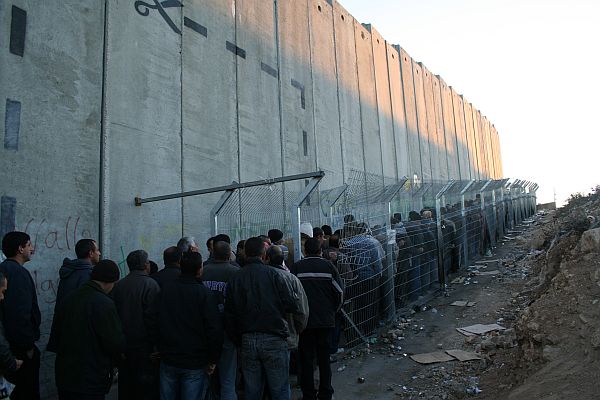
Israel’s Civil Administration issues 101 different types of permits to govern the movement of Palestinians, whether within the West Bank, between the West Bank and Israel or beyond the borders of the state, according to an agency document of which Haaretz obtained a copy.
The most common permits are those allowing Palestinians to work in Israel, or in Jewish settlements in the West Bank. Over the decades, however, the permit regimen has grown into a vast, triple-digit bureaucracy.
There are separate permits for worshipers who attend Friday prayers on the Temple Mount in Jerusalem and for clerics working at the site; for unspecified clergy and for church employees. Medical permits differentiate between physicians and ambulance drivers, and between “medical emergency staff” and “medical staff in the seam zone,” meaning the border between Israel and the West Bank. There is a permit for escorting a patient in an ambulance and one for simply escorting a patient.
There are separate permits for traveling to a wedding in the West Bank or traveling to a wedding in Israel, and also for going to Israel for a funeral, a work meeting, or a court hearing.
The separation fence gave rise to an entirely new category of permits, for farmers cut off from their fields. Thus, for instance, there is a permit for a “farmer in the seam zone,” not to be confused with the permit for a “permanent farmer in the seam zone.”
Human rights organizations have challenged the permit regime on various grounds.
According to a report by the UN Office for the Coordination of Humanitarian Affairs, international agencies operating in the West Bank waste an estimated 20 percent of their working days on permits from the Civil Administration – applying for them, renewing them and sorting out problems.
The checkpoint-monitoring organization Machsom Watch claims that the Shin Bet security service uses the permit regime to recruit informers. Palestinians whose permit requests are rejected “for security reasons” are often invited to meetings with Shin Bet agents, who then offer “assistance” in obtaining the desired permits in exchange for information.
Guy Inbar, spokesman for the Coordinator of Government Activities in the Territories, said in response that the Civil Administration is aware of the issues raised in the article and intends to evaluate them in the coming year as part of its streamlining program.
‘If Jesus were to come this year, Bethlehem would be closed’
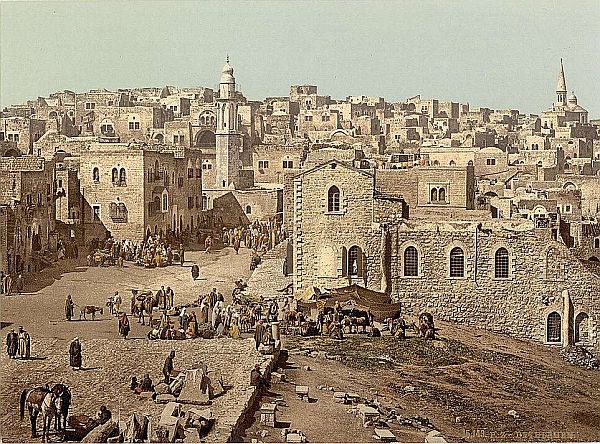
The Guardian reports: If Joseph and Mary were making their way to Bethlehem today, the Christmas story would be a little different, says Father Ibrahim Shomali, a parish priest in the town. The couple would struggle to get into the city, let alone find a hotel room.
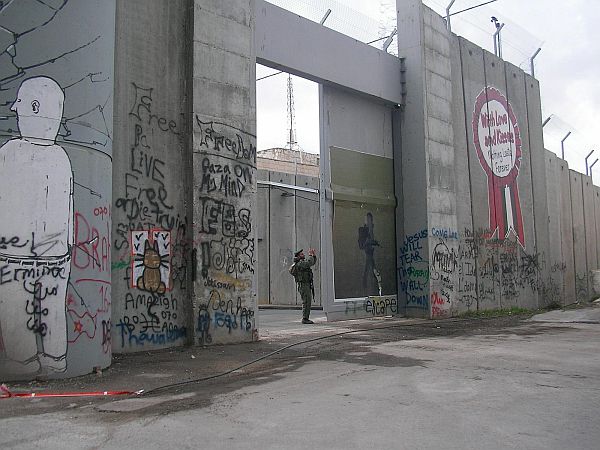
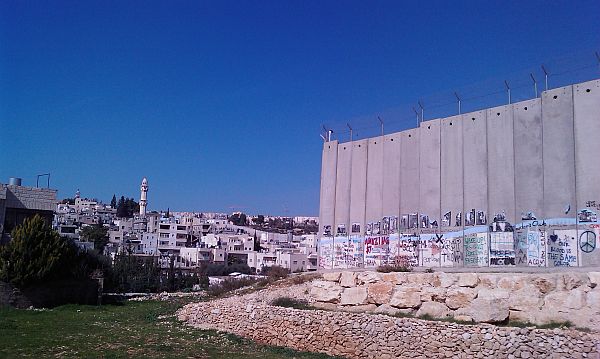
“If Jesus were to come this year, Bethlehem would be closed,” says the priest of Bethlehem’s Beit Jala parish. “He would either have to be born at a checkpoint or at the separation wall. Mary and Joseph would have needed Israeli permission – or to have been tourists.
“This really is the big problem for Palestinians in Bethlehem: what will happen when they close us off completely?”
Bethlehem is the heart of Christian Palestine and it swells with pride every Christmas. Manger Square is transformed into a grotto of lights and stalls crowned by a towering Christmas tree. Strings of illuminated angels, stars and bells festoon the streets. But just a few minutes’ drive to the north, the festive atmosphere stops abruptly.
A strip of Israeli settlements built on 18 sq km of what was once northern Bethlehem threatens to cut the city off from its historic twin, Jerusalem. To the Israeli authorities, these have been neighbourhoods of Jerusalem since 1967. One of the settlements, Har Homa, is built on land where angels are said to have announced the birth of Christ to local shepherds. A narrow corridor of land between Har Homa and another settlement, Gilo, still connects Bethlehem to Jerusalem but the construction of Givat Hamatos, a new settlement announced in October, will fill this in a matter of years.
The European Union and United Nations routinely denounce Israel’s unilateral settlement expansion but in October, EU high commissioner Baroness Catherine Ashton warned the construction of Givat Hamatos was “of particular concern as [it] would cut the geographic contiguity between Jerusalem and Bethlehem”.
European concern is not slowing Israel’s progress. Last week, 500 new units were approved for Har Homa and a further 348 in Betar Illit, on Bethlehem’s western boundary. Earlier this month, an additional 267 units were sanctioned for settlements running up to the edge of the city’s southern suburbs, where the Ministry of Defence also gave settlers permission to start a farm on Palestinian land. This is in addition to the 6,782 new apartments already slated for Har Homa, Gilo and Givat Hamatos.
In the short term, the closure won’t make a big difference to everyday life in Bethlehem: the separation wall already prevents Palestinians from entering Jerusalem from the town without an Israeli permit.
But this ring of settlements will permanently change the geography of the biblical landscape: if a peace agreement razes the separation wall, the two cities will remain divided.
Israeli activist Hargit Ofram, director of Peace Now, reads a clear political intention in Israel’s plans: “These efforts are being made to prevent a possible two-state solution because in order for that to work, you would need a viable Palestinian state with its capital in East Jerusalem.
“If that capital is going to be surrounded by settlements, Israel would have to remove them. The more Israel is building, the higher the price of a Palestinian state is becoming.”
A year ago, Mayor Victor Batarseh described the impact of the occupation on the Bethlehem and Palestinian Christians who wish to visit the town to celebrate Christmas.


Israeli sniper shoots unarmed protester in Nabi Saleh
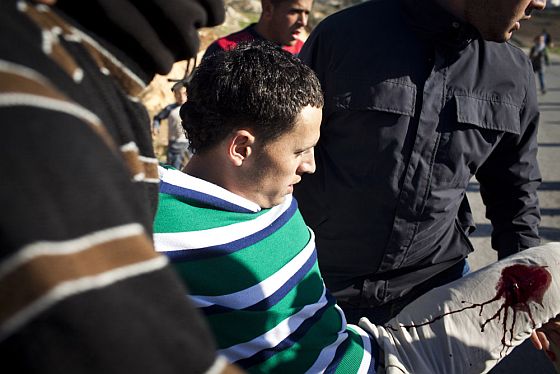
The Popular Struggle Coordination Committee reports: Earlier today, an Israeli military sniper opened fire at demonstrators in the village of Nabi Saleh, injuring one in the thigh. The wounded protester was evacuated by a Red Crescent ambulance to the Salfit hospital. The incident takes place only two weeks after the fatal shooting of Mustafa Tamimi at the very same spot. Additionally, a Palestinian journalist was injured in his leg by a tear-gas projectile shot directly at him, and two Israeli protesters were arrested.
The protester was hit by 0.22″ caliber munitions, which military regulations forbid using in the dispersal of demonstrations. Late in 2001, Judge Advocate General, Menachem Finkelstein, reclassified 0.22” munitions as live ammunition, and specifically forbade its use as a crowd control means. The reclassification was decided upon following numerous deaths of Palestinian demonstrators, mostly children.
Despite this fact, the Israeli military resumed using the 0.22” munitions to disperse demonstrations in the West Bank in the wake of Operation Cast Lead. Since then at least two Palestinian demonstrators have been killed by 0.22” fire:
- Az a-Din al-Jamal, age 14, was killed on 13 February 2009, in Hebron,
- Aqel Sror, age 35, was killed on 5 June 2009, in Ni’lin.
Following the death of Aqel Srour, JAG Brig. Gen. Avichai Mandelblit reasserted [PDF] that 0.22” munitions “are not classified by the IDF as means for dispersing demonstrations or public disturbances. The rules for use of these means in Judea and Samaria are stringent, and comparable to the rules for opening fire with ‘live’ ammunition.”
Contrary to the army’s official position, permissive use of 0.22” munitions against demonstrators continues in non life-threatening situations. [Continue reading for more background.]
Revolution through banking?
Carne Ross writes: It has been clear for some time that the conduct of the banking and financial industry is one very important cause of the 2008 credit crunch. Moreover, for-profit banks by and large fail to deliver services to the poor, deepening poor people’s marginalization from the mainstream economy. The banks relentless pursuit of profit, an intrinsic feature of the industry (as of the broader economy), continues to expose all of us to the risk of another banking crisis which would repeat the enormous harm done last time, above all to the world’s poorest. Sadly, it’s unrealistic to expect Washington to do much to curb the industry, given the banks’ enormous lobbying sway and privileged access to senior officials, regardless which party is in power.
It’s no surprise then that the banks have been an important focus of discussion in the Occupy Wall Street movement. And a new approach to banking may become one of the important ways that Occupy moves forward and starts producing material change.
One evening in Zuccotti Park, I somewhat rashly, and without much forethought, stood up and announced that I wanted to set up a working group to explore alternative systems of banking. I did not have a clear plan but felt that we had to get to the heart of the problem. If we could change banking and make it embody the values of Occupy—equality, transparency, democracy—we might not only change the financial industry for the better, but also change the very nature of the economy—and thus society itself.
Other members of the group share this ambition. Those who have joined the group represent an extraordinary and eclectic mix. There are army vets and unemployed students, but also a large number of financial experts: former derivative traders, SEC regulators, bankers, financial analysts and bloggers and even a professor of financial law. We have no shortage of expertise, and no shortage of determination either.
Over the last several weeks, we have been examining what legislative changes are needed to reform the banking sector: some day soon there may be Occupy-originated proposals and draft legislation, for instance to amend the so-called “Volcker Rule”. One group has split off to explore and design the creation of an ideal bank that would put into practice the values of Occupy. What would this look like? [Continue reading…]

‘No, Chadian.’