Category Archives: Obama administration

America’s latest nemesis

Among the many problems the Obama administration inherited from the Bush administration, none may be more troublesome than the fact that the man once granted the status most dangerous man in the world still remains the most elusive man in the world.

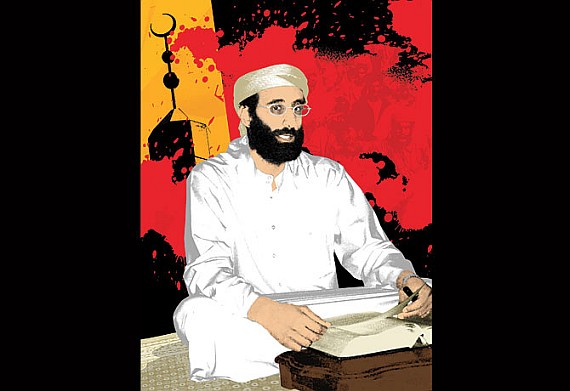
But if Osama bin Laden can’t be tracked down, maybe the alternative is to elevate an easier target to the same status in the hope of being able to claim an equal victory. It appears that the American-born and now fugitive imam, Anwar al-Awlaki, is being groomed for such a role.

This is how the New York Times is feeding the narrative:

One day in August 2001, Mr. Awlaki knocked at the door of Mr. Higgie, his neighbor [in San Diego], to say goodbye. He had moved the previous year to Virginia, becoming imam at the far bigger Dar al-Hijrah mosque, and he had returned to pick up a few things he had left behind.

As Mr. Higgie tells it, he told the imam to stop by if he was ever in the area — and got a strange response. “He said, ‘I don’t think you’ll be seeing me. I won’t be coming back to San Diego again. Later on you’ll find out why,’” Mr. Higgie said.

The next month, when Al Qaeda attacked New York and Washington, Mr. Higgie remembered the exchange and was shaken, convinced that his friendly neighbor had some advance warning of the Sept. 11 attacks.

In fact, the F.B.I. had first taken an interest in Mr. Awlaki in 1999, concerned about brushes with militants that to this day remain difficult to interpret. In 1998 and 1999, he was a vice president of a small Islamic charity that an F.B.I. agent later testified was “a front organization to funnel money to terrorists.” He had been visited by Ziyad Khaleel, a Qaeda operative who purchased a battery for Osama bin Laden’s satellite phone, as well as by an associate of Omar Abdel Rahman, the so-called Blind Sheik, who was serving a life sentence for plotting to blow up New York landmarks.

Still more disturbing was Mr. Awlaki’s links to two future Sept. 11 hijackers, Khalid al-Midhar and Nawaq Alhazmi. They prayed at his San Diego mosque and were seen in long conferences with the cleric. Mr. Alhazmi would follow the imam to his new mosque in Virginia, and 9/11 investigators would call Mr. Awlaki Mr. Alhazmi’s “spiritual adviser.”

The F.B.I., whose agents interviewed Mr. Awlaki four times in the days after the Sept. 11 attacks, concluded that his contacts with the hijackers and other radicals were random, the inevitable consequence of living in the small world of Islam in America. But records of the 9/11 commission at the National Archives make clear that not all investigators agreed.

One detective, whose name has been redacted, told the commission he believed Mr. Awlaki “was at the center of the 9/11 story.” An F.B.I. agent, also unidentified, said that “if anyone had knowledge of the plot, it would have been” the cleric, since “someone had to be in the U.S. and keep the hijackers spiritually focused.”

The 9/11 commission staff members themselves had sharp arguments about him. “Do I think he played a role in helping the hijackers here, knowing they were up to something?” said one staff member, who would speak only on condition of anonymity. “Yes. Do I think he was sent here for that purpose? I have no evidence for it.”

Let’s assume that the suspicions about Awlaki are well-founded. And let’s set aside questions about the legality or morality of Obama’s policy of targeted killing. The question this administration should soberly consider, now that Awlaki has been designated a target for assassination, is whether this influential imam poses a greater threat dead or alive?

Are we really to believe that while Awlaki remains a fugitive in Yemen and is dodging drone attacks, he is also handling an operational role in planning new attacks on the US? After all, one of George Bush’s favorite expressions, “on the run,” did actually have some practical and realistic implications.

And are we really to believe that once granted the status of martyr, Awlaki’s widely disseminated lectures and his iconic status would exert less and not more influence among those most likely to become radicalized in their hostility towards the United States?

In other words, right or wrong, is killing Anwar al-Awlaki really a smart idea?

Facebooktwittermail

The terrorism recruiting myth

After almost a decade of a US-led global war on terrorism, America’s approach to the issue has barely advanced from being a deadly game of Whack-a-Mole.

On CBS, Scott Pelley asked Secretary of State, Hillary Clinton: “I wonder if there’s anything about U.S. foreign policy that needs to change in your estimation to put more pressure on these terrorist groups where they live, like in Pakistan?”

“Well, we are doing that. And we’re increasing it. We’re expecting more from it. This is a global threat. We have probably the best police work in the world. But we are also the biggest target. And therefore, we just have to be better than everybody else,” Clinton replied.

Earlier in the interview she said: “We’ve made it very clear [to the Pakistani government] that, if, heaven forbid, that an attack like this [in Times Square], if we can trace back to Pakistan, were to have been successful, there would be very severe consequences.”

The US will start bombing Pakistan? Special Forces will start conducting operations in North Waziristan? Clinton would not specify what form these severe consequences might take.

In response to the Times Square incident, Richard Clarke, former counter-terrorism coordinator for the Bush administration writes:

The reason such attacks are hard to stop is rooted in the identity of the attackers. They often seem to be successful or well-educated members of society, uninvolved in any form of radicalism. But then, the drip-drip of terrorist propaganda — either on the Internet or circulated through friends — has its effect. They quietly make contact with radical groups overseas, perhaps even traveling abroad for training and indoctrination. They throw away the life they have made in the West and agree to stage an attack. Faisal Shahzad, the alleged Times Square terrorist, fits that profile, as have others in the United States and Europe.

For U.S. intelligence and law enforcement authorities, these newly minted terrorists are the hardest to stop. They may not be part of any known cell; there is no reason for their phones or e-mail accounts to come under surveillance. When they buy rifles, handguns, tanks of propane gas or fertilizer, they are doing nothing out of the ordinary in American society.

If they succeed in inflicting harm on us with terrorist acts designed to rivet media and public attention, our political debate may once again be as wrongheaded as it will be predictable. Some elected officials will claim that their party would have done a much better job protecting the country. Critics of America’s Middle East policy — or our energy policy, or our foreign policy writ large — will also fault whatever administration is in power.

Likewise, in a 60 Minutes report that aired last night, the prism through which the issue is filtered is one in which individuals are turned into the tools of a deadly ideology. Vulnerable young men are in jeopardy of being recruited by merciless ideologues and terrorist planners.

But as Scott Atran points out, the idea that Shahzad and those like him have to be recruited, does not fit the evidence.

Shahzad was also apparently inspired by the online rhetoric of Anwar al-Awlaki, a former preacher at a Northern Virginia mosque who gained international notoriety for blessing the suicide mission of the failed Christmas airplane bomber, Umar Farouk Abdulmutallib, and for Facebook communications with Major Nadal Hasan, an American-born Muslim psychiatrist who killed thirteen fellow soldiers at Fort Hood in November 2009. Although many are ready to leap to the conclusion that Awlaki helped to “brainwash” and “indoctrinate” these jihadi wannabes, it is much more likely that they sought out the popular Internet preacher because they already self-radicalized to the point of wanting reassurance and further guidance. “The movement is from the bottom up,” notes forensic psychiatrist and former CIA case officer Marc Sageman, “just like you saw Major Hasan send twenty-one e-mails to al-Awlaki, who sends him back two, you have people seeking these guys and asking them for advice.”

The CBS report, stuck on the track that recruitment is a central issue, homes in on the role of the internet. The would-be terrorist is someone whose deadly intent is sure to be triggered by something he sees online.

Phillip Mudd, who until a few months ago was the senior intelligence advisor to the FBI and its director says:

They’re seeing images, for example, of children and women in places like Palestine and Iraq, they’re seeing sermons of people who explain in simple, compelling, and some cases magnetic terms why it’s important that they join the jihad. They’re seeing images, and messages that confirm a path that they’re already thinking of taking.

CBS helpfully provides such an image, but predictably neglects to add any commentary.

What are we seeing? An Israeli soldier terrorizing a Palestinian mother and her two girls.

And there we have it: exactly the kind of image the foments terrorism.

Viewed through the American counter-terrorism lens, the problem lies with the propagation of the image and the violent reaction such an image can provoke. Why? Because any serious consideration of the foreign policy issues that the image signals is still off-limits.

But here’s what everyone in the Middle East sees: An Israeli Jew brandishing an American-made weapon, serving America’s closest ally in the Middle East, is threatening a Muslim family. This is the narrative that no amount of spin or cleverly fought battles in a war of ideas, can undo.

Yet here is the foreign policy dilemma for Washington: How can the United States adopt a posture in the Middle East that acknowledges the role America has played in fueling terrorism, without appearing to capitulate to terrorist demands?

The answer is to trust in the universally recognized truth: actions speak louder than words.

What Obama does in Pakistan matters more than what he said in Cairo.

In April 2003, the Bush administration made a step in the right direction when it withdrew American troops from Saudi Arabia. The moved turned out to be of little consequence since it was triggered by utterly false expectations about the war in Iraq. Yet there was an implicit recognition: the presence of American soldiers in close proximity to Islam’s holiest sites sends an ugly message to the Muslim world.

Seven years later, as the Obama administration puts increased pressure on the Pakistani government to launch a major offensive in North Waziristan — an operation that would yet again result in the displacement of tens of thousands of civilians — and as the CIA continues to expand a drone war that has resulted in hundreds of civilian deaths, what kind of signal is this sending to those who might now contemplate following in the footsteps of Faisal Shahzad?

Facebooktwittermail

Lieberman’s TEA party and dual loyalty

Joe Lieberman’s Terrorist Expatriation Act is designed to strip the constitutional rights from any American who is accused of supporting terrorism, but the political sentiment he’s tapping into is simply, America first. Does Lieberman have no concern about where this might go?

How about this New Yorker who Max Blumenthal interviewed recently? Presumably she’s an American citizen, but it sounds like she puts Israel first:

As for where Lieberman is finding support, it isn’t coming from the White House but other Democrats have spoken favorably:

Several major Democratic officials spoke positively about the proposal, including Secretary of State Hillary Rodham Clinton. Noting that the State Department already had the authority to rescind the citizenship of people who declare allegiance to a foreign state, she said the administration would take “a hard look” at extending those powers to cover terrorism suspects.

“United States citizenship is a privilege,” she said. “It is not a right. People who are serving foreign powers — or in this case, foreign terrorists — are clearly in violation, in my personal opinion, of that oath which they swore when they became citizens.”

Speaker Nancy Pelosi said she supported the “spirit” of the measure, although she urged caution and said that the details of the proposal, like what would trigger a loss of citizenship, still needed to be fleshed out.

Interesting comment from Clinton… Makes me wonder: how does she feel about Rahm Emanuel serving in the Israeli Defense Force? I know that doesn’t count as an infraction of the law because Israel is not a country hostile to the US, but there’s no avoiding the fact that serving in the Israeli military is serving a foreign power.

As for the “spirit” of the measure, I guess Pelosi will have to explain what she means, but Megan McArdle is not alone in finding this spirit hard to discern:

Can someone explain to me–hopefully using graphs, and small words–why Joe Lieberman is willing to share the precious blessing of American citizenship with Charles Manson, Gary Ridgeway, and David Berkowitz, but wants citizenship stripped from a guy who strapped some firecrackers to a bag of non-explosive fertilizer?

Indeed. And if even Glenn Beck and Chuck Schumer both doubt the wisdom of Lieberman’s bill, that might be a hint that this truly is an act of idiocy.

Facebooktwittermail

An arrest warrant needs a name on it; a death warrant needs none.

In the narrative that sketches the legality of the war on terrorism, the tribal nature of the “battlefield” is the pretext used to justify killing people instead of attempting to arrest them. Counterterrorism experts scoff at the notion that FBI agents (or Pakistani law enforcement officials for that matter) could possibly waltz into a village in South Waziristan and handcuff a Taliban or al Qaeda suspect. The logistics of such an operation would indeed be daunting.

But here’s the thing: The United States is now killing people when it doesn’t even have a legal basis for even initiating their capture.

In the US — and most other legal jurisdictions — an arrest warrant needs to show probable cause connecting a crime that has been committed to the person named on the warrant.

In Pakistan, the CIA can target someone for assassination without knowing their name, without witnessing them commit a crime — simply on the Orwellian pretext that their “pattern of life” can be deemed a threat to the United States.

The Los Angeles Times reports:

The CIA received secret permission to attack a wider range of targets, including suspected militants whose names are not known, as part of a dramatic expansion of its campaign of drone strikes in Pakistan’s border region, according to current and former counter-terrorism officials.

The expanded authority, approved two years ago by the Bush administration and continued by President Obama, permits the agency to rely on what officials describe as “pattern of life” analysis, using evidence collected by surveillance cameras on the unmanned aircraft and from other sources about individuals and locations.

The information then is used to target suspected militants, even when their full identities are not known, the officials said. Previously, the CIA was restricted in most cases to killing only individuals whose names were on an approved list.

The new rules have transformed the program from a narrow effort aimed at killing top Al Qaeda and Taliban leaders into a large-scale campaign of airstrikes in which few militants are off-limits, as long as they are deemed to pose a threat to the U.S., the officials said.

At a time when Faisal Shahzad — a name that might not evoke much terror — is a name uppermost in many people’s minds, it’s worth remembering Mir Aimal Kasi.

In 1993 he too had conducted a pattern of life analysis, having noted the turn lane that directed traffic into the CIA’s Langley headquarters. In his targeted killing operation, he too had found the high-value targets of his choice — James Woollsey and Robert Gates — were too illusive and so he opted to shoot CIA employees whose names he didn’t know.

Soon before receiving a death sentence in 1998, Kasi told Salon:

“I am not against the USA or the American people. I am against the policies of the U.S. government toward Islamic countries or toward Muslims.”

“A lot of young people in Pakistan,” he said, “think mostly the same.”

Whoever follows in the footsteps of Faisal Shahzad may have less interest in constructing a Rube Goldberg type contraption than in causing mayhem the America way — as did Mir Aimal Kasi, John Allen Muhammad, and Nidal Malik Hasan.

“This is a blow back. This is a reaction. This is retaliation. And you could expect that,” Pakistani Foreign Minister Mahkdoom Qureshi told CBS News after the Times Square bombing attempt. “Let’s not be naive. They’re not going to sort of sit and welcome you eliminate them. They’re going to fight back.”

Facebooktwittermail

Drone attacks provoke calls for revenge

In a report on the CIA’s campaign of drone warfare in Pakistan, the Los Angeles Times recounts the stories of some of the civilian victims of the attacks.

Many of the boys that Zaman Khan grew up with in the South Waziristan town of Shakai eventually joined the Taliban. He knew they had become militants, but he never thought it odd to have them over for tea.

Whether it was because of Taliban visits or the proximity of a regular Taliban meeting place 30 yards away, Khan’s house became a target March 15, 2008.

The missile struck while everyone slept, killing Khan’s brother, Wazir Khan, 40; Wazir’s wife, Zara Bibi, 30; and their 4-year-old son, Irshad. The left half of Wazir’s body had been sheared off. Zara’s and Irshad’s bodies were charred from head to toe.

Wazir’s two other children, Noor Rehman, 10 at the time, and Ishaq Khan, 3, survived. Physically, they recovered but suffer from psychological problems, Zaman Khan said.

“Ishaq doesn’t talk at all,” Khan said. “He can’t recognize his family, and he drinks only if someone helps him.”

Three weeks after that strike, a house full of civilians in the same neighborhood was struck, instantly killing cousins Sher Maan, 20, and Azeem Ullah, 30, and Azeem’s wife, Gul Anama, 25.

“It was a huge blast that shook the ground,” said Amin Ullah, 20, a Shakai farmer.

“I believe that most of the victims of these drone attacks are innocent people,” Ullah said. “Pakistan should be carrying out these attacks. Pakistan knows the terrain, knows its people and knows the militants.”

Andrew Exum, a former Army officer in Afghanistan and Iraq, has declared the drone program counterproductive and called for an end to it. In an analysis published last year, Exum and David Kilcullen, a former counterinsurgency advisor to the head of U.S. Central Command, Army Gen. David H. Petraeus, dismissed drones as technology substituting for strategy.

“Every one of these dead noncombatants represents an alienated family, a new desire for revenge, and more recruits for a militant movement,” they wrote.

Drones have proved invaluable in Afghanistan, where they focus on surveillance, intelligence-gathering and watching over coalition troops, Exum said in an interview. But in Pakistan, the U.S. and the government in Islamabad need to make the case that the attacks are part of a joint strategy supporting Pakistani policy, he said.

“I’m not saying drones can’t be part of the solution, but right now I think they’re part of the problem,” Exum said.

Drone attacks have enraged men such as Momin Khan. On a September morning last year, Khan heard the thunderclap of a drone strike in Machis, his village in North Waziristan, and ran to see what had happened.

As he joined other villagers running down a dirt road, the 50-year-old unemployed teacher saw black smoke and flames curling out of a house about 60 yards away. The missile had killed two people there. As he ran closer, a second missile strike shook the ground.

Shrapnel from the blast cut into his shoulder and legs. He woke up in a hospital.

Four people were killed in the second strike, he said. Although Taliban militants have often used Machis as a haven, Khan said he was sure the house initially targeted had only civilians in it.

“These drones fly day and night, and we don’t know where to hide because we don’t know who they will target,” he said. “If I could, I would take revenge on America.”

Philip Alston, the United Nations special representative on extrajudicial, summary or arbitrary killings, said that without full disclosure of the CIA drone program, “the opportunities for abuse are immense.”

“The CIA is running a program that is killing a significant number of people, and there is absolutely no accountability in terms of the relevant international law,” he said.

Scott Horton, while considering some of the legal issues surrounding the program notes:

No weapons system remains indefinitely the province of a single power. Drone technology is particularly striking in this regard, because it is not really all that sophisticated. It seems clear that other powers have this technology–Israel and Iran have each been reported to be working with it, Russia and China could obviously do so easily if they desired, and the same is probably true for Britain, France, and Germany, not to mention Japan and Taiwan, where many of the cutting-edge breakthroughs in robotics actually occur. The way America uses this technology is therefore effectively setting the rules for others. Put another way, if it’s lawful for America to employ a drone to take out an enemy in the desert of Yemen, on the coast of Somalia, in a village in Sudan or Mauretania, then it would be just as lawful for Russia, or China–or, for that matter, for Israel or Iran. What kind of world is this choice then creating? Doesn’t it invariably lead us closer to the situation in which a targeted killing will be carried out in a major metropolis of Europe or East Asia, or even the United States? And doesn’t that move us in the direction of a dark and increasingly lawless world?

This is not idle speculation. The choices the United States has made are being studied very closely in capitals around the world. In Russia, for instance, national-security analysts have noted the American drone strikes with a measure of approbation, because they see such strikes as justifying lethal countermeasures of their own against perceived terrorist enemies. A number of enemies of the Russian government who were critical of policies or actions connected with the Second Chechen War have recently met violent death, often after Russian authorities linked them to Chechen terrorist groups. The Polonium poisoning of Aleksandr Litvinenko in London, for instance, or the assassination of Umar Israilov in Vienna, which Austrian prosecutors linked earlier this week to a Putin-protégé, the president of Chechnya, are two examples that suggest that Europe may have been cleared as a theater for targeted killings by a great power. The 2004 killing of former Chechen President Zelimkhan in Qatar is an example of another Russian targeted killing in the Gulf. The recent likely Israeli assassination of Mahmoud al-Mabhouh in Dubai is another instance. Targeted killings of this sort have always been with us, of course, but with the Bush-era “War on Terror” they are making a strong comeback and are gaining in claims of legitimacy and legality. The drone technology promises to take targeted killings to a whole new level.

My point here is a simple one. The United States cannot assume exclusivity in this technology, and how it uses the technology will guide others. The United States has to decide now whether it wants to legitimize a broader right of sovereign states to assassinate their enemies using drones. The consequence of such a step to the world as a whole will be severe. This also points to the danger of the United States using drones for targeted killings and keeping silent about the process, which invites the view that the practice involves an arbitrary and capricious use of power. If the United States elects to continue on its current path, it also owes the world a clear accounting for its use of drones as a vehicle for targeted killings.

Facebooktwittermail

Predator warfare blowback

“Looks like you just lost that bet, Mr. Woodward. I’ll be waiting for your apology,” a reader said after I wrote on Sunday, “if I was to place a bet on who did this, I’d go with someone whose sympathies are probably more Tea Party than Taliban.”

Indeed I was wrong, though I’m not sure what I’m being asked to apologize for. Having engaged in premature speculation or having entertained the suspicion that there could be among the ranks of the Tea Party crowd anyone crazy enough to try and set off a bomb in Times Square?

Even if I and others were mistaken in suggesting that the Times Square incident might be connected to the Tea Party movement, the movement itself needs to engage in a bit of self-examination if it wants to understand its image problem — not pretend it’s simply the victim of unfair criticism.

Moving on, Noah Shachtman reports:

Federal agents have made an arrest in the Times Square bombing attempt. And YouTube may have provided some clues to the investigators.

Faisal Shahzad was attempting to board a plane for Dubai when he was apprehended at New York’s JFK airport. Law enforcement officials believe the Connecticut resident recently bought the 1993 Nissan Pathfinder that was rigged with explosives and fertilizer and left smoldering in Times Square.

One “clue in the investigation is a video posted online early Sunday morning by persons in Connecticut, who may have been involved in the bomb attempt and are being sought by law enforcement,” ABC News reports.

The video (below), features the voice of Qari Hussain Mehsud, the “Pakistani Taliban master trainer of suicide bombers,” according to the Long War Journal. The clip congratulates fellow Muslims for the “jaw-breaking blow to Satan’s USA.” “The attack a revenge” for the slaying of extremist leaders in Iraq and Pakistan, the video continues, and is a response to “the recent rain of drone attacks.”

If Faisal Shahzad was the best recruit the Pakistani Taliban could find, the threat they pose to the United States is probably limited, but DHS Secretary Janet Napolitano’s initial assessment that this was a “one-off” operation is clearly premature. Indeed, if the intense campaign of drone warfare in Pakistan has triggered enough outrage among a few Pakistani Americans to seek revenge in Times Square, then there is one word that this administration should now be thinking about seriously: blowback.

President Obama seems to pride himself in having been less hesitant to take the war to Pakistan than was his predecessor, yet as the reappearance of Hakimullah Mehsud should make clear, the successes of the drone campaign have not been as great as the CIA has often claimed, while the costs have just as frequently been understated.

Killing innocent people “over there,” inevitably elevates the risk that innocent people will again end up dying here.

The bomb-making abilities on display in Times Square may have made some observers respond dismissively — and I am guilty of having done so — but the Taliban’s threat to bring the war to the United States can no longer be regarded as empty rhetoric.

Facebooktwittermail

US lifting the veil on Israel’s nuclear status

The Wall Street Journal reports:

The U.S. is negotiating with Egypt a proposal to make the Middle East a region free of nuclear weapons, as the U.S. seeks to prevent Iran from derailing a monthlong U.N. conference on nuclear nonproliferation that begins Monday.

U.S. officials familiar with the move call it an important step in assuring countries that Washington—criticized by some for its silence about Israel’s undeclared nuclear arsenal—will equitably address weapons proliferation across the region, as Iran seeks to shift focus away from its own nuclear program.

But here’s the catch: before Washington applies any pressure on Israel, there must be significant progress in the peace process.

Still, there is one element here that should have been worthy of a headline of its own but doesn’t even get a mention in the article: the Obama administration seems to effectively be ending US complicity in Israel’s policy of nuclear ambiguity.

Another important part of this story that the WSJ article glides over without clarification is the reason the US is negotiating specifically with Egypt.

Washington is pushing for revisions to the Non-Proliferation Treaty to close some of its loopholes but for these to pass in the 189-nation conference, the US needs the support of the 118-non-aligned states led by Egypt. That support will not be forthcoming without some kind of agreement on a nuclear-free Middle East.

Facebooktwittermail

The future of Palestine: righteous Jews vs. the new Afrikaners

Professor John Mearsheimer, in a speech delivered at The Palestine Center in Washington DC on Thursday said:

As anyone who has spent time in the Occupied Territories knows, it is already an incipient apartheid state with separate laws, separate roads, and separate housing for Israelis and Palestinians, who are essentially confined to impoverished enclaves that they can leave and enter only with great difficulty.

Israelis and their American supporters invariably bristle at the comparison to white rule in South Africa, but that is their future if they create a Greater Israel while denying full political rights to an Arab population that will soon outnumber the Jewish population in the entirety of the land. Indeed, two former Israeli prime ministers have made this very point. Ehud Olmert, who was Netanyahu’s predecessor, said in late November 2007 that if “the two-state solution collapses,” Israel will “face a South-African-style struggle.” He went so far as to argue that, “as soon as that happens, the state of Israel is finished.” Former Prime Minister Ehud Barak, who is now Israel’s defense minister, said in early February of this year that, “As long as in this territory west of the Jordan River there is only one political entity called Israel it is going to be either non-Jewish, or non-democratic. If this bloc of millions of Palestinians cannot vote, that will be an apartheid state.”

Other Israelis, as well as Jimmy Carter and Bishop Desmond Tutu, have warned that if Israel does not pull out of the Occupied Territories it will become an apartheid state like white-ruled South Africa. But if I am right, the occupation is not going to end and there will not be a two-state solution. That means Israel will complete its transformation into a full-blown apartheid state over the next decade.

In the long run, however, Israel will not be able to maintain itself as an apartheid state. Like racist South Africa, it will eventually evolve into a democratic bi-national state whose politics will be dominated by the more numerous Palestinians. Of course, this means that Israel faces a bleak future as a Jewish state. Let me explain why.

For starters, the discrimination and repression that is the essence of apartheid will be increasingly visible to people all around the world. Israel and its supporters have been able to do a good job of keeping the mainstream media in the United States from telling the truth about what Israel is doing to the Palestinians in the Occupied Territories. But the Internet is a game changer. It not only makes it easy for the opponents of apartheid to get the real story out to the world, but it also allows Americans to learn the story that the New York Times and the Washington Post have been hiding from them. Over time, this situation may even force these two media institutions to cover the story more accurately themselves.

The growing visibility of this issue is not just a function of the Internet. It is also due to the fact that the plight of the Palestinians matters greatly to people all across the Arab and Islamic world, and they constantly raise the issue with Westerners. It also matters very much to the influential human rights community, which is naturally going to be critical of Israel’s harsh treatment of the Palestinians. It is not surprising that hardline Israelis and their American supporters are now waging a vicious smear campaign against those human rights organizations that criticize Israel.

The main problem that Israel’s defenders face, however, is that it is impossible to defend apartheid, because it is antithetical to core Western values. How does one make a moral case for apartheid, especially in the United States, where democracy is venerated and segregation and racism are routinely condemned? It is hard to imagine the United States having a special relationship with an apartheid state. Indeed, it is hard to imagine the United States having much sympathy for one.

Facebooktwittermail

How to: risk World War III, and blow billions doing it

At Wired, Noah Shachtman writes:

The Pentagon’s plan to fire ballistic missiles at terrorists isn’t just a nuclear Armageddon risk. It’s a ludicrously expensive way to accidentally start World War III: each weapon could cost anywhere from a few hundred million to $1 billion.

The Defense Department wants to spend about $240 million next year on the controversial “prompt global strike” project. Eventually, it could lead to weapons that could strike virtually anywhere in the planet within an hour or two. But that quarter-billion would be the tiniest of down payments.

“There are no accurate cost estimates for the program, largely because the technology is unproven,” writes Joe Cirincione at ForeignPolicy.com. His back-of-the-envelope calculation: $10 billion for 10 conventionally-armed Intercontinental Ballistic Missiles, meant to strike at terrorists on the move. “Each missile with its tiny payload could easily go over $1 billion each.”

Visit msnbc.com for breaking news, world news, and news about the economy

Facebooktwittermail

Obama’s Middle East star gazing

“Despite the inevitable difficulties, so long as I am President, the United States will never waver in our pursuit of a two-state solution that ensures the rights and security of both Israelis and Palestinians.” President Barack Obama, Washington, April 26, 2010.

“There has never been in the White House a president that is so committed on this issue, including Clinton who is a personal friend, and there will never be, at least not in the lifetime of anyone in this room.” US Middle East envoy, George Mitchell, in a meeting during his most recent trip to Israel and the West Bank.

* * *

If the two-state solution is a destination, then any US president who claims he has an unwavering commitment to get their should demonstrate that by stating an estimated time of arrival. A goal is a dream with a deadline.

But if the two-state solution is a reference point — something akin to the North Star when viewed by an ocean navigator — then keeping it in sight has nothing to do with getting there.

Thus it is with President Obama’s carefully chosen words: his stated commitment is not to the resolution of the conflict but to the pursuit of a two-state solution — a star he promises to gaze at for at least three and maybe seven more years.

And if George Mitchell is right in saying that Obama is the best we can hope for in the White House in our lifetimes, should we abandon hope that the conflict will be resolved, or should we abandon the idea that in this foreign arena a US president is an indispensable agent of change?

Among Washington’s peace dreamers, the latest star upon which many are hoping to hitch a ride is “linkage”: the idea that the prospect of more dead American soldiers Afghanistan or Iraq — deaths that can loosely be associated to an adjacent festering conflict — will help galvanize a domestic sense of urgency, required for resolving the Israeli-Palestinian conflict.

But here’s a problem with that idea. If the president won’t set a target date for resolving the conflict, and he sees American troops thereby placed at further risk, are we to infer that he views the duration of the deployment of those troops with equal uncertainty?

To argue that the Middle East conflict endangers the lives of American troops in the Middle East would seem to make their withdrawal as great if not a greater imperative than resolving the conflict. After all, which is an American president more likely to be able to accomplish? Order the withdrawal of the troops under his command, or end a conflict that has lasted for most of the last century?

But if there is an imperative upon which those who seek Middle East peace should really be focused, it is not the national interests of the United States; not the need for solidarity in opposing Iran’s nuclear ambitions; nor the need for stability across a region fractured by conflict; but to address and make amends for the injustices upon which Israel was founded; injustices whose perpetuation have for 62 years fomented anger and resentment which will never be pacified until a just solution can be found.

Facebooktwittermail

Abbas says Obama needs to impose a Middle East solution

In a speech to the Fatah leadership, Mahmoud Abbas pointed out the contradiction inherent in the posture that President Obama has assumed. On the one hand Washington has been pushing the line that a resolution to the Israeli-Palestinian conflict represents a vital American interest, yet at the same time Obama says, “we can’t want it more than they do.”

Unless Obama believes that in this particular arena he lacks the ability to defend American interests, he needs to advance or withdraw from his position — a position which is unsustainable.

What is Obama actually doing? He is, as far as I can see, employing a range of tactics yet has no strategy. As a result, every move he makes lacks credibility.

The Independent reports:

Palestinian president Mahmoud Abbas made a blunt appeal to the US at the weekend, asking US President Barack Obama to “impose” a solution to the Middle East conflict. The call comes amid deepening frustration at Israel’s refusal to suspend the construction of Jewish homes in Arab-dominated East Jerusalem.

The plea, made several times in private but uttered in public for the first time, came as US envoy George Mitchell wrapped up a three-day visit to Jerusalem without any breakthrough on starting the proximity talks. “Since you, Mr President and you, the members of the American administration, believe in this [Palestinian statehood], it is your duty to call for the steps in order to reach the solution and impose the solution – impose it,” Mr Abbas said in a speech to leaders of his Fatah party.

“But don’t tell me it’s a vital national strategic American interest … and then not do anything,” he added.

Richard Haass, in the Wall Street Journal, argues that an initiative to impose peace at this time is doomed to failure but that even if the conflict could be resolved, the national security rewards for the United States would be limited.

The danger of exaggerating the benefits of solving the Palestinian conflict is that doing so runs the risk of distorting American foreign policy. It accords the issue more prominence than it deserves, produces impatience, and tempts the U.S. government to adopt policies that are overly ambitious.

This is not an argument for ignoring the Palestinian issue. As is so often the case, neglect will likely prove malign. But those urging President Obama to announce a peace plan are doing him and the cause of peace no favor. Announcing a comprehensive plan now—one that is all but certain to fail—risks discrediting good ideas, breeding frustration in the Arab world, and diluting America’s reputation for getting things done.

As Edgar noted in “King Lear,” “Ripeness is all.” And the situation in the Middle East is anything but ripe for ambitious diplomacy. What is missing are not ideas—the outlines of peace are well-known—but the will and ability to compromise.

Haass’ argument, as one would expect, is that of an avowed foreign policy realist and it exposes a weakness inherent in every angle from which every US government has approached the conflict: they have studiously avoided acknowledging that injustice lies at the heart of the conflict. Instead of pursuing justice, they frame the issue as being one of balancing interests.

In the latest effort to skirt around the issue of justice we have been told that the conflict needs to be resolved because it is in America’s national interests and that the perpetuation of the conflict is endangering the lives of American soldiers in the region. In this narrative, the Palestinians — as has happened so many times before — somehow become marginal. Enlisting their support is reduced to an exercise in recruiting a few good sports — obliging fellows like Salam Fayyad, who will be good enough to assist the US and Israel in accomplishing their aims.

Facebooktwittermail

Israel’s indispensable enemies

The brutality with which the Iranian authorities have suppressed political dissent since last June’s disputed presidential election has been widely reported. The Washington Post now reveals that the political turmoil has had another effect: it has resulted in a new supply of intelligence as disaffected officials leak information about Iran’s nuclear program.

As a result, a National Intelligence Estimate being prepared for President Obama which was due out last fall is not expected to be completed until August.

The revisions to the NIE underscore the pressure on the U.S. intelligence community to produce an accurate assessment of Iran’s nuclear ambitions as President Obama pursues a policy aimed at preventing the country from acquiring an atomic bomb. The community’s 2007 assessment presented the startling conclusion that Iran had halted its work on developing a nuclear warhead, provoking enduring criticism that the report had underestimated the Iranian threat.

Officials briefed on the new version, which is technically being called a “memo to holders” of the first, say it will take a harder tone. One official who has seen a draft said that the study asserts that Iran is making steady progress toward nuclear weapons capability but that it stops short of concluding that the Islamic republic’s top leaders have decided to build and test a nuclear device.

There is little question that Iran sees strategic value in making its nuclear intentions hard to decipher, but let’s for the sake of argument assume that its goal is to put itself in the same position as Japan: not to assemble a nuclear arsenal but to have the means to do so at short notice. Could such a capability pose an existential threat to Israel (or anyone else)?

Israeli leaders have already made it clear that they draw no distinction between a nuclear armed Iran and an Iran that has nuclear weapons capability, yet this may say less about the nature of an Iranian threat than it does about the nature of Zionism. Deprive Israel of its existential threats, and the necessity for a Jewish state becomes less imperative. Take away the fear of annihilation and Jewish identity will lose one of its most unifying attributes.

Israel might fear its enemies, yet can it survive without them?

Facebooktwittermail

U.S. targets an American abroad

Vicki Divoll, observes that President Obama’s de facto death sentence for the American Muslim cleric, Anwar al Awlaki, indicates that in its application of the law, this administration has a greater regard for Awlaki’s right to privacy than his right to life.

According to media reports, the United States has taken the apparently unprecedented step of authorizing the “targeted killing” of one of its citizens outside a war zone — though the government has not officially acknowledged it.

Unnamed intelligence and counter-terrorism sources told reporters that the Obama administration had added Anwar al Awlaki, a Muslim cleric born in New Mexico, to the CIA list of suspected terrorists who may be captured or killed. Awlaki, believed to be in hiding in Yemen, has been linked to Nidal Malik Hasan, the Ft. Hood, Texas, shooter, and to Umar Farouk Abdulmutallab, the Nigerian charged with trying to blow up an airliner in December.

The reports indicate that the administration had concluded Awlaki had taken on an operational role in terrorist attacks. His addition to the CIA list shouldn’t “surprise anyone,” according to one anonymous U.S. official quoted in the New York Times.

It is surprising, however. As a matter of U.S. law, had the administration wanted merely to listen to Awlaki’s cellphone conversations or read his e-mails, it would have needed to check with another branch of government — the judiciary. But to target him for death, the executive branch appears to have acted alone.

It adds up to this: Awlaki’s right to privacy exceeds his right to life.

Dennis Blair, the Director of National Intelligence, has indicated that Awlaki enjoys no special privileges simply by virtue of being America, and that might be so. Yet it’s hard to believe that Awlaki would now be in the CIA’s hit list were it not for three additional enabling factors: that he possesses an Arabic name, that he is a Muslim, and that he is not white.

Facebooktwittermail

Nuclear force without nuclear restraint

Military organizations, like muscles, atrophy unless they get regular exercise. And as much as the destructive power of the Cold War’s nuclear arsenals is credited with having prevented their use, there is no form of deterrence that can have as much appeal to the military as an actual show of force. The fear of disarmament is less a fear of military vulnerability than it is a fear of military redundancy.

So, when it comes to the prospects of global nuclear disarmament it should come as no surprise that the Pentagon won’t support the elimination of one class of weapons without first winning support for an alternative. Prompt Global Strike promises to be such an alternative and one with what to the military must seem like an irresistible appeal: the prospect that it can be put into use.

The New York Times now reports:

In coming years, President Obama will decide whether to deploy a new class of weapons capable of reaching any corner of the earth from the United States in under an hour and with such accuracy and force that they would greatly diminish America’s reliance on its nuclear arsenal…

Called Prompt Global Strike, the new weapon is designed to carry out tasks like picking off Osama bin Laden in a cave, if the right one could be found; taking out a North Korean missile while it is being rolled to the launch pad; or destroying an Iranian nuclear site — all without crossing the nuclear threshold. In theory, the weapon will hurl a conventional warhead of enormous weight at high speed and with pinpoint accuracy, generating the localized destructive power of a nuclear warhead.

Prompt Global Strike should be seen not merely as an alternative to nuclear weapons but as a means through which the US military can free itself from what is known as the nuclear taboo.

In his acceptance speech for the Nobel Prize in 2005, the nuclear strategist Thomas Schelling said:

There has never been any doubt about the military effectiveness of nuclear weapons or their potential for terror. A large part of the credit for their not having been used must be due to the “taboo” that Secretary of State [John Foster] Dulles perceived to have attached itself to these weapons as early as 1953, a taboo that the Secretary deplored.

The weapons remain under a curse, a now much heavier curse than the one that bothered Dulles in the early 1950s. These weapons are unique, and a large part of their uniqueness derives from their being perceived as unique. We call most of the others “conventional,” and that word has two distinct senses. One is “ordinary, familiar, traditional,” a word that can be applied to food, clothing, or housing. The more interesting sense of “conventional” is something that arises as if by compact, by agreement, by convention. It is simply an established convention that nuclear weapons are different.

True, their fantastic scale of destruction dwarfs the conventional weapons. But as early as the end of the Eisenhower administration nuclear weapons could be made smaller in explosive yield than the largest conventional explosives.

There were military planners to whom “little” nuclear weapons appeared untainted by the taboo that they thought ought properly to attach only to weapons of a size associated with Hiroshima, or Bikini. But by then nuclear weapons had become a breed apart; size was no excuse from the curse.

This attitude, or convention, or tradition, that took root and grew over these past five decades, is an asset to be treasured.

If Obama pushes forward with Prompt Global Strike — and all the indications seem to be that he will — then his promise of guiding the world towards a nuclear weapons-free age, will not only have been hollow, it may have signaled a new age of destruction.

And with a military that still espouses a belief in the value of full-spectrum dominance; that operates a Space Command (with an insignia inspired by Star Trek); that has just launched the X-37B that (denials notwithstanding) appears geared towards the weaponization of space — no one should imagine that the Pentagon’s appetite for exercising global power is any less now than it was while the neoconservatives were in charge.

Facebooktwittermail

How the FBI and the press attempted to destroy an innocent man

The one thing we know about President Obama’s view of the war on terrorism is that he doesn’t like the name. But when it comes to one of the longest running and unresolved debates — whether counter-terrorism is a law enforcement or a military issue — it’s unclear how far the current president departs, if at all, from his predecessor.

For Obama or anyone else considering that question, the case of the anthrax attacks in 2001 is instructive and if it is possible to deduce a “lesson learned” from this, it may well be that, as this administration demonstrates with some frequency, it is much easier to kill terrorist suspects than determine their guilt.

In the account laid out in by David Freed in The Atlantic, it appears that the United States Government with the willing assistance of the American media, when unable to prove that the American research scientist, Dr Steven J Hatfill, had any role whatsoever in the anthrax attacks, concluded that if under relentless pressure he eventually committed suicide, then his death could be regarded as an admission of guilt and the case could be closed.

The FBI’s efforts, if not by the letter of the law then at least in spirit, fall little short of attempted murder. The press were fully complicit in this exercise.

“I was a guy who trusted the government,” [Hatfill] says. “Now, I don’t trust a damn thing they do.” He trusts reporters even less, dismissing them as little more than lapdogs for law enforcement.

The media’s general willingness to report what was spoon-fed to them, in an effort to reassure a frightened public that an arrest was not far off, is somewhat understandable considering the level of fear that gripped the nation following 9/11. But that doesn’t “justify the sliming of Steven Hatfill,” says Edward Wasserman, who is the Knight Professor of Journalism Ethics at Washington and Lee University, in Virginia. “If anything, it’s a reminder that an unquestioning media serves as a potential lever of power to be activated by the government, almost at will.”

In February 2008, Reggie B. Walton, the U.S. District Court judge presiding over Hatfill’s case against the government, announced that he had reviewed secret internal memos on the status of the FBI’s investigation and could find “not a scintilla of evidence that would indicate that Dr. Hatfill had anything to do with” the anthrax attacks.

Four months later, the Justice Department quietly settled with Hatfill for $5.82 million. “It allowed Doc to start over,” Connolly, his lawyer, says.

For Hatfill, rebuilding remains painful and slow. He enters post offices only if he absolutely must, careful to show his face to surveillance cameras so that he can’t be accused of mailing letters surreptitiously. He tries to document his whereabouts at all times, in case he should ever need an alibi. He is permanently damaged, Hatfill says. Yet he still professes to love America. “My country didn’t do this to me,” he is quick to point out. “A bloated, incompetent bureaucracy and a broken press did. I wouldn’t be doing what I’m doing today if I didn’t still love my country.”

Much of Hatfill’s time these days is devoted to teaching life-saving medical techniques to military personnel bound for combat. They are his “band of brothers,” and the hours he spends with them, Hatfill says, are among his happiest. He also serves as an adjunct associate professor of emergency medicine at George Washington University.

Then there is his boat.

Hatfill has committed $1.5 million to building his floating genetic laboratory, a futuristic-looking vessel replete with a helicopter, an operating room to treat rural indigenous peoples, and a Cordon Bleu–trained chef. Hatfill intends to assemble a scientific team and cruise the Amazon for undiscovered or little-known plants and animals. From these organisms, he hopes to develop new medications for leukemia, and for tuberculosis and other diseases that have been growing increasingly resistant to existing antibiotics. Any useful treatments, he says, will be licensed to pharmaceutical companies on the condition that developing nations receive them at cost. Hatfill hopes to christen the boat within two years. Scientists at USAMRIID, where the FBI once suspected him of stealing anthrax, have expressed tentative interest in helping him mount his expedition.

In addition to suing the Justice Department for violating his privacy and The New York Times for defaming him, Hatfill also brought a libel lawsuit against Don Foster, Vanity Fair, and Reader’s Digest, which had reprinted Foster’s article. The lawsuit led to a settlement whose dollar amount all parties have agreed to keep confidential. The news media, which had for so long savaged Hatfill, dutifully reported his legal victories, but from where he stands, that hardly balanced things on the ledger sheet of journalistic fairness.

Three weeks after the FBI exonerated Hatfill, in the summer of 2008, Nicholas Kristof apologized to him in The New York Times for any distress his columns may have caused. The role of the news media, Kristof wrote on August 28, is “to afflict the comfortable and comfort the afflicted. Instead, I managed to afflict the afflicted.”

Many others who raised critical questions about Hatfill have remained silent in the wake of his exoneration. Barbara Hatch Rosenberg, the molecular biologist who spurred the FBI to pursue Hatfill, retired two years ago. Through a former colleague, she declined to be interviewed for this article. Jim Stewart, the television correspondent whose report compared Hatfill to Al Capone, left CBS in 2006. Stewart admitted in a deposition to having relied, for his report, on four confidential FBI sources. When I reached the former newsman at his home in Florida, Stewart said he couldn’t talk about Hatfill because he was entertaining houseguests. When I asked when might be a good time to call back, he said, “There isn’t a good time,” and hung up.

“The entire unhappy episode” is how Don Foster, the Vassar professor who wrote the Vanity Fair article, sums up Hatfill’s story and his own role in it. Foster says he no longer consults for the FBI. “The anthrax case was it for me,” he told me recently. “I’m happier teaching. Like Steven Hatfill, I would prefer to be a private person.”

Foster says he never intended to imply that Hatfill was a murderer, yet continues to stand by his reporting as “inaccurate in only minor details.” I asked if he had any regrets about what he’d written.

“On what grounds?” he asked.

“The heartache it caused Hatfill. The heartache it caused you and Vanity Fair.”

Foster pondered the question, then said, “I don’t know Steven Hatfill. I don’t know his heartache. But anytime an American citizen, a journalist, a scientist, a scholar, is made the object of unfair or inaccurate public scrutiny, it’s unfortunate. It’s part of a free press to set that right.”

This past February, the Justice Department formally closed its investigation of the 2001 anthrax attacks, releasing more than 2,500 pages of documents, many of them heavily redacted, buttressing the government’s assertion that Bruce Ivins was solely responsible for the anthrax letters.

When I asked FBI spokesperson Debra Weierman how much money had been spent chasing Hatfill, she said the bureau was unable to provide such an accounting. She would neither confirm nor deny that the FBI ever opened any administrative inquiries into the news leaks that had defamed him. The FBI, she said, was unwilling to publicly discuss Hatfill in any capacity, “out of privacy considerations for Dr. Hatfill.” Weierman referred me instead to what she described as an “abundance of information” on the FBI’s Web site.

Information about the anthrax case is indeed abundant on the bureau’s Web site, with dozens of documents touting the FBI’s efforts to solve the murders. Included is a transcript of a press conference held in August 2008, a month after Ivins’s suicide, in which federal authorities initially laid out the evidence they had amassed against him. But beyond a handful of questions asked by reporters that day, in which his last name is repeatedly misspelled, and a few scant paragraphs in the 96-page executive summary of the case, there is no mention anywhere on the FBI’s Web site of Steven Hatfill.

Visit msnbc.com for breaking news, world news, and news about the economy

Facebooktwittermail

Obama administration looks beyond sanctions against Iran

David Ignatius sketches some of the details in the the sanctions regime being crafted by Stuart Levey, undersecretary of the Treasury for terrorism and financial intelligence, but he concedes that sanctions have rarely been effective instruments for changing policy.

For policymakers, the discussion is beginning to shift to the sensitive area suggested by Gates’s memo — the space between sanctions and outright military action. What options would the United States and its allies have, short of war, to raise the cost to Iran of pursuing a nuclear weapons program? Are there means of subverting, sabotaging or containing such a program without actually bombing Iranian facilities?

We won’t be hearing a lot of public discussion about this gray area. But that’s where senior officials will focus more of their energy in coming months, as they prepare for the possibility that Levey’s clever trap won’t work.

Is a “gray area” for the Obama administration the equivalent of the “dark side” Dick Cheney made infamous? Are we talking about kidnappings and assassinations? Having demonstrated his willingness to authorize extra-judicial detention and extra-judicial killing, is Obama getting ready to employ full-fledged state-sponsored terrorism?

Facebooktwittermail

Will not one but two Guantanamos define the American future?

At TomDispatch, Karen J. Greenberg writes:

On his first day in office, President Barack Obama promised that he would close the Bush-era prison at Guantanamo Bay, Cuba, “as soon as practicable” and “no later than one year from the date of this order.” The announcement was met with relief, even joy, by those, like me, who had opposed the very existence of Guantanamo on the grounds that it represented a legal black hole where the distinction between guilt and innocence had been obliterated, respect for the rule of law was mocked, and the rights of prisoners were dismissed out of hand. We should have known better.

By now, it’s painfully obvious that the rejoicing, like the president’s can-do optimism, was wildly premature. To the dismay of many, that year milestone passed, barely noticed, months ago. As yet there is no sign that the notorious eight-year-old detention facility is close to a shut down. Worse yet, there is evidence that, when it finally is closed, it will be replaced by two Guantanamos — one in Illinois and the other in Afghanistan. With that, this president will have committed himself in a new way to the previous president’s “long war” and the illegal principles on which it floundered, especially the idea of “preventive detention.”

For those who have been following events at Guantanamo for years, perhaps this should have come as no surprise. We knew just how difficult it would be to walk the system backwards toward extinction, as did many of the former lawyer-critics of Guantanamo who joined the Obama administration. The fact is: once a distorted system has been set in stone, the only way to correct it is to end the distortion that started it: indefinite detention.

Facebooktwittermail

Speculation dismounts on Obama Middle East peace plan

I claim no special knowledge of the inside workings of the Obama administration — merely an ear that notes the difference between substance and flatulence and to my ear what sounded like a farting contest started on April 7 with a column by David Ignatius: “Obama weighs new peace plan for the Middle East.”

According to Ignatius — which is to say, according to the nameless officials he had been talking to — Obama was “seriously considering” proposing a peace plan. Chatter, chatter, chatter.

Even as late as Thursday, Ignatius wasn’t ready to completely pull the plug on the story he’d started. After all, one of the primary reasons it had been taken so seriously was because it came from such an august columnist. A Middle East peace plan is on Obama’s foreign policy checklist and he’s “still working on it,” Ignatius wrote last week.

Even yesterday, Agence France Press reported: “Washington’s foreign policy echo chamber is reverberating with speculation that President Barack Obama could try to blow open the deadlock between Israelis and Palestinians with his own peace plan.”

Enough. The man has now spoken — Rahm Emanuel, that is.

The Jewish Telegraph Agency reports:

The time is not ripe for a U.S.-promoted Middle East peace plan, President Obama’s chief of staff said.

“A number of people have advocated that,” Rahm Emanuel said Monday on the Charlie Rose show on Bloomberg Television.

“That time is not now,” Emanuel said. The “time now is to get back to the proximity talks, have those conversations that eventually will lead to direct negotiations…”

I guess George Mitchell can carry on snoozing in the back of his limo as he waits to start shuttling between Jerusalem and Ramallah.

Facebooktwittermail