Category Archives: US government

The Israelification of America

As the Transportation Security Administration faces a barrage of criticism, some indignant Americans are calling for the “Israelification” of US airports — as though the security procedures used in a tiny Middle Eastern ethnocracy with one international airport could easily be scaled up for America.

Ironically, Israelification is not what we need — it’s what we already have.

Consider the real outrages of the last decade that, simply because they were done in the name of national security, the majority of Americans found tolerable:

  • a global war on terrorism that led to massive increases in defense spending, the creation of multiple new intelligence and security agencies, and Washington’s enslavement to fear-based politics — that was OK;
  • with disregard for international law, the invasion of Iraq on a false pretext — that was OK;
  • the kidnapping, secret imprisonment and torture of individuals most of whom had nothing to do with 9/11 — that was OK;
  • the authorization of warrantless wiretaps — that was OK;
  • the implementation of a remote-controlled assassination program — that was OK;
  • in short, the normalization of war crimes all of which were deemed justifiable because of 9/11 — that was OK;
  • but “don’t touch my junk” — there are limits to what Americans will tolerate.

TSA administrators are no doubt frustrated by the fact that had the new pat-down procedures been implemented in late 2001, they would probably have been welcomed by a population that widely supported the idea of doing “whatever it takes” to stop “the terrorists.”

The problem, then and now, is that air transportation security is imagined to be about catching terrorists. On this count, the TSA seems to have a poor record.

At Slate, Juliet Lapidos notes:

In May, the Government Accountability Office released a report noting that SPOT’s [“Screening of Passengers by Observational Techniques”] annual cost is more than $200 million and that as of March 2010 some 3,000 behavior detection officers [BDOs] were deployed at 161 airports but had not apprehended a single terrorist. (Hundreds of illegal aliens and drug smugglers, however, were arrested due to the program between 2004 and 2008.) What’s more, the GAO noted that at least 16 individuals later accused of involvement in terrorist plots flew 23 different times through U.S. airports since 2004, but TSA behavior-detection officers didn’t sniff out any of them.

Does this imply that the TSA’s BDOs have yet to pinpoint the way a terrorist walks, talks, or dresses? The TSA’s “failure” in this instance might simply mean that the individuals who escaped their attention were not at those times actually doing anything suspicious.

The point is, there are justifiable and unjustifiable grounds to turn a person into an object of suspicion. A system that simply on the basis of religion, ethnicity or nationality, regards a person with suspicion, is unjust and will be ineffective. Indeed, a system which even regards its targets as “the terrorists” conjures up the false notion that it is dealing with a class of people rather than a class of behavior.

Which brings me back to my initial claim that the Israelification of America is already deeply entrenched. Israel’s fear of the Arab world has been transplanted into American consciousness to such a degree that we are moving toward the absurd conclusion that if this country operated even more like Israel than it already does, then we would be able to feel as safe as the Israelis do.

Living inside a fortress and defining ones existence in terms of threats posed by eternal enemies, is a good way of justifying spending more and more on increasingly elaborate fortifications. But those who invest deeply in this mindset and who profit from its perpetuation, have the least interest in exploring what we need to understand most: why our enemies think the way they do. Delve into that question, and the notion of eternal enmity quickly evaporates — thus the perpetuation of the myth that we are under threat not because of what we do but because of who we are.

Meanwhile, next time a TSA officer offends your dignity, spare a thought for the Palestinians who while passing through IDF checkpoints suffer vastly worse when attempting no more than to travel from one town to the next.


Facebooktwittermail

Billions can be saved in defense budget: McCain

Reuters reports:

Senator John McCain, the top Republican on the Senate Armed Services Committee, said billions of dollars could be saved from the defense budget by cutting lawmakers’ pet projects, known as earmarks, and fixing troubled arms programs.

McCain told a foreign policy forum on Monday that he is confident Defense Secretary Robert Gates will be able to cut $100 billion from the defense budget over the next five years to fund personnel costs and keep weapons programs on track.

He cited several big arms programs that were over budget and behind schedule, saying they presented further opportunities to save money.

He said the Lockheed Martin Corp F-35 fighter program, now projected to cost $382 billion, was one example, saying it was “unacceptable” that the cost of each fighter jet was now double what was initially planned.

Axe the most expensive defense program ever — sounds like a good idea. But the Israelis will be disappointed. Maybe this says something about why the Obama administration is offering F-35 squadrons as though it was handing out candy.

Facebooktwittermail

From the top there’s only one way forward: down

Mature cosmological systems recognize the cyclical nature of change: that growth is followed by decay and that power gathered is later dispersed. These are not ideas readily embraced by an imperial power and thus America has driven itself into a trap which it cannot back out of without undermining its own image of preeminence.

The trap that a great power falls into as soon as it makes the mistake of using blunt force against an asymmetrical threat is that its opponent has the exclusive ability to make tactical retreats with its pride in tact.

For a decade now, America has been fighting adversaries who operate unwaveringly according to the Maoist principles of guerrilla warfare: “The enemy advances, we retreat; the enemy camps, we harass; the enemy tires, we attack; the enemy retreats, we pursue.”

The war on terrorism, whose sole purpose was to put on display the preeminence of American power, has instead in every possible way demonstrated the limits of American power and yet even now the prospect of defeat cannot be entertained.

The Obama administration, desperate to find a way out of Afghanistan, refuses to admit that it is developing an exit strategy. The plan to end combat missions by 2014 is not an exit strategy; it is a “transition strategy” US envoy Richard Holbrooke claims.

And as if to guard against the risk that Obama might end a second term (if he gets one) with the United States no longer at war, he seems intent on starting a war of his very own — a war whose beginning echoes America’s entry into Vietnam.

The Wall Street Journal reports:

The U.S. is preparing for an expanded campaign against al Qaeda in Yemen, mobilizing military and intelligence resources to enable Yemeni and American strikes and drawing up a longer-term proposal to establish Yemeni bases in remote areas where militants operate.

The developments are part of a U.S. scramble to step up the hunt for members of al Qaeda in the Arabian Peninsula, the terrorist organization behind a recent failed attempt to blow up two planes over the U.S. using bombs hidden in cargo.

Limited U.S. intelligence experience in Yemen has created “a window of vulnerability” that the U.S. government is “working fast to address,” a senior Obama administration official said.

For now, the U.S. gets much of its on-the-ground intelligence from a growing partnership with Saudi Arabia, which shares a border with Yemen and has a fruitful informant network in Yemen’s tribal areas.

In the rush to build up capabilities, the Central Intelligence Agency and other agencies are moving in equipment and personnel from other areas, and over the past year have expanded the size of teams in the U.S. analyzing intelligence on AQAP. The emphasis now is on expanding the number of intelligence operatives and analysts in the field.

There is a debate within the Obama administration and Pentagon about how best to ramp up the fight against AQAP, the Yemen-based terrorist group. Supporters of establishing forward operating bases for Yemeni forces say they would help the weak Yemeni government expand its control and create an opportunity to get a small number of American Special Operations trainers and advisers out of the capital region and into the field.

Facebooktwittermail

Why America will come to regret the craven deal Obama is offering Netanyahu

Christopher Hitchens writes:

Those of us who keep an eye on the parties of God are avid students of the weekly Sabbath sermons of Rabbi Ovadia Yosef. In these and other venues, usually broadcast, this elderly Sephardic ayatollah provides an action-packed diet that seldom disappoints. A few months ago, he favored his devout audience with a classic rant in which he called down curses on the Palestinian Arabs and their leaders, wishing that a plague would come and sweep them all away. Last month, he announced that the sole reason for the existence of gentiles was to perform menial services for Jews: After that, he opined, their usefulness was at an end. A huge hubbub led to his withdrawal of the first of these diatribes. (I would be interested to know if this was on partly theological grounds. After all, the local Palestinians may still have some labor to perform before the divine plan is through with them.) The second sermon, so far as I know, still stands without apology. Why on earth should anybody care about the ravings of this scrofulous medieval figure, who peppers his talk of non-Jews in Palestine with comparisons to snakes, monkeys, and other lesser creations, rather as Hamas and Hezbollah refer to the Jews? Well, one reason is that he is the spiritual leader of the Shas Party, an important member of Prime Minister Benjamin Netanyahu’s coalition. Indeed, two key portfolios, of the Interior and of Construction and Housing, are held by Shas members named Eli Yishai and Ariel Atias.

Yishai recently delighted the Diaspora by saying that only those Jews who converted via the Orthodox route could carry “the Jewish gene.” Atias has expressed alarm about the tendency of Israeli Arab citizens to try to live where they please—or “spread,” as he phrases it—and has advocated a policy of segregation in housing within Israel proper. He also advocates the segregation by neighborhood of secular from Orthodox Jews, adding that he does not wish his own children to mix with their nonreligious peers. It is Yishai’s ministry that is famous for making announcements about new “housing” developments outside Israel itself and in legally disputed territory. Very often, Netanyahu himself has claimed to be taken by surprise at these announcements, which usually involve tense areas of Jerusalem. Thus the huge embarrassment inflicted on Vice President Joe Biden earlier this year, when fresh settlement construction was proclaimed in the middle of his high-level visit. And thus the undisguised irritation of President Obama and Secretary of State Hillary Clinton last week, when yet another round of such housing was scheduled while Obama was in Asia and Netanyahu was in the United States. Apparently, the latest high-level round of the peace process has included the modest and tentative suggestion to Israel that such disclosures be timed with greater tact and coordination in the future.

Facebooktwittermail

Cantor recants

MJ Rosenberg writes:

[Soon-to-be House Majority Leader Eric Cantor] has been an AIPAC cutout since he first was elected to office. He’s been to more AIPAC meetings than he can probably count. And he should have figured out by now that the lobby is extremely careful, obsessively careful, to always emphasize loyalty to the United States while simultaneously endorsing Israeli policies that undermine our foreign policy objectives.

AIPAC officials never, ever, say that when push comes to shove their loyalty is with Israel not the United States. In fact, the accusation that this is the case is the charge AIPAC hates most.

But the soon-to-be Majority Leader came right out and said it: Israel, right or wrong.

It took a few days for Cantor to understand how utterly offensive his statement was. (He might have heard from a few Tea Party types who, say what you will about them, tend to take their patriotism seriously.)

So today Cantor explained he was misunderstood. His inconvenient truth, his gaffe, was replaced by a laughable untruth.

This is how the Washington Post‘s Dana Milbank reports it:

Brad Dayspring, Cantor’s press guy, tells me Cantor’s promise that the Republican majority would “serve as a check on the administration” was “not in relation to U.S./Israel relations.”

Mmmm. So Cantor’s pledge to stand with Netanyahu against Obama was “not in relation to US/Israel relations” despite the context of Cantor’s statement — just before Netanyahu’s meeting with Clinton — and the fact that the person he was talking to was the Prime Minister of Israel.

So, what was Cantor’s pledge “in relation to”?

Was it in relation to either repealing “Don’t Ask, Don’t Tell” or the Bush tax cuts for millionaires? Maybe it was about farm subsidies.

Facebooktwittermail

Netanyahu assumes command in Washington

After winning the US midterm elections, Israel’s prime minister Benjamin Netanyahu hardly needs to worry about holding his own coalition government together. The fact that he so transparently now has Washington in his pocket should duly impress anyone who might have doubted America’s willingness to tolerate its increasingly servile relationship with Israel.

Even so, after the announcement that 1,345 new housing units will be built for Jewish occupants in Israeli-occupied East Jerusalem, President Obama’s reaction — to suggest that this move is “unhelpful” during peace negotiations — set off alarm bells. The White House was swift to assure those concerned, that the administration is not stepping out of line.

On a conference call with American Jewish leaders today, a White House official said the administration hadn’t sought a confrontation with the Israelis over a new construction announcement.

President Barack Obama answered a question at a press conference on the subject straightforwardly but hadn’t specifically planned to make a statement criticizing new Israeli building, National Security Council official Dan Shapiro said on the call, according to a participant.

Perhaps the press can avoid causing Obama any further embarrassment by henceforth not asking questions on such sensitive topics.

Still, this administration remains an object of mistrust and so when Netanyahu met his leading representative in Washington a few days ago, Eric Cantor, the congressman and likely GOP majority leader assured his prime minister that the Republican party will now be able impose the required discipline.

Eric stressed that the new Republican majority will serve as a check on the Administration and what has been, up until this point, one party rule in Washington. He made clear that the Republican majority understands the special relationship between Israel and the United States, and that the security of each nation is reliant upon the other.

Unfortunately, a few Americans might be perplexed by this claim that the security of the United States is dependent on the security of Israel. Cantor believes “most Americans understand that Israel’s security is synonymous with America’s security.”

Mutual dependence and the security of these two nations being synonymous are not quite the same thing.

It’s easy to see that Israel is capable of having such a disruptive impact on the Middle East that this will damage US interests and in that sense that the US depends on Israel not to undermine its national security even more than it already does.

But to say that Israel’s security is synonymous with America’s security suggests another possibility. If our interests do indeed so perfectly overlap, then we really don’t need to think about Israel’s security. If America focuses on its own interests, Israel’s — in as much as their interests are identical — will be taken care of. In as much as our interests differ — well that’s Israel’s problem, not ours.

Facebooktwittermail

U.S. to store another $400m worth of emergency military equipment in Israel

Haaretz reports:

The U.S. government is to move an additional $400 million worth of military equipment to emergency storage in Israel over the next two years.

The equipment, which includes so-called smart bombs, will stand at Israel’s disposal in an emergency.

The U.S. Congress approved the hike last month, which will bring the value of American military equipment stockpiled in Israel to $1.2 billion by 2012. The story was first reported this week by Defense News magazine’s reporter in Israel, Barbara Opall-Rome.

The U.S. stores equipment in Israel by virtue of a special clause in U.S. foreign aid law governing war reserves stockpiles for allies. According to the clause, the equipment can be utilized by American forces throughout the world, and also, in an emergency, by the military in the country where the equipment is stored.

The clause was originally intended to allow South Korea use of American equipment in case of a surprise attack by North Korea.

The type of equipment stockpiled in Israel is determined through dialogue between the Israel Defense Forces and the U.S. Army’s European Command. The issue was raised in discussions last week during the visit by the IDF’s logistics and technology chief, Maj. Gen. Dan Biton, at the Pentagon in Washington.

The agreement between the two armed forces also includes conditions under which the IDF may use the equipment. It is believed that a great deal of the equipment will include precision weapons launched from the air.

IDF Chief of Staff Gabi Ashkenazi said this week that in Israel’s future wars, much more precise weaponry will be needed to strike urban targets from the air without injuring civilians.

During Operation Cast Lead, 81 percent of the missiles and bombs launched from the air on and by IDF artillery were of the precision type.

Use of the the American equipment is allowed with permission of the American administration; Israel used such U.S. weaponry during the Second Lebanon War.

Facebooktwittermail

First sign of the new U.S. political reality — Netanyahu’s swagger

At JTA, Ron Kampeas writes:

The sharpest signal of what last week’s elections meant for Jews came not from Washington but from New Orleans, Nova Scotia and Australia.

In New Orleans, Israeli Prime Minister Benjamin Netanyahu delivered a speech Monday calling for moving beyond sanctions to mounting a “credible military threat” against Iran as a means of avoiding war.

“Containment will not work,” Netanyahu said in his address to the General Assembly of the Jewish Federations of North America.

The prime minister’s remarks echoed the precise terminology used by Sen. Lindsey Graham (R-S.C.) in Nova Scotia two days earlier, when he told the Halifax International Security Forum that “containment is off the table.” The likely new majority leader in the U.S. House of Representatives, Rep. Eric Cantor (R-Va.), referred to a “credible military threat” in the days before the election.

It was a clear sign that Netanyahu feels empowered by the Republican sweep last week of the House of Representatives to trump the Obama administration’s emphasis on peacemaking with the Palestinians with his own priority: confronting Iran.

Facebooktwittermail

Pentagon’s Cyber Command seeks authority to expand its battlefield

A defense official quote in this report from the Washington Post says: “Al Qaeda is everywhere.”

That’s the same as saying that anyone who has a blog is “everywhere” — presence on the web is by its nature global. Still, it’s a dubious claim when coming out of the mouth of a US government official because it will inevitably be used to justify the extension of government powers in ways that vastly exceed the size or scope of the threat that they are designed to counter.

The Pentagon’s new Cyber Command is seeking authority to carry out computer network attacks around the globe to protect U.S. interests, drawing objections from administration lawyers uncertain about the legality of offensive operations.

Cyber Command’s chief, Gen. Keith B. Alexander, who also heads the National Security Agency, wants sufficient maneuvering room for his new command to mount what he has called “the full spectrum” of operations in cyberspace.

Offensive actions could include shutting down part of an opponent’s computer network to preempt a cyber-attack against a U.S. target or changing a line of code in an adversary’s computer to render malicious software harmless. They are operations that destroy, disrupt or degrade targeted computers or networks.

But current and former officials say that senior policymakers and administration lawyers want to limit the military’s offensive computer operations to war zones such as Afghanistan, in part because the CIA argues that covert operations outside the battle zone are its responsibility and the State Department is concerned about diplomatic backlash.

The administration debate is part of a larger effort to craft a coherent strategy to guide the government in defending the United States against attacks on computer and information systems that officials say could damage power grids, corrupt financial transactions or disable an Internet provider.

The effort is fraught because of the unpredictability of some cyber-operations. An action against a target in one country could unintentionally disrupt servers in another, as happened when a cyber-warfare unit under Alexander’s command disabled a jihadist Web site in 2008. Policymakers are also struggling to delineate Cyber Command’s role in defending critical domestic networks in a way that does not violate Americans’ privacy.

Facebooktwittermail

Israel lobby claims election victory

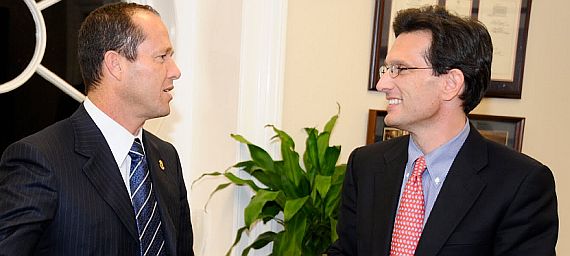
Jerusalem Mayor Nir Barkat meeting Rep. Eric Cantor, the presumptive Republican leader following the midterm elections. They are shown meeting in Washington DC last year.

Whatever the outcome of yesterday’s election had been, the Israel lobby had good reason to claim victory. Josh Rogin writes:

One prominent pro-Israel lobbying group in Washington is already praising the GOP takeover of the House of Representatives as a net benefit for Israel.

“While Democrats are likely to keep control of the U.S. Senate, Republicans will take over the U.S. House of Representatives following Tuesday’s elections. This is likely to have implications for Israel-related issues such as Israel’s relationship with the United States and the push for sanctions against Iran,” said an e-mail blasted out by The Israel Project only minutes after news stations called the turnover of House control a certainty.

“The takeover of the House by Republicans is great news for Israel and her supporters,” the email quotes Ari Fleischer, White House spokesman under President George W. Bush, as saying. “The House leadership and almost every single GOP member is rock-solid behind Israel. At times like this, Israel needs friends everywhere.”

But the Israel Project’s e-mail then quickly turns on its head and praises Congressional Democrats in the House and Senate for their staunch support of Israel.

“The House Democratic leadership has been powerfully supportive of Israel, and Speaker Pelosi has been nothing short of passionate in her successful pursuit of biting sanctions against Iran – a key interest of the pro-Israel community,” The Israel Project quotes David Harris, president and CEO of the National Jewish Democratic Council, as saying.

So which is it? Is The Israel Project saying that Republicans or Democrats are better for Israel?

“American voters on both sides of the aisle support Israel,” Jennifer Laszlo Mizrahi, founder and president of The Israel Project, says in the e-mail.

See also: 10 Republicans who are about to become the new foreign-policy power brokers.

Facebooktwittermail

How Wikileaks amplifies the Pentagon echo chamber

At Columbia Journalism Review, Ali Gharib writes:

A source provides details to the American government about the nefarious activities of a Middle Eastern country. That information ends up in scores of secret U.S. government documents. Subsequently, the information winds up on the front pages of major newspapers, and is heralded by war hawks in Washington as a casus belli.

Sound familiar? It should, but perhaps not in the way you’re thinking. Here’s a hint: It’s not 2003, but 2010. This is the story of what happened recently to Iran in the wake of the latest WikiLeaks document release, where U.S military field reports from Iraq made their way into major national newspapers and painted the Islamic Republic as a force out to murder U.S. soldiers in Iraq.

While the WikiLeaks document dump provided a useful way to glean historic details of the seven-year-old occupation, much of the prominent media coverage focused closely on the extent of Iranian support for anti-U.S. forces in Iraq and Iran’s alleged role.

“Leaked Reports Detail Iran’s Aid for Iraqi Militias,” blared the headline on a front page story in The New York Times, which went on to report on several incidents recounted in WikiLeaks documents that journalist Michael Gordon called “the shadow war between the United States and Iraqi militias backed by Iran’s Revolutionary Guards.”

“The field reports also provide a detailed account of what American military officials on the ground in Iraq saw as Iran’s shadowy role training and equipping Iraqi Shiite militias to fight the U.S.,” wrote Julian Barnes in The Wall Street Journal. “American intelligence believed the training was provided not only by the Islamic Revolutionary Guards Corps in Iran, but also by Hezbollah, their Lebanese ally.”

And the hawks went wild.

Facebooktwittermail

The phantom left

Chris Hedges writes:

The American left is a phantom. It is conjured up by the right wing to tag Barack Obama as a socialist and used by the liberal class to justify its complacency and lethargy. It diverts attention from corporate power. It perpetuates the myth of a democratic system that is influenced by the votes of citizens, political platforms and the work of legislators. It keeps the world neatly divided into a left and a right. The phantom left functions as a convenient scapegoat. The right wing blames it for moral degeneration and fiscal chaos. The liberal class uses it to call for “moderation.” And while we waste our time talking nonsense, the engines of corporate power—masked, ruthless and unexamined—happily devour the state.

The loss of a radical left in American politics has been catastrophic. The left once harbored militant anarchist and communist labor unions, an independent, alternative press, social movements and politicians not tethered to corporate benefactors. But its disappearance, the result of long witch hunts for communists, post-industrialization and the silencing of those who did not sign on for the utopian vision of globalization, means that there is no counterforce to halt our slide into corporate neofeudalism. This harsh reality, however, is not palatable. So the corporations that control mass communications conjure up the phantom of a left. They blame the phantom for our debacle. And they get us to speak in absurdities.

The phantom left took a central role on the mall this weekend in Washington. It had performed admirably for Glenn Beck, who used it in his own rally as a lightning rod to instill anger and fear. And the phantom left proved equally useful for the comics Jon Stewart and Stephen Colbert, who spoke to the crowd wearing red-white-and-blue costumes. The two comics evoked the phantom left, as the liberal class always does, in defense of moderation, which might better be described as apathy. If the right wing is crazy and if the left wing is crazy, the argument goes, then we moderates will be reasonable. We will be nice. Exxon and Goldman Sachs, along with predatory banks and the arms industry, may be ripping the guts out of the country, our rights—including habeas corpus—may have been revoked, but don’t get mad. Don’t be shrill. Don’t be like the crazies on the left.

“Why would you work with Marxists actively subverting our Constitution or racists and homophobes who see no one’s humanity but their own?” Stewart asked. “We hear every damn day about how fragile our country is—on the brink of catastrophe—torn by polarizing hate, and how it’s a shame that we can’t work together to get things done. But the truth is we do. We work together to get things done every damn day. The only place we don’t is here [in Washington] or on cable TV.”

The rally delivered a political message devoid of reality or content. The corruption of electoral politics by corporate funds and lobbyists, the naive belief that we can somehow vote ourselves back to democracy, was ignored for emotional catharsis. The right hates. The liberals laugh. And the country is taken hostage.

Facebooktwittermail

Israel’s vain quest for sovereignty

Why is it that a country that defines itself in terms of existential threats and the need to provide a safe refuge for the Jewish people, nevertheless seems strangely remiss in securing its own autonomy?

Even if Israel stands out as the preeminent military power in the Middle East, it has only been able to acquire this status through its dependence on the United States. It often masks that dependence by behaving like a brash teenager who is secretly terrified by the thought of leaving home.

Last week, Rabbi Ovadia Yosef, the former Sephardi Chief Rabbi of Israel and spiritual leader of the Shas party — part of Netanyahu’s ruling coalition — made his latest inflammatory statement. In August Yosef called for the annihilation of the Palestinian people. This time he showed his contempt for humanity — at least that rather large portion which happens not to be Jewish, the Goyim.

Goyim were born only to serve us. Without that, they have no place in the world; only to serve the People of Israel …Why are gentiles needed? They will work, they will plow, they will reap. We will sit like an effendi [lord] and eat…

Yosef’s comments and the lack of censure they received from Israeli politicians, drew swift criticism from the Anti-Defamation League (ADL) Director Abraham Foxman and David Harris, executive director of the American Jewish Committee. Foxman warned that this might have a detrimental effect on Israel’s relations with American Jewry.

While leaders of the American Jewish community acknowledged the damage Yosef’s words could cause, they did not attempt to analyse them.

The Israeli-born anti-Zionist activist and musician, Gilad Atzmon suffers no such reservations.

In just a few words Rabbi Yossef expresses the depth of Judaic contempt towards labour.

The senior Rabbi provides us with a devastating glimpse into the Judaic alienation from these aspects of the human condition and human experience. In an unequivocal manner, Rabbi Yosef depicts a clear dichotomy: Jews are the master race and the Goyim are nothing but a work force. The Goyim are there to sweat and struggle while the Jew is ‘sitting’ and ‘eating.’ I guess that Rabbi Yossef has managed, in just a few words, to portray the intrinsic relationships between Judaism and Capitalism.

But in fact, Rabbi Yossef didn’t invent anything new here — his Saturday sermon sounds familiar enough to me. Karl Marx in his paper “On The Jewish Question,” identified aspects of Jewish ideology at the heart of Capitalism: “It is mankind (both Christians and Jews) that needs to emancipate itself from Judaism.”

Marx managed to identify an inclination towards exploitation at the heart of Jewish culture.

However, being a humanist, Marx wanted to believe that mankind (Jews and others) could overcome this tendency. Many early Zionists too, were also convinced that in Zion, Jews would liberate themselves and eventually become a nation like other nations, through productivity and labour.

Seemingly though, Rabbi Ovadia Yosef is not that impressed with either Marx, or some of the ideals within the early Zionist dream: Rabbi Yossef is brave (or foolish) enough to sketch the inherent bond between Jewish culture and Capital.

The only question that is still open is, for how long can the rest of humanity tolerate that kind of Rabbinical arrogance?

Meanwhile, the publication of a “millionaire’s list” last week, revealed Netanyahu’s complete dependence on foreign money for his fundraising efforts. His office in an attempt to explain his donor preferences released a statement in which they made the implausible claim: “His approach is that funds should be raised abroad so as not to put anyone in a potential conflict of interests, and this is the reason he prefers donations from abroad.”

On Capitol Hill, U.S. Rep. Eric Cantor, the Republican whip and the only Jewish Republican in the House of Representatives, is concerned that a GOP-led Congress which aims to cut foreign aid could make Israel vulnerable, since it receives more aid than any other country. A possible solution would be that aid to Israel be part of the US defense budget, adding new meaning to the idea that Israel and US interests are indivisible.

Israel demands that it be recognized as a Jewish state by the Palestinians. “Affirmation of Israel’s Jewishness…, is the very foundation of peace, its DNA,” says Israel’s ambassador to the US, Michael Oren. Yet in the shadow of this fixation on Jewish identity, we see a singular lack of interest in autonomy expressed through a religious leader’s contempt for work, a prime minister’s appetite for foreign money, and a Congressman’s concern that the umbilical chord tying Israel to the US not suffer any interruption or constriction in the steady supply of US tax dollars required for supporting the Jewish state.

Where in this condition is any understanding of the real meaning of sovereignty? Might not Israel’s greatest existential threats be the ones of its own making?

Facebooktwittermail

Torture and terrorism

One of the strange aspects relating to conspiracy theories concerning 9/11 is that they unwittingly obscure something even worse: that the US government foments terrorism not by design but by neglect; that its policies have had a direct and instrumental role in creating terrorists not simply by providing individuals and groups with an ideological pretext for engaging in terrorism but much more specifically by creating the conditions an individual’s political opposition to America’s actions would shift to unrestrained violent opposition.

The key which often unlocks the terrorist’s capacity for violence is his experience of being subject to violence through torture.

Chris Zambelis writes:

There is ample evidence that a number of prominent militants — including al-Qaeda deputy commander Dr. Ayman al-Zawahiri and the late al-Qaeda in Iraq leader Abu Musab al-Zarqawi — endured systematic torture at the hands of the Egyptian and Jordanian authorities, respectively. Many observers believe that their turn toward extreme radicalism represented as much an attempt to exact revenge against their tormentors and, by extension, the United States, as it was about fulfilling an ideology. Those who knew Zawahiri and can relate to his experience believe that his behavior today is greatly influenced by his pursuit of personal redemption to compensate for divulging information about his associates after breaking down amid brutal torture sessions during his imprisonment in the early 1980s. For radical Islamists and their sympathizers, U.S. economic, military, and diplomatic support for regimes that engage in this kind of activity against their own citizens vindicates al-Qaeda’s claims of the existence of a U.S.-led plot to attack Muslims and undermine Islam. In al-Qaeda’s view, these circumstances require that Muslims organize and take up arms in self-defense against the United States and its allies in the region.

The latest revelations provided by Wikileaks show how the war in Iraq — the centerpiece of the Bush administration’s war on terrorism — became not simply a terrorist training ground, but a cauldron in which terrorists could be forged.

FRAGO 242: PROVIDED THE INITIAL REPORT CONFIRMS U.S. FORCES WERE NOT INVOLVED IN THE DETAINEE ABUSE, NO FURTHER INVESTIGATION WILL BE CONDUCTED UNLESS DIRECTED BY HHQ. JUNE 26, 2004

The Guardian reports:

A grim picture of the US and Britain’s legacy in Iraq has been revealed in a massive leak of American military documents that detail torture, summary executions and war crimes.

Almost 400,000 secret US army field reports have been passed to the Guardian and a number of other international media organisations via the whistleblowing website WikiLeaks.

The electronic archive is believed to emanate from the same dissident US army intelligence analyst who earlier this year is alleged to have leaked a smaller tranche of 90,000 logs chronicling bloody encounters and civilian killings in the Afghan war.

The new logs detail how:

• US authorities failed to investigate hundreds of reports of abuse, torture, rape and even murder by Iraqi police and soldiers whose conduct appears to be systematic and normally unpunished.

• A US helicopter gunship involved in a notorious Baghdad incident had previously killed Iraqi insurgents after they tried to surrender.

• More than 15,000 civilians died in previously unknown incidents. US and UK officials have insisted that no official record of civilian casualties exists but the logs record 66,081 non-combatant deaths out of a total of 109,000 fatalities.

The Pentagon might hide behind claims that it neither authorized nor condoned violence used by Iraqi authorities on Iraqi detainees, but the difference between being an innocent bystander and being complicit consists in whether one has the power to intervene. The US military’s hands were not tied. As the occupying power it had both the means, the legal authority and the legal responsibility to stop torture in Iraq. It’s failure to do so was a matter of choice.

Will the latest revelations from Wikileaks be of any political consequence? I seriously doubt it, given that we now have a president dedicated not only to refusing to look back but also to perpetuating most of the policies instituted by his predecessor.

For more information on the documents released by Wikileaks, see The Guardian‘s Iraq war logs page.

Facebooktwittermail

Would-be spies should approach Israeli consulates with caution

In June 2006, Elliot Doxer, an employee at an internet company in Boston, sent an email to a foreign consulate. “I am a Jewish American who lives in Boston,” he allegedly wrote. “I know you are always looking for information and I am offering the little I may have.” He also wrote that he wanted “to help our homeland and our war against our enemies.”

Let’s take a wild guess: he was referring to the Jewish homeland and communicating with the Israeli consulate. That’s the assumption made by the Jerusalem Post and just about everyone else — even though court documents only refer to “Country X.”

As the victim of an FBI sting operation, Doxer now faces the prospect of 20 years in jail and a $250,000 fine if convicted.

But here’s the interesting bit. In response to Doxer’s approach, the consulate informed US law enforcement officials and then assisted the FBI with its investigation.

So what’s a would-be spy to do?

Don’t trust your local Israeli consulate?

Don’t ask for compensation?

Make sure you have extremely valuable intelligence?

Acquire Israeli citizenship before you do anything else?

The next Jonathan Pollard might now be reconsidering his options.

Facebooktwittermail

Obama desperate to please Netanyahu

How much is a two-month extension in the West Bank settlement slowdown really worth?

The Obama administration is pursuing this paltry prize as if it was staving off another economic meltdown — even as hundreds of building projects have already been started.

The Los Angeles Times reported:

The U.S. has been wooing Netanyahu for weeks with offers including a squadron of F-35 fighters, support for a long-term Israeli troop presence in a new Palestinian state, and a pledge to veto any anti-Israel resolutions passed by the United Nations Security Council. The U.S. also is offering access to its satellites that could provide early warning of attacks.

To the Palestinians, the White House is pledging support for their position on the exact location of borders for a future state in exchange for a promise to continue negotiating even if Israel refuses to extend the construction moratorium.

Although the Obama administration was expected to eventually give out incentives to keep the negotiations alive, diplomats and other observers say they are surprised that it has offered so much, so early for such a small victory: a commitment by both sides to keep talking.

“From the left to the right, people are saying that the administration is looking desperate,” said Robert Danin, a former U.S. official and an advisor to former British Prime Minister Tony Blair, an envoy to the region for the United Nations, U.S., European Union and Russia.

On Thursday by Ehud Shani, director general of the Israeli Ministry of Defense, signed a contract for 20 F-35 fighter jets.

Making a hint that they will be used to bomb Iran, he described them as being “one of the answers” for dealing with the “problem” of Tehran.

Israel will get the jets at a discount, pay for them with US tax dollars (through recession-proof military aid), while also likely profiting from F-35 production — it has expressed an interest in manufacturing 25% of the wings of the more than 3,000 aircraft Lockheed expects to build.

The jets won’t be delivered until about 2016, but by that point Israel’s war-mongers no doubt feel optimistic that there will be a war-friendly Republican administration in place — though whether GOP control of the White House is necessary to serve Israel’s needs, is highly debatable.

Facebooktwittermail

The rock upon which our nation no longer rests

In a landmark case, the first trial of a former Guantánamo detainee, Judge Lewis A. Kaplan of United States District Court in Manhattan made a ruling that presents a major setback for the Department of Justice. He barred the key witness from testifying because he had been identified and located through torturing the accused, Ahmed Khalfan Ghailani, who was being held in a secret prison by the CIA.

Kaplan explained his decision in this way:

The Court has not reached this conclusion lightly. It is acutely aware of the perilous nature of the world in which we live. But the Constitution is the rock upon which our nation rests. We must follow it not only when it is convenient, but when fear and danger beckon in a different direction. To do less would diminish us and undermine the foundation upon which we stand.

At face value, this sounds like one of those rare feel-good moments in the post 9/11 era when someone who has sworn to uphold the Constitution took that responsibility very seriously.

“… the Constitution is the rock upon which our nation rests.” I imagine Judge Kaplan took satisfaction in crafting that sentence. It’s good.

But just in case anyone might be alarmed that the innocent-until-proven-guilty Ghailani might end up being acquited, the judge was eager to pacify such fears.

[H]is status as an “enemy combatant” probably would permit his detention as something akin to a prisoner of war until hostilities between the United States and Al Qaeda and the Taliban end even if he were found not guilty in this case.

So is Ghailani on trial to determine his innocence or guilt, or simply to decide on the location of his prison cell?

Isn’t that the direction in which fear and danger beckon?

Facebooktwittermail