Category Archives: Israel-Palestinian conflict

Netanyahu — disgraced, isolated and weaker

The headline for Aluf Benn’s article in Haaretz says it all: “Netanyahu leaves U.S. disgraced, isolated and weaker.”

Benn’s full account appears below but some of the comments elsewhere in the Israeli press reveal how deeply a racist outlook on the world is embedded within the Israeli perspective. As the Daily Telegraph reported:

Sending a clear message of his displeasure, Mr Obama treated his guest to a series of slights. Photographs of the meeting were forbidden and an Israeli request to issue a joint-statement once it was over were turned down.

“There is no humiliation exercise that the Americans did not try on the prime minister and his entourage,” Israel’s Maariv newspaper reported. “Bibi received in the White House the treatment reserved for the president of Equatorial Guinea.”

Why, the editors of Maariv might care to explain, would the president of Equatorial Guinea not be afforded respect during a visit to the White House?

The Telegraph says that upon his arrival to meet with President Obama, Netanyahu was presented with a set of 13 demands, key among those that Israel halt all new settlement construction in East Jerusalem:

When the Israeli prime minister stalled, Mr Obama rose from his seat declaring: “I’m going to the residential wing to have dinner with Michelle and the girls.”

As he left, Mr Netanyahu was told to consider the error of his ways. “I’m still around,” Mr Obama is quoted by Israel’s Yediot Ahronot newspaper as having said. “Let me know if there is anything new.”

When the two men met briefly an hour later, a short meeting failed to break the impasse.

Aluf Benn writes:

The visit – touted as a fence-mending effort, a bid to strengthen the tenuous ties between Netanyahu and U.S. President Barack Obama – only highlighted the deep rift between the American and Israeli administrations.

The prime minister leaves America disgraced, isolated, and altogether weaker than when he came.

Instead of setting the diplomatic agenda, Netanyahu surrendered control over it. Instead of leaving the Palestinian issue aside and focusing on Iran, as he would like, Netanyahu now finds himself fighting for the legitimacy of Israeli control over East Jerusalem.

The most sensitive and insoluble core issues – those which when raised a decade ago led to the dissolution of the peace process and explosion of the second intifada – are now being served as a mere appetizer.

At the start of his visit, Netanyahu was tempted to bask in the warm welcome he received at the AIPAC conference, at which he gave his emotional address on Jerusalem.

Taking a page from Menachem Begin, he spoke not on behalf of the State of Israel, but in the name of the Jewish people itself and its millennia of history.

His speech was not radical rightist rhetoric. Reading between the lines, one could spot a certain willingness to relinquish West Bank settlements as long as Israel maintains a security buffer in the Jordan Valley.

But at the White House, the prime minister’s speech to thousands of pro-Israel activists and hundreds of cheering congressmen looked like an obvious attempt to raise political capital against the American president.

Knowing Netanyahu would be reenergized by his speech at the lobby, Obama and his staff set him a honey trap. Over the weekend they sought to quell the row that flared up during U.S. Vice President Joe Biden’s trip here two weeks ago, and U.S. Secretary of State Hillary Clinton described Netanyahu’s response to the ultimatums Washington presented to him as “useful.”

Special envoy George Mitchell made a televised visit to the prime minister’s bureau Sunday to invite Netanyahu to the White House. Washington, it seemed, was trying to make nice.

Far from it. Just when Netanyahu thought he had resolved the crisis by apologizing to Biden, Clinton called him up for a dressing down.

This time as well, Netanyahu almost believed the crisis had passed, that he had survived by offering partial, noncommittal answers to the Americans’ questions. Shortly before meeting with Obama, Netanyahu even warned the Palestinians that should they continue to demand a freeze on construction, he would postpone peace talks by a year.

His arrogant tone underscored the fact that Netanyahu believed that on the strength of his AIPAC speech, he could call the next few steps of the diplomatic dance.

But then calamity struck. At their White House meeting, Obama made clear to his guest that the letter Netanyahu had sent was insufficient and returned it for further corrections. Instead of a reception as a guest of honor, Netanyahu was treated as a problem child, an army private ordered to do laps around the base for slipping up at roll call.

The revolution in the Americans’ behavior is clear to all. On Sunday morning Obama was still anxiously looking ahead to the House of Representatives vote on health care – the last thing he wanted was a last-minute disagreement with congressmen over ties with Israel.

The moment the bill was passed, however, a victorious Obama was free to deal with his unruly guest.

The Americans made every effort to downplay the visit. As during his last visit in November, Netanyahu was invited to the White House at a late hour, without media coverage or a press conference. If that were not enough, the White House spokesman challenged Netanyahu’s observation at AIPAC that “Jerusalem is not a settlement.”

The Americans didn’t even wait for him to leave Washington to make their disagreement known. It was not the behavior Washington shows an ally, but the kind it shows an annoyance.

The approval of construction at the Shepherd Hotel in Sheikh Jarrah, announced before his meeting with Obama, again caught Netanyahu unawares. Apparently the special panel appointed after the Ramat Shlomo debacle to prevent such surprises failed its first test.

Netanyahu is having his most difficult week since returning to office, beginning with the unfortunate decision to relocate the planned emergency room at Ashkelon’s Barzilai Medical Center and lasting through his humiliating jaunt through Washington.

Returning to Israel today, Netanyahu will need to work hard to rehabilitate his image, knowing full well that Obama will not relent, but instead demand that he stop zigzagging and decide, once and for all, whether he stands with America or with the settlers.

The satisfaction that Washington gains from putting Netanyahu in his place may be short-lived. As Seth Freedman notes in The Guardian: “External pressure on Israel from the likes of the United States and European Union serves only to provoke a siege-mentality response from Israelis and plays into the hands of the paranoiacs on the Israeli right.”


Facebooktwittermail

The two-state illusion

Mya Guarnieri writes:

A drive east of the Green Line suggests the two-state solution is moot. Jewish-only roads slice through the hills. The separation barrier winds through the West Bank, choking Palestinian villages. Settlements are lodged in the land’s throat.

Dr. Neve Gordon, author of the book Israel’s Occupation comments, “The one-state solution is already on the ground, in the sense that close to half a million Israeli Jews currently live in the area occupied by the [Israeli] army. They’re enmeshed within the Palestinian population.”

While the body of one state is here, the spirit isn’t. The current system, according to Dr. Gordon, is a democracy for Jews and an apartheid regime for Palestinians–different from that of South Africa, but functioning in a similar way.

“The question is whether there can be a separation,” Dr. Gordon says, pointing to the argument made by former Deputy Mayor of Jerusalem, Meron Benvenisti, who called the West Bank an egg that can’t be unscrambled.

And even if Israel could undo some of the mess, the proverbial finger Netanyahu recently gave the Americans suggests that the government has another agenda.

“I think what’s clear is that there is no intention on the part of the Israeli government to support a two-state solution,” Dr. Gordon says. “The borders, the airspace, all remain under Israeli control. What Netanyahu means when he says two states is not a state–it’s a municipality [for Palestinians] to collect their own garbage… What Netanyahu is supporting is a deepening of [settlements and the occupation] while talking about two states.”

To continue to advocate for a two-state solution, Dr. Gordon explains, is to support Netanyahu and his map for an unacknowledged, de facto single state that oppresses Palestinian residents.

Meanwhile, The Media Line reports:

Palestinian support for a two-state solution to the conflict with Israel is declining, a joint Palestinian-Israeli study has found.

The latest public opinion survey conducted by the Palestinian Center for Policy and Survey Research and the Harry S. Truman Research Institute for the Advancement of Peace at the Hebrew University of Jerusalem found that the while the majority of Palestinians and Israelis support a two-state solution to the conflict, Palestinian support for such a resolution has declined in recent months.

“The results show a decline in the Palestinians support for the two-state solution,” Waleed Ladadweh, a researcher with the Palestinian Center for Policy and Survey Research told The Media Line. “From 64 percent in December 2009 to 57 percent in this poll.”

Dr Nabil Kukali, Director of the Palestinian Center for Public Opinion, agreed that Palestinian public opinion is trending towards a bi-national state.

“On the whole Palestinians support the peace process, but there are some changes in attitudes towards the two-state solution,” he told The Media Line. “The Palestinians feel hopeless and they don’t think the Israelis will give the Palestinians one meter of their land.”

Facebooktwittermail

Israel escalates its repression, stoking the fires of division

Jesse Rosenfeld reports:

A week of Palestinian frustration with Israeli settler expansion in East Jerusalem and state provocations at Palestinian national and religious sites culminated last weekend with four young men from the Nablus region killed in suspicious circumstances. The grief and outrage at Sunday’s funeral in the village of Iraq Burin over the fatal shootings of 16-year-olds Muhammad and Useid Qadus was made more severe as news of two more deaths in the nearby village of Awarta spread through the procession.

The Qadus cousins were shot with live ammunition in the chest and head during a riot the previous day, instigated by soldiers sealing residents in their homes in an attempt to secure the main village road for use by settlers in the West Bank. Despite evidence of live rounds being fired, including X-rays showing an M16 round lodged in Useid’s brain, the army has claimed that they fired tear gas and rubber bullets.

“The two boys lived with the settlers attacking their land and family,” said Majida al Masri, a politician in Nablus and politburo member for the leftist, Democratic Front for the Liberation of Palestine, told me.

No sooner had the bodies been put in the ground than a line of funeral attendees headed back toward the Nablus hospital, this time to get information on the shooting of two farm boys by the army while they worked near the Itamar settlement.

Facebooktwittermail

What’s worse than an insult?

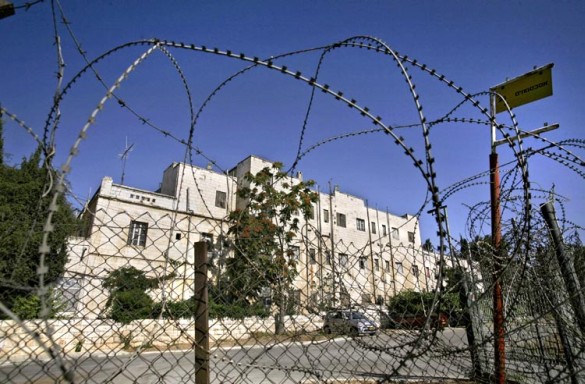
The Shepherd Hotel in the Sheikh Jarrah neighborhood of occupied East Jerusalem

[Updated below.] For Israel to announce new settlement construction in Israeli-occupied East Jerusalem right when Joe Biden was visiting, was, Hillary Clinton said, “insulting” to the United States.

Now Benjamin Netanyahu is visiting Washington and what happens right before he goes to the White House to meet President Obama? Another announcement from Jerusalem, but this time it’s even more inflammatory than the last one:

The Jerusalem municipality has given final approval to a group of settlers construct 20 apartments in a controversial hotel in east Jerusalem, Haaretz learned on Tuesday.

The announcement comes as Prime Minister Benjamin Netanyahu was in Washington smoothing over ties with the United States over the latest settlement-related tensions, and hours before the premier was to meet with President Barack Obama in Washington.

The Shepherd Hotel in the Sheikh Jarrah neighborhood was purchased by American Jewish tycoon Irving Moskowitz in 1985 for $1 million.

Moskowitz, an influential supporter of Ateret Cohanim and heightened Israeli settlement in East Jerusalem, plans to tear down the hotel and build housing units for Jewish Israelis in its place.

The local planning council initially approved the plan in July, a move which angered Britain and the United States and prompted them to call on Israel to cancel the plans. The council issued its final approval for the project last Thursday, which now enables the settlers to begin their construction at once.

An existing structure in the area will be town down to make room for the housing units, while the historic Shepherd Hotel will remain intact. A three-story parking structure and an access road will also be constructed on site.

Jake Tapper adds:

Moskowitz is a supporter of Ateret Cohanim (“Crown of the Priests”), a religious movement that seeks to populate East Jerusalem with Jewish settlers. As the Yeshiva puts it: “The Yeshiva is the spiritual epicenter of a community of almost 1000 residents in the heart of the Old City in the so-called ‘Moslem’ Quarter. This area was in fact, prior to the Arab riots, largely inhabited by Jews. It is on this historical basis that we refer to it now as the Renewed Jewish Quarter.”

No word yet on reaction from the White House.

Ynet reports:

Hatem Abdel Kader, holder of the Jerusalem portfolio in Fatah, told Ynet that the decision was tantamount to “Netanyahu slapping Obama in the face in his own house.”

Abdel Kader added that “Netanyahu feels that AIPAC is on his side, that he owns the US and that no action, no pressure by the Americans can prevent him from going ahead with the construction.”

The Fatah official added that the construction’s approval proved that the reports of Washington’s acquiescence in the face of Israel’s plans to build in east Jerusalem were true.

“The new plans for the Shepherd Hotel prove that the dispute between the Administration and Israel was not real and pertained to the way the plans were presented, rather than to the construction itself. What the Americans are actually saying to the Israelis is ‘keep building – but I don’t want to know about it,'” he said.

Update: After Netanyahu and Obama’s closed-door White House meeting, Politico says: “any impression that Netanyahu’s trip would mark a renewal of the troubled relationship between U.S. and Israeli leaders had faded by the time the men met.” The meeting was “shrouded in unusual secrecy” and marked a transition in the administration’s dealings with the Israeli prime minister that has shifted from the “red hot anger” of last week to “an icier suspicion” yesterday, reflected in the fact that no official statements followed the awkward encounter.

Still, the fact is, Obama didn’t turn Netanyahu away. The news that the Shepherd Hotel development had been approved prompted this: “This is exactly what we expect Prime Minister Netanyahu to get control of,” a senior U.S. official told POLTICO Tuesday evening. “The current drip-drip-drip of projects in East Jerusalem impedes progress.”

The transition from the Bush administration to the current administration has been in which the last secretary of state said the Israelis were being “unhelpful” whereas they are now described as “insulting” — either way, the status quo remains the same: Israel can do what it pleases whatever words of displeasure it might provoke.

Facebooktwittermail

The gulf in the Persian Gulf

From the Los Angeles Times (and don’t be put off by the author!):

For the Saudis, concern about Iran’s nuclear ambitions, which Riyadh sees as a longer-term threat, has taken a back seat to its concern about the lack of perceived progress in solving the Israel-Palestinian struggle.

Riyadh’s growing unease about the effect of this protracted conflict on the kingdom and on Iran’s hegemonic ambitions was conveyed to Adm. Michael G. Mullen, chairman of the Joint Chiefs of Staff, in meetings in the region last month with senior Saudi and other Arab officials, according to a senior U.S. military official.

Initially, the kingdom’s concern about the plight of the Palestinians was mostly lip service. While Saudi Arabia and other Arab oil states bankrolled the Palestine Liberation Organization and rhetorically endorsed the Palestinians’ right to a state of their own and a theoretical return to the lands of Palestine, Jerusalem in particular, the lack of a settlement and the perpetuation of the status quo following the 1973 Arab-Israeli war jeopardized neither vital Saudi nor Arab interests.

Today, however, concern about the rise of militant Palestinian Hamas, Palestinian political disarray and the growing political despair of Palestinians under Israeli occupation — if not those in the refugee camps of Jordan, Syria and Lebanon — seems widespread within the kingdom, for practical, self-serving reasons. The Saudi government has come to see the festering wound of Palestine as a primary source of the radicalization of its own population and, hence, of the extremism that threatens the kingdom’s stability and plays directly into Iranian hands.

Because Saudi Arabia is overwhelmingly young — more than 75% of Saudis are under 30 — most of the country’s citizens have no memory of a time when an Arab-Israeli peace seemed not only possible but likely. The 1991 Madrid peace conference, the 1993 Oslo accords, the Arab-Israeli handshakes on the White House lawn — all are now ancient history. Instead, Saudis, and young Saudis in particular, see Israelis not as potential partners in peace but as brutal occupiers.

The Arab media and the exponential growth of the Internet have reinforced among Saudis a sense of humiliation, injustice and outrage over Israel’s incursions into Lebanon and the Gaza Strip. Al Jazeera and the thousands of websites that Saudis avidly monitor have brought the once-distant suffering of Palestinians directly into their living rooms, giving their plight an immediacy and resonance it once lacked.

Everyone I talked to on a recent trip to Riyadh — from princes to merchants to bloggers — mentioned the Palestinian cause, rather than Iran, as their top foreign policy concern (an impression supported by recent opinion polls). Saudi royals and government officials know well that Al Qaeda and other “jihadi” groups exploited the Palestinian cause not only to help recruit the Saudi “muscle” for the 9/11 attacks — 15 of the 19 hijackers were Saudis — but also for subsequent attacks on the kingdom itself.

Facebooktwittermail

The status quo is unsustainable. Really?

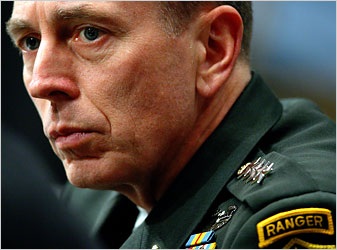
A week ago, Gen David Petraeus referred to “a perception of U.S. favoritism for Israel” that fuels anti-American sentiment across the Middle East.

He knows — as does anyone else who is even marginally aware of the issues — that this is not simply a matter of perception.

The United States does not merely exhibit favoritism towards Israel. Its political leaders express a level of loyalty towards the Jewish state that should be regarded as unseemly by any patriotic American.

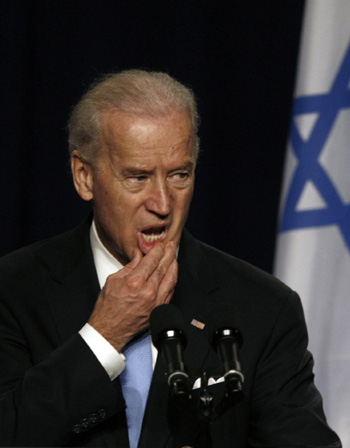
Last week, right on the heels of receiving what was widely regarded as a monumental insult, Joe Biden said: “Throughout my career, Israel has not only remained close to my heart but it has been the center of my work as a United States Senator and now as Vice President of the United States.”

On Friday, Hillary Clinton spoke of US relations with Israel as “deep and broad, strong and enduring,” and today at the AIPAC conference in Washington said that America’s future is “bound up with the future of Israel.”

This is the status quo that should be changed but shows every sign of being thoroughly sustainable. It is one in which American politicians shamelessly pander to Israel’s wealthy supporters and cast aside any semblance of dignity in their efforts to display their unfailing devotion to the Jewish state.

The obsequious nature of these flourishes of unvarnished affection is further reinforced by the fact that neither on a political level nor a popular level are such feelings reciprocated from the other side.

As Chris McGreal wrote yesterday:

In a country permeated by fear and insecurity, Israelis define the rest of the world not by loyalties but by varying degrees of distrust. You can hear it among residents of Jewish settlements deep in the occupied territories and in the cafes of liberal Tel Aviv: angst over the perception of a new wave of antisemitism gripping Europe, the incomprehension over foreign condemnation of Israel’s crimes in Gaza, the common agreement that the United Nations is a conspiracy against the Jewish state.

In all of this, the US emerges as the least distrusted country by far… . Israelis recognise that they have long counted on Washington to pay a good chunk of their military budget and provide diplomatic cover for the illegalities of occupation.

Israel depends on defense and political aid from Washington and Washington dances to the tune of the Israel lobby.

Those who now hold on to the notion that this administration is intent on shifting the political dynamic simply because it proclaims that the Israeli-Palestinian status quo is unsustainable are paying attention to the wrong status quo.

Facebooktwittermail

Which is worse for women? Hamas oppression or Israeli oppression?

Ever since Hamas assumed full political control of Gaza in June 2007, there have been occasional reports that the Islamist movement is finding ways to impose a more rigidly conservative and religiously intolerant way of life in the Palestinian enclave — changes that would impact secular, liberal-minded women more harshly than any other social group.

The BBC spoke to five Palestinian women ranging in age from 21 to 36 to find out how they have personally been affected by living under Hamas’ rule. The consensus was pretty clear: nothing Hamas has done has had a fraction of the effect that Israel has had through imposing a brutal economic siege on the population of 1.5 million.

Mona Ahmad al-Shawa, 36, who runs the women’s unit at the Palestinian Centre for Human Rights, said:

The siege of Gaza, which Israeli tightened when Hamas took control in June 2007, makes women’s lives much more complicated.
There are shortages of water, electricity and cooking gas. It is very difficult to leave Gaza for medical treatment.

And after the war in Gaza last year, things got worse because many women lost their husbands. Women lost lives too, of course.

You can’t imagine how hard it is to be a disabled woman in this society. Or a widow.
Our Sharia law means that a widowed woman will lose custody of her children when a boy reaches nine years old and a girl 11.

Since the war, Hamas has ruled that a widow can keep her children if she doesn’t remarry. This is an improvement.

Women’s priorities in Gaza are focused on practical matters – a home, clean water and electricity. Finer points of human rights are not top of the list.

We have many problems with the Hamas authority, but we are not in a big fight with them about women.

People in Gaza feel they are in a big prison, they feel have no choices in life.
Conditions change according to the political situation.

When the first intifada started in 1987 most women covered up, because people could speak badly of you, or throw stones if you went uncovered in the streets. It is not as bad as that now.

Facebooktwittermail

Hamas says rocket attacks are helping Israel

Once a strongman, always a strongman…

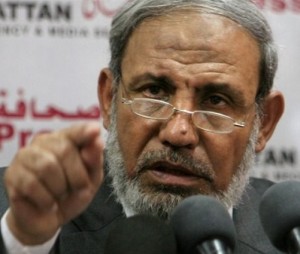
I don’t remember Ariel Sharon — or any other Israeli leader — being referred to as a “strongman”. I guess it’s a term reserved for men on the other side. Still, it’s funny (yet predictable) that a Hamas leader such as Dr. Mahmoud al-Zahar will be referred to as a strongman even when what he is reported as saying is that rocket attacks on Israel do not serve Palestinian interests. It’s not exactly a strongmanish, belligerent observation to make. Be that as it may, this is how his comments are reported by Ynet:

Hamas strongman Dr. Mahmoud al-Zahar on Saturday night slammed the Palestinian groups firing rockets at Israel. Zahar told the Iranian al-Alam television station that the rocket fire was a “suspicious action aimed at allowing the enemy to gain points in its favor in the public opinion and divert the attention from its crimes in the territories.”
According to Zahar, “The enemy wants to portray itself as defending itself against the rocket fire while being criticized by the Quartet. We are aware of the fact that there are elements wishing to help the enemy divert the attention from what is happening in Jerusalem.

“We are closely following those firing the rockets and are aware of the real motives behind the fire,” Zahar said, implying that the groups’ main goal was to undermine Hamas’ rule in the Gaza Strip.

He also slammed the Palestinian Authority for not allowing protests for Jerusalem, and noted that the International Quartet’s decision in Moscow was not serious. “It was more of a media event, and the most important thing is maintaining a popular movement for Jerusalem.”

Earlier, Al Jazeera reported:

A previously unknown Gaza group, Ansar al-Sunna, as well as the al-Aqsa Martrys Brigades, a wing of the mainstream Fatah movement, both claimed responsibility for the rocket attack from Gaza that preceded the air raids.

“The jihadist mission came in response to the Zionist assaults against the Ibrahimi and al-Aqsa mosques and the continued Zionist aggression against our people in Jerusalem,” Ansar al-Sunna said in a statement.

Matan Vilnai, the Israeli deputy defence minister, said that regardless of any claims of responsibility, Israel blamed the rocket strike on Hamas, the de facto ruler of the Gaza Strip.

Facebooktwittermail

The most racist “democracy” in the world

As the process of ethnic cleansing continues in Jerusalem — Benjamin Netanyahu confirmed today that there will be no interruption — those outside Israel who are calling most loudly for the swift implementation of a two-state solution, frequently do so on the basis that this is what is urgently needed in order to ensure the survival of Israel as a “Jewish democracy.”

Stephen Walt writes:

In her scheduled address to the conference, Secretary of State Hillary Rodham Clinton should reaffirm the U.S. commitment to Israel’s existence but make it crystal clear that Washington will no longer tolerate Israel’s self-defeating policy on settlements. She should explain unambiguously that Israel faces a choice: It can end the occupation, embrace a genuine two-state solution, preserve its democratic and Jewish character and remain a cherished U.S. ally. Or it can continue the occupation of the West Bank and the siege of Gaza — a course that will eventually force it to abandon either its Jewish character or its democratic principles, and jeopardize its standing with its most important partner.

Member of the Knesset, Zevulun Orlev, has another proposal: any Israeli who denies that Israel is a democracy should be thrown in jail. He has said that those who “talk about a country belonging to all its citizens belong in prison.”

Today Ynet reports:

The current Knesset is the most racist Knesset since the establishment of the State, according to the Mossawa Center’s annual report on racism published Sunday. The report, published in honor of International Day for the Elimination of Racial Discrimination being marked Sunday, reveals a 75% increase in discriminatory and racist bills submitted to the Knesset in the past year.

According to the report, 11 bills deemed “discriminatory and racist” were placed on the legislature’s table in 2007, while 12 such bills were initiated in 2008. However, in 2009 a full 21 problematic bills were discussed in the Knesset.

The Mossawa Center asserted that this is a worrisome trend and estimate that such bills will only increase if the Ministerial Committee for Legislative Affairs does not take immediate action against the phenomenon.

“A Knesset so active in discriminatory and racist bills against Arab citizens of the State has never been witnessed,” said the report’s authors, Lizi Sagi and Attorney Nidal Ottman.

Another report also published today, further underlines the intrinsically anti-democratic character of the Jewish state.

While a government decision was made that by 2012, non-Jews — who make up 25% of Israel’s population — should fill at least 10% of government positions, the facts on the ground in the Negev demonstrate the gulf between Israel’s democratic pretensions and the undemocratic reality. From a population of 200,000 Bedouin, 16 hold government positions!

As for Israel’s “democratic” future, the signs are clear. Nearly half of Jewish high schoolers recently polled said that they oppose Israel’s Arab citizens being allowed to vote. Among religious Jewish students — representative of what has become the most politically influential minority in Israel — 82% oppose equal rights for Arabs and Jews.

Facebooktwittermail

The American backbone deficit

Gideon Levy writes:

Israel has no real intention of quitting the territories or allowing the Palestinian people to exercise their rights. Israel does not truly intend to pursue peace, because life here seems to be good even without it. The continuation of the occupation doesn’t just endanger Israel’s future, it also poses the greatest risk to world peace, serving as a pretext for Israel’s most dangerous enemies.

No change will come to pass in the complacent, belligerent and condescending Israel of today. That’s why this difficult, thankless task has fallen on the shoulders of an ally, as only it has the power to get things started. No agreement will come out of another endless series of futile diplomatic trips or peace plans to which no one intends to adhere. We have tried this enough in the past, and all for naught. This is the time to come up with a rehabilitation program for Israel. The entire world, and ultimately Israel too, will applaud Barack Obama if he succeeds.

Expressing offense at “poor timing” and giving Israel’s prime minister the cold shoulder are not enough. This is the time for action, comprehensive and unwavering. America must now decide where it is heading and where it aims to lead Israel, the Middle East and the world. At issue is not just the future of 1,600 homes in Ramat Shlomo, but that of Israel itself. What is required is not merely extending the settlement construction freeze – whether or not it includes the occupied areas of Jerusalem – but applying pressure on Israel to begin withdrawing to its own borders. The means at Washington’s disposal – including assistance on security and economic issues, the campaign against Iran’s nuclear program and diplomatic support of Israel – can all be conditioned on an end to the occupation.

America must now decide whether it’s for us or against us. Will it make do with easing the sting of the insult to the vice president? Will it continue to give in to its powerful Jewish lobby? Will it keep passing itself off as a friend while acting as a foe? Or are we really playing by different rules now? Yes, it’s likely to hurt Israel, and even many Americans, but this is the opportunity. There will be no other.

I’m not holding my breath.

A few days ago, when Hillary Clinton read the riot act to Benjamin Netanyahu, the word was that she was reading from an Obama-approved script. The image was of an angry president being tough while maintaining his facade of cool.

Almost a week later there are signs that the latest manifestation of Obama toughness was yet another mirage. Obama’s characteristically bland assessment that there is no crisis in US-Israeli relations but merely “a disagreement in terms of how we can move this peace process forward,” will yet again confirm Benjamin Netanyahu’s understanding that he is dealing with a spineless president.

Can Clinton and Mitchell make up for the backbone deficit? If the latter ends up in Israel in a few days without Netanyahu having made any significant concessions and if the former shows up at the AIPAC conference next week and doesn’t manage to make a few of the participants piss in their pants, then we’ll know the answer is no.

Facebooktwittermail

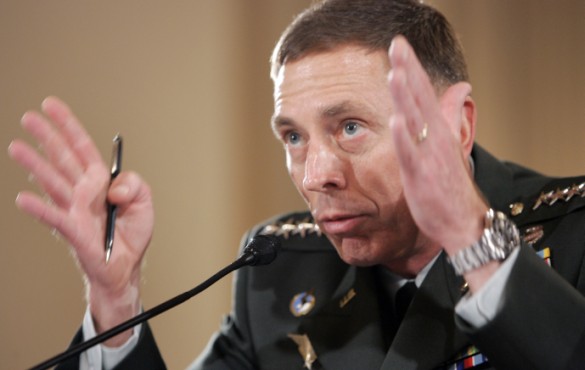
Israel is empowering al Qaeda, Petraeus warns

As erupting violence in Jerusalem suggests a third intifada may soon take hold, the CENTCOM commander Gen David Petraeus, testifying before the US Senate Armed Services Committee today, gave a grave warning about the wider impact of a conflict that has been the epicenter of Middle East hostilities ever since the creation of Israel.

In issuing his warning, Petraeus — arguably the most influential even if not the highest ranking member of the US military — was reiterating a statement he made almost a year ago. The only difference between what he said in April 2009 and what he said today, was that he now acknowledges al Qaeda is being strengthened by the conflict.

He now says:

The enduring hostilities between Israel and some of its neighbors present distinct challenges to our ability to advance our interests in the AOR [CENTCOM’s area of responsibility]. Israeli-Palestinian tensions often flare into violence and large-scale armed confrontations. The conflict foments anti-American sentiment, due to a perception of U.S. favoritism for Israel. Arab anger over the Palestinian question limits the strength and depth of U.S. partnerships with governments and peoples in the AOR and weakens the legitimacy of moderate regimes in the Arab world. Meanwhile, al-Qaeda and other militant groups exploit that anger to mobilize support. The conflict also gives Iran influence in the Arab world through its clients, Lebanese Hizballah and Hamas.

If such a statement was being made outside the American political arena, it could be regarded as a rather bland expression of what has long been utterly obvious. Yet from the lips of a celebrated general, regarded by many as a potential future president, these words come as a bombshell.

Neoconservatives and the Israel lobby have worked hard and long to obscure the deeply corrosive regional impact of a conflict that successive Israeli leaders have either been unwilling or seemingly incapable of resolving. Others, who earlier said what Petraeus now says, have either been dismissed as poorly informed or worse, branded as anti-Israeli or by insinuation, anti-Semitic.

No such charge will stick to Petraeus. Indeed, if the Israel lobby was so foolhardy as to try and go after an American general who sometimes gets treated like a latterday Eisenhower, the lobby will be at dire risk of being visited by its own greatest fear: being branded as anti-American.

Facebooktwittermail

Netanyahu remains defiant

As Bill Clinton famously said about Benjamin Netanyahu in 1998, “Who the fuck does he think he is? Who’s the fucking superpower here?”

Twelve years later there is no sign that Bibi’s hubris has been tempered. In the midst of what Israel’s ambassador to the United States, Michael Oren, has told the country’s diplomats is the worst crisis in U.S.-Israeli relations in 35 years, what does Israel’s prime minister do? He declares that “building in Jerusalem – and in all other places – will continue in the same way as has been customary over the last 42 years.” In other words, Netanyahu reaffirms that Israel will continue on the same course that precipitated the crisis.

Meanwhile, Israel’s foreign minister today followed what appears to have now become standard diplomatic protocol in the aspiring pariah state by snubbing a visiting head of state, Brazil’s president Luiz Inacio Lula da Silva, because the latter declined to pay homage to Zionism.

I imagine that in fairly short order Israel’s leaders will no longer have the task of figuring out new ways of insulting their guests; they simply won’t have any guests to insult.

Even so, Netanyahu has persuaded his loyal American supporters that he has eaten enough humble pie. For that reason it seems hard to imagine that he will go very far in meeting a set of demands that Haaretz says were put on his plate when he got lectured by Hillary Clinton on Friday.

These were the demands:

1. Investigate the process that led to the announcement of the Ramat Shlomo construction plans in the middle of Biden’s visit. The Americans seek an official response from Israel on whether this was a bureaucratic mistake or a deliberate act carried out for political reasons. Already on Saturday night, Netanyahu announced the convening of a committee to look into the issue.

2. Reverse the decision by the Jerusalem District Planning and Building Committee to approve construction of 1,600 new housing units in Ramat Shlomo.

3. Make a substantial gesture toward the Palestinians enabling the renewal of peace talks. The Americans suggested that hundreds of Palestinian prisoners be released, that the Israel Defense Forces withdraw from additional areas of the West Bank and transfer them to Palestinian control, that the siege of the Gaza Strip be eased and further roadblocks in the West Bank be removed.

4. Issue an official declaration that the talks with the Palestinians, even indirect talks, will deal with all the conflict’s core issues – borders, refugees, Jerusalem, security arrangements, water and settlements.

The report continued:

Two advisers of the prime minister, Yitzhak Molcho and Ron Dermer, held marathon talks Sunday with senior White House officials in Washington and U.S. Mideast envoy George Mitchell and his staff to try to calm the situation. Mitchell will return to Israel Tuesday and expects to hear if Netanyahu intends to take the proposed steps.

At the beginning of Sunday’s cabinet meeting, Netanyahu tried to convey a message that there was no crisis in relations with the United States. But he sent precisely the opposite message to Oren in Washington.

In Oren’s Saturday conference call with the Israeli consuls general, he said that the current crisis was the most serious with the Americans since a confrontation between Henry Kissinger and Yitzhak Rabin in 1975 over an American demand for a partial withdrawal from the Sinai Peninsula.

At Sunday’s cabinet meeting, Netanyahu said the matter had been blown out of proportion by the media. He added: “There was an unfortunate incident here that was innocently committed and was hurtful, and certainly should not have occurred.”

He said steps would be taken to prevent such cases in the future. “It is extremely important to understand that the State of Israel and the United States have common interests,” he said, adding that those interests “also require us to take decisions to change the situation in the country.”

Four consuls discussed the conference call with Haaretz. Some noted that in previous conference calls with Oren, the ambassador took pains to make clear that relations with the United States were excellent. This time, however, Oren sounded extremely tense and pessimistic. Oren was quoted as saying that “the crisis was very serious and we are facing a very difficult period in relations [between the two countries].”

Oren told the consuls to lobby congressmen, Jewish community leaders and the media to convey Israel’s position. He said the message to be relayed was that Israel had no intention to cause offense to Vice President Biden and that the matter had stemmed from actions by junior bureaucrats in the Interior Ministry and was caused by a lack of coordination between government offices. “It should be stressed that [our] relations with the United States are very important to us,” Oren reportedly said.

Several of the consuls suggested waiting, but Oren hinted that his approach reflected Netanyahu’s wishes. “These instructions come from the highest level in Jerusalem,” he was quoted as saying, adding that the utmost must be done to calm matters.

If only Washington could be more understanding and recognize that Israel has a dysfunctional bureaucracy. The Jewish state should be seen as a Middle Eastern version of Pakistan, then all these misunderstandings could be resolved. That at least is the counsel offered by Israel’s pre-eminent American booster, the Anti-Defamation League’s, Abe Foxman.

Facebooktwittermail

Israel is putting American lives at risk

In Foreign Policy, Mark Perry describes an extraordinary Pentagon briefing on Israel’s impact on conflicts across the Middle East. Here is an excerpt and following some comments of my own, the author has provided me with additional background on his reporting.
[Important update: A senior military officer told Foreign Policy by email that one rather minor detail in Perry’s report was incorrect. A request from Gen Petraeus for the Palestinian occupied territories to be brought within CENTCOM’s region of operations was sent to the Chairman of the Joint Chiefs of Staff, Admiral Mullen, and not directly to the White House (who may or may not have subsequently been consulted). It is significant that the Pentagon made this correction, not because it was an important detail but on the contrary, because it was inconsequential to the overall narrative. In effect, the Pentagon clearly but discreetly said that there was virtually nothing in this report that could be denied.]

On January 16, two days after a killer earthquake hit Haiti, a team of senior military officers from the U.S. Central Command (responsible for overseeing American security interests in the Middle East), arrived at the Pentagon to brief JCS Chairman Michael Mullen on the Israeli-Palestinian conflict. The team had been dispatched by CENTCOM commander David Petraeus to underline his growing worries at the lack of progress in resolving the issue. The 33-slide 45-minute PowerPoint briefing stunned Mullen. The briefers reported that there was a growing perception among Arab leaders that the U.S. was incapable of standing up to Israel, that CENTCOM’s mostly Arab constituency was losing faith in American promises, that Israeli intransigence on the Israeli-Palestinian conflict was jeopardizing U.S. standing in the region, and that Mitchell himself was (as a senior Pentagon officer later bluntly described it) “too old, too slow…and too late.”
The January Mullen briefing was unprecedented. No previous CENTCOM commander had ever expressed himself on what is essentially a political issue; which is why the briefers were careful to tell Mullen that their conclusions followed from a December 2009 tour of the region where, on Petraeus’s instructions, they spoke to senior Arab leaders. “Everywhere they went, the message was pretty humbling,” a Pentagon officer familiar with the briefing says. “America was not only viewed as weak, but its military posture in the region was eroding.” But Petraeus wasn’t finished: two days after the Mullen briefing, Petraeus sent a paper to the White House requesting that the West Bank and Gaza (which, with Israel, is a part of the European Command – or EUCOM), be made a part of his area of operations. Petraeus’s reason was straightforward: with U.S. troops deployed in Iraq and Afghanistan, the U.S. military had to be perceived by Arab leaders as engaged in the region’s most troublesome conflict.

The Mullen briefing and Petraeus’s request hit the White House like a bombshell. While Petraeus’s request that CENTCOM be expanded to include the Palestinians was denied (“it was dead on arrival,” a Pentagon officer confirms), the Obama Administration decided it would redouble its efforts – pressing Israel once again on the settlements issue, sending Mitchell on a visit to a number of Arab capitals and dispatching Mullen for a carefully arranged meeting with Chief of the Israeli General Staff, Lt. General Gabi Ashkenazi. While the American press speculated that Mullen’s trip focused on Iran, the JCS Chairman actually carried a blunt, and tough, message on the Israeli-Palestinian conflict: that Israel had to see its conflict with the Palestinians “in a larger, regional, context” – as having a direct impact on America’s status in the region. Certainly, it was thought, Israel would get the message. [Read the rest of the report here.]

In December 2006, the Iraq Study Group Report was explicit in making this linkage: “The United States cannot achieve its goals in the Middle East unless it deals directly with the Arab-Israeli conflict and regional instability.”

What Mark Perry’s report indicates is that for the Obama administration a tipping point has been crossed in its perception of Israel’s effect on the conflicts that span the region.

Until now, the necessity for a resolution of the Arab-Israeli conflict has been framed in quasi-positive terms — such as that it would help defuse some of the hostility that the US now faces, or, that it would strengthen an alliance of nations attempting to curtail Iran’s nuclear program.

The shift, as expressed by Joe Biden last week and by the Petraeus briefing in January is that Israel is now being seen as a liability: the Jewish state is putting American lives at risk. “This is starting to get dangerous for us,” Biden reportedly told Netanyahu.

Such a shift marks a watershed in US-Israeli relations and so Perry’s report naturally raises questions. Indeed, the first line of defense from Israel and its supporters will be to claim that, on the contrary, recent events are nothing more than a bump in the road; that we can expect a quick resumption of business as usual between such close allies.

For this reason, I asked Mark — who I have had the privilege of working with in recent years — to provide some background to his report. This is what he said:

My piece on the briefing of Admiral Mullen by CENTCOM senior officers has occasioned a great deal of comment, as well as some skepticism: how accurate is the account? Was it told to me by direct participants in the briefing? Is there any basis for imagining that Petraeus has any kind of hidden agenda, whether that is a desire to expand CENTCOM – or even hostility towards Israel.

I won’t name my sources, even though it’s clear to people in the Pentagon – and certainly to General Petraeus – who they are. Was I told of the briefing by the briefers themselves? I will only say that there were four people in the briefing – the two briefers, Admiral Mullen, and Admiral Mullen’s primary adviser on the Israeli-Palestinian conflict. I know two of the people involved in the briefing. Whether or not they are my sources is something for the reader to determine. The account is not only accurate, it’s a precis of what actually happened. There is a lot more to it. The White House, State Department and Pentagon have not denied the account, and for good reason: it’s true.

Is there any basis for imagining that Petraeus has any kind of hidden agenda in ordering the briefing?

I have been reporting on the American military for thirty years. My work on the Joint Chiefs of Staff, Four Stars, is the authoritative account on the subject. I have deeply rooted contacts in the military that go back thirty years. I have never met a senior military officer whom I do not admire. There is no greater insult than to believe that General Petraeus or any other senior American military officer would use the lives of American soldiers as a lever to enhance their own political future. My sense is that General Petraeus neither likes nor dislikes Israel: but he loves his country and he wants to protect our soldiers. The current crisis in American relations with Israel is not a litmus test of General Petraeus’s loyalty to Israel, but of his, and our, concern for those Americans in uniform in the Middle East.

It is, perhaps, a sign of the depth of “the Biden crisis” that every controversy of this type seems to get translated into whether or not America and its leaders are committed to Israel’s security. This isn’t about Israel’s security, it’s about our security.

Facebooktwittermail

Obama gets kind of tough with Netanyahu

The Los Angeles Times says: “a dispute this week between the Obama administration and Israel has ballooned into the biggest U.S.-Israeli clash in 20 years.”

Tom Friedman says: “what the Israelis did played right into a question a lot of people are asking about the Obama team: how tough are these guys? The last thing the president needs, at a time when he is facing down Iran and China — not to mention Congress — is to look like America’s most dependent ally can push him around.”

But then Washington hit back — bam!

This is how Aluf Benn describes Obama’s get-tough approach:

Washington delivered its rebuke to Netanyahu through a number of channels. There was the extended censure by telephone from Secretary of State Hillary Clinton, a phone call from Biden, the summoning of Israel’s ambassador to Washington to the office of Deputy Secretary of State James Steinberg, the condemnation from the Quartet and, perhaps most important, a media briefing Clinton delivered during a CNN interview which escalated private rebukes into a full-blown public reprimand.

The reproofs were reminiscent of the “low chair diplomacy” the Turkish ambassador to Jerusalem was subjected to by the Israeli Foreign Ministry at the beginning of the year. The media was informed that the conversation between Clinton and Netanyahu lasted 43 minutes, “rather than 10 minutes as usual,” and that the prime minister barely uttered a word.

Obama himself reportedly worded the message to be delivered to Netanyahu during his weekly Thursday meeting with Clinton, lest the argument be made that it was merely the secretary of state scolding the Israeli leader, and not the U.S. president himself.

A State Department spokesman described the conversation using phrases which bring to mind a teacher castigating a student, not a working discussion with the leader of a friendly country and ally.

The substance was no less damning than the form – Clinton spoke of an “insult” to the United States and of “harming bilateral ties.” She could not understand, she said, how such a thing could have been done in light of America’s strong obligation to Israel’s security. U.S. media interpreted these remarks as suggesting that Washington’s military support for Israel is hardly unconditional.

Clinton dismissed Netanyahu’s explanation that the decision to approve the housing plan was made without his knowledge, reminding him that as prime minister he is responsible for his government’s actions.

The statements from the United States were publicized Friday evening – Shabbat – while Israel was officially unable to respond, therefore affording the White House a media exclusive. The instinctive reaction from Netanyahu and his associates was to accuse Washington of a diplomatic ambush, to simply rely on the support of his backers in the United States. Indeed, Abraham Foxman, national director of the Anti-Defamation League, was the first to charge the White House with “humiliating” the Israeli prime minister.

This week presents Netanyahu with a difficult decision. He may choose to visit Washington as planned to speak at the AIPAC conference, which would embarrass the preeminent pro-Israel lobby and put it on a collision course with the Obama administration. Senior U.S. officials will likely decline meetings with him, unless he agrees to at least some of Washington’s conditions. Canceling his flight, however, will be interpreted as acknowledgment of the crisis in U.S.-Israel ties.

High drama! But will it be of any lasting consequence? I really doubt it.

To put this in perspective we should not forget that the initiative the Obama administration is in a desperate effort to salvage — so-called proximity talks — is one that virtually no one had any confidence would accomplish anything in the first place. A successful resolution to the current dispute means getting this initiative back on a track that leads nowhere.

The Jerusalem District Planning and Building committee has canceled two meetings planned for this week. Big deal. It can reschedule them in a few weeks once America and the media are suitably distracted by current events. Indeed, the closer mid-term elections come, the greater this administration’s interests will be in restoring cordial relations with Israel.

Daniel Levy, a former adviser to then-Israeli prime minister Ehud Barak, says the administration is trying to “lay down a marker with [Netanyahu] that they will not allow him to make them look weak,” and no doubt that is true, but this is a marker on a movable line.

Nothing Netanyahu does or refrains from doing will reverse the perception of weakness that was Obama’s own doing when he caved on the issue of imposing a settlement freeze. To insist that this Israeli prime minister avoid doing anything to embarrass the US president merely underlines the extent to which this president is already highly susceptible to appearing weak.

As for whether the Israeli government has any interest in making meaningful gestures of reconciliation with the Palestinians, Ma’an reports on the latest indication: an order from Israeli authorities for the demolition of a mosque in Nablus, right in the heart of the West Bank.

Facebooktwittermail

Why did Joe Biden insult America’s friends?

In an interview on CNN, Hillary Clinton was refreshingly blunt in saying that Israel insulted the US:

But now that’s been clearly stated, why did Joe Biden have to cap the first insult by adding another when he said: “the United States has no better friend in the community of nations than Israel”?

That’s not true — and most Americans know it. Canada, Britain, Germany and Japan are all viewed more favorably by Americans than is Israel.

Is it because Israel is the most ill-mannered among America’s friends that it has to be flattered with this “best friend” status? Is it because Israel remains perpetually on the verge of throwing a tantrum that its wet nurse feels compelled to constantly sing sweet words to this troublesome infant?

At least there are a few Israelis who can see through this farce.

Akiva Eldar writes:

The apology offered by Prime Minister Benjamin Netanyahu and Interior Minister Eli Yishai recalls the joke about the servant who pinched the king’s bottom. En route to the gallows, the servant apologized: He thought it was the queen’s bottom.

The statement issued by Netanyahu’s bureau said that in light of the ongoing dispute between Israel and the United States over construction in East Jerusalem, the plans for new housing in the Ramat Shlomo neighborhood should not have been approved this particular week. It also said the premier had ordered Yishai to draft procedures that would prevent a recurrence. In other words, Yishai is welcome to submit more plans for Jewish construction in East Jerusalem next week, when U.S. Vice President Joe Biden will no longer be here.

Based on Biden’s reaction, it seems that he (and, presumably, his boss) has decided that it is better to leave with a few sour grapes than to quarrel with the vineyard guard. In his speech at Tel Aviv University, he said he appreciated Netanyahu’s pledge that there would be no recurrence. But what exactly does that mean? That next time he comes, the Planning and Building Committee will be asked to defer discussion of similar plans until the honored guest has left? With the media storm dying down, Netanyahu can breathe a sigh of relief.

In a sense, the uproar actually helped him: To wipe the spit off his face, Biden had to say it was only rain. Therefore, he lauded Netanyahu’s assertion that actual construction in Ramat Shlomo would begin only in another several years.

Thus Israel essentially received an American green light for approving even more building plans in East Jerusalem.

Biden might not know it, but the Palestinians certainly remember that this is exactly how East Jerusalem’s Har Homa neighborhood began: Then, too, Netanyahu persuaded the White House that construction would begin only in another several years.

When Biden arrived, the Arab League had just recommended that Palestinian Authority President Mahmoud Abbas accede to Washington’s proposal for indirect talks with Israel.

But instead of being able to leave with an announcement that the talks have officially begun, Biden is leaving with the news that the Arab League has suspended its recommendation.

Netanyahu can thus hope that the Ramat Shlomo imbroglio has deferred the moment of truth when he must reveal his interpretation of “two states for two peoples.” And just in case anyone failed to realize how impartial a mediator the U.S. is, Biden said in his Tel Aviv speech that the U.S. has “no better friend” than Israel.

For Netanyahu, the cherry on top was that the onus for advancing the negotiations has now been put on the Arab states – just two weeks before the Arab League summit in Tripoli, where the league’s 2002 peace initiative will again be up for discussion. For months, U.S. President Barack Obama has been trying to persuade Arab leaders not to disconnect this important initiative from life support. His argument is that nothing would make Iranian President Mahmoud Ahmadinejad happier than a final blow-up of the peace process and the outbreak of a third intifada. And his joy would be redoubled if the fire started in Jerusalem.

But while the U.S. may be papering over the rift for now, Western diplomats said the bill will come due once the talks with the PA begin (assuming they do). The U.S. has already said it will submit bridging proposals of its own during these talks, and its anger and frustration over the Ramat Shlomo incident are likely to make it far more sympathetic to the Palestinians’ positions, the diplomats said.

For instance, Netanyahu wants security issues to top the talks’ agenda, an Israeli source said. But the Palestinians want the first issue to be borders, including in Jerusalem.

And the European Union, which had planned to upgrade various agreements with Israel this week in honor of the resumed talks, has now postponed the upgrade until it becomes clear whether the talks will in fact take place.

Facebooktwittermail

Time for George Mitchell and the US to step aside

Among commentators unable to see beyond the bankrupt perspective that the United States has the indispensable role of mediating a Middle East peace agreement (if such an agreement is ever to be reached), much is being made about Joe Biden’s tough words “behind closed doors”. Laura Rozen quotes from a Yedioth Ahronoth report:

People who heard what Biden said were stunned. “This is starting to get dangerous for us,” Biden castigated his interlocutors. “What you’re doing here undermines the security of our troops who are fighting in Iraq, Afghanistan and Pakistan. That endangers us and it endangers regional peace.”

The vice president told his Israeli hosts that since many people in the Muslim world perceived a connection between Israel’s actions and US policy, any decision about construction that undermines Palestinian rights in East Jerusalem could have an impact on the personal safety of American troops fighting against Islamic terrorism.

Help us fight the war on terrorism, Biden admonishes his Israeli friends. But we are, they think but in this instance are too polite to say. That’s why we’re taking over East Jerusalem. We’re fortifying the front-line.

It seems to me that the crux of the issue is not the latest upset; it is that the so-called peace process has always rested on an unbalanced foundation. Which is to say, Israel will only accept the direct involvement of third parties that have a clear bias in their favor.

If President Obama wanted to do something truly radical, it might not have to take the form of applying pressure — pressure that would be fiercely and effectively resisted by the Israel lobby. On the contrary, it could be to acknowledge that American efforts have failed — not only his own but those of all his predecessors — and that there comes a point when failure has been so persistent and become so predictable, that it is time to step aside.

There is someone else waiting in the wings, eager to step in — a man who regards dialogue as the essence of politics and who can make a stronger claim to be even-handed than anyone in the United States or Europe: Brazil’s President Lula da Silva. He also happens to be the most popular political leader in the world.

Ahead of his visit to the Middle East next week, where his first stop will be in Israel, Lula was interviewed by Haaretz:

Lula was one of the first leaders to host President Mahmoud Ahmadinejad after Iran’s blood-stained election of June 2009. Brazil was also one of only five countries to abstain from an International Atomic Energy Agency vote last November on a condemnation of Iran.

He is set to visit the Islamic Republic in May, where his hosts will repay him in kind for the red carpet he laid out for them in Brasilia last November. When asked how he’ll be able to win over the Israelis, whose vantage point is related to the trauma of the Holocaust, Lula replies: “I spoke with the president of Iran and made it clear to him that he cannot go on saying that he wants Israel’s liquidation, just as it is untenable for him to deny the Holocaust, which is a legacy of all humanity. I added that the fact that he has differences with Israel does not allow him to deny or ignore history.”

In a way that will undoubtedly disturb those who will host him in Israel next week, Lula draws a direct association between the failure to advance Israeli-Palestinian peace and his planned visit to Tehran; between the need to ensure that Iran will not manufacture nuclear weapons and the need to resolve the Middle East conflict; and between the failed attempts at mediation led by international players, first and foremost the United States, and the need to bring in fresh new players – Brazilians, in all likelihood.

“I talked about Iran with many leaders, and particularly with those whose countries have a seat on the Security Council,” he explains. “The Americans, the French, the British, the Russians and the Chinese all want to advance the Middle East peace process. But I also feel that the parties to the conflict and the people involved in the process have long since grown tired of it. So, the time has come to bring into the arena players who will be able to put forward new ideas. Those players must have access to all levels of the conflict: in Israel, in Palestine, in Iran, in Syria, in Jordan and in many other countries that are associated with this conflict. This is the only way we will be able to advance Israeli-Palestinian peace, and at the same time be able to say clearly to Iran that we are against the manufacture of nuclear weapons.”

Lula does not overlook any of the elements in this comprehensive linkage when asked about the fact that Israeli patience regarding Iran seems to have worn thin. “The leaders I spoke to believe that we must act quickly, otherwise Israel will attack Iran. I do not want Israel to attack Iran, just as I do not want Iran to attack Israel. In an orderly world, people have to learn to talk to one another.” Here he seems to be alluding critically to the “proximity talks” about to get underway between Israel and the Palestinian Authority.

“The appropriate partners from each country have to be found, and more serious talks conducted,” he continues. “The importance of talks between third- and fourth-rank officials [does not hold] even 1 percent of the importance of tete-a-tete talks between leaders. Politics is mainly contact. People have to look at each other, sense each other. A leader has to look into the eyes of his interlocutor instead of communicating with him through lower-level individuals.”

The Brazilian president says he is disappointed that all that remains of the Oslo Accords is “Nobel Prizes and photographs of people hugging each other,” as well as the fact that the Annapolis conference of November 2007, in which Brazil participated, did not have any follow-up. “This gives me serious doubts: Who really wants peace in the Middle East? Who has an interest in achieving a solution and who would like the conflict to continue? The impression is that someone is constantly working here as though he has hidden enemies, people who simply do not want an agreement to be reached.”

Lula describes himself as a negotiator, not an ideologue, a person who manages to get along with both Hugo Chavez and George W. Bush, with Shimon Peres and Mahmoud Ahmadinejad. He says he has never read a book in his life, even though everyone admires his “supreme wisdom” and “creative mind.” As a chairman of the workers union during the years of military rule in Brazil, he encountered and resolved many difficult conflicts.

“I was born into the politics of dialogue, I became president of this country through dialogue and I have conducted my entire presidency by means of dialogue. I believe that through dialogue we will succeed in solving all the conflicts which today appear to be unsolvable,” he says.

He is well aware that he will be regarded as “naive” by his Israeli interlocutors. He is also familiar with the counter-rhetoric of Prime Minister Benjamin Netanyahu – who likens Ahmadinejad to Hitler, Iran to the Nazi regime and the world of 2010 to that of 1938. Lula’s assertive response is likely to surprise even those familiar with his arguments: “Anyone who compares Ahmadinejad and modern-day Iran to Hitler and the Nazis is having the same kind of radicalism of which Iran is being accused. Anyone who takes that line is not contributing in the least to the peace process which we want to create for the sake of the future. You cannot do politics with hate and resentment. Anyone who wants to do politics with hate and resentment should get out of politics. Nobody can rule a country through the liver. You have to rule a country with your head and your heart. Other than that, it’s best to stay somewhere else other than in politics

No doubt many veterans of the peace process would scoff at the notion that the Brazilian leader might succeed where those who have made this undertaking their professions have consistently failed. But if there is one place failure should succeed it is in the cultivation of humility.

As for the Israelis, there seems little prospect that they have the stomach for a genuinely even-handed approach and if they were to decline such an offer then that is undoubtedly their prerogative. They should be given these options: fair mediation or splendid isolation.

Claudio Lottenberg, the president of Sao Paulo’s Albert Einstein Hospital and a leader of Brazil’s Jewish community notes: “Lula is an important rising player in the international arena, and Israel should take account of this. It is important for Israel to have partners and allies besides the United States.”

But not only is Lula an important figure; Brazil itself clearly has much to teach a world which must become a multicultural success if it is to have any future at all.

Lula’s ambition to make a deep imprint in the Middle East goes beyond his country’s international status, to what he describes proudly as “a long Brazilian history of peace and a life of brotherhood in a region of diverse cultures. More than 120,000 Jews live here in full harmony with 10 million Arabs. It would seem that people can learn from us.” Brazil terms itself “the world’s largest Lebanese country” (some six million of Brazil’s Arabs are of Lebanese origin), “the second-largest African country in the world” (after Nigeria), and also the second-largest Italian and Japanese countries. It is a huge blend of peoples and cultures that do not know the meaning of friction.

You’d be hard-pressed to find someone in Rio de Janeiro who hasn’t heard of Saara Street, where Jews and Arabs sell clothing, toys and other items side by side. Whenever tension in the Middle East rises, local television crews show up to film the Brazilian version of coexistence. “All Brazilians are brothers,” they say – hence their ability, in their view, to bring brotherhood to all other nations.

Facebooktwittermail

Cornel West points out Obama’s hypocrisy on Israelis and Palestinians

Watch the clip above as Cornel West responds to this question:

The Obama administration talks about a new era of engagement. You spoke earlier about a “friendlier face of empire”. What does that mean? Is that just marketing? Or is there actually a change in US foreign policy these days?

Watch the whole 23-minute interview — if you live outside the U.S. in a location where Al Jazeera does not block access to its own videos.

Facebooktwittermail

The peace-process masquerade falls apart

It turns out that at least when it comes to the Israeli-Palestinian conflict the difference between the Bush administration and the Obama administration is this: team Bush had better choreography.

The Guardian now reports:

The US vice-president, Joe Biden, today attempted to salvage the Middle East peace talks after the Palestinians announced they were pulling out of a new round of indirect negotiations before they had begun.

The Palestinian move was in protest against Israel’s decision to build hundreds of new homes in a Jewish settlement in East Jerusalem.

The withdrawal from negotiations, announced in Cairo by Amr Moussa, the head of the Arab League, represents a major setback to months of diplomacy by the US administration prior to Biden’s visit to the region.

The US vice-president said an agreement would be “profoundly” in Israel’s interests and appealed to the Israeli government to make a serious attempt to reach peace with the Palestinians

Even so, Biden went on to say that in Israel the US has “no better friend”.

Does the vice president, does this administration, have no dignity?

Is it so craven that in the moment of its humiliation it feels driven to ingratiate itself even further?

What Goliaths are these that never fail in turning America’s leaders into gibbering fools?

Gideon Levy offers credit where credit is due:

Here’s someone new to blame for everything: Eli Yishai. After all, Benjamin Netanyahu wanted it so much, Ehud Barak pressed so hard, Shimon Peres wielded so much influence – and along came the interior minister and ruined everything.

There we were, on the brink of another historic upheaval (almost). Proximity talks with the Palestinians were in the air, peace was knocking on the door, the occupation was nearing its end – and then a Shas rogue, who knows nothing about timing and diplomacy, came and shuffled all the proximity and peace cards.

The scoundrel appeared in the midst of the smile- and hug-fest with the vice president of the United States and disrupted the celebration. Joe Biden’s white-toothed smiles froze abruptly, the great friendship was about to disintegrate, and even the dinner with the prime minister and his wife was almost canceled, along with the entire “peace process.” And all because of Yishai.

Well, the interior minister does deserve our modest thanks. The move was perfect. The timing, which everyone is complaining about, was brilliant. It was exactly the time to call a spade a spade. As always, we need Yishai (and occasionally Avigdor Lieberman) to expose our true face, without the mask and lies, and play the enfant terrible who shouts that the emperor has no clothes.

For the emperor indeed has no clothes. Thank you, Yishai, for exposing it. Thank you for ripping the disguise off the revelers in the great ongoing peace-process masquerade in which nobody means anything or believes in anything.

Facebooktwittermail