Category Archives: United States

Too much freedom in America

There’s too much freedom, a few constitutional amendments need tossing out and the government needs greater powers — this would seem to sum up the views of the majority of Americans… if the latest polling is reliable.

The American public is highly critical of the recent release of confidential U.S. diplomatic cables on the WikiLeaks Web site and would support the arrest of WikiLeaks founder Julian Assange by U.S. authorities, a new Washington Post-ABC News poll finds.

Most of those polled – 68 percent – say the WikiLeaks’ exposure of government documents about the State Department and U.S. diplomacy harms the public interest. Nearly as many – 59 percent – say the U.S. government should arrest Assange and charge him with a crime for releasing the diplomatic cables.

Assange was scheduled to appear in a London courtroom Tuesday to formally contest an extradition order on sexual assault charges in Sweden. U.S. federal authorities are reportedly investigating whether Assange could be charged with violating the Espionage Act by releasing the documents, but his potential extradition to Sweden could significantly complicate any U.S. attempt to quickly try him.

A generational gap was evident among those polled, with younger Americans raised in the Internet age expressing distinct views on the matter. Nearly a third of those ages 18 to 29 say the release of the U.S. diplomatic cables serves the public interest, double the proportion of those older than 50 saying so. When it comes to Assange, these younger adults are evenly split: Forty-five percent say he should be arrested by the United States; 46 percent say it is not a criminal matter. By contrast, those age 30 and older say he should be arrested by a whopping 37-point margin.

As always, the polling information is frustrating as much because of what it doesn’t show as by what it reveals. The answers to these follow-up questions might have helped clarify who was dumber — the pollsters or those being polled:
1. If you believe the release of the cables damaged the public interest, can you list the top five most damaging revelations?
2. If you believe the release of the cables damaged the public interest, can you explain whether you see any distinction between the interests of the American people and the interests of the US government?
3. If you would like to see Julian Assange arrested, can you explain what crime you think he committed?
4. If you think he committed a crime, do you believe that the same charges should be brought against the editors of the New York Times and other newspapers that published the cables?
5. The First Amendment protects freedom of speech and freedom of the press. Can you explain your understanding of these freedoms and do you believe that the US Constitution can be set aside whenever the government says that national security is at stake?

Facebooktwittermail

John F Kennedy’s opposition to secrecy

The President and the Press: Address before the American Newspaper Publishers Association
President John F. Kennedy, Waldorf-Astoria Hotel, New York City, April 27, 1961

Ladies and gentlemen, the very word secrecy is repugnant, in a free and open society, and we are as a people, inherently and historically, opposed to secret societies, to secret oaths and secret proceedings.

We decided long ago that the dangers of excessive and unwarranted concealment of pertinent facts far outweigh the dangers which are cited to justify it.

Even today there is little value in opposing the threat of a closed society by imitating it’s arbitrary restrictions.

Even today there is little value in ensuring the survival of our nation, if our traditions do not survive with it.

And there is very grave danger that an announced need for increased security will be seized upon by those anxious who wish to expand it’s meaning to the very limits of official censorship and concealment.

That I do not intend to permit, to the extent that it is in my control.

And no official of my administration whether his rank is high or low, civilian or military, should interpret my words here tonight, as an excuse to censor the news, to stifle dissent, to cover up our mistakes, or to withhold from the press and the public the facts they deserve to know.

For we are opposed, around the world, by a monolithic and ruthless conspiracy, that relies primarily on covet means for expanding it’s fear of influence, on infiltration instead of invasion, on subversion instead of elections, on intimidation, instead of free choice, on guerrillas by night, instead of armies by day.

It is a system which has conscripted, vast human and material resources into the building of a tightly knit, highly efficient machine that combines military, diplomatic, intelligence, economic, scientific, and political operations.

Its preparations are concealed, not published. It’s mistakes are buried, not headlined. Its dissenters are silenced, not praised. No expenditure is questioned. No rumor is printed. No secret is revealed.

No president should fear public scrutiny of his program. For from that scrutiny comes understanding. And from that understanding comes support or opposition, and both are necessary.

I am not asking your newspaper to support an administration. But I am asking your help in the tremendous task of informing and alerting the American people. For I have complete confidence in the response and the dedication of our citizens whenever they are fully informed.

I not only could not stifle controversy from your readers — I welcome it. This administration intends to be candid about its errors. For as a wise man once said, “an error doesn’t become a mistake until you refuse to correct it”.

We intend to accept full responsibility for our errors and we expect you to point them out when we miss them. Without debate, without criticism, no administration and no country can succeed. And no republic can survive.

That is why the Athenian lawmaker Solon decreed it a crime for any citizen to shrink from controversy. And that is why our press was protected by the first amendment, the only business in America specifically protected by the constitution, not primarily to amuse or entertain, not to emphasize the trivial and sentimental, not to simply give the public what it wants, but to inform, to arouse, and to reflect, to state our dangers and our opportunities, to indicate our crises and our choices, to lead, mould, and educate and sometimes even anger public opinion.

This means greater coverage and analysis of international news, for it is no longer far away and foreign, but close at hand and local. It means greater attention to improved attention to greater understanding of the news, as well as improved transmission, and it means finally, that government at all levels, must meet its obligation, to provide you with it’s possible information, outside the narrowest limits of national security.

And so it is to the printing press, to the recorder of man’s deeds, the keeper of his conscience, the courier of his news, that we look for strength, and his assistance, confident that with your help, Man will be what he was born to be: free and independent.

Facebooktwittermail

America the material

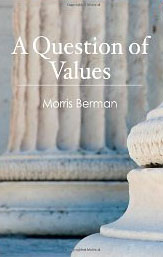
At truthdig, Nomi Prins reviews A Question of Values, by Morris Berman:

A Question of Values is an alternately sobering and inspiring collection of essays by noted historian and cultural critic Morris Berman. Berman pulls no punches in laying bare the truths about who we are, not just as a nation, but also as individuals wrapped up in the destructive pursuit of material excess. In the unswerving style of his other writings, he rips apart the national illusion of greatness.

The book is divided into four sections: “Lament for America,” “Mind and Body,” “Progress True and False” and “Quo Vadis?” (Where are you going?). Each part examines the American identity from a historical, spiritual, technological and alternative future perspective, respectively. Taken together, they ask the imperative questions: How did we get to this point, and how do we get out? Or will we? (Here being a country caught in a societal malaise of promoting external accumulation over internal compassion.) Taken together, the sections inspect our inner and outer fabric as a nation.

In Section I, the second essay, “Conspiracy vs. Conspiracy in American History,” Berman dissects America’s profound sense of self-importance, a central theme of the entire collection. He discusses how the “post-election euphoria in the United States over Barack Obama was nothing more than a bubble, an illusion, because the lion’s share of the $750 million he collected in campaign contributions” came from Wall Street. Thus, the fact that Obama proceeded to promise to rein in Wall Street’s excesses lay in stark and rather public contrast to his own connections with the banks.

This political sleight of hand is part of a larger problem for which Berman lists four descriptive conspiracies (or fallacies): First, that we are a chosen people (so we get to do whatever we want); second, that America itself is a kind of religion; third, that we must endlessly expand, whether it be geographically or financially; and, lastly, that our national character is composed of extreme individuals going back to our colonization. This he considers to be the main reason why “American history can be seen as the story of a nation consistently choosing individual solutions over collective ones.”

Facebooktwittermail

The origin of America’s intellectual vacuum

Chris Hedges writes:

The blacklisted mathematics instructor Chandler Davis, after serving six months in the Danbury federal penitentiary for refusing to cooperate with the House Un-American Activities Committee (HUAC), warned the universities that ousted him and thousands of other professors that the purges would decimate the country’s intellectual life.

“You must welcome dissent; you must welcome serious, systematic, proselytizing dissent—not only the playful, the fitful, or the eclectic; you must value it enough, not merely to refrain from expelling it yourselves, but to refuse to have it torn from you by outsiders,” he wrote in his 1959 essay “…From an Exile.” “You must welcome dissent not in a whisper when alone, but publicly so potential dissenters can hear you. What potential dissenters see now is that you accept an academic world from which we are excluded for our thoughts. This is a manifest signpost over all your arches, telling them: Think at your peril. You must not let it stand. You must (defying outside power; gritting your teeth as we grit ours) take us back.”

But they did not take Davis back. Davis, whom I met a few days ago in Toronto, could not find a job after his prison sentence and left for Canada. He has spent his career teaching mathematics at the University of Toronto. He was one of the lucky ones. Most of the professors ousted from universities never taught again. Radical and left-wing ideas were effectively stamped out. The purges, most carried out internally and away from public view, announced to everyone inside the universities that dissent was not protected. The confrontation of ideas was killed.

“Political discourse has been impoverished since then,” Davis said. “In the 1930s it was understood by anyone who thought about it that sales taxes were regressive. They collected more proportionately from the poor than from the rich. Regressive taxation was bad for the economy. If only the rich had money, that decreased economic activity. The poor had to spend what they had and the rich could sit on it. Justice demands that we take more from the rich so as to reduce inequality. This philosophy was not refuted in the 1950s and it was not the target of the purge of the 1950s. But this idea, along with most ideas concerning economic justice and people’s control over the economy, was cleansed from the debate. Certain ideas have since become unthinkable, which is in the interest of corporations such as Goldman Sachs. The power to exclude certain ideas serves the power of corporations. It is unfortunate that there is no political party in the United States to run against Goldman Sachs. I am in favor of elections, but there is no way I can vote against Goldman Sachs.”

The silencing of radicals such as Davis, who had been a member of the Communist Party, although he had left it by the time he was investigated by HUAC, has left academics and intellectuals without the language, vocabulary of class war and analysis to critique the ideology of globalism, the savagery of unfettered capitalism and the ascendancy of the corporate state. And while the turmoil of the 1960s saw discontent sweep through student bodies with some occasional support from faculty, the focus was largely limited to issues of identity politics—feminism, anti-racism—and the anti-war movements. The broader calls for socialism, the detailed Marxist critique of capitalism, the open rejection of the sanctity of markets, remained muted or unheard. Davis argues that not only did socialism and communism become outlaw terms, but once these were tagged as heresies, the right wing tried to make liberal, secular and pluralist outlaw terms as well. The result is an impoverishment of ideas and analysis at a moment when we desperately need radical voices to make sense of the corporate destruction of the global economy and the ecosystem. The “centrist” liberals manage to retain a voice in mainstream society because they pay homage to the marvels of corporate capitalism even as it disembowels the nation and the planet.

Facebooktwittermail

From the top there’s only one way forward: down

Mature cosmological systems recognize the cyclical nature of change: that growth is followed by decay and that power gathered is later dispersed. These are not ideas readily embraced by an imperial power and thus America has driven itself into a trap which it cannot back out of without undermining its own image of preeminence.

The trap that a great power falls into as soon as it makes the mistake of using blunt force against an asymmetrical threat is that its opponent has the exclusive ability to make tactical retreats with its pride in tact.

For a decade now, America has been fighting adversaries who operate unwaveringly according to the Maoist principles of guerrilla warfare: “The enemy advances, we retreat; the enemy camps, we harass; the enemy tires, we attack; the enemy retreats, we pursue.”

The war on terrorism, whose sole purpose was to put on display the preeminence of American power, has instead in every possible way demonstrated the limits of American power and yet even now the prospect of defeat cannot be entertained.

The Obama administration, desperate to find a way out of Afghanistan, refuses to admit that it is developing an exit strategy. The plan to end combat missions by 2014 is not an exit strategy; it is a “transition strategy” US envoy Richard Holbrooke claims.

And as if to guard against the risk that Obama might end a second term (if he gets one) with the United States no longer at war, he seems intent on starting a war of his very own — a war whose beginning echoes America’s entry into Vietnam.

The Wall Street Journal reports:

The U.S. is preparing for an expanded campaign against al Qaeda in Yemen, mobilizing military and intelligence resources to enable Yemeni and American strikes and drawing up a longer-term proposal to establish Yemeni bases in remote areas where militants operate.

The developments are part of a U.S. scramble to step up the hunt for members of al Qaeda in the Arabian Peninsula, the terrorist organization behind a recent failed attempt to blow up two planes over the U.S. using bombs hidden in cargo.

Limited U.S. intelligence experience in Yemen has created “a window of vulnerability” that the U.S. government is “working fast to address,” a senior Obama administration official said.

For now, the U.S. gets much of its on-the-ground intelligence from a growing partnership with Saudi Arabia, which shares a border with Yemen and has a fruitful informant network in Yemen’s tribal areas.

In the rush to build up capabilities, the Central Intelligence Agency and other agencies are moving in equipment and personnel from other areas, and over the past year have expanded the size of teams in the U.S. analyzing intelligence on AQAP. The emphasis now is on expanding the number of intelligence operatives and analysts in the field.

There is a debate within the Obama administration and Pentagon about how best to ramp up the fight against AQAP, the Yemen-based terrorist group. Supporters of establishing forward operating bases for Yemeni forces say they would help the weak Yemeni government expand its control and create an opportunity to get a small number of American Special Operations trainers and advisers out of the capital region and into the field.

Facebooktwittermail

Dark lord, dark victory — America’s dark passage

At Kosmos Journal, Michael Vlahos writes:

The fall of the Soviet Union initiated a new passage of American identity. Then the 9/11 War took us a long way down the road to journey’s end. This passage is also a migration. America has not simply abandoned one collective identity for another; we have become a different people, a different idea.

Our sacrosanct national narrative of ‘redeemer nation’ has been rewritten into a perverse story of a chosen people beleaguered and a civilization beset by barbarism. Those wretched of the earth we once so proudly pledged our sacred honor to succor and lift up are now our forever-foe — to be monitored, held down and, if necessary, hounded to the darkest ends of the earth.

But the darkness has instead come into us. While official banners still trumpet American altruism, our own spoken words, daily spun into the network ether of contemporary human consciousness, betray our true intent.

Our actions even speak so much louder. Daily our implacable national energies destroy yet more little bits of human society, no longer in the name of their salvation, but rather for our sake to defend the homeland. We are the Dark Lord now — the mythic essence of children’s nightmares. This is the story of our descent.

Part one: enemy of change (PDF)

Part two: dark lord, dark victory (PDF)

Facebooktwittermail

A nation of the richest is not the richest nation

Robert Freeman writes:

For the past thirty years the rich have been waging war on the middle class. It’s been astonishingly effective, partly because it has been undeclared. But even that pretense is now being abandoned. The President’s National Deficit Commission has effectively declared that the rich will now go after what is left of working and middle class wealth and will take whatever steps are necessary to seize it. If allowed to succeed, their plan will reduce Americans to a state of serfdom.

Ronald Reagan began the war on the middle class with his “supply-side” economics. Its very purpose, according to David Stockman, Reagan’s Budget Director, was to transfer wealth and income upwards. It cut the marginal tax rate on the highest income earners from 75% to 35% while dramatically expanding spending for war. The results were two-fold: massive federal debt and an astonishing rise in the share of income and wealth going to those who were already the wealthiest people in the world.

The national debt quadrupled between 1980 and 1992. George W. Bush would repeat Reagan’s policies and double it again between 2000 and 2008. Meanwhile, the share of national income going to the top 1% more than doubled, from 9% to 24%. The share going to the top one-tenth of 1% of income earners more than tripled. We now have the most unequal distribution of income in the developing world and the inequality is growing rapidly.

Shifts of this magnitude over such short periods of time have never been seen in American history. With the rich getting much, much richer, its means that everybody else is getting poorer. And in fact, real wages for median workers are lower today than they were in 1973. Indeed, while the inflation-adjusted income of the bottom fifth of workers fell by $6,900 between 1979 and 2007, the top 1% saw its annual income increase by $741,000!

Facebooktwittermail

Glenn Beck: inspired by Iran or Lyndon LaRouche?

George Soros is a Jewish tycoon and mastermind of ultra-modern colonialism. He is also a thug who is deployed as an economic hitman for the British empire.

The first claim comes from a video produced by Iran’s Ministry of Intelligence which has depicted Soros operating out of the Situation Room in the White House, while the second comes from Hector A Rivas Jr at LaRouchePAC, serving longtime presidential aspirant Lyndon LaRouche.

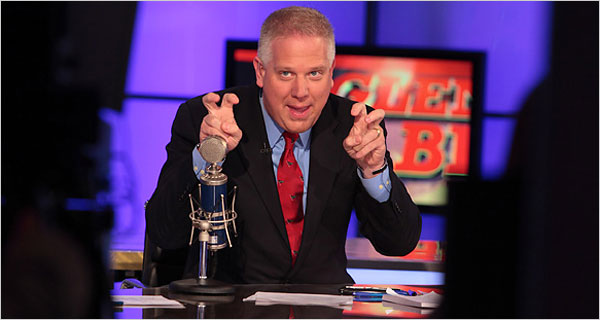
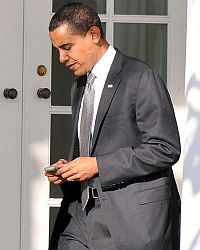
Now comes Glenn Beck, asking ominously about President Obama’s channels of communication: “Have you ever wondered who is at the other end of a BlackBerry?”

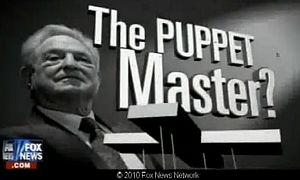
Who else but Obama’s puppet master, the omnipotent George Soros.

Soros the macro-managing controller of global events is also the micro-manager of Obama’s daily agenda. He really has taken multi-tasking to a supernatural level as he steers the global financial markets, runs his empire of 501(c)3s, and tells Obama what to do!

Even with his show’s title and images of Soros pulling puppet strings and with puppets dangling from the studio ceiling, Beck still didn’t seem completely confident with his puppet-master metaphor and so needed to make it more literal, the Blackberry supposedly providing the tangible evidence that on a minute-by-minute basis, George Soros has the power and ability to control all of Obama’s actions. But as Beck himself says in his comprehensive disclaimer: “if you take what I say as gospel, you’re an idiot.”

Thus we are presented with the distinctive blend of fear and farce from a man who clearly doesn’t take himself seriously yet who surely lives in a state of constant amazement that his own antics have made him so rich and influential.

In the last year, Glenn Beck’s estimated earnings were $33 million, putting him in second place after Rush Limbaugh ($58.7 million) in Newsweek‘s “Power 50” list which ranks the highest earning political figures in 2010. Bundle the Fox News triumvirate of Beck, Sean Hannity and Bill O’Reilly together and they rank #1 with combined earnings of $75 million. Following the same career trajectory as Beck, Lou Dobbs has just joined Fox, a year after his departure from CNN.

Are Beck and his cohorts now themselves the puppet masters of American politics? Emma Mustich shows how the five-point formula Beck ascribes to Soros just as accurately represents Beck and Fox News‘ methods for gathering and exerting enormous political power.

Meanwhile, Michelle Goldberg writes:

Soros, a billionaire financier and patron of liberal causes, has long been an object of hatred on the right. But Beck went beyond demonizing him; he cast him as the protagonist in an updated Protocols of the Elders of Zion. He described Soros as the most powerful man on earth, the creator of a “shadow government” that manipulates regimes and currencies for its own enrichment. Obama is his “puppet,” Beck says. Soros has even “infiltrated the churches.” He foments social unrest and economic distress so he can bring down governments, all for his own financial gain. “Four times before,” Beck warned. “We’ll be number five.”

It’s true, of course, that Soros has had a hand in bringing down governments—communist, authoritarian governments. Beck seems to be assuming a colossal level of ignorance on the part of his viewers when he informs them, “Along with currencies, Soros also collapses regimes. With his Open Society Fund… Soros has helped fund the Velvet Revolution in the Czech Republic, the Orange Revolution in the Ukraine, the Rose Revolution in Georgia. He also helped to engineer coups in Slovakia, Croatia, and Yugoslavia. So what is his target now? Us. America.”

Beck’s implication is that there was something sinister in Soros’ support for anti-communist civil society organizations in the former Soviet Union. Further, he sees such support as evidence that Soros will engineer a communist coup here in the United States. This kind of thinking only makes sense within the conspiratorial mind-set of classic anti-Semitism, in which Jews threaten all governments equally. And as a wealthy Jew with a distinct Eastern European accent, Soros is a perfect target for such theories.

And in an indication that for the American Jewish community, Beck has indeed crossed a line with his slanderous attack, suggesting that the 14-year-old Soros was a Nazi collaborator, Abraham Foxman, director of the Anti-Defamation League, called Beck’s comments “horrific” and “totally off limits and over the top.” Whether Beck’s antipathy for Soros makes him an anti-Semite, is nevertheless questionable.

For Beck, fear is a commodity in which he has deeply invested in futures — an investment whose value he works on inflating every day. But the fear he trades in is not something he invented. It has long resided in the heart of that predominantly white America which is a nation of islanders, challenged by the inconvenient truth that America is not an island.

Facebooktwittermail

America’s power has already been eclipsed in Asia

As many a conservative American commentator remains obsessed with the question as to how the United States can retain its position as the world’s preeminent power, Pankaj Mishra indicates why that question is already moot: it is a position America has already lost.

He points out:

India has many more likely and rewarding partners in booming Asia than in the recession-hit west. Politically damaged Thailand as well as Hong Kong, Singapore, South Korea and Taiwan have recovered from the downturn. Last year India signed a major free-trade deal with Asean. Not surprisingly a columnist in the Star, Malaysia’s leading newspaper in English, deemed the Indian prime minister’s visit to Kuala Lumpur last week more important than the jaunt of Hillary Clinton, the US secretary of state, to the region at the same time.

A tangle of bilateral trade agreements underpins Asia’s new economic unity. China and Asean countries already constitute the biggest free-trade zone in the world. Asian fears of China’s rise, which the United States keenly monitors, look minor beside the fact that China is now the largest export market for Japan, South Korea and Taiwan, in addition to being India’s biggest trading partner.

All this sounds a planet away from those Tea-Partying Americans who think that the US can bomb its way out of any political and economic difficulties abroad. It now falls to Obama to advance their education; and he’ll most likely fail in this thankless task.

Facebooktwittermail

Bibi, Tom Friedman, and U.S. Jews divesting from Israel

Bradley Burston writes:

Ahead of a New Orleans address to the General Assembly [GA] of the Jewish Federations of North America, sources quoted Prime Minister Benjamin Netanyahu as having said that there is fundamental support for Israel within the United States.

“We may have lost Thomas Friedman, but I don’t think we lost America,” Netanyahu was quoted as saying.

I was getting ready to leave for the airport, when my wife caught me unawares. This was the first inkling I would have of something I was to learn again and again:

Where it comes to any issue of the Mideast conflict, and where it comes to questions relating to the complex relations between the U.S. Jewish community and Israel, you can either answer in three hours, or in one sentence. This was hers:

“You know what it is – American Jews are divesting from Israel.”

This is what I was to see in Los Angeles, San Francisco, Marin County, Portland and Seattle. It’s not that they’re getting involved in significant numbers in the divestment movement. It’s that American Jews are divesting emotionally. They are quietly – but in terms of impact, dramatically – withdrawing altogether.

Not just Jews. Americans. And the younger they are, that is, the more crucial they are to Israel’s future, the more likely they are to divest.

Facebooktwittermail

America’s ever-expanding knowledge deficit

At Salon, Justin Elliot reports:

An August Pew poll found that a growing number of Americans — 18 percent — falsely believe that President Obama is a Muslim. Why does that figure keep rising? It’s a difficult question, but it may partly be explained by the remarkable success of videos like this one, which has racked up over 2.5 million views in just three months on YouTube. It’s titled, “”BREAKING NEWS! – Is Barack Obama Really A Saudi / Muslim ‘Plant’ in the White House?”

The thrust of the video, put up by YouTube user ppsimmons, is this: The wife of an American-born Israeli author, Avi Lipkin, monitors the Egyptian media. She saw a broadcast in which the Egyptian foreign minister said that Obama personally told the him that Obama is a Muslim — and that the president is hiding that fact (and also that he is going to betray Israel).

All of this is narrated not by Lipkin, but by an unidentified man (possibly the YouTube user). Lipkin, who sometimes using the alias “Victor Mordecai,” is a former IDF spokesman and current right-wing speaker and writer on Islamic terrorism. He told Salon in an email that the YouTube video is an accurate portrayal of his beliefs.

“My wife, Rachel, has been listening to the Arabic language media from her office in Kol Israel Radio in Jerusalem, and this is just the tip of the iceberg,” he said. “It is ironic, because the whole Islamic world knows the American president is a Moslem. The only ones who don’t know it or want to know it are the Americans, themselves.”

There is no evidence presented that this Egyptian interview ever happened. And the YouTube video itself (which was apparently put up not by Lipkin, but by one of his fans) could well be the product of a lone conspiracy theorist. Which makes it all the more remarkable that it has racked up 2.5 million views.

The video does actually identify its narrator: PCG. That is, Pastor Carl Gallups from the Hickory Hammock Baptist Church in Milton, Florida. Online shoppers who want to accessorize their faith might enjoy visiting the church’s gift shop where they will find a fine line of “CHRISTIAN and GOD AND COUNTRY T-Shirts, Gifts Accessories and Home Items.”

Pastor Gallups was given national attention in late June when he was named as a runner-up in one of Keith Olbermann’s “worst person in the world” lists after the release another popular YouTube video: “EXCLUSIVE! OIL SPILL IN GULF – Hand of God? Connection to Israel?

To the extent that Gallups’ videos have gone “viral” (at least prior to receiving attention from MSNBC and Salon), the pathways of proliferation they have followed seem somewhat predictable. Spreading out from Pastor Gallups’ own congregation, along with listeners to his Freedom Friday show on northwest Florida’s 1330 AM Weby talk radio, these are messages spreading most likely among the already converted. Which is to say, people whose worldview is confirmed — not challenged — by claims such as that the Saudi Arabian monarchy is in control of the US government or that the BP Gulf oil spill was an expression of the wrath of God in reaction to the Obama administration applying pressure on the Netanyahu government.

Are these ideas that can only be accepted by people who have lost any grasp on reason? I think not.

The issue is the boundaries that circumscribe the pool of information that individuals draw upon as they form their understanding of the world. People like Gallups present a view of America and the world that has its own internal logic which holds up through the reinforcement of rigid definitions about what constitute legitimate and illegitimate sources of information.

Progressives, liberals, conservatives, evangelicals, and atheists, all employ the same form of prejudicial review in accessing the credibility of information, which is to attach weight to the source before assessing the value of the information. We attend to who is speaking before we hear what they are saying. Where we differ is in how broad and deep or narrow and shallow is the pool of imputed credibility we draw upon.

This is worth remembering at a time when it’s easy to believe that a wave of irrationality is sweeping across America.

Facebooktwittermail

Bloomberg to America: lay off the Chinese

The Wall Street Journal reports:

New York City Mayor Michael Bloomberg, on a visit to Hong Kong and the neighboring city of Shenzhen, had some harsh criticism for his own fellow Americans: Stop blaming the Chinese for their problems.

As the debate rages over China’s trade and currencies policies, the 68-year-old Bloomberg, now in his third term as mayor of New York, was tough on China’s critics in the U.S. He spoke to reporters Saturday in Hong Kong after addressing a meeting of leaders from top cities around the world, dubbed the C40, focused on climate change and environment.

“I think in America, we’ve got to stop blaming the Chinese and blaming everybody else and take a look at ourselves,” he said.

A day earlier, Mr. Bloomberg visited several businesses (incluing a solar panel maker) in Shenzhen, a manufacturing hub that borders Hong Kong.

China’s big push into solar and other environmentally friendly energy technologies has begun to attract negative attention. Last month, the U.S. Trade Representative’s office said it would investigate China’s policies over complaints that the country was using tactics that violated its World Trade Organization commitments to shut other countries out of the burgeoning market for clean energy.

Mr. Bloomberg attacked the notion that using Chinese-made technology to promote green energy in the U.S. was politically objectionable. “Let me get this straight: There’s a country on the other side of the world that is taking their taxpayers’ dollars, and trying to sell subsidized things so we can buy them cheaper, and have better products, and we’re going to criticize that?”

Earlier, in an interview, the mayor was deeply, undiplomatically critical of provincialism and populism in U.S. Congress.

“If you look at the U.S., you look at who we’re electing to Congress, to the Senate—they can’t read,” he said. “I’ll bet you a bunch of these people don’t have passports. We’re about to start a trade war with China if we’re not careful here,” he warned, “only because nobody knows where China is. Nobody knows what China is.”

The mayor said his biggest impression from meeting his mayoral counterparts from China (the C40 includes about a half dozen heads of major cities in China) was their focus on environmental issues.

In the past, he said, “they have focused on jobs, jobs, jobs, economic development at all costs. Now all of a sudden they are realizing their rivers are becoming undrinkable, their air is killing people.”

Facebooktwittermail

Sunshine in America – a tea party with scones

Rally to Restore Sanity and/or Fear
Jon Stewart – Moment of Sincerity
www.comedycentral.com
Rally to Restore Sainty and/or Fear The Daily Show The Colbert Report

Do you want to know why I am here and what I want from you? I can only assure you of this: You have already given it to me. Your presence was what I wanted.

Sanity will always be and has always been in the eyes of the beholder, and to see you here today, and the kind of people that you are, has restored mine.

With these words, Jon Stewart wrapped up his Rally to Restore Sanity in Washington DC yesterday afternoon.

If images of division were at the root of the political malaise of these times, then Stewart’s rally was a suitable palliative. His metaphor of America — the willingness of drivers to give way to one another as they enter the Lincoln Tunnel — fittingly represents the civility of American society. Indeed, many Americans who travel overseas for the first time may well be surprised to discover that despite this country’s reputation for being brash and uncultured, its population turns out to be among the world’s most mild-mannered as they conduct themselves in daily life.

“The country’s 24-hour-politico-pundit-perpetual-panic-conflictinator did not cause our problems, but its existence makes solving them that much harder.”

True.

“If we amplify everything, we hear nothing.”

True.

“The image of Americans that is reflected back to us by our political and media process is false.”

True.

OK. So Americans aren’t doing such a bad job at getting along. And the image of American society ripped apart by political polarization is a distortion. Where do these observations get us?

Another way of saying this is to say that Americans no longer live in a representative democracy. We are not represented in Congress or in the media.

But Stewart says he feels good — good knowing that the America he sees, is radically different from the twisted representation that the media conveys. His rally thus ended as an America-affirmation event with the chants “U-S-A, U-S-A, U-S-A…”

Still, what he, and no doubt many of those gathered with him in Washington yesterday represent, may be a different kind of political malaise: that in which it is possible to make astute observations about the problems we face and yet feel comfortable in doing nothing more than make these observations.

The America that is getting along, dealing with the problems it faces is also an America that has turned away from many of the problems of its own making.

A decade of conflict in which hundreds of thousands have died has persisted precisely because massive slaughter could so easily be shut out of American consciousness.

Assessing the political significance of rallies in Washington invariably comes down to crunching the numbers — doing the body count. The good news from yesterday is that Jon Stewart seems to have much stronger crowd appeal than Glenn Beck — though with New York City so close by, Stewart clearly had a home team advantage.

But for me, another comparison comes to my mind — that being with the only rally I’ve attended in Washington, which happened to be at exactly the same time of year, late October, eight years ago. Fewer than half as many people showed up to protest against an imminent war against Iraq — and that was at a point when the antiwar movement had growing vitality.

How many would show up now to call for American troops to be pulled out of Afghanistan and Iraq? A rally in March drew, by the organizers’ own estimation, a mere 10,000 people.

Is America really at greater risk from the false image that it is being ripped apart by polarization, or, from the fact that its political torpor persists with so little comment?

Facebooktwittermail

The challenge of religious pluralism in America

Legal scholar, Stanley Fish, writes:

The conflict between religious imperatives and the legal obligations one has as a citizen of a secular state — a state that does not take into account the religious affiliations of its citizens when crafting laws — is an old one…; but in recent years it has been felt with increased force as Muslim immigrants to Western secular states evidence a desire to order their affairs, especially domestic affairs, by Shariah law rather than by the supposedly neutral law of a godless liberalism. I say “supposedly” because of the obvious contradiction: how can a law that refuses, on principle, to recognize religious claims be said to be neutral with respect to those claims? Must a devout Muslim (or orthodox Jew or fundamentalist Christian) choose between his or her faith and the letter of the law of the land?

The context in which Muslims in America find their religion under assault is riddled with contradictions. Islamophobia — as The Tennessean reports — has become a profitable business in which fearmongers who profess no expertise on the subject are couching the “threat” from Islam in similar terms to the Red Menace of the 1950s.

“Islam,” says Pastor Darrel Whaley from Kingdom Ministries Worship Center in Rutherford County, Tennessee, “is political; it is ideas and philosophies; it’s not a religion at all… They want to take over America and the whole world.”


(The image in this video freezes after one minute but the audio continues uninterrupted.)

At the same time that Islam is being presented as an ideological threat to America, among those receptive to this message, another message resonates with equal strength: that Americans of faith are threatened by secularists who insist on imposing a separation of church and state.

When Colorado Republican Senate candidate and Tea Party favorite Ken Buck declared: “I disagree strongly with the concept of separation of church and state,” he drew a strong round of applause. Secularism and Sharia are seen by many as a dual threat to the American way of life.

One might imagine that — at least in theory — it would be possible for the embattled faithful, both Muslim and Christian, to find some common ground — at least one would if it were not for the fact that Christianity in America is in so many ways a secularized religion. That’s why the idea of religion shaping the whole life of the faithful is presented as foreign.

Religion in America has less to do with the devotional and ethical practices that circumscribe religious life, than with the experience of belonging to communities of affiliation within which a religious national identity finds expression. It’s about banding together around particular definitions of what it means to be American and taking on battles against those who pose a threat to these definitions.

For that reason, the fight against abortion is a much more popular cause than the fight against adultery. As with most crusades the preferred battleground is not home turf. Religious solidarity comes less through shared practice, than shared animosity.

But before the secularists here (and I include myself) start feeling too smug, Fish makes an important point:

[T]he respect liberalism can accord Islam (or any other strong religion) is the respect one extends to curiosities, eccentrics, the backward, the unenlightened and the unfortunately deluded. Liberal respect stops short — and this is not a failing of liberalism, but its very essence — of taking religious claims seriously, of considering them as possible alternative ways of ordering not only private but public life.

On that basis, it’s easy to adopt a live-and-let-live philosophy — well encapsulated in the COEXIST bumper sticker — in which tolerance is a kind of benign indifference. But coexistence in healthily functioning pluralistic societies must really go much further.

In an interesting talk, Muneer Fareed points out that the challenges America now faces have been addressed before and indeed that Islam in its formation saw its own existence in a pluralistic context.

[The Quran says] If God had so wanted, then all of humanity would be following one way. This is clear unmistakable evidence from the text itself, that Islam is a religion that doctrinally endorses, encourages and accomodates religious pluralism.

The faithful and fearful across America will remain unmoved, convinced paradoxically that this is an argument they cannot win even while truth remains on their side. According to the evangelicals, God does want all of humanity following one way and has chosen men like Pastor Darrel Whaley and Pastor Terry Jones to shepherd us in the right direction.

Facebooktwittermail

The decline of the West

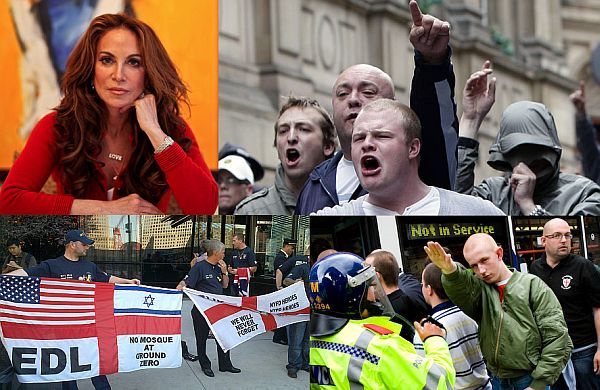
Perhaps the clearest evidence of the decline of Western civilization is the example of those who now shout it its defense.

In the name of protecting civilization, a movement promoting racial supremacism is infecting Western consciousness with the notion that a set of values and cultural constructions is now in jeopardy when in fact our civilization’s corruption is already well advanced.

If the progress of Western civilization came about through the unfettering of the power of the people in egalitarian societies, that trend was quietly reversed as citizens became consumers. In recent decades, that decline further deepened as economic “advance” turned out to be a mask concealing expanding inequality.

In the hollow culture which this has created, beyond employing a stock of well-worn platitudes about freedom and liberty, civilization’s self-appointed protectors find it easier to spotlight purported threats than describe exactly what they are defending.

In this context we should note that American culture remains influenced by European culture more than any other and to the extent that Europe provides a cultural compass, we should be alarmed at the direction this now points. An ocean will not protect us from its influence.

Christian Science Monitor reports:

A new survey in Germany shows that 13 percent of its citizens would welcome a “Führer” — a German word for leader that is explicitly associated with Adolf Hitler — to run the country “with a firm hand.”

The findings signal that Europe’s largest nation, freed from cold-war strictures, is not immune from the extreme and often right-wing politics on the rise around the Continent.

The study, released Oct. 13 by the Friedrich Ebert Foundation, affiliated with the center-left Social Democratic Party, revealed among other things that more than a third of Germans feel the country is “overrun by foreigners,” some 60 percent would “restrict the practice of Islam,” and 17 percent think Jews have “too much influence.”

The study’s overall snapshot of German society shows new forms of extremism and hate are no longer the province of far-right cohorts who shave their heads or wear leather jackets adorned with silver skulls – but register in the tweedy political center, on the right and the left. Indeed, the study found, extremism in Germany isn’t a fringe phenomenon but is found in the political center, “in all social groups and in all age groups, regardless of employment status, educational level or gender.”

The year 2010 is marking a clear shift toward extremist politics across Europe, analysts say. An uncertain economy, a gap between elites and ordinary Europeans, and fraying of a traditional sense of national identity has just in the past month brought more hard-line politics and speech, often aimed at Islam or immigrants – into a political mainstream where it had been absent or considered taboo.

On Oct. 10, the city of Vienna, a cosmopolitan and socialist stronghold since World War II, voted the far-right Freedom Party into a ruling coalition. The party, which ran on an “anti-minaret” platform in a city with only one mosque, was formerly associated with nationalist Jorg Haider, but has been reinvented by an animated former dental hygienist, Heinz-Christian Strache.

On Sept. 19, Sweden, long a Scandinavian redoubt of social tolerance and openness, put the far-right Sweden Democrats into parliament for the first time.

Further, this week the Netherlands saw the rise to influence, if not power, of the anti-Islam party of Geert Wilders, a social liberal who argues for gay rights – but whose main platform is to ban the Quran and the practice of Islam in the Low Countries. Mr. Wilders’ party will formally participate in the Dutch ruling coalition without specifically joining it.

Ian Buruma writes:

All these countries may soon be following the Danish model, in which the illiberal populist parties pledge their support without actually governing, thereby gaining power without responsibility. Denmark’s Conservative government could not govern without the support of the People’s party. Sweden’s recently re-elected conservative Moderate party will have to rely on the Democrats to form a viable government. And Wilders has already received assurances from the conservative and Christian Democrat parties that, in exchange for his support, the burqa will be banned in the Netherlands and immigration curbed.

The influence of these slick new populists, waging their war on Islam, goes well beyond their countries’ borders. Nativism is on the rise all over the western world, and Wilders, in particular, is a popular speaker at rightwing anti-Muslim gatherings in the US, Britain and Germany.

European populism focuses on Islam and immigration, but it may be mobilising a wider rage against elites expressed by people who feel unrepresented, or fear being left behind economically. They share a feeling of being dispossessed by foreigners, of losing their sense of national, social, or religious belonging. Northern Europe’s political elites, largely Social or Christian Democrats, have often been dismissive of such fears, and their paternalism and condescension may be why the backlash in those liberal countries has been particularly fierce.

The question is what to do about it. One possible solution is to let populist parties join the government if they get a sufficient number of votes. The idea of a Tea Party candidate becoming US president is alarming, to be sure, but European populists could only be part of coalition governments.

True, Hitler’s Nazis took over Germany almost as soon as they were voted into power, but the new European right are not Nazis. They have not used violence, or broken any laws. Not yet. As long as this is so, why not give them real political responsibility? They would then not only have to prove their competence, but also moderate their attitudes.

Buruma’s assumption that governance inherently imposes a moderating effect, seems very dubious. Look at Avigdor Lieberman and his Yisrael Beiteinu party in an Israel that prides itself on its Western identity. There’s little evidence that participation in government has forced them to turn away from extremism.

The underlying idea here is one that has guided the eviscerated Left for the last two decades: that the political challenges of the day can only be met by some form of reaction or accommodation through which the sacred political center can be reclaimed. The idea that the Left provides a genuine political alternative has — at least by mainstream politicians — been effectively abandoned.

This is the context in which an American underclass is expanding, ready to be corralled by rightwing, xenophobic opportunists.

The Guardian‘s Paul Mason went to Atlanta to see how economic decline is reshaping American society.

Unable to borrow or earn, a whole generation is being shut out of the American lifestyle.

Meanwhile, some states have begun a race to the bottom: slashing welfare, labour regulations and local taxes to attract investment. High-wage companies close and relocate to low-wage states, and foreign investment flows to the towns where labour costs are lowest. These states are being transformed by the arrival of low-waged Hispanic migrants even as the rightwing politicians who support the economics rail against the demographics.

As a result the so-called Sun Belt, identified by Republican strategist Kevin Phillips in the 1970s as the new political bedrock of conservatism, now feels like the unhappiest place in America. Median incomes in the south are, on average, $8,000 lower than in the northeast; poverty rates are higher than anywhere else in America — and so are the racial and religious tensions.

In the midterm elections politicians have promised to “do something” for the middle class. The kindest thing they could do is tell the truth: Americans have been living a middle-class lifestyle on working-class wages — and bridging the gap with credit. And it’s over.

Instead, the message is that the American way of life is as good as ever — just so long as it can be protected from foreign threats: the economic threat from undocumented Latino workers and the cultural threat from dangerous Muslims.

A real alternative, however, would go much further than pointing out that most Americans have for too long been living beyond their means — it would spell out that the American dream is built on a false promise and our concern should not be reduced to who has access to its fulfillment and who does not. That false promise is that the good life flows from the good stuff.

In one of the tales of Mullah Nasrudin, his friend finds him in misery with bleeding lips as he chews on red hot chillies. “Why do you keep on biting into those chillies?” his friend asks. “I’m looking for the sweet one,” the Mullah answers as he digs deeper into his basket. We too find it difficult to abandon that futile quest for a sweet chili.

America now suffers less from the consequences of easy access to credit than the fact that we have virtually no conception of material sufficiency. Our fascination with the future is driven by an experience of the present as defined by unmet needs. Ours is a condition of perpetual insufficiency. The land of opportunity is populated by people who can never have enough.

Only when we discover we have enough can we pause, take stock and consider what is of real value. The defense of civilization consists not in thwarting foreign threats but recognizing the ways in which we value or devalue civilization’s core assets.

We are now warned of a dreadful “Japanification” of America if consumers refuse to consume.

Is that all that Americans are: the earthworms of the global economy? Or might we find some hidden wealth through material loss?

Facebooktwittermail