Yearly Archives: 2010

Iran tests its checks and balances

Jamsheed K. Choksy writes:

Casual Iran observers tend to portray the country’s most prominent political division as that between fundamentalist hard-liners and secular moderates. In reality, however, the struggle for Iran’s future is a three-way fight waged by the different branches of conservatives that control the parliament, the presidency, and the theocracy. The Green Movement may have stalled, but the parliamentary opposition to President Mahmoud Ahmadinejad has only grown stronger and more assertive over the past year — culminating in a recent push to charge the president with abuses of power warranting impeachment. Those efforts are coming to a halt under orders from Supreme Leader Ali Khamenei, who fears that the parliament’s attempt to assert itself against the president will also be at the expense of his own power base, the country’s conservative mullahs.

In fact, this isn’t the first round of infighting among Iran’s leaders. In July 2009, legislators warned Ahmadinejad that they would seek to oust him as the chief executive if he continued acting in an autocratic manner. Ahmadinejad responded by claiming the executive branch is the most important one of the government.

Ahmadinejad has also clashed with parliamentarians over his prerogative to influence the activities of the Central Bank. As financial hardships mount on common Iranians, in part due to mismanagement and in part from international sanctions, their elected representatives are blaming the president and his bureaucrats for the economy’s woes.

It’s a naked power struggle that has cloaked itself in ideology.

Facebooktwittermail

Israeli forces demolish mosque in a wave of West Bank demolitions

Joseph Dana reports:

Israeli forces demolished Palestinian homes in the Jordan Valley and the South Hebron Hills today in what seems as a wave of demolitions following yesterday’s demolitions all across the West Bank. Non-violent leaders from Beit Ummar have also been arrested in night raids. Grassroots organizers Mousa and Yousef Abu Maria were arrested from their homes as harassment continues in Beit Ummar

After carrying demolitions in the villages of Qarawat Bani Hassan near Salfeet, al-Jiftlik in the Jordan Valley and Hizma near Jerusalem yesterday, Israeli bulldozers returned to the Jordan Valley today. At 6:30 this morning, Israeli Civil Administration bulldozers accompanied by soldiers and armored military jeeps entered the Jordan Valley village of Khirbet Yarza, east of Tubas, and demolished the village’s mosque, a houses and four animal shelters. The demolitions rendered eleven people homeless.

Demolitions continued later in the morning in the South Hebron Hills village of al-Rifayaia, east of Yatta, where at 8:15 AM Israeli forces demolished a 250 meter house. The house was home to two families of twenty people, 16 of them minors.

Facebooktwittermail

“We will be with you until you are bankrupt and your economy collapses”

Daveed Gartenstein-Ross writes:

[In a March 2010 video, al Qaeda spokesman Adam] Gadahn put his finger on an important insight that AQAP [Al Qaeda in the Arabian Peninsula] is now reiterating: Even failed attacks can help the jihadists by “bring[ing] major cities to a halt, cost[ing] the enemy billions, and send[ing] his corporations into bankruptcy.” Failed attacks, simply put, can themselves be successes. This is precisely why AQAP devoted an entire issue of Inspire to celebrating terror attempts that killed nobody.

A message making this point at length was posted to the Al-Fallujah Islamic forums in December 2009. The author mockingly addressed the security services monitoring the website, asking them to write the following in their reports:

A Very Serious Threat

Source: A Radical Islamist Forum

Warn them that they must protect every federal building and skyscraper, such as: Library Tower (California), Sears Tower (Chicago), Plaza Bank (Washington State), the Empire State Building (New York), suspension bridges in New York, and the financial district in New York.

Nightclubs frequented by Americans and the British in Thailand, Philippines, Indonesia (especially our dear Bali Island), the oil company owned by the former Secretary of State Henry Kissinger in Sumatra (Indonesia), and US ships and oil tankers in the Strait of Hormuz, Gibraltar, and the Port of Singapore.

Let us not forget any airport, seaport, or stadium. Tell them to protect [these places] no matter the cost, day and night, around the clock.

The point is clear: Security is expensive, and driving up costs is one way jihadists can wear down Western economies. The writer encourages the United States “not to spare millions of dollars to protect these targets” by increasing the number of guards, searching all who enter those places, and even preventing flying objects from approaching the targets. “Tell them that the life of the American citizen is in danger and that his life is more significant than billions of dollars,” he wrote. “Hand in hand, we will be with you until you are bankrupt and your economy collapses.”

Unfortunately, the author, and the editors of Inspire, are all too right: The economics of this fight favor the terrorists, not those seeking to defend against terrorism.

Facebooktwittermail

America’s obsession with The Man

The American geopolitical prism is distorted in multiple ways, but none is more consistently evident than the strange idea that the actions of a nation can be understood simply by deciphering the thoughts and intentions of one man — even if we’re not always sure who The Man really is.

Iran — Ahmadinejad or Khamenei? North Korea — Kim Jong-il. Russia — Putin. Turkey — Erdogan. Syria — Bashar al-Assad. Egypt — Hosni Mubarak. Iraq — Saddam. Brazil — Lula. Venezuala — Chavez. Cuba — Castro. North Vietnam — Ho Chi Minh. South Africa — Mandela. Britain — Churchill. Germany — Hitler. Soviet Union — Stalin. China — Mao, Hu or who?

Reduce a nation to a single man and the task of understanding that nation’s cultural and political complexity will often be reduced to a question about how we deal with The Man.

Can he be trusted? Can he be befriended? Can he be bribed? Should he be kept at a distance? Does he need to be contained? Must he be killed?

For a few months in Afghanistan recently, Mullah Akhtar Muhammad Mansour became The Man — a representative of the Taliban offering the US a ticket home. That man turned out to be an impostor, while the word is that the man with one eye and his fellow commanders have no interest in laying down their weapons:

Sayed Amir Muhammad Agha, a onetime Taliban commander who says he has left the Taliban but who acted as a go-between with the movement in the past, said in an interview that he did not know the tale of the impostor.

But he said the Taliban leadership had given no indications of a willingness to enter talks.

“Someone like me could come forward and say, ‘I am a Talib and a powerful person,’ ” he said. “But I can tell you, nothing is going on.”

“Whenever I talk to the Taliban, they never accept peace and they want to keep on fighting,” he said. “They are not tired.”

Where does this obsession with The Man come from? Faith in personal salvation through Jesus Christ? The institution of the regal American presidency? The religion of individualism?

Whatever its origin, it skews America’s relations with the world — a world in which individuals, even those regarded as the authors of history, both shape and mirror the societies, cultures and historical junctures within which they operate. It is that which they mirror, to which we give far too little account.

Facebooktwittermail

Impostor claiming to be Taliban leader was key to meetings coalition touted as mark of progress

The Wall Street Journal reports:

The revelation that an impostor passed himself off as a Taliban leader in Afghan peace talks called into question coalition reports of progress in the war, and illustrated how little the allies know of the insurgency’s top leaders and the difficulty that lack of knowledge presents for U.S. strategy.

The man, who claimed to be one of the highest-ranking members of the Taliban, held at least two meetings with Afghan President Hamid Karzai and other officials in recent months, officials said.

Senior coalition officers—U.S. Gen. David Petraeus, chief of coalition forces, foremost among them—had sought to portray the nascent peace talks as a sign that the one-two punch of American forces clearing territory and Special Operations forces targeting insurgent field commanders was wearing down the Taliban and pushing them to the negotiating table.

Those claims are now in question. Many Western officials have concluded that the peace process is making little progress and the Taliban are ready to fight on.

Facebooktwittermail

An American jolt for the Middle East

Chester Crocker, Scott Lasensky and Samuel W. Lewis propose that the US lays out its own set of principles for solving the Israeli-Arab conflict.

At a minimum, the American declaration should be based on the 1967 lines, with agreed territorial swaps; support a compromise on Jerusalem that allows for two capitals for two states; include provisions about security limitations and guarantees; reiterate America’s support for an agreed solution to the refugee problem; and reaffirm our long-standing commitment to the state of Israel. But American principles should also include some caveats, given that our ultimate interest is in an agreed, viable solution — not in any particular formula.

What would it take for American ideas to succeed? Unlike some past efforts, Washington should not try to “pre-cook” this declaration with one or more parties or to choreograph their reactions. In fact, the U.S. statement of principles would be explicitly described as what our own country believes in and can support; and by implication what it cannot support.

Thus the U.S. statement would not be designed to achieve immediate approval or adoption by the parties. Its purpose would be to clarify where America stands, how we define our interests and what we can work for. It would aim at influencing the climate of thinking in the region, sobering up those with illusions and encouraging those who need our support.

The authors here presuppose that the United States would be willing to display a level of autonomy from Israel that it has been incapable of demonstrating for many years. If such an initiative was taken, it would not only be momentous as an intervention but also because it could only be done by an administration that had truly unshackled itself from the Israel lobby.

Facebooktwittermail

US anticipates imminent nuclear test by North Korea

The Chosunilbo reports:

The U.S. Air Force moved a WC-135 Constant Phoenix reconnaissance jet from the U.S. mainland to the Kadena Air Base in Okinawa, in September in preparation for another nuclear test by North Korea, the Sankei Shimbun reported Tuesday.

The WC-135, a modified aircraft, is able to detect nuclear explosions from the air by collecting samples from the atmosphere. It was stationed in Okinawa about a month before North Korea carried out its second nuclear test in May 2009. Apparently the U.S. believes that another nuclear test is imminent after unusual movements were detected at the North’s test site.

Facebooktwittermail

Tim Shorrock: Direct talks with North Korea are the only answer to end Korean War

“The United States has only one choice in dealing with North Korea, even after its deadly artillery attack on a South Korean island,” writes Tim Shorrock, an investigative journalist who has covered Korea for more than 30 years. “Negotiate directly with its government, forge an agreement to end Pyongyang’s nuclear weapons program, and move towards a peace agreement to formally end the Korean War.” (Democracy Now!)

Facebooktwittermail

West Bank turning into a police state where torture is frequently used

American officials and journalists visiting the West Bank, if they are eager to boost the credibility of its unelected political leaders, like to speak about the professionalism of the Palestinian Authority’s security services. For instance, an aide to Hillary Clinton was recently quoted by Roger Cohen, saying:

[A]s we approached Ramallah there were these troops in berets. They were so professional, we thought at first they were Israel Defense Forces. But, no, they were Palestinians, this completely professional outfit, and it was clear this was something new.

What could be more inspiring — to a visitor from Washington — than Palestinians who looked like Israelis?

The Financial Times presents a much grimmer picture in which local human rights groups warn that a brutal regime is emerging with the authoritarianism of a police state. (As a report by David Rose almost two years ago makes clear, the trend is not new — but it is getting worse.)

Naiema Abu Ayyash’s worst fears were confirmed this month when she finally managed to visit her husband in Jericho prison.

Badr Abu Ayyash, 42, a farmer and local politician in the west Bank, was arrested by the Palestinian Authority’s Preventive Security unit on September 14. Aside from two brief and apparently supervised phone calls, his family was denied all contact with him.

“He looked very different,” said Ms Abu Ayyash, a mother of four. “He could hardly walk. He had difficulty breathing and was very thin. When he shook my hand, I noticed that he had no strength at all.”

She has no doubt her husband was tortured. “I started screaming at the officer: ‘What are you doing to him?”’ Her pleas fell on deaf ears. After a few cursory exchanges, her husband was led back to his cell.

According to former inmates and activists familiar with Palestinian prisons, Ms Abu Ayyash has every reason to be worried. They say prisoners affiliated with the Islamist Hamas movement, which runs the Gaza Strip, are beaten regularly and deprived of medicine and basic comforts such as blankets and mattresses.

There is evidence that a significant number of detainees are tortured during interrogation. The most common form of abuse is known as Shabeh, in which detainees are handcuffed and bound in stress positions for long periods.

Claims of torture and abuse by members of the Palestinian security forces are not new. There has, however, been a sharp rise in reported cases, leading Human Rights Watch to remark last month that “reports of torture by Palestinian security forces keep rolling in”. The New York-based organisation also bemoaned the “rampant impunity” of officers allegedly involved in the abuses.

Many analysts and observers fear that life in the west Bank is taking on an increasingly authoritarian hue. “I feel real concern that we are reaching the level of a police state,” says Shawan Jabarin, the director of al-Haq, a Ramallah-based human rights group.

It is a concern shared by Randa Siniora, the director of the Palestinian Independent Commission for Human Rights, the ombudsman responsible for processing complaints against Palestinian officials. Her commission received more complaints about torture in the west Bank in October than in any month since mid- 2009. “We are looking at a very gloomy situation,” she said. “I am afraid that this [problem of torture and abuse] will become systematic.”

Facebooktwittermail

Ahmadinejad faces impeachment threat

The Wall Street Journal reports:

Iran’s parliament revealed it planned to impeach President Mahmoud Ahmadinejad but refrained under orders from Supreme Leader Ayatollah Ali Khamenei, exposing a deepening division within the regime.

Lawmakers also launched a new petition to bring a debate on the president’s impeachment, conservative newspapers reported Monday.

The reports of challenges to Mr. Ahmadinejad were intended as retorts to a powerful body of clerics that urged Mr. Khamenei to curb the parliament’s authority and give greater clout to the president.

In a report released Sunday and discussed in parliament Monday, four prominent lawmakers laid out the most extensive public criticism of Mr. Ahmadinejad to date.

Farnaz Fassihi talks about the move by Iran’s parliament, later blocked by the nation’s supreme leader, to impeach President Ahmadinejad.

They accused him and his government of 14 counts of violating the law, often by acting without the approval of the legislature. Charges include illegally importing gasoline and oil, failing to provide budgetary transparency and withdrawing millions of dollars from Iran’s foreign reserve fund without getting parliament’s approval.

“The president and his cabinet must be held accountable in front of the parliament,” the report stated. “A lack of transparency and the accumulation of legal violations by the government is harming the regime.”

The moves against Mr. Ahmadinejad come as the regime faces domestic pressure over his plans to gradually eliminate subsidies for fuel, food and utilities from an economy strained by a string of international sanctions over Tehran’s controversial nuclear program.

Facebooktwittermail

House Democrats call for release of one of the most notorious spies in Israel’s history

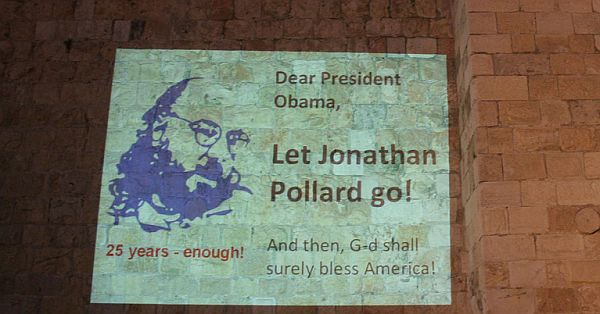
A “relentless” campaign by David Nyer, a Jewish Orthodox activist from Monsey, New York, has succeeded in winning significant support from House Democrats who are now calling on President Obama to release Jonathan Pollard.

Pollard is a former civilian intelligence analyst who was convicted of spying for Israel and through a plea bargain received a life sentence in 1987. He is believed to have caused incalculable damage to US national security.

Nyer’s campaign “struck gold” when he succeeded in winning the support of Rep. Barney Frank. The JTA reported:

Getting Frank was a coup, one congressional insider said, not only because he has a leadership position, but because his pronounced liberalism in other arenas adds credibility to an effort that has been identified in recent years with the Israeli and pro-Israel right.

Frank took up the cause because he long has believed that Pollard’s life sentence was disproportionate to the crime, his spokesman said.

“It is something he feels strongly about,” Harry Gural told JTA.

Launching the initiative at a Capitol Hill news conference Nov. 18, Frank listed two factors that made the matter timely: Pollard’s 25 years in prison as of Sundayand the parlous state of the Israeli-Palestinian peace process.

“The justification of this is the humanitarian one and the notion that the American justice system should be a fair one,” Frank said. “We believe that clemency after 25 years for the offenses of Jonathan Pollard would do that.

“My own hope is that if the president would do this, it would contribute to the political climate within the democracy of Israel and would enhance the peace process.”

Frank alluded to Obama’s low popularity in Israel where, fairly or not, the president has been saddled with a reputation as cool to Israeli interests.

The Jerusalem Post reports that Benjamin Netanyahu has asked the US to add Pollard’s release to the many other generous incentives the Obama administration have offered Israel in the hope of a 90 day, once only, extension to the settlement slowdown.

In “Why Pollard Should Never Be Released (The Traitor),” published in the New Yorker in January 1999, Seymour Hersh wrote:

A full accounting of the materials provided by Pollard to the Israelis has been impossible to obtain: Pollard himself has estimated that the documents would create a stack six feet wide, six feet long, and ten feet high. Rafi Eitan, the Israeli who controlled the operation, and two colleagues of his attached to the Israeli diplomatic delegation — Irit Erb and Joseph Yagur — were named as unindicted co-conspirators by the Justice Department. In the summer of 1984, Eitan brought in Colonel Aviem Sella, an Air Force hero, who led Israel’s dramatic and successful 1981 bombing raid on the Iraqi nuclear reactor at Osirak. (Sella was eventually indicted, in absentia, on three counts of espionage.) Eitan’s decision to order Sella into the case is considered by many Americans to have been a brilliant stroke: the Israeli war hero was met with starry eyes by Pollard, a chronic wannabe.

Yagur, Erb, and Sella were in Washington when Pollard was first seized by the F.B.I., in November, 1985, but they quickly left the country, never to return. During one period, Pollard had been handing over documents to them almost weekly, and they had been forced to rent an apartment in northwest Washington, where they installed a high-speed photocopying machine. “Safe houses and special Xeroxes?” an American career intelligence officer said, despairingly, concerning the Pollard operation. “This was not the first guy they’d recruited.” In the years following Pollard’s arrest and confession, the Israeli government chose not to cooperate fully with the F.B.I. and Justice Department investigation, and only a token number of the Pollard documents have been returned. It was not until last May [1998] that the Israeli government even acknowledged that Pollard had been its operative.

In fact, it is widely believed that Pollard was not the only one in the American government spying for Israel. During his year and a half of spying, his Israeli handlers requested specific documents, which were identified only by top-secret control numbers. After much internal assessment, the government’s intelligence experts concluded that it was “highly unlikely,” in the words of a Justice Department official, that any of the other American spies of the era would have had access to the specific control numbers. “There is only one conclusion,” the expert told me. The Israelis “got the numbers from somebody else in the U.S. government.”

Richard Perle? He was Assistant Secretary of Defense in the Reagan administration at that time and early in his career had been caught by the FBI passing classified information to the Israeli embassy in Washington.

Pollard’s American interrogators eventually concluded that in his year and a half of spying he had provided the Israelis with more than a year’s worth of the daily FOSIF reports from Rota [in Spain, the location of the Navy’s Sixth Fleet Ocean Surveillance Information Facility (FOSIF)]. Pollard himself told the Americans that at one point in 1985 the Israelis had nagged him when he missed several days of work because of illness and had failed to deliver the FOSIF reports for those days. One of his handlers, Joseph Yagur, had complained twice about the missed messages and had asked him to find a way to retrieve them. Pollard told his American interrogators that he had never missed again.

The career intelligence officer who helped to assess the Pollard damage has come to view Pollard as a serial spy, the Ted Bundy of the intelligence world. “Pollard gave them every message for a whole year,” the officer told me recently, referring to the Israelis. “They could analyze it” — the intelligence — “message by message, and correlate it. They could not only piece together our sources and methods but also learn how we think, and how we approach a problem. All of a sudden, there is no mystery. These are the things we can’t change. You got this, and you got us by the balls.” In other words, the Rota reports, when carefully studied, gave the Israelis “a road map on how to circumvent” the various American collection methods and shield an ongoing military operation. The reports provide guidance on “how to keep us asleep, thinking all is working well,” he added. “They tell the Israelis how to raid Tunisia without tipping off American intelligence in advance. That is damage that is persistent and severe.”

Facebooktwittermail

Knesset decapitates two-state solution

Dimi Reider writes:

I just finished watching a live transmission of the Knesset vote on the referendum law. The law, which passed at a majority of 65 to 33, conditions any Israeli withdrawal from any of its territory – into which Israel, alone in the world, includes the Golan Heights East Jerusalem – on passing a nation-wide referendum. To revoke the law, the Knesset would need a privileged majority of 80 out of 120 parliamentarians. Considering current and foreseeable trends in the public mood, overwhelming support for withdrawing from East Jerusalem – including the Old City, Gilo, Ramot Eshkol, and others – is highly unlikely.

This means that even if we ever get to an agreement on the key issue of a Palestinian capital in Jerusalem and the status of the city’s Palestinian residents, the referendum will kill it. The only alternative are if the government makes a new legislation and kills referendum law first, which seems highly improbable. The future Palestinian state, if it ever comes to pass, will be without its main symbol and historic capital.

The two state solution was in dire straits ever since it was born; the huge settlement expansion under Israel’s most leftist governments, especially the Rabin-Peres one, made it all but impossible to achieve on the ground. Whatever was left of its political future was further cast into question by the Olmert and Netanyahu documents, demanding the new Palestinian state has no control of airspace or non-Israeli borders, and other attributes of a sovereign state. The referendum bill put nail-before-last in the two-state process. The last nail will come when the Palestinian Authority implodes, whether for lack of credibility, or for a conscious change of tactic in favour of demanding vote and collective rights within the overarching Israeli government.

Facebooktwittermail

Stuxnet could cause Bushehr meltdown

On the eve of the release of a new IAEA report on Iran, officials linked to the UN nuclear oversight agency have added to speculation on the possible impact that the Stuxnet malware may have had on Iran’s nuclear program — including the possibility that it could lead to the meltdown of the reactor in the Bushehr nuclear power plant.

The Associated Press reports:

Iran’s nuclear program has suffered a recent setback, with major technical problems forcing the temporary shutdown of thousands of centrifuges enriching uranium, diplomats told The Associated Press on Monday.

The diplomats said they had no specifics on the nature of the problem that in recent months led Iranian experts to briefly power down the machines they use for enrichment — a nuclear technology that has both civilian and military uses.

But suspicions focused on the Stuxnet worm, the computer virus thought to be aimed at Iran’s nuclear program, which experts last week identified as being calibrated to destroy centrifuges by sending them spinning out of control.
[…]
Tehran has taken hundreds of centrifuges off line over the past 18 months, prompting speculation of technical problems.

A U.N official close to the IAEA said a complete stop in Iran’s centrifuge operation would be unprecedented to his knowledge but declined to discuss specifics.
[…]
Separately, another official from an IAEA member country suggested the worm could cause further damage to Iran’s nuclear program.

The official also asked for anonymity because his information was privileged. He cited a Western intelligence report suggesting that Stuxnet had infected the control system of Iran’s Bushehr reactor and would be activated once the Russian-built reactor goes on line in a few months.

Stuxnet would interfere with control of “basic parameters” such as temperature and pressure control and neutron flow, that could result in the meltdown of the reactor, raising the specter of a possible explosion, he said.

Facebooktwittermail

The Israelification of America

As the Transportation Security Administration faces a barrage of criticism, some indignant Americans are calling for the “Israelification” of US airports — as though the security procedures used in a tiny Middle Eastern ethnocracy with one international airport could easily be scaled up for America.

Ironically, Israelification is not what we need — it’s what we already have.

Consider the real outrages of the last decade that, simply because they were done in the name of national security, the majority of Americans found tolerable:

  • a global war on terrorism that led to massive increases in defense spending, the creation of multiple new intelligence and security agencies, and Washington’s enslavement to fear-based politics — that was OK;
  • with disregard for international law, the invasion of Iraq on a false pretext — that was OK;
  • the kidnapping, secret imprisonment and torture of individuals most of whom had nothing to do with 9/11 — that was OK;
  • the authorization of warrantless wiretaps — that was OK;
  • the implementation of a remote-controlled assassination program — that was OK;
  • in short, the normalization of war crimes all of which were deemed justifiable because of 9/11 — that was OK;
  • but “don’t touch my junk” — there are limits to what Americans will tolerate.

TSA administrators are no doubt frustrated by the fact that had the new pat-down procedures been implemented in late 2001, they would probably have been welcomed by a population that widely supported the idea of doing “whatever it takes” to stop “the terrorists.”

The problem, then and now, is that air transportation security is imagined to be about catching terrorists. On this count, the TSA seems to have a poor record.

At Slate, Juliet Lapidos notes:

In May, the Government Accountability Office released a report noting that SPOT’s [“Screening of Passengers by Observational Techniques”] annual cost is more than $200 million and that as of March 2010 some 3,000 behavior detection officers [BDOs] were deployed at 161 airports but had not apprehended a single terrorist. (Hundreds of illegal aliens and drug smugglers, however, were arrested due to the program between 2004 and 2008.) What’s more, the GAO noted that at least 16 individuals later accused of involvement in terrorist plots flew 23 different times through U.S. airports since 2004, but TSA behavior-detection officers didn’t sniff out any of them.

Does this imply that the TSA’s BDOs have yet to pinpoint the way a terrorist walks, talks, or dresses? The TSA’s “failure” in this instance might simply mean that the individuals who escaped their attention were not at those times actually doing anything suspicious.

The point is, there are justifiable and unjustifiable grounds to turn a person into an object of suspicion. A system that simply on the basis of religion, ethnicity or nationality, regards a person with suspicion, is unjust and will be ineffective. Indeed, a system which even regards its targets as “the terrorists” conjures up the false notion that it is dealing with a class of people rather than a class of behavior.

Which brings me back to my initial claim that the Israelification of America is already deeply entrenched. Israel’s fear of the Arab world has been transplanted into American consciousness to such a degree that we are moving toward the absurd conclusion that if this country operated even more like Israel than it already does, then we would be able to feel as safe as the Israelis do.

Living inside a fortress and defining ones existence in terms of threats posed by eternal enemies, is a good way of justifying spending more and more on increasingly elaborate fortifications. But those who invest deeply in this mindset and who profit from its perpetuation, have the least interest in exploring what we need to understand most: why our enemies think the way they do. Delve into that question, and the notion of eternal enmity quickly evaporates — thus the perpetuation of the myth that we are under threat not because of what we do but because of who we are.

Meanwhile, next time a TSA officer offends your dignity, spare a thought for the Palestinians who while passing through IDF checkpoints suffer vastly worse when attempting no more than to travel from one town to the next.

Facebooktwittermail

Power and tiny acts of rebellion

Chris Hedges writes:

We have reached a point where stunted and deformed individuals, whose rapacious greed fuels the plunge of tens of millions of Americans into abject poverty and misery, determine the moral fiber of the nation. It is no more morally justifiable to kill someone for profit than it is to kill that person for religious fanaticism. And yet, from health companies to the oil and natural gas industry to private weapons contractors, individual death and the wholesale death of the ecosystem have become acceptable corporate business. The mounting human misery in the United States, which could lead to the sporadic bursts of anger we have seen on the streets of France, will be met with severe repression from the security and surveillance state, which always accompanies the rise of the corporate state. The one method left open by which we can respond—massive street protests, the destruction of corporate property and violence—will become the excuse to impose total tyranny. The intrusive pat-downs at airports may soon become a fond memory of what it was like when we still had a little freedom left.

All reform movements, from the battle for universal health care to the struggle for alternative energy and sane environmental controls to financial regulation to an end to our permanent war economy, have run into this new, terrifying configuration of power. They have confronted an awful truth. We do not count. And they have been helpless to respond as those who are most skilled in the manipulation of hate lead a confused populace to call for their own enslavement.

Facebooktwittermail

George Bush gets some advice from the Conservative Mayor of London

Borris Johnson writes:

It is not yet clear whether George W Bush is planning to cross the Atlantic to flog us his memoirs, but if I were his PR people I would urge caution. As book tours go, this one would be an absolute corker. It is not just that every European capital would be brought to a standstill, as book-signings turned into anti-war riots. The real trouble — from the Bush point of view — is that he might never see Texas again.

One moment he might be holding forth to a great perspiring tent at Hay-on-Wye. The next moment, click, some embarrassed member of the Welsh constabulary could walk on stage, place some handcuffs on the former leader of the Free World, and take him away to be charged. Of course, we are told this scenario is unlikely. Dubya is the former leader of a friendly power, with whom this country is determined to have good relations. But that is what torture-authorising Augusto Pinochet thought. And unlike Pinochet, Mr Bush is making no bones about what he has done.

Unless the 43rd president of the United States has been grievously misrepresented, he has admitted to authorising and sponsoring the use of torture. Asked whether he approved of “waterboarding” in three specific cases, he told his interviewer that “damn right” he did, and that this practice had saved lives in America and Britain. It is hard to overstate the enormity of this admission.

Facebooktwittermail

The impact today and tomorrow of Chalmers Johnson

Steve Clemons writes:

Next week, Foreign Policy magazine and its editor-in-chief Susan Glasser will be releasing its 2nd annual roster of the world’s greatest thinkers and doers in foreign policy. I have seen the list — and it’s impressively creative and eclectic.

There is one name that is not on the FP100 who should be — and that is Chalmers Johnson, who from my perspective rivals Henry Kissinger as the most significant intellectual force who has shaped and defined the fundamental boundaries and goal posts of US foreign policy in the modern era.

Johnson, who passed away Saturday afternoon at 79 years, invented and was the acknowledged godfather of the conceptualization of the “developmental state”. For the uninitiated, this means that Chalmers Johnson led the way in understanding the dynamics of how states manipulated their policy conditions and environments to speed up economic growth. In the neoliberal hive at the University of Chicago, Chalmers Johnson was an apostate and heretic in the field of political economy. Johnson challenged conventional wisdom with he and his many star students — including E.B. Keehn, David Arase, Marie Anchordoguy, Mark Tilton and others — writing the significant treatises documenting the growing prevalence of state-led industrial and trade and finance policy abroad, particularly in Asia.

Today, the notion of “State Capitalism” has become practically commonplace in discussing the newest and most significant features of the global economy. Chalmers Johnson invented this field and planted the intellectual roots of understanding that other nation states were not trying to converge with and follow the so-called American model.

Facebooktwittermail