Author Archives: Paul Woodward

Obama’s defense of religious freedom

On Friday, Glenn Greenwald wrote:

This is one of the most impressive and commendable things Obama has done since being inaugurated:

President Obama delivered a strong defense on Friday night of a proposed Muslim community center and mosque near ground zero in Manhattan, using a White House dinner celebrating Ramadan to proclaim that “as a citizen, and as president, I believe that Muslims have the same right to practice their religion as anyone else in this country” . . . .

“I understand the emotions that this issue engenders. Ground zero is, indeed, hallowed ground,” the president said in remarks prepared for the annual White House iftar, the sunset meal breaking the day’s fast.

But, he continued: “This is America, and our commitment to religious freedom must be unshakable. The principle that people of all faiths are welcome in this country, and will not be treated differently by their government, is essential to who we are” . . . .

What makes this particularly commendable is there is virtually no political gain to be had from doing it, and substantial political risk. Polls shows overwhelming opposition to the mosque nationwide (close to 70% opposed), and that’s true even in New York, where an extraordinary “50% of Democrats, 74% of Republicans, and 52% of ‘non-enrolled’ voters, don’t want to see the mosque built.” The White House originally indicated it would refrain from involving itself in the dispute, and there was little pressure or controversy over that decision. There was little anger over the President’s silence even among liberal critics. And given the standard attacks directed at Obama — everything from being “soft on Terror” to being a hidden Muslim — choosing this issue on which to take a very politically unpopular and controversial stand is commendable in the extreme.

On Saturday, Obama was questioned by CNN on the reaction provoked by his speech the night before. Obama responded:

My intention was to simply let people know what I thought. Which was that in this country, we treat everybody equally in accordance with the law. Regardless of race. Regardless of religion. I was not commenting on and will not comment on the wisdom of making a decision to put a mosque there. I was commenting very specifically on the right that people have that dates back to our founding. That’s what our country’s about and I think it’s very important that as difficult as some of these issues are, we stay focused on who we are as a people and what our values are all about.

Fair enough?

Well not if you’re a journalist who wants to construct a story about the president who “seemed to contradict himself.”

In a country that has a constitution that protects religious freedom by separating Church and State, what business does any politician have in expressing an opinion about the wisdom of building a house of worship anywhere? Just because this is a representative democracy doesn’t mean elected politicians have an obligation to reflect the bigotry of their constituents.

Facebooktwittermail

Obama’s secret war

The Bush administration was well known for its lack of accountability and its disregard for international law, yet if the lead proponents of outlaw governance — men such as Dick Cheney and his chief of staff David Addington — preferred to operate in the shadows, there was a political form of accountability in as much as their approach was seen as an integral feature of the neoconservative agenda — an agenda that got roundly criticized in many quarters.

This is what makes President Obama’s approach in some ways more dangerous than that of the neocons.

The New York Times reports on Obama’s secret war being conducted in Yemen and elsewhere which discredited neocons must now be applauding not only because this administration has in in so many ways adopted their approach but because this approach has now become institutionalized and legitimized by an administration that is not weighed down by the ideological baggage of its predecessor.

A convergence between the CIA — operating increasingly as a paramilitary organization — and the Pentagon — conducting more and more clandestine operations — has produced an American killing machine that operates with minimal political and legal oversight. As the Times says: “the American military campaign in Yemen began without notice in December and has never been officially confirmed.”

“Where we want to get is to much more small scale, preferably locally driven operations,” said Representative Adam Smith, Democrat of Washington, who serves on the Intelligence and Armed Services Committees.

“For the first time in our history, an entity has declared a covert war against us,” Mr. Smith said, referring to Al Qaeda. “And we are using similar elements of American power to respond to that covert war.”

Some security experts draw parallels to the cold war, when the United States drew heavily on covert operations as it fought a series of proxy battles with the Soviet Union.

And some of the central players of those days have returned to take on supporting roles in the shadow war. Michael G. Vickers, who helped run the C.I.A.’s campaign to funnel guns and money to the Afghanistan mujahedeen in the 1980s and was featured in the book and movie “Charlie Wilson’s War,” is now the top Pentagon official overseeing Special Operations troops around the globe.

Facebooktwittermail

You must do what we can’t, because if you don’t, we will

There are those who would have us believe that:

[O]ne day next spring, the Israeli national-security adviser, Uzi Arad, and the Israeli defense minister, Ehud Barak, will simultaneously telephone their counterparts at the White House and the Pentagon, to inform them that their prime minister, Benjamin Netanyahu, has just ordered roughly one hundred F-15Es, F-16Is, F-16Cs, and other aircraft of the Israeli air force to fly east toward Iran — possibly by crossing Saudi Arabia, possibly by threading the border between Syria and Turkey, and possibly by traveling directly through Iraq’s airspace, though it is crowded with American aircraft.

Worried about an Israeli attack on Iran? That’s the idea.

You must do what we can’t, because if you don’t, we will.

This is how some Israelis are trying to twist Washington’s arm to get the US to attack Iran.

A more honest way of making the argument would be to say this: If the US won’t attack Iran, then Israel will — even though it won’t accomplish its military objectives and it will open Pandora’s box. Desperate nations sometimes do desperate things. You have been warned.

Another name for this: blackmail.

It’s hard to counter an irrational argument when the irrationality is intentional. Such are the means by which someone like erstwhile Israeli army corporal and current Atlantic commentator, Jeffrey Goldberg, attempts to persuade his readers — not through cogent reasoning based on clear evidence, but by an insidious form of argument that has the clarity of slime.

Consider the way he tries to close his case for an attack on Iran — even while avoiding saying straight out that he supports such a course of action.

The United States must not take the risk of letting Israel attack Iran because if President Obama orders US forces to attack instead, this would be the most patriotic thing to do. Obama would not be serving Israel’s interests; he would be defending Western civilization.

Based on months of interviews, I have come to believe that the administration knows it is a near-certainty that Israel will act against Iran soon if nothing or no one else stops the nuclear program; and Obama knows — as his aides, and others in the State and Defense departments made clear to me — that a nuclear-armed Iran is a serious threat to the interests of the United States, which include his dream of a world without nuclear weapons. Earlier this year, I agreed with those, including many Israelis, Arabs — and Iranians — who believe there is no chance that Obama would ever resort to force to stop Iran; I still don’t believe there is a great chance he will take military action in the near future — for one thing, the Pentagon is notably unenthusiastic about the idea. But Obama is clearly seized by the issue. And understanding that perhaps the best way to obviate a military strike on Iran is to make the threat of a strike by the Americans seem real, the Obama administration seems to be purposefully raising the stakes. A few weeks ago, Denis McDonough, the chief of staff of the National Security Council, told me, “What you see in Iran is the intersection of a number of leading priorities of the president, who sees a serious threat to the global nonproliferation regime, a threat of cascading nuclear activities in a volatile region, and a threat to a close friend of the United States, Israel. I think you see the several streams coming together, which accounts for why it is so important to us.”

When I asked Peres what he thought of Netanyahu’s effort to make Israel’s case to the Obama administration, he responded, characteristically, with a parable, one that suggested his country should know its place, and that it was up to the American president, and only the American president, to decide in the end how best to safeguard the future of the West. The story was about his mentor, David Ben-Gurion.

“Shortly after John F. Kennedy was elected president, Ben-Gurion met him at the Waldorf-Astoria” in New York, Peres told me. “After the meeting, Kennedy accompanied Ben-Gurion to the elevator and said, ‘Mr. Prime Minister, I want to tell you, I was elected because of your people, so what can I do for you in return?’ Ben-Gurion was insulted by the question. He said, ‘What you can do is be a great president of the United States. You must understand that to have a great president of the United States is a great event.’”

Peres went on to explain what he saw as Israel’s true interest. “We don’t want to win over the president,” he said. “We want the president to win.”

Israel only wants what’s good for America — and we’re supposed to believe that, even while few if any Israelis could be persuaded that America only wants what’s good for Israel.

The truth is that everyone gets to define their own interests so let’s ignore the obsequious crap from Peres and consider Goldberg’s core claim: that Israel is gearing up to strike Iran.

Even if Goldberg is participating in a neocon game of bluff, the only kind of bluff worth engaging in is one that has credibility. To make a credible argument that Israel has the intention of going it alone, Goldberg would have to present the outline of a credible plan of attack. He doesn’t even try.

Israeli planes would fly low over Saudi Arabia, bomb their targets in Iran, and return to Israel by flying again over Saudi territory, possibly even landing in the Saudi desert for refueling—perhaps, if speculation rife in intelligence circles is to be believed, with secret Saudi cooperation.

And he prefaces this “plan” by saying Israel only gets one try. That’s not even a back-of-an-envelope war plan. It’s more like a Twitter war plan.

Five years ago Kenneth Pollack dismissed the idea that Israel could attack Iran on its own. I don’t see any reason to doubt that his analysis on the military logistics of an attack still remains sound. Indeed, there seem to be plenty of Israeli analysts who concede that Israel simply does not have the option of going it alone. Even Goldberg quotes an unnamed Israeli general who says: “This is too big for us.”

In The Persian Puzzle: The Conflict Between Iran and America, Pollack wrote:

[T]he United States … should not count on Israel to conduct a counterproliferation strike for us. It is almost certainly the case that Israel would be willing to absorb the diplomatic costs of a strike, would be prepared to deal with Iran’s retaliation in the form of either terrorist attacks or missile strikes on Israel, and probably is not overly concerned about Iranian behavior in Iraq. The problem for Israel is much simpler: Iran is too far away. Most of the known Iranian nuclear facilities are around 1,000 miles away from Israel. Its Jericho II ballistic missiles could reach these targets, but they lack the payload, accuracy, and numbers to be able to significantly damage (let alone destroy) more than one or two of the large Iranian nuclear facilities, which leaves the matter to the Israeli Air Force. Even assuming that Israeli aircraft were to fly directly to Iran, overflying Jordan and Iraq, the only aircraft in its inventory that could reach Iran’s known nuclear sites are its 25 F-151 strike fighters. (Israel would need to set up aerial refueling stations at three to five locations between Israel and the Iranian targets for its roughly 350 F-16s to be able to participate, which would be practically impossible.) Because the F-151s would have to carry a considerable amount of fuel, they could not carry a great deal of ordinance. Given the size of the various Iranian nuclear facilities, it would not be possible for Israel to destroy all of them in a single raid as it did Osiraq. Nor would it be politically, militarily, or logistically possible for Israel to sustain multiple such strikes over the many days, if not weeks, it would take for all its F-151s to accomplish the job. [My emphasis.]

The neocon game of bluff will only box in the Obama administration if the Israeli “threats” are treated seriously. A more appropriate response would seem to be to focus on the limits of Israeli military action — unless that is one imagines that Israel would launch a nuclear attack on Iran, which to my mind is wildly implausible. (If Israel wants to permanently seal its global pariah status, the first offensive use of nuclear weapons since Nagasaki is a sure way.)

Goldberg reports, but apparently didn’t take seriously, the observations of some Israelis who given their positions of military command seem to merit close attention:

Gabi Ashkenazi, the Israeli army chief of staff, is said by numerous sources to doubt the usefulness of an attack, and other generals I spoke with worry that talk of an “existential threat” is itself a kind of existential threat to the Zionist project, which was meant to preclude such threats against the Jewish people. “We don’t want politicians to put us in a bad position because of the word Shoah [Holocaust],” one general said. “We don’t want our neighbors to think that we are helpless against an Iran with a nuclear bomb, because Iran might have the bomb one day. There is no guarantee that Israel will do this, or that America will do this.”

The message Netanyahu, Goldberg and other panic-stricken Zionists are unintentionally sending out is that come the day Iran acquires a nuclear weapon, Israelis may as well back their bags and abandon the Jewish state.

That probably won’t happen because in such an event Israel will “discover” what many Israelis no doubt already think: that retired General John Abizaid was right when he said that the United States and its allies can “live with” a nuclear-armed Iran. “Let’s face it — we lived with a nuclear Soviet Union, we’ve lived with a nuclear China, and we’re living with nuclear powers as well,” Abizaid told an audience at the Center for Strategic and International Studies.

That was true in 2007 and it’s true now. It’s also true that spineless politicians remain the playthings of fear-mongers who are addicted to war.

Facebooktwittermail

The Israeli bastion of fear

The prefix anti- has become tarnished — no longer the signal of vital dissent. To be anti-war is to be dismissed as belonging to an ineffectual movement that paraded its political impotence until the marching lost all conviction and withered away. To be anti-American or anti-Israel is to be condemned as an enemy of civilization. To be an anti-Zionist is to be cast as someone with no regard for the rights of the Jewish people. And meanwhile, behind all these variants of opposition lurks the most dangerous negation of all: anti-Semitism.

You say no and we say yes. Who can escape seeing the appeal of being on the side of yes — even when it’s far from clear what this yes is supposed to affirm?

In a speech Chris Hedges delivered in New York City last Thursday at a fundraiser for sponsoring a U.S. boat to break the blockade of Gaza, he made a point worth heavily underlining when it comes to defining the oppositional antonyms that we use to define the issue of Palestine. This is not a struggle between yes and no.

Addressing secret informants in the room who were undoubtedly there gathering intelligence for the Israeli government, Hedges said:

You may have the bulldozers, planes and helicopters that smash houses to rubble, the commandos who descend from ropes on ships and kill unarmed civilians on the high seas as well as in Gaza, the vast power of the state behind you. We have only our hands and our hearts and our voices. But note this. Note this well. It is you who are afraid of us. We are not afraid of you.

This indeed is the most telling marker — not one that distinguishes those who are for or against but one that separates the fearful and the fearless.

To stand up in the name of justice is to align oneself with something bigger than ones own interests. The fearful cling to the things they are in jeopardy of losing. They defend an inequity that is inherently unstable. Their resistance is against balance and against a natural order. It is they who are most loudly saying “no” — even while calling it “peace.” Their resistance is through opposition to inevitable change.

The challenge to the fearful is this: you say you want to protect yourself from danger, yet you have allowed fear to become your closest companion. Do you not see that fear itself poses a greater threat to life than all the perils you name? Think less about how you can feel safe and you might discover how you can become less afraid.

* * *

Chris Hedges:

When I lived in Jerusalem I had a friend who confided in me that as a college student in the United States she attended events like these, wrote up reports and submitted them to the Israel consulate for money. It would be naive to assume this Israeli practice has ended. So, I want first tonight to address that person, or those persons, who may have come to this event for the purpose of reporting on it to the Israeli government.

I would like to remind them that it is they who hide in darkness. It is we who stand in the light. It is they who deceive. It is we who openly proclaim our compassion and demand justice for those who suffer in Gaza. We are not afraid to name our names. We are not afraid to name our beliefs. And we know something you perhaps sense with a kind of dread. As Martin Luther King said, the arc of the moral universe is long but it bends toward justice, and that arc is descending with a righteous fury that is thundering down upon the Israeli government.

You may have the bulldozers, planes and helicopters that smash houses to rubble, the commandos who descend from ropes on ships and kill unarmed civilians on the high seas as well as in Gaza, the vast power of the state behind you. We have only our hands and our hearts and our voices. But note this. Note this well. It is you who are afraid of us. We are not afraid of you. We will keep working and praying, keep protesting and denouncing, keep pushing up against your navy and your army, with nothing but our bodies, until we prove that the force of morality and justice is greater than hate and violence. And then, when there is freedom in Gaza, we will forgive … you. We will ask you to break bread with us. We will bless your children even if you did not find it in your heart to bless the children of those you occupied. And maybe it is this forgiveness, maybe it is the final, insurmountable power of love, which unsettles you the most.

And so tonight, a night when some seek to name names and others seek to hide names, let me do some naming. Let me call things by their proper names. Let me cut through the jargon, the euphemisms we use to mask human suffering and war crimes. “Closures” mean heavily armed soldiers who ring Palestinian ghettos, deny those trapped inside food or basic amenities—including toys, razors, chocolate, fishing rods and musical instruments—and carry out a brutal policy of collective punishment, which is a crime under international law. “Disputed land” means land stolen from the Palestinians. “Clashes” mean, almost always, the killing or wounding of unarmed Palestinians, including children. “Jewish neighborhoods in the West Bank” mean fortress-like compounds that serve as military outposts in the campaign of ethnic cleansing of the Palestinians. “Targeted assassinations” mean extrajudicial murder. “Air strikes on militant bomb-making posts” mean the dropping of huge iron fragmentation bombs from fighter jets on densely crowded neighborhoods that always leaves scores of dead and wounded, whose only contact with a bomb was the one manufactured in the United States and given to the Israeli Air Force as part of our complicity in the occupation. “The peace process” means the cynical, one-way route to the crushing of the Palestinians as a people.

Read Hedges’ whole speech.

Facebooktwittermail

Remembering Tony Judt: 1948-2010

“The problem with Israel, in short, is not — as is sometimes suggested — that it is a European ‘enclave’ in the Arab world; but rather that it arrived too late. It has imported a characteristically late-nineteenth-century separatist project into a world that has moved on, a world of individual rights, open frontiers, and international law. The very idea of a ‘Jewish state’ — a state in which Jews and the Jewish religion have exclusive privileges from which non-Jewish citizens are forever excluded — is rooted in another time and place. Israel, in short, is an anachronism.”

Israel: The Alternative by Tony Judt, New York Review of Books, September, 2003

A tribute on Democracy Now!

Still Life: A short film about Tony Judt

Clips from “The Israel Lobby” (Marije Meerman, VPRO Backlight 2007)

Facebooktwittermail

America’s wars of indifference

David Bromwich writes:

Something is rotten in our democracy. Like a family where everything goes wrong and nobody says a word, we suffer a load of unasked questions that have under them still more questions. Do Americans always need a war? That is a first question. It did not seem so before 2001. And the attacks that America endured then, attacks whose misery we have returned a hundredfold against actual and imagined enemies — did those events and the interpretation put on them by Cheney and Bush (and ratified, with an agreeable change of tone, by Barack Obama ) trigger a mutation in the American character? In relation to the Constitution and our place in the world of nations, 2001 in that case must have assumed the status of the Big Bang in the universe of politics. Useless even to think of anything that came before.

To say we now act as if we need a war may underrate the syndrome. We seem to require three wars at a given time: a war to be getting out of, a war we’re in the middle of, and a war we aim to step into. The three at present are Iraq, Afghanistan, and Iran. And the three to follow? Pakistan, Sudan, and Yemen, perhaps: we are already well along in all three — well along in missile strikes, black ops, alienated people whom we say we support.

The commitment to war as a general need was not less wrong but it seemed more comprehensible when the president was George W. Bush. “All wars are boyish, and are fought by boys,” wrote Melville; and it was evident to anyone with nerve-endings that Bush was an unsatisfied boy. The pursuit of multiple wars seems more exposed under Barack Obama because he fits a common idea of a grown-up. So we look more dryly now for the principle backing wars that once seemed driven by crude passions and a cruel simplicity of heart.

America’s wars are sustained less by public support than by the absence of public opposition. These are wars of indifference that endure because tolerably few Americans get killed.

A society which likes to declare: we support our troops, is comfortable with the idea that a few thousand won’t come home. Tens of thousands Americans maimed is also tolerable — not because the number is tolerable but because it’s a number rarely mentioned. And hundreds of thousands of non-Americans killed or disfigured, with millions losing their homes while seeing their countries ripped apart — these are the tears in a global fabric, whose weave, texture, design are of little concern to a nation that perpetually sees the world as other.

When and how did this indifference emerge? I don’t believe that 9/11 was a turning point as much as a clarifying moment: it revealed that as far as most Americans are concerned, the US government is free to do as it pleases overseas so long as its military adventures do not intrude too much within the insulated American way of life.

And what is the nature of that way of life? It was anticipated 150 years ago by Alexis de Tocqueville when he described how democracy would fall apart:

I seek to trace the novel features under which despotism may appear in the world. The first thing that strikes the observation is an innumerable multitude of men, all equal and alike, incessantly endeavoring to procure the petty and paltry pleasures with which they glut their lives. Each of them, living apart, is as a stranger to the fate of all the rest; his children and his private friends constitute to him the whole of mankind. As for the rest of his fellow citizens, he is close to them, but he does not see them; he touches them, but he does not feel them; he exists only in himself and for himself alone; and if his kindred still remain to him, he may be said at any rate to have lost his country.

Facebooktwittermail

What happened before we left Afghanistan

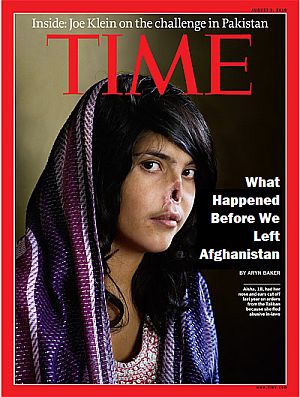
What Happens if We Leave Afghanistan” predicts the latest Time magazine cover, yet Time has not mastered a new art — taking photographs of the future. The image reflects what has happened under our watch and rather than representing the dreadful fate for Afghan women should the US and its allies prematurely relinquish control, it underlines the fact that we have never had anything more than a tenuous grip on Afghanistan.

The idea that we went there to make it a better country merely pandered to our world-saving vanity. A war billed as a necessity — the linchpin of American national security — was itself a face-saving exercise. It wasn’t about saving the faces of Afghan women, but saving the reputation of America’s military might after its weakness had been exposed by a small band of men armed with nothing more than box cutters.

The means through which the US will eventually extricate itself from this ill-conceived war will likewise be another face-saving exercise through which failure can be dressed up as success.

Meanwhile, as fewer Americans are acquiring college degrees, more are taking to the streets to protest against the construction of mosques — even while a recent study indicates mosques deter the spread of Islamic militancy.

9/11 might have caused a national wound, but the means through which we treated it turned out to be more harmful than the injury itself. Nine years later should mean nine years wiser. Instead, we find ourselves living in a nation that gets harder to parody, as reality itself becomes increasingly absurd.

Consider for instance the Pentagon’s ways of responding to Wikileaks — demanding leaked documents be “returned” (as though they had been spirited away to a secret location where a stash of Xerox sheets are now hidden) while telling DoD employees they mustn’t look at the documents (as though they’re now going to pretend they forgot how to use the internet).

As Noah Shachtman writes:

Any citizen, any foreign spy, any member of the Taliban, and any terrorist can go to the WikiLeaks website, and download detailed information about how the U.S. military waged war in Afghanistan from 2004 to 2009. Members of that same military, however, are now banned from looking at those internal military documents. “Doing so would introduce potentially classified information on unclassified networks,” according to one directive issued by the armed forces.

That cry you hear? It’s common sense, writhing in pain.

There was a time, just a few months ago, when the Pentagon appeared to be growing comfortable with the emerging digital media landscape. Troops were free to blog and tweet, as long as they used their heads and didn’t disclose secrets. Thumb drives and DVDs could be employed, as long as they didn’t carry viruses or classified information. But the WikiLeaks disclosures — tens of thousands of classified documents — seem to have reversed that trajectory.

And in a commentary on this country’s perversely misconceived national priorities, Glenn Greenwald writes:

As we enter our ninth year of the War in Afghanistan with an escalated force, and continue to occupy Iraq indefinitely, and feed an endlessly growing Surveillance State, reports are emerging of the Deficit Commission hard at work planning how to cut Social Security, Medicare, and now even to freeze military pay. But a new New York Times article today illustrates as vividly as anything else what a collapsing empire looks like, as it profiles just a few of the budget cuts which cities around the country are being forced to make. This is a sampling of what one finds:

Plenty of businesses and governments furloughed workers this year, but Hawaii went further — it furloughed its schoolchildren. Public schools across the state closed on 17 Fridays during the past school year to save money, giving students the shortest academic year in the nation.

Many transit systems have cut service to make ends meet, but Clayton County, Ga., a suburb of Atlanta, decided to cut all the way, and shut down its entire public bus system. Its last buses ran on March 31, stranding 8,400 daily riders.

Even public safety has not been immune to the budget ax. In Colorado Springs, the downturn will be remembered, quite literally, as a dark age: the city switched off a third of its 24,512 streetlights to save money on electricity, while trimming its police force and auctioning off its police helicopters.

There are some lovely photos accompanying the article, including one showing what a darkened street in Colorado looks like as a result of not being able to afford street lights. Read the article to revel in the details of this widespread misery. Meanwhile, the tiniest sliver of the wealthiest — the ones who caused these problems in the first place — continues to thrive.

And let’s be clear about what it means to thrive while others suffer. This isn’t simply callous indifference or unrestrained greed; it is parasitic behavior.

Facebooktwittermail

New York City Mayor Bloomberg’s remarks on the proposed mosque and community center in Lower Manhattan

On Tuesday August 3 2010, Mayor Michael Bloomberg joined NYC City Council Speaker Christine Quinn and religious leaders from across New York City at an event on Governor’s Island. He spoke about the importance of religious freedom and the great tradition of tolerance and diversity that has characterized New York City since its founding.

“We have come here to Governors Island to stand where the earliest settlers first set foot in New Amsterdam, and where the seeds of religious tolerance were first planted. We’ve come here to see the inspiring symbol of liberty that, more than 250 years later, would greet millions of immigrants in the harbor, and we come here to state as strongly as ever – this is the freest City in the world. That’s what makes New York special and different and strong.

“Our doors are open to everyone – everyone with a dream and a willingness to work hard and play by the rules. New York City was built by immigrants, and it is sustained by immigrants – by people from more than a hundred different countries speaking more than two hundred different languages and professing every faith. And whether your parents were born here, or you came yesterday, you are a New Yorker.

“We may not always agree with every one of our neighbors. That’s life and it’s part of living in such a diverse and dense city. But we also recognize that part of being a New Yorker is living with your neighbors in mutual respect and tolerance. It was exactly that spirit of openness and acceptance that was attacked on 9/11.

“On that day, 3,000 people were killed because some murderous fanatics didn’t want us to enjoy the freedom to profess our own faiths, to speak our own minds, to follow our own dreams and to live our own lives.

“Of all our precious freedoms, the most important may be the freedom to worship as we wish. And it is a freedom that, even here in a City that is rooted in Dutch tolerance, was hard-won over many years. In the mid-1650s, the small Jewish community living in Lower Manhattan petitioned Dutch Governor Peter Stuyvesant for the right to build a synagogue – and they were turned down.

“In 1657, when Stuyvesant also prohibited Quakers from holding meetings, a group of non-Quakers in Queens signed the Flushing Remonstrance, a petition in defense of the right of Quakers and others to freely practice their religion. It was perhaps the first formal, political petition for religious freedom in the American colonies – and the organizer was thrown in jail and then banished from New Amsterdam.

“In the 1700s, even as religious freedom took hold in America, Catholics in New York were effectively prohibited from practicing their religion – and priests could be arrested. Largely as a result, the first Catholic parish in New York City was not established until the 1780’s – St. Peter’s on Barclay Street, which still stands just one block north of the World Trade Center site and one block south of the proposed mosque and community center.

“This morning, the City’s Landmark Preservation Commission unanimously voted not to extend landmark status to the building on Park Place where the mosque and community center are planned. The decision was based solely on the fact that there was little architectural significance to the building. But with or without landmark designation, there is nothing in the law that would prevent the owners from opening a mosque within the existing building. The simple fact is this building is private property, and the owners have a right to use the building as a house of worship.

“The government has no right whatsoever to deny that right – and if it were tried, the courts would almost certainly strike it down as a violation of the U.S. Constitution. Whatever you may think of the proposed mosque and community center, lost in the heat of the debate has been a basic question – should government attempt to deny private citizens the right to build a house of worship on private property based on their particular religion? That may happen in other countries, but we should never allow it to happen here. This nation was founded on the principle that the government must never choose between religions, or favor one over another.

“The World Trade Center Site will forever hold a special place in our City, in our hearts. But we would be untrue to the best part of ourselves – and who we are as New Yorkers and Americans – if we said ‘no’ to a mosque in Lower Manhattan.

“Let us not forget that Muslims were among those murdered on 9/11 and that our Muslim neighbors grieved with us as New Yorkers and as Americans. We would betray our values – and play into our enemies’ hands – if we were to treat Muslims differently than anyone else. In fact, to cave to popular sentiment would be to hand a victory to the terrorists – and we should not stand for that.

“For that reason, I believe that this is an important test of the separation of church and state as we may see in our lifetime – as important a test – and it is critically important that we get it right.

“On September 11, 2001, thousands of first responders heroically rushed to the scene and saved tens of thousands of lives. More than 400 of those first responders did not make it out alive. In rushing into those burning buildings, not one of them asked ‘What God do you pray to?’ ‘What beliefs do you hold?’

“The attack was an act of war – and our first responders defended not only our City but also our country and our Constitution. We do not honor their lives by denying the very Constitutional rights they died protecting. We honor their lives by defending those rights – and the freedoms that the terrorists attacked.

“Of course, it is fair to ask the organizers of the mosque to show some special sensitivity to the situation – and in fact, their plan envisions reaching beyond their walls and building an interfaith community. By doing so, it is my hope that the mosque will help to bring our City even closer together and help repudiate the false and repugnant idea that the attacks of 9/11 were in any way consistent with Islam. Muslims are as much a part of our City and our country as the people of any faith and they are as welcome to worship in Lower Manhattan as any other group. In fact, they have been worshipping at the site for the better part of a year, as is their right.

“The local community board in Lower Manhattan voted overwhelming to support the proposal and if it moves forward, I expect the community center and mosque will add to the life and vitality of the neighborhood and the entire City.

“Political controversies come and go, but our values and our traditions endure – and there is no neighborhood in this City that is off limits to God’s love and mercy, as the religious leaders here with us today can attest.”

Facebooktwittermail

Shimon Peres — king of bombast

“You write history — I have to make history,” Shimon Peres says at the end of an interview with the Israeli historian Benny Morris.

At times in the interview the Israeli president almost sounds deranged.

The main reason for war was that people earned their livelihood from land. People wanted either to defend their land or conquer more land. From the moment people live from science, force can’t do [anything]. An army can’t overcome science. All these borders will be blurred. The main reason for classic wars has disappeared. What will remain are fanatical religious groups, irrational groups, dangerous to the whole world. They will be destroyed in the end, out of self-defense. There won’t be wars. There will be great rivalry. Football will be more important than war, and science more important than football. There will be a contest to develop nature’s riches. What importance is there today to land?

So I guess Israel, with its fuzzy borders and expanding settlements, is not as it appears to many of us on the outside, a state engaged in old-fashioned colonization, but rather it heralds a future in which land is no longer of any importance.

And what’s Peres’ transcendental perspective on the most contested piece of territory, Jerusalem?

Original Jerusalem, the Sacred Basin, is all told one square kilometer — the Old City, the Temple Mount, that’s the whole story. It’s small, but it’s not territory; it’s a flame, and it is difficult to divide fire, to fence in flames. What can be done? Let’s set aside [the idea of] national sovereignty and let’s look at religious sovereignty. Give each religion responsibility for its own holy sites.

So Israel’s ready to relinquish its claim of national sovereignty with an undivided Jerusalem as its capital and return to the UN’s original proposal for the holy city, internationalization?

All that will do is perpetuate the conflict, but with the involvement of more parties.

Leaving Jerusalem aflame, let’s turn to what for me was the most entertaining part of the interview — where Peres vents some good old Anglophobia (at least there’s one thing Israelis and Iranians see eye-to-eye on) and then reveals that he only watches TV broadcast from Mars.

How do you explain the rise in the delegitimization of Israel in the world in recent years? Do you agree that this is happening?

Let me give you a contrary picture: Israel is the most popular country in the world. [Peres’s media aide giggles. “Benny, you won’t leave here depressed,” she says.] For 2,000 years there was friction between the Vatican and the Jews. There are, what is it, 1.3 billion Christians? Now we have excellent relations with the Vatican. This is no small thing. And we have good relations with India, also hit by Muslim terrorists. And that’s together 3 billion. And [we now have] excellent relations with China.

Right. But why the delegitimization, especially in the West?

Firstly, there is a problem in the Scandinavian countries. They always want to appear like yefei nefesh [the Hebraism roughly translates as “bleeding hearts,” with an undertone of hypocrisy]. And I don’t expect them to understand us. Sweden doesn’t understand why we are at war. For 150 years they have not had a war. There were even Hitler and Stalin, but they kept out of the picture. As did Switzerland. So, they don’t understand why we are “for war,” as if we really like wars. It’s like Marie Antoinette didn’t understand why the people didn’t bake cakes. The same logic.

But it goes a bit beyond [Sweden and Switzerland]?

Our next big problem is England. There are several million Muslim voters. And for many members of parliament, that’s the difference between getting elected and not getting elected. And in England there has always been something deeply pro-Arab, of course, not among all Englishmen, and anti-Israeli, in the establishment. They abstained in the [pro-Zionist] 1947 U.N. Partition Resolution, despite [issuing the pro-Zionist] Balfour Declaration [in 1917]. They maintained an arms embargo against us [in the 1950s]; they had a defense treaty with Jordan; they always worked against us.

But England changed after the 1940s and 1950s. They supported us in 1967, there was Harold Brown [sic — presumably Harold Wilson or Harold Macmillan, both of whom secretly and illegally assisted Israel’s nuclear program] and Mrs. Thatcher [who were pro-Israeli].

There is also support for Israel today [on the British right].

But in Labor there was always a deep pro-Israeli current.

But [the late 1940s prime minister and Labor leader Clement] Attlee was [anti-Israel].

Anyway, this [pro-Israeli current] vanished because they think the Palestinians are the underdog. In their eyes the Arabs are the underdog. Even though this is irrational. Take the Gaza Strip. We unilaterally evacuated the Gaza Strip [in 2005]. We evacuated 8,000 settlers and it was very difficult, after mobilizing 47,000 policemen [and soldiers]. It cost us $2.5 billion in compensation. We left the Gaza Strip completely. Why did they fire rockets at us, for years they fired rockets at us. Why?

Maybe because they don’t like us?

You fire rockets at everyone you don’t like? For eight years they fired and we refrained from retaliating. When they fired at us, the British didn’t say a word.

Maybe it is anti-Semitism?

Yes, there is also anti-Semitism. There is in England a saying that an anti-Semite is someone who hates the Jews more than is necessary. But with Germany relations are pretty good, as with Italy and France.

But there is erosion of public pro-Israel sentiment — at the universities, in the press. I’m not talking about the governments.

I’ll tell you why. On television there is an asymmetry that can’t be corrected. What the terrorists do is never broadcast.

So there you have it, from the man who believes Israel is the most popular country in the world and claims that acts of terrorism directed at Israel never appear on TV. What can one say?

As an Englishman, I naturally take an interest in expressions of suspicion or hostility directed towards the British, but there is one point Peres makes that cannot pass without comment: his reference to Muslim voters in Britain. This is where Peres’ racism seeps out since he cannot bring himself to refer to this political constituency as British Muslims. They are for Peres, Muslims with the power to vote — not Britons who practice Islam.

As for the general tone of the interview as it deals with the British current, I’m reminded of similar, if somewhat more forcefully expressed sentiments coming from an American writer who sees Peter Beinart as a victim of the malevolent British influence.

After Beinart wrote his widely acclaimed piece in the New York Review of Books, “The Failure of the American Jewish Establishment,” Jim Sleeper was sure he knew how Beinart’s mind had been corrupted:

Political decay, impotence and bitterness slither out of people in peculiar ways, and, for too many Brits, who have so much more to regret and apologize for and so much bottomless hypocrisy to plumb than Israel ever will, the anguish of decline slithers out against the Jews in eerily disembodied, oddly passionless ways:

“How odd of God to Choose the Jews,” runs a characteristically disdainful verse by the 20th Century British journalist William Norman Ewer. (To which my own riposte is, “Moses, Jesus, Spinoza; Marx, Einstein, and Freud; no wonder the gentiles are annoyed.”)

Well, there are lots of annoying people and things in the world, but British Jews who swallowed Ewer’s hook on some playground or classroom in their early years seem condemned to writhe with it, much as American blacks who’ve internalized a standard of idealized whiteness turn it against blacks who are darker-skinned than themselves, and much as German Jews who’d internalized an idealized German kultur loathed the embarrassing Ostjuden from… Russia and Eastern Europe. Here — and let us not mince words — we are talking about self-hatred, a cold, fine-spun, exacting usurper of sound judgment.

Beinart’s ancestors came from Lithuania, but before World War I they migrated, with a sizable contingent of other Litvaks, to South Africa. In the interwar years of Wilsonian nationalist awakening In Lithuania and all over Europe, many more Lithuanian Jews saw what was rising around them in their home of 500 years and opted for Zionism, transforming their ancestral, liturgical Hebrew into an old/new language and migrating to Palestine in the 1920s and 30s. Still others opted for the more universal promise of Communism in Europe and Russia, and others for capitalist opportunity in America. Those who stayed put were slaughtered — more than 135,000 of them in the woods and fields around their towns and were buried in mass trenches by the Nazi Einsatzgruppen and their Lithuanian recruits in the summer of 1941.

Some Lithuanian-Jewish Communists had fled not to the USSR but to South Africa as well as to America, among them Joseph Slovo, a founder of the African National Congress. A few of the next generation of South African Jews were ANC sympathizers, like the young Ian Shapiro, now a political scientist at Yale. And some of these leftists later became neo-conservatives or bureaucratic apparatchiks in the manner I’ve mentioned, grafting an old mental morphology onto Established Power rather than onto a revolutionary pursuit of Power.

Beinart’s family and most other South African Jews weren’t leftists. They came seeking freedom from persecution and bourgeois. But in South Africa they internalized the idealized British standards I’ve mentioned, and few were immune to internalizing the “odd” but unrelenting British discomfort and pretended bemusement about Jews.

All this prompts many a British Jew’s own efforts at expiation and projection. Even young Beinart, although he grew up in Cambridge, Massachusetts and attended the Buckingham Brown and Nichols School and then Yale, where he was influenced by the Jewish nationalist political theorist Steven Smith, eventually spent a year at Oxford reckoning with whatever aspirations and insecurities the Brits of South Africa had implanted in his parents and, through them, in him.

This is a recipe for the unsavory mix of aspirations and fears we encountered in his writings and his trajectory as I sketch them briefly in bookforum. Although I don’t share their positions, Chait and Goldberg have a point: Beinart, like the estimable Tony Judt, himself a British Jew, is right in principle about Israel’s worst apologists, but he overstates his case for reasons having more to do with swift, dark currents in history and himself than with the complicated realities in Israel and Palestine.

Maybe I need to place a prominent warning on this site, alerting readers about the dangerous influence of the evil country where I grew up.

Facebooktwittermail

Iran targeted in cyber attack

Last September, Reuters reported: “Israel has been developing “cyber-war” capabilities that could disrupt Iranian industrial and military control systems. Few doubt that covert action, by Mossad agents on the ground, also features in tactics against Iran. An advantage of sabotage over an air strike may be deniability.”

Now it seems, such an attack may have occurred in recent months.

“Looks like this malware was made for espionage,” was the assessment of industry analyst Frank Boldewin when describing the recently discovered computer worm, known has Stuxnet. It targets Siemens SCADA (supervisory control and data acquisition) management systems that control energy utilities, transportation, and other vital systems. Elias Levy, senior technical director with Symantec Security Response, said: “The most we can say is whoever developed these particular threats was targeting companies in those geographic areas,” when explaining why this particular trojan has had its greatest impact in Iran.

It is just two months since the newly-created United States Cyber Command based at Fort Meade, Maryland, became operational. The creation of CYBERCOM is ostensibly a response to the United States’ vulnerability to cyber attacks. “Given our increasing dependency on cyberspace, this new command will bring together the resources of the department to address vulnerabilities and meet the ever-growing array of cyberthreats to our military systems,” Defense Secretary Robert Gates said in a statement.

But as Robert Fry, a former Deputy Commanding General of coalition forces in Iraq, notes, “the speed of cyber operations places a premium on first strike and so inverts the Clausewitzian principle of the inherent advantage of defense.” Thus, as Federal Computer Week points out: “CYBERCOM also oversees offensive cyber capabilities, and that involves developing weapons and the doctrine that governs when and how those weapons can be used.”

Did we just witness one of the opening shots in a cyber war against Iran? Stuxnet is, according to Andy Greenberg, “the first publicly-known threat, aside from occasional unattributed reports, to target the long-vulnerable infrastructure systems.” As such, the most likely instigator of such an attack would be a hostile government.

The question is: which government? Israel and/or the United States have to be the prime suspects.

Facebooktwittermail

U.S. military cyberwar: What’s off-limits?

CNET reports:

The United States should decide on rules for attacking other nations’ networks in advance of an actual cyberwar, which could include an international agreement not to disable banks and electrical grids, the former head of the CIA and National Security Agency said Thursday.

Michael Hayden, who was the principal deputy director of national intelligence and retired last year, said the rules of engagement for electronic battlefields are still too murky, even after the Defense Department created the U.S. Cyber Command last spring. The new organization is charged with allowing the U.S. armed forces to conduct “full-spectrum military cyberspace operations in order to enable actions in all domains,” which includes destroying electronic infrastructure as thoroughly as a B-2 bomber would level a power plant.

Even a formal cyberwar may have rules different from those applying to traditional warfare, Hayden suggested. One option would be for the larger G8 or G20 nations to declare that “cyberpenetration of any (financial) grid is so harmful to the international financial system that this is like chemical weapons: none of us should use them,” he said at the Black Hat computer security conference here.

Another option would be for those nations to declare that “outside of actual physical attacks in declared conflicts, denial of service attacks are never allowed and are absolutely forbidden and never excused,” and a consensus would “stigmatize their use,” said Hayden, who’s now a principal at the Chertoff Group. Nations “do not do it and they do not allow it to happen from their sovereign space.”

Facebooktwittermail

Looking back at torture

President Obama has so far refused to look back at the previous administration’s use of torture, but David Cole says: “on this issue, we cannot move forward without looking back. Unless we acknowledge that what the United States did was not just a bad idea, but illegal, we risk treating torture as simply another policy option.”

Cole presents some of the reasons the administration is unwilling to grasp the issue and argues that Britain’s new prime minister, David Cameron, has taken a lead worth following.

The Justice Department is investigating allegations of torture at the CIA’s secret prisons — but is considering only the actions of interrogators who are reported to have exceeded the brutality authorized by the Justice Department and Bush’s Cabinet. Why are the underlings being investigated, but not those who set the illegal scheme in motion?

The answer is politics. A torture investigation that could implicate the former president and vice president would be too divisive, some say. It would consume the nation’s attention and divert us from addressing other urgent problems, such as health care, the economy, global warming and immigration.

But there is an even larger political obstacle: fear. The Democratic administration is afraid of appearing more concerned about the rights of terrorism suspects than about the security of the nation. Cheney and his supporters have already accused the administration of not being tough enough on terrorists; Democrats fear that a torture inquiry might play into critics’ hands.

There is another element at work here which is the moral relativism that underpins American views on violence.

Why would a society that widely supports the death penalty regard torture as unacceptable? From the American perspective, it’s OK to poison someone, electrocute them, hang them, shoot them (though not decapitate them), with the sole condition that a reasonably sound legal process is followed.

Torture might be illegal, but it’s not clear that it conflicts with the values that Americans live by, especially those applied to people who, in the popular imagination, deserve to suffer.

Facebooktwittermail

Tree that sparked deadly border clash on Israeli side, says UN

My reference yesterday to an Israeli soldier having been on the Lebanese side of the Israel-Lebanon border turns out to have been incorrect.

The Guardian reports:

The tree that sparked a deadly confrontation between Israeli and Lebanese troops along the tense border between the two countries was on Israeli territory, the UN has said.

Five people died in the most serious clash between the two countries since the war of 2006.

Unifil, the UN force that has monitored the border since the ceasefire that ended that conflict, said that investigations had established that the tree, which Israeli troops were cutting down when Lebanese forces fired on them, was south of the “blue line” which marks the border.

“Following the exchange of fire between the Lebanese army and the Israeli army across the blue line in El Adeisse, the Unifil investigators were on the ground and commenced investigations,” it said. “The investigations are still ongoing and the findings will be intimated on [their] conclusion.

“Unifil established, however, that the trees being cut by the Israeli army are located south of the blue line on the Israeli side.”

Unifil confirmed that Israel had notified it of its intention to carry out routine maintenance work on trees along the border, and that Unifil passed the information on to the Lebanese army.

The Lebanese army admitted that its soldiers opened fire on troops from the Israeli Defence Forces (IDF) in the confrontation.

In a statement issued to the news agency AFP, a spokesman said: “The Lebanese army opened fire first at Israeli soldiers who entered Lebanese territory… This constituted defence of our sovereignty and is an absolute right.”

An Israeli battalion commander was shot dead and another officer seriously wounded. In Israeli shelling that followed, three Lebanese soldiers and a Lebanese journalist were killed.

The IDF claimed that its forces were the subject of a planned ambush, citing the presence of Lebanese media close to the border. “We have reason to believe this was planned in advance,” an IDF spokeswoman, Avital Leibovich, said. She added that the initiative could have come from Lebanese army units under the influence of the Islamist militant organisation Hezbollah.

Most analysts agreed that the incident was likely to be contained rather than flaring into an ongoing conflict along the tense border.

The dead Israeli soldier, Lieutenant Colonel Dov Harari, a 45-year-old father of four, was to be buried in the coastal city of Netanya later today.

Meanwhile, a Palestinian militant was killed in an air strike in Gaza early today. Sharif Abdel Hadi Abbey, 22, died and two others were injured in the strike close to Khan Younis, according to Palestinian souces. The IDF said aircraft had fired at Palestinians approaching the Gaza border fence.

Facebooktwittermail

Israeli provocation on Lebanese border could trigger new war

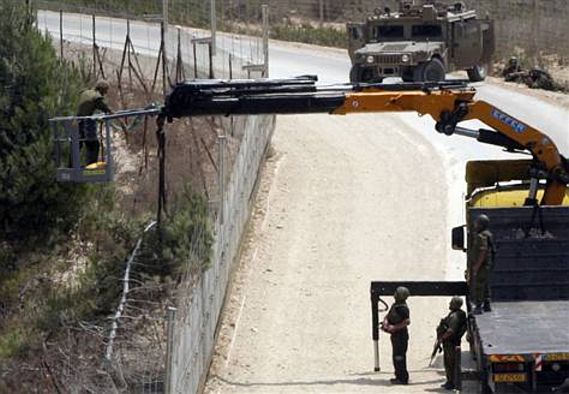
An Israeli soldier being dangled like bait on the Lebanese side of the Israel-Lebanon border today.

Update below

Border clashes between Israeli and Lebanese troops have left three Lebanese soldiers and a journalist dead. Lebanon’s Hezbollah TV, Al Manar, reports one high-ranking Israeli officer has been killed but this has not been confirmed by the Lebanese army or UN troops stationed in southern Lebanon.

As the photo above makes clear, this was a blatant act of provocation by Israeli forces — no one accidentally strayed over the border. This is more like kids tossing matches to find out whether a brush fire will start.

Tony Karon writes:

Should a new war break out, Israel is determined to strike a more devastating blow more quickly than it did during the last conflict, in which it failed in its objective of destroying Hizballah. It has publicly warned that it would destroy Lebanese civilian infrastructure, and that Syria, as Hizballah’s armorer, would not be off-limits. But Hizballah believes its capacity to fire missiles into Tel Aviv is key to restraining Israel from returning to finish off the Shi’ite militia. And, of course, amid regional tensions over Iran’s nuclear program, members of the self-styled “axis of resistance” — Iran, Syria, Hamas and Hizballah — have deepened their alliance, raising the possibility of any one of those groups joining the fray should any of the others come under attack from Israel or the U.S.

Although all of the main players have good reason to avoid initiating another war right now, the Crisis Group warns that “tensions are mounting with no obvious safety valve.” At some point, Hizballah’s growing deterrent could cross Israel’s red line. And the Western diplomatic boycott of the resistance camp is cause for alarm because there are no effective channels through which the various antagonists can be made to understand how their actions could produce unintended consequences — in the tragic tradition of Middle Eastern wars that erupted in part because the adversaries failed to understand one another’s intentions. Indeed, after proclaiming his movement’s “divine victory” in standing up to Israel’s 2006 offensive, a feat that made him a hero on the streets of the Arab world, Hizballah leader Sheik Hassan Nasrallah did admit that had he known Israel would respond with a full-blown invasion, he would have avoided the provocation of snatching the Israeli troops that started the showdown.

The danger posed by the lack of communication channels between the resistance camp and the Israelis explains why British Prime Minister David Cameron, a recent guest at the White House, last week went to Ankara to urge Turkey to maintain its ties with Israel and use its ties to the likes of Syria to facilitate communication that could mitigate an outbreak. Turkey has been pilloried in some quarters in the West — and certainly in Israel — for its diplomatic rapprochement with the likes of Syria, Iran and Hamas, but Cameron’s appeal was a tacit admission that the continuing Bush-era policy of refusing to engage with the region’s designated “radicals” has sharply diminished the ability of the U.S. and the European Union to influence events in the Middle East. Peace talks between Palestinian Authority President Mahmoud Abbas and the Israelis are all very well, but Abbas is not at war with Israel, nor would he be even if a new round of fighting broke out in Gaza.

While it is widely assumed that Hezbollah would have a critical role to play in the event that Israel launches or instigates an attack on Iran, it likewise follows that the IDF will be tempted to decisively neutralize this threat preemptively. The problem, for Israel, is this: what happens if a preemptive attack fails, meaning, Israel comes under even heavier rocket attack than it did in 2006 and that Hezbollah survives an even more brutal onslaught than it suffered in that war? In such an outcome, the idea of subsequent military action against Iran becomes even more implausible than it already is.

Update: Ynet reports:

IDF Lieutenant Colonel Dov Harari, 45, was killed in the border skirmish with the Lebanese army Tuesday.

Harari was an IDF reservist who served as a battalion commander in the sector where the clash took place. Another Israeli commander sustained serious wounds in the skirmish, the army said.

The fact that Al Manar reported this fatality hours before it was confirmed by the IDF, suggests that Hezbollah continues to effectively monitor Israeli communications.

Haaretz provides the quaint explanation that the violence was triggered “over a move by Israeli soldiers to trim some hedges along the border,” though the Jerusalem Post said: “Other reports said the Israeli soldiers were attempting to plant cameras.”

Facebooktwittermail

Is Payoneer under US investigation for role in Dubai murder?

The Wall Street Journal reports:

American investigators, cooperating in a probe of the January assassination of a top Palestinian leader in Dubai, have identified a handful of U.S.-based companies believed to have been used to transfer money to suspects in the case, a finding that brings international authorities closer to identifying who funded the operation.

The findings show American authorities playing a bigger role in the investigation than previously revealed. The case is especially delicate for the U.S., because Dubai police have said their prime suspect in the case is Mossad, the intelligence service of Israel, a key U.S. ally.

International investigators see money transfers made through the U.S. companies as key clues in a globe-spanning manhunt aimed at identifying more than two dozen suspects in the case, according to officials familiar with the matter.

The U.S. companies identified by investigators include Internet-based businesses that match freelance job-seekers with employers and process payments between the two sides. Authorities have identified financial transfers from several of these intermediary businesses into prepaid, cash-card accounts used by suspects in the Dubai killing, according to international investigators.

U.S. authorities say they don’t believe the intermediary companies had any way of knowing the money would be used in the plot, according to a U.S. official familiar with the investigation.

Instead, U.S. investigators believe, suspects might have posed as freelancers in order to get money in a way that obscured their funding source, and used the money for operational expenses, such as buying plane tickets.

The next step in the investigation would be to determine who the employers were in the transactions.

Representatives of several companies identified in the probe said they hadn’t been contacted by U.S. authorities and weren’t aware of any investigation.

Note that the report says “several companies” — it does not say “all the companies” — which leaves open the possibility that Payoneer, the New York-based company run by the former IDF special ops commando, Yuval Tal, is indeed under investigation.

In March Al Jazeera reported: “The UAE central bank is investigating how 24 suspects obtained credit cards from US company, Payoneer. Although registered in the US, Payoneer’s employees are mostly in Israel, this creating a stir on the internet about possible Mossad connections.”

In March, Gulf News reported:

The Payoneer connection unveils a network of links to Israel, specifically its intelligence community.

Its CEO is Yuval Tal, an Israeli citizen who, according to media reports, described himself as a former Israeli special forces commando in a 2006 Fox News interview.

Clips of the interview on video sharing websites have been removed.

However, a person who said he met Tal a couple of times but did not want to be named told Gulf News that “there is no question in my mind that Yuval has contacts with [Israel’s spy agency] Mossad”.
He recalled a conversation Tal had with attendees of a Jewish charity event in New York, where he spoke of his connections with Mossad.

“Yuval was entertaining a small group of people with tales of his IDF [Israeli Defence Forces] exploits… Specifically, he was commending Israeli intelligence and how Mossad and [Israel’s internal security agency] Shin Bet always gave him great information on his commando raids. He said his ‘colleagues’ are tracking [Hamas leaders Khaled] Mesha’al and [Esmail] Haniyeh’s movements almost every day,” he said.

Payoneer is held by three venture capital firms: Greylock Partners, Carmel Ventures, and Crossbar Capital.
Greylock, which has offices in the US, India and Herzliya, Israel, was established by Moshe Mor, a former military intelligence captain in the Israeli army.

Carmel Ventures is an Israeli venture capital fund based in Herzliya. Crossbar Partners is run by Charlie Federman, who is also managing director of the BRM Group, a venture capital fund also in Herzliya that was founded by Nir and Eli Barkat, the former of whom is the mayor of occupied Jerusalem.

Facebooktwittermail

The Goldilocks view of war against Iran

Steven Simon and Ray Takeyh present a Goldilocks approach to war against Iran: not too much, not too little but war cooked just right. Who knew war could be modulated so carefully?

As it contemplated the use of force, the administration’s decision-making would be further complicated by the need for a plan to unwind military hostilities and make sure a confrontation did not escalate out of control. The White House would have to signal to Tehran that the U.S. military objective was not to overthrow the clerical regime but to enforce the will of the international community by disabling Iran’s nuclear program. The message would need to make clear that for the United States, hostilities would end with the destruction of Iran’s nuclear facilities, but that if Iran retaliated, Washington would press its attacks until Tehran could no longer respond. A sobering thought not just for the mullahs, but also for a U.S. administration that would have to carry out the threat.

Facebooktwittermail

America’s sense of the sacred

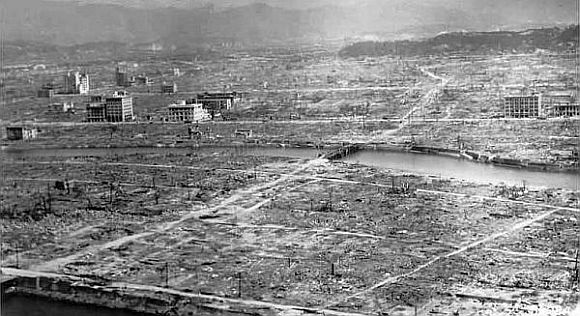
Hiroshima: the original Ground Zero

The New York Times reports:

An influential Jewish organization on Friday announced its opposition to a proposed Islamic center and mosque two blocks north of ground zero in Lower Manhattan, intensifying a fierce national debate about the limits of religious freedom and the meaning of the Sept. 11 terrorist attacks.

The decision by the group, the Anti-Defamation League, touched off angry reactions from a range of religious groups, which argued that the country would show its tolerance and values by welcoming the center near the site where radical Muslims killed about 2,750 people.

But the unexpected move by the ADL, a mainstream group that has denounced what it saw as bigoted attacks on plans for the Muslim center, could well be a turning point in the battle over the project.

In New York, where ground zero has slowly blended back into the fabric of the city, government officials appear poised to approve plans for the sprawling complex, which would have as many as 15 stories and would house a prayer space, a performing arts center, a pool and a restaurant.

But around the country opposition is mounting, fueled in part by Republican leaders and conservative pundits. Sarah Palin, the 2008 Republican vice-presidential nominee, has urged “peace-seeking Muslims” to reject the center, branding it an “unnecessary provocation.” A Republican political action committee has produced a television commercial assailing the proposal. And former House Speaker Newt Gingrich has decried it in speeches.

The complex’s rapid evolution from a local zoning dispute into a national referendum highlights the intense and unsettled emotions that still surround the World Trade Center site nine years after the attacks.

To many New Yorkers, especially in Manhattan, it is a construction zone, passed during the daily commute or glimpsed through office windows. To some outside of the city, though, it stands as a hallowed battlefield that must be shielded and memorialized.

Those who are fighting the project argue that building a house of Muslim worship so close to ground zero is at best an affront to the families of those who died there and at worst an act of aggression that would, they say, mark the place where radical Islam achieved a blow against the United States.

“The World Trade Center is the largest loss of American life on our soil since the Civil War,” Mr. Gingrich said. “And we have not rebuilt it, which drives people crazy. And in that setting, we are told, why don’t we have a 13-story mosque and community center?”

He added: “The average American just thinks this is a political statement. It’s not about religion, and is clearly an aggressive act that is offensive.”

Several family members of victims at the World Trade Center have weighed in against the plan, saying it would desecrate what amounts to a graveyard. “When I look over there and see a mosque, it’s going to hurt,” C. Lee Hanson, whose son, Peter, was killed in the attacks, said at a recent public hearing. “Build it someplace else.”

Those who support it seem mystified and flustered by the heated opposition. They contend that the project, with an estimated cost of $100 million, is intended to span the divide between Muslim and non-Muslim, not widen it.

Oz Sultan, the programming director for the center, said the complex was based on Jewish community centers and Y.M.C.A.’s in Manhattan. It is to have a board composed of Muslim, Christian and Jewish leaders and is intended to create a national model of moderate Islam.

“We are looking to build bridges between faiths,” Mr. Sultan said in an interview.

City officials, particularly Mayor Michael R. Bloomberg, have forcefully defended the project on the grounds of religious freedom, saying that government has no place dictating where a house of worship is located. The local community board has given overwhelming backing to the project, and the city’s landmarks commission is expected to do the same on Tuesday.

“What is great about America, and particularly New York, is we welcome everybody, and if we are so afraid of something like this, what does that say about us?” Mr. Bloomberg asked recently.

“Democracy is stronger than this,” he added. “And for us to just say no is just, I think — not appropriate is a nice way to phrase it.”

Still, the arguments against the Muslim center appear to be resonating. Polling shows that a majority of Americans oppose building it near ground zero.

It’s not surprising that the destructive force of two massive collapsing buildings — sinking like atomic mushroom clouds in reverse — would at that time have evoked comparisons with nuclear destruction. Even so, the fact that the name “ground zero” stuck shows how little effort was ever made to view the horror of that day with a sense of proportion.

On August 6, 1945, beneath the original ground zero where at 8.15 that summer morning the “Little Boy” nuclear weapon exploded, two-thirds of Hiroshima was instantly destroyed and a third of the inhabitants perished.

If survivors of America’s nuclear attack on Japan, from which over 200,000 people died, feel that it is inappropriate to associate that level of destruction with the way America suffered on 9/11, I can understand why. It is as if to say, nothing more devastating the 9/11 could be imagined — when of course it can, and to do so we need not look far back in history or to the deeds of some horrific foreign foe.

That the sanctity of the World Trade Centers site is said to be threatened by the construction of a mosque a few blocks away says more about the way the site remains a potent vehicle of American nationalism than it does about anyone’s insensitivity towards the memory of those who died there.

Want to know what gross insensitivity looks like? Then look at another construction site 5,000 miles further east, to Jerusalem where the inaptly named Museum of Tolerance is being built on top of an historic Muslim cemetery. A round-the-clock excavation has proceeded with haste under high security as skeletons are stuffed in boxes and carted off the site — apart from those that get trampled under foot. A senior archaeologist told Haaretz: “They wanted to create a done deed, after which people could yell all they wanted to, but there wouldn’t be any graves left anymore.”

Facebooktwittermail

Secrets worth revealing

“Dr Ellsberg, do you have any concern about the possibility of going to prison for this?”

“Wouldn’t you go to prison to help end this war?” Ellsberg responded when asked by reporters about the repercussions he might face after leaking the Pentagon Papers.

The 40-year old former US military analyst who was then working for the RAND Corporation, knew exactly the risks he was taking. In 1971, his was a courageous act of conscience, clear-eyed and utterly responsible.

Almost 40 years later, Wikileaks founder Julian Assange sees himself in the same role — with a difference. Assange seems to have become caught up in the mystique of whistleblowing and allowed the actors and the mechanism through which they reveal secrets to assume as much importance as the secrets themselves.

Someone using the handle Bradass87 seems to have been the source of the leaked Afghan war logs, which he described like this: “its open diplomacy … its Climategate with a global scope and breathtaking depth … its beautiful and horrifying … It’s public data, it belongs in the public domain.”

It would appear that Bradass87 is a 22-year old intelligence analyst, Private Bradley Manning. He was arrested on May 26 and was transferred today from Kuwait to Quantico, Virginia where he is in military custody and has been placed on suicide watch.

Assuming that Manning was indeed the source, it’s hard to believe that he deeply weighed up the risks he was taking. The comparison with the so-called Climategate is perhaps telling — another leak where the act of revelation had more significance than the content.

It was Assange who held up the Pentagon Papers parallel, which again perhaps said less about the documents than about the Wikileaks founder’s desire to be seen as a modern Ellsberg — even though Assange’s role is actually much closer to that of a newspaper publisher than that of a whistleblower.

Through Wikileaks, Assange has created a new and immensely valuable infrastructure for whistleblowing, but as with everything else enabled by the internet, the medium should not be confused with the content. But since in this case that is to a significant degree what has happened, the story that has captivated the media for a week has been a story about Wikileaks as much as it has been about the war in Afghanistan.

In the short run, this might provide a boost to Wikileaks and draw wider attention to its work, but in the long run the value of whistleblowing itself will be undermined if it comes to be regarded as political theater where the actors claim more attention that the text.

When asked to comment on the war logs, Ellsberg said that they are significant more for what they lack than what they contain: they provide no plausible justification for the war. But when asked by the Washington Post whether there are indeed important documents, yet to be leaked, declassified or otherwise made public, that could fundamentally alter public understanding of key national security issues and foreign policy debates, he gladly drew up a wish list:

1. The official U.S. “order of battle” estimates of the Taliban in Afghanistan, detailing its size, organization and geographic breakdown — in short, the total of our opponents in this war. If possible, a comparison of the estimate in December 2009 (when President Obama decided on a troop increase and new strategy) and the estimate in June or July 2010 (after six or seven months of the new strategy). We would probably see that our increased presence and activities have strengthened the Taliban, as has happened over the past three years.

2. Memos from the administration’s decision-making process between July and December 2009 on the new strategy for Afghanistan, presenting internal critiques of the McChrystal-Petraeus strategy and troop requests — similar to the November 2009 cables from Ambassador Karl W. Eikenberry that were leaked in January. In particular, memos by Vice President Biden, national security adviser Jim Jones and others; responses to the critiques; and responses to the responses. This paperwork would probably show that, like Eikenberry, other high-level internal critics of escalation made a stronger and more realistic case than its advocates, warranting congressional reexamination of the president’s policy.

3. The draft revision, known as a “memo to holders,” of the National Intelligence Estimate on Iran from November 2007. This has been held up for the past several months, apparently because it is consistent with the judgment of that NIE that Iran has not made a decision to produce nuclear weapons. In particular, the contribution to that memo by the State Department’s Bureau of Intelligence and Research (INR), since the INR has had the best track record on such matters. Plus, estimates by the INR and others of the likelihood of an Israeli attack on Iran later this summer. Such disclosures could arrest momentum toward a foreseeably disastrous U.S.-supported attack, as the same finding did in 2007.

4. The 28 or more pages on the foreknowledge or involvement of foreign governments (particularly Saudi Arabia) that were redacted from the congressional investigation of 9/11, over the protest of then-Sen. Bob Graham (D-Fla.).

On each of these matters, congressional investigation is called for. The chance of this would be greatly strengthened by leaks from insiders. Subsequent hearings could elicit testimony from the insiders who provided the information (whose identities could be made known to congressional investigators) and others who, while not willing to take on the personal risks of leaking, would be ready to testify honestly under oath if requested or subpoenaed by Congress. Leaks are essential to this process.

Through the revelation of such documents, Wilileaks would demonstrate its value, but if such revelations are to occur it will most likely require a selfless act of courage from someone who occupies a higher perch in government than the one held by Private Bradley Manning.

Facebooktwittermail