Author Archives: Paul Woodward

Cost of Operation Hemorrhage: $4,200. Damage done: priceless

Al Qaeda no longer needs its bombs to detonate. It merely needs to toy with those who have allowed themselves to be governed by fear.

By pursuing a strategy with minimal cost to itself, al Qaeda can be assured that we will inflict the maximum economic damage to ourselves because of our unwillingness to face life’s only certainty: our mortality. Neither the TSA, nor the US Government, nor the US military, nor the war on terrorism, can make us safe, because life isn’t safe.

In pursuit of an unattainable level of safety we show ourselves willing to accept all manner of indignities — all in the name of security. But as one of the latest airline passengers, recounting the humiliation he suffered at the hands of TSA officers, said: “if this country is going to sacrifice treating people like human beings in the name of safety, then we have already lost the war.”

Indeed, as al Qaeda’s planners survey the American scene, they can only marvel at the ease with which they have established their own competitive advantage.

As the New York Times reports:

In a detailed account of its failed parcel bomb plot last month, Al Qaeda’s branch in Yemen said late Saturday that the operation cost only $4,200 to mount, was intended to disrupt global air cargo systems and reflected a new strategy of low-cost attacks designed to inflict broad economic damage.

The group, Al Qaeda in the Arabian Peninsula, released to militant Web sites a new edition of its English-language magazine, called Inspire, devoted entirely to explaining the technology and tactics in the attack, in which toner cartridges packed with explosives were intercepted in Dubai and Britain. The printers containing the cartridges had been sent from Yemen’s capital, Sana, to out-of-date addresses for two Chicago synagogues.

The attack failed as a result of a tip from Saudi intelligence, which provided the tracking numbers for the parcels, sent via United Parcel Service and FedEx. But the Qaeda magazine said the fear, disruption and added security costs caused by the packages made what it called Operation Hemorrhage a success.

“Two Nokia mobiles, $150 each, two HP printers, $300 each, plus shipping, transportation and other miscellaneous expenses add up to a total bill of $4,200. That is all what Operation Hemorrhage cost us,” the magazine said.

It mocked the notion that the plot was a failure, saying it was the work of “less than six brothers” over three months. “This supposedly ‘foiled plot,’ ” the group wrote, “will without a doubt cost America and other Western countries billions of dollars in new security measures. That is what we call leverage.”

The magazine included photographs of the printers and bombs that the group said were taken before they were shipped, as well as a copy of the novel “Great Expectations” by Charles Dickens that it said it had placed in one package because the group was “very optimistic” about the operation’s success.

Although Western security officials have insisted that at least one of the parcel bombs was hours away from exploding, it seems just as likely that this operation was designed to showcase security vulnerabilities — that indeed it was conceived as a magazine cover story.

Facebooktwittermail

Evolving understanding of Stuxnet

Reporting on the latest findings on the design of the Stuxnet malware which targeted Iran’s nuclear program, the New York Times says that Ralph Langner — a German software engineer who has been one of the leading investigators — has identified two forms of attack directed at different targets.

In a statement Friday on his Web site, he described two different attack modules that are designed to run on different industrial controllers made by Siemens, the German industrial equipment maker. “It appears that warhead one and warhead two were deployed in combination as an all-out cyberstrike against the Iranian nuclear program,” he wrote.

In testimony before the Senate on Wednesday, federal and private industry officials said that the Iranian nuclear program was a probable target, but they stopped short of saying they had confirming evidence. Mr. Langner said, however, that he had found enough evidence within the programs to pinpoint the intended targets. He described his research process as being akin to being at a crime scene and examining a weapon but lacking a body.

The second code module — aimed at the [Bushehr] nuclear power plant — was written with remarkable sophistication, he said. The worm moves from personal computers to Siemens computers that control industrial processes. It then inserts fake data, fooling the computers into thinking that the system is running normally while the sabotage of the frequency converters is taking place. “It is obvious that several years of preparation went into the design of this attack,” he wrote.

In a separate report, the New York Times said:

The paternity of the worm is still in dispute, but in recent weeks officials from Israel have broken into wide smiles when asked whether Israel was behind the attack, or knew who was.

Langner says: “Stuxnet is like the arrival of an F-35 fighter jet on a World War I battlefield.”

Why would Israel target a civilian nuclear facility that is generally understood to pose no proliferation threat?

In line with its practice of paying selective attention to international opinion, Israel’s public position has been that Iran should not be “rewarded” for its defiance of the international community by being allowed to operate Bushehr. Moreover, there could also be a political motive for trying to prevent Bushehr from operating successfully, that being, to undermine the credibility of the nuclear program in the eyes of the otherwise widely supportive Iranian public.

Langner says that a cyber attack targeting a nuclear reactor is virtually impossible but that Bushehr’s steam turbine (located outside the containment facility) could be hit and that “Stuxnet can destroy the turbine as effectively as an air strike.”

Like everyone else, the Israelis understand that the most critical part of the infrastructure in Iran’s nuclear program is not made of steel or concrete — it is the expertise of Iran’s nuclear scientists and engineers. (For that reason, Israel’s covert war against Iran apparently includes a “decapitation” program aimed at eliminating the top figures in Iran’s nuclear operations.)

Since many of the skills required to run a civilian nuclear power program are presumably transferable to a military program, sabotage on any of Iran’s nuclear facilities will have the net effect of becoming a drain on the human resources available to advance the program as a whole.

The fact is, after decades of nuclear development, Iran still has precious little to show for its efforts. Keep in mind, the construction of Bushehr began 35 years ago and Iran’s nuclear program was launched in the 1950s!

Facebooktwittermail

American supremacy

Matt Miller writes:

Does anyone else think there’s something a little insecure about a country that requires its politicians to constantly declare how exceptional it is? A populace in need of this much reassurance may be the surest sign of looming national decline.

American exceptionalism is now the central theme of Sarah Palin’s speeches. The supposedly insufficient Democratic commitment to this idea will be a core Republican complaint in 2012. Conservatives assail Barack Obama for his alleged indifference to it. It’s part of their broader indictment of Obama’s fishy cosmopolitanism, his overseas “apology tours,” his didn’t-wear-the-flag-lapel-pin-until-he-had-to peevishness. Not to mention the whole anti-colonial Kenyan resentment thing the president’s got going.

Real men – real Americans – know America is the greatest country ever invented. And they shout it from the rooftops. Don’t they?

Miller quotes newly-elected Republican senator, Marco Rubio, who offers this supercharged declaration of American exceptionalism: “Americans believe with all their heart, that the United States of America is simply the single greatest nation in all of human history, a place without equal in the history of all of mankind.”

Leave aside the fact that many Americans who hold this view have never actually visited another country, expressions of America’s exceptional character such as that by Rubio, represent a view of the world as much as one of America. Moreover, this is not merely about saying that America is unique but that it is superior to every other nation and that it must vigorously guard this position of supremacy.

If this was about praising a set of virtues, then one might imagine that those who see America in this way, would hope that every other nation might at some time share the same set of virtues. Clearly they do not hold this hope, because this is not about virtue or excellence — it is about power and domination. That America could be dislodged from its position of supremacy — this is the greatest fear of the supremacists.

In as much as American exceptionalism is rooted in a belief in American supremacy, then the power ascribed to the nation is implicitly shared by every American. That this is make-believe power is evident in the frequency and loudness with which it is declared and the fact that those who profess their conviction in this power nevertheless clearly easily feel threatened — threatened by the government; by the rest of the world; by immigrants; and by other Americans who don’t share their views.

And yet, the idea that the next presidential election will be a contest based on Americanism, is something that Democrats can justifiably fear. Even if Sarah Palin’s candidacy flops, this theme will be picked up by others as the cause of raw American nationalism easily resonates with a dispirited electorate.

As his victory speech made evident, Marco Rubio has an America-first message much harder to dismiss than Palin’s. The worst mistake of those who find this view of America unpalatable is to fail to take it seriously.

Facebooktwittermail

How long will it take the Washington press corps to discover the big story in Washington?

The story so far:

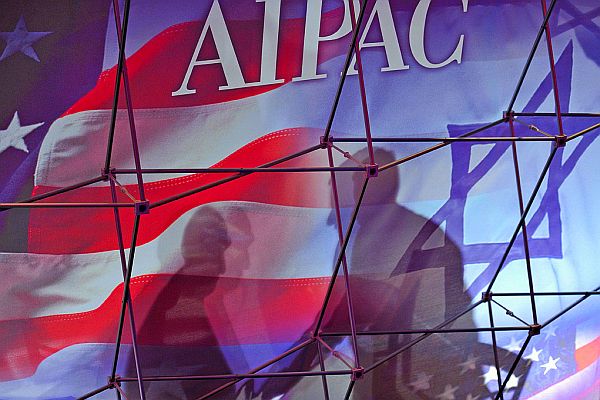
November 8: the American Israel Public Affairs Committee (AIPAC) files a 260-page motion [large pdf — don’t attempt to download without broadband] in the District of Columbia Superior Court, in which AIPAC is attempting to fend off a $20 million defamation suit from former employee Steven J Rosen who claims he was wrongfully dismissed. AIPAC ditched him and his colleague Keith Weissman in 2005 when the pro-Israel lobby feared investigation by the FBI.

November 15: Grant Smith highlights much of the politically damaging content of the motion in an Antiwar article, AIPAC Bares All to Quash Lawsuit.

November 16: the story is picked up by MJ Rosenberg, The Forward and others.

November 17: the story is gathering steam in the Jewish press, with items in the JTA and Haaretz.

As for the Washington Post, the New York Times and the rest of the US mainstream media, well as of noon Wednesday, it’s apparently still nap time — or, a figurative bloodbath at that obscure and uninfluential lobbying organization really isn’t news — or, there’s no such thing as the Israel lobby and so why should the press pay any attention — or, a bunch of spineless editors, worried about embarrassing their friends at AIPAC, are looking over their shoulders waiting to see which of their competitors is going to break loose first and force them to report on this unseemly turn of events.

And as for why AIPAC and Rosen are both willing to engage in what looks like a self-destructive fight, I suspect that their interests are not actually as far apart as they seem.

Rosen says: “Any embarrassment I suffered as a result of what they filed will be insignificant compared to the embarrassment they’ll suffer after we file our motion.” This seems to be key: that both sides are engaged in campaigns to embarrass the other and both sides are ultimately served if the conflict can be contained to one of embarrassment.

AIPAC can survive embarrassment. What it cannot survive would be investigation by the FBI. It can get away with looking like a sleazy operation. It can’t get away with being exposed as being the instrument of a foreign government.

At the same time, this is also a fight over money. Rosen’s devotion to Zionism turns out to have come with an enormous price tag at a time that AIPAC is not as flush with funds as it used to be.

Hard times for the Israel lobby.

Facebooktwittermail

Clear evidence that Stuxnet targeted Natanz nuclear centrifuges

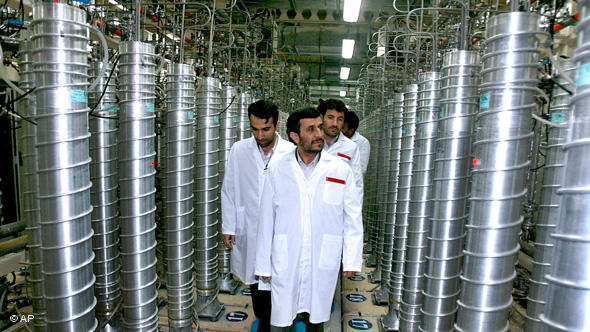
The latest evidence revealed by two independent groups of researchers studying the code in the Stuxnet malware — the world’s first identified cyber weapon — indicates the Iran’s uranium enrichment facility at Natanz was almost certainly the target for attack. Not only was it aimed at programmable logic controllers that regulate motor speeds in a limited number of applications, mainly in uranium enrichment. Stuxnet would also alter operating speeds in such a way that centrifuges would unpredictably malfunction — the intent clearly being that the sabotage would be both effective yet also go unrecognized as sabotage.

Christian Science Monitor reports:

Once Stuxnet has locked its sights on the target, it alternately brings the centrifuge process to either a grinding slowdown or an explosive surge – by sabotaging the centrifuge refining process. It tells the commandeered PLC to force the frequency converter drive to do something it’s not ever supposed to do: Switch back and forth from high speed to low speed at intervals punctuated by long period of normal operation. It also occasionally pushes the centrifuge to far exceed its maximum speed.

“Stuxnet changes the output frequencies and thus the speed of the motors for short intervals over periods of months,” Symantec researcher Eric Chien reported Nov. 12 on his blog. “Interfering with the speed of the motors sabotages the normal operation of the industrial control process.”

Normal operating frequency of the special drive is supposed to be between 807 and 1210 Hz – the higher the hertz, the higher the speed. One hertz means that a cycle is repeated once per second.

Stuxnet “sabotages the system by slowing down or speeding up the motor to different rates at different times,” including sending it up to 1410 Hz, well beyond its intended maximum speed. Such wide swings would probably destroy the centrifuge – or at least wreck its ability to produce refined uranium fuel, others researchers say.

“One reasonable goal for the attack could be to destroy the centrifuge rotor by vibration, which causes the centrifuge to explode” as well as simply degrading the output subtly over time, Ralph Langner, the German researcher who first revealed Stuxnet’s function as a weapon in mid-September, wrote on his blog last week.

All of the circumstantial evidence points in the same direction: Natanz.

The Natanz nuclear centrifuge fuel-refining plant may have been hit first by Stuxnet in mid-2009, said Frank Rieger, a German researcher with Berlin encryption firm GSMK. The International Atomic Energy Agency found a sudden drop in the number of working centrifuges at the Natanz site, he noted in an interview in September.

“It seems like the parts of Stuxnet dealing with PLCs have been designed to work on multiple nodes at once – which makes it fit well with a centrifuge plant like Natanz,” Mr. Rieger says. By contrast, Bushehr is a big central facility with many disparate PLCs performing many different functions. Stuxnet seems focused on replicating its intrusion across a lot of identical units in a single plant, he said.

That and Symantec’s new findings also dovetail nicely with Mr. Langner’s detailed findings in his ongoing dissection of Stuxnet. Parts of the code show Stuxnet causing problems for short periods, then resuming undisturbed operation, Symantec’s findings show. As a result, Langner writes, “the victim, having no clue of being under a cyber attack, will replace broken centrifuges by new ones – until ending in frustration. It’s like a Chinese water torture.”

Facebooktwittermail

From the top there’s only one way forward: down

Mature cosmological systems recognize the cyclical nature of change: that growth is followed by decay and that power gathered is later dispersed. These are not ideas readily embraced by an imperial power and thus America has driven itself into a trap which it cannot back out of without undermining its own image of preeminence.

The trap that a great power falls into as soon as it makes the mistake of using blunt force against an asymmetrical threat is that its opponent has the exclusive ability to make tactical retreats with its pride in tact.

For a decade now, America has been fighting adversaries who operate unwaveringly according to the Maoist principles of guerrilla warfare: “The enemy advances, we retreat; the enemy camps, we harass; the enemy tires, we attack; the enemy retreats, we pursue.”

The war on terrorism, whose sole purpose was to put on display the preeminence of American power, has instead in every possible way demonstrated the limits of American power and yet even now the prospect of defeat cannot be entertained.

The Obama administration, desperate to find a way out of Afghanistan, refuses to admit that it is developing an exit strategy. The plan to end combat missions by 2014 is not an exit strategy; it is a “transition strategy” US envoy Richard Holbrooke claims.

And as if to guard against the risk that Obama might end a second term (if he gets one) with the United States no longer at war, he seems intent on starting a war of his very own — a war whose beginning echoes America’s entry into Vietnam.

The Wall Street Journal reports:

The U.S. is preparing for an expanded campaign against al Qaeda in Yemen, mobilizing military and intelligence resources to enable Yemeni and American strikes and drawing up a longer-term proposal to establish Yemeni bases in remote areas where militants operate.

The developments are part of a U.S. scramble to step up the hunt for members of al Qaeda in the Arabian Peninsula, the terrorist organization behind a recent failed attempt to blow up two planes over the U.S. using bombs hidden in cargo.

Limited U.S. intelligence experience in Yemen has created “a window of vulnerability” that the U.S. government is “working fast to address,” a senior Obama administration official said.

For now, the U.S. gets much of its on-the-ground intelligence from a growing partnership with Saudi Arabia, which shares a border with Yemen and has a fruitful informant network in Yemen’s tribal areas.

In the rush to build up capabilities, the Central Intelligence Agency and other agencies are moving in equipment and personnel from other areas, and over the past year have expanded the size of teams in the U.S. analyzing intelligence on AQAP. The emphasis now is on expanding the number of intelligence operatives and analysts in the field.

There is a debate within the Obama administration and Pentagon about how best to ramp up the fight against AQAP, the Yemen-based terrorist group. Supporters of establishing forward operating bases for Yemeni forces say they would help the weak Yemeni government expand its control and create an opportunity to get a small number of American Special Operations trainers and advisers out of the capital region and into the field.

Facebooktwittermail

AIPAC bares all to quash Rosen lawsuit

Maybe the days of the Israel lobby are numbered — not because it’s about to fall apart but because the terms of discourse will change. That is, we will no longer be speaking about a “lobby” as such but more explicitly about the evidence that the state of Israel has effectively pulled off a soft coup and through its informal representatives in Washington assumed a controlling influence over significant parts of the US government.

To put the notion of America under Israeli control in perspective, imagine this: if at the height of the Cold War, hundreds of USG officials and political operatives inside Washington were discovered to have sympathies and close ties with the Soviet Union. No greater shock to the American political system would have been seen since the Civil War. The fact that Israel is characterized as a friendly state really does little to diminish the significance of the influence it wields in domestic American politics. No other foreign government enjoys a fraction of Israel’s power in the US.

Grant Smith writes:

On Nov. 8, 2010, the American Israel Public Affairs Committee (AIPAC) filed a massive 260-page motion [.pdf] in the District of Columbia Superior Court. It asks Judge Erik Christian to dismiss former AIPAC employee Steven J. Rosen’s $20 million defamation suit. In October the court dismissed all counts of the March 2009 lawsuit except for Rosen’s claim of harm over AIPAC statements to the press that he did not uphold its standards of conduct. Rosen and AIPAC have – until now – abstained from filing damaging information about the internal workings of AIPAC in court. AIPAC’s willingness to publicly air some extremely sordid and revealing content to get the remaining count thrown out before an alternative dispute resolution hearing begins in December is a sign that AIPAC is now fighting for its life, or – as one former AIPAC attorney put it – “reason for being.” If Rosen proves in court that AIPAC has long handled classified information while lobbying for Israel, the worn public pretense that AIPAC is anything but a stealth extension of the Israeli Ministry of Foreign Affairs – from which it emerged in 1951 – will end forever.

Rosen filed his civil suit after adverse judicial rulings made his (and coworker Keith Weissman’s) prosecution under the Espionage Act unlikely. Col. Lawrence Franklin pled guilty to passing classified national defense information to persons not entitled to receive it while Rosen and Weissman were indicted in 2005 for their role in the espionage affair. Although prosecutors reluctantly dropped [.pdf] their indictment in May 2009 – as AIPAC carefully notes in its filing – Rosen was never acquitted. Outstanding questions in the defamation suit about classified-information trafficking have now placed AIPAC in a bind. If AIPAC financially settles with Rosen, it will signal to the American people and attentive law enforcement officials that it is honoring a previous compensation deal to pay Rosen off after the spy flap subsided. On May 11, 2010, Rosen revealed an e-mail to Washington Post reporter Jeff Stein asserting that AIPAC promised “when this is over we will do right by Steve.” But it’s now far from clear whether AIPAC has the financial wherewithal or donors willing to honor such a – possibly illegal – commitment.

Facebooktwittermail

Netanyahu assumes command in Washington

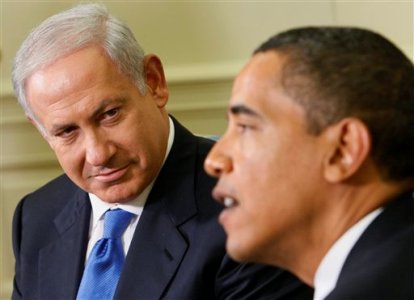
After winning the US midterm elections, Israel’s prime minister Benjamin Netanyahu hardly needs to worry about holding his own coalition government together. The fact that he so transparently now has Washington in his pocket should duly impress anyone who might have doubted America’s willingness to tolerate its increasingly servile relationship with Israel.

Even so, after the announcement that 1,345 new housing units will be built for Jewish occupants in Israeli-occupied East Jerusalem, President Obama’s reaction — to suggest that this move is “unhelpful” during peace negotiations — set off alarm bells. The White House was swift to assure those concerned, that the administration is not stepping out of line.

On a conference call with American Jewish leaders today, a White House official said the administration hadn’t sought a confrontation with the Israelis over a new construction announcement.

President Barack Obama answered a question at a press conference on the subject straightforwardly but hadn’t specifically planned to make a statement criticizing new Israeli building, National Security Council official Dan Shapiro said on the call, according to a participant.

Perhaps the press can avoid causing Obama any further embarrassment by henceforth not asking questions on such sensitive topics.

Still, this administration remains an object of mistrust and so when Netanyahu met his leading representative in Washington a few days ago, Eric Cantor, the congressman and likely GOP majority leader assured his prime minister that the Republican party will now be able impose the required discipline.

Eric stressed that the new Republican majority will serve as a check on the Administration and what has been, up until this point, one party rule in Washington. He made clear that the Republican majority understands the special relationship between Israel and the United States, and that the security of each nation is reliant upon the other.

Unfortunately, a few Americans might be perplexed by this claim that the security of the United States is dependent on the security of Israel. Cantor believes “most Americans understand that Israel’s security is synonymous with America’s security.”

Mutual dependence and the security of these two nations being synonymous are not quite the same thing.

It’s easy to see that Israel is capable of having such a disruptive impact on the Middle East that this will damage US interests and in that sense that the US depends on Israel not to undermine its national security even more than it already does.

But to say that Israel’s security is synonymous with America’s security suggests another possibility. If our interests do indeed so perfectly overlap, then we really don’t need to think about Israel’s security. If America focuses on its own interests, Israel’s — in as much as their interests are identical — will be taken care of. In as much as our interests differ — well that’s Israel’s problem, not ours.

Facebooktwittermail

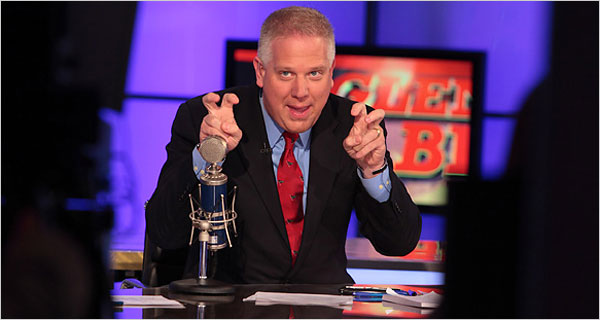
Glenn Beck: inspired by Iran or Lyndon LaRouche?

George Soros is a Jewish tycoon and mastermind of ultra-modern colonialism. He is also a thug who is deployed as an economic hitman for the British empire.

The first claim comes from a video produced by Iran’s Ministry of Intelligence which has depicted Soros operating out of the Situation Room in the White House, while the second comes from Hector A Rivas Jr at LaRouchePAC, serving longtime presidential aspirant Lyndon LaRouche.

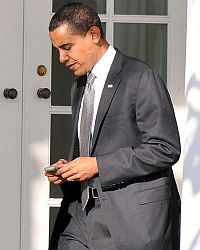
Now comes Glenn Beck, asking ominously about President Obama’s channels of communication: “Have you ever wondered who is at the other end of a BlackBerry?”

Who else but Obama’s puppet master, the omnipotent George Soros.

Soros the macro-managing controller of global events is also the micro-manager of Obama’s daily agenda. He really has taken multi-tasking to a supernatural level as he steers the global financial markets, runs his empire of 501(c)3s, and tells Obama what to do!

Even with his show’s title and images of Soros pulling puppet strings and with puppets dangling from the studio ceiling, Beck still didn’t seem completely confident with his puppet-master metaphor and so needed to make it more literal, the Blackberry supposedly providing the tangible evidence that on a minute-by-minute basis, George Soros has the power and ability to control all of Obama’s actions. But as Beck himself says in his comprehensive disclaimer: “if you take what I say as gospel, you’re an idiot.”

Thus we are presented with the distinctive blend of fear and farce from a man who clearly doesn’t take himself seriously yet who surely lives in a state of constant amazement that his own antics have made him so rich and influential.

In the last year, Glenn Beck’s estimated earnings were $33 million, putting him in second place after Rush Limbaugh ($58.7 million) in Newsweek‘s “Power 50” list which ranks the highest earning political figures in 2010. Bundle the Fox News triumvirate of Beck, Sean Hannity and Bill O’Reilly together and they rank #1 with combined earnings of $75 million. Following the same career trajectory as Beck, Lou Dobbs has just joined Fox, a year after his departure from CNN.

Are Beck and his cohorts now themselves the puppet masters of American politics? Emma Mustich shows how the five-point formula Beck ascribes to Soros just as accurately represents Beck and Fox News‘ methods for gathering and exerting enormous political power.

Meanwhile, Michelle Goldberg writes:

Soros, a billionaire financier and patron of liberal causes, has long been an object of hatred on the right. But Beck went beyond demonizing him; he cast him as the protagonist in an updated Protocols of the Elders of Zion. He described Soros as the most powerful man on earth, the creator of a “shadow government” that manipulates regimes and currencies for its own enrichment. Obama is his “puppet,” Beck says. Soros has even “infiltrated the churches.” He foments social unrest and economic distress so he can bring down governments, all for his own financial gain. “Four times before,” Beck warned. “We’ll be number five.”

It’s true, of course, that Soros has had a hand in bringing down governments—communist, authoritarian governments. Beck seems to be assuming a colossal level of ignorance on the part of his viewers when he informs them, “Along with currencies, Soros also collapses regimes. With his Open Society Fund… Soros has helped fund the Velvet Revolution in the Czech Republic, the Orange Revolution in the Ukraine, the Rose Revolution in Georgia. He also helped to engineer coups in Slovakia, Croatia, and Yugoslavia. So what is his target now? Us. America.”

Beck’s implication is that there was something sinister in Soros’ support for anti-communist civil society organizations in the former Soviet Union. Further, he sees such support as evidence that Soros will engineer a communist coup here in the United States. This kind of thinking only makes sense within the conspiratorial mind-set of classic anti-Semitism, in which Jews threaten all governments equally. And as a wealthy Jew with a distinct Eastern European accent, Soros is a perfect target for such theories.

And in an indication that for the American Jewish community, Beck has indeed crossed a line with his slanderous attack, suggesting that the 14-year-old Soros was a Nazi collaborator, Abraham Foxman, director of the Anti-Defamation League, called Beck’s comments “horrific” and “totally off limits and over the top.” Whether Beck’s antipathy for Soros makes him an anti-Semite, is nevertheless questionable.

For Beck, fear is a commodity in which he has deeply invested in futures — an investment whose value he works on inflating every day. But the fear he trades in is not something he invented. It has long resided in the heart of that predominantly white America which is a nation of islanders, challenged by the inconvenient truth that America is not an island.

Facebooktwittermail

Deadlock in Afghanistan: ‘It’s taken a year to move 20km’

In June and July, The Guardian‘s Sean Smith accompanied US Marines and a helicopter ambulance crew in Helmand province. He described how embedded reporters quickly adopt the language and mindset of the soldiers they are with:

All the journalists here are starting to act like they want to be soldiers. They’re talking about “L-shaped attacks” and speaking military speak. I hear one saying, “Right, now we’re being drawn into L-shaped attacks, so they’re planting IEDs in front of them.” They’re all getting very enthusiastic, going into the military shops and buying contractor-type trousers and getting military haircuts.

Facebooktwittermail

Police step in to protect young Jewish protesters from Jewish mob violence — in New Orleans

For more details on the protest during Benjamin Netanyahu’s address to the Jewish Federation’s General Assembly in New Orleans yesterday, see the post below.

One of the protesters has now provided her own first hand account of what happened. Although sheriffs were in attendance to provide security for the event, in the end the police needed to protect the protesters from the mob!

Rae Abileah writes:

I stood up and unfurled a pink banner that read, “The settlements betray Jewish values” and in Hebrew: “Justice, justice you shall pursue,” a verse from Deuteronomy. The crowd had grown increasingly hostile with each disruption, and I was instantly attacked from all sides. A man in the row in front of me pulled the El Al seat cover off his chair and tried to gag me with it. Another man came up from the side and grabbed me by the throat. I fell into a pile of chairs until two female sheriffs buoyed me up and hustled me out of the room. The police later confided that they were trying to protect me from the angry mob and get me out of there in one piece.

Facebooktwittermail

Tribal loyalty versus the integrity of the individual

(Young Jews disrupt Netanyahu at Jewish General Assembly from stefanie fox on Vimeo.)

Human beings are animals, but the aspects of our nature that can most fittingly be called animalistic, most often express themselves collectively. They require the abandonment of a sense of self, a loss of the awareness of individual autonomy and personal integrity as individual will submerges in collective will.

When individuals from Jewish Voice of Peace disrupted Benjamin Netanyahu’s speech in New Orleans yesterday, waves of anger swept through the audience.

Jeff Shapira from San Antonio grabbed one of the protesters by the throat, but when later asked whether he had ever put a woman in a choke hold before, he responded: “Not really. No. I really did not know what was going to happen, I wanted to keep her in check. I was trying to help.”

As can be seen in the video above, a rabbi in the audience performed his own ritualistic denunciation of the protests by tearing and biting one of the protest banners as though he was slaughtering a sacrificial animal.

The collective judgement was, no doubt, that these are all appropriate ways of dealing with “self-hating” Jews — the only type of Jew who can be expected to criticize Israel.

Meanwhile, Alfred Grosser, a Jewish intellectual and Holocaust survivor who is the keynote speaker at a ceremony marking the 72nd anniversary of Kristallnacht in Frankfurt tonight, has similarly been attacked because he describes himself as pro-Palestinian.

In an interview with the Jerusalem Post, Israel’s deputy chief of mission in Germany, Emmanuel Nahshon, said that Frankfurt’s decision to invite Mr. Grosser to speak at the memorial “casts an unfortunate and unnecessary shadow on the event.” He also said that Mr. Grosser’s criticism of Israel was “illegitimate and immoral,” and suggested that his “extreme opinions are tainted by self-hatred.”

The campaign to demean and delegitimize individual Jews by describing them as being afflicted by self-hatred is transparently coercive. There is perhaps a sense that the tribe cannot allow itself to rip itself apart by rejecting any of its members, but those who display what is cast as a form of tribal disloyalty must be neutered and silenced — both as a form of punishment and as a way of signalling to waverers the risks involved in stepping out of line. Rather than the threat of exile, there is the threat of being branded a lesser Jew, a self-hating Jew.

But the phrase itself — self-hating — seems to indicate more. This “self” is a particular form of Jewish identity which recognizes no such thing as a fully autonomous individual identity. A tribal consciousness, which rejects true autonomy, cannot accommodate expressions of personal conscience through dissent. The putative self which is supposedly being hated, exists inside the individual only in as much as the individual mirrors the collective

While social mechanisms such as these stretch all the way back to the origins of primate behavior, in the age of complex, diverse modern societies, they point in a darker direction: this is where fascism finds its base.

The New Orleans protesters later described who they are and why they took their action:

They also released a declaration at Young Jewish and Proud:

A vision of collective identity, purpose and values written by and for young Jews committed to justice in Israel and Palestine. It is an invitation and call to action for both our peers and our elders, launched as a counter-protest at the 2010 Jewish Federation General Assembly in New Orleans. [Read their full declaration.]

Facebooktwittermail

America’s ever-expanding knowledge deficit

At Salon, Justin Elliot reports:

An August Pew poll found that a growing number of Americans — 18 percent — falsely believe that President Obama is a Muslim. Why does that figure keep rising? It’s a difficult question, but it may partly be explained by the remarkable success of videos like this one, which has racked up over 2.5 million views in just three months on YouTube. It’s titled, “”BREAKING NEWS! – Is Barack Obama Really A Saudi / Muslim ‘Plant’ in the White House?”

The thrust of the video, put up by YouTube user ppsimmons, is this: The wife of an American-born Israeli author, Avi Lipkin, monitors the Egyptian media. She saw a broadcast in which the Egyptian foreign minister said that Obama personally told the him that Obama is a Muslim — and that the president is hiding that fact (and also that he is going to betray Israel).

All of this is narrated not by Lipkin, but by an unidentified man (possibly the YouTube user). Lipkin, who sometimes using the alias “Victor Mordecai,” is a former IDF spokesman and current right-wing speaker and writer on Islamic terrorism. He told Salon in an email that the YouTube video is an accurate portrayal of his beliefs.

“My wife, Rachel, has been listening to the Arabic language media from her office in Kol Israel Radio in Jerusalem, and this is just the tip of the iceberg,” he said. “It is ironic, because the whole Islamic world knows the American president is a Moslem. The only ones who don’t know it or want to know it are the Americans, themselves.”

There is no evidence presented that this Egyptian interview ever happened. And the YouTube video itself (which was apparently put up not by Lipkin, but by one of his fans) could well be the product of a lone conspiracy theorist. Which makes it all the more remarkable that it has racked up 2.5 million views.

The video does actually identify its narrator: PCG. That is, Pastor Carl Gallups from the Hickory Hammock Baptist Church in Milton, Florida. Online shoppers who want to accessorize their faith might enjoy visiting the church’s gift shop where they will find a fine line of “CHRISTIAN and GOD AND COUNTRY T-Shirts, Gifts Accessories and Home Items.”

Pastor Gallups was given national attention in late June when he was named as a runner-up in one of Keith Olbermann’s “worst person in the world” lists after the release another popular YouTube video: “EXCLUSIVE! OIL SPILL IN GULF – Hand of God? Connection to Israel?

To the extent that Gallups’ videos have gone “viral” (at least prior to receiving attention from MSNBC and Salon), the pathways of proliferation they have followed seem somewhat predictable. Spreading out from Pastor Gallups’ own congregation, along with listeners to his Freedom Friday show on northwest Florida’s 1330 AM Weby talk radio, these are messages spreading most likely among the already converted. Which is to say, people whose worldview is confirmed — not challenged — by claims such as that the Saudi Arabian monarchy is in control of the US government or that the BP Gulf oil spill was an expression of the wrath of God in reaction to the Obama administration applying pressure on the Netanyahu government.

Are these ideas that can only be accepted by people who have lost any grasp on reason? I think not.

The issue is the boundaries that circumscribe the pool of information that individuals draw upon as they form their understanding of the world. People like Gallups present a view of America and the world that has its own internal logic which holds up through the reinforcement of rigid definitions about what constitute legitimate and illegitimate sources of information.

Progressives, liberals, conservatives, evangelicals, and atheists, all employ the same form of prejudicial review in accessing the credibility of information, which is to attach weight to the source before assessing the value of the information. We attend to who is speaking before we hear what they are saying. Where we differ is in how broad and deep or narrow and shallow is the pool of imputed credibility we draw upon.

This is worth remembering at a time when it’s easy to believe that a wave of irrationality is sweeping across America.

Facebooktwittermail

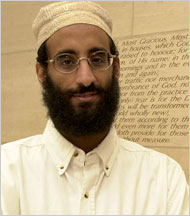
Anwar al Awlaki: wanted dead, not alive

Patrick Cockburn writes:

Anwar al-Awlaki, the militant Islamic cleric in hiding in Yemen, was being denounced in the US and Britain last week as an arch-conspirator against the West, leading to hundreds of videos of his speeches and interviews being hurriedly removed from YouTube.

Awlaki, an eloquent preacher, is alleged to have radicalised Roshonara Choudhry, the theology student who stabbed Stephen Timms MP for voting for the Iraq war. Awlaki was also in contact with militant Muslims who later attacked American targets, such as the Nigerian student with explosives sewn into his underpants and the US officer who shot dead 13 of his fellow soldiers at Fort Hood.

On the videos of Awlaki still available on YouTube, often excerpts from his speeches broadcast on US TV, his message remains chillingly clear. In a soft, measured voice he describes how he was born in America, lived there for 21 years and became an Islamic preacher, advocating non-violence until the invasion of Iraq in 2003. This turned him into a supporter of holy war against America: “I eventually came to the conclusion that jihad against Islam is binding for Muslims.”

(That should of course read “jihad against America” and Cockburn’s gaffe should have been caught by the Independent‘s editors.)

The fact that Awlaki is currently being turned into a larger than life figure is highlighted in this report from Yemen, appearing in the Los Angeles Times:

“Anwar Awlaki?”

Mmmmm.

“Is he a doctor? I don’t think I know him.”

Americans may regard the U.S.-born cleric with the beard and hard stare as a new face of terror, but when you mention Awlaki in the Yemeni capital, it’s as if you’ve asked someone to solve a complicated bit of arithmetic. Eyes narrow, faces scrunch.

“I don’t know who he is. I work all day and don’t watch a lot of TV,” said Ibrahim Abdulrab, standing over an ironing board with a pile of shirts at his feet.

The radical preacher is on the CIA’s assassination list and is believed to be hiding with Al Qaeda fighters in Yemen’s mountainous tribal lands. He is implicated in a number of plots, including inspiring a U.S. Army psychiatrist who is charged with killing 13 people a year ago at Ft. Hood, Texas, and the recent attempt to blow up aircraft with packages of concealed explosives.

Internet videos, website manifestos and pundit rhetoric are splicing Awlaki into the American consciousness. But he is largely unknown here or referred to as an apparition hiding in a distant crevice. Even his Al Qaeda in the Arabian Peninsula is scoffed at by many as an invention, a ploy by Washington and Yemeni President Ali Abdullah Saleh to advance larger agendas.

What’s interesting about the way in which Awlaki has rapidly been elevated to the status of latest and greatest threat to America is that his potency as a radicalizing force is clearly being amplified by those who regard him as a threat.

As Cockburn notes: “Most alarming for the US and British governments, Awlaki’s words are directed primarily at English-speaking Muslims. He asks how American Muslims can give their loyalty to a country that is at war with Islam.”

These are the competing narratives of the ideological fight in which Awlaki has been cast as the West’s new nemesis:

On the one hand Western governments claim that the most dire threat to democracy comes from small groups of Islamic extremists, mostly scattered across the Middle East — even while inside these threatened Western countries, life continues largely as normal with little or no evidence that these are nations at war — such as during the US midterm elections where war barely got mentioned.

On the other hand, ideologues such as Awlaki assert that America and its allies are engaged in a war against Islam — that claim being rather strongly reinforced by the fact that the Middle East has been ripped apart by a decade of war in which the overwhelming majority of the hundreds of thousands of casualties have been Muslim men, women and children.

As vehemently as Western politicians might deny the existence of a war against Islam, Muslims do not have to be wild-eyed conspiracy theorists to conclude otherwise.

So this leads to the question of how exactly the threat posed by Awlaki is being measured. Is it, as we have been told, that he has had an instrumental role in planning acts of terrorism? Or is it that he poses an unacceptable risk because he has the capacity radicalize others in the same way that he himself was radicalized and that worst of all, these others are, so to speak, on the wrong side of the border?

If Awlaki can be assassinated because he expresses what have simply been deemed dangerous ideas then we live in an era in which democracy is being destroyed in the name of saving democracy.

The Predator drones now hunting Awlaki are not simply in the business of thwarting future acts of terrorism. Awlaki’s death will ensure that he never goes on trial — a prospect whose improbability is underlined by the fact that he has been selected for assassination even while in the United States no warrant for his arrest has been issued.

Facebooktwittermail

The Tea Party is tapping into legitimate grievances

Noam Chomsky writes:

The U.S. midterm elections register a level of anger, fear and disillusionment in the country like nothing I can recall in my lifetime. Since the Democrats are in power, they bear the brunt of the revulsion over our current socioeconomic and political situation.

More than half the “mainstream Americans” in a Rasmussen poll last month said they view the Tea Party movement favorably—a reflection of the spirit of disenchantment.

The grievances are legitimate. For more than 30 years, real incomes for the majority of the population have stagnated or declined while work hours and insecurity have increased, along with debt. Wealth has accumulated, but in very few pockets, leading to unprecedented inequality.

Facebooktwittermail

YouTube bows to political pressure and removes Awlaki videos

On Wednesday, The Guardian reported:

Hundreds of videos inciting violence, including some linked to the suspected al-Qaida mastermind of the cargo plane bomb plot, were removed from YouTube today.

The videos were highlighted after the conviction of Roshonara Choudhry for attempting to kill the former [British] government minister Stephen Timms. She was radicalised watching internet sermons by Anwar al-Awlaki, an Islamist cleric now in Yemen who the US suspects masterminded several terrorist plots.

In a private speech in the US last week, the security minister, Lady Neville-Jones, called on the White House to “take down this hateful material” in cases where servers were located within its jurisdiction.

“When you have incitement to murder, when you have people actively calling for the killing of their fellow citizens and when you have the means to stop that person doing so, then I believe we should act,” she said. “Those websites would categorically not be allowed in the UK. They incite cold-blooded murder and as such are surely contrary to the public good.”

Will YouTube also now be looking at videos conveying messages of hate from people like Michael Savage?

When Byron Williams went on a shooting spree in California this summer, his desire to “start a revolution” was inspired in part, it was reported, by Savage’s talk radio rants. Speaking about the ACLU, Savage had warned: “They will kill us all if they’re not stopped.” Williams aimed to do just that by killing the ACLU’s leaders.

In 2006, Savage called for the killing of 100 million Muslims:

There are too many RDDBs [red-diaper doper babies, Savage’s term for people supposedly raised by Marxist parents] in high places and in the media and in the courts for us to stand up to this fanatical enemy. And so unless the RDDB is reined in somehow or taken out of power, we’re going to die as a nation. I swear to God that’s what people are saying to me. And these are intelligent people, wealthy people. They are very depressed by the weakness that America is showing to these psychotics in the Muslim world. They say, “Oh, there’s a billion of them.” I said, “So, kill 100 million of them, then there’ll be 900 million of them.” I mean, would you rather die — would you rather us die than them? I mean, what is it going to take for you people to wake up? Would you rather we disappear or we die? Or would you rather they disappear and they die? Because you’re going to have to make that choice sooner rather than later.

In 2008, after the Mumbai attacks, Savage advocated genocide, referring to the tribal areas of Western Pakistan, saying: “[T]here’s no question that entire region needs to be annihilated and stripped off the earth.”

From Michael Savage, to Pastors John Hagee, Rod Parsley and Terry Jones, America has no shortage of hate-mongers whose words are capable of inciting violence. Should YouTube and other publishers and media outlets be policing their operations so that none of these men can find an easily available platform from which to vent their anger?

Not if we want to protect the First Amendment.

In 1969 in Brandenburg v. Ohio, the Supreme Court ruled that “the constitutional guarantees of free speech and free press do not permit a State to forbid or proscribe advocacy of the use of force or of law violation except where such advocacy is directed to inciting or producing imminent lawless action and is likely to incite or produce such action.” The ruling went on to cite Noto v United States (1961) which said: “the mere abstract teaching … of the moral propriety or even moral necessity for a resort to force and violence, is not the same as preparing a group for violent action and steeling it to such action.”

On this basis, it seems pretty clear that lectures by Anwar al-Awlaki, available on YouTube, and Michael Savage’s talk-radio rants, are both examples of free speech protected by the First Amendment.

Facebooktwittermail

Reading al Qaeda’s signals from Yemen — and Pakistan

David Ignatius writes:

Behind the latest terrorism plots is an al-Qaeda leadership that is getting battered in Pakistan but that is determined to strike back wherever it can – using a dispersed network and new tactics that are harder to detect.

The package bombs sent last week from Yemen are one face of al-Qaeda’s continuing campaign. The Yemeni operatives are nimble, adaptive and “frustratingly clever,” says a U.S. counterterrorism official. “They have one main goal, which is to mess with us.”

We’ve got all sorts of metaphors going here. Al Qaeda is up against the ropes — but it’s punching back. It used to wait in caves, ready to be smoked out — even while it was on the run. But just in case its persistent ability to outwit US intelligence services might make the latter look unintelligent, we are duly reminded that our cavebound-boxing-running nemesis is actually very smart.

Now, with a melodramatic Hollywood-style flourish, France’s interior minister, Brice Hortefeux, adds that one of the printer bombs was defused just 17 minutes before it was due to explode! Let’s not forget (or maybe we are meant to forget) that British investigators took 20 hours to figure out that one of these devices was actually a bomb.

What’s the common thread here? That when officials and commentators talk about al Qaeda, the structure of their own thinking is much more in evidence than any understanding of the strategic thinking that probably connects a set of seemingly disparate events. My hunch is that the string of “failed” operations emanating from Yemen have actually accomplished most of their objectives.

Consider, for instance, this detail in the printer bombs: the way they were addressed — with names linked to the Crusades at out-of-date locations for two synagogues in Chicago.

We are told the bombs were designed to blow up on board the cargo aircraft that carried them, so why use addresses that could prematurely flag the parcels? If on the other hand the bombs were meant to reach the synagogues, in a meticulously planned operation such as this, wouldn’t we expect valid addresses to have been used? The addresses provide a clue that these were bombs meant to be found rather than explode.

Let’s not forget how the attack was actually averted — not through an NSA intercept but thanks to a tip from a former Guantanamo inmate who had a change of heart just in time.

Perhaps the object of the exercise here was neither to blow up synagogues nor bring down aircraft but simply generate fear around both possibilities. Indeed, al Qaeda is currently demonstrating that bombs which don’t explode can in many ways be just as effective and in some ways more effective than those that wreak havoc.

The choice of synagogues in Chicago may simply have been a way of making sure that some of President Obama’s most influential supporters — such as Lester Crown — would be pressing the White House to do everything necessary to tackle the threat from Yemen.

But why would al Qaeda be wanting America’s attention to now focus on Yemen?

Ignatius quotes a US official who claims that bin Laden’s response to Obama’s expansion of drone warfare in Pakistan was to send out a directive which could be summarized: “Undertake operations however and wherever you can. We need to prove ourselves again.”

Even if such a directive went out — one that portrays this fight simply as a contest in the expression of power — I find it hard to believe that this actually reveals much about al Qaeda’s strategic thinking. After all, as grandiose as their ambitions might be, they surely have few illusions about the nature of the power differential they face as Hellfire missiles come raining down.

Bin Laden’s more pressing concern, I would suggest, is to find a way of getting the hell out of Waziristan and lining up a new base for operations — a move precipitated not just as a result of drone warfare but more importantly because of the likelihood that any process of reconciliation that brings about an end to the war in Afghanistan will result in al Qaeda losing its sanctuary in Pakistan.

The conventional wisdom is that al Qaeda in the Arabian Peninsula (AQAP) operates independently from Pakistan-based commanders, but the Australian counterterrorism expert, Leah Farrall, thinks otherwise. AQAP, she writes:

… is not an affiliate, not a franchise, and not a network. Rather it is an operating branch of AQ, which means that while it may have authority for attacks in its area of operations (the Arabian Peninsula), it comes under AQ’s strategic command and control for external attacks outside of this area of operation. And it has always done so, right back to 02.

To the extent that the message coming out of Washington for most of the last year has been that Yemen is now the epicenter of the al Qaeda threat, this may reflect less about the depth of US intelligence than it does about al Qaeda’s own messaging. In other words, al Qaeda very much wants to be equated with Yemen.

Why? This much should be obvious to everyone: wherever the US sees a terrorist threat emanating from, its primary response is military. Yemen is no exception. Ignatius confirms that in the wake of Obama’s expanding drone war in Pakistan:

[a] similar escalation is likely in Yemen, with soldiers from the U.S. Joint Special Operations Command working with Yemeni government forces. The JSOC sums up its lethal approach with the phrase ‘find, fix, finish,’ but a U.S. official says it has been hard to keep track of al-Qaeda targets in Yemen’s tribal villages and cities.

The Pentagon’s thinking no doubt, is that a sufficiently “robust” response will ensure that the burgeoning threat from al Qaeda in Yemen can be nipped in the bud. Al Qaeda’s strategic view however, may well be radically different.

Farrall points out that al Qaeda in Iraq began with only 16 operatives. Thanks to the blundering American military machine, the jihadists were able to tap into enough local hostility that they were eventually able to trigger a civil war.

Even though the US is not contemplating invading Yemen, operations it conducts in collaboration with a compliant Yemeni government will do more to weaken that already weak government and thereby make the country an even more hospitable environment for al Qaeda HQ to relocate its operations.

Yemenis, far from sharing Washington’s concerns, view them with a mix of skepticism and suspicion. As the New York Times reports:

For now, most Yemenis seem to dismiss reports of Al Qaeda killings as a “masrah,” or drama, staged by the government and its American backers. The suspicion runs so deep that any action by the Yemeni government seems to confirm it: counterterrorist raids are often described as punitive measures against domestic foes, and the failure to act decisively is derided as collusion.

“This latest episode with the packages is only making it worse,” said Mr. Faqih, the Sana University professor. “Many people think it was all about the elections in the U.S., or an excuse for American military intervention here.”

If there is a set of assumptions that al Qaeda’s strategists can reliably make about their American adversaries it is that the Americans find it next to impossible to respond to acts of terrorism without recourse to military violence; that they pay insufficient attention to the motives of those they choose to fight; that patience is their most easily exhausted asset; and that without fail a fear-bound America can always be guaranteed to overreact.

Meanwhile, what passes for strategic thinking in Washington still takes seriously this bizarre idea: that it is possible to simultaneously bomb a country and assist in its development.

And people still wonder how it’s possible for a tiny militant organization to challenge American might? Because America makes it far too easy.

Facebooktwittermail

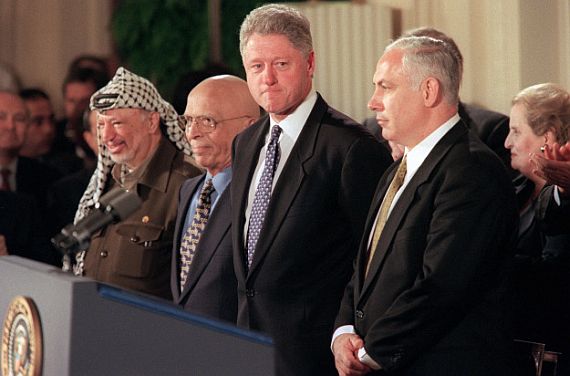
Bill Clinton’s prayer for peace

Bill Clinton referring to Benjamin Netanyahu in 1996: 'Who the fuck does he think he is? Who's the fucking superpower here?'

Less than two weeks ago, while observers gathered around the fetid corpse of the Middle East peace process, once again looking to see whether it might miraculously spring back to life, Laura Rozen reported:

[T]he New America Foundation’s Steve Clemons said he is convinced that the man who can help Obama bring peace to the Middle East is former President Bill Clinton. That is the spouse of Obama’s Secretary of State Hillary Clinton.

“Bill Clinton is the only guy I can think of who is trusted and liked by all sides,” Clemons told Politico. “He is the only guy I know who successfully wrestled and pushed Netanyahu to do what he wants to do. And Clinton has spectacular popularity in Israel and Obama doesn’t.”

The former president “has granular understanding of every deal and piece of the deal – behind the scenes stuff that has been distorted and reframed,” Clemons continued. “No one has a better grasp, … sees the opportunity and has the global stature to both cajole, seduce and embarrass” the parties towards an agreement.

And under that scenario, which Clemons concedes is a float though one influenced by some kibitzing on the peace process with Bill Clinton at an event last week, how would Obama control the force that is Bill Clinton?

“Why would you want to control him,” Clemons responded. The Israeli-Palestinian conflict “has become a global fault line in the eyes of the world, and a manifestation of America’s weakness today. It has far greater significance” strategically “than northern Ireland. My bet is this is one of several defining issues” for the U.S. and the Obama administration, Clemons continued.

And how would Hillary Clinton not lose her authority as Secretary of State if her husband played such a role?

“Hillary Clinton should embrace and support what he does, giving him the latitude to be a creative player,” Clemons responded. “He can outmaneuver” the obstacles to an agreement and “all their corks will rise.”

Lo and behold the force that is Bill Clinton has appeared like a comet soaring over the horizon, shining light when all seemed consumed by darkness. Or maybe not.

In his remembrance of Yitzhak Rabin who was assassinated 15 years ago, Clinton’s main message seems to be that Rabin could have delivered on the implementation of the two-state solution — but he got shot, and the rest is history.

In Clinton’s view, all the necessary pieces for a resolution to the conflict are now lined up — everyone just needs to get on with the work at hand.

Let us pray on this anniversary that [Rabin’s] service and sacrifice will be redeemed in the Holy Land and that all of us, wherever we live, whatever our capacity, will do our part to build a world where cooperation triumphs over conflict. Rabin’s spirit continues to light the path, but we must all decide to take it.

Those are not the words of an unstoppable force. “We must all decide” is really just a positive construction on the assertion that has been repeated so many times before: “We can’t want peace more than the parties themselves.”

If Clinton is laying groundwork here it is not for his own entry into the fray; it is instead the path along which Obama can gracefully bow out by saying, I did what I could but the time was not right.

Facebooktwittermail