Category Archives: human rights

Iranian general murdered in Israel’s Ayalon prison?

Richard Silverstein writes:

New and astonishing developments in the case of Prisoner X, known to a source within Ehud Barak’s inner circle as Ali Reza Asgari, retired Iran Revolutionary Guard general and former deputy defense minister.

I exposed the name of Prisoner X here a few weeks ago. Today, brings news from Israel that Asgari is dead in his cell. According to the standard version, he committed suicide in his cell within the past week or so. Ynet reported the suicide story and noted that it was under gag order. Of course, this story was erased from the internet, but I’m posting a copy of the article which was taken down from the Ynet site.

What is so interesting about this story is that you have to combine two different articles (the second from Haaretz) to gain more insight into what really happened here. The Haaretz article, which was not removed under gag order because it was written in a sufficiently vague form that it could slip under the gag order, noted that there are investigations of those who die while in secret detention (the case with Asgari). One of the considerations in such an inquiry is whether a “government agency” may have caused the death:

Did such an agency have an interest in silencing the detainee? And if so, was a death declared a “suicide,” really murder? In the case of the death of a prisoner under special treatment [held by the security services], why it was not within the power of the Prison Service to prevent the suicide or some other form of violent death. [Emphasis added]

I should also confirm at this point that my original source for this story reaffirms specifically that it is Asgari, and not some other secret security prisoner who died. My source, I should add, only confirms the “official” government version that he committed suicide and not that he was murdered.

Assuming that the prisoner was indeed Asgari, I wouldn’t be quick to dismiss the claim that he committed suicide. Prolonged isolation, most likely accompanied by intermittent torture, with no prospect of release or a trial, would easily sap anyone’s will to live.

Meanwhile, a new report reveals the barbaric conditions in which Israel keeps prisoners in isolation — conditions one would expect to find used by a brutal authoritarian regime in a third world country.

A classified report by the Israel Bar Association obtained by Haaretz provides a glimpse into the harrowing conditions prisoners separated from the main jail population must endure.

According to the document, which is the first external review of the Prison Service, the isolation wings at the Ayalon and Shikma prisons are not fit for human habitation and “look more like a dungeon,” while most solitary cells in prisons across the country are “crammed, rancid with smells of sewer and mold, and infested with insects.”

“It’s difficult to ignore the feeling that isolation as practiced today serves a function of punishment rather than imprisonment,” wrote the authors of the report, Michael Atia – chairman of the prison service committee at the Israel Bar Association, and Moran Kabalo – chief of criminal law for the IBA.

Facebooktwittermail

Israel jails peaceful protester for riding a bike

Joseph Dana writes:

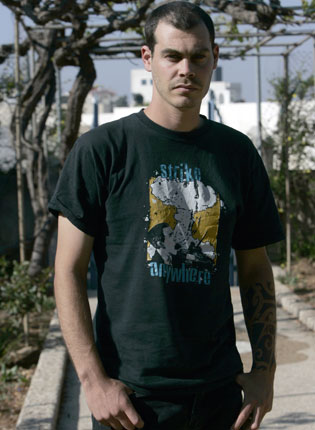
Of all the criminals involved with the 2008 Gaza war, an Israeli leftist will be going to jail for riding his bike against the war in Tel Aviv. Tel Aviv Magistrates court judge Yitzhak Yitzhak convicted Israeli leftist Jonathan Pollak of illegal assembly for his participation in a January 2008 Critical Mass ride against the siege on Gaza and then sentenced him to three months imprisonment that will begin on January 11th, 2011. Pollak was the only one detained at the said protest, and was accused of doing nothing other than riding his bicycle in the same manner as the rest of the protesters. The conviction activates an older three-month suspended sentence imposed on Pollak in a previous trial for protesting the construction of the Separation Barrier. An additional three month prison term was also imposed for the current conviction, which will be served concurrently. His imprisonment is part of a clear strategy of silencing dissent in the Israeli left.

Jonathan Pollak is one of the founders of the Israeli leftist group “Anarchists Against the Wall“, which join weekly unarmed Palestinian protests throughout the West Bank against the Separation Wall and the Occupation. Since 2008, he has served the media coordinator of the Popular Struggle Coordination Committee, an Palestinian umbrella organization designed to garner media attention for the unarmed struggle in the West Bank.

Pollak gave the following statement in court today:

Your Honor, once found guilty, it is then customary for the accused to ask the court for leniency, and express remorse for having committed the offence. However, I find myself unable to do so. From its very beginning, this trial contained practically no disagreements over the facts. As the indictment states, I indeed rode my bicycle, alongside others, through the streets of Tel Aviv, to protest the siege on Gaza. And indeed, while riding our bicycles, which are legally vehicles belonging on the road, we may have slightly slowed down traffic. The sole and trivial disagreement in this entire case revolves around testimonies heard from police detectives, who claimed I played a leading role throughout the protest bicycle ride, something I, as well as the rest of the Defense witnesses, deny.

As said earlier, it is customary at this point of the proceedings to sound remorseful, and I would indeed like to voice my regrets regarding one particular aspect of that day’s events: if there is remorse in my heart, it is that, just as I argued during the trial, I did not play a prominent role in the protest that day, and thus did not fulfill my duty to do everything within my power to change the unbearable situation of Gaza’s inhabitants, and bring to an end Israel’s control over the Palestinians.

His Honor has stated during the court case, and will most likely state again in the future, that a trial is not a matter of politics, but of law. To this I reply that there is hardly anything to this trial except political disagreement. This Court may have impeded the mounting of an appropriate defense when it refused to hear arguments regarding political selectiveness in the Police’s conduct, but even from the testimonies which were admitted, it became clear such a selectiveness exists.

The subject of my alleged offense, as well as the motivation behind it were political. This is something that cannot be sidestepped. The State of Israel maintains an illegitimate, inhuman and illegal siege on the Gaza Strip, which still is occupied territory according to international law. This siege, carried out in my name and in yours as well, sir, in fact in all of our names, is a cruel collective punishment inflicted on ordinary citizens, residents of the Gaza strip, subjects-without-rights under Israeli occupation.

In the face of this reality, and as a stance against it, we chose on January 31st, 2008, to exercise the freedom of speech afforded to Jewish citizens of Israel. However, it appears that here in our one-of-many-faux-democracies in the Middle East, even this freedom is no longer freely granted, even to society’s privileged sons.

I am not surprised by the Court’s decision to convict me despite having no doubt in my mind that our actions on that day correspond to the most basic, elementary definitions of a person’s right to protest.

Indeed, as the Prosecution pointed out, a suspended prison sentence hung over my head at the time of the bicycle protest, having been convicted before under an identical article of law. And, although I still maintain I did not commit any offense whatsoever, I was aware of the possibility that under Israeli justice, my suspended sentence would be imposed.

I must add that, if His Honor decides to go ahead and impose my suspended prison sentence, I will go to prison wholeheartedly and with my head held high. It will be the justice system itself, I believe, that ought to lower its eyes in the face of the suffering inflicted on Gaza’s inhabitants, just like it lowers its eyes and averts its vision each and every day when faced with the realities of the occupation.

In a profile for The Independent, Donald Macintyre wrote:

[Pollak] attended the first of very many demonstrations as a months-old babe-in-arms at the huge mass rally in Tel Aviv calling for an end to the first Lebanon war in 1982. What makes him and his Israeli comrades unusual, however, is the decision to go beyond mere demonstrations to, as he himself puts it, “crossing sides, moving from protest to joining resistance”.

A high school dropout at 15, he was a teenage animal right activist, a cause with few Israeli adherents – and most of those Israelis who were part of it were anarchists. Very much part of Tel Aviv’s young counterculture in the politically relatively relaxed Nineties, Mr Pollak became one too. He remains an anarchist and a vegan, still a strong believer in animal rights, which he sees as consistent with his wider politics. For him, “racism, chauvinism, sexism, speciesism all come from the same place of belittling the other”, he said.

A few minor brushes with the law appear to have been enough to convince the army that he was not suitable material for compulsory military service. “I don’t think they wanted me any more than I wanted them,” he said. He spent two years in the Netherlands, living in a squat, before being deported back to Israel.

By this time, the second intifada was at its peak, and Mr Pollak found himself drawn, despite the dangers for a young Israeli of visiting the West Bank at the time, to the unarmed dimension of the Palestinian cause – including, most significantly, the very first anti-barrier protests in the West Bank village of Jayyous.

According to [Ayed] Morrar [the director of Budrus], a long-term opponent of armed uprising, “Jonathan… is a man trying to prove that those who believe in occupation cannot claim to be humanitarian or civilised. He also wants to prove that resisting oppression and occupation does not mean being a terrorist or killing”.

Facebooktwittermail

Congress blocks closure of Guantanamo

The New York Times reports:

Congress voted Wednesday to impose strict new limits on transferring detainees out of the Guantánamo Bay prison, dealing a major blow to President Obama’s vows to shut down the center and give federal court trials to many of the prisoners.

The Guantánamo provisions were contained in a major defense authorization bill, which both chambers passed on the last day of Congress’s lame-duck session. It is considered highly unlikely that Mr. Obama will veto the bill because it also authorizes billions in spending for the wars in Afghanistan and Iraq.

Robert M. Chesney, a University of Texas law professor who specializes in national security matters, said the legislation would make it even harder to close the prison, at the American military base in Cuba. He said the next Congress, in which Republicans will have more power, was likely to keep or even intensify the restrictions.

“A Democratic Congress has done its level best to prevent prosecutions in civilian court,” Professor Chesney said.

“It strengthens the relative position of military commissions, and it separately strengthens the likelihood of continuing to rely on military detention” without trial, he said.

Facebooktwittermail

WikiLeaks reveals Bangladeshi ‘death squad’ trained by UK government

The Guardian reports:

The British government has been training a Bangladeshi paramilitary force condemned by human rights organisations as a “government death squad”, leaked US embassy cables have revealed.

Members of the Rapid Action Battalion (RAB), which has been held responsible for hundreds of extra-judicial killings in recent years and is said to routinely use torture, have received British training in “investigative interviewing techniques” and “rules of engagement”.

Details of the training were revealed in a number of cables, released by WikiLeaks, which address the counter-terrorism objectives of the US and UK governments in Bangladesh. One cable makes clear that the US would not offer any assistance other than human rights training to the RAB – and that it would be illegal under US law to do so – because its members commit gross human rights violations with impunity.

Since the RAB was established six years ago, it is estimated by some human rights activists to have been responsible for more than 1,000 extra-judicial killings, described euphemistically as “crossfire” deaths. In September last year the director general of the RAB said his men had killed 577 people in “crossfire”. In March this year he updated the figure, saying they had killed 622 people.

Facebooktwittermail

CIA gave waterboarders $5M legal shield

The Associated Press reports:

The CIA agreed to cover at least $5 million in legal fees for two contractors who were the architects of the agency’s interrogation program and personally conducted dozens of waterboarding sessions on terror detainees, former U.S. officials said.

The secret agreement means taxpayers are paying to defend the men in a federal investigation over an interrogation tactic the U.S. now says is torture. The deal is even more generous than the protections the agency typically provides its own officers, giving the two men access to more money to finance their defense.

It has long been known that psychologists Jim Mitchell and Bruce Jessen created the CIA’s interrogation program. But former U.S. intelligence officials said Mitchell and Jessen also repeatedly subjected terror suspects inside CIA-run secret prisons to waterboarding, a simulated drowning tactic.

The revelation of the contractors’ involvement is the first known confirmation of any individuals who conducted waterboarding at the so-called black sites, underscoring just how much the agency relied on outside help in its most sensitive interrogations.

Facebooktwittermail

Rethinking terrorist blacklisting

Gavin Sullivan writes:

Terrorist blacklisting has been a central plank of the “war on terror” pursued by western states since 9/11. The idea is simple. International or regional bodies (such as the UN and EU) and states (such as the UK) designate individuals and groups thought to be terrorists or “associated with” terrorism, freeze their assets, impose travel bans, criminalise their membership and prevent others from supporting them. Yet after almost 10 years – following a plethora of successful legal challenges, the failure of reforms that have tried to render listing procedures compliant with human rights, and widespread criticism by judges and other officials – the policy of blacklisting is now facing a fundamental crisis of legitimacy.

The evolution of this crisis, and the possible ways of moving beyond it, are detailed in a critical report launched today by the European Centre for Constitutional and Human Rights (ECCHR), which suggests that the time has come for radically rethinking the policy of blacklisting. Following the recent recommendations of Martin Scheinin, the outgoing UN special rapporteur on the promotion and protection of human rights while countering terrorism, it calls for the two key security council resolutions underpinning the blacklisting system to be abolished.

Resolution 1267 (and the resolutions that amended it) created the UN sanctions committee, comprised of all members of the security council, to compile a list of individuals and groups “associated with” Osama bin Laden, al-Qaida and the Taliban and compel states to bring proceedings or penalise those designated. Resolution 1373 requires states to criminalise the support and financing of terrorism while giving them the autonomy to set up their own domestic blacklists. The EU has used it to set up its own list criminalising groups such as the PKK and the LTTE as terrorist organisations.

The most persistent criticism of both regimes is that they breach fundamental rights. Most listing decisions are based on secret intelligence material that neither blacklisted individuals nor the courts responsible for reviewing the implementation of the lists will ever see. As courts have repeatedly affirmed, one cannot oppose allegations against them (and exercise their right to judicial review) if they are prevented from knowing what the allegations actually are. Such treatment is a fundamental breach of the right to a fair trial. Yet it is an ongoing Kafkaesque reality for the majority of those who are placed on the blacklists.

Facebooktwittermail

Court ruling gives Obama power of judge, jury and executioner

The New York Times reports:

A federal judge on Tuesday threw out a lawsuit that had sought to block the American government from trying to kill Anwar al-Awlaki, a United States citizen and Muslim cleric in hiding overseas who is accused of helping to plan attacks by Al Qaeda’s branch in Yemen.

The ruling, which clears the way for the Obama administration to continue to try to kill Mr. Awlaki, represents a victory in its efforts to shield from judicial review so-called targeted killings, one of its most striking counterterrorism policies.

In an 83-page opinion, Judge John D. Bates said Mr. Awlaki’s father, the plaintiff, had no standing to file the lawsuit on behalf of his son. He also said decisions about targeted killings in such circumstances were a “political question” for executive branch officials to make — not judges.

Judge Bates acknowledged that the case raised “stark, and perplexing, questions” — including whether the president could “order the assassination of a U.S. citizen without first affording him any form of judicial process whatsoever, based the mere assertion that he is a dangerous member of a terrorist organization.”

Jameel Jaffer, a lawyer for the American Civil Liberties Union, said: “If the court’s ruling is correct, the government has unreviewable authority to carry out the targeted killing of any American, anywhere, whom the president deems to be a threat to the nation.” He said: “It would be difficult to conceive of a proposition more inconsistent with the Constitution, or more dangerous to American liberty.”

Facebooktwittermail

Obama and GOPers worked together to kill Bush torture probe

David Corn reports:

In its first months in office, the Obama administration sought to protect Bush administration officials facing criminal investigation overseas for their involvement in establishing policies the that governed interrogations of detained terrorist suspects. A “confidential” April 17, 2009, cable sent from the US embassy in Madrid to the State Department—one of the 251,287 cables obtained by WikiLeaks—details how the Obama administration, working with Republicans, leaned on Spain to derail this potential prosecution.

The previous month, a Spanish human rights group called the Association for the Dignity of Spanish Prisoners had requested that Spain’s National Court indict six former Bush officials for, as the cable describes it, “creating a legal framework that allegedly permitted torture.” The six were former Attorney General Alberto Gonzales; David Addington, former chief of staff and legal adviser to Vice President Dick Cheney; William Haynes, the Pentagon’s former general counsel; Douglas Feith, former undersecretary of defense for policy; Jay Bybee, former head of the Justice Department’s Office of Legal Counsel; and John Yoo, a former official in the Office of Legal Counsel. The human rights group contended that Spain had a duty to open an investigation under the nation’s “universal jurisdiction” law, which permits its legal system to prosecute overseas human rights crimes involving Spanish citizens and residents. Five Guantanamo detainees, the group maintained, fit that criteria.

Soon after the request was made, the US embassy in Madrid began tracking the matter. On April 1, embassy officials spoke with chief prosecutor Javier Zaragoza, who indicated that he was not pleased to have been handed this case, but he believed that the complaint appeared to be well-documented and he’d have to pursue it. Around that time, the acting deputy chief of the US embassy talked to the chief of staff for Spain’s foreign minister and a senior official in the Spanish Ministry of Justice to convey, as the cable says, “that this was a very serious matter for the USG.” The two Spaniards “expressed their concern at the case but stressed the independence of the Spanish judiciary.”

Facebooktwittermail

Controversial drug given to all Guantanamo detainees akin to “pharmacologic waterboarding”

At Truthout, Jason Leopold and Jeffrey Kaye report:

The Defense Department forced all “war on terror” detainees at the Guantanamo Bay prison to take a high dosage of a controversial antimalarial drug, mefloquine, an act that an Army public health physician called “pharmacologic waterboarding.”

The US military administered the drug despite Pentagon knowledge that mefloquine caused severe neuropsychiatric side effects, including suicidal thoughts, hallucinations and anxiety. The drug was used on the prisoners whether they had malaria or not.

The revelation, which has not been previously reported, was buried in documents publicly released by the Defense Department (DoD) two years ago as part of the government’s investigation into the June 2006 deaths of three Guantanamo detainees.

Army Staff Sgt. Joe Hickman, who was stationed at Guantanamo at the time of the suicides in 2006, and has presented evidence that demonstrates the three detainees could not have died by hanging themselves, noticed in the detainees’ medical files that they were given mefloquine. Hickman has been investigating the circumstances behind the detainees’ deaths for nearly four years.

Interviews with mefloquine and malaria experts and a review of peer-reviewed journals and government documents show there were no preexisting cases where mefloquine was ever prescribed for mass presumptive treatment of malaria.

Facebooktwittermail

Obama’s national security state

Michael Ratner, president of the Center for Constitutional Rights (CCR) and adjunct professor of law at Columbia University Law School, interviewed by International Socialist Revew:

ISR: Let’s start with the Obama administration’s policies on habeas corpus and on torture. As a presidential candidate, Obama said he would close Guantánamo, said he believed in habeas corpus rights, and was critical of President Bush. What’s been his practice since he came to office?

Michael Ratner: My office, CCR, is one of the legal groups that represents many of the Guantánamo detainees and brings these writs of habeas corpus. That is a fancy way of saying, “Let’s go to court, and see if there’s any evidence to hold the person.” The expectations of the team of lawyers representing the detainees was very high that Guantánamo would actually close, that Obama would do it. There were probably a little over 300 people in Guantánamo when he took office. It’s down to maybe 200-some now. But we expected better—and now it may go on for years. We really thought that Obama wouldn’t fight us in court on the rights of the detainees, that he would get the detainees either to another country or he would charge and try them. And of course, it hasn’t worked out that way at all, and it’s a deep disappointment. In fact a lot of the habeas lawyers signed a letter supporting Obama saying his election would actually be good for our clients. Obama’s effort to close it seemingly got off to a somewhat quick start. Obama, within two days of being in office, signed an executive order, which is essentially a presidential order, which said that Guantánamo would be closed in a year. Of course, as we speak now, it’s more than a year and a half after that order, and it is not near closed. Obama’s commitment has been abandoned. And he made a number of other promises that have not been met about secret detention sites, military commissions, and the like.

Obama has put new clothes on the Bush doctrine toward “enemy combatants,” but the underlying lawlessness of the doctrine is the same. In particular, imagine this: you go to court on behalf of someone in Guantánamo, and the judge has to decide whether there is sufficient evidence to hold him. What Bush said was they can be held as “enemy combatants,” and he gave the term a vague definition, such as that the person was hostile to the United States or picked up arms against the United States or belonged to a group that was hostile to the United States. If there was “evidence” those detainees could be held in prison indefinitely, essentially a form of preventive detention. We had hoped Obama would get rid of that entire preventive detention scheme. CCR’s view is there should not be a preventive detention scheme—it’s illegal and immoral. What you must do, and what is legally necessary, is to charge someone with a crime, and hold them only if they’re convicted. The rule is simple: charge and try people with crimes, or release them. There are not any other valid legal choices.

I considered this preventive detention scheme to be one of the worst hallmarks of the Bush administration. Sadly, this intolerable preventive detention scheme has continued, and you could say continued with a vengeance, under Obama.

Facebooktwittermail

West Bank turning into a police state where torture is frequently used

American officials and journalists visiting the West Bank, if they are eager to boost the credibility of its unelected political leaders, like to speak about the professionalism of the Palestinian Authority’s security services. For instance, an aide to Hillary Clinton was recently quoted by Roger Cohen, saying:

[A]s we approached Ramallah there were these troops in berets. They were so professional, we thought at first they were Israel Defense Forces. But, no, they were Palestinians, this completely professional outfit, and it was clear this was something new.

What could be more inspiring — to a visitor from Washington — than Palestinians who looked like Israelis?

The Financial Times presents a much grimmer picture in which local human rights groups warn that a brutal regime is emerging with the authoritarianism of a police state. (As a report by David Rose almost two years ago makes clear, the trend is not new — but it is getting worse.)

Naiema Abu Ayyash’s worst fears were confirmed this month when she finally managed to visit her husband in Jericho prison.

Badr Abu Ayyash, 42, a farmer and local politician in the west Bank, was arrested by the Palestinian Authority’s Preventive Security unit on September 14. Aside from two brief and apparently supervised phone calls, his family was denied all contact with him.

“He looked very different,” said Ms Abu Ayyash, a mother of four. “He could hardly walk. He had difficulty breathing and was very thin. When he shook my hand, I noticed that he had no strength at all.”

She has no doubt her husband was tortured. “I started screaming at the officer: ‘What are you doing to him?”’ Her pleas fell on deaf ears. After a few cursory exchanges, her husband was led back to his cell.

According to former inmates and activists familiar with Palestinian prisons, Ms Abu Ayyash has every reason to be worried. They say prisoners affiliated with the Islamist Hamas movement, which runs the Gaza Strip, are beaten regularly and deprived of medicine and basic comforts such as blankets and mattresses.

There is evidence that a significant number of detainees are tortured during interrogation. The most common form of abuse is known as Shabeh, in which detainees are handcuffed and bound in stress positions for long periods.

Claims of torture and abuse by members of the Palestinian security forces are not new. There has, however, been a sharp rise in reported cases, leading Human Rights Watch to remark last month that “reports of torture by Palestinian security forces keep rolling in”. The New York-based organisation also bemoaned the “rampant impunity” of officers allegedly involved in the abuses.

Many analysts and observers fear that life in the west Bank is taking on an increasingly authoritarian hue. “I feel real concern that we are reaching the level of a police state,” says Shawan Jabarin, the director of al-Haq, a Ramallah-based human rights group.

It is a concern shared by Randa Siniora, the director of the Palestinian Independent Commission for Human Rights, the ombudsman responsible for processing complaints against Palestinian officials. Her commission received more complaints about torture in the west Bank in October than in any month since mid- 2009. “We are looking at a very gloomy situation,” she said. “I am afraid that this [problem of torture and abuse] will become systematic.”

Facebooktwittermail

George Bush gets some advice from the Conservative Mayor of London

Borris Johnson writes:

It is not yet clear whether George W Bush is planning to cross the Atlantic to flog us his memoirs, but if I were his PR people I would urge caution. As book tours go, this one would be an absolute corker. It is not just that every European capital would be brought to a standstill, as book-signings turned into anti-war riots. The real trouble — from the Bush point of view — is that he might never see Texas again.

One moment he might be holding forth to a great perspiring tent at Hay-on-Wye. The next moment, click, some embarrassed member of the Welsh constabulary could walk on stage, place some handcuffs on the former leader of the Free World, and take him away to be charged. Of course, we are told this scenario is unlikely. Dubya is the former leader of a friendly power, with whom this country is determined to have good relations. But that is what torture-authorising Augusto Pinochet thought. And unlike Pinochet, Mr Bush is making no bones about what he has done.

Unless the 43rd president of the United States has been grievously misrepresented, he has admitted to authorising and sponsoring the use of torture. Asked whether he approved of “waterboarding” in three specific cases, he told his interviewer that “damn right” he did, and that this practice had saved lives in America and Britain. It is hard to overstate the enormity of this admission.

Facebooktwittermail

Guantánamo Bay detainees to be paid compensation by UK government

The Guardian reports:

The [British] government will announce today that it will pay millions of pounds in compensation to former Guantánamo Bay detainees following weeks of negotiations between lawyers for the government and the former prisoners.

Ministers appear to have decided on the advice of the security services that they could not afford to risk the exposure of thousands of documents in open court on how Britain co-operated with the US on the so-called extraordinary rendition of terrorist suspects.

Some of the suspects, who were taken for interrogation in secret locations around the world before ending up in Guantánamo, were alleged to have links with the Afghan Taliban.

According to ITN, the high court has been notified that a settlement had been reached between the lawyers. The exact amounts may never be known, but at least one detainee is understood to be in line for a payout of more than £1m.

Facebooktwittermail

British deny George Bush’s claims that torture helped foil terror plots

The Guardian reports:

British officials said today there was no evidence to support claims by George Bush, the former US president, that information extracted by “waterboarding” saved British lives by foiling attacks on Heathrow airport and Canary Wharf. In his memoirs, Bush said the practice – condemned by Downing Street as torture – was used in CIA interrogations of Khalid Sheikh Mohammed, the alleged mastermind of the 9/11 attacks on the US.

He said Mohammed, below, was one of three al-Qaida suspects subjected to waterboarding. “Their interrogations helped break up plots to attack American diplomatic facilities abroad, Heathrow airport, and Canary Wharf in London, and multiple targets in the United States,” he wrote.

It is not the first time information extracted from Mohammed has been claimed as helping to prevent al-Qaida attacks on British targets. Mohammed cited attacks on Heathrow, Big Ben and Canary Wharf in a list of 31 plots he described at Guantánamo Bay after he was subjected to waterboarding 183 times following his capture in Pakistan in March 2003. The Heathrow alert in fact happened a month before his arrest, with army tanks parked around the airport, in what was widely regarded as an overreaction.

British counter-terrorism officials distanced themselves from Bush’s claims. They said Mohammed provided “extremely valuable” information which was passed on to security and intelligence agencies, but that it mainly related to al-Qaida’s structure and was not known to have been extracted through torture. Eliza Manningham-Buller,head of MI5 at the time, said earlier this year that the government protested to the US over the torture of terror suspects, but that the Americans concealed Mohammed’s waterboarding from Britain. Officials said today the US still had not officially told the British government about the conditions in which Mohammed was held.

Facebooktwittermail

Torture and terrorism

One of the strange aspects relating to conspiracy theories concerning 9/11 is that they unwittingly obscure something even worse: that the US government foments terrorism not by design but by neglect; that its policies have had a direct and instrumental role in creating terrorists not simply by providing individuals and groups with an ideological pretext for engaging in terrorism but much more specifically by creating the conditions an individual’s political opposition to America’s actions would shift to unrestrained violent opposition.

The key which often unlocks the terrorist’s capacity for violence is his experience of being subject to violence through torture.

Chris Zambelis writes:

There is ample evidence that a number of prominent militants — including al-Qaeda deputy commander Dr. Ayman al-Zawahiri and the late al-Qaeda in Iraq leader Abu Musab al-Zarqawi — endured systematic torture at the hands of the Egyptian and Jordanian authorities, respectively. Many observers believe that their turn toward extreme radicalism represented as much an attempt to exact revenge against their tormentors and, by extension, the United States, as it was about fulfilling an ideology. Those who knew Zawahiri and can relate to his experience believe that his behavior today is greatly influenced by his pursuit of personal redemption to compensate for divulging information about his associates after breaking down amid brutal torture sessions during his imprisonment in the early 1980s. For radical Islamists and their sympathizers, U.S. economic, military, and diplomatic support for regimes that engage in this kind of activity against their own citizens vindicates al-Qaeda’s claims of the existence of a U.S.-led plot to attack Muslims and undermine Islam. In al-Qaeda’s view, these circumstances require that Muslims organize and take up arms in self-defense against the United States and its allies in the region.

The latest revelations provided by Wikileaks show how the war in Iraq — the centerpiece of the Bush administration’s war on terrorism — became not simply a terrorist training ground, but a cauldron in which terrorists could be forged.

FRAGO 242: PROVIDED THE INITIAL REPORT CONFIRMS U.S. FORCES WERE NOT INVOLVED IN THE DETAINEE ABUSE, NO FURTHER INVESTIGATION WILL BE CONDUCTED UNLESS DIRECTED BY HHQ. JUNE 26, 2004

The Guardian reports:

A grim picture of the US and Britain’s legacy in Iraq has been revealed in a massive leak of American military documents that detail torture, summary executions and war crimes.

Almost 400,000 secret US army field reports have been passed to the Guardian and a number of other international media organisations via the whistleblowing website WikiLeaks.

The electronic archive is believed to emanate from the same dissident US army intelligence analyst who earlier this year is alleged to have leaked a smaller tranche of 90,000 logs chronicling bloody encounters and civilian killings in the Afghan war.

The new logs detail how:

• US authorities failed to investigate hundreds of reports of abuse, torture, rape and even murder by Iraqi police and soldiers whose conduct appears to be systematic and normally unpunished.

• A US helicopter gunship involved in a notorious Baghdad incident had previously killed Iraqi insurgents after they tried to surrender.

• More than 15,000 civilians died in previously unknown incidents. US and UK officials have insisted that no official record of civilian casualties exists but the logs record 66,081 non-combatant deaths out of a total of 109,000 fatalities.

The Pentagon might hide behind claims that it neither authorized nor condoned violence used by Iraqi authorities on Iraqi detainees, but the difference between being an innocent bystander and being complicit consists in whether one has the power to intervene. The US military’s hands were not tied. As the occupying power it had both the means, the legal authority and the legal responsibility to stop torture in Iraq. It’s failure to do so was a matter of choice.

Will the latest revelations from Wikileaks be of any political consequence? I seriously doubt it, given that we now have a president dedicated not only to refusing to look back but also to perpetuating most of the policies instituted by his predecessor.

For more information on the documents released by Wikileaks, see The Guardian‘s Iraq war logs page.

Facebooktwittermail

What would Cheney say?

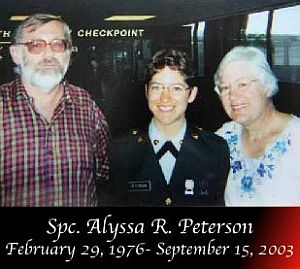
Greg Mitchell reports (parts one and two) on the suicide of Spc. Alyssa Peterson, one of the first women soldiers to die in Iraq. She took her own life exactly seven years ago after being reprimanded for showing empathy for Iraqi prisoners who were undergoing interrogation. All records of the techniques being used have been destroyed but there seems little doubt that the Iraqis were being tortured.

The 27-year-old’s parents didn’t even know their daughter was in Iraq until they were informed of her death. The fact that she committed suicide was concealed by the military for several more years — the most likely reason for the cover-up being that it was Peterson’s unwillingness to participate in torture that drove her to take her own life.

Kayla Williams, a US Army sergeant who served with Peterson, described the impact of participating in interrogations which she could see clearly contravened the Geneva Conventions.

Fellow soldiers, echoing then vice-president Dick Cheney, told the young sergeant that “the old rules no longer applied because this was a different world. This was a new kind of war.” But Williams said: “it really made me feel like we were losing that crucial moral higher ground, and we weren’t behaving in the way that Americans are supposed to behave.”

“It also made me think,” Williams says, “what are we as humans, that we do this to each other? It made me question my humanity and the humanity of all Americans. It was difficult, and to this day I can no longer think I am a really good person and will do the right thing in the right situation.”

As the famous Milgram experiment demonstrated, individuals who choose to do the right thing — especially when that demands defying authority — are usually in a minority. The much more prevalent tendency is a willingness to follow orders and suspend ones own moral judgment — even when that involves participating in torture.

Should Alyssa Peterson have been turned away from the military on the grounds that she was too humane, her conscience too strong, for her to serve in the US Army? She ended up being reprimanded for showing empathy to Iraqi prisoners. As the official investigation of her death revealed: “She said that she did not know how to be two people; she… could not be one person in the cage [where prisoners were apparently tortured] and another outside the wire.”

Suppose before she took her life, Dick Cheney had had an opportunity to council her, what would he have said? Or suppose Cheney was now to speak to her father, what would he say?

Empathy is a liability in wartime? Americans need to set aside their humanity when they put on a uniform?

Peterson’s ability to empathize with Iraqi prisoners was no doubt in large part an expression of her character and her humanity, yet to an extent it must also have resulted from the humanizing effect of understanding and speaking Arabic. In spite of the dehumanizing effect of seeing men stripped of their dignity, she must also have been able to see beyond that and through their words seen not mere “terrorist” suspects, but fathers with daughters and sons with parents.

Recognition of humanity is not something we can pick up or discard whenever it seems expedient — whenever cast aside it henceforth becomes increasingly difficult to rediscover.

The choice to cross over to the “dark side” is a choice that may prove impossible to reverse. At 27 Alyssa Peterson seems to have understood that. As far as we can tell, Dick Cheney has not even attempted to find the way back.

Facebooktwittermail

Looking back at torture

President Obama has so far refused to look back at the previous administration’s use of torture, but David Cole says: “on this issue, we cannot move forward without looking back. Unless we acknowledge that what the United States did was not just a bad idea, but illegal, we risk treating torture as simply another policy option.”

Cole presents some of the reasons the administration is unwilling to grasp the issue and argues that Britain’s new prime minister, David Cameron, has taken a lead worth following.

The Justice Department is investigating allegations of torture at the CIA’s secret prisons — but is considering only the actions of interrogators who are reported to have exceeded the brutality authorized by the Justice Department and Bush’s Cabinet. Why are the underlings being investigated, but not those who set the illegal scheme in motion?

The answer is politics. A torture investigation that could implicate the former president and vice president would be too divisive, some say. It would consume the nation’s attention and divert us from addressing other urgent problems, such as health care, the economy, global warming and immigration.

But there is an even larger political obstacle: fear. The Democratic administration is afraid of appearing more concerned about the rights of terrorism suspects than about the security of the nation. Cheney and his supporters have already accused the administration of not being tough enough on terrorists; Democrats fear that a torture inquiry might play into critics’ hands.

There is another element at work here which is the moral relativism that underpins American views on violence.

Why would a society that widely supports the death penalty regard torture as unacceptable? From the American perspective, it’s OK to poison someone, electrocute them, hang them, shoot them (though not decapitate them), with the sole condition that a reasonably sound legal process is followed.

Torture might be illegal, but it’s not clear that it conflicts with the values that Americans live by, especially those applied to people who, in the popular imagination, deserve to suffer.

Facebooktwittermail