Snowden leaks: France summons U.S. envoy over NSA surveillance claims

The Guardian reports: The French government has summoned the US ambassador in Paris, demanding an explanation about claims that the National Security Agency has been engaged in widespread phone surveillance of French citizens.

On Monday, Le Monde published details from the NSA whistleblower Edward Snowden suggesting that the US agency had been intercepting phone calls on what it terms “a massive scale”.

The French foreign minister, Laurent Fabius, warned: “This sort of practice between partners that invades privacy is totally unacceptable and we have to make sure, very quickly, that this no longer happens.”

His summoning of the ambassador for urgent talks came as the US secretary of state, John Kerry, arrived in the French capital for the start of a European tour focused on discussions over the Middle East and Syria, and keen to stress close military and intelligence ties with Paris, which he recently called America’s “oldest ally”.

The French interior minister, Manuel Valls, described the revelations as shocking and said he would be pressing for detailed explanations from Washington.

“Rules are obviously needed when it comes to new communication technologies, and that’s something that concerns every country,” he told Europe-1 radio. “If a friendly country – an ally – spies on France or other European countries, that is completely unacceptable.”

The report in Le Monde, which carries the byline of the outgoing Guardian journalist Glenn Greenwald, who worked with Snowden to lay bare the extent of the NSA’s actions, claims that between 10 December 2012 and 8 January 2013 the NSA recorded 70.3m phone calls in France. [Continue reading…]

Facebooktwittermail

In mountains of scrap, America leaves its mark on Afghanistan

After thirteen years of war, a mission long described as an effort to win hearts and minds, for many Afghans for generations to come, the enduring memory of America will be of this nation’s grotesque wastefulness. America will have become synonymous with trash as the legacy of a pointless war will be precisely that: a pile of trash.

But as if to highlight America’s exceptional relationship with trash, in this instance in an orgy of destruction, items of value are first getting crushed before they get left behind.

The Washington Post reports: The armored trucks, televisions, ice cream scoops and nearly everything else shipped here for America’s war against the Taliban are now part of the world’s biggest garage sale. Every week, as the U.S. troop drawdown accelerates, the United States is selling 12 million to 14 million pounds of its equipment on the Afghan market.

Returning that gear to the United States from a landlocked country halfway around the world would be prohibitively expensive, according to U.S. officials. Instead, they’re leaving behind $7 billion worth of supplies, a would-be boon to the fragile Afghan economy.

But there’s one catch: The equipment is being destroyed before it’s offered to the Afghan people — to ensure that treadmills, air-conditioning units and other rudimentary appliances aren’t used to make roadside bombs.

“Many non-military items have timing equipment or other components in them that can pose a threat. For example, timers can be attached to explosives. Treadmills, stationary bikes, many household appliances and ­devices, et cetera, have timers,” said Michelle McCaskill, a spokeswoman for the Pentagon’s Defense Logistics Agency.

That policy has produced more scrap metal than Afghanistan has ever seen. It has also led to frustration among Afghans, who feel as if they are being robbed of items such as flat-panel televisions and armored vehicles that they could use or sell — no small thing in a country where the average annual income hovers at just over $500.

In Afghanistan, nicknamed the “graveyard of empires,” foreign forces are remembered for what they leave behind. In the 1840s, the British left forts that still stand today. In the 1980s, the Russians left tanks, trucks and aircraft strewn about the country. The United States is leaving heaps of mattresses, barbed wire and shipping containers in scrap yards near its shrinking bases.

“This is America’s dustbin,” said Sufi Khan, a trader standing in the middle of an immense scrap yard outside Bagram air base, the U.S. military’s sprawling headquarters for eastern Afghanistan. [Continue reading…]

Facebooktwittermail

Sleep cleanses the brain

The Washington Post reports: While we are asleep, our bodies may be resting, but our brains are busy taking out the trash.

A new study has found that the cleanup system in the brain, responsible for flushing out toxic waste products that cells produce with daily use, goes into overdrive in mice that are asleep. The cells even shrink in size to make for easier cleaning of the spaces around them.

Scientists say this nightly self-clean by the brain provides a compelling biological reason for the restorative power of sleep.

“Sleep puts the brain in another state where we clean out all the byproducts of activity during the daytime,” said study author and University of Rochester neurosurgeon Maiken Nedergaard. Those byproducts include beta-amyloid protein, clumps of which form plaques found in the brains of Alzheimer’s patients.

Staying up all night could prevent the brain from getting rid of these toxins as efficiently, and explain why sleep deprivation has such strong and immediate consequences. Too little sleep causes mental fog, crankiness, and increased risks of migraine and seizure. Rats deprived of all sleep die within weeks.

Although as essential and universal to the animal kingdom as air and water, sleep is a riddle that has baffled scientists and philosophers for centuries. Drifting off into a reduced consciousness seems evolutionarily foolish, particularly for those creatures in danger of getting eaten or attacked. [Continue reading…]

Facebooktwittermail

No scientific consensus on the safety of GMOs

Sustainable Pulse reports: There is no scientific consensus on the safety of genetically modified foods and crops, according to a statement released today by an international group of more than 90 scientists, academics and physicians.

The statement comes in response to recent claims from the GM industry and some scientists, journalists, and commentators that there is a “scientific consensus” that GM foods and crops were generally found safe for human and animal health and the environment. The statement calls these claims “misleading”, adding, “This claimed consensus on GMO safety does not exist.”

“Such claims may place human and environmental health at undue risk and create an atmosphere of complacency,” states Dr. Angelika Hilbeck, chairperson of the European Network of Scientists for Social and Environmental Responsibility (ENSSER) and one of the signatories. “The statement draws attention to the diversity of opinion over GMOs in the scientific community and the often contradictory or inconclusive findings of studies on GMO safety. These include toxic effects on laboratory animals fed GM foods, increased pesticide use from GM crop cultivation, and the unexpected impacts of Bt insecticidal crops on beneficial and non-target organisms,” Dr Hilbeck continues.

In spite of this nuanced and complex picture, a group of like-minded people makes sweeping claims that GM crops and foods are safe. In reality, many unanswered questions remain and in some cases there is serious cause for concern.

Prof C. Vyvyan Howard, a medically qualified toxicopathologist based at the University of Ulster and a signatory to the statement, said: “A substantial number of studies suggest that GM crops and foods can be toxic or allergenic. It is often claimed that millions of Americans eat GM foods with no ill effects. But as the US has no GMO labeling and no epidemiological studies have been carried out, there is no way of knowing whether the rising rates of chronic diseases seen in that country have anything to do with GM food consumption or not. Therefore this claim has no scientific basis.” [Continue reading…]

Facebooktwittermail

The phenomenology of a drone strike

Nasser Hussain writes: Let us then take a closer look at the visual regime of the drone. Let us see what a drone sees (and what it does not). Here is a representative clip, chosen more or less randomly from the many available online.

While many commentators worry about the “video-game style warfare” of such footage, the comparison is both exaggerated and inapt. Contrary to drone footage, video games offer a deeply immersive environment in which at least the player’s virtual life is at stake. Perhaps what fuels the comparison of drone footage to video games is the aura of detachment they share. The worry is that detachment eases the ability to kill.

In his study On Killing, Dave Grossman, a colonel in the military, argues persuasively for a correlation between distance and the ease of killing.

On the one hand, the video feed of drone footage transmitted to a distant location, precisely fits Grossman’s maximum range category: “a range at which the killer is unable to perceive his individual victims without using some form of mechanical assistance—binoculars, radar, periscope, remote TV camera, and so on.” At this distance, Grossman reports, “I have not found a single instance of individuals who have refused to kill the enemy under these circumstances, nor have I found a singe instance of psychiatric trauma associated with this type of killing.” On the other hand, the drone’s ability to zoom in to a sight line just a few hundred feet above the ground produces images of startling intimacy. In the end, we should be less concerned with how the mediation of the drone’s camera increases or decreases the pilot’s willingness to fire—since that decision is dispersed along a complex chain of command, referred to in military circles as the “kill chain”—than with how the purely visual quality reinforces certain conditions of control and asymmetric violence.

Looking at the clip again, one element is obviously missing: sound. Although the pilots can hear ground commands, there is no microphone equivalent to the micro-scopic gaze of the drone’s camera. This mute world of dumb figures moving about on a screen has particular consequences for how we experience the image. As Michel Chion notes in The Voice in Cinema, although sound or voice is easily swallowed up by the image, it nonetheless structures the image: “only the creators of a film’s sound — recordist, sound effects person, mixer, director — know that if you alter or remove these sounds, the image is no longer the same.” In the case of the drone strike footage, the lack of synchronic sound renders it a ghostly world in which the figures seem unalive, even before they are killed. The gaze hovers above in silence. The detachment that critics of drone operations worry about comes partially from the silence of the footage.

The camera angle is always the same: the overhead shot. By definition, the overhead shot excludes the shot/reverse shot, the series of frontal angles and edits that make up face-to-face dialogue. With the overhead shot, there is no possibility of returning the gaze. The overhead shot neither invites nor permits participation in its visual economy. It is the filmic cognate of asymmetric war.

Asymmetric war is typically a conflict between a regular army and a guerilla force, but could describe any conflict in which one side cannot retaliate in kind. [Continue reading…]

Facebooktwittermail

The deadly fury that demonization unleashes

Katrin Bennhold writes: From a comfortable couch in his London living room, Sean O’Callaghan had been watching the shaky televised images of terrified people running from militants in an upscale mall in Kenya. Some of those inside had been asked their religion. Muslims were spared, non-Muslims executed.

“God, this is one tough lot of jihadis,” said a friend, a fellow Irishman, shaking his head.

“But we used to do the same thing,” Mr. O’Callaghan replied.

There was the 1976 Kingsmill massacre. Catholic gunmen stopped a van with 12 workmen in County Armagh, Northern Ireland, freed the one Catholic among them and lined up the 11 Protestants and shot them one by one.

Mr. O’Callaghan, a former paramilitary with the Irish Republican Army, has particular insight into such coldblooded killing.

On a sunny August day in 1974, he walked into a bar in Omagh, Northern Ireland, drew a short-barreled pistol and shot a man bent over the racing pages at the end of the counter, a man he had been told was a notorious traitor to the Irish Catholic cause.

Historical parallels are inevitably flawed. But a recent flurry of horrific bloodletting — the attack in Nairobi that left 60 dead, the execution by Syrian jihadis of bound and blindfolded prisoners, an Egyptian soldier peering through his rifle sight and firing on the teenage daughter of a Muslim Brotherhood leader — raises a question as old as Cain and Abel: Do we all have it in us?

Many experts think we do. For Mr. O’Callaghan, it was a matter of focus.

“What you’re seeing in that moment,” he said in an interview last week, “is not a human being.”

It is dangerous to assume that it takes a monster to commit a monstrosity, said Herbert Kelman, professor emeritus of social ethics at Harvard. [Continue reading…]

Facebooktwittermail

NSA hacked Mexican president’s email

Der Spiegel reports: The NSA has been systematically eavesdropping on the Mexican government for years. It hacked into the president’s public email account and gained deep insight into policymaking and the political system. The news is likely to hurt ties between the US and Mexico.

The National Security Agency (NSA) has a division for particularly difficult missions. Called “Tailored Access Operations” (TAO), this department devises special methods for special targets.

That category includes surveillance of neighboring Mexico, and in May 2010, the division reported its mission accomplished. A report classified as “top secret” said: “TAO successfully exploited a key mail server in the Mexican Presidencia domain within the Mexican Presidential network to gain first-ever access to President Felipe Calderon’s public email account.”

According to the NSA, this email domain was also used by cabinet members, and contained “diplomatic, economic and leadership communications which continue to provide insight into Mexico’s political system and internal stability.” The president’s office, the NSA reported, was now “a lucrative source.” [Continue reading…]

Facebooktwittermail

Jewish Americans see generational split on Israel-Palestine

Sarah Posner writes: In an eatery here, 28-year-old Israeli human rights activist Avner Gvaryahu described the first time he came face to face with a Palestinian.

He was 19 and serving in the Israel Defense Forces when his unit invaded the home of a Palestinian family in the dead of night. They were there to perform a “straw widow,” a raid during which soldiers forcibly seize control of a Palestinian civilian home.

“This is the reality of the occupation,” said Gvaryahu, now the Jewish diaspora coordinator for the Israeli human rights group Breaking the Silence, which, using the testimony of veterans such as himself, educates the Israeli public about military tactics and abuses in the occupied territories.

“This is the story of my generation,” said Gvaryahu, who said only a small fraction of Israelis serve in combat units in the West Bank. “No one knows about it. They don’t really understand what we’re asked to do.”

He was on tour for Breaking the Silence’s book “Our Harsh Logic,” the timing of which coincided with the publication of the Pew Research Center’s major survey of Jewish American attitudes. The survey showed an increasing secularization of American Jews, and decreasing affiliation with synagogues and organized religion, a phenomenon that exists within American Christianity as well. It also tracked changes in Jewish American attitudes to Israel.

While 30 percent of respondents professed to be very attached to Israel and 39 percent said they felt “somewhat” attached, 31 percent answered that they felt not very or not at all attached to Israel. Asked whether caring about Israel was an “essential” part of being Jewish, 43 percent answered in the affirmative. And the Pew researchers noted a demographic shift: “Older Jews are more likely than younger Jews to see caring about Israel as an essential part of what being Jewish means to them,” the study noted, with more than half of respondents over 65 believing that caring about Israel was an essential part of their Jewish identity, whereas only 32 percent of respondents under 30 shared that belief. [Continue reading…]

Facebooktwittermail

Egypt ‘looking to Russia’ for arms after U.S. aid freeze

The Times of Israel reports: Egypt is looking to Russia to supply it with arms now that the US has frozen much of its military aid to the Egyptians, Israeli television reported Friday night.

The “historic achievement,” under which the US brought Egypt into its orbit in the years since the 1979 Camp David Israel-Egypt peace treaty, is about to “go down the drain,” the Channel 2 report said.

It referred to comments earlier this week by Egypt’s Foreign Minister Nabil Fahmy, who said ties between Cairo and Washington were in “turmoil” and told CNN that Egypt would have to “find other sources” to meet its national security needs.

By “other sources,” said the TV report, Fahmy was referring to Russia, with whom Egypt was now looking to conclude a major arms deal.

This would represent a major change of orientation for Egypt, since its entire army had been built on US equipment for the past three decades.

The news came four days after reports that Israel had argued “directly and bluntly” with the Obama administration against US aid cuts to Egypt, telling Washington it was making “a strategic error” in reducing financial assistance to Cairo in the wake of the military’s ouster of president Mohammed Morsi. [Continue reading…]

U.S. military support for Egypt is much like that it provides to other countries: it’s involves the desire to foster political cooperation through dependence. However much independence Egypt’s current rulers might now want to assert, military support from Russia won’t remove the need for American hardware. With its F-16 fighters, Apache and Black Hawk helicopters, and C-130 Hercules transport aircraft, the Egyptian military remained tied to the U.S.

Facebooktwittermail

Hamas rejects Palestinian negotiations with Israel based on U.S. ‘blackmail’

Ma’an News Agency reports: Prime minister of the Hamas-run government in the Gaza Strip Ismail Haniyeh on Saturday called on Palestinians to oppose any new negotiations with Israel, arguing that they “jeopardize the Palestinian issue and the Palestinian people’s rights.”

“These negotiations mark the violation of the Palestinian national consensus as negotiations are carried out as a result of US pressure and blackmail,” he said, urging Palestinians to protect Jerusalem and never abandon any Palestinian right, especially the right of return of refugees.

Haniyeh made the comments during a speech delivered in Gaza City on the second anniversary of the prisoner swap between Hamas and Israel which saw 1,027 Palestinian prisoners freed in a deal for captured Israeli soldier Gilad Shalit.

In order to ensure the protection of Palestinian rights, “negotiations must stop and the Oslo approach must be ignored. Political forces must together find a new national strategy adopting diverse visions and means,” he continued.

“To confront any dangers or possible compromises emerging from negotiations,” added Haniyeh, “Palestinian factions and dignitaries should get together and build a Palestinian national strategy.”

This strategy, Haniyeh said, must include all possible options including armed resistance and popular resistance in addition to political and diplomatic means including academic and diplomatic divestment using all regional and international platforms.

Haniyeh also reiterated that his movement remained committed to reconciliation with the Fatah-led Palestinian Authority on the basis of the agreements reached through Cairo dialogue.

Facebooktwittermail

Jewish fear of irresistible Arab men

Ma’an News Agency reports: Jewish women have been banned from working night shifts as a part of their national service at hospitals in Israel in order to avoid “contact with Arabs,” Israeli Channel 10 reported on Wednesday.

Israeli National Service Administration Director Sar-Shalom Jerbi issued the directive two weeks ago banning any volunteer shifts past 9 p.m. for women fulfilling their national service duties.

The director explained that “we reached the decision based on concern for our volunteers, and Minister [Naftali] Bennett gave his blessing.”

Naftali Bennett is the leader of the far-right Israeli political party “Jewish Home,” and is currently the minister of religious services.

Many young Jewish women in Israel choose to volunteer at hospitals in order to fulfill their national service requirements. The national service is an alternative to service in the Israeli army, which is required for most Israeli Jews.

The decision marks a victory for an intense campaign led by religious Zionist rabbis and other right-wing groups within Israel to prevent contact of any sort between Israeli Jews and Palestinians, especially between Jewish women and Palestinian men.

According to the Channel 10 report, these groups began a campaign against women’s night-time service last year after reports surfaced of “intimate relations” between some Jewish volunteers and Palestinian doctors at hospitals.

In response to the decision, the director of the Lehava organization which was involved in the campaign issued a statement lamenting that the move did not go far enough. “Unfortunately, this is too narrow and too late a step. National service should be terminated anywhere there are non-Jews,” he said.

Facebooktwittermail

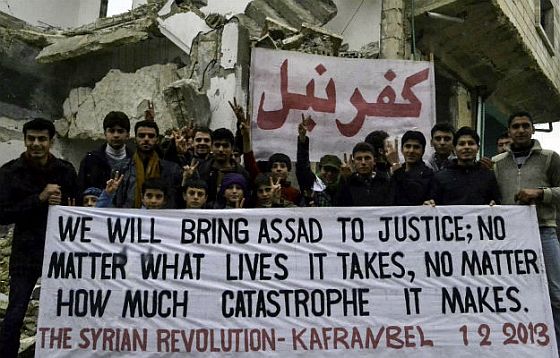
Kafranbel’s fight against isolationism abroad and at home

Kafranbel

Amal Hanano traveled to Kafranbel in northern Syria, famous for its witty posters and banners, where she met 40-year-old Raed Faris and his partner, 33-year-old Ahmad Jalal, the creative couple behind the banners.

For six weeks this summer, Kafranbel went silent.

The people of the town had been coming to Faris for months. They begged him to stop creating the antagonistic banners and organizing the protests that had attracted international attention. They blamed the protests for the regime’s air raids that were devastating the town.

This is the twisted logic that plagues people in Syria. Facing continuously escalating violence, many civilians have directed blame toward the revolution. Obviously, you can’t blame the Syrian regime for being vicious and relentless — that’s just what it is, and always was. It was the revolution that should have known its limits: In many Syrians’ eyes, the revolution had brought death and destruction, invited unwanted extremists, and steered the country to the point of no return. Returning to silence, they reasoned, was the way to end the nightmare that had been unleashed on their country.

Faris tried to compromise. He moved the protests to an inconspicuous side street, away from the main square. He banned children from attending the Friday protests and changed the set time of the gathering. Nothing stopped the residents’ complaints. And so after a protest on July 15 that featured a banner dedicated to Trayvon Martin’s family, he stopped.

“Without popular support, we can’t do this anymore,” Faris said. At first he was angry — especially when the air raids did not stop. On July 27, during the holy month of Ramadan, the bombs fell at sunset while the town broke its fast. Several people were killed in the now-silent town. And still the people blamed the protests.

“While I search for your mistakes and you search for mine, while we search for someone to blame, we realize that we have lost because we no longer trust each other,” Faris wrote on his Facebook page on July 31. “Our revolution needs us all. Let us search for each other, for victory is nothing but grasping each others’ hands in solidarity.”

After a few weeks, Faris’s anger waned. The time off had given him time to reflect. He stopped focusing on what the world wanted to hear and see. Instead, he began to listen to the town, and worked on a plan to regain his lost legitimacy.

One August evening, activists set up screens, projectors, and sound systems in five different public spaces across Kafranbel. For two hours, news was broadcast on the screens — a report from Al Jazeera, a compilation of YouTube videos, and a special local news broadcast produced by the media team. Men stopped on the street to watch. They pulled up chairs and lined the sidewalks. Some had not watched the news for months. Others had not seen the YouTube videos at all.

After two years of projecting Kafranbel to the world, Faris had brought back the world into Kafranbel.

The media team started to put together the broadcasts every day. They compiled videos of the early protests, of the banners shared around the word, and stories about Kafranbel’s martyrs. Faris and his team ignored calls from journalists who asked for new banners and cartoons. They didn’t even create artwork or organize a protest after the horrific Aug. 21 chemical weapons attack on the eastern Damascus suburbs.

After a few weeks of these outdoor events, people requested that the protests and banners return. They regained their pride in their town’s defiance. And so on Aug. 30, Kafranbel reclaimed its revolutionary role.

Isolationism — which many Syrians view as President Barack Obama’s foreign policy with regards to their home country — works both ways. Many activists inside and outside Syria realize that there is no longer a reason to convince the world to action. No one is coming to save Syria.

The collective message of Kafranbel’s body of work is the opposite of isolationism. It’s an awakening to the world after decades of neglect and forced isolation by the Assad regime. Sadly, Syrians have realized their costly awakening has come to an unwelcoming world.

Over the last two and a half years, Kafranbel’s banners projected the same message over and over: “Listen to us. Watch us. Respond.”

The message is slightly different now. Children and men alike proudly walk the streets of Kafranbel. They chant for their brave town. They are no longer hiding on side streets or standing on a stage for the world. Instead, their message is: “We are here. We are not going anywhere. Watch us if you wish.”

Facebooktwittermail

Random acts of secret generosity

Kate Murphy writes: If you place an order at the Chick-fil-A drive-through off Highway 46 in New Braunfels, Tex., it’s not unusual for the driver of the car in front of you to pay for your meal in the time it took you to holler into the intercom and pull around for pickup.

“The people ahead of you paid it forward,” the cashier will chirp as she passes your food through the window.

Confused, you look ahead at the car — it could be a mud-splashed monster truck, Mercedes or minivan — which at this point is turning onto the highway. The cashier giggles, you take your food and unless your heart is irreparably rotted from cynicism and snark, you feel touched.

You could chalk it up to Southern hospitality or small town charm. But it’s just as likely the preceding car will pick up your tab at a Dunkin’ Donuts drive-through in Detroit or a McDonald’s drive-through in Fargo, N.D. Drive-through generosity is happening across America and parts of Canada, sometimes resulting in unbroken chains of hundreds of cars paying in turn for the person behind them.

This is taking place at a time when the nation’s legislators can’t speak a civil word unless reading from Dr. Seuss. “We really don’t know why it’s happening but if I had to guess, I’d say there is just a lot of stuff going on in the country that people find discouraging,” said Mark Moraitakis, director of hospitality at Chick-fil-A, which is based in Atlanta. “Paying it forward is a way to counteract that.” [Continue reading…]

Facebooktwittermail

Obama colludes with CIA in effort to block release of Senate’s damning report on torture

Jane Mayer reports: Last night, along with the bill reopening the government, the Senate confirmed Stephen W. Preston, the top lawyer at the C.I.A., to move to the Pentagon to serve in the same role there. The vote slipped by unnoticed by most, but on close inspection, it revealed previously unreleased documents that lift the lid on an unusual standoff between Congress and the Obama Administration’s C.I.A. At its core is a bitter disagreement over an apparently devastating, and still secret, report by the Senate Intelligence Committee documenting in detail how the C.I.A.’s brutalization of terror suspects during the Bush years was unnecessary, ineffective, and deceptively sold to Congress, the White House, the Justice Department, and the public. The report threatens to definitively refute former C.I.A. personnel who have defended the program’s integrity. But so far, to the consternation of several members of the Intelligence Committee, the Obama Administration, like Bush’s before it, is keeping the damning details from public view.

Preston’s confirmation became a proxy skirmish in the fight. Obama reportedly hoped to get Preston confirmed before the congressional recess this past summer. Instead, Senator Mark Udall, a Democrat from Colorado, who is a member of both the Senate Select Committee on Intelligence and the Armed Services Committee, put a “hold” on Preston’s confirmation until he answered a set of additional, and previously undisclosed, questions. A copy of these seven questions, and Preston’s answers, obtained by The New Yorker (below), sheds new light on the conflict.

The questions and answers make clear that Udall, who has pushed vigorously for the report’s release, voted to confirm Preston only after he believed that the general counsel distanced himself from his own intelligence agency’s defiant and defensive stance on the six-thousand-three-hundred page report, which cost forty million dollars to produce. Democrats on the Senate Intelligence Committee, including Chairwoman Dianne Feinstein, are pushing to declassify and publicly release it. But John Brennan, the agency’s director, a career C.I.A. officer, and an Obama confidant, is apparently resisting disclosure, and challenging many of the report’s conclusions.

On June 27th, the C.I.A. delivered an impassioned rebuttal of the report to the committee. Last month marked the last of numerous meetings between C.I.A. and Intelligence Committee personnel over the disputed report. They did not go well, according to several informed sources. Meanwhile, despite Obama’s calls for increased transparency, the White House has apparently sat on the sidelines, urging the two intransigent sides to work out their differences. Without White House involvement, the standoff is likely to remain a huge battle. [Continue reading…]

Facebooktwittermail

How the CIA and the Taliban undermined the global campaign to eradicate polio

The New York Times, July 2012: Did the killing of Osama bin Laden have an unintended victim: the global drive to eradicate polio?

In Pakistan, where polio has never been eliminated, the C.I.A.’s decision to send a vaccination team into the Bin Laden compound to gather information and DNA samples clearly hurt the national polio drive. The question is: How badly?

After the ruse by Dr. Shakil Afridi was revealed by a British newspaper a year ago, angry villagers, especially in the lawless tribal areas on the Afghan border, chased off legitimate vaccinators, accusing them of being spies.

And then, late last month, Taliban commanders in two districts banned polio vaccination teams, saying they could not operate until the United States ended its drone strikes. One cited Dr. Afridi, who is serving a 33-year sentence imposed by a tribal court, as an example of how the C.I.A. could use the campaign to cover espionage.

“It was a setback, no doubt,” conceded Dr. Elias Durry, the World Health Organization’s polio coordinator for Pakistan. “But unless it spreads or is a very longtime affair, the program is not going to be seriously affected.”

Reuters, October 18, 2013: A Taliban ban on vaccination is exacerbating a serious polio outbreak in Pakistan, threatening to derail dramatic progress made this year towards wiping out the disease worldwide, health officials say.

Health teams in Pakistan have been attacked repeatedly since the Taliban denounced vaccines as a Western plot to sterilize Muslims and imposed bans on inoculation in June 2012.

In North Waziristan, a region near the Afghan border that has been cordoned off by the Taliban, dozens of children, many under the age of two, have been crippled by the viral disease in the past six months.

And there is evidence in tests conducted on sewage samples in some of the country’s major cities that the polio virus is starting to spread beyond these isolated pockets and could soon spark fresh polio outbreaks in more densely populated areas.

“We have entered a phase that we were all worried about and were afraid might happen,” Elias Durry, head of the Global Polio Eradication Initiative (GPEI) in Pakistan, told Reuters in a telephone interview.

“The risk is that as long as the virus is still circulating, and as long as we have no means of reaching these children and immunizing them to interrupt virus transmission, it could jeopardize everything that has been done so far – not only in Pakistan, but also in the region and around the globe.”

Facebooktwittermail