Yearly Archives: 2010

How to deal with Islamophobia in the media

So, as just about everyone now knows, NPR analyst and Fox News contributor, Juan Williams said this to Bill O’Reilly on Monday:

I’m not a bigot… But when I get on the plane, I got to tell you, if I see people who are in Muslim garb and I think, you know, they are identifying themselves first and foremost as Muslims, I get worried. I get nervous.

When someone says, “I’m not a bigot,” we can generally be sure they’re about to say something that we’d expect to come out of the mouth of bigot. We can also infer that they’ve bought into an improbable idea: bigots identify themselves as such. Thus the implausible disclaimer: take my word for it — I’m not a bigot. Err, OK Juan, but I’m sorry. You don’t sound too convincing.

Jeff Bercovici notes:

The notion that “people in Muslim garb are scary” is widespread in America, and its noxious that many people believe as much. Countless people getting on planes have thought the same thing as Mr. Williams. This is exactly the sort of case where airing and logically refuting a bigoted view is better than making it so that it’s an unspoken thing that many people persist in thinking privately.

Thanks to NPR’s knee-jerk reaction, more is now being said about the fact that Williams got fired than the fact that what he said was both prejudiced and dumb. Not only does the debate have the wrong focus but Williams has now been rewarded for his “blunder” by getting a new three-year contract from Fox News worth almost $2 million.

The people with the greatest regrets right now are probably local NPR station managers whose current fundraising efforts have been disrupted by the ruckus.

NPR’s CEO Vivian Schiller says: “This isn’t a case of one strike and you’re out.” They have had “an on-going issue” with Williams.

The problem is, each time a journalist gets fired for making a dumb remark, this doesn’t improve the overall quality of journalism. Instead it means that those journalists who are most disciplined in concealing their views will have a professional advantage over those journalists guilty of the occasional indiscretion. My suspicion is that the well-wrapped bigots are more common than the bigots with loose tongues. Bigots are better clearly labelled than fired.

What consequences should Williams have faced for revealing his Islamophobia? How about mockery on the Daily Show where the evidence that known terrorists do not wear “Muslim garb” would swiftly have exposed the folly behind his fear.

What should really scare Williams and anyone else who wants to play spot-the-terrorist next time they fly is that terrorists can wear business suits, carry US passports and have names like David Headley.

Facebooktwittermail

The post-colonial era is slow coming

“It seems like the ragheads and the Pakis are worrying your dad, but your dad’s favorite food is curry and kebab,” sings Lowkey, summing up the multicultural dilemma facing quite a few white Englishmen.

Peyvand Khorsandi provides another multicultural vignette:

Golborne Road, on the outskirts of Notting Hill in west London, is home to two Portuguese cafés, Stella McCartney, and my favourite burger van, run by two Moroccan men. I’ve been a regular for almost 10 years – the van offers no ordinary fare. A ball of meat goes splat on the griddle as it’s evened into shape while onions sizzle.

Money and Arabic banter are exchanged – when the meat is crispy brown an egg is cracked open, stuffed alongside the patty into a heated bun with a sprinkle of chopped salad, fries and some warm, homemade, tomato sauce (fried prawns optional).

I am usually finishing off my second bowl of soup – they do a mean bean, lentil and pea – when the beaming parcel of beefy goodness is handed to me, smiling as a good burger should.

On Fridays Mohammed and Aziz repair to a mosque in the converted building opposite – customers find the van shut from around 12.30pm to 2pm. Caterers should hold these hours sacred but Mohammed and Aziz, as their prices testify, are not about money. The van’s closes for Ramadan.

The punters are largely Moroccan men but you do see Bohemian non-Moroccan women and men of all ages stopping off for a bite, too.

In the background the magnificent Trellick Tower — a hive of different people and cultures living next-door to, and on top of, each other — literally looks down on the rest of us.

If German Chancellor Angela Merkel’s declaration this weekend that multiculturalism has been an utter failure, was to be reduced to a motto, it might be this: we don’t want you, we just want your stuff.

That stuff includes all kinds of things from food, to cheap labor, to exotic artifacts, to land. But the one thing it excludes is non-native culture in the form of people.

If multiculturalism has failed it is only in as much as it has been conceived as a method for grappling with the legacy of colonialism. The problem with that notion is that colonialism hasn’t ended; it simply can’t be delineated on maps as clearly as it once could.

Meanwhile, out in the state that views itself as the most dangerous outpost of Western civilization, the old-fashioned colonial land-grabbing mindset was never more clearly expressed than it was a couple of years ago by Uzi Arad, currently Benjamin Netanyahu’s national security adviser. When asked whether it was time to abandon the two-state solution (and by implication for Israel to annex the West Bank) he responded: “We want to relieve ourselves of the burden of the Palestinian populations — not territories. It is territory we want to preserve, but populations we want to rid ourselves of.”

If there should be any doubt that we in the West remain shackled to mindsets shaped by colonialism, just look at the ever-widening chasm that separates Barack Obama as the embodiment of hope from Barack Obama, the 44th President of the United States.

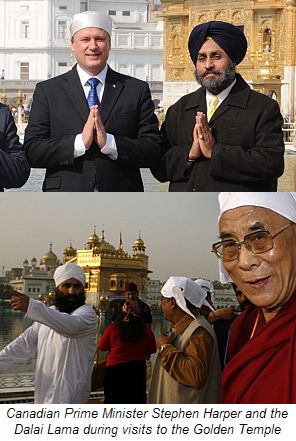
The only chance that our multicultural president could be enticed to take an action requiring only a modicum of political daring during his upcoming trip to India — to visit Amritsar’s Golden Temple where head coverings are obligatory — would have been if the Sikh religious custodians of the temple deemed a baseball cap acceptable. The don’t. (As a reader here suggested in jest: “Why can’t he just wear a kippah? It would fulfill the requirement, and he loves sucking up to the Israelis.)

Tunku Varadarajan asks:

[W]hat does this decision to avoid Amritsar tell us about how this White House feels about Americans? Does it feel that ordinary Americans will pillory their president for having associated himself with “ragheads” in Amritsar? Is this a variant of that elite condescension for ordinary folks who are “bitter,” and who “cling to guns and religion”?

That Obama can’t find a way to explain the symbolism of a little square of cloth on his head — placed there by enthusiastic, welcoming Indian hosts who wish him and America well — suggests that he has lost confidence in his own intellect, his own charisma, his own eloquence. A man once celebrated for his promise of change now allows a state visit to be shaped by his fear of the blogosphere — and by his fear of abuse that might come at him from an ignorant subset of the American population. Let’s just call it the pygmification of a president, and lament the gutlessness of this White House.

The operative fears here no doubt include all those Varadarajan lists but he omits the most obvious one, the one that was probably decisive: the reasonable expectation that images of Obama with head covered, showing his respects at a foreign domed temple would feature in GOP attack ads during the 2012 presidential campaign. The political value of such images suggests that the “ignorant subset” this commentator dismisses, penetrate much more deeply into mainstream America than he cares to admit.

Obama’s failing — and it is unforgivable — is that rather than challenge prevailing prejudices he has chosen to accommodate them.

When he meets India’s Prime Minister Manmohan Singh — note that he is a Sikh in a majority Hindu nation — will Obama muster the courage to put his hands together and say namaste?

Facebooktwittermail

Israel’s coma

While most Israelis can’t visit Ariel Sharon in hospital, they can now do the closest thing: go stand next to a life-size model of the former prime minister, propped up in bed, attached to a drip and steadily breathing in an otherwise empty room in a Tel Aviv art gallery.

“Sharon’s still breathing and beating body is an allegory for the Israeli political body — a dependent and mediated existence, self-perpetuated artificially and out of inertia, with open eyes that cannot see,” the gallery’s curator Joshua Simon writes in an introduction to the exhibit, the creation of Israeli artist Noam Braslavsky.

Sharon’s coma mirrors the effect that Israel’s withdrawal from Gaza was intended to have: that it would suspend any real movement towards the creation of a Palestinian state.

But as Henry Siegman made clear, three years ago, the fiction that Israel was responsive to external stimuli began over 40 years ago:

Just one year after the 1967 war, Moshe Dayan, a former IDF chief of staff who at the time was minister of defence, described his plan for the future as ‘the current reality in the territories’. ‘The plan,’ he said, ‘is being implemented in actual fact. What exists today must remain as a permanent arrangement in the West Bank.’ Ten years later, at a conference in Tel Aviv, Dayan said: ‘The question is not “What is the solution?” but “How do we live without a solution?”’ Geoffrey Aronson, who has monitored the settlement enterprise from its beginnings, summarises the situation as follows:

Living without a solution, then as now, was understood by Israel as the key to maximising the benefits of conquest while minimising the burdens and dangers of retreat or formal annexation. This commitment to the status quo, however, disguised a programme of expansion that generations of Israeli leaders supported as enabling, through Israeli settlement, the dynamic transformation of the territories and the expansion of effective Israeli sovereignty to the Jordan River.

In an interview in Ha’aretz in 2004, Dov Weissglas, chef de cabinet to the then prime minister, Ariel Sharon, described the strategic goal of Sharon’s diplomacy as being to secure the support of the White House and Congress for Israeli measures that would place the peace process and Palestinian statehood in ‘formaldehyde’. It is a fiendishly appropriate metaphor: formaldehyde uniquely prevents the deterioration of dead bodies, and sometimes creates the illusion that they are still alive. Weissglas explains that the purpose of Sharon’s unilateral withdrawal from Gaza, and the dismantling of several isolated settlements in the West Bank, was to gain US acceptance of Israel’s unilateralism, not to set a precedent for an eventual withdrawal from the West Bank. The limited withdrawals were intended to provide Israel with the political room to deepen and widen its presence in the West Bank, and that is what they achieved.

Do we really have to wait until Sharon stops breathing before the peace process can officially be declared dead?

Whatever political differences there have been between Barak, Sharon, Olmert and Netanyahu, each Israeli prime minister has shown himself equally adept in the art of living without a solution, “with eyes open that cannot see.”

Facebooktwittermail

“No Pakistani child is worth one whit less that any American child”

FB Ali at Sic Semper Tyrannis drew my attention to a blog post that appeared in Pakistan’s Express Tribune. It was written by a US Army helicopter pilot, John Bockmann, who was recently deployed to help in relief work, following this summer’s devastating flooding.

US humanitarian aid — especially when provided to a country like Pakistan — often looks like nothing more than a cynical attempt to pacify resentment provoked by the Pentagon’s primary mission: attacking its adversaries. For that reason, American soldiers have good reason to wonder how they will be received when their mission is peaceful.

Bockmann writes:

The days since arriving have passed quickly. Every day we take rice, flour, blankets, housing materials, cooking oil – anything – up and down the Swat and Indus River Valleys. We also bring sick, injured, and displaced people to hospitals and hometowns.

My first mission took us up the Indus river valley, and I embarrassed myself by constantly exclaiming its beauty. Below me was the Karakorum Highway – the old Silk Road into China – and the valley itself, with terraced farmland overshadowed by majestic, snow-capped mountains.

Along with the beauty, though, I see reminders of the flood, bridges that are broken or missing and roads and fields that have been washed away. I am beginning to see widespread reconstruction now as well and feel hope for the people in these villages. They will soon have another way to get help.

I realize that some who read this will question our intentions and some may even wish us ill. I certainly did not imagine that cheering throngs would greet us at each village though — we are always welcomed. I did not expect our goodwill to be taken at face value by all of Pakistan, but we have received immense support.

I have learned in my time here that Pakistani people are truly gracious. Strangers have invited me for chai and conversation. Almost anyone will shake my hand and ask my name, inquire about my health and how I am getting along. Instead of a handshake at our first meeting, I have sometimes been embraced. “Strangers shake hands,” my new friend Mahmood explained, “but brothers hug each other.”

This warms my heart. My mission, our mission, is straightforward, noble, and good. I am deeply grateful to those who support us here, for we need all the help we can get in order to help those in need. I am honored to do this work. I feel at home here beyond anything I could have expected.

So is this just the sentimental perspective of an American soldier who believes, almost as a matter of religious conviction, that America is a force of good in the world? The dozens of comments that follow his post suggest otherwise. Admittedly they come mostly from Pakistan’s English-speaking educated liberal elite, but they lead this helicopter pilot to this conclusion:

I know the hearts of many Pakistanis now, but I am still surprised by their outpouring of warmth–especially in such hard times. I read all of the comments — the stories, the blessings, the frustrations — and I am increasingly convinced that international relations are effected more by common people like you and me than by politicians who may never get a chance to have tea and real conversation with “the other side”. I am so privileged to be so well loved while I am so far from home. God’s blessings on Pakistan and her people.

His mother, Maggie Bockmann, adds her own thoughts which reveal that she does not have a sugar-coated view of America’s impact on Pakistan:

I scarcely comprehend where this delightful soul named John might have come from. As Gibran said,
“Your children are not your children.
They are the sons and daughters of Life’s longing for itself.
They come through you but not from you,
And though they are with you, yet they belong not to you.
You may give them your love but not your thoughts.
For they have their own thoughts.
You may house their bodies but not their souls,
For their souls dwell in the house of tomorrow, which you cannot visit, not even in your dreams.”
I trust John will not mind my telling you that in the early days of our family, we had a particularly heartbreaking religious fracture between his dad and myself. But now, by the grace of God, we are strong in all the weak places.
Thus shall it be between Christians and Muslims, your country and mine: despite the heartbreaking fractures, we shall become strong in all the weak places, and no government policies, no misguided violent people shall prevent it, because God wills it, whether we call him Allah or Jehovah, and we will it, with all our hearts. We shall support each other while respecting our differences.
And though I understand from this newspaper that some of your countrymen support the U.S. drone attacks, and I’m sure they have compelling reasons, which I shall not judge, I want you to know that I am willing to suffer whatever I must suffer to stand with the Pakistani people against such heartbreaking attacks, for no Pakistani child is worth one whit less that any American child, and mothers are the same around the world, as Wajih said.
As Kathy Kelly so poignantly says in this video, no Pakistani children should be quaking in their beds at night for fear of what devastation my countrymen may visit on them from the sky.
CIA Drone Protest, Kathy Kelly – 1/16/2010

For those who disagree, please forgive me, for I do not mean to be contentious. I am but a mother with a mother’s heart. That is my weakness and that is my power.

Civilian Harm and Conflict in Northwest Pakistan, a new report by CIVIC, the Campaign for Innocent Victims in Conflicts, reveals that while the local populations in the areas being targeted by drone attacks do not, by and large, question their accuracy, they object to the fact that the losses caused to innocent bystanders are being ignored.

Nadia, 10 years-old, was at school when her house was hit by a drone, killing her father and mother: “My relatives rushed to the spot and tried to recover the dead bodies trapped under the debris but we couldn’t identify them as they were completely burned.” Nadia is an only child and has moved in with her aunt in a nearby town.

She says she has “no source of income with my parents gone… my aunt looks after me now and I help her in the house…but I want admission into school. I want an education. Please ask the government to provide me with a monthly stipend so I can get an education.” The lack of US transparency about the drone program as well as the Pakistani government’s duplicity — public criticism while offering clandestine support — means civilians’ losses are entirely ignored. Civilian victims interviewed by CIVIC demanded an end to the drone strikes and compensation for their losses.

Without exception, drone strike victims interviewed by CIVIC were left to pick up the pieces on their own, denied even the recognition and acknowledgement of their loss by the Pakistani and US governments. Neither the US, FATA Secretariat or the Pakistani Federal Government have any standard, public procedures for investigating civilian losses from drone strikes, acknowledging or recognizing losses, or providing help for victims to recover.

The common denominator here is that human beings, whether they live in North Waziristan, the Swat Valley, Gaza, New Orleans, or Washington DC, all want the same thing: respect.

This is the basis of human relations and human society, that right down on the level at which one person engages with another, the foundation of their transactions needs to be the recognition: your life is worth just as much as mine. As war tramples on this recognition, all other forms of destruction then become possible.

Facebooktwittermail

Obama bows to sensitivities of ignorant Americans and political advisers

The New York Times reports:

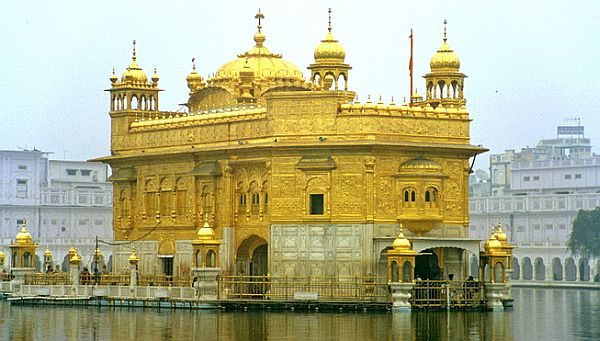
The Golden Temple, a sprawling and serene complex of gleaming gold and polished marble that is the spiritual center of the Sikh religion, is one of India’s most popular tourist attractions. Revered by Indians of all faiths, it is a cherished emblem of India’s religious diversity. So it was no surprise when the gold-plated marvel was promoted as the likely third stop on President Obama’s visit to India, scheduled for early November.

But the United States has ruled out a Golden Temple visit, according to an American official involved in planning. Temple officials said that American advance teams had gone to Amritsar, the holy city that is the site of the temple, to discuss a possible visit. But the plan appears to have foundered on the thorny question of how Mr. Obama would cover his head, as Sikh tradition requires, while visiting the temple.

“To come to golden temple he needs to cover his head,” said Dalmegh Singh, secretary of the committee that runs the temple. “That is our tradition.”

Mr. Obama, a Christian, has struggled to fend off persistent rumors that he is a Muslim, and Sikhs in the United States have often been mistaken for Muslims. Sikhism, which arose in the Punjab region in the 15th century, includes elements of Hinduism and Islam but forms a wholly distinct faith. Since Sept. 11, 2001, Sikhs in the United States have been occasional targets of anti-Muslim discrimination and violence — a Sikh was killed in Arizona a few days after the attack on the World Trade Center by a man who mistook him for a Muslim.

Facebooktwittermail

Zionism and the war on terrorism both rest on the same hollow foundation

Distilling some of his findings from extensive research conducted at the University of Chicago’s Project on Security and Terrorism, Robert Pape writes:

For nearly a decade, Americans have been waging a long war against terrorism without much serious public debate about what is truly motivating terrorists to kill them. In the immediate aftermath of the 9/11 attacks, this was perfectly explicable — the need to destroy al Qaeda’s camps in Afghanistan was too urgent to await sober analyses of root causes.

But, the absence of public debate did not stop the great need to know or, perhaps better to say, to “understand” the events of that terrible day. In the years before 9/11, few Americans gave much thought to what drives terrorism — a subject long relegated to the fringes of the media, government, and universities. And few were willing to wait for new studies, the collection of facts, and the dispassionate assessment of alternative causes. Terrorism produces fear and anger, and these emotions are not patient.

A simple narrative was readily available, and a powerful conventional wisdom began to exert its grip. Because the 9/11 hijackers were all Muslims, it was easy to presume that Islamic fundamentalism was the central motivating force driving the 19 hijackers to kill themselves in order to kill Americans. Within weeks after the 9/11 attacks, surveys of American attitudes show that this presumption was fast congealing into a hard reality in the public mind. Americans immediately wondered, “Why do they hate us?” and almost as immediately came to the conclusion that it was because of “who we are, not what we do.” As President George W. Bush said in his first address to Congress after the 9/11 attacks: “They hate our freedoms: our freedom of religion, our freedom of speech, our freedom to vote and assemble and disagree with each other.”

Thus was unleashed the “war on terror.”

The narrative of Islamic fundamentalism did more than explain why America was attacked and encourage war against Iraq. It also pointed toward a simple, grand solution. If Islamic fundamentalism was driving the threat and if its roots grew from the culture of the Arab world, then America had a clear mission: To transform Arab societies — with Western political institutions and social norms as the ultimate antidote to the virus of Islamic extremism.

This narrative had a powerful effect on support for the invasion of Iraq. Opinion polls show that for years before the invasion, more than 90 percent of the U.S. public believed that Saddam Hussein was harboring weapons of mass destruction (WMD). But this belief alone was not enough to push significant numbers to support war.

What really changed after 9/11 was the fear that anti-American Muslims desperately wanted to kill Americans and so any risk that such extremists would get weapons of mass destruction suddenly seemed too great. Although few Americans feared Islam before 9/11, by the spring of 2003, a near majority — 49 percent — strongly perceived that half or more of the world’s 1.4 billion Muslims were deeply anti-American, and a similar fraction also believed that Islam itself promoted violence.

The narrative — “it’s not what we do but who we are” — that Americans swallowed after 9/11, came ready-made. It is the narrative that provides the bedrock of Zionism by characterizing opposition to Israel’s creation and expansion as being an expression of anti-Semitism rather than a reaction to colonialism and dispossession.

Palestinians don’t attack Jews because their homes are being destroyed and their land is being taken away; Palestinians attack Jews because Palestinians hate Jews.

Al Qaeda didn’t attack Americans because American governments for many decades have propped up oppressive regimes across the Middle East and supported Zionism; al Qaeda attacked America because al Qaeda hates Americans.

In both Zionism and the war on terrorism, the refusal to deal with political injustice expresses itself through an ideological fixation on security and military solutions.

As Ariel Sharon focused on “dismantling the terrorist infrastructure” in Gaza and the West Bank, George Bush pursued a parallel course across the whole region. Americans and Israelis united in the belief that they were all innocent targets of the same implacable enemy: Islamic extremism.

Our war on terrorism was simply an extension of Israel’s war on terrorism — simply on a much larger scale. Naturally, we would borrow most of Israel’s techniques for tackling “the terrorists” — targeted killing, torture, extrajudicial detention, remote warfare and so forth.

And the underlying imperative was identical: that our righteous victimhood could not be questioned, our innocence was unassailable. Indeed it was our virtue that made us targets for attack.

If we were successful in dismantling the terrorist infrastructure or draining the swamp in which evil festered, we would save the world. We would engage in war without choice, knowing that we did so in the name of peace.

No wonder that on September 11, Benjamin Netanyahu was unable to contain his satisfaction about the way the attacks would help solidify the bond between Americans and Israelis. “It’s very good,” he said and then, quickly realizing his candor might not be well-received, added: “Well, not very good, but it will generate immediate sympathy.” The attack would “strengthen the bond between our two peoples, because we’ve experienced terror over so many decades, but the United States has now experienced a massive hemorrhaging of terror.”

Lies breed unconsciousness because they deprive intelligence of the invigorating effect of experience, thus, as we near the end of a decade of a war on terrorism we now inquire even less as shock has been given way to indifference.

Facebooktwittermail

Dubai murder suspect arrested in Canada

(Update below)
Gulf News reports:

Dubai Police Chief Tuesday confirmed the arrest in Canada of a suspect, believed to be involved in the assassination of Hamas commander Mahmoud Al Mabhouh last January.

Speaking to reporters, Lieutenant General Dahi Khalfan Tamim said Canadian authorities have arrested another suspect who is connected to the murder of Al Mabhouh that took place in a Dubai Hotel on January 19.

Lt Gen Dahi refused to give further details, but according to Al Ittihad Arabic daily, the suspect was one two people caught by the hotel’s CCTV cameras wearing tennis gears as they staked out Al Mabhouh’s room in the Bustan Rotana Hotel.

Update: Richard Silverstein reports: “Israel’s Channel 10 has revealed that the alias of the arrested Mossad agent is Eric Rassineux. His passport is displayed here. It is the first Israeli source also to confirm that Canada is holding him.”

Facebooktwittermail

Taking over Jerusalem

At 7 min 45 sec into this segment we see a widely reported incident where Imran Mansur, 12, and Iyad Gheit, 10, are hit by a car driven by David Be’eri, leader of Silwan’s Jewish settlers. Mansur’s leg was broken and Gheit had to have glass removed from his arm. Be’eri was briefly questioned after the hit and run, but Mansur — the boy who went flying into the air — has now been arrested.

The thread that ties together this 60 Minutes report is the unassailable confidence of the Israelis in their resolute intransigence.

To the extent that they acknowledge that any viewpoint might exist other than their own, they regard such perspectives as a product of ignorance. If you knew everything we know, you’d think the way we do. To some extent this is like the inflexible conviction of evangelicals, but whereas the success of the business of saving souls hinges on having some powers of persuasion, the Zionists taking over Jerusalem simply don’t care if they fail to win over non-Zionist global opinion. We don’t give a damn about the world, is the implicit message. Jerusalem belongs to the Jews.

But how can anyone who holds to this assertion — as most of Israel’s leaders do — claim to have an interest in negotiations with the Palestinians? Such “negotiations” amount to nothing more than a desire to force Palestinians to agree to Israeli terms of surrender. No capital in Jerusalem. No right of return. No sovereignty for a Palestinian state…. Oh, and there should of course be no preconditions for talks.

Facebooktwittermail

Why some Israelis regard peace as the greatest threat to the Jewish state

Zeev Sternhell writes:

The facts must be acknowledged: The heads of the rightist parties have a strategic outlook and the ability to take the long view, and they also know how to choose the right tools to carry out their mission.

The proposed new amendment to the Citizenship Law, which is aimed at fomenting a state of constant hostility between Jews and everyone else, is just one aspect of the greater plan of which Foreign Minister Avigdor Lieberman is the official spokesman. The other aspect is the foreign minister’s promise to the nations of the world that our war with the Palestinians is an eternal war. Israel needs both an external and an internal enemy, a constant sense of emergency – because peace, whether with the Palestinians in the territories or the Palestinians in Israel, is liable to weaken it to the point of existential danger.

And indeed, the right, which includes most of the leaders of Likud, is permeated with the awareness that Israeli society lives under a cloud of danger of breakdown from within. The democratic and egalitarian virus is eating away at the body politic from within. This virus rests on the universal principle of human rights and nurtures a common denominator among all human beings because they are human beings. And what do human beings have more in common than their right to be masters of their own fate and equal to one another?

In the right’s view, that is precisely where the problem lies: Negotiations on partitioning the land are an existential danger because they recognize the Palestinians’ equal rights, and thereby undermine the Jews’ unique status in Eretz Israel. Therefore, in order to prepare hearts and minds for exclusive Jewish control of the population of the entire land, it is necessary to cling to the principle that what really matters in the lives of human beings is not what unites them, but rather what separates them. And what separates people more than history and religion?

Beyond that, there is a clear hierarchy of values. We are first of all Jews, and only if we are assured that there will be no clash between our tribal-religious identity and the needs of Jewish rule, on one hand, and the values of democracy on the other can Israel also be democratic. But in any case, its Jewishness will always be given clear preference. This fact ensures an endless fight, because the Arabs will refuse to accept the sentence of inferiority that the state of Lieberman and Justice Minister Yaakov Neeman intends for them.

Facebooktwittermail

The utter failure of multiculturalism?

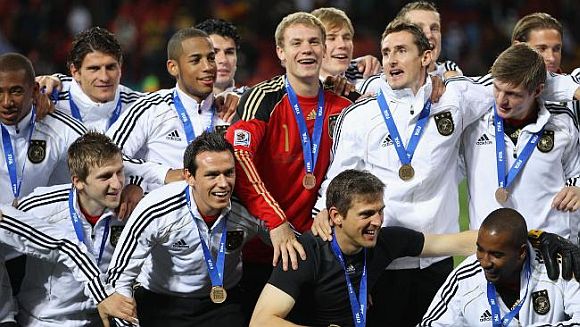
Germany: third place winners in 2010 World Cup

It wasn’t just Germans who were disappointed to see their team fail to win the 2010 World Cup in South Africa this summer. If this was the team that represented “multi-kulti”, for most of us who had the pleasure of watching their performance, the response was: let’s have more — not: this is an utter failure. Did Angela Merkel so quickly forget?

In The Guardian, Philip Oltermann writes:

Today, when I heard reports of Angela Merkel announcing that multiculturalism had “utterly failed”, my first thoughts were: who is she talking about? I am German, and I have a sister whose three boys are half-Peruvian. My brother’s children are part-Japanese. My partner is English. Were we all utter failures?

“Multi-kulti” covers a grey area somewhere between co-existence and co-operation, and one hopes the German chancellor was trying to speak in favour of team-play and against mere tolerance. My guess is that Merkel wasn’t talking about us, or about Poles, Italians or Greeks living in Germany, but about her country’s 4 million-strong Muslim population – in which case she has still chosen her words terribly badly. The result is a faux pas uncharacteristic of a politician who has won a reputation for treading quietly in matters diplomatic.

So what made her say it? The question over how to integrate Muslim migrants and the rest of German society is hardly new: politicians and commentators have been discussing it ever since the first wave of Gastarbeiter (migrant workers) arrived in the 1960s. If you look at the figures alone, there would be no particular reason to reheat the debate at this time: the number of Turkish immigrants into Germany in 2008 was as low as it had last been in 1983, according to Der Spiegel magazine, and the number of asylum applications is about a sixth of what it was in the mid-90s. More Turks returned to Turkey last year than came to live in Germany, which is actually bad news for the German economy, because with the population forecast to fall by 11.6 million by 2050, the country needs every qualified worker it can get its hands on.

Facebooktwittermail

The decline of the West

Perhaps the clearest evidence of the decline of Western civilization is the example of those who now shout it its defense.

In the name of protecting civilization, a movement promoting racial supremacism is infecting Western consciousness with the notion that a set of values and cultural constructions is now in jeopardy when in fact our civilization’s corruption is already well advanced.

If the progress of Western civilization came about through the unfettering of the power of the people in egalitarian societies, that trend was quietly reversed as citizens became consumers. In recent decades, that decline further deepened as economic “advance” turned out to be a mask concealing expanding inequality.

In the hollow culture which this has created, beyond employing a stock of well-worn platitudes about freedom and liberty, civilization’s self-appointed protectors find it easier to spotlight purported threats than describe exactly what they are defending.

In this context we should note that American culture remains influenced by European culture more than any other and to the extent that Europe provides a cultural compass, we should be alarmed at the direction this now points. An ocean will not protect us from its influence.

Christian Science Monitor reports:

A new survey in Germany shows that 13 percent of its citizens would welcome a “Führer” — a German word for leader that is explicitly associated with Adolf Hitler — to run the country “with a firm hand.”

The findings signal that Europe’s largest nation, freed from cold-war strictures, is not immune from the extreme and often right-wing politics on the rise around the Continent.

The study, released Oct. 13 by the Friedrich Ebert Foundation, affiliated with the center-left Social Democratic Party, revealed among other things that more than a third of Germans feel the country is “overrun by foreigners,” some 60 percent would “restrict the practice of Islam,” and 17 percent think Jews have “too much influence.”

The study’s overall snapshot of German society shows new forms of extremism and hate are no longer the province of far-right cohorts who shave their heads or wear leather jackets adorned with silver skulls – but register in the tweedy political center, on the right and the left. Indeed, the study found, extremism in Germany isn’t a fringe phenomenon but is found in the political center, “in all social groups and in all age groups, regardless of employment status, educational level or gender.”

The year 2010 is marking a clear shift toward extremist politics across Europe, analysts say. An uncertain economy, a gap between elites and ordinary Europeans, and fraying of a traditional sense of national identity has just in the past month brought more hard-line politics and speech, often aimed at Islam or immigrants – into a political mainstream where it had been absent or considered taboo.

On Oct. 10, the city of Vienna, a cosmopolitan and socialist stronghold since World War II, voted the far-right Freedom Party into a ruling coalition. The party, which ran on an “anti-minaret” platform in a city with only one mosque, was formerly associated with nationalist Jorg Haider, but has been reinvented by an animated former dental hygienist, Heinz-Christian Strache.

On Sept. 19, Sweden, long a Scandinavian redoubt of social tolerance and openness, put the far-right Sweden Democrats into parliament for the first time.

Further, this week the Netherlands saw the rise to influence, if not power, of the anti-Islam party of Geert Wilders, a social liberal who argues for gay rights – but whose main platform is to ban the Quran and the practice of Islam in the Low Countries. Mr. Wilders’ party will formally participate in the Dutch ruling coalition without specifically joining it.

Ian Buruma writes:

All these countries may soon be following the Danish model, in which the illiberal populist parties pledge their support without actually governing, thereby gaining power without responsibility. Denmark’s Conservative government could not govern without the support of the People’s party. Sweden’s recently re-elected conservative Moderate party will have to rely on the Democrats to form a viable government. And Wilders has already received assurances from the conservative and Christian Democrat parties that, in exchange for his support, the burqa will be banned in the Netherlands and immigration curbed.

The influence of these slick new populists, waging their war on Islam, goes well beyond their countries’ borders. Nativism is on the rise all over the western world, and Wilders, in particular, is a popular speaker at rightwing anti-Muslim gatherings in the US, Britain and Germany.

European populism focuses on Islam and immigration, but it may be mobilising a wider rage against elites expressed by people who feel unrepresented, or fear being left behind economically. They share a feeling of being dispossessed by foreigners, of losing their sense of national, social, or religious belonging. Northern Europe’s political elites, largely Social or Christian Democrats, have often been dismissive of such fears, and their paternalism and condescension may be why the backlash in those liberal countries has been particularly fierce.

The question is what to do about it. One possible solution is to let populist parties join the government if they get a sufficient number of votes. The idea of a Tea Party candidate becoming US president is alarming, to be sure, but European populists could only be part of coalition governments.

True, Hitler’s Nazis took over Germany almost as soon as they were voted into power, but the new European right are not Nazis. They have not used violence, or broken any laws. Not yet. As long as this is so, why not give them real political responsibility? They would then not only have to prove their competence, but also moderate their attitudes.

Buruma’s assumption that governance inherently imposes a moderating effect, seems very dubious. Look at Avigdor Lieberman and his Yisrael Beiteinu party in an Israel that prides itself on its Western identity. There’s little evidence that participation in government has forced them to turn away from extremism.

The underlying idea here is one that has guided the eviscerated Left for the last two decades: that the political challenges of the day can only be met by some form of reaction or accommodation through which the sacred political center can be reclaimed. The idea that the Left provides a genuine political alternative has — at least by mainstream politicians — been effectively abandoned.

This is the context in which an American underclass is expanding, ready to be corralled by rightwing, xenophobic opportunists.

The Guardian‘s Paul Mason went to Atlanta to see how economic decline is reshaping American society.

Unable to borrow or earn, a whole generation is being shut out of the American lifestyle.

Meanwhile, some states have begun a race to the bottom: slashing welfare, labour regulations and local taxes to attract investment. High-wage companies close and relocate to low-wage states, and foreign investment flows to the towns where labour costs are lowest. These states are being transformed by the arrival of low-waged Hispanic migrants even as the rightwing politicians who support the economics rail against the demographics.

As a result the so-called Sun Belt, identified by Republican strategist Kevin Phillips in the 1970s as the new political bedrock of conservatism, now feels like the unhappiest place in America. Median incomes in the south are, on average, $8,000 lower than in the northeast; poverty rates are higher than anywhere else in America — and so are the racial and religious tensions.

In the midterm elections politicians have promised to “do something” for the middle class. The kindest thing they could do is tell the truth: Americans have been living a middle-class lifestyle on working-class wages — and bridging the gap with credit. And it’s over.

Instead, the message is that the American way of life is as good as ever — just so long as it can be protected from foreign threats: the economic threat from undocumented Latino workers and the cultural threat from dangerous Muslims.

A real alternative, however, would go much further than pointing out that most Americans have for too long been living beyond their means — it would spell out that the American dream is built on a false promise and our concern should not be reduced to who has access to its fulfillment and who does not. That false promise is that the good life flows from the good stuff.

In one of the tales of Mullah Nasrudin, his friend finds him in misery with bleeding lips as he chews on red hot chillies. “Why do you keep on biting into those chillies?” his friend asks. “I’m looking for the sweet one,” the Mullah answers as he digs deeper into his basket. We too find it difficult to abandon that futile quest for a sweet chili.

America now suffers less from the consequences of easy access to credit than the fact that we have virtually no conception of material sufficiency. Our fascination with the future is driven by an experience of the present as defined by unmet needs. Ours is a condition of perpetual insufficiency. The land of opportunity is populated by people who can never have enough.

Only when we discover we have enough can we pause, take stock and consider what is of real value. The defense of civilization consists not in thwarting foreign threats but recognizing the ways in which we value or devalue civilization’s core assets.

We are now warned of a dreadful “Japanification” of America if consumers refuse to consume.

Is that all that Americans are: the earthworms of the global economy? Or might we find some hidden wealth through material loss?

Facebooktwittermail

Time to make national heroes out of those who steal secrets and publish them in the newspaper

Coleen Rowley, legal counsel to the FBI field office in Minneapolis from 1990 to 2003 and Bogdan Dzakovic, a special agent for the Federal Aviation Authority’s security division, suggest that had WikiLeaks existed in 2001, they might have been able to make public information that could have prevented the 9/11 attacks.

In the Los Angeles Times they write:

The 9/11 Commission concluded, correctly in our opinion, that the failure to share information within and between government agencies — and with the media and the public — led to an overall failure to “connect the dots.”

Many government careerists are risk-averse. They avoid making waves and, when calamity strikes, are more concerned with protecting themselves than with figuring out what went wrong and correcting it.

Decisions to speak out inside or outside one’s chain of command — let alone to be seen as a whistle-blower or leaker of information — is fraught with ethical and legal questions and can never be undertaken lightly. But there are times when it must be considered. Official channels for whistle-blower protections have long proved illusory. In the past, some government employees have gone to the media, but that can’t be done fully anonymously, and it also puts reporters at risk of being sent to jail for refusing to reveal their sources. For all of these reasons, WikiLeaks provides a crucial safety valve.

“Dr Ellsberg, do you have any concern about the possibility of going to prison for this?” Daniel Ellsberg was asked after he had leaked the Pentagon Papers to the New York Times in 1971.

Wouldn’t you go to prison to help end this war?” Ellsberg responded.

Since 9/11, how many employees or now former-employees of the US government have asked themselves whether actions they declined to take at the most opportune moment could have prevented a decade of war and the loss of hundreds of thousands of lives?

The idea that WikiLeaks could have facilitated such actions, seems to me, to have more to do with soothing troubled consciences than with a need to make whistle-blowing easier.

Ambassador Joe Wilson published his famous op-ed, “What I Didn’t Find in Africa,” in July 2003, once it was clear that weapons of mass destruction were not going to be found in Iraq. The day he should have gone public with what he knew was January 29, 2003 — the day after President Bush’s State of the Union speech in which Bush falsely claimed: “The British government has learned that Saddam Hussein recently sought significant quantities of uranium from Africa.”

What Wilson lacked was not WikiLeaks but the courage of a man like Ellsberg and the willingness to place the interests of others above his own.

Rather than looking for ways to make whistle-blowing safer, we might benefit more as a society if we more whole-heartedly celebrated those who risk their careers and even their liberty by following the dictates of their conscience.

While WikiLeaks can perform a vital function, we should not lose sight of the fact that the political impact of whistle-blowing can have more to do with the power of a public act of conscience than with the information that is revealed. When an individual in a position of authority takes a huge personal risk because of their allegiance to truth, the sheer power of their integrity calls the operations of government into question. The availability of WikiLeaks cannot make up for the shortage of Ellsbergs.

Facebooktwittermail

Chas Freeman: Engaging the Middle East — after the Cairo speech

By Ambassador Chas W. Freeman, Jr. (USFS, Ret.), Tufts University, October 15, 2010

As an American, I look at the results of U.S. policies in the Middle East and they remind me of the T-shirt someone once gave me. It said: “Sinatra is dead. Elvis is dead. And me, I don’t feel so good.”

The Middle East is a constant reminder that a clear conscience is usually a sign of either a faulty memory or a severe case of arrogant amorality. It is not a badge of innocence. These days, we meticulously tally our own battlefield dead; we do not count the numbers of foreigners who perish at our hands or those of our allies. Yet each death is a tragedy that extinguishes one soul and wounds others. This deserves our grief. If we cannot feel it, we may justly be charged with inhumanity.

All that is required to be hated is to do hateful things. Apparent indifference to the pain and humiliation one has inflicted further outrages its victims, their families, and their friends. As the Golden Rule, common – in one form or another – to all religions, implicitly warns, moral blindness is contagious. That is why warring parties engaged in tit for tat come in time to resemble each other rather than to sharpen their differences.

War is in fact not the spectator sport that the fans who watch it on television or on big screens in theaters imagine. Nor is it the “cakewalk” that its armchair advocates sometimes suggest it might be. War is traumatic for all its participants. Recent experience suggests that 30 percent of troops develop serious mental health problems that dog them after they leave the battlefield. But what of the peoples soldiers seek to punish or pacify? To understand the hatreds war unleashes and its lasting psychological and political consequences, one has only to translate foreign casualty figures into terms we Americans can relate to. You can do this by imagining that the same percentages of Americans might die or suffer injury as foreigners have. Then think about the impact that level of physical and moral insult would have on us.

Consider, for example, the two sides of the Israel-Palestine struggle. So far in this century – since September 29, 2000, when Ariel Sharon marched into the Al Aqsa mosque and ignited the Intifada of that name, about 850 Israeli Jews have died at the hands of Palestinians, 125 or so of them children. That’s equivalent to 45,000 dead Americans, including about 6,800 children. It’s a level of mayhem we Americans cannot begin to understand. But, over the same period, Israeli soldiers and settlers have killed 6,600 or so Palestinians, at least 1,315 of whom were children. In American terms, that’s equivalent to 460,000 U.S. dead, including 95,000 children.

Meanwhile, the American equivalent of almost 500,000 Israelis and 2.9 million Palestinians have been injured. To put it mildly, the human experiences these figures enumerate are not conducive to peace or goodwill among men and women in the Holy Land or anywhere with emotional ties to them.

We all know that events in the Holy Land have an impact far beyond it. American sympathy for Israel and kinship with Jewish settlers assure that Jewish deaths there arouse anti-Arab and anti-Muslim passions here, even as the toll on Palestinians is seldom, if ever, mentioned. But, among the world’s 340 million Arabs and 1.6 billion Muslims, all eyes are on the resistance of Palestinians to continuing ethnic cleansing and the American subsidies and political support for Israel that facilitates their suffering. The chief planner of 9/11, Khalid Sheikh Mohammed, testified under oath that a primary purpose of that criminal assault on the United States was to focus “the American people . . . on the atrocities that America is committing by supporting Israel against the Palestinian people . . . .” The occupation and attempted pacification of other Muslim lands like Iraq and Afghanistan as well as the shocking hate speech about Islam that now pervades American politics lend credence to widening Muslim belief in a U.S. crusade against Islam and its believers.

No one knows how many Iraqis have died as a direct or indirect consequence of the U.S. invasion and the anarchy that followed it. Estimates range between a low of something over 100,000 to a high of well over 1 million. Translated to comparable proportions in the United States, that equates to somewhere between 1 and 13 million dead Americans. Over two-and-a-quarter million Iraqis fled to neighboring countries to escape this bloodbath. An equal number found shelter inside Iraq. Few Iraqis have been able to go back to Iraq or to return to their homes. In our terms, that equals an apparently permanent flight to Canada and Mexico of 24 million Americans, with another 24 million driven into homelessness but, years later, still somewhere inside the country. I think you will agree that, had this kind of thing happened to Americans, religious scruples would not deter many of us from seeking revenge and reprisal against whoever had done it to us.

The numbers in Afghanistan aren’t quite as frightful but they make the same point. We’re accumulating a critical mass of enemies with personal as well as religious and nationalistic reasons to seek retribution against us. As our violence against foreign civilians has escalated, our enemies have multiplied. The logic of this progression is best understood anecdotally.

I am grateful to Bruce Fein (a noted constitutional scholar in Washington, DC) for calling attention to the colloquy of convicted Times Square car bomber Faisal Shahzad with United States District Judge Miriam Cederbaum. She challenged Shahzad’s self-description as a ‘Muslim soldier’ because his contemplated violence targeted civilians,

“Did you look around to see who they were?”

“Well, the people select the government,” Shahzad retorted. “We consider them all the same. The drones, when they hit …”

Cedarbaum interrupted: “Including the children?”

Shahzad countered: “Well, the drone hits in Afghanistan and Iraq, they don’t see children, they don’t see anybody. They kill women, children, they kill everybody. It’s a war, and in war, they kill people. They’re killing all Muslims.”

Later, he added: “I am part of the answer to the U.S. terrorizing the Muslim nations and the Muslim people. And, on behalf of that, I’m avenging the attack. Living in the United States, Americans only care about their own people, but they don’t care about the people elsewhere in the world when they die.”

No amount of public diplomacy, no matter how cleverly conducted, can prevail over the bitterness of personal and collective experience. The only way to reverse trends supporting anti-American violence by the aggrieved is to reverse the policies that feed it. That means finding alternatives to military intervention as the principal instrument of U.S. foreign policy, and it means returning to the American tradition of respect for the sovereignty and ways of life of other nations.

That perspective was best stated by John Quincy Adams in his speech to the U.S. House of Representatives of July 4, 1821. Adams said, with pride, that: “America . . . has abstained from interference in the concerns of others, [even] when the conflict has been for principles to which she clings, as to the last vital drop that visits the heart . . . She is the well-wisher to the freedom and independence of all. She is the champion and vindicator only of her own. . . . She might become the dictatress of the world: she would be no longer the ruler of her own spirit.” In my view, Adams was right in both his prescription and his prognosis.

We are now a nation with unmatched military capabilities. Perhaps that is why we are the only country in the world to have proclaimed that our conflict with terrorists is a “war,” or to have dismissed civilian victims of our violence as “collateral damage.” Other nations have joined us in Afghanistan to demonstrate their solidarity with us, not because they see the piecemeal pacification of the Muslim world as the answer to the extremist non-state actors in its midst. It is not simply that terrorism is a tactic, not a cause against which one can wage war. Weapons are indeed tools with which to change men’s minds, but to do this they must be employed with care, otherwise they can entrench animosity and justify reprisal against the nation that wields them. No other people has so powerful a military establishment that it could even begin to persuade itself, as many Americans have, that guns can cure grudges or missiles erase militancy.

If you view the world through a bombsight, everything looks like a target. Yet the lesson of 9/11 is that if you drop bombs on enough people – even on people with no air force – the most offended amongst them will do their best to bomb you back. Security challenges far from our shores now challenge domestic tranquility. The lesson of Iraq and Afghanistan is that there are some problems for which invasion and occupation are not appropriate or effective responses. Far from demonstrating the irresistible might of the United States, as their neo-conservative champions intended, these wars have revealed the considerable limits of American power. Over-reliance on military instruments of statecraft has become a major problem for us. It is one we need to address.


Facebooktwittermail

Gilad Atzmon joins forces with Robert Wyatt

Yaron Frid writes:

In 1963 a baby was born in Israel. In 1972 a man fell from the third floor (or the fourth – views are divided ) in England in the middle of the night. Both of them took off on the wings of music, and life would one day organize a surprising encounter between them.

This is a sad story with a jolting soundtrack made of the howl of a saxophone and the wail of a clarinet. It’s a story of displaced persons who have no other country, featuring war criminals, Nazi-hunters and God in a cameo role, tempered by large daubs of irony and a few crumbs of hope.

Morning. Rain. Rail strike. Soho, London. Who is the huge chuckling fellow in the Italian cafe who is polishing off a schnitzel sandwich (washed down with tea ) and welcomes me with comments like “There is no light at the end of the Israeli tunnel”? Or, “I think there is something untenable, simply untenable in the fact that the Jews, who suffered so much racial discrimination, should establish a state that is founded on race laws.” And, topping the charts, “I am dead against the existence of the Jewish state.” It’s still early in the morning, let me remind you. I-am-dead-against-the-existence-of-the-Jewish-state-and-pass-the-sweetener-please. Good morning to you, too, Gilad Atzmon.

The fact that the cafe is across from Ronnie Scott’s famous jazz club offers a subtle hint about Atzmon’s identity. He is one of the most acclaimed and in-demand jazz musicians in the world and he only enhances his glory – or totally destroys it, it depends whom you ask – when his mouth isn’t otherwise occupied with a saxophone (or a schnitzel ).

Atzmon says he is dealing not with politics, but with ethics. Maybe in his case it really isn’t just a matter of semantics. Or cosmetics. But we’re here to talk about music. And about beauty. “This beauty which simply spills out of you,” he says, “effortlessly, unconsciously, in the most wonderful moments of creativity, and when that happens you understand that you are only the carrier of the spirit, of something bigger than you, over which you have absolutely no control. I have no connection with that beauty, I just eat schnitzels. I am only the messenger. I don’t look for the beauty, the beauty finds me and through me finds its way into the world.”

And plenty of beauty finds its way into the world in “For the Ghosts Within,” the new album by Atzmon and his musical partners, which has already earned rave reviews in the British music press, with praise such as “the surprise of the year” and ecstatic descriptions of angels entering the listener’s heart. On the album Atzmon joins forces, as performer, composer, arranger and musical producer, with Ros Stephen and Robert Wyatt.

This is the great Robert Wyatt himself. Cult figure, one of the fathers and pioneers of progressive rock. The one calls the other a genius (“We have a mutual genius pact,” Atzmon chuckles ), while Wyatt says, “It’s a huge honor for me and not at all self-evident that Gilad agreed to work with me. He is an amazing musician, amazing.” But judging by the people Wyatt has worked with – Jimi Hendrix, Mike Oldfield, David Gilmour, Paul Weller, Syd Barrett, Brian Eno, Bjork (a “heavenly creature,” Wyatt sighed ) among others – it’s clear that the honor is also definitely Atzmon’s. He has performed with Paul McCartney, but the collaboration with Wyatt, 65, a unique object of admiration who cuts across tastes, generations and categories (just ask Radiohead’s Thom Yorke ), is something of a step up and a certificate of honor that further cements Atzmon’s status in the British music industry.

Wyatt is the hippie enfant terrible who became a white-bearded guru, a kind of secret national treasure, a genuine survivor who is almost unclassifiable. A drummer in Soft Machine (from which he was thrown out – to this day he maintains “there is nothing worse in life than humiliation” ) and in Matching Mole, he was reborn as a singer-songwriter after falling out of that London window during a drinking binge that lurched out of control. (Pink Floyd immediately rallied to the cause and organized a benefit concert for him. ) The fall left him in a wheelchair for life.

Few musicians have done all he has done – psychedelic, punk, post-punk, avant-garde, fusion and now “clean” jazz with his own twists.

Wyatt is married to Alfreda (Alfie ) Benge, who came to England from Poland as a childhood war refugee. She does the artwork for his album covers, once wrote a searing song about his alcoholism (he has since kicked the habit, or maybe not ) and calls him an “overgrown baby,” while he calls her “the dark side of my moon.” He records his albums, which are like nothing else and are always received as an “event,” in a studio in his home. He has a distinctive tremulous voice (a kind of trademark ), which the composer and musician Ryuichi Sakamoto called “the saddest sound in the world.” Wyatt has survived periods of bottomless, suicidal depression, and for entire decades avoided performing live. (“I think it’s stage fright,” Atzmon says. )

In an interview with the Guardian in June 2009, Wyatt selected Atzmon as the “greatest living artist” and noted that he was “born in Israel, which I prefer to call occupied Palestine.” Atzmon, for his part, says Wyatt is “a genius of the kind that Kant described so well – a genius who seemingly has no part in his own genius, who creates beauty as though ex nihilo. Everything he touches sounds new and completely different and utterly his own. He is totally transparent and through him you see the light.”

Gilad Atzmon writes:

Netanyahu, Barak and many other Israelis are often ‘outraged’ by FM Lieberman. I guess that Israelis grasp that their senior diplomat exposes the Israeli ploy: when Israelis talk peace — what they really mean is war with no end. When Israeli government spokesmen insist that Lieberman “misrepresents Israeli Government’s policies” — what they really mean is that he fails to repeat the Israeli official lies. As it stands, Lieberman’s UN speech few days ago, conveys not only Israeli cabinet vision, it is also a devastating glimpse into the Israeli mindset, worldview and spirit. Lieberman is a transparent image of the Israeli desire for racial and cultural homogeneity. Many Israelis claim to detest him and his ideas: but my guess is that they grasp that Lieberman is actually their true mirror. Otto Weininger wrote in “Sex & Character” that people hate in others that which they detest in themselves. Many Israelis ostensibly oppose Lieberman because he reminds them of the bigot whom they can’t stand in themselves. Some people do not like to look in the mirror; others are devastated when the mirror gazes back at them with pity.

Musical genius rarely accepts the confinement of a genre — or even a restrictive definition of music. In “Little Red Riding Hood Hit the Road,” Robert Wyatt takes a sound that generally remains on the periphery of most people’s consciousness when they hear it, and turns it into a song. It’s a sound probably unfamiliar to many Americans: the sound of a high speed train as it passes into the distance, heard from the platform of a station at which the train didn’t stop. The airborne noise of the engine and carriages are long gone but continue being telegraphed down the tracks in steel-shaped frequencies.

Facebooktwittermail

Obama’s escalating robot war in Pakistan is making a terror attack more likely

Johann Hari writes:

Imagine if, an hour from now, a robot plane swooped over your house and blasted it to pieces. The plane has no pilot. It is controlled with a joystick from 7,000 miles away, sent by the Pakistani military to kill you. It blows up all the houses on your street, and so barbecues your family and your neighbors until there is nothing left to bury but a few charred slops. Why? They refuse to comment. They don’t even admit the robot planes belong to them. But they tell the Pakistani newspapers back home it is because one of you was planning to attack Pakistan. How do they know? Somebody told them. Who? You don’t know, and there are no appeals against the robot.

Now imagine it doesn’t end there: These attacks are happening every week somewhere in your country. They blow up funerals and family dinners and children. The number of robot planes in the sky is increasing every week. You discover they are named “Predators,” or “Reapers” — after the Grim Reaper. No matter how much you plead, no matter how much you make it clear you are a peaceful civilian getting on with your life, it won’t stop. What do you do? If there were a group arguing that Pakistan was an evil nation that deserved to be violently attacked, would you now start to listen?

This sounds like a sketch for the next James Cameron movie — but it is in fact an accurate description of life in much of Pakistan today, with the sides flipped. The Predators and Reapers are being sent by Barack Obama’s CIA, with the support of other Western governments, and they killed more than 700 civilians in 2009 alone — fourteen times more than the 7/7 attacks in London. Last month there was the largest number of robot plane bombings ever: 21. Over the next decade, spending on drones is set to increase by 700 percent.

Facebooktwittermail

Michael Vlahos: Chilean transcendence

By Michael Vlahos*

Miners. Trapped. No way out. Miraculously rescued. Happy end. End of story.

Not so fast.

The resurrection of Chile’s lost miners is a testament to the power of belonging and meaning in human life.

We humans live singularly evanescent lives. Our consciousness is like to the Moth: Done in the flicker of candlelight on a summer night. Gone in an instant.

Yet we live on because eternal hope lives in our collective self. We draw meaning from the river of humanity. Only in this way can we take comfort from the desperate enterprise of life — because our life is eternally shared. Because we belong to a river of life that must go on, our single summer night has meaning. In the end it is all right — because we go on together.

We know this is true. We know this is our prime directive because the shadows of our forgotten ancestors are still there to remind us. They proclaim the river of us in the cave paintings of Lascaux and at the seat of celebration that was Stonehenge.

We all have the same deep-wired drive to make our lives make sense joining ourselves to the river of sacred identity.

My work focuses on how “civilization” — complex post-Neolithic groups of societies — created a celebratory ritual we call war. In history war has always served to create identity, to celebrate identity, and to help identity migrate and transform. War is perhaps our most special human vehicle for framing and reframing consciousness, and for helping consciousness to change.

Since about 1800 war has served the nation-state, and since about 1800 our vision of the “nation” has been our collective benchmark of sacred identity. Peg the U.S. at 1776, France at 1789, and Latin America at 1810-1821. Then the rest followed.

Like it or not we in the West still inhabit a world where the nation is sacred. Our world, tarnished as it is, is still a realm ruled by religious nationalism. We are the reluctant inheritors of a tradition that once corralled hundreds of thousands of young men into a place so that they might selflessly clamber out of trench lines to certain death. We framed and wove for them the most perversely grand human sacrifice in all of humanity’s religious experience: All for the sake of our nations’ transcendence. All for us.

The West blindly drove through two world wars before it could truly see how self-destructive and primitive was its terrible blood ritual. War can celebrate identity and it can also kill it. But thankfully war is not our only ritual of identity.

Chile tells us that. The nation in modernity no longer needs battle to clear our pathways for collective meaning and national transcendence. In fact it never did. Blame Napoleon. His answer to the dispiriting bloodbath of Robespierre revolution was the gloriously bloodbath of battle where the whole nation might transcend.

But Napoleon’s vision brought European civilization to its knees — to its very last gasp — by 1945.

Latin America, Western twin of European Modernity in the early 19th century, never fully embraced Napoleon’s victory-or-death vision. Sure there were skirmishes and scraps like the “War of the Pacific” between Chile and Peru, and of course the notorious Chaco War, but in retrospect these seem like outlier flare-ups compared to European civilization’s drive to self-immolation. Latin America still enshrines the passion of religious nationalism — but without its death-march wars.

So uniting a nation in the rescue of its lost miners makes perfect sense.

Look at the awful contrast. In the wars of religious nationalism the nation would be renewed by the sacrifice of its most precious children on the field of battle. It was an unimaginable blood-sacrifice — a collective ritual that demanded the most horrifying sacrifices for the nation to transcend.

But the miners offer an alternative ritual venue — and an alternative take on nationalism and sacred identity.

If the sacrifice of millions to shrapnel and machine guns in the world wars was for nothing, it was always, always lovingly conveyed and compared to a barely-disguised imagery of Jesus on the Cross.

Like him they died for us. Our own, our beautiful boys died so we might live and ascend as a nation.

But consider the Chilean alternative in the same sacral Christian-national context.

Jesus also came back from the dead out of a tomb in stone. Buried, the miners have come back to Chile — to the body of the nation — from a Stygian sarcophagus. Moreover the lingering and overhanging evil that may have placed them there — Latin America’s daunting legacy of racism and iniquity and latifundial-corporate evil — was instantly expunged by a Presidential commitment to Chile’s buried own.

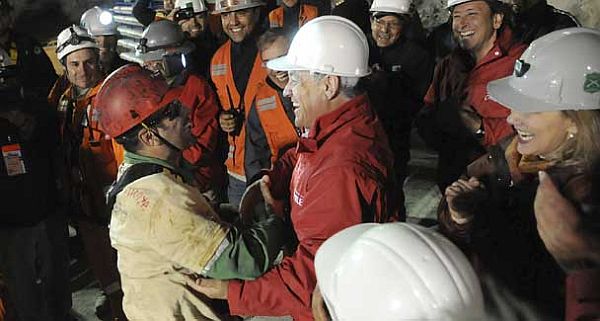
Ancient legacies can be cast off. The nation can find celebration and renewal without war — and create that sacred moment when the people are one and whole again. The President — with his badge of office signifying the body of the nation — ritually embraces each miner as he emerges into the light of resurrection: Reclaiming them to the body of the nation.

The miracle that ties Chileans to the deep currents of their river is not in blood-sacrifice but rather the promise of a nation transcendent in new life.

*Michael Vlahos is Professor of Strategy at the United States Naval War College. This article first appeared at Huffington Post and is republished here with the author’s permission.

Facebooktwittermail

Israel’s identity problem

Michael Oren, Israel’s ambassador to the United States, is calling for an end to Israel’s invisibility.

Whatever Israel suffers from, invisibility is not among its problems. A country like Lesotho might wish for greater visibility, but Israel already claims a share of the world’s attention that vastly outsizes its importance.

Oren’s appeal for attention however, is not directed at the world — the pining for acceptance that he articulates is that the Palestinians should recognize Israel as a Jewish state. Isn’t it strange that Israelis could prize the opinions of Palestinians so highly while treating their lives so harshly? (Yes, I’m being sarcastic.)

Affirmation of Israel’s Jewishness… is the very foundation of peace, its DNA. Just as Israel recognizes the existence of a Palestinian people with an inalienable right to self-determination in its homeland, so, too, must the Palestinians accede to the Jewish people’s 3,000-year connection to our homeland and our right to sovereignty there. This mutual acceptance is essential if both peoples are to live side by side in two states in genuine and lasting peace.

As the saying goes, possession is nine-tenths of the law, so Oren’s claim that Israel already accords the same level of recognition to Palestinians that it now demands from them, doesn’t mean much. The Palestinian homeland (which he posits not as their homeland but its homeland), is clear in only one respect: it is located some place else than “our” homeland. And this of course denies any conventional notion of a homeland which would likely include the place ones grandparents or great grandparents lived — the place where ones ancestral roots trace back centuries.

Oren cherry-picks part of the Balfour Declaration noting that it “called for the creation of ‘a national home for the Jewish people’ in the land then known as Palestine,” but neglecting that part of the very same sentence which says “it being clearly understood that nothing shall be done which may prejudice the civil and religious rights of existing non-Jewish communities in Palestine.” Had a national home for the Jewish people actually been established on those terms, it’s hard to see how it could have been established as a Jewish state. Certainly three quarters of a million Palestinians could not have been driven out of the homes and off their land.

“The core of the Israeli-Palestinian conflict has been the refusal to recognize Jews as a people, indigenous to the region and endowed with the right to self-government,” Oren claims, yet could have much more reasonably asserted: “The core of the Israeli-Palestinian conflict has been the refusal to recognize Palestinians as a people, indigenous to the region and endowed with the right to self-government.”

What’s Oren and the Israeli government’s agenda here? Having fully grasped the fact that they now have a desperate sucker in the White House batting for them, they’re going for gold: push the Palestinians to relinquish their right of return in exchange for a momentary continuation in the slight slowdown of colonial expansion in the West Bank. What a deal! Except of course they know full well that even Mahmoud Abbas is not going to make a concession like this, so, as has happened so many times before, Israel makes an impossible demand so that once it is refused the Palestinians can be portrayed as intransigent.

It’s a game that Israel will continue to play for as long as it believes that it has more to lose than it has to gain from a peace agreement.

Facebooktwittermail

Israeli forces train for Arab transfer riots

Jonathan Cook reports:

Israel secretly staged a training exercise last week to test its ability to quell any civil unrest that might result from a peace deal that calls for the forcible transfer of many Arab citizens, the Israeli media has reported.

The drill was intended to test the readiness of the civil defence units, police, army and prison service to contain large-scale riots by Israel’s Arab minority in response to such a deal.

The transfer scenario echoes a proposal by Avigdor Lieberman, Israel’s far-right foreign minister, for what he has called a “population exchange”. Mr Lieberman proposes land swaps that would force many of Israel’s 1.3 million Arab citizens into a future Palestinian state in return for annexation into Israel of most of the Jewish settlements in the West Bank. The scheme has been widely criticised as a violation of international law.

He outlined his proposal to the United Nations General Assembly last month. Although Benjamin Netanyahu, Israel’s prime minister, said he was not consulted about the speech, he did not admonish Mr Lieberman. The training exercise has fuelled fears among Israel’s Arab minority that the government might be hoping to pressure Mahmoud Abbas, the president of the Palestinian Authority (PA), to agree to land and population swaps as part of US-sponsored peace negotiations, which have stalled.

Facebooktwittermail