Author Archives: Paul Woodward

Israel’s coma

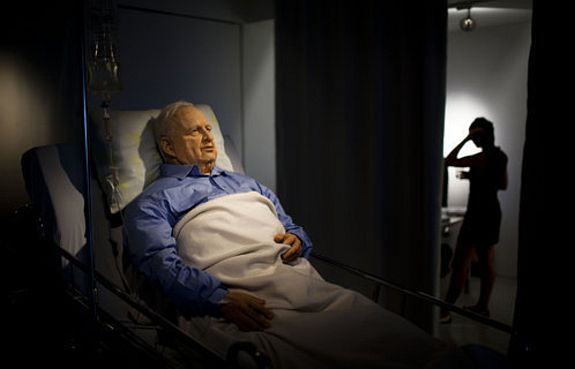
While most Israelis can’t visit Ariel Sharon in hospital, they can now do the closest thing: go stand next to a life-size model of the former prime minister, propped up in bed, attached to a drip and steadily breathing in an otherwise empty room in a Tel Aviv art gallery.

“Sharon’s still breathing and beating body is an allegory for the Israeli political body — a dependent and mediated existence, self-perpetuated artificially and out of inertia, with open eyes that cannot see,” the gallery’s curator Joshua Simon writes in an introduction to the exhibit, the creation of Israeli artist Noam Braslavsky.

Sharon’s coma mirrors the effect that Israel’s withdrawal from Gaza was intended to have: that it would suspend any real movement towards the creation of a Palestinian state.

But as Henry Siegman made clear, three years ago, the fiction that Israel was responsive to external stimuli began over 40 years ago:

Just one year after the 1967 war, Moshe Dayan, a former IDF chief of staff who at the time was minister of defence, described his plan for the future as ‘the current reality in the territories’. ‘The plan,’ he said, ‘is being implemented in actual fact. What exists today must remain as a permanent arrangement in the West Bank.’ Ten years later, at a conference in Tel Aviv, Dayan said: ‘The question is not “What is the solution?” but “How do we live without a solution?”’ Geoffrey Aronson, who has monitored the settlement enterprise from its beginnings, summarises the situation as follows:

Living without a solution, then as now, was understood by Israel as the key to maximising the benefits of conquest while minimising the burdens and dangers of retreat or formal annexation. This commitment to the status quo, however, disguised a programme of expansion that generations of Israeli leaders supported as enabling, through Israeli settlement, the dynamic transformation of the territories and the expansion of effective Israeli sovereignty to the Jordan River.

In an interview in Ha’aretz in 2004, Dov Weissglas, chef de cabinet to the then prime minister, Ariel Sharon, described the strategic goal of Sharon’s diplomacy as being to secure the support of the White House and Congress for Israeli measures that would place the peace process and Palestinian statehood in ‘formaldehyde’. It is a fiendishly appropriate metaphor: formaldehyde uniquely prevents the deterioration of dead bodies, and sometimes creates the illusion that they are still alive. Weissglas explains that the purpose of Sharon’s unilateral withdrawal from Gaza, and the dismantling of several isolated settlements in the West Bank, was to gain US acceptance of Israel’s unilateralism, not to set a precedent for an eventual withdrawal from the West Bank. The limited withdrawals were intended to provide Israel with the political room to deepen and widen its presence in the West Bank, and that is what they achieved.

Do we really have to wait until Sharon stops breathing before the peace process can officially be declared dead?

Whatever political differences there have been between Barak, Sharon, Olmert and Netanyahu, each Israeli prime minister has shown himself equally adept in the art of living without a solution, “with eyes open that cannot see.”

Facebooktwittermail

“No Pakistani child is worth one whit less that any American child”

FB Ali at Sic Semper Tyrannis drew my attention to a blog post that appeared in Pakistan’s Express Tribune. It was written by a US Army helicopter pilot, John Bockmann, who was recently deployed to help in relief work, following this summer’s devastating flooding.

US humanitarian aid — especially when provided to a country like Pakistan — often looks like nothing more than a cynical attempt to pacify resentment provoked by the Pentagon’s primary mission: attacking its adversaries. For that reason, American soldiers have good reason to wonder how they will be received when their mission is peaceful.

Bockmann writes:

The days since arriving have passed quickly. Every day we take rice, flour, blankets, housing materials, cooking oil – anything – up and down the Swat and Indus River Valleys. We also bring sick, injured, and displaced people to hospitals and hometowns.

My first mission took us up the Indus river valley, and I embarrassed myself by constantly exclaiming its beauty. Below me was the Karakorum Highway – the old Silk Road into China – and the valley itself, with terraced farmland overshadowed by majestic, snow-capped mountains.

Along with the beauty, though, I see reminders of the flood, bridges that are broken or missing and roads and fields that have been washed away. I am beginning to see widespread reconstruction now as well and feel hope for the people in these villages. They will soon have another way to get help.

I realize that some who read this will question our intentions and some may even wish us ill. I certainly did not imagine that cheering throngs would greet us at each village though — we are always welcomed. I did not expect our goodwill to be taken at face value by all of Pakistan, but we have received immense support.

I have learned in my time here that Pakistani people are truly gracious. Strangers have invited me for chai and conversation. Almost anyone will shake my hand and ask my name, inquire about my health and how I am getting along. Instead of a handshake at our first meeting, I have sometimes been embraced. “Strangers shake hands,” my new friend Mahmood explained, “but brothers hug each other.”

This warms my heart. My mission, our mission, is straightforward, noble, and good. I am deeply grateful to those who support us here, for we need all the help we can get in order to help those in need. I am honored to do this work. I feel at home here beyond anything I could have expected.

So is this just the sentimental perspective of an American soldier who believes, almost as a matter of religious conviction, that America is a force of good in the world? The dozens of comments that follow his post suggest otherwise. Admittedly they come mostly from Pakistan’s English-speaking educated liberal elite, but they lead this helicopter pilot to this conclusion:

I know the hearts of many Pakistanis now, but I am still surprised by their outpouring of warmth–especially in such hard times. I read all of the comments — the stories, the blessings, the frustrations — and I am increasingly convinced that international relations are effected more by common people like you and me than by politicians who may never get a chance to have tea and real conversation with “the other side”. I am so privileged to be so well loved while I am so far from home. God’s blessings on Pakistan and her people.

His mother, Maggie Bockmann, adds her own thoughts which reveal that she does not have a sugar-coated view of America’s impact on Pakistan:

I scarcely comprehend where this delightful soul named John might have come from. As Gibran said,
“Your children are not your children.
They are the sons and daughters of Life’s longing for itself.
They come through you but not from you,
And though they are with you, yet they belong not to you.
You may give them your love but not your thoughts.
For they have their own thoughts.
You may house their bodies but not their souls,
For their souls dwell in the house of tomorrow, which you cannot visit, not even in your dreams.”
I trust John will not mind my telling you that in the early days of our family, we had a particularly heartbreaking religious fracture between his dad and myself. But now, by the grace of God, we are strong in all the weak places.
Thus shall it be between Christians and Muslims, your country and mine: despite the heartbreaking fractures, we shall become strong in all the weak places, and no government policies, no misguided violent people shall prevent it, because God wills it, whether we call him Allah or Jehovah, and we will it, with all our hearts. We shall support each other while respecting our differences.
And though I understand from this newspaper that some of your countrymen support the U.S. drone attacks, and I’m sure they have compelling reasons, which I shall not judge, I want you to know that I am willing to suffer whatever I must suffer to stand with the Pakistani people against such heartbreaking attacks, for no Pakistani child is worth one whit less that any American child, and mothers are the same around the world, as Wajih said.
As Kathy Kelly so poignantly says in this video, no Pakistani children should be quaking in their beds at night for fear of what devastation my countrymen may visit on them from the sky.
CIA Drone Protest, Kathy Kelly – 1/16/2010

For those who disagree, please forgive me, for I do not mean to be contentious. I am but a mother with a mother’s heart. That is my weakness and that is my power.

Civilian Harm and Conflict in Northwest Pakistan, a new report by CIVIC, the Campaign for Innocent Victims in Conflicts, reveals that while the local populations in the areas being targeted by drone attacks do not, by and large, question their accuracy, they object to the fact that the losses caused to innocent bystanders are being ignored.

Nadia, 10 years-old, was at school when her house was hit by a drone, killing her father and mother: “My relatives rushed to the spot and tried to recover the dead bodies trapped under the debris but we couldn’t identify them as they were completely burned.” Nadia is an only child and has moved in with her aunt in a nearby town.

She says she has “no source of income with my parents gone… my aunt looks after me now and I help her in the house…but I want admission into school. I want an education. Please ask the government to provide me with a monthly stipend so I can get an education.” The lack of US transparency about the drone program as well as the Pakistani government’s duplicity — public criticism while offering clandestine support — means civilians’ losses are entirely ignored. Civilian victims interviewed by CIVIC demanded an end to the drone strikes and compensation for their losses.

Without exception, drone strike victims interviewed by CIVIC were left to pick up the pieces on their own, denied even the recognition and acknowledgement of their loss by the Pakistani and US governments. Neither the US, FATA Secretariat or the Pakistani Federal Government have any standard, public procedures for investigating civilian losses from drone strikes, acknowledging or recognizing losses, or providing help for victims to recover.

The common denominator here is that human beings, whether they live in North Waziristan, the Swat Valley, Gaza, New Orleans, or Washington DC, all want the same thing: respect.

This is the basis of human relations and human society, that right down on the level at which one person engages with another, the foundation of their transactions needs to be the recognition: your life is worth just as much as mine. As war tramples on this recognition, all other forms of destruction then become possible.

Facebooktwittermail

Zionism and the war on terrorism both rest on the same hollow foundation

Distilling some of his findings from extensive research conducted at the University of Chicago’s Project on Security and Terrorism, Robert Pape writes:

For nearly a decade, Americans have been waging a long war against terrorism without much serious public debate about what is truly motivating terrorists to kill them. In the immediate aftermath of the 9/11 attacks, this was perfectly explicable — the need to destroy al Qaeda’s camps in Afghanistan was too urgent to await sober analyses of root causes.

But, the absence of public debate did not stop the great need to know or, perhaps better to say, to “understand” the events of that terrible day. In the years before 9/11, few Americans gave much thought to what drives terrorism — a subject long relegated to the fringes of the media, government, and universities. And few were willing to wait for new studies, the collection of facts, and the dispassionate assessment of alternative causes. Terrorism produces fear and anger, and these emotions are not patient.

A simple narrative was readily available, and a powerful conventional wisdom began to exert its grip. Because the 9/11 hijackers were all Muslims, it was easy to presume that Islamic fundamentalism was the central motivating force driving the 19 hijackers to kill themselves in order to kill Americans. Within weeks after the 9/11 attacks, surveys of American attitudes show that this presumption was fast congealing into a hard reality in the public mind. Americans immediately wondered, “Why do they hate us?” and almost as immediately came to the conclusion that it was because of “who we are, not what we do.” As President George W. Bush said in his first address to Congress after the 9/11 attacks: “They hate our freedoms: our freedom of religion, our freedom of speech, our freedom to vote and assemble and disagree with each other.”

Thus was unleashed the “war on terror.”

The narrative of Islamic fundamentalism did more than explain why America was attacked and encourage war against Iraq. It also pointed toward a simple, grand solution. If Islamic fundamentalism was driving the threat and if its roots grew from the culture of the Arab world, then America had a clear mission: To transform Arab societies — with Western political institutions and social norms as the ultimate antidote to the virus of Islamic extremism.

This narrative had a powerful effect on support for the invasion of Iraq. Opinion polls show that for years before the invasion, more than 90 percent of the U.S. public believed that Saddam Hussein was harboring weapons of mass destruction (WMD). But this belief alone was not enough to push significant numbers to support war.

What really changed after 9/11 was the fear that anti-American Muslims desperately wanted to kill Americans and so any risk that such extremists would get weapons of mass destruction suddenly seemed too great. Although few Americans feared Islam before 9/11, by the spring of 2003, a near majority — 49 percent — strongly perceived that half or more of the world’s 1.4 billion Muslims were deeply anti-American, and a similar fraction also believed that Islam itself promoted violence.

The narrative — “it’s not what we do but who we are” — that Americans swallowed after 9/11, came ready-made. It is the narrative that provides the bedrock of Zionism by characterizing opposition to Israel’s creation and expansion as being an expression of anti-Semitism rather than a reaction to colonialism and dispossession.

Palestinians don’t attack Jews because their homes are being destroyed and their land is being taken away; Palestinians attack Jews because Palestinians hate Jews.

Al Qaeda didn’t attack Americans because American governments for many decades have propped up oppressive regimes across the Middle East and supported Zionism; al Qaeda attacked America because al Qaeda hates Americans.

In both Zionism and the war on terrorism, the refusal to deal with political injustice expresses itself through an ideological fixation on security and military solutions.

As Ariel Sharon focused on “dismantling the terrorist infrastructure” in Gaza and the West Bank, George Bush pursued a parallel course across the whole region. Americans and Israelis united in the belief that they were all innocent targets of the same implacable enemy: Islamic extremism.

Our war on terrorism was simply an extension of Israel’s war on terrorism — simply on a much larger scale. Naturally, we would borrow most of Israel’s techniques for tackling “the terrorists” — targeted killing, torture, extrajudicial detention, remote warfare and so forth.

And the underlying imperative was identical: that our righteous victimhood could not be questioned, our innocence was unassailable. Indeed it was our virtue that made us targets for attack.

If we were successful in dismantling the terrorist infrastructure or draining the swamp in which evil festered, we would save the world. We would engage in war without choice, knowing that we did so in the name of peace.

No wonder that on September 11, Benjamin Netanyahu was unable to contain his satisfaction about the way the attacks would help solidify the bond between Americans and Israelis. “It’s very good,” he said and then, quickly realizing his candor might not be well-received, added: “Well, not very good, but it will generate immediate sympathy.” The attack would “strengthen the bond between our two peoples, because we’ve experienced terror over so many decades, but the United States has now experienced a massive hemorrhaging of terror.”

Lies breed unconsciousness because they deprive intelligence of the invigorating effect of experience, thus, as we near the end of a decade of a war on terrorism we now inquire even less as shock has been given way to indifference.

Facebooktwittermail

Taking over Jerusalem

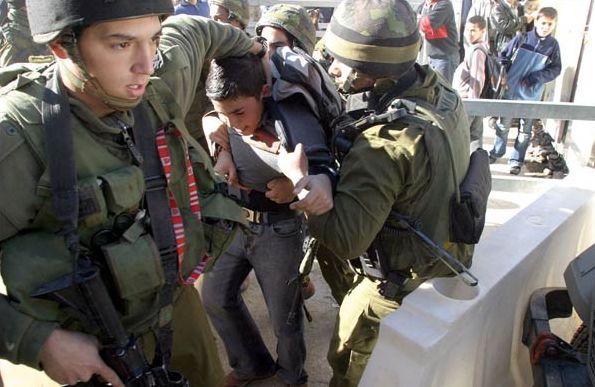
At 7 min 45 sec into this segment we see a widely reported incident where Imran Mansur, 12, and Iyad Gheit, 10, are hit by a car driven by David Be’eri, leader of Silwan’s Jewish settlers. Mansur’s leg was broken and Gheit had to have glass removed from his arm. Be’eri was briefly questioned after the hit and run, but Mansur — the boy who went flying into the air — has now been arrested.

The thread that ties together this 60 Minutes report is the unassailable confidence of the Israelis in their resolute intransigence.

To the extent that they acknowledge that any viewpoint might exist other than their own, they regard such perspectives as a product of ignorance. If you knew everything we know, you’d think the way we do. To some extent this is like the inflexible conviction of evangelicals, but whereas the success of the business of saving souls hinges on having some powers of persuasion, the Zionists taking over Jerusalem simply don’t care if they fail to win over non-Zionist global opinion. We don’t give a damn about the world, is the implicit message. Jerusalem belongs to the Jews.

But how can anyone who holds to this assertion — as most of Israel’s leaders do — claim to have an interest in negotiations with the Palestinians? Such “negotiations” amount to nothing more than a desire to force Palestinians to agree to Israeli terms of surrender. No capital in Jerusalem. No right of return. No sovereignty for a Palestinian state…. Oh, and there should of course be no preconditions for talks.

Facebooktwittermail

The utter failure of multiculturalism?

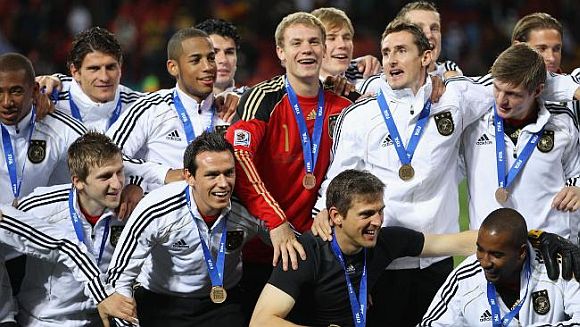
Germany: third place winners in 2010 World Cup

It wasn’t just Germans who were disappointed to see their team fail to win the 2010 World Cup in South Africa this summer. If this was the team that represented “multi-kulti”, for most of us who had the pleasure of watching their performance, the response was: let’s have more — not: this is an utter failure. Did Angela Merkel so quickly forget?

In The Guardian, Philip Oltermann writes:

Today, when I heard reports of Angela Merkel announcing that multiculturalism had “utterly failed”, my first thoughts were: who is she talking about? I am German, and I have a sister whose three boys are half-Peruvian. My brother’s children are part-Japanese. My partner is English. Were we all utter failures?

“Multi-kulti” covers a grey area somewhere between co-existence and co-operation, and one hopes the German chancellor was trying to speak in favour of team-play and against mere tolerance. My guess is that Merkel wasn’t talking about us, or about Poles, Italians or Greeks living in Germany, but about her country’s 4 million-strong Muslim population – in which case she has still chosen her words terribly badly. The result is a faux pas uncharacteristic of a politician who has won a reputation for treading quietly in matters diplomatic.

So what made her say it? The question over how to integrate Muslim migrants and the rest of German society is hardly new: politicians and commentators have been discussing it ever since the first wave of Gastarbeiter (migrant workers) arrived in the 1960s. If you look at the figures alone, there would be no particular reason to reheat the debate at this time: the number of Turkish immigrants into Germany in 2008 was as low as it had last been in 1983, according to Der Spiegel magazine, and the number of asylum applications is about a sixth of what it was in the mid-90s. More Turks returned to Turkey last year than came to live in Germany, which is actually bad news for the German economy, because with the population forecast to fall by 11.6 million by 2050, the country needs every qualified worker it can get its hands on.

Facebooktwittermail

The decline of the West

Perhaps the clearest evidence of the decline of Western civilization is the example of those who now shout it its defense.

In the name of protecting civilization, a movement promoting racial supremacism is infecting Western consciousness with the notion that a set of values and cultural constructions is now in jeopardy when in fact our civilization’s corruption is already well advanced.

If the progress of Western civilization came about through the unfettering of the power of the people in egalitarian societies, that trend was quietly reversed as citizens became consumers. In recent decades, that decline further deepened as economic “advance” turned out to be a mask concealing expanding inequality.

In the hollow culture which this has created, beyond employing a stock of well-worn platitudes about freedom and liberty, civilization’s self-appointed protectors find it easier to spotlight purported threats than describe exactly what they are defending.

In this context we should note that American culture remains influenced by European culture more than any other and to the extent that Europe provides a cultural compass, we should be alarmed at the direction this now points. An ocean will not protect us from its influence.

Christian Science Monitor reports:

A new survey in Germany shows that 13 percent of its citizens would welcome a “Führer” — a German word for leader that is explicitly associated with Adolf Hitler — to run the country “with a firm hand.”

The findings signal that Europe’s largest nation, freed from cold-war strictures, is not immune from the extreme and often right-wing politics on the rise around the Continent.

The study, released Oct. 13 by the Friedrich Ebert Foundation, affiliated with the center-left Social Democratic Party, revealed among other things that more than a third of Germans feel the country is “overrun by foreigners,” some 60 percent would “restrict the practice of Islam,” and 17 percent think Jews have “too much influence.”

The study’s overall snapshot of German society shows new forms of extremism and hate are no longer the province of far-right cohorts who shave their heads or wear leather jackets adorned with silver skulls – but register in the tweedy political center, on the right and the left. Indeed, the study found, extremism in Germany isn’t a fringe phenomenon but is found in the political center, “in all social groups and in all age groups, regardless of employment status, educational level or gender.”

The year 2010 is marking a clear shift toward extremist politics across Europe, analysts say. An uncertain economy, a gap between elites and ordinary Europeans, and fraying of a traditional sense of national identity has just in the past month brought more hard-line politics and speech, often aimed at Islam or immigrants – into a political mainstream where it had been absent or considered taboo.

On Oct. 10, the city of Vienna, a cosmopolitan and socialist stronghold since World War II, voted the far-right Freedom Party into a ruling coalition. The party, which ran on an “anti-minaret” platform in a city with only one mosque, was formerly associated with nationalist Jorg Haider, but has been reinvented by an animated former dental hygienist, Heinz-Christian Strache.

On Sept. 19, Sweden, long a Scandinavian redoubt of social tolerance and openness, put the far-right Sweden Democrats into parliament for the first time.

Further, this week the Netherlands saw the rise to influence, if not power, of the anti-Islam party of Geert Wilders, a social liberal who argues for gay rights – but whose main platform is to ban the Quran and the practice of Islam in the Low Countries. Mr. Wilders’ party will formally participate in the Dutch ruling coalition without specifically joining it.

Ian Buruma writes:

All these countries may soon be following the Danish model, in which the illiberal populist parties pledge their support without actually governing, thereby gaining power without responsibility. Denmark’s Conservative government could not govern without the support of the People’s party. Sweden’s recently re-elected conservative Moderate party will have to rely on the Democrats to form a viable government. And Wilders has already received assurances from the conservative and Christian Democrat parties that, in exchange for his support, the burqa will be banned in the Netherlands and immigration curbed.

The influence of these slick new populists, waging their war on Islam, goes well beyond their countries’ borders. Nativism is on the rise all over the western world, and Wilders, in particular, is a popular speaker at rightwing anti-Muslim gatherings in the US, Britain and Germany.

European populism focuses on Islam and immigration, but it may be mobilising a wider rage against elites expressed by people who feel unrepresented, or fear being left behind economically. They share a feeling of being dispossessed by foreigners, of losing their sense of national, social, or religious belonging. Northern Europe’s political elites, largely Social or Christian Democrats, have often been dismissive of such fears, and their paternalism and condescension may be why the backlash in those liberal countries has been particularly fierce.

The question is what to do about it. One possible solution is to let populist parties join the government if they get a sufficient number of votes. The idea of a Tea Party candidate becoming US president is alarming, to be sure, but European populists could only be part of coalition governments.

True, Hitler’s Nazis took over Germany almost as soon as they were voted into power, but the new European right are not Nazis. They have not used violence, or broken any laws. Not yet. As long as this is so, why not give them real political responsibility? They would then not only have to prove their competence, but also moderate their attitudes.

Buruma’s assumption that governance inherently imposes a moderating effect, seems very dubious. Look at Avigdor Lieberman and his Yisrael Beiteinu party in an Israel that prides itself on its Western identity. There’s little evidence that participation in government has forced them to turn away from extremism.

The underlying idea here is one that has guided the eviscerated Left for the last two decades: that the political challenges of the day can only be met by some form of reaction or accommodation through which the sacred political center can be reclaimed. The idea that the Left provides a genuine political alternative has — at least by mainstream politicians — been effectively abandoned.

This is the context in which an American underclass is expanding, ready to be corralled by rightwing, xenophobic opportunists.

The Guardian‘s Paul Mason went to Atlanta to see how economic decline is reshaping American society.

Unable to borrow or earn, a whole generation is being shut out of the American lifestyle.

Meanwhile, some states have begun a race to the bottom: slashing welfare, labour regulations and local taxes to attract investment. High-wage companies close and relocate to low-wage states, and foreign investment flows to the towns where labour costs are lowest. These states are being transformed by the arrival of low-waged Hispanic migrants even as the rightwing politicians who support the economics rail against the demographics.

As a result the so-called Sun Belt, identified by Republican strategist Kevin Phillips in the 1970s as the new political bedrock of conservatism, now feels like the unhappiest place in America. Median incomes in the south are, on average, $8,000 lower than in the northeast; poverty rates are higher than anywhere else in America — and so are the racial and religious tensions.

In the midterm elections politicians have promised to “do something” for the middle class. The kindest thing they could do is tell the truth: Americans have been living a middle-class lifestyle on working-class wages — and bridging the gap with credit. And it’s over.

Instead, the message is that the American way of life is as good as ever — just so long as it can be protected from foreign threats: the economic threat from undocumented Latino workers and the cultural threat from dangerous Muslims.

A real alternative, however, would go much further than pointing out that most Americans have for too long been living beyond their means — it would spell out that the American dream is built on a false promise and our concern should not be reduced to who has access to its fulfillment and who does not. That false promise is that the good life flows from the good stuff.

In one of the tales of Mullah Nasrudin, his friend finds him in misery with bleeding lips as he chews on red hot chillies. “Why do you keep on biting into those chillies?” his friend asks. “I’m looking for the sweet one,” the Mullah answers as he digs deeper into his basket. We too find it difficult to abandon that futile quest for a sweet chili.

America now suffers less from the consequences of easy access to credit than the fact that we have virtually no conception of material sufficiency. Our fascination with the future is driven by an experience of the present as defined by unmet needs. Ours is a condition of perpetual insufficiency. The land of opportunity is populated by people who can never have enough.

Only when we discover we have enough can we pause, take stock and consider what is of real value. The defense of civilization consists not in thwarting foreign threats but recognizing the ways in which we value or devalue civilization’s core assets.

We are now warned of a dreadful “Japanification” of America if consumers refuse to consume.

Is that all that Americans are: the earthworms of the global economy? Or might we find some hidden wealth through material loss?

Facebooktwittermail

Time to make national heroes out of those who steal secrets and publish them in the newspaper

Coleen Rowley, legal counsel to the FBI field office in Minneapolis from 1990 to 2003 and Bogdan Dzakovic, a special agent for the Federal Aviation Authority’s security division, suggest that had WikiLeaks existed in 2001, they might have been able to make public information that could have prevented the 9/11 attacks.

In the Los Angeles Times they write:

The 9/11 Commission concluded, correctly in our opinion, that the failure to share information within and between government agencies — and with the media and the public — led to an overall failure to “connect the dots.”

Many government careerists are risk-averse. They avoid making waves and, when calamity strikes, are more concerned with protecting themselves than with figuring out what went wrong and correcting it.

Decisions to speak out inside or outside one’s chain of command — let alone to be seen as a whistle-blower or leaker of information — is fraught with ethical and legal questions and can never be undertaken lightly. But there are times when it must be considered. Official channels for whistle-blower protections have long proved illusory. In the past, some government employees have gone to the media, but that can’t be done fully anonymously, and it also puts reporters at risk of being sent to jail for refusing to reveal their sources. For all of these reasons, WikiLeaks provides a crucial safety valve.

“Dr Ellsberg, do you have any concern about the possibility of going to prison for this?” Daniel Ellsberg was asked after he had leaked the Pentagon Papers to the New York Times in 1971.

Wouldn’t you go to prison to help end this war?” Ellsberg responded.

Since 9/11, how many employees or now former-employees of the US government have asked themselves whether actions they declined to take at the most opportune moment could have prevented a decade of war and the loss of hundreds of thousands of lives?

The idea that WikiLeaks could have facilitated such actions, seems to me, to have more to do with soothing troubled consciences than with a need to make whistle-blowing easier.

Ambassador Joe Wilson published his famous op-ed, “What I Didn’t Find in Africa,” in July 2003, once it was clear that weapons of mass destruction were not going to be found in Iraq. The day he should have gone public with what he knew was January 29, 2003 — the day after President Bush’s State of the Union speech in which Bush falsely claimed: “The British government has learned that Saddam Hussein recently sought significant quantities of uranium from Africa.”

What Wilson lacked was not WikiLeaks but the courage of a man like Ellsberg and the willingness to place the interests of others above his own.

Rather than looking for ways to make whistle-blowing safer, we might benefit more as a society if we more whole-heartedly celebrated those who risk their careers and even their liberty by following the dictates of their conscience.

While WikiLeaks can perform a vital function, we should not lose sight of the fact that the political impact of whistle-blowing can have more to do with the power of a public act of conscience than with the information that is revealed. When an individual in a position of authority takes a huge personal risk because of their allegiance to truth, the sheer power of their integrity calls the operations of government into question. The availability of WikiLeaks cannot make up for the shortage of Ellsbergs.

Facebooktwittermail

Israel’s identity problem

Michael Oren, Israel’s ambassador to the United States, is calling for an end to Israel’s invisibility.

Whatever Israel suffers from, invisibility is not among its problems. A country like Lesotho might wish for greater visibility, but Israel already claims a share of the world’s attention that vastly outsizes its importance.

Oren’s appeal for attention however, is not directed at the world — the pining for acceptance that he articulates is that the Palestinians should recognize Israel as a Jewish state. Isn’t it strange that Israelis could prize the opinions of Palestinians so highly while treating their lives so harshly? (Yes, I’m being sarcastic.)

Affirmation of Israel’s Jewishness… is the very foundation of peace, its DNA. Just as Israel recognizes the existence of a Palestinian people with an inalienable right to self-determination in its homeland, so, too, must the Palestinians accede to the Jewish people’s 3,000-year connection to our homeland and our right to sovereignty there. This mutual acceptance is essential if both peoples are to live side by side in two states in genuine and lasting peace.

As the saying goes, possession is nine-tenths of the law, so Oren’s claim that Israel already accords the same level of recognition to Palestinians that it now demands from them, doesn’t mean much. The Palestinian homeland (which he posits not as their homeland but its homeland), is clear in only one respect: it is located some place else than “our” homeland. And this of course denies any conventional notion of a homeland which would likely include the place ones grandparents or great grandparents lived — the place where ones ancestral roots trace back centuries.

Oren cherry-picks part of the Balfour Declaration noting that it “called for the creation of ‘a national home for the Jewish people’ in the land then known as Palestine,” but neglecting that part of the very same sentence which says “it being clearly understood that nothing shall be done which may prejudice the civil and religious rights of existing non-Jewish communities in Palestine.” Had a national home for the Jewish people actually been established on those terms, it’s hard to see how it could have been established as a Jewish state. Certainly three quarters of a million Palestinians could not have been driven out of the homes and off their land.

“The core of the Israeli-Palestinian conflict has been the refusal to recognize Jews as a people, indigenous to the region and endowed with the right to self-government,” Oren claims, yet could have much more reasonably asserted: “The core of the Israeli-Palestinian conflict has been the refusal to recognize Palestinians as a people, indigenous to the region and endowed with the right to self-government.”

What’s Oren and the Israeli government’s agenda here? Having fully grasped the fact that they now have a desperate sucker in the White House batting for them, they’re going for gold: push the Palestinians to relinquish their right of return in exchange for a momentary continuation in the slight slowdown of colonial expansion in the West Bank. What a deal! Except of course they know full well that even Mahmoud Abbas is not going to make a concession like this, so, as has happened so many times before, Israel makes an impossible demand so that once it is refused the Palestinians can be portrayed as intransigent.

It’s a game that Israel will continue to play for as long as it believes that it has more to lose than it has to gain from a peace agreement.

Facebooktwittermail

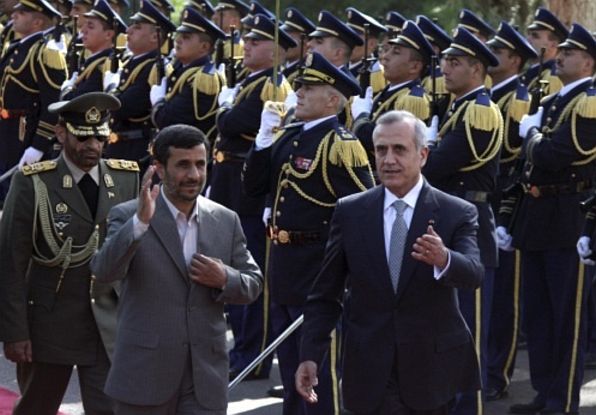
Ahmadinejad in Lebanon

While the Iranian president’s visit to Southern Lebanon is being portrayed in the Western media largely in terms of an act of provocation directed at Israel by an antagonist and intruding regional power, the historical ties between that part of Lebanon and Iran span centuries.

Nicholas Blanford writes:

When Iranian President Mahmoud Ahmadinejad tours Lebanon’s border with Israel today, he may pause a moment to consider that Iran owes its existence as a Shiite nation to the ancestors of those living in these rural hilltop villages.

Iran wasn’t always the center of Shiite scholarship

In the early 16th century, the center for Shiite scholarship was in an area known as Jabal Amil, a rugged hill country that conforms closely to the geographical perimeters of modern-day south Lebanon. When Shah Ismael I, the Safavid ruler of Iran, introduced Shiism as the state religion in the 16th century, he turned to the scholars of Jabal Amil to help promulgate the new faith.

Dozens of scholars traveled to Iran, settling there, marrying, learning Persian, and involving themselves in the rivalries and intrigues of the Safavid court. It was the beginning of a linkage of families and learning between two Shiite communities lying at opposite ends of the Middle East that remains today.

Reports that Ahmadinejad received a hero’s welcome are put in perspective by Nussaibah Younis, who writes:

The support that Ahmadinejad enjoys in Lebanon’s Shia heartlands can be compared to the support that a corporate sponsor might expect from Manchester United fans: bored gratitude. The biggest cheer that Ahmadinejad’s speech managed to raise out of the crowd came when he thanked Hezbollah’s leader, Hassan Nasrallah, as a “dear warrior and scholar”.

Nasrallah was the real star of the show. Rumours that he might appear in person at the rally drew large expectant crowds. Though there was a sigh of disappointment when Nasrallah only appeared via video link, the forceful and impassioned clarity with which he spoke whipped the crowd into a flag-waving and slogan-chanting frenzy. Nasrallah spoke mindfully of his larger audience in Lebanon, and tried the novel approach of presenting Iran’s foreign policy as “unifying”. He praised Iran’s supreme leader, Ayatollah Ali Khamenei, for issuing a fatwa forbidding Muslims to react to the Qur’an burning-fiasco in the US with “similar acts”, claiming that Iran was acting in the best interests of Christian-Muslim unity.

He also congratulated the Iranian cleric for his handling of a highly controversial London conference in which a little-known Shia activist disparaged Aisha, the wife of the prophet Muhammad, who is highly revered by Sunnis but considered a traitor by many Shias. Iran’s supreme leader Khamenei had responded with a statement forbidding insulting talk about the wives of the prophet, thereby – according to Nasrallah – acting as a force for unity between Sunnis and Shias.

Many Lebanese would have a lot to say about claims that Iran is a “unifying force in the region”, but the speech did make clear that Nasrallah’s crowd appeal is unmatched and that his power among many Shias does not need to be enforced by Iran. If anything, Hezbollah deftly staged a welcome for Ahmadinejad designed to encourage the Iranians to dig deeper and give more generously to Hezbollah’s cause.

Facebooktwittermail

How did 1938 turn out to be such a long year?

It’s 1938 and Iran is Germany and it’s racing to arm itself with atomic bombs,” Benjamin Netanyahu declared four years ago.

By 1942, Germany had snared itself in the disastrous Battle of Stalingrad — but let’s allow Netanyahu some latitude with his metaphor and assume that it’s still 1938 and that Iran’s race has merely suffered a few interruptions.

So, it’s still 1938 and Iran’s Hitler has come to Israel’s border to survey the nation he intends wiping off the map.

In anticipation of this historic moment, Aluf Benn wrote last month:

Netanyahu will have a one-time opportunity to stop the new Hitler and thwart the incitement to genocide. Ahmadinejad will pay his first visit to Lebanon and devote an entire day to a tour of the southern part of that country. He will visit sites where Hezbollah waged battles against Israel and, according to one report, he will also pop over to Fatima Gate, just beyond the border fence at Metula. The route is known, the range is close and it is possible to send a detail across the border to seize the president of Iran and bring him to trial in Israel as an inciter to genocide and Holocaust denier.

The media effect will be dramatic: Ahmadinejad in a glass cage in Jerusalem, with the simultaneous translation earphones, facing grim Israeli judges. In the spirit of the times, it will also be possible to have foreign observers join them (David Trimble of the Turkel commission was a leader of the “try the Iranian president” initiative ).

There are also operational advantages: Iran will hesitate to react to its president’s arrest by flinging missiles, out of fear for their leader’s life. It will also be possible to capture Hezbollah leader Hassan Nasrallah, who will no doubt emerge from his hiding place and accompany Ahmadinejad. Israel will have high-ranking hostages it will be able to exchange for Gilad Shalit.

And if the world has any complaints, it will be reminded that the Americans invaded Panama in order to arrest its ruler Manuel Noriega – and only for dealing drugs, a far smaller offense than incitement to genocide.

Of course, the idea also has disadvantages. Ahmadinejad might be killed in the action and Iran would embark on a cruel war of revenge. The precedent of arresting leaders would endanger Israeli personages suspected abroad of crimes against humanity or murder (according to the Goldstone report and the flotilla report ). Ahmadinejad could be acquitted and make Israel look like a bully and Netanyahu a fool.

Nevertheless, how can Netanyahu refrain from an action to stop Hitler’s heir, when the year is already 1939, if not 1940? According to Netanyahu’s reasoning, if he refrains from acting history will condemn him for “not preventing a crime,” as with Margalit Har-Shefi, who didn’t stop Yigal Amir from assassinating Yitzhak Rabin.

Benn’s point was not to advocate a reckless course of action but to underline the difference between rousing rhetoric and statesmanship.

For all those inside and outside Israel who swallowed Netanyahu’s rhetoric however, this is a telling moment to reflect on the proposition that the clown from Tehran — provocative as he might be — can seriously be compared to Hitler. Anyone who still clings to this notion must now consider its corollary: that if Ahmadinejad is Hitler, then Netanyahu — through his inaction — turns out to be a Chamberlain not Churchill.

So how truly significant is it that Iran’s president is currently now enjoying all the honors of a visiting head of state (even though he isn’t one)?

Rhami Khouri puts the drama in perspective and says:

[Ahmadinejad’s] visit represents a blow to Washington’s strategy of bringing Lebanon firmly into its orbit.

For most Arab governments, the Iranian-Hizbullah connection represents everything they fear for their own incumbency: armed Shiite movements inside countries where mostly Sunni Muslim Arabs dominated public life; popular resistance movements that do battle according to their own strategic calculations; Iranian meddling in Arab affairs; and, Arab mass movements that connect with compatriots across the region in their common opposition to and defiance of conservative Arabs, Israel and the US itself.

So at some levels it is understandable why so many people in the region and abroad are making a lot of noise about the Iranian president’s visit to Lebanon. At another level, though, that of substance vs. symbolism, this is a pretty routine event that does not necessarily break new ground, but mainly reflects and emphasizes existing political realities that generate frenzied, nearly hysterical, reactions on both sides.

The irony is that by elevating his importance on the international stage while his real challenges come from home, no one serves Iran’s president as more effective publicists than do Israel and the United States.

As Meir Javedanfar notes:

Ahmadinejad has never been more unpopular in Iran, not only with the public but also his conservative allies and the clergy. By going to Lebanon, he is going to one of the last places where the Islamic Republic still has genuine support. When he speaks in Bint Jbeil, unlike in Iran, schools won’t be closed and civil servants won’t be threatened with dismissal unless they attend the president’s speech. People will voluntarily turn up because they genuinely support the Islamic republic and will pay respect to almost any senior Iranian politician.

By going to Lebanon, Ahmadinejad will primarily be using the occasion to try to strengthen his support back home with the public, and with the Revolutionary Guards, whose support is important to him. He will also be trying to outshine his rivals such as Ali Larijani and Hashemi Rafsanjani by using the trip to say that he is the true face of Iran abroad, and not them.

This development will also benefit supreme leader Ali Khamenei, who is most probably very concerned about Ahmadinejad’s flagging popularity.

What is important to note is that such a visit did not take place when Khatami was president. If anyone deserves to be in southern Lebanon, it is him, and not Ahmadinejad. Israel evacuated southern Lebanon in May 2000 on Khatami’s watch, not Ahmadinejad’s.

However, Khamenei did not send Khatami to southern Lebanon because he was not worried about his unpopularity. In fact, compared with Ahmadinejad, he was far more popular. The opposite is true about Ahmadinejad and this is why Khamenei, for the sake of his regime, is sending him there.

The RealNews Network has an interesting report on Ahmadinejad’s posture as an anti-capitalist.

Facebooktwittermail

Might the US be holding a fugitive Mossad agent in secret detention?

Eight months after the murder of the Hamas commander, Mahmoud al-Mabhouh, in Dubai, two reports in the last few days present intriguingly contradictory pictures.
First came a Wall Street Journal report on Friday with the headline, “In Global Hunt for Hit Men, Tantalizing Trail Goes Cold.”

The Journal has followed this story more closely than any other US newspaper and this report contained some interesting new information — such as that one of the key suspects, recently using the name Christopher Lockwood, had previously used the identity of a young Israeli soldier, Yehuda Lustig, who was killed during the Yom Kippur War in 1973.

Still, as the headline suggested, investigators were no closer to tracking down Lockwood or any of the other suspects widely assumed to be Israeli Mossad agents. An Israeli who had been arrested in Poland, extradited to Germany and then released on bail in August, swiftly returned to Israel.

The trail has gone cold — but not according to Lt Gen Dahi Khalfan Tamim, the Dubai chief of police. He told The National on Monday that in fact a major suspect was arrested two months ago by a Western country but authorities in that country have requested that no information about the arrest should be made public.

The Abu Dhabi newpaper reported: “The country that arrested the suspect two months ago is not believed to be European.”

So which Western countries do we already know are involved in the case? The only non-European Western country that suspects are known to have traveled to after the murder is the United States.

A suspect traveling as an Irishman, Evan Dennings, entered the US on January 21, the day after Mabhouh’s body was found. And another suspect traveling with a British passport under the name, Roy Allan Cannon, casually entered the US on February 14, right in the middle of the period when the story was receiving global media attention.

The Journal now reports on these suspects that:

Their passport details showed up in a U.S. border-control system that collects electronic manifests of international flights and screens them against passenger watch lists, according to people familiar with the probe and to investigation documents reviewed by the Journal. That suggested the suspects had boarded planes bound for the U.S. The information was passed to international investigators involved in the case, raising hopes of a capture.

But the U.S. Department of Homeland Security has since said it doesn’t have records of the two suspects in its system.

It doesn’t have the records — meaning the records have vanished? Been handed over to a different agency, such as the FBI? Or what?

Something doesn’t add up here.

If it turned out that a suspected murderer who belonged to Mossad was arrested in the US, there’s no doubt that the Obama administration would be in a quandary about how to proceed. The one thing we can sure of is that it would guard its actions with the utmost secrecy.

Facebooktwittermail

Israel is ceasing to be a Jewish state and turning into a state for some Jews

Carlo Strenger has an interesting op-ed in Haaretz. It’s worth reading the whole piece (part of which appears below). Comments of mine follow.

There is nothing left to say about how bad, harmful and useless the new citizenship law is: Labor Party Minister Isaac Herzog has warned that it is another step towards fascism; legal experts like Mordechai Kremnitzer have pointed out that it doesn’t serve any identifiable purpose except making Arabs feeling even less at home in Israel. Likud Ministers Benny Begin and Dan Meridor have pointed out how harmful the law is for the relation with Israeli Arabs and for Israel’s standing in the world.

Both Shas and Yisrael Beiteinu have already declared that they see this law as just a first step in a general attempt towards ensuring loyalty to the state by legislation. The time has come to ask what really stands behind this rising tide. The obvious answer seems to be that it is directed against both Israel’s Arab citizenry, whom Avigdor Lieberman is alienating and insulting almost every day, and Palestinians who want to gain Israeli citizenship.

But I think that this is not the whole story. Consider this strangest of alliances between Yisrael Beiteinu and Shas; one is a completely secular, ultra-nationalist, the other an ultra-Orthodox party. What do they have in common? Why are they lately so effectively cooperating with each other, together with other extreme-right parties?

I believe that what unites them is less a fear of Israel’s enemies (and Israel does have enemies). It is a visceral hatred for the Western values and the liberal ethos. They all hate freedom; they all hate the idea of critical, open discourse, in which ideas are discussed according to their merit. They keep criticizing what they see as the liberal bias of the media and academia, and they have made sustained attempts to curtail freedom of speech at the universities.

Lieberman’s disdain for these ideas breaks through at every possible moment: lately he has insulted French Foreign Minister Bernard Kouchner and Spanish Foreign Minister Miguel Moratinos, telling them they should take care of their own problems in Europe before they come to advise Israel. This has been typical of him for a long time: Lieberman thinks that Israel should turn east; that it should no longer define itself as a Western country, and should finally shake off Israel’s original commitment to be part of the Western world.

Shas has made clear for decades that it just plays along with democracy; that it doesn’t believe in the idea of citizens thinking critically: they believe that only their spiritual leader, Ovadia Yossef, must determine what is right and what is wrong. Other ultra-rightists have been feeling for a long time that the commitment to universal values is undermining their program for the greater Israel in which Palestinians should have no political rights.

They cannot stand the idea that a liberal democracy should be based on rational legislation and is open to criticism by all. They are furious that tribal loyalty is not above criticism. Just lately, national religious rabbis have claimed that studying at universities is a danger for young religious people, because they internalize too many enlightenment values.

We are really talking about a right-wing anti-liberal coalition united by an instinctive hatred against the idea that there are universal standards of rationality and of morality. They do not want to hear criticism of their worldviews that relies on ideas that have, for a long time, been common to the free world. What we are seeing is a fight about Israel’s cultural and political identity.

For many liberal Israelis, the proposed new citizenship law represents a red line which once crossed will lead inexorably to the end of Israeli democracy. The foundation of that fear is the conviction that Israel has a democracy to lose.

Point out the contradictions inherent in the idea of a Jewish democracy, which by its nature grants preferential rights to Jews, and the liberal-Zionist shrug is to say, it’s a work in progress. No democracy is perfect.

Still, a real threshold has emerged and it consists above all in matters of perception: Israel is becoming a state which no longer serves and is instead threatening the needs of liberal Jewish identity — an identity in which neither half is meant to subvert the other.

Israel is ceasing to be a Jewish state and turning into a state for some Jews.

One could argue that this has long been the case, since for most Jews Israel is either an imaginary life insurance policy or of no particular relevance to their own lives. Even so, what has sustained Israel is the importance of the idea of a Jewish state in the minds of most Jews, irrespective of where they choose to live.

In this context, the Palestinians are irrelevant. They are peripheral to a conversation that has less to do with contested rights than it has to do with contested Jewish identity.

No wonder the peace process has gone nowhere. The wrong parties have been engaged in negotiations.

There is no Israeli consensus because there is no Jewish consensus. The tribe no longer exists (if it ever did) but rather than confront that fact, it has been hidden behind a veil: the unquestionable need for a Jewish state.

As the need for a Jewish state becomes untethered from Jewish identity, no wonder there is a drive to chain it to the law.

Facebooktwittermail

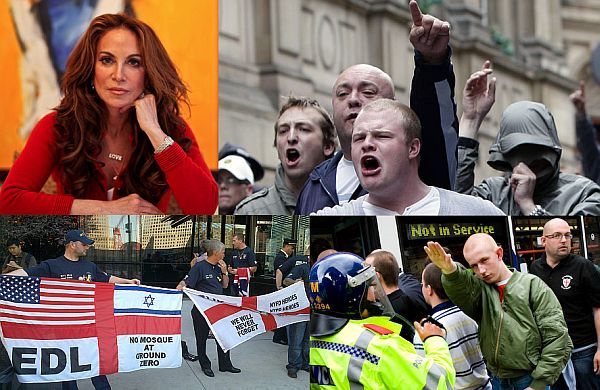
Pamela Geller’s English friends — Islamophobes united

(Update below)

Pamela Geller — “hate monger and anti-mosque queen bee,” as she has been dubbed by Charles Johnson at the conservative blog where she got her start — has “helped bring into the mainstream a concept that after 9/11 percolated mainly on the fringes of American politics: that terrorism by Muslims springs not from perversions of Islam but from the religion itself,” write Anne Barnard and Alan Feuer in a New York Times profile.

Geller’s profile is twice the length of a piece Barnard wrote on Park51’s Imam Feisal Abdul Rauf in August. That’s presumably because Geller is now “a media commodity.”

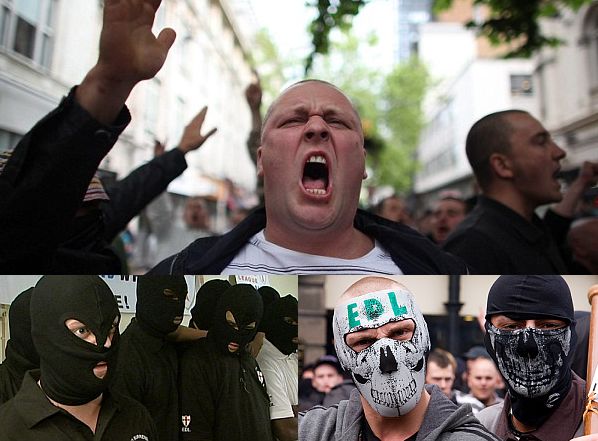
Not until we get close to the end of the Geller profile do we hear mention of her connections to the notorious fascist group, the English Defence League.

Ms. Geller went on to champion as patriotic the English Defense League, which opposes the building of mosques in Britain and whose members have been photographed wearing swastikas. (In the interview, Ms. Geller said the swastika-wearers must have been “infiltrators” trying to discredit the group.)

In March, when the EDL held a rally in support of the visiting Dutch politician and anti-Islam leader, Geert Wilders, Geller wrote:

How I wish I could be there to stand with the English Defense League.

The EDL’s notoriety has no doubt been fueled by its more photogenic members and their drunken behavior, but the movement is not only attracting disaffected white skinheads.

In May, The Guardian (see also the accompanying video) recounted meeting an EDL leader who alluded to the group’s growing links to the US.

On a chilly evening in early March, Alan Lake settles into his seat in a cafe in central London. This smartly dressed man in his mid-40s has emerged as a key figure in the organisation and is quickly into his stride — warning that the UK will have Sharia law in the next 40 years “unless something is done”.
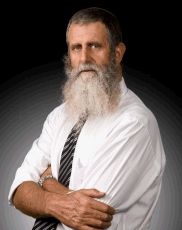
A London-based IT consultant, Lake has spoken at several EDL rallies and sees himself as one of the organisation’s thinkers. “The middle-class intellectuals are coming forward and also American speakers – some of them quite famous, although I can’t give you names yet … they love the fact that we can have people that can go on the streets.”

Addressing a far-right anti-Islam conference in Sweden last year, Lake told delegates it was necessary to build a united “anti-Jihad movement” and spoke of the need for “people that are ready to go out in the street”, boasting that he and his friends had begun to build alliances with “more physical groups like football fans”. Lake says he is opposed to violence or confrontation but regularly returns to the importance of the EDL’s physical presence.

In a post at the 4Freedoms Community website, Lake described his vision of segregation in the UK in the coming decades:

In 20 or 30 years the UK will start to fragment into Islamic enclaves and non-Islamic areas around them. Its time we decided who will be allowed in the non-Islamic areas. These are the people who we will force into the Islamic enclaves (and who we will execute if they sneak out).

By forcing these liberal twits into those enclaves we will be sending them to their death, at worst, and at best they and their families will be subjected to all the depredations, persecution and abuse that non-Muslims worldwide currently ‘enjoy’ in countries like Pakistan, Iran and Egypt. It will be great to see them executed or tortured to death…

Please everyone, start to contribute the names of all those we will send with their wives and children to enjoy the religion of peace. We are taking away the middle ground for sympathisers and appeasers. Sure, they can say they support the gangsters of Islamism if they want, it’s their choice! But we will not let them just stand in the middle and say it, hanging back from actually BEING WITH those Hamas and Hizbullah endorsing gangs. If they like that so much, they can be with them, lock, stock and barrel.

Here’s some names to start off. Please note this is a discussion, we need to work it out before sending them to their sordid end.
1. Rowan Williams, the Archbishop of Canterbury
2. David Cameron [Britain’s prime minister]
3. Nick Clegg [Britain’s deputy prime minister]

After this post caught the attention of Indymedia, Lake made some revisions and wrote: “I said execute the leftists that left the Islamic enclaves — yes that was a bit provocative, but I was trying to be brief.”

In a further indication of the blossoming relationship between America and Britain’s anti-Islam movements, the EDL has announced an upcoming event, welcoming Rabbi Nachum Shifren who is a candidate for California State Senate District 26.

“The English Defence League Event @ Embassy of Israel” has this description on Facebook:

The English Defence League will be holding an event in London on Oct 24th in support of Israel, we have an orthodox Rabbi joining us from Los Angeles who is fighting Sharia in L.A and running for state congressman there, we sympathise with what Israel are going through, it’s the only country in the west that is tackling the issues we highlight, we have seen members of the Islamic community hold anti-Israel marches in England which the country is in disgust over but still no action from the government, our four [sic] fathers fought a Nazi regime and won to protect our god given human rights, we cannot allow such fascist ideologies try to rule our streets once again using the same racist tactics, the English Defence League ignited the flame that has awoke this whole world, we are at the fore front of this movement, we have to support our brothers and sisters worldwide the way they are supporting us.
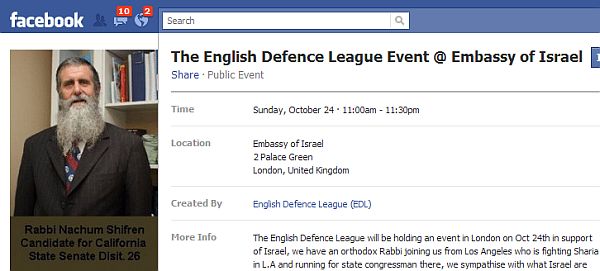
A spokesman at the embassy told me they have nothing to do with the event and will be issuing a statement shortly.*

Lastly, back on Geller, the New York Times made no reference to her possible connections with organized crime.

In 2007, the New York Post reported on a murder that took place at a Long Island auto dealership where Geller was reported to be a co-owner. A car salesman, Collin Thomas, had been murdered outside the showroom of Universal Auto World. In the course of the investigation, detectives also uncovered evidence of an alleged million dollar scam.

As part of the homicide probe, Nassau County police raided the dealership, owned by auto czar Michael Oshry [Geller’s former husband], and Oshry’s Hewlett Harbor home and seized business records.

Cops found banking records were sent to the house, though the state requires such files be kept at businesses, according to court papers filed in a civil forfeiture action by the Nassau district attorney.

“The dealership knew what was going on,” an investigator said.

Oshry’s lawyer, William Petrillo, said his client “has not engaged in any criminal activity.”

His ex-wife, Pamela Geller, former associate publisher of the New York Observer and a conservative blogger, burst into tears when told her ex is under criminal investigation.

Although listed in business records as a Universal co-owner, she denied it. “I have nothing to do with this,” Geller said.

Thomas’ fiancée, Cindy Heron, 21, said he was popular and successful. “All his customers loved him,” she said.

Universal shut its doors June 22 and liquidated its assets.

The New York Times does mention:

Ms. Geller got nearly $4 million when the couple divorced in 2007, and when Mr. Oshry died in 2008, there was a $5 million life-insurance policy benefiting her four daughters, said Alex Potruch, Mr. Oshry’s lawyer. She also kept some proceeds from the sale of Mr. Oshry’s $1.8 million house in Hewlett Harbor.

*Update: The Israeli embassy in London issued a brief statement today, Tuesday, saying that it “wishes to disassociate itself from next Sunday’s event, and from any attempts to link Israel to the EDL.”

Facebooktwittermail

Tea Party teaming up with English fascists

The Observer reports:

The English Defence League, a far-right grouping aimed at combating the “Islamification” of British cities, has developed strong links with the American Tea Party movement.

An Observer investigation has established that the EDL has made contact with anti-jihad groups within the Tea Party organisation and has invited a senior US rabbi and Tea Party activist to London this month. Rabbi Nachum Shifren, a regular speaker at Tea Party conventions, will speak about Sharia law and also discuss funding issues.

The league has also developed links with Pamela Geller, who was influential in the protests against plans to build an Islamic cultural centre near Ground Zero. Geller, darling of the Tea Party’s growing anti-Islamic wing, is advocating an alliance with the EDL. The executive director of the Stop Islamisation of America organisation, she recently met EDL leaders in New York and has defended the group’s actions, despite a recent violent march in Bradford.

Geller, who denies being anti-Muslim, said in one of her blogs: “I share the EDL’s goals… We need to encourage rational, reasonable groups that oppose the Islamisation of the west.”

Devin Burghart, vice-president of the Kansas-based Institute for Research & Education on Human Rights, said: “Geller is acting as the bridge between the EDL and the Tea Party. She plays an important role in bringing Islamophobia into the Tea Party. Her stature has increased substantially inside the Tea Party ranks after the Ground Zero mosque controversy. She has gained a lot of credibility with that stuff.”

Details of the EDL’s broadening aspirations came as about 1,000 supporters yesterday gathered to demonstrate in Leicester, which has a significant Muslim population. Home secretary Theresa May banned marches in the city last week but the EDL said its protest would proceed, raising fears of violence. Parts of Leicester were cordoned off to separate a counter-protest from Unite Against Fascism. Officers from 13 forces were on hand to maintain order.

At the end of August, EDL members converged on Bradford (which has a large British Muslim population) for a demonstration they promoted as “The Big One”.

This is their promotional video and beneath it is a video of the actual demonstration. In an apparent effort to fend off accusations that the EDL is a band of fascist, racist thugs, they have adopted as one of their rally symbols the Israeli flag (see 1 min 30 seconds into the second video) — even while they use the Nazi salute.

EDL rally in Bolton, March, 2010:

Facebooktwittermail

Mearsheimer on the undiminished power of the Israel lobby


(H/t Pulse)

How do we know the power of the lobby is undiminished? Each time President Obama pressed Israeli Prime Minister Netanyahu on the issue of a settlement freeze, Obama was forced into a humiliating retreat. That would not have happened had it not been for the behind-the-scenes machinations of the lobby.

That’s John Mearsheimer’s argument.

Not for a second do I doubt the existence and power of the lobby, but in this instance I think Mearsheimer is actually undermining his and Stephen Walt’s overarching argument about the extent of the lobby’s influence.

To portray Obama as a victim of the lobby is to avoid looking at the effect of two other major factors: Obama’s political skills and political instability in Iran.

Obama went into a fight without carrying weapons. He put pressure on Netanyahu yet neither threatened any consequences if the Israeli leader refused to yield, nor took any kind of punitive actions (beyond petty insults like withholding photo-opportunities) when Netanyahu stood his ground.

Even if the president was constrained in terms of the weapons at his disposal — the lobby as always keeps Congress in its pocket, meaning that legislative pressure is unavailable — he had recourse to more than sternness. He could for instance have derived leverage from Goldstone. In other words, he could have made American support for Israel at the UN conditional on a settlement freeze.

Aside from these types of tactical errors Obama made in terms of how he wielded the power of the presidency, the other factor that seriously undermined his strategy for challenging Netanyahu was the impact of political unrest in Iran resulting from the disputed 2009 presidential elections.

As the Iranian regime set about crushing the Green Movement, Obama became an awkward and passive spectator. For good reasons he believed that there was very little the US could constructively do to support Iran’s embattled democracy movement, yet that created the perception that having been tough on Israel he was now being soft on Iran. In what appeared to be an effort to counter that perception he essentially abandoned his tough love approach to Israel. Thereafter, it became all carrots and no sticks when dealing with Netanyahu.

The lobby no doubt took satisfaction at this turn of events and helped push the claim that Obama must not be tough on Israel while soft on Iran, but this was secondary to the effect of what was playing out on the streets of Tehran.

So, even if I would agree that the lobby’s power is largely undiminished, Obama’s failed Middle East strategy is very much a train wreck of his own making. To say that the lobby tied his hands, simply lets him off the hook.

Facebooktwittermail

Would-be spies should approach Israeli consulates with caution

In June 2006, Elliot Doxer, an employee at an internet company in Boston, sent an email to a foreign consulate. “I am a Jewish American who lives in Boston,” he allegedly wrote. “I know you are always looking for information and I am offering the little I may have.” He also wrote that he wanted “to help our homeland and our war against our enemies.”

Let’s take a wild guess: he was referring to the Jewish homeland and communicating with the Israeli consulate. That’s the assumption made by the Jerusalem Post and just about everyone else — even though court documents only refer to “Country X.”

As the victim of an FBI sting operation, Doxer now faces the prospect of 20 years in jail and a $250,000 fine if convicted.

But here’s the interesting bit. In response to Doxer’s approach, the consulate informed US law enforcement officials and then assisted the FBI with its investigation.

So what’s a would-be spy to do?

Don’t trust your local Israeli consulate?

Don’t ask for compensation?

Make sure you have extremely valuable intelligence?

Acquire Israeli citizenship before you do anything else?

The next Jonathan Pollard might now be reconsidering his options.

Facebooktwittermail

Obama desperate to please Netanyahu

How much is a two-month extension in the West Bank settlement slowdown really worth?

The Obama administration is pursuing this paltry prize as if it was staving off another economic meltdown — even as hundreds of building projects have already been started.

The Los Angeles Times reported:

The U.S. has been wooing Netanyahu for weeks with offers including a squadron of F-35 fighters, support for a long-term Israeli troop presence in a new Palestinian state, and a pledge to veto any anti-Israel resolutions passed by the United Nations Security Council. The U.S. also is offering access to its satellites that could provide early warning of attacks.

To the Palestinians, the White House is pledging support for their position on the exact location of borders for a future state in exchange for a promise to continue negotiating even if Israel refuses to extend the construction moratorium.

Although the Obama administration was expected to eventually give out incentives to keep the negotiations alive, diplomats and other observers say they are surprised that it has offered so much, so early for such a small victory: a commitment by both sides to keep talking.

“From the left to the right, people are saying that the administration is looking desperate,” said Robert Danin, a former U.S. official and an advisor to former British Prime Minister Tony Blair, an envoy to the region for the United Nations, U.S., European Union and Russia.

On Thursday by Ehud Shani, director general of the Israeli Ministry of Defense, signed a contract for 20 F-35 fighter jets.

Making a hint that they will be used to bomb Iran, he described them as being “one of the answers” for dealing with the “problem” of Tehran.

Israel will get the jets at a discount, pay for them with US tax dollars (through recession-proof military aid), while also likely profiting from F-35 production — it has expressed an interest in manufacturing 25% of the wings of the more than 3,000 aircraft Lockheed expects to build.

The jets won’t be delivered until about 2016, but by that point Israel’s war-mongers no doubt feel optimistic that there will be a war-friendly Republican administration in place — though whether GOP control of the White House is necessary to serve Israel’s needs, is highly debatable.

Facebooktwittermail

Obama chooses new national security adviser who has ‘no credibility with the military’

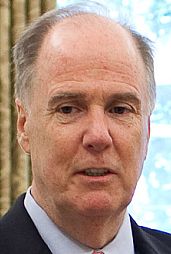
Undaunted by the revelations from Bob Woodward’s book, Obama’s Wars, President Obama is replacing National Security Adviser Gen James Jones with his deputy, Tom Donilon.

Last year, Defense Secretary Robert Gates said Donilon would be a “disaster” in that position and Jones said Donilon had “no credibility with the military.”

Was it Donilon’s performance as a vice president at Fannie Mae that impressed Obama?

If Obama is to be judged by those he surrounds himself with, it sure looks like he seeks the company of those who make him comfortable rather than those who appear most competent.

As reported by Woodward, the performance evaluation that Jones gave Donilon was pretty scathing:

First, he had never gone to Afghanistan or Iraq, or really left the office for a serious field trip. As a result, he said, you have no direct understanding of these places. “You have no credibility with the military.” You should go overseas. The White House, Situation Room, interagency byplay, as important as they are, are not everything.

Second, Jones continued, you frequently pop off with absolute declarations about places you’ve never been, leaders you’ve never met, or colleagues you work with. Gates had mentioned this to Jones, saying that Donilon’s sound-offs and strong spur-of-the-moment opinions, especially about one general, had offended him so much at an Oval Office meeting that he nearly walked out.

Third, he said, you have too little feel for the people who work day and night on the NSC staff, their salaries, their maternity leaves, their promotions, their family troubles, all the things a manager of people has to be tuned to. “Everything is about personal relations,” Jones said.

Update: Shoot-from-hip posts sometimes need revision. As others have pointed out, the criticisms of Donilon don’t necessarily put him in a negative light. My own snap judgement was largely based on a negative view of Jones and the expectation that his deputy was unlikely to outshine the general.

At Foreign Policy, Josh Rogin writes:

Immediate reaction within the administration to Jones’s resignation was consistent with the long-held view that Jones was never able to be effective as national security advisor because he was outside of Obama’s inner circle and was intellectually and sometimes physically cut out of major foreign policy discussions.

“Jones always carried an ’emeritus’ air about him and appeared removed and distant from the day-to-day operations,” one administration official told The Cable. “In six months, you will be hard pressed to find anyone in the administration who notices that Jones is no longer there.”

Emeritus is a polite way of saying unengaged. This was strikingly evident when he was the keynote speaker at the J Street conference last year.

So what about Donilon? Josh Rogin again:

According to all accounts, Donilon has been the machine running the NSC for some time, chairing the crucial deputies committee meetings and making the trains run on time throughout the NSC. But Donilon is not viewed as a strategic thinker along the lines of someone like former NSA Henry Kissinger or Zbigniew Brzezinski.

“Donilon will represent continuity and I can’t see any major shifts in policy stemming from the changeover,” one administration source said.

On one major issue, Jones and Donilon seemed to agree. Donilon is skeptical about the prospects for success in Afghanistan, for reasons similar to Jones’s. Just after Obama announced the decision to add 30,000 more troops to Afghanistan, Donilon said to the NSC’s Gen. Doug Lute, “My god, what have we got this guy into?,” according to Woodward.

And there you have — horribly predictably — the illegitimate offspring of “change”: continuity.

Everything’s being going so stunningly well, who could dream of changing course?

But Obama will need someone who can inspire boldness if he’s going to find a way out of the Afghan labyrinth. I don’t see that a man whose chief virtue is that he knows how to keep operations running smoothly will have such a talent.

Facebooktwittermail